Chinese Journal of Tissue Engineering Research ›› 2026, Vol. 30 ›› Issue (34): 8946-8952.doi: 10.12307/2026.895
Previous Articles Next Articles
Immunological mechanisms of Xuling Jiangu Formula in intervening osteoporosis model rats
Huang Jingwen, Li Shengqiang, Jiang Hong, Chen Xuan, Ye Yunjin, Ge Jirong
- Fujian Academy of Chinese Medicine Sciences, Fuzhou 350001, Fujian Province, China
-
Received:2025-09-26Revised:2026-02-28Online:2026-12-08Published:2026-04-13 -
Contact:Ge Jirong, PhD, Researcher, Fujian Academy of Chinese Medicine Sciences, Fuzhou 350001, Fujian Province, China -
About author:Huang Jingwen, MS, Assistant researcher, Fujian Academy of Chinese Medicine Sciences, Fuzhou 350001, Fujian Province, China -
Supported by:Natural Science Foundation of Fujian Province (General Program), Nos. 2022J01860 (to HJW) and 2023J01853 (to HJW [project participant]); Open Project of Traditional Chinese Medicine Orthopedics Discipline, Fujian University of Traditional Chinese Medicine, No. XGS2023001 (to HJW [project participant]); Fundamental Research Project for Public Welfare Research Institutes of Fujian Province, Nos. 2024R1003001 (to HJW), 2023R1003004 (to HJW [project participant]) and 2022R1003002 (to HJW [project participant])

CLC Number:
Cite this article
Huang Jingwen, Li Shengqiang, Jiang Hong, Chen Xuan, Ye Yunjin, Ge Jirong. Immunological mechanisms of Xuling Jiangu Formula in intervening osteoporosis model rats[J]. Chinese Journal of Tissue Engineering Research, 2026, 30(34): 8946-8952.
share this article
Add to citation manager EndNote|Reference Manager|ProCite|BibTeX|RefWorks
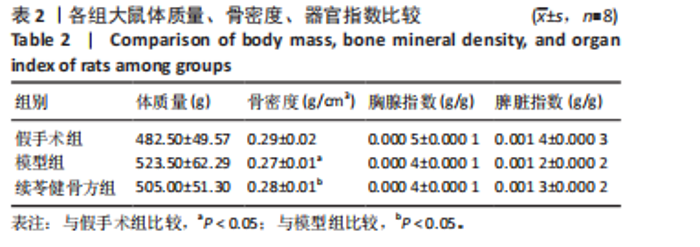
2.1 实验动物数量分析 纳入大鼠24只,随机分成3组,实验过程中无死亡,均进入结果分析。 2.2 各组大鼠骨密度和脏器指数比较 如表2所示,对比假手术组,造模后模型组骨密度值显著下降(P < 0.05);在给药16周后对比模型组,续苓健骨方组骨密度值显著上升(P < 0.05)。3组体质量和器官指数对比无显著性差异,但模型组大鼠体质量、假手术组胸腺指数和脾脏指数均略高于另外两组。"
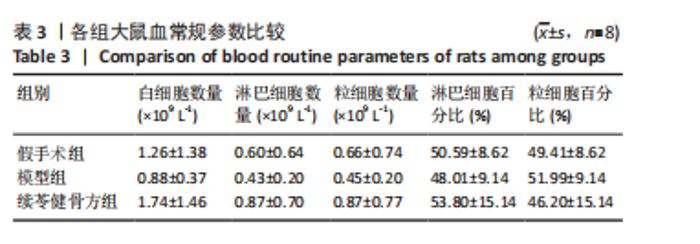
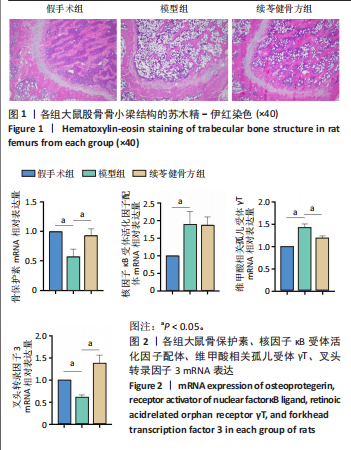
2.3 续苓健骨方对大鼠股骨骨小梁的作用 假手术组中股骨骨小梁成网状致密结构,少有脂肪类细胞,整体结构完整;与假手术组相比,模型组和续苓健骨方组骨小梁结构完整度欠缺,其中模型组最为严重,断裂迹象和纤维组织明显,可见大量空泡状的细胞组织;续苓健骨方组情况明显优于模型组,骨小梁结构较为完整,空泡细胞较少,见图1。 2.4 续苓健骨方对骨质疏松症模型大鼠炎性细胞的影响 血常规检测结果未见明显差异,假手术组和续苓健骨方组的白细胞、淋巴细胞、粒细胞数量均大于模型组但无显著性差异,淋巴细胞百分比与粒细胞百分比3组之间无明显差异,见表3。"
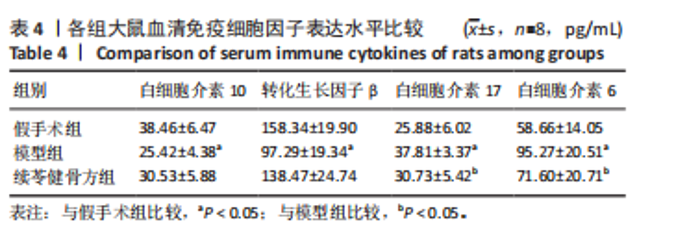
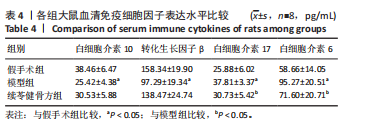
2.5 续苓健骨方对骨质疏松症模型大鼠免疫细胞因子的影响 与假手术组相比,模型组的血清白细胞介素10、转化生长因子β、白细胞介素17和白细胞介素6质量浓度均有显著变化,其中白细胞介素10和转化生长因子β质量浓度显著下降(P < 0.05),白细胞介素17和白细胞介素6质量浓度显著增加(P < 0.05)。续苓健骨方组血清白细胞介素17和白细胞介素6的质量浓度与模型组相比显著降低(P < 0.05),虽然白细胞介素10和转化生长因子β的质量浓度有所增加,但是与模型组相比无显著差异,见表4。"
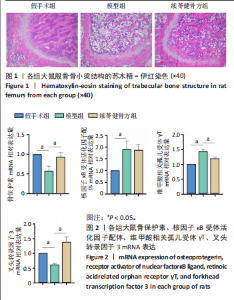
2.6 骨保护素、核因子κB受体活化因子配体、维甲酸相关孤儿受体γT、叉头转录因子3基因表达 如图2所示,与假手术组相比,模型组的骨保护素、叉头转录因子3 mRNA表达显著降低(P < 0.05),维甲酸相关孤儿受体γT、核因子κB受体活化因子配体 mRNA表达显著升高(P < 0.05)。与模型组相比,续苓健骨方组的骨保护素、叉头转录因子3 mRNA表达显著提高(P < 0.05),而核因子κB受体活化因子配体 mRNA表达有降低趋势但无统计学差异,维甲酸相关孤儿受体γT mRNA表达显著降低(P < 0.05)。"
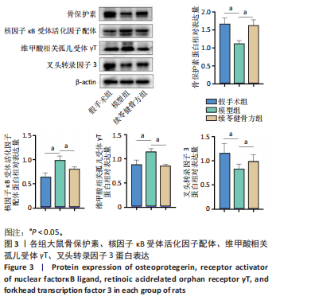
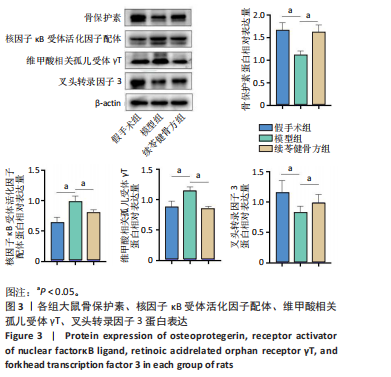
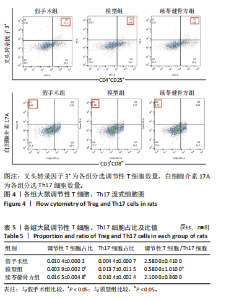
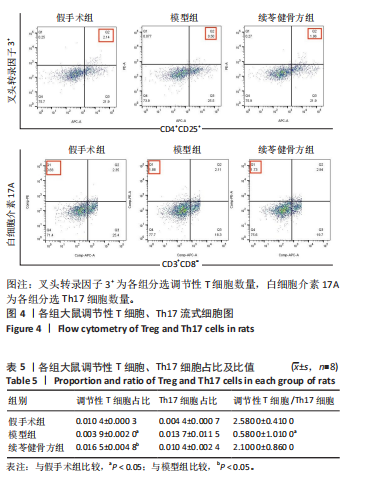
2.7 骨保护素、核因子κB受体活化因子配体、维甲酸相关孤儿受体γT、叉头转录因子3蛋白表达 如图3所示,模型组骨保护素和叉头转录因子3蛋白表达水平与假手术组相比显著降低(P < 0.05),核因子κB受体活化因子配体和维甲酸相关孤儿受体γT蛋白表达水平显著提高(P < 0.05)。用药干预后,续苓健骨方组骨保护素和叉头转录因子3蛋白表达水平较模型组显著提高(P < 0.05),核因子κB受体活化因子配体和维甲酸相关孤儿受体γT蛋白表达水平显著降低(P < 0.05)。 2.8 续苓健骨方对骨质疏松症模型大鼠调节性T细胞、Th17细胞分化的影响 与假手术组比较,模型组的调节性T细胞数量显著减少(P < 0.05),Th17细胞数量增多但无统计学差异,调节性T细胞/Th17比值显著下降(P < 0.05);与模型组比较,续苓健骨方组的调节性T细胞数量显著增多(P < 0.05),Th17细胞数量减少但无统计学差异,调节性T细胞/Th17比值有提升但是无显著性差异,见图4、表5。"
"
| [1] 葛继荣, 郑洪新, 万小明, 等. 中医药防治原发性骨质疏松症专家共识(2015)[J]. 中国骨质疏松杂志,2015,21(9):1023-1028. [2] ZHU L, HUA F, DING W, et al. The correlation between the Th17/Treg cell balance and bone health. Immun Ageing. 2020;17:30. [3] 罗干,杨虹,顾祖超,等. Th17/Treg细胞平衡关系及其相关细胞因子在绝经后骨质疏松症发病机制中的作用研究[J]. 医学理论与实践,2021,34(16): 2752-2754. [4] 谢丽华, 柴昊, 叶云金, 等. 续苓健骨颗粒治疗肾虚血瘀型绝经后骨质疏松症的疗效及转录机制研究[J]. 中国骨质疏松杂志,2022,28(4):558-561. [5] YANG X, ZHOU F, YUAN P, et al. T cell-depleting nanoparticles ameliorate bone loss by reducing activated T cells and regulating the Treg/Th17 balance. Bioact Mater. 2021;6(10):3150-3163. [6] 张悦, 李运峰.骨质疏松症动物模型研究进展[J].中国骨质疏松杂志,2020, 26(1):152-156. [7] KALU DN. The ovariectomized rat model of postmenopausal bone loss. Bone Miner. 1991;15(3):175-191. [8] 何姣姣,陈以发,陈玉林,等.绝经后骨质疏松的骨免疫学机制[J].中国骨质疏松杂志,2023,29(7):1032-1036. [9] 吕娟,罗十之,吴玉龙,等.基于“脾肾论治”探讨骨免疫学对骨质疏松症的调控机制[J].现代中西医结合杂志,2024,33(16):2295-2299. [10] 王梦蝶,吴虹,王荣慧,等.RANKL介导的诱导破骨细胞分化的相关经典信号通路研究进展[J].中国药理学通报,2020,36(7):898-902. [11] 石敏,黄永银,李宏玉,等.RANKL/RANK/OPG信号通路与其他通路串扰在骨质疏松症中的作用[J].国际骨科学杂志,2025,46(4):248-252. [12] JÄGER C, DIMITROVA P, SUN Q, et al. Inducible protein degradation reveals inflammation-dependent function of the Treg cell lineage-defining transcription factor Foxp3. Sci Immunol. 2025;10(108):eadr7057. [13] DIKIY S, GHELANI AP, LEVINE AG, et al. Terminal differentiation and persistence of effector regulatory T cells essential for preventing intestinal inflammation. Nat Immunol. 2025;26(3):444-458. [14] HUANG SW, JIANG W, XU S, et al. Systemic longitudinal immune profiling identifies proliferating Treg cells as predictors of immunotherapy benefit: biomarker analysis from the phase 3 CONTINUUM and DIPPER trials. Signal Transduct Target Ther. 2024;9(1):285. [15] SINGER M, ELSAYED AM, HUSSEINY MI. Regulatory T-cells: The Face-off of the Immune Balance. Front Biosci (Landmark Ed). 2024;29(11):377. [16] CHEN KY, KIBAYASHI T, GIGUELAY A, et al. Genome-wide CRISPR screen in human T cells reveals regulators of FOXP3. Nature. 2025;642(8066):191-200. [17] BOZEC A, ZAISS MM. T Regulatory Cells in Bone Remodelling. Curr Osteoporos Rep. 2017;15(3):121-125. [18] TAYLOR A, VERHAGEN J, BLASER K, et al. Mechanisms of immune suppression by interleukin-10 and transforming growth factor-beta: the role of T regulatory cells. Immunology. 2006;117(4):433-442. [19] WANG H, LI Y, LI H, et al. T cell related osteoimmunology in fracture healing: Potential targets for augmenting bone regeneration. J Orthop Translat. 2025; 51:82-93. [20] ZHU L, HUA F, DING W, et al. The correlation between the Th17/Treg cell balance and bone health. Immun Ageing. 2020;17:30. [21] LEE GR. The Balance of Th17 versus Treg Cells in Autoimmunity. Int J Mol Sci. 2018;19(3):730. [22] WU B, WAN Y. Molecular control of pathogenic Th17 cells in autoimmune diseases. Int Immunopharmacol. 2020;80:106187. [23] SARAN A, NISHIZAKI D, LIPPMAN SM, et al. Interleukin-17: A pleiotropic cytokine implicated in inflammatory, infectious, and malignant disorders. Cytokine Growth Factor Rev. 2025;83:35-44. [24] MIOSSEC P, KOLLS JK. Targeting IL-17 and TH17 cells in chronic inflammation. Nat Rev Drug Discov. 2012;11(10):763-776. [25] SRIVASTAVA RK, SAPRA L. The Rising Era of “Immunoporosis”: Role of Immune System in the Pathophysiology of Osteoporosis. J Inflamm Res. 2022;15:1667-1698. [26] DENG G, GUO M, FAN J, et al. Interleukin-17 family in health and immune diseases: From origin to clinical implications. Neural Regen Res. 2026;21(5):1809-1833. [27] MILLS KHG. IL-17 and IL-17-producing cells in protection versus pathology. Nat Rev Immunol. 2023;23(1):38-54. [28] 王志强,魏振朴,陈旭征,等.基于肠道菌群-Th17/Treg轴探讨电针对卵巢切除大鼠骨代谢的影响[J].康复学报,2025,35(5):504-513+521. [29] 王斌,董洪洋,高松,等.积雪草酸调节Treg/Th17平衡和肠道菌群改善卵巢切除小鼠骨质疏松症[J].中国优生与遗传杂志,2025,33(2):253-259. [30] 谭张奎,周广文,张妍,等. 补肾化痰方对去势骨质疏松模型大鼠Th17/Treg平衡机制的影响[J]. 中国实验方剂学杂志,2021,27(5):33-40. [31] 安玉兰,曹昌霞,田玉梅,等.金匮肾气丸合补中益气汤加减治疗绝经后骨质疏松症的疗效及对免疫炎症因子的调节作用[J].中国实验方剂学杂志, 2021,27(6):69-75. [32] 张金威,李秀成.基于“肾虚、血瘀、脾虚”理论探讨骨质疏松症的病因病机及治疗[J].内蒙古中医药,2024,43(7):141-144. [33] 李志文,刘元禄,杨永菊,等.补肾阳中药有效成分治疗骨质疏松症作用机制研究进展[J].辽宁中医药大学学报,2023,25(10):135-141. [34] 陈果,樊梅,孙华政,等.白术及其药对研究进展[J/OL].中华中医药学刊,1-17[2025-09-06].https://link.cnki.net/urlid/21.1546.R.20250606.1121.004. [35] 陈果,樊梅,杨柱,等.茯苓及其药对研究进展[J/OL].中华中医药学刊,1-12[2025-09-06].https://link.cnki.net/urlid/21.1546.R.20250606.1116.002. [36] 罗春花,莫斯锐,黄杰连,等.陈皮的药理作用及产品开发研究进展[J].亚太传统医药,2023,19(9):229-234. [37] 张欢,刘国雄,方勇兵,等.红花在经典名方中的应用及药理作用研究进展[J].广东药科大学学报,2025,41(3):181-190. [38] 刘现磊,李琨,孙文静,等.川芎化学成分、药理作用及质量标志物的预测分析[J].中国新药杂志,2025,34(15):1569-1576. [39] 杨晶莹,田硕,苗明三.延胡索化学成分和药理作用研究进展及质量标志物的预测分析[J].中华中医药学刊,2025,43(12):119-125. [40] 张悦,付晓琪,徐紫晨,等.赤芍的化学成分、药理作用和质量标志物的预测分析[J].中国新药杂志,2025,34(15):1602-1607. [41] 王彩虹,邱智东,王永春,等.牡丹皮的现代研究进展及质量标志物预测分析[J].中药材,2023,46(9):2361-2369. [42] 徐浩然,程国良,黄志伟,等.女贞药用价值及其相关上市药品的研究进展[J].中草药,2023,54(5):1663-1671. [43] 李彦承,贺爽,周正灿,等.中药方剂配伍中“使药”作用探究[J].世界中医药,2023,18(2):163-169. [44] 陈赛楠, 吴华嵩, 程佑民, 等. 续苓健骨方对去卵巢骨质疏松模型大鼠血液钙磷代谢的影响[J]. 中国骨质疏松杂志,2019,25(4):528-532. [45] 葛继荣, 李生强, 陈娟, 等. 续苓健骨方对骨质疏松模型大鼠骨密度及OPG和RANKL蛋白表达的影响[J]. 中国骨质疏松杂志,2016,22(5):592-595. [46] 黄景文, 李生强, 陈玄, 等. 基因表达谱芯片分析续苓健骨方治疗去卵巢大鼠骨质疏松症的基因表达差异[J]. 中国骨质疏松杂志,2022,28(10):1453-1458. |
| [1] | Chen Huiting, Zeng Weiquan, Zhou Jianhong, Wang Jie, Zhuang Congying, Chen Peiyou, Liang Zeqian, Deng Weiming. Tail anchoring technique of vertebroplasty in treatment of osteoporotic vertebral compression fractures with intravertebral cleft: a finite element analysis [J]. Chinese Journal of Tissue Engineering Research, 2026, 30(9): 2145-2152. |
| [2] | Zeng Xuan, Weng Rui, Ye Shicheng, Tang Jiadong, Mo Ling, Li Wenchao. Two lumbar rotary manipulation techniques in treating lumbar disc herniation: a finite element analysis of biomechanical differences [J]. Chinese Journal of Tissue Engineering Research, 2026, 30(9): 2153-2161. |
| [3] | Cheng Qisheng, Julaiti·Maitirouzi, Xiao Yang, Zhang Chenwei, Paerhati·Rexiti. Finite element analysis of novel variable-diameter screws in modified cortical bone trajectory of lumbar vertebrae [J]. Chinese Journal of Tissue Engineering Research, 2026, 30(9): 2162-2171. |
| [4] | Liu Wenlong, Dong Lei, Xiao Zhengzheng, Nie Yu. Finite element analysis of tibial prosthesis loosening after fixed-bearing unicompartmental knee arthroplasty for osteoporosis [J]. Chinese Journal of Tissue Engineering Research, 2026, 30(9): 2191-2198. |
| [5] | Chen Long, Wang Xiaozhen, Xi Jintao, Lu Qilin. Biomechanical performance of short-segment screw fixation combined with expandable polyetheretherketone vertebral body replacement in osteoporotic vertebrae [J]. Chinese Journal of Tissue Engineering Research, 2026, 30(9): 2226-2235. |
| [6] | Hu Xiongke, Liu Shaohua, Tan Qian, Liu Kun, Zhu Guanghui. Shikonin intervention with bone marrow mesenchymal stem cells improves microstructure of femur in aged mice [J]. Chinese Journal of Tissue Engineering Research, 2026, 30(7): 1609-1615. |
| [7] | Wen Guangwei, Zhen Yinghao, Zheng Taikeng, Zhou Shuyi, Mo Guoye, Zhou Tengpeng, Li Haishan, Lai Yiyi. Effects and mechanisms of isoginkgetin on osteoclastogenesis [J]. Chinese Journal of Tissue Engineering Research, 2026, 30(6): 1348-1358. |
| [8] | Wu Zhilin, , He Qin, Wang Pingxi, Shi Xian, Yuan Song, Zhang Jun, Wang Hao . DYRK2: a novel therapeutic target for rheumatoid arthritis combined with osteoporosis based on East Asian and European populations [J]. Chinese Journal of Tissue Engineering Research, 2026, 30(6): 1569-1579. |
| [9] | Zhang Haiwen, Zhang Xian, Xu Taichuan, Li Chao. Bibliometric and visual analysis of the research status and trends of senescence in osteoporosis [J]. Chinese Journal of Tissue Engineering Research, 2026, 30(6): 1580-1591. |
| [10] | Huang Jie, Zeng Hao, Wang Wenchi, Lyu Zhucheng, Cui Wei. Visualization analysis of literature on the effect of lipid metabolism on osteoporosis [J]. Chinese Journal of Tissue Engineering Research, 2026, 30(6): 1558-1568. |
| [11] | Yang Zhijie, Zhao Rui, Yang Haolin, Li Xiaoyun, Li Yangbo, Huang Jiachun, Lin Yanping, Wan Lei, HuangHongxing. Postmenopausal osteoporosis: predictive values of muscle mass, grip strength, and appendicular skeletal muscle index [J]. Chinese Journal of Tissue Engineering Research, 2026, 30(5): 1073-1080. |
| [12] | Zhou Jian, Zhang Tao, Zhou Weili, Zhao Xingcheng, Wang Jun, Shen Jie, Qian Li, Lu Ming. Effects of resistance training on quadriceps mass and knee joint function in patients with osteoporosis and sarcopenia [J]. Chinese Journal of Tissue Engineering Research, 2026, 30(5): 1081-1088. |
| [13] | Cao Wenqi, Feng Xiuzhi, Zhao Yi, Wang Zhimin, Chen Yiran, Yang Xiao, Ren Yanling. Effect of macrophage polarization on osteogenesis-angiogenesis coupling in type 2 diabetic osteoporosis [J]. Chinese Journal of Tissue Engineering Research, 2026, 30(4): 917-925. |
| [14] | Zeng Hao, Sun Pengcheng, Chai Yuan, Huang Yourong, Zhang Chi, Zhang Xiaoyun. Association between thyroid function and osteoporosis: genome-wide data analysis of European populations [J]. Chinese Journal of Tissue Engineering Research, 2026, 30(4): 1019-1027. |
| [15] | Cheng Xinyi, Chen Yida, Wang Yi, Liu Daihui, Zheng Yi, Shi Qin. Role of myeloid-derived suppressor cells in osteoclast differentiation in primary osteoporosis [J]. Chinese Journal of Tissue Engineering Research, 2026, 30(34): 8852-8859. |
| Viewed | ||||||
|
Full text |
|
|||||
|
Abstract |
|
|||||