Chinese Journal of Tissue Engineering Research ›› 2026, Vol. 30 ›› Issue (35): 9174-9181.doi: 10.12307/2026.454
Previous Articles Next Articles
Construction and functional verification of vascular endothelial growth factor receptor 2 gene knockdown rats
Qian Jiaming1, Li Yumei1, Wang Xiaole1, Fang Ting1, Liu Fushui1, 2
- 1Affiliated Hospital of Jiangxi University of Chinese Medicine, Nanchang 330006, Jiangxi Province, China; 2Jiangxi University of Chinese Medicine, Nanchang 330004, Jiangxi Province, China
-
Received:2025-09-19Revised:2026-02-12Online:2026-12-18Published:2026-04-28 -
Contact:Liu Fushui, PhD, Professor, Affiliated Hospital of Jiangxi University of Chinese Medicine, Nanchang 330006, Jiangxi Province, China -
About author:Qian Jiaming, PhD, Affiliated Hospital of Jiangxi University of Chinese Medicine, Nanchang 330006, Jiangxi Province, China; Jiangxi University of Chinese Medicine, Nanchang 330004, Jiangxi Province, China -
Supported by:National Natural Science Foundation of China, No. 82360940 (to LFS); Key Project of Natural Science Foundation of Jiangxi Province, No. 20224ACB206041 (to LFS); Jiangxi Graduate Student Innovation Fund Project, No. YC2023-B223 (to QJM); Scientific Plan Project of Jiangxi Provincial Administration of Traditional Chinese Medicine, No. 2025020818 (to QJM)

CLC Number:
Cite this article
Qian Jiaming, Li Yumei, Wang Xiaole, Fang Ting, Liu Fushui. Construction and functional verification of vascular endothelial growth factor receptor 2 gene knockdown rats[J]. Chinese Journal of Tissue Engineering Research, 2026, 30(35): 9174-9181.
share this article
Add to citation manager EndNote|Reference Manager|ProCite|BibTeX|RefWorks
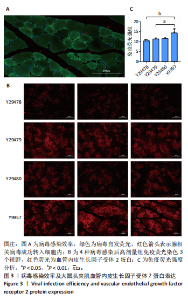
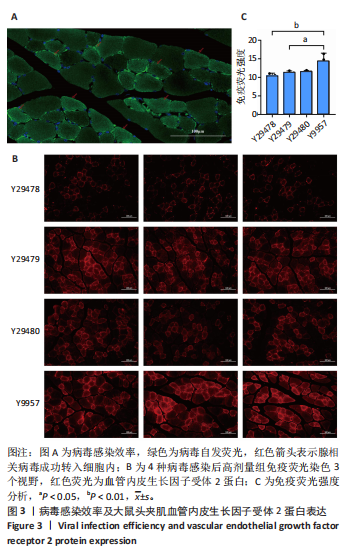
2.1 实验动物数量分析 实验选用24只SD大鼠,其中12只进行筛靶实验,另12只进行功能验证,实验过程大鼠均无脱失,全部进入结果分析。 2.2 病毒感染效率及血管内皮生长因子受体2蛋白表达 见图3。免疫荧光检测可见绿色荧光较多,表明病毒成功进入肌肉组织,感染效率较为理想,见图3A。高剂量病毒情况下,4种病毒感染后头夹肌中血管内皮生长因子受体2蛋白表达情况见图3B;其中,Y9957红光最亮,相比之下,其余3个红光较暗;免疫荧光强度分析表明Y29478敲低效果最好,见图3C。"
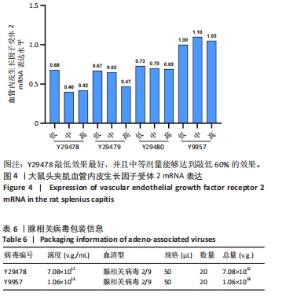
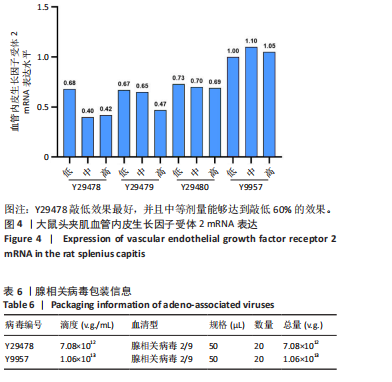
2.3 血管内皮生长因子受体2 mRNA表达 荧光定量PCR检测各大鼠头夹肌血管内皮生长因子受体2 mRNA表达水平。相比之下,Y29478敲低效果最好,并且中等剂量能够达到敲低60%的效果,见图4。 2.4 血管内皮生长因子受体2基因敲低大鼠的功能验证 经过12只SD大鼠进行筛靶实验,敲定最佳shRNA序列为Y29478,合适的病毒总量为2×10¹¹ v.g.,根据病毒滴度情况保留尽可能大的滴度,后续进行功能验证。经载体的构建和腺相关病毒的包装后,得到Y29478及对照Y9957,具体信息见表6。按照病毒滴度尽可能高、病毒总量及体积一致的原则,按照7.08×10¹² v.g./mL的滴度,每只大鼠注射2×1011 v.g.的总量,加PBS定容至30 μL,平均分成4等分注射在两侧头夹肌的头端和尾端4个点位上。"
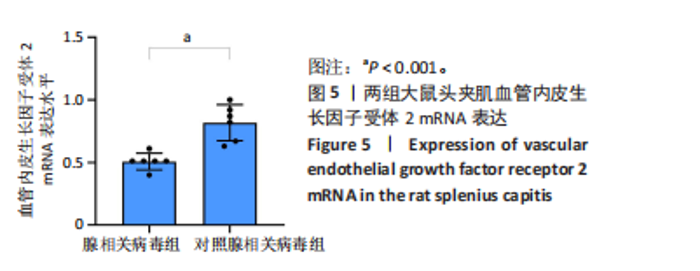
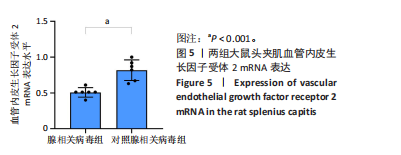
2.4.1 血管内皮生长因子受体2 mRNA表达 20周后取材,荧光定量PCR检测两组大鼠头夹肌mRNA表达。结果表明,与对照腺相关病毒组相比,腺相关病毒组血管内皮生长因子受体2 mRNA表达明显下降(P < 0.05),见图5。"
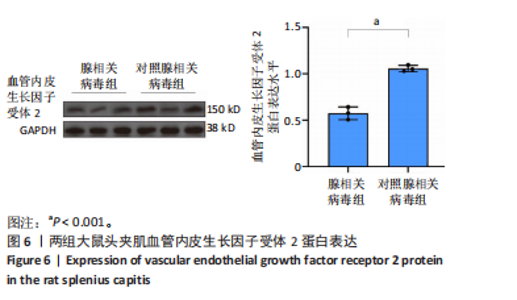
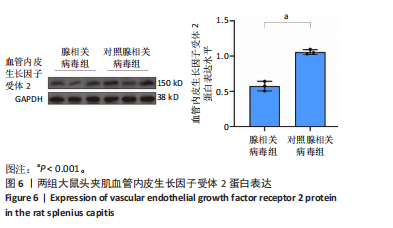
2.4.2 血管内皮生长因子受体2蛋白表达 每组随机选取3只大鼠Western blot检测头夹肌血管内皮生长因子受体2蛋白表达。结果表明,与对照腺相关病毒组相比,腺相关病毒组血管内皮生长因子受体2蛋白表达明显下降(P < 0.05),见图6。"
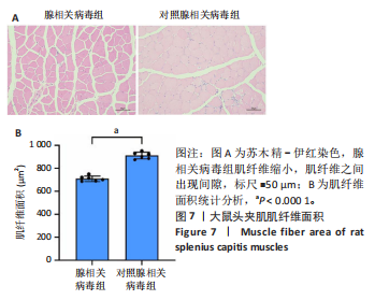
2.4.3 大鼠肌纤维面积检测 腺相关病毒组及对照腺相关病毒组的典型图片及统计数据见图7。腺相关病毒组大鼠头夹肌肌纤维缩小,肌纤维之间出现间隙,见图7A;结果表明敲低血管内皮生长因子受体2后大鼠肌纤维面积明显减小(P < 0.05),可能发生肌萎缩,见图7B。"

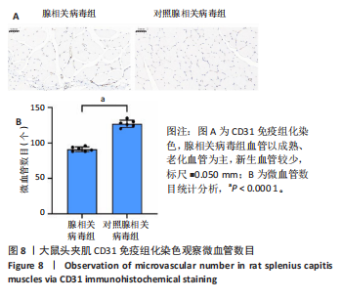
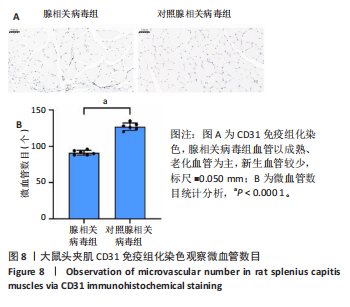
2.4.4 大鼠微血管数目检测 腺相关病毒组及对照腺相关病毒组的典型图片及统计数据见图8。腺相关病毒组头夹肌血管以成熟、老化血管为主,新生血管较少,见图8A;结果表明敲低血管内皮生长因子受体2后大鼠微血管数目明显减小(P < 0.05),可能存在微循环障碍,见图8B。"
| [1] THEODORE N. Degenerative Cervical Spondylosis. N Engl J Med. 2020; 383(2):159-168. [2] 王璎. 关于青少年颈椎病的防治措施探析[J]. 数据,2023(2):38-39. [3] 黄于婷, 杨岚菲, 屈伸华, 等. 电针对大鼠颈肌慢性损伤模型肌电活动及细胞凋亡的影响[J]. 世界中医药,2023,18(8):1072-1078. [4] FERRARA N. Role of vascular endothelial growth factor in regulation of physiological angiogenesis. Am J Physiol Cell Physiol. 2001;280(6): C1358-C1366. [5] MANNI S, KISKO K, SCHLEIER T, et al. Functional and structural characterization of the kinase insert and the carboxy terminal domain in VEGF receptor 2 activation. FASEB J. 2014;28(11):4914-4923. [6] LI B, WANG Z, HE Y, et al. Adropin Improves Radiation-Induced Myocardial Injury via VEGFR2/PI3K/Akt Pathway. Oxid Med Cell Longev. 2022;2022: 8230214. [7] WANG Y, LU YH, TANG C, et al. Calcium Dobesilate Restores Autophagy by Inhibiting the VEGF/PI3K/AKT/mTOR Signaling Pathway. Front Pharmacol. 2019;10:886. [8] 刘福水, 钱嘉铭, 方婷, 等. 针刀干预后颈椎病大鼠头夹肌成纤维细胞生长因子家族及其受体的表达[J]. 中国组织工程研究,2025,29(18): 3775-3783. [9] 何静, 禚鑫喆, 邹欣雨, 等. 小鼠CTSK敲降重组腺相关病毒的构建及其功能研究[J]. 安徽医科大学学报,2024,59(6):1001-1005. [10] 罗志梅, 刘虹延, 孙得胜. 靶向敲减KLF4基因的重组腺相关病毒载体的构建及其在肺动脉高压动物模型中的应用[J]. 中国现代医学杂志, 2023,33(17):30-36. [11] 颜榕, 易颖琪, 柳丽, 等. 腺相关病毒介导的RNA干扰沉默GATA4对老年大鼠心房纤维化的影响[J]. 中国老年学杂志,2025,45(10):2406-2411. [12] 陈雪, 宁谦. 过表达IRG1抑制NLRP3炎症小体改善哮喘小鼠气道炎症[J]. 山西医科大学学报,2025,56(2):134-141. [13] 颜榕, 易颖琪, 柳丽, 等. 腺相关病毒介导的RNA干扰沉默GATA4对老年大鼠心房纤维化的影响[J]. 中国老年学杂志,2025,45(10):2406-2411. [14] 蒋晓伟, 王强, 缪逸鸣, 等. 重组腺相关病毒调控间充质干细胞成骨分化的作用机制[J]. 病毒学报,2025,41(2):479-487. [15] 张静烨, 卓阳, 俞佳宁, 等. 腺相关病毒载体类体内基因治疗产品临床使用及安全性信息分析[J]. 中国新药杂志,2024,33(24):2562-2567. [16] 陈永昌, 刘小平, 肖浦豪. 腺相关病毒载体及其在基因治疗研究中的应用[J]. 昆明理工大学学报(自然科学版),2024,49(3):188-201. [17] 赵晓东, 陈华英, 陈涛, 等. 小干扰RNA递送系统和化学修饰的研究进展[J]. 世界临床药物,2024,45(7):786-793. [18] 唐佳佳, 陈旭昕, 丁毅伟, 等. 靶向小鼠VASP基因shRNA慢病毒载体的构建及鉴定[J]. 医学研究杂志,2024,53(12):72-77. [19] 霍云飞, 高明慧, 豆双双, 等. 靶向RelA(p65)基因shRNA慢病毒载体构建及功能鉴定[J]. 中国临床新医学,2023,16(9):907-912. [20] 孙启鑫, 吴秉毅, 姚倩倩, 等. 靶向人c-Cbl基因重组干扰慢病毒与过表达腺病毒载体的构建、鉴定以及病毒功效研究[J]. 中国实验血液学杂志, 2024,32(1):274-281. [21] COLELLA P, RONZITTI G, MINGOZZI F. Emerging Issues in AAV-Mediated In Vivo Gene Therapy. Mol Ther Methods Clin Dev. 2018;8:87-104. [22] LE MEUR G, LEBRANCHU P, BILLAUD F, et al. Safety and Long-Term Efficacy of AAV4 Gene Therapy in Patients with RPE65 Leber Congenital Amaurosis. Mol Ther. 2018;26(1):256-268. [23] BORTOLUSSI G, ZENTILIN L, BAJ G, et al. Rescue of bilirubin-induced neonatal lethality in a mouse model of Crigler-Najjar syndrome type I by AAV9-mediated gene transfer. FASEB J. 2012;26(3):1052-1063. [24] NATHWANI AC, ROSALES C, MCINTOSH J, et al. Long-term safety and efficacy following systemic administration of a self-complementary AAV vector encoding human FIX pseudotyped with serotype 5 and 8 capsid proteins. Mol Ther. 2011;19(5):876-885. [25] NIEMEYER GP, HERZOG RW, MOUNT J, et al. Long-term correction of inhibitor-prone hemophilia B dogs treated with liver-directed AAV2-mediated factor IX gene therapy. Blood. 2009;113(4):797-806. [26] SMITH C J, ROSS N, KAMAL A, et al. Pre-existing humoral immunity and complement pathway contribute to immunogenicity of adeno-associated virus (AAV) vector in human blood. Front Immunol. 2022;13:999021. [27] CAO D, BYRNE BJ, de JONG YP, et al. Innate Immune Sensing of Adeno-Associated Virus Vectors. Hum Gene Ther. 2024;35(13-14):451-463. [28] BARNES C, SCHEIDELER O, SCHAFFER D. Engineering the AAV capsid to evade immune responses. Curr Opin Biotechnol. 2019;60:99-103. [29] NAKAI H, MONTINI E, FUESS S, et al. AAV serotype 2 vectors preferentially integrate into active genes in mice. Nat Genet. 2003;34(3):297-302. [30] NAKAI H, IWAKI Y, KAY MA, et al. Isolation of recombinant adeno-associated virus vector-cellular DNA junctions from mouse liver. J Virol. 1999;73(7): 5438-5447. [31] WHITELEY LO. An Overview of Nonclinical and Clinical Liver Toxicity Associated With AAV Gene Therapy. Toxicol Pathol. 2023;51(7-8):400-404. [32] CROSS M J, DIXELIUS J, MATSUMOTO T, et al. VEGF-receptor signal transduction.Trends Biochem Sci. 2003;28(9):488-494. [33] GERBER HP, MCMURTREY A, KOWALSKI J, et al. Vascular endothelial growth factor regulates endothelial cell survival through the phosphatidylinositol 3’-kinase/Akt signal transduction pathway. Requirement for Flk-1/KDR activation. J Biol Chem. 1998;273(46):30336-30343. [34] DUDEK H, DATTA SR, FRANKE TF, et al.Regulation of neuronal survival by the serine-threonine protein kinase Akt. Science. 1997;275(5300):661-665. [35] 杨阳, 王万祥. 血管内皮生长因子及其受体靶向治疗在胆道恶性肿瘤中的研究进展[J].中国普通外科杂志,2024,33(2):265-272. [36] 刘一凡, 林佳静, 林源, 等. VEGF/VEGFR2促进人胃癌组织微血管生成的研究[J]. 宁夏医学杂志,2023,45(12):1068-1070. [37] 张攀, 张宜凡, 缪伟伟, 等. 天然产物抗血管内皮生长因子及其受体抑制肿瘤血管生成作用研究进展[J]. 中华中医药杂志,2023,38(12):5950-5954. [38] MI YY, JI Y, ZHANG L, et al. A first-in-class HBO1 inhibitor WM-3835 inhibits castration-resistant prostate cancer cell growth in vitro and in vivo. Cell Death Dis. 2023;14(1):67. [39] 陶一秋, 张冬梅, 沈菲菲, 等. 创面血管内皮生长因子、血管内皮生长因子受体2水平表达与Ⅱ期肛裂患者术后创面愈合时间的关系研究[J]. 河北医科大学学报,2024,45(5):595-600. [40] 吴熙, 陈高. 芍药苷对难愈性溃疡大鼠创面愈合及HIF-1α/VEGF/VEGFR2信号通路的影响[J]. 河北医学,2023,29(3):369-374. [41] HU S, CHEN Y, XIE D, et al. Nme(2) Cas9-mediated therapeutic editing in inhibiting angiogenesis after wet age-related macular degeneration onset. Clin Transl Med. 2023;13(8):e1383. [42] WU W, LEI H.Genome Editing Inhibits Retinal Angiogenesis in a Mouse Model of Oxygen-Induced Retinopathy. Methods Mol Biol. 2023;2678:207-217. [43] SHE K, SU J, WANG Q, et al. Delivery of nVEGFi using AAV8 for the treatment of neovascular age-related macular degeneration. Mol Ther Methods Clin Dev. 2022;24:210-221. [44] ROVIELLO G, RAVELLI A, FIASCHI A I, et al. Apatinib for the treatment of gastric cancer. Expert Rev Gastroenterol Hepatol. 2016;10(8):887-892. [45] SHIBUYA M. Vascular endothelial growth factor and its receptor system: physiological functions in angiogenesis and pathological roles in various diseases. J Biochem. 2013;153(1):13-19. [46] WANG F, LIU G. Influence of KDR Genetic Variation on the Effectiveness and Safety of Bevacizumab in the First-Line Treatment for Patients with Advanced Colorectal Cancer. Int J Gen Med. 2022;15:5651-5659. [47] JIANG Z, LU Z, KOU S, et al. Overexpression of Kdr in adult endocardium induces endocardial neovascularization and improves heart function after myocardial infarction. Cell Res. 2021;31(4):485-487. [48] WAGATSUMA A, TAMAKI H, OGITA F. Sequential expression of vascular endothelial growth factor, Flt-1, and KDR/Flk-1 in regenerating mouse skeletal muscle. Physiol Res. 2006;55(6):633-640. [49] RISSANEN TT, VAJANTO I, HILTUNEN MO, et al. Expression of vascular endothelial growth factor and vascular endothelial growth factor receptor-2 (KDR/Flk-1) in ischemic skeletal muscle and its regeneration. Am J Pathol. 2002;160(4):1393-1403. [50] 刘福水, 方婷, 洪滔, 等. 针刀干预对颈椎病兔颈后伸肌细胞PI3K/Akt信号通路的影响[J].中华中医药杂志,2020,35(2):918-922. |
| [1] | Wu Yanting, Li Yu, Liao Jinfeng. Magnesium oxide nanoparticles regulate osteogenesis- and angiogenesis-related gene expressions to promote bone defect healing [J]. Chinese Journal of Tissue Engineering Research, 2026, 30(8): 1885-1895. |
| [2] | Han Teng, Ma Hong, Yang Ruoyi, Luo Yi, Li Chao. Oral squamous cell carcinoma-derived exosomal delivery of angiopoietin-2 is involved in tumor angiogenesis [J]. Chinese Journal of Tissue Engineering Research, 2026, 30(7): 1755-1767. |
| [3] | Cao Wenqi, Feng Xiuzhi, Zhao Yi, Wang Zhimin, Chen Yiran, Yang Xiao, Ren Yanling. Effect of macrophage polarization on osteogenesis-angiogenesis coupling in type 2 diabetic osteoporosis [J]. Chinese Journal of Tissue Engineering Research, 2026, 30(4): 917-925. |
| [4] | Yang Xiao, Bai Yuehui, Zhao Tiantian, Wang Donghao, Zhao Chen, Yuan Shuo. Cartilage degeneration in temporomandibular joint osteoarthritis: mechanisms and regenerative challenges [J]. Chinese Journal of Tissue Engineering Research, 2026, 30(4): 926-935. |
| [5] | Li Wenhui, Shi Chenyan, Yang Yiyan, Liu Guobin. Zizhu ointment enhances wound healing in diabetic ulcer mice via angiogenesis regulation [J]. Chinese Journal of Tissue Engineering Research, 2026, 30(35): 9182-9188. |
| [6] | Zhang Yiwei, Fang Ya, Sun Xin, Yang Han, Lin Haiyang, Chen Zhouhao, Zheng Yue, Fu Jingke, Wang Jinwu. Regulatory effects of optimized extraction processes for chlorella-derived peptides on key pathological links in rheumatoid arthritis [J]. Chinese Journal of Tissue Engineering Research, 2026, 30(32): 8460-8470. |
| [7] | Zheng Ying, Li Mengyao, Zheng Fanfan, He Zhao, Zhang Ning, Zou Jialun, Li Youlei, Gao Feng. Mechanism of action of extracellular vesicles loaded with biomaterials in repairing spinal cord injury [J]. Chinese Journal of Tissue Engineering Research, 2026, 30(32): 8544-8554. |
| [8] | Du Yaxin, Zhao Xiaojuan, Wu Ruixia, Dong Yizhi, Song Xinyue, Fu Hongyang, She Yitong, Zhang Jialin, Zhu Yong. Interaction between vascular-lymphatic system imbalance and immune microenvironment in intervertebral disc degeneration [J]. Chinese Journal of Tissue Engineering Research, 2026, 30(29): 7612-7618. |
| [9] | Yang Ning, Han Zekui, Wang Xinyu, Huang Yiping, Han Jiaqi, Wang Yu, Duan Feng. Differences in angiogenesis and osteogenic effects between autogenous bone and mixed bone in guided bone regeneration [J]. Chinese Journal of Tissue Engineering Research, 2026, 30(24): 6207-6213. |
| [10] | Sun Zuyan, Huang Wenliang, Xu Lin, Li Haojie, Xie Tongliang, Yang Zhihang, Deng Jiang. Transverse tibial bone transfer accelerates healing of foot ulcers in a rabbit model of type 2 diabetes mellitus: involvement and regulation of circular RNA [J]. Chinese Journal of Tissue Engineering Research, 2026, 30(22): 5639-5649. |
| [11] | Lin Kejian, Chai Yinghong, Zou Jie, Huang Ruixin, Fang Yongchao, Huang Jing, Yang Qin, Luo Xia, Zhang Hong. Preparation of Cu2+-containing microarc oxidation functional coating on medical magnesium alloy and its anti-tumor and angiogenesis-promoting effects [J]. Chinese Journal of Tissue Engineering Research, 2026, 30(20): 5103-5114. |
| [12] | Fan Meirong, Li Guangqi, Song Xumei, Yan Xin, Sui Ruizhi. Chemokine receptor 7-bone marrow mesenchymal stem cells combined with porcine small intestinal submucosa promote skin repair in rats [J]. Chinese Journal of Tissue Engineering Research, 2026, 30(13): 3242-3249. |
| [13] | Yao Jinfeng, Deng Mengzhao, Xie Tian, Chen Kan, Wang Haixia. Reduced graphene oxide improves endothelial differentiation efficiency and angiogenesis ability of adipose-derived stem cells [J]. Chinese Journal of Tissue Engineering Research, 2026, 30(13): 3270-3279. |
| [14] | Shi Yuxin, Kaiwusail · Tursun, Liu Jia. Effects of basic fibroblast growth factor-loaded composite bioscaffold on angiogenesis of dental pulp stem cells [J]. Chinese Journal of Tissue Engineering Research, 2026, 30(13): 3343-3349. |
| [15] | Wu Jiazhou, Qian Tao, Liu Zexian, Wu Yanbin, He Ying, Li Yazhou, Peng Jiang. Three-dimensional culture of stromal vascular fraction self-assembles into complex vascularized osteogenic organoids [J]. Chinese Journal of Tissue Engineering Research, 2026, 30(11): 2681-2690. |
| Viewed | ||||||
|
Full text |
|
|||||
|
Abstract |
|
|||||