Chinese Journal of Tissue Engineering Research ›› 2026, Vol. 30 ›› Issue (33): 8662-8668.doi: 10.12307/2026.491
Previous Articles Next Articles
Long non-coding RNA-TNFRSF13C improves periodontal pathomorphology in rat models of periodontitis via target regulation
Zhou Dayu1, Dong Na1, Geng Ganshu2, Zhang Xue3
- 1Tangshan Polytechnic College Affiliated Hospital, Tangshan 063000, Hebei Province, China; 2Tangshan Union Hospital, Tangshan 063000, Hebei Province, China; 3Tangshan Central Hospital, Tangshan 063000, Hebei Province, China
-
Received:2025-10-29Revised:2026-03-26Online:2026-11-28Published:2026-06-13 -
Contact:Zhou Dayu, Tangshan Polytechnic College Affiliated Hospital, Tangshan 063000, Hebei Province, China -
About author:Zhou Dayu, Attending physician, Tangshan Polytechnic College Affiliated Hospital, Tangshan 063000, Hebei Province, China -
Supported by:Scientific Research Fund of Hebei Administration of Traditional Chinese Medicine, No. 2023411 (to GGS); Scientific Research Project of the Hebei Provincial Health Commission, No. 20230240 (to ZX)

CLC Number:
Cite this article
Zhou Dayu, Dong Na, Geng Ganshu, Zhang Xue. Long non-coding RNA-TNFRSF13C improves periodontal pathomorphology in rat models of periodontitis via target regulation[J]. Chinese Journal of Tissue Engineering Research, 2026, 30(33): 8662-8668.
share this article
Add to citation manager EndNote|Reference Manager|ProCite|BibTeX|RefWorks
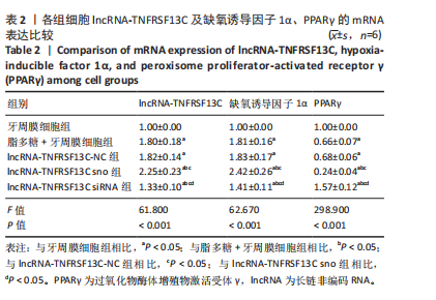
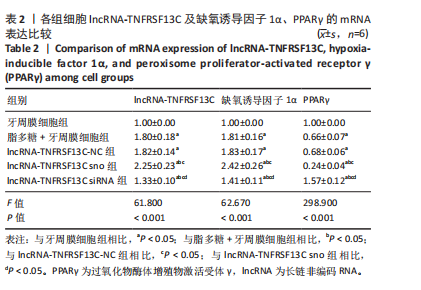
2.1 各组细胞lncRNA-TNFRSF13C及缺氧诱导因子1α、PPARγ mRNA表达比较 与牙周膜细胞组相比,脂多糖+牙周膜细胞组lncRNA-TNFRSF13C、缺氧诱导因子1α mRNA表达升高(P < 0.05),PPARγ mRNA表达升降低(P < 0.05);与脂多糖+牙周膜细胞组相比,lncRNA-TNFRSF13C-NC组lncRNA-TNFRSF13C及缺氧诱导因子1α、PPARγ mRNA表达无明显差异(P > 0.05);与lncRNA-TNFRSF13C-NC组相比,lncRNA-TNFRSF13C sno组lncRNA-TNFRSF13C及缺氧诱导因子1α mRNA表达升高(P < 0.05),PPARγ mRNA表达降低 (P < 0.05);与lncRNA-TNFRSF13C sno组相比,lncRNA-TNFRSF13C siRNA组lncRNA-TNFRSF13C及缺氧诱导因子1α mRNA表达降低 (P < 0.05),PPARγ mRNA表达升高(P < 0.05),见表2。"
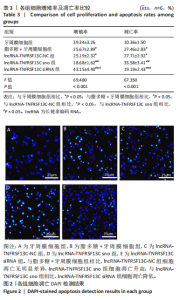
2.2 各组细胞增殖及凋亡比较 与牙周膜细胞组相比,脂多糖+牙周膜细胞组细胞增殖降低(P < 0.05),细胞凋亡升高(P < 0.05);与脂多糖+牙周膜细胞组相比,lncRNA-TNFRSF13C-NC组细胞增殖和凋亡无明显差异(P > 0.05);与lncRNA-TNFRSF13C-NC组相比,lncRNA-TNFRSF13C sno组细胞增殖降低(P < 0.05),细胞凋亡升高(P < 0.05);与lncRNA-TNFRSF13C sno组相比,lncRNA-TNFRSF13C siRNA组细胞增殖升高(P < 0.05),细胞凋亡降低(P < 0.05),见表3,图2。"

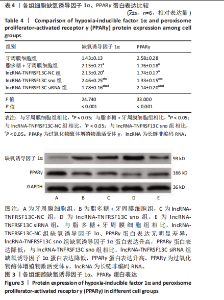
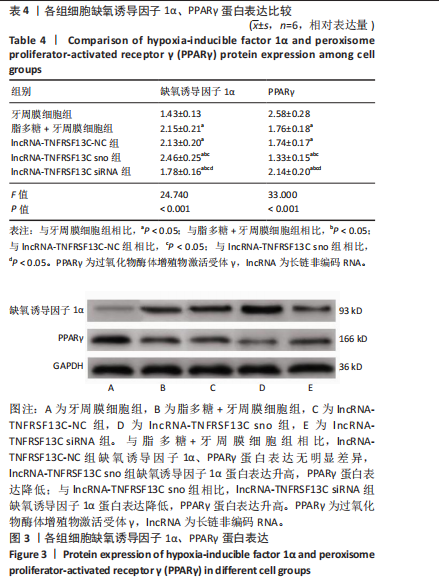
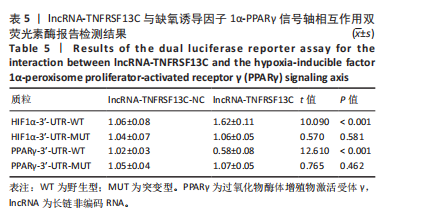
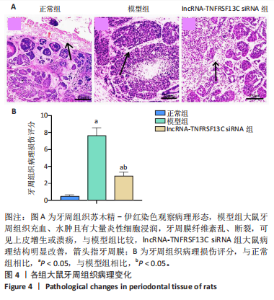
2.3 各组细胞缺氧诱导因子1α、PPARγ蛋白表达比较 与牙周膜细胞组相比,脂多糖+牙周膜细胞组缺氧诱导因子1α蛋白表达升高(P < 0.05),PPARγ蛋白表达降低(P < 0.05);与脂多糖+牙周膜细胞组相比,lncRNA-TNFRSF13C-NC组缺氧诱导因子1α、PPARγ蛋白表达无明显差异(P > 0.05);与lncRNA-TNFRSF13C-NC组相比,lncRNA-TNFRSF13C sno组缺氧诱导因子1α蛋白表达升高(P < 0.05),PPARγ蛋白表达降低(P < 0.05);与lncRNA-TNFRSF13C sno组相比,lncRNA-TNFRSF13C siRNA组缺氧诱导因子1α蛋白表达降低(P < 0.05),PPARγ蛋白表达升高(P < 0.05),见表4,图3。 2.4 双荧光素酶报告检测结果 结果显示,转染lncRNA-TNFRSF13C后可显著升高HIF1α-3′-UTR-WT的荧光素酶活性(P < 0.05),降低PPARγ-3′-UTR-WT的荧光素酶活性(P < 0.05),但对突变基因无显著影响(P > 0.05),见表5。 "

"
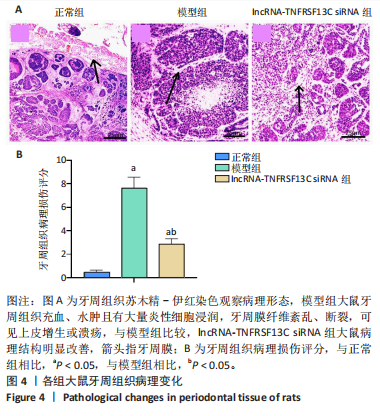
2.5 各组大鼠牙周组织苏木精-伊红染色结果 实验过程中各组大鼠均无死亡,30只大鼠全部进入结果分析。正常组大鼠牙周组织排列整齐,牙周膜纤维清晰且均匀分布,牙周组织病理损伤较低;模型组大鼠牙周组织充血、水肿且有大量炎性细胞浸润,牙周膜纤维紊乱、断裂,可见上皮增生或溃疡,牙周组织病理损伤升高;与模型组比较,lncRNA-TNFRSF13C siRNA组大鼠病理结构明显改善,牙周组织病理损伤明显降低,见图4。"
| [1] BAIMA G, MINOLI M, MICHAUD DS, et al. Periodontitis and risk of cancer: Mechanistic evidence. Periodontol 2000. 2024;96(1):83-94. [2] AGNESE CCD, SCHÖFFER C, KANTORSKI KZ, et al. Periodontitis and Oral Health-Related Quality of Life: A Systematic Review and Meta-Analysis. J Clin Periodontol. 2025;52(3):408-420. [3] CHAPPLE ILC, HIRSCHFELD J, COCKWELL P, et al. Interplay between periodontitis and chronic kidney disease. Nat Rev Nephrol. 2025;21(4):226-240. [4] BENAHMED AG, GASMI A, NOOR S, et al. Hallmarks of Periodontitis. Curr Med Chem. 2025;32(14):2731-2749. [5] TELES F, MARTIN L, PATEL M, et al. Gingival Crevicular Fluid Biomarkers During Periodontitis Progression and After Periodontal Treatment. J Clin Periodontol. 2025;52(1):40-55. [6] ROMANDINI P, MARRUGANTI C, ROMANDINI WG, et al. Are periodontitis and dental caries associated? A systematic review with meta-analyses. J Clin Periodontol. 2024;51(2):145-157. [7] MUKHERJEE S, CHOPRA A, KARMAKAR S, et al. Periodontitis increases the risk of gastrointestinal dysfunction: an update on the plausible pathogenic molecular mechanisms. Crit Rev Microbiol. 2025;51(1):187-217. [8] ELAHI VAHED I, MOTTAGHI M, KHAMISI N, et al. Periodontitis and Mediterranean fever: a systematic review and metaanalysis. Quintessence Int. 2025;56(8):604-617. [9] XIN Y, WANG Y. Programmed Cell Death Tunes Periodontitis. Oral Dis. 2025; 31(6):1583-1594. [10] WANG Z, SAXENA A, YAN W, et al. The impact of aging on neutrophil functions and the contribution to periodontitis. Int J Oral Sci. 2025;17(1):10. [11] TANG S, ZHONG Y, LI J, et al. Long intergenic non-coding RNA 01126 activates IL-6/JAK2/STAT3 pathway to promote periodontitis pathogenesis. Oral Dis. 2025; 31(1):193-205. [12] FENG Y, GUO X, YANG Y, et al. Noncoding RNAs in periodontitis: Progress and perspectives (Review). Int J Mol Med. 2025;56(5):166. [13] GUO J, HE Y. LncRNA HOTTIP as a potential biomarker of chronic periodontitis and its role in inflammatory responses. Odontology. 2025;113(4):1678-1688. [14] LONG L, ZHANG C, HE Z, et al. LncRNA NR_045147 modulates osteogenic differentiation and migration in PDLSCs via ITGB3BP degradation and mitochondrial dysfunction. Stem Cells Transl Med. 2025;14(2):szae088. [15] TONG T, ZHAO F, TAO R, et al. lncRNA RNA AC114812 Regulates the Inflammatory Response of Periodontal Ligament Cells via the miR-181a-5p-SPP1 Axis. J Inflamm Res. 2025;18:13039-13053. [16] HU A, XIAO F, WU W, et al. LincRNA-EPS inhibits caspase-11 and NLRP3 inflammasomes in gingival fibroblasts to alleviate periodontal inflammation. Cell Prolif. 2024;57(1):e13539. [17] YUAN Y, ZHU B, SU X, et al. Comprehensive Analysis of the Mechanism of Periodontitis-Related mRNA Expression Combined with Upstream Methylation and ceRNA Regulation. Genet Test Mol Biomarkers. 2021;25(11):707-719. [18] LI JS, XIE YF, SONG LT, et al. Expression profile of long non-coding RNA in gingival tissues from the patients with aggressive periodontitis. Zhonghua Kou Qiang Yi Xue Za Zhi. 2018;53(9):635-639. [19] NING Y, LI W, ZOU L, et al. Hypoxia-inducible Factor 1α Contributes to Matrix Metalloproteinases 2/9 and Inflammatory Responses in Periodontitis. Cell Biochem Biophys. 2025;83(1):1159-1166. [20] YAMAMOTO T, YUAN H, SUZUKI S, et al. Procyanidin B2 enhances anti-inflammatory responses of periodontal ligament cells by inhibiting the dominant negative pro-inflammatory isoforms of peroxisome proliferator-activated receptor γ. J Dent Sci. 2024;19(3):1801-1810. [21] 王道荣,倪成励,丁鳌.羽扇豆醇调节RhoA/ROCK信号通路对牙周炎大鼠牙周组织损伤的影响[J].实用口腔医学杂志,2025,41(3):321-327. [22] 刘珊珊,黄晓菲,孙巍.大黄素上调miR-218表达对慢性牙周炎大鼠骨密度和炎症反应的影响[J].现代医学,2024,52(4):594-601. [23] WU Z, ZHAO L, GUO Y, et al. Hyperuricemia Exacerbates Experimental Periodontitis via Uric Acid-Induced Periodontal Inflammation and Oxidative Stress. J Clin Periodontol. 2025;52(5):773-786. [24] ZHANG Z, LIU Y, YU T, et al. Unraveling the Complex Nexus of Macrophage Metabolism, Periodontitis, and Associated Comorbidities. J Innate Immun. 2025;17(1):211-225. [25] CHEONG ASQ, SUVAN JE. Considerations in the treatment of individuals with obesity and periodontitis. Clin Obes. 2025;15(3):e70002. [26] VALVERDE A, GEORGE A, NARES S, et al. Emerging therapeutic strategies targeting bone signaling pathways in periodontitis. J Periodontal Res. 2025;60(2):101-120. [27] LI K, LI B, LI J, et al. Chairside live biotherapeutic hydrogel for comprehensive periodontitis therapy. Trends Biotechnol. 2025;43(2):408-432. [28] ASL ZK, FARSHAD F, JAFARI F, et al. Investigating hormonal imbalances in aggressive periodontitis: a scoping review. Hormones (Athens). 2025;24(3):651-662. [29] 钱文博,郝新宇,孙颖.牙龈卟啉单胞菌脂多糖通过MEK/ERK/MLCK/MLC2途径破坏口腔上皮屏障功能的机制初探[J].口腔生物医学,2025,16(3):127-134+149. [30] 王露锦,崔敬雅,郭亚奇,等.黄芪多糖通过激活ERK/AMPK途径和减少氧化应激减轻脂多糖诱导的牙周炎[J].广州中医药大学学报,2025,42(4):969-981. [31] 高晶萍,贾凌璐,梁洪宁,等.熊果苷通过NF-κB信号通路减轻脂多糖对人牙周膜干细胞成骨分化的抑制作用[J].口腔医学,2025,45(5):347-354. [32] 王欣,刘延山,束传亮.瑞香素调控NLRP3/IL-1β通路对脂多糖诱导的牙周膜干细胞炎性损伤及成骨能力的影响[J].解剖学研究,2025,47(2):127-134. [33] 王思青,张茂奇,胡婷婷,等.KCNQ1OT1靶向miR-218对脂多糖诱导的人牙周膜干细胞增殖和成骨分化的影响[J].中国医科大学学报,2025,54(6):559-564. [34] 杨艳,张楠,李娜.异欧前胡素对脂多糖诱导牙周膜成纤维细胞损伤的调节作用机制[J].遵义医科大学学报,2025,48(4):332-338. [35] 陈雨佳,苏进,李倩,等.维生素D对牙龈卟啉单胞菌脂多糖诱导人牙周膜干细胞炎性衰老和成骨分化能力的影响[J].通化师范学院学报,2025, 46(4):81-89. [36] LIU F, QIAN C, WANG W, et al. LncRNA LBX2-AS1 exacerbates LPS-induced stress on periodontal ligament cells by activating the TLR2 signaling pathway through miR-654-3p. Ann Med. 2025;57(1):2554931. [37] QI Y, FEI Y, WANG J, et al. Expression level and clinical significance of NEAT1 in patients with chronic periodontitis. J Dent Sci. 2025;20(2):1221-1228. [38] XU M, GAN D, ZHANG XY, et al. SLC30A4-AS1 Mediates the Senescence of Periodontal Ligament Stem Cells in Inflammatory Environments via the Alternative Splicing of TP53BP1. Cell Prolif. 2025;58(4):e13778. [39] 王祥璞.LncRNA-TNFRSF13C在侵袭性牙周炎中的作用及调控机制的初步研究[D].天津:天津医科大学,2019. [40] 冯加飞,谢冰.缺氧诱导因子-1α在糖尿病伴牙周炎患者牙周组织中的表达及其与牙龈微循环障碍的关系[J].口腔医学研究,2024,40(2):118-124. [41] 相星辰.薯蓣皂素通过PPARγ/NF-κB信号通路促进M1型巨噬细胞向M2型转化改善牙周炎的研究[D].长春:吉林大学,2024. [42] SHI W, SONG J, WEINER JM 3RD, et al. lncRNA CDKN2B-AS1 regulates collagen expression. Hum Genet. 2024;143(7):907-919. [43] DU Y, GUAN X, ZHU Y, et al. LncRNA in periodontal tissue-derived cells on osteogenic differentiation in the periodontitis field. Oral Dis. 2024;30(7):4087-4097. [44] FAN Z, LIU Y, LAN Y, et al. CoCl2-Induced hypoxia promotes hPDLSCs osteogenic differentiation through AKT/mTOR/4EBP-1/HIF-1α signaling and facilitates the repair of alveolar bone defects. Cell Biol Int. 2024;48(6):808-820. [45] 张怡凡,陈悦,周硕,等.HIF-1α通过调控H型血管生成参与牙周炎的发展[J].山西医科大学学报,2024,55(6):746-752. [46] CIRELLI T, NICCHIO IG, BUSSANELI DG, et al. Evidence Linking PPARG Genetic Variants with Periodontitis and Type 2 Diabetes Mellitus in a Brazilian Population. Int J Mol Sci. 2023;24(7):6760. [47] QIAN L, YIN X, LAN T, et al. Peroxisome proliferator-activated receptor gamma preserves intracellular homeostasis of insulin-resistant periodontal ligament stem cells. Ann Transl Med. 2022;10(10):580. [48] 白静,张雪,任燕,等.lncRNA-TNFRSF13C调控miR-1246对牙周细胞低氧诱导因子1α的作用[J].中国组织工程研究,2025,29(5):928-935. [49] 杨芳.PPARγ在牙周炎中调节炎症及骨代谢的相关研究[D].武汉:武汉大学, 2017. [50] 张雪,任燕,白静,等.LncRNA-TNFRSF13C调控miR-1246对LPS诱导的牙髓细胞HIF-1α及生物活性的影响[J].临床口腔医学杂志,2024,40(5):263-268. |
| [1] | Qin Yufeng, Feng Xiaoyun, Gao Hongli, Xiong Lin, Zhang Yuehan, Chen Helin. Bioinformatics analysis of cuproptosis in periodontitis and verification in a periodontitis rat model [J]. Chinese Journal of Tissue Engineering Research, 2026, 30(33): 8676-8686. |
| [2] | Lyu Tianyang, Li Ning, Huang Shuo, Liu Changkui, Guo Yayuan, Hu Kaijin. Preparation and biocompatibility of odanacatib microspheres-gel composite sustained-release carrier [J]. Chinese Journal of Tissue Engineering Research, 2026, 30(26): 6840-6848. |
| [3] | Zhang Kaijing, Li Chunnian, Li Yizhuo, Xu Shifang, Liu Xinyue. A network meta-analysis of therapeutic effects of different bone repair materials on apical bone defects [J]. Chinese Journal of Tissue Engineering Research, 2026, 30(26): 6946-6951. |
| [4] | Chen Chaoqi, Liu Fei, Song Chao, Shen Baoxin, Huang Wutao, Chen Feng, Yang Lei. Yanggan Roujin Decoction delays intervertebral disc degeneration: network pharmacological analysis and experimental validation in rat models [J]. Chinese Journal of Tissue Engineering Research, 2026, 30(25): 6533-6543. |
| [5] | Qiu Xuedi, Guo Chao, He Jiayue, Zhou Zheng. Single-cell sequencing data identifies differentially expressed genes and immune cell subtypes in periodontitis patients [J]. Chinese Journal of Tissue Engineering Research, 2026, 30(19): 4949-4964. |
| [6] | Huang Jiayao, Gu Yu. Application of exosomes in the diagnosis and monitoring of oral diseases [J]. Chinese Journal of Tissue Engineering Research, 2026, 30(13): 3392-3401. |
| [7] | Yang Xirui, He Jinfeng. Pathogenesis of diabetic periodontitis and its local drug delivery treatment strategies [J]. Chinese Journal of Tissue Engineering Research, 2026, 30(11): 2846-2857. |
| [8] | Bai Jing, Zhang Xue, Ren Yan, Li Yuehui, Tian Xiaoyu. Effect of lncRNA-TNFRSF13C on hypoxia-inducible factor 1alpha in periodontal cells by modulation of #br# miR-1246 #br# [J]. Chinese Journal of Tissue Engineering Research, 2025, 29(5): 928-935. |
| [9] | Zhao Zengbo, Li Chenxi, Dou Chenlei, Ma Na, Zhou Guanjun. Anti-inflammatory and osteogenic effects of chitosan/sodium glycerophosphate/sodium alginate/leonurine hydrogel [J]. Chinese Journal of Tissue Engineering Research, 2025, 29(4): 678-685. |
| [10] | Zhang Yixuan, Li Dongna, Liu Chunyan. Pathological processes, inflammatory responses, and related biomarkers of periodontitis: a multi-omics analysis [J]. Chinese Journal of Tissue Engineering Research, 2025, 29(35): 7601-7610. |
| [11] | Tang Haoxu, Liang Yingjie, Li Ce, Ding Penglin, Qian Minlong, Yuan Lingli. Deferoxamine alleviates the inhibitory effect of glucocorticoids on osteogenic differentiation [J]. Chinese Journal of Tissue Engineering Research, 2025, 29(32): 6821-6827. |
| [12] | Li Zeming, Zhang Yuntao, Wang Maolin, Hou Yudong. Role and mechanism of hypoxia-inducible factor 1 alpha regulating bone homeostasis in oral and maxillofacial diseases [J]. Chinese Journal of Tissue Engineering Research, 2025, 29(26): 5680-5687. |
| [13] | Gao Hongli, Qin Yufeng, Zhang Yuehan, Shu Jiayu, Chen Helin. Copper metabolism and diagnosis and treatment of oral diseases [J]. Chinese Journal of Tissue Engineering Research, 2025, 29(20): 4316-4324. |
| [14] | Ji Mingyi, Ji Xinyi, Xu Junfeng. Mechanism by which melatonin promotes bone regeneration and its application in oral implantation [J]. Chinese Journal of Tissue Engineering Research, 2025, 29(18): 3868-3876. |
| [15] | He Li, , Ren Lu, , Jiang Xiaoxi, , Liu Xuqian, , Li Chunhui, . Effects of 1,8-cineole on inflammatory response in a rat model of experimental periodontitis [J]. Chinese Journal of Tissue Engineering Research, 2025, 29(17): 3605-3613. |
| Viewed | ||||||
|
Full text |
|
|||||
|
Abstract |
|
|||||