Chinese Journal of Tissue Engineering Research ›› 2026, Vol. 30 ›› Issue (33): 8669-8675.doi: 10.12307/2026.493
Previous Articles Next Articles
Effects of risedronate sodium on periodontal inflammation and osteoclasts in rats with orthodontic tooth movement
Wang Anran, Zhang Xihong, Zhao Yijun
- Huaibei Hospital of Traditional Chinese Medicine, Huaibei 235000, Anhui Province, China
-
Received:2025-11-18Revised:2026-03-19Online:2026-11-28Published:2026-06-13 -
Contact:Zhang Xihong, MS, Attending physician, Huaibei Hospital of Traditional Chinese Medicine, Huaibei 235000, Anhui Province, China -
About author:Wang Anran, MS, Attending physician, Huaibei Hospital of Traditional Chinese Medicine, Huaibei 235000, Anhui Province, China -
Supported by:National Natural Science Foundation of China, No. 82104792 (to WAR)

CLC Number:
Cite this article
Wang Anran, Zhang Xihong, Zhao Yijun. Effects of risedronate sodium on periodontal inflammation and osteoclasts in rats with orthodontic tooth movement[J]. Chinese Journal of Tissue Engineering Research, 2026, 30(33): 8669-8675.
share this article
Add to citation manager EndNote|Reference Manager|ProCite|BibTeX|RefWorks
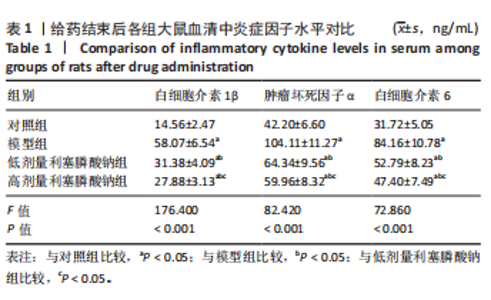
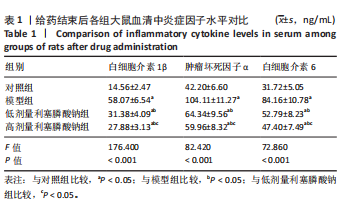
2.1 实验动物数量分析 40只大鼠全部进入结果分析。 2.2 各组大鼠血清中炎症因子水平对比 给药结束后,与对照组比较,模型组大鼠血清白细胞介素1β、肿瘤坏死因子α、白细胞介素6水平升高(P < 0.05);与模型组比较,低剂量利塞膦酸钠组大鼠血清白细胞介素1β、肿瘤坏死因子α、白细胞介素6水平降低(P < .05);与低剂量利塞膦酸钠组比较,高剂量利塞膦酸钠组大鼠血清白细胞介素1β、肿瘤坏死因子α、白细胞介素6水平降低(P < 0.05),见表1。"
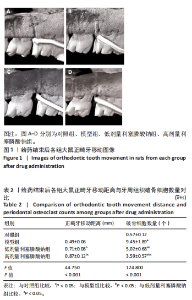
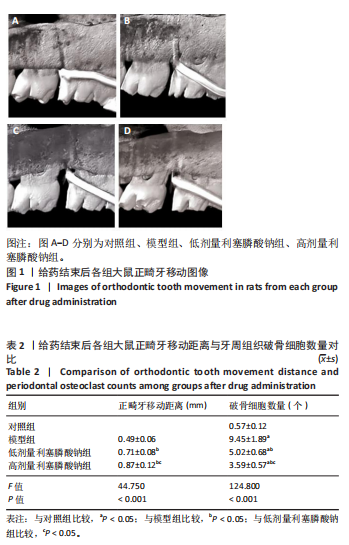
2.3 各组大鼠正畸牙移动距离对比 给药结束后,各组大鼠正畸牙移动图像,见图1。与模型组比较,低剂量利塞膦酸钠组大鼠正畸牙移动距离增加(P < 0.05);与低剂量利塞膦酸钠组比较,高剂量利塞膦酸钠组大鼠正畸牙移动距离增增加(P < 0.05),见表2。"
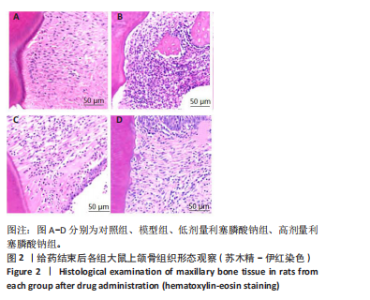
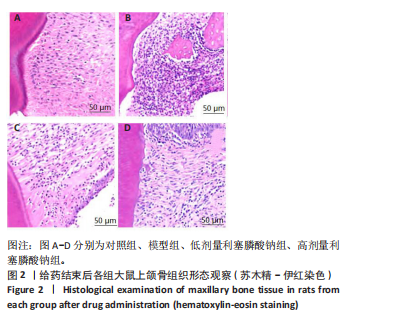
2.4 大鼠上颌骨组织形态对比 苏木精-伊红染色显示,对照组骨结构完整;模型组呈现典型的正畸牙移动特征,压力侧牙周间隙缩窄,张力侧牙周韧带增宽,并伴有明显的牙骨质吸收陷窝;低、高剂量利塞膦酸钠组表现出剂量依赖性的改善效果,随着药物剂量的增加,压力侧牙周改建更加显著,张力侧新骨形成逐渐增多的同时骨吸收陷窝明显减少,见图2。"
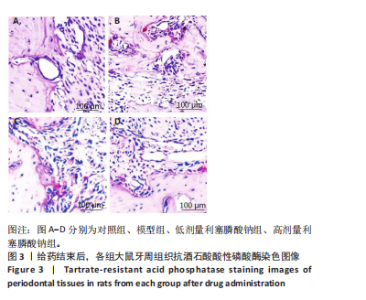
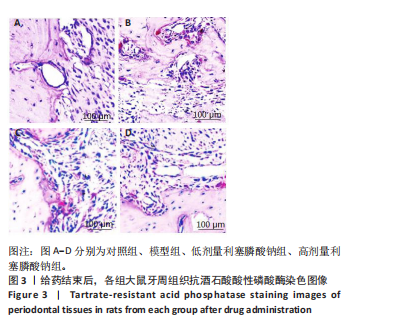
2.5 各组大鼠牙周组织破骨细胞数量对比 给药结束后,各组大鼠牙周组织抗酒石酸酸性磷酸酶染色图像,见图3。与对照组比较,模型组牙周组织破骨细胞数量增加(P < 0.05);与模型组比较,低剂量利塞膦酸钠组牙周组织破骨细胞数量减少(P < 0.05);与低剂量利塞膦酸钠组比较,高剂量利塞膦酸钠组牙周组织破骨细胞数量减少(P < 0.05),见表2。"
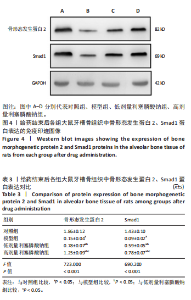
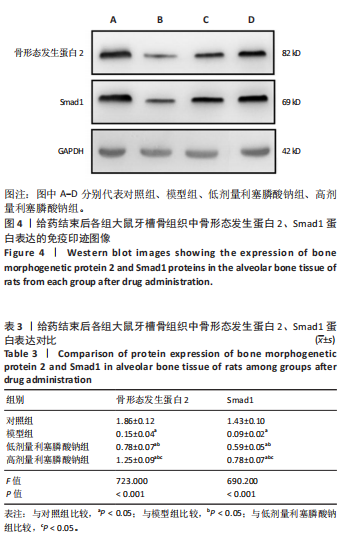
2.6 各组大鼠牙槽骨组织中骨形态发生蛋白2、Smad1蛋白表达对比 给药结束后,各组大鼠牙槽骨组织中骨形态发生蛋白2、Smad1蛋白表达的免疫印迹图像,见图4。与对照组比较,模型组大鼠牙槽骨组织中骨形态发生蛋白2、Smad1蛋白表达降低(P < 0.05);与模型组比较,低剂量利塞膦酸钠组大鼠牙槽骨组织中骨形态发生蛋白2、Smad1蛋白表达升高(P < 0.05);与低剂量利塞膦酸钠组比较,高剂量利塞膦酸钠组大鼠牙槽骨组织中骨形态发生蛋白2、Smad1蛋白表达升高(P < 0.05),见表3。"
| [1] SODSOOK W, KOBAYASHI Y, KAMIMOTO H, et al. Roles of B-cell lymphoma 6 in orthodontic tooth movement of rat molars. Eur J Orthod. 2025;47(2):cjaf006. [2] ZHENG Y, LAM XY, WU M, et al. Acceleration of Orthodontic Tooth Movement: A Bibliometric and Visual Analysis. Int Dent J. 2025;75(2):1223-1233. [3] MAI ZH, HUANG JH, PENG ZWH. miR-20a: a key regulator of orthodontic tooth movement via BMP2 signaling pathway modulation. Connect Tissue Res. 2024;65(4):304-312. [4] SEKI Y, TAKEBE H, NAKAO Y, et al. Osteoblast differentiation of Gli1 cells via Wnt and BMP signaling pathways during orthodontic tooth movement. J Oral Biosci. 2024;66(2):373-380. [5] ZIELIŃSKA M, PACHOLAK A, ORWAT B, et al. Comparative analysis of risedronate and its regioisomers synthesized via microwave-assisted method: bone affinity, cytotoxicity, permeability, and therapeutic potential. Pharmacol Rep. 2025;77(2):517-531. [6] SULTANA N, ALI A, WAHEED A, et al. Dissolving microneedle transdermal patch loaded with Risedronate sodium and Ursolic acid bipartite nanotransfersomes to combat osteoporosis: Optimization, characterization, in vitro and ex vivo assessment. Int J Pharm. 2023;644):123335. [7] 曹策,李玲美,訾明杰,等.医学研究中动物实验样本量的确定方法[J].中国比较医学杂志,2023,33(2):99-105. [8] 支方静,刘振霞,白琴.不同剂量利塞膦酸钠对正畸大鼠牙根组织中FAK、MMP-2、RANK蛋白表达及牙移动、牙根吸收的影响[J].临床和实验医学杂志,2023,22(3):233-237. [9] LEI F, LI M, LIN T, et al. Treatment of inflammatory bone loss in periodontitis by stem cell-derived exosomes. Acta Biomater. 2022;15(141):333-343. [10] LYU J, HASHIMOTO Y, HONDA Y, et al. Comparison of Osteogenic Potentials of Dental Pulp and Bone Marrow Mesenchymal Stem Cells Using the New Cell Transplantation Platform, CellSaic, in a Rat Congenital Cleft-Jaw Model. Int J Mol Sci. 2021;22(17):9478. [11] YU F, GENG D, KUANG Z, et al. Sequentially releasing self-healing hydrogel fabricated with TGFβ3-microspheres and bFGF to facilitate rat alveolar bone defect repair. Asian J Pharm Sci. 2022;17(3):425-434. [12] ZER T, GULIYEVA V, AKTA A, et al. Effects of a locally administered risedronate/autogenous bone graft combination on bone healing in a critical-size rabbit defect model. J Orthop Surg Res. 2023;18(1):88. [13] LIU S, YU X, GUO Q, et al. Periodontal ligament-associated protein-1 promotes osteoclastogenesis in mice by modulating TGF-β1/Smad1 pathway. J Periodontol. 2024;95(2):146-158. [14] GUO R, LI L, LIN Y, et al. Long-term bone remodeling of maxillary anterior teeth with post-treatment alveolar bone defect in adult patients with maxillary protrusion: a prospective follow-up study. Prog Orthod. 2023; 24(1):36. [15] GUARNIERI R, REDA R, DI NARDO D, et al. Expression of IL-1β, IL-6, TNF-α, and a-MMP-8 in sites with healthy conditions and with periodontal and peri-implant diseases: A case-control study. J Dent Res Dent Clin Dent Prospects. 2024;18(2):135-142. [16] LUO S, LI Z, LIU L, et al. Static magnetic field-induced IL-6 secretion in periodontal ligament stem cells accelerates orthodontic tooth movement. Sci Rep. 2024;14(1):9851. [17] 马玲,张钊.骨质疏松治疗药物在口腔领域的局部应用[J].中国组织工程研究,2025,29(30):6547-6555. [18] 徐远金,徐春枝,陈早梅,等.经皮椎体成形术联合利塞膦酸钠治疗绝经后骨质疏松性椎体压缩骨折疗效与对RANKL、OPG表达的影响[J].中国骨与关节损伤杂志,2023,38(1):6-10. [19] KURTIŞ B, ŞAHIN S, GÜRBÜZ S, et al. Vertical Bone Augmentation With Customized CAD/CAM Titanium Mesh for Severe Alveolar Ridge Defect in the Posterior Mandible: A Case Letter. J Craniofac Surg. 2023;34(3):e289-e293. [20] YANG X, FAN Y, LIANG J, et al. Polyaptamer-Driven Crystallization of Alendronate for Synergistic Osteoporosis Treatment through Osteoclastic Inhibition and Osteogenic Promotion. ACS Nano. 2024;18(33):22431-22443. [21] 支方静,刘振霞,白琴.不同剂量利塞膦酸钠对正畸大鼠牙根组织中FAK、MMP-2、RANK蛋白表达及牙移动、牙根吸收的影响[J].临床和实验医学杂志,2023,22(3):233-237. [22] XU C, WANG A, ZHANG L, et al. Epithelium-Specific Runx2 knockout mice display junctional epithelium and alveolar bone defects. Oral Dis. 2021; 27(5):1292-1299. [23] LI B, WANG L, HE H. Autophagy in orthodontic tooth movement: advances, challenges, and future perspectives. Mol Med. 2025;31(1):245. [24] 赵玲帆,叶鑫鑫,张强.双膦酸盐颌骨坏死的机制研究进展[J].中华老年口腔医学杂志,2023,21(1):50-55. [25] SHI X, YANG G, LIU MY, et al. Exosomes derived from human dental pulp stem cells increase flap survival with ischemia-reperfusion injuries. Regen Med. 2023;18(4):313-327. [26] XIAO X, ZOU S, HU Z, et al.”The role of mitogen-activated protein kinase signaling pathway in bone formation during mid-palatal suture expansion”. Connect Tissue Res. 2025;66(3):216-226. [27] GU JH, CHAE MY, CHOI JJ, et al. Deer antler velvet (Cervus elaphus sibiricus) promotes fracture healing via partial BMP2-Smad mediated osteoblast differentiation. J Orthop Surg Res. 2025;20(1):70. [28] MO L, CHEN L, WAN Y, et al. An aqueous extract of Prunella vulgaris L. ameliorates cadmium-induced bone loss by promoting osteogenic differentiation in female rats. Food Chem Toxicol. 2023;180(1):114005. [29] LIU L, YAO L, LU Z, et al. Epithelial-specific deletion of FAM20A leads to short root defects. Gene. 2023;30(1):147731. [30] CHANG MC, CHAO YC, CHEN YC, et al. Bone morphogenetic protein-4 induced matrix turnover and osteogenic differentiation-related molecules of stem cells from apical papilla and its associated ALK/Smad signaling. J Dent Sci. 2025;20(1):646-659. [31] ZHANG D, WU YF, LI ZH, et al. MiR-144-5p, an exosomal miRNA from bone marrow-derived macrophage in type 2 diabetes, impairs bone fracture healing via targeting Smad1. J Nanobiotechnology. 2021;19(1):226. [32] KAUR G, PIPPIN JA, CHANG S, et al. Osteoporosis GWAS-implicated DNM3 locus contextually regulates osteoblastic and chondrogenic fate of mesenchymal stem/progenitor cells through oscillating miR-199a-5p levels. JBMR Plus. 2024;8(5):ziae051. [33] 梁桂洪,梁祖建,谢平金,等.川芎嗪对膝骨性关节炎大鼠软骨下骨中miR-20b/VEGF和BMP2/Smad1通路的影响[J].中国药房,2019, 30(4):448-453. [34] 安庆,刘国雄,BIKASH KUMARSAH,等.淫羊藿苷对MC3T3-E1细胞增殖分化的影响及机制研究[J].安徽医科大学学报,2019,54(6):893-898. [35] WANG C, LIU W, HUANG Y, et al. Mitigating Gastrointestinal Side Effects of Risedronate Sodium: A Study on Bletilla Striata Polysaccharide Microneedle Patches. Int J Pharm. 2025;30(677):125609. [36] CHEN J, YANG X, HUANG Y, et al. Knockdown of SIGLEC1 inhibits osteogenic differentiation to alleviate ankylosing spondylitis progression by suppressing the TGF-β1/SMAD signaling pathway. Naunyn Schmiedebergs Arch Pharmacol. 2025;398(3):2933-2944. [37] 姜莹,胡晨,乔光伟,等.阿仑膦酸钠局部给药调节骨代谢在口腔医学中的应用[J].西部医学,2023,35(4):619-624. [38] RASTOGI SK, KHANKA S, KUMAR S, et al. Design, synthesis and biological evaluation of novel pyrimidine derivatives as bone anabolic agents promoting osteogenesis via the BMP2/SMAD1 signaling pathway. RSC Med Chem. 2024;15(2):677-694. [39] SZCZUKA J, SANDOMIERSKI M, VOELKEL A, et al. Surface Modification of Ti6Al4V ELI Titanium Alloy by Poly(Ethylene-Alt-Maleic Anhydride) and Risedronate Sodium. Materials (Basel). 2023;16(15):5404. |
| [1] | Yan Chengbo, Luo Qiuchi, Fan Jiabing, Gu Yeting, Deng Qian, Zhang Junmei. Effect of type 2 diabetes mellitus on orthodontic tooth movement and bone microstructure parameters on the tension side in rats [J]. Chinese Journal of Tissue Engineering Research, 2026, 30(4): 824-831. |
| [2] | Li Wenhao, Zhang Wei, Li Wenming, Xia Wenyu, Wu Zebin, Geng Dechun. Nimbolide relieves osteoporosis by regulating osteoclast differentiation and apoptosis [J]. Chinese Journal of Tissue Engineering Research, 2026, 30(35): 9120-9127. |
| [3] | Dong Shiming, Xie Zhenzi, Tao Rongrong, Mardan·Mamat, Ma Hairong. Type VI collagen: a multifunctional regulator in bone homeostasis and tissue engineering [J]. Chinese Journal of Tissue Engineering Research, 2026, 30(35): 9239-9247. |
| [4] | Lu Chuan, Yang Jiale, Li Youliang, Li Chao. Anethole promotes osteogenic differentiation of human bone marrow mesenchymal stem cells [J]. Chinese Journal of Tissue Engineering Research, 2026, 30(31): 8041-8046. |
| [5] | Hu Jie, He Hui, Ma Fengyu, Shen Xiaotian, Yuan Zhangqin, Liang Ting, Han Fengxuan. 10-Hydroxy-2-decenoic acid facilitates osteogenic differentiation via the enhancement of autophagy and antioxidant capacity [J]. Chinese Journal of Tissue Engineering Research, 2026, 30(25): 6433-6445. |
| [6] | Gao Jiabin, Li Tianqi, Xu Kun, Zhu Hanmin, Zhou Xi, Li Wei. Mitophagy regulates osteoclasts: a new perspective for osteoporosis treatment [J]. Chinese Journal of Tissue Engineering Research, 2026, 30(23): 5982-5991. |
| [7] | Wu Lingjie, Zheng Kaiyuan, Wang Guangrong, Yin Chong . Strategies for the application of miRNA-targeted therapy in the treatment of osteoporosis [J]. Chinese Journal of Tissue Engineering Research, 2026, 30(22): 5792-5803. |
| [8] | Yao Kaining, Yan Yunan, Zhou Yifan, Shi Liang, Cao Ximei, Zeeshan Rahim, Yang Yanping. Sonic hedgehog signaling pathway regulates the formation and septation of the outflow tract in the embryoic mouse heart [J]. Chinese Journal of Tissue Engineering Research, 2026, 30(16): 4077-4087. |
| [9] | Huang Jiayao, Gu Yu. Application of exosomes in the diagnosis and monitoring of oral diseases [J]. Chinese Journal of Tissue Engineering Research, 2026, 30(13): 3392-3401. |
| [10] | Sun Long, Wu Haiyang, Tong Linjian, Liu Rui, Yang Weiguang, Xiao Jian, Liu Lice, Sun Zhiming. Regulatory mechanism of leptin in bone metabolism [J]. Chinese Journal of Tissue Engineering Research, 2026, 30(12): 3100-3108. |
| [11] | Lu Xiuli, Xu Huazhen, Chen Yuxing, Yao Nan, Hu Zixuan, Huang Dane. Mechanism of Jiangu Formula in treating osteoporosis based on osteoclast-osteoblast coupling [J]. Chinese Journal of Tissue Engineering Research, 2025, 29(32): 6828-6835. |
| [12] | Wu Wangxiang, Ran Dongcheng, Xu Jiamu, Xu Jiafu, Chen Jingjing, Wang Chunqing. Long noncoding RNAs related to osteoporosis: current research status and developmental trends [J]. Chinese Journal of Tissue Engineering Research, 2025, 29(29): 6360-6368. |
| [13] | Yu Lei, Zhang Wei, Qin Yi, Ge Gaoran, Bai Jiaxiang, Geng Dechun. Repair of femoral condyle defects using mesoporous bioactive glass grafted with bone morphogenetic protein 2 osteogenic peptide inspired by mussel [J]. Chinese Journal of Tissue Engineering Research, 2025, 29(22): 4629-4638. |
| [14] | Li Haishan, Wu Yuheng, Liang Zixuan, Zhang Shiyin, Zhang Zhen, Mai Bin, Deng Wei, Li Yongxian, Tang Yongchao, , Zhang Shuncong, , Yuan Kai, . Carnosic acid inhibits osteoclast differentiation by inhibiting mitochondrial activity [J]. Chinese Journal of Tissue Engineering Research, 2025, 29(2): 245-253. |
| [15] | Gao Feng, Wang Jiliang, Wang Hongbo, Yang Yongsheng, Liu Yuan, Fu Su. Passage-associated senescence decreases osteogenic activity of MC3T3-E1 cells via primary cilia [J]. Chinese Journal of Tissue Engineering Research, 2025, 29(18): 3741-3746. |
| Viewed | ||||||
|
Full text |
|
|||||
|
Abstract |
|
|||||