Chinese Journal of Tissue Engineering Research ›› 2026, Vol. 30 ›› Issue (31): 8272-8281.doi: 10.12307/2026.345
Previous Articles Next Articles
Bibliometric analysis of soft robotic rehabilitation applications: a multidisciplinary perspective and trend insight in the context of greater health
Shi Liupeng1, Xie Liangyu2, Dan Yuqin3, Li Wang4, Wang Jie4, Shi Liang4, Shi Bin4, Cao Shengnan4, Sun Guodong5, 6
- 1School of Medical Information Engineering, Shandong University of Traditional Chinese Medicine, Jinan 250355, Shandong Province, China; 2College of Medical Information and Artificial Intelligence, Shandong First Medical University, Jinan 250117, Shandong Province, China; 3Rehabilitation Medical College, Shandong University of Traditional Chinese Medicine, Jinan 250355, Shandong Province, China; 4Neck-Shoulder and Lumbocrural Pain Hospital of Shandong First Medical University, Jinan 250062, Shandong Province, China; 5Rehabilitation Department, the Third Affiliated Hospital of Shandong First Medical University (Affiliated Hospital of Shandong Academy of Medical Sciences), Jinan 250031, Shandong Province, China; 6School of Medical Engineering and Translational Medicine, Tianjin University, Tianjin 300072, China
-
Received:2025-05-06Accepted:2025-08-20Online:2026-11-08Published:2026-05-26 -
Contact:Cao Shengnan, PhD, Attending physician, Master’s supervisor, Neck-Shoulder and Lumbocrural Pain Hospital of Shandong First Medical University, Jinan 250062, Shandong Province, China. Co-corresponding author: Sun Guodong, PhD, Chief physician, Professor, Rehabilitation Department, the Third Affiliated Hospital of Shandong First Medical University (Affiliated Hospital of Shandong Academy of Medical Sciences), Jinan 250031, Shandong Province, China; School of Medical Engineering and Translational Medicine, Tianjin University, Tianjin 300072, China -
About author:Shi Liupeng, MS candidate, School of Medical Information Engineering, Shandong University of Traditional Chinese Medicine, Jinan 250355, Shandong Province, China. Xie Liangyu, PhD candidate, College of Medical Information and Artificial Intelligence, Shandong First Medical University, Jinan 250117, Shandong Province, China Shi Liupeng and Xie Liangyu contributed equally to this work. -
Supported by:the National Natural Science Foundation of China, No. 82405600 (to CSN); China Postdoctoral Science Foundation, No. 2024M761872 (to CSN); Shandong Provincial Key Research and Development Program, No. 2022CXGC020510 (to SGD); Shandong Provincial Higher Education Institutes Young Innovative Team, Nos. 2024KJN012 (to CSN) and 2023KJ176 (to SL); Jinan Clinical Medicine Science and Technology Innovation Program, No. 202328051 (to CSN); Jinan Science and Technology Program, No. 202430007 (to SGD)

CLC Number:
Cite this article
Shi Liupeng, Xie Liangyu, Dan Yuqin, Li Wang, Wang Jie, Shi Liang, Shi Bin, Cao Shengnan, Sun Guodong. Bibliometric analysis of soft robotic rehabilitation applications: a multidisciplinary perspective and trend insight in the context of greater health[J]. Chinese Journal of Tissue Engineering Research, 2026, 30(31): 8272-8281.
share this article
Add to citation manager EndNote|Reference Manager|ProCite|BibTeX|RefWorks
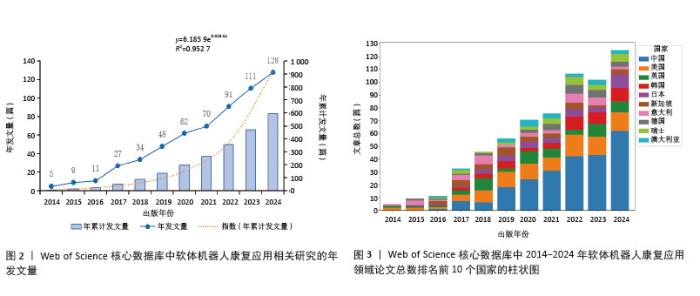
2.1 年度出版物 共纳入596篇关于软体机器人在康复应用领域中的研究文献,总引用次数为23 671次,平均每篇论文引用39.72次,H-Index为76。由图2可知,该领域年发文量和年累计发文量均呈现稳步上升趋势,其中年累计发文量的拟合曲线函数公式为:y=6.185 9e0.454 6x;R2=0.952 7(式中,x代表以起始年份为基准的时间偏移量,y代表年发文量,e为自然常数,约等于2.718 28)。具体而言,发表数量从2014年的5篇增加到2024年的128篇,增长了25倍。图3进一步显示了2014-2024年间,全球前10个国家的年发文量均呈现上升趋势,其中中国的年发文量增幅尤为显著。这些结果表明,该领域的研究关注度和国际认知度持续提升。 "

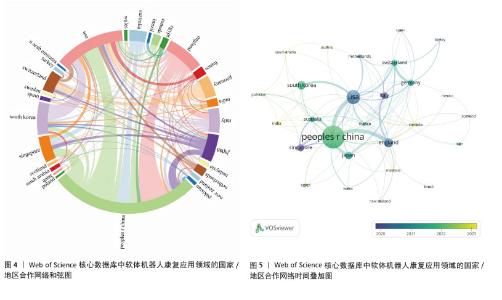
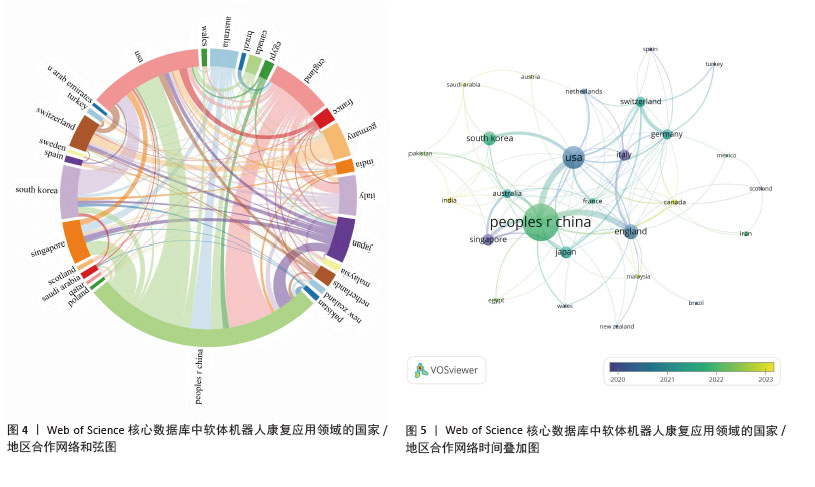
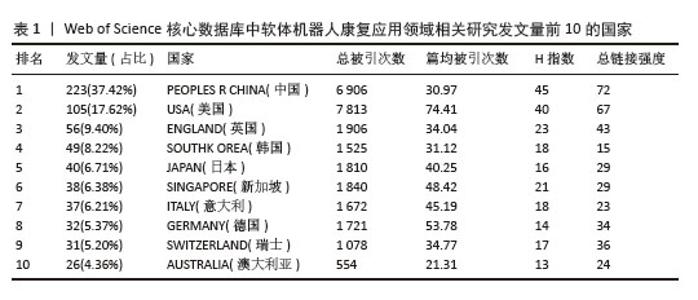
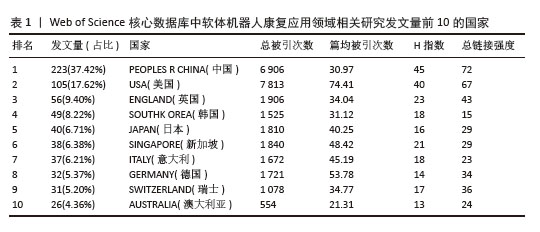
2.2 国家/地区分析 图4展示国家/地区合作网络的知识图谱,其中每个彩色块代表一个国家/地区,块的大小与出版物数量呈正比。连接线表示国家/地区之间的合作关系,线条的粗细则反映了合作频率[7]。如图所示,中国在该领域发表的论文数量最多,并与美国、英国、新加坡、澳大利亚和日本等国家保持密切合作关系。图5则呈现了国家/地区之间的合作关系及其平均出版时间,节点大小代表出版物的数量,线条的粗细表示合作关系及其强度,节点的暖色则指示较晚的平均发表时间[8]。 美国在该领域的早期研究中做出了突出贡献,平均发表时间较早,而中国近期发布了大量学术成果。此外,表1列出了出版量排名前10的国家及其相关信息,其中中国(223篇,37.42%)、美国(105篇,17.62%)和英国(56篇,9.40%)合计占总出版量的64.44%。在总被引次数和篇均被引次数方面,美国分别以7 813次和74.41次排名首位;而在总链接强度和H指数方面,中国分别以72和45排名第一。H指数反映学术影响力,而总链接强度则反映了与其他国家/地区的合作关系强度[9]。 "
"
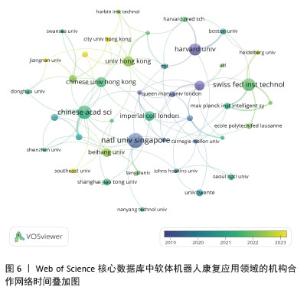
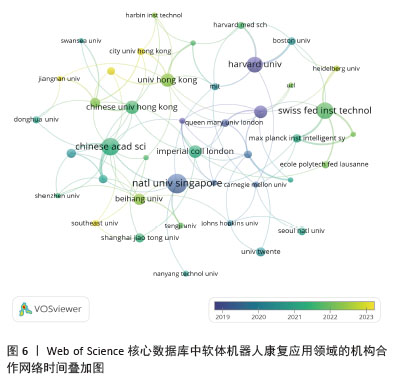
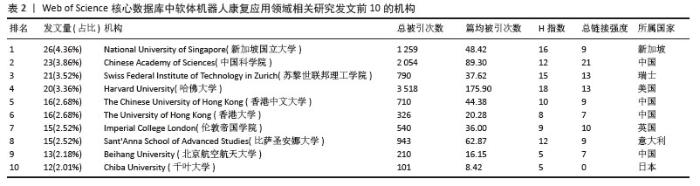
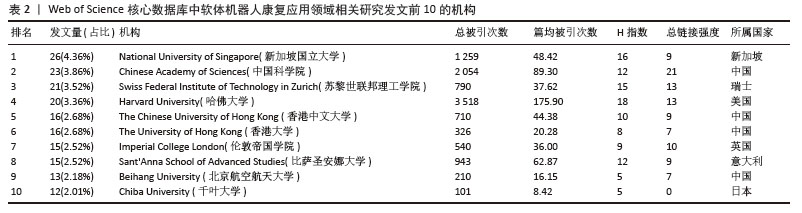
2.3 发文机构分析 数据显示,共有652个机构参与了该领域的相关研究。为平衡发文机构覆盖度与网络可视化效果,此研究基于文献计量学中布拉德福定律对核心发文机构的界定原则[10],并结合数据分布特征:发文量达到或超过5篇的机构的发文量占总发文量的82.7%,将VOSviewer发文机构的最小发表阈值设定为5,包含前54个研究机构的合作网络时间叠加图(图6)。图中的球体大小与发文量呈正比,连线的粗细表示机构之间的合作强度,而球体的颜色深浅则反映了机构的平均发文时间。分析结果显示,新加坡国立大学、哈佛大学和比萨圣安娜大学的发文时间较早,而近年来,中国高校如香港大学、北京航空航天大学和香港理工大学在该领域的发文量显著增加。表2列出了出版物数量排名前10的机构。其中新加坡国立大学(26篇,4.36%)位居首位,其次是中国科学院(23篇,3.86%)、苏黎世联邦理工学院(21篇,3.52%)和哈佛大学(20篇,3.36%)。此外,哈佛大学虽然在发文量上排名第四,但在总被引次数(3 518)、篇均被引次数(175.90)和H指数(18)方面领先;而中国科学院则拥有最高的总链接强度(21)。 "
"
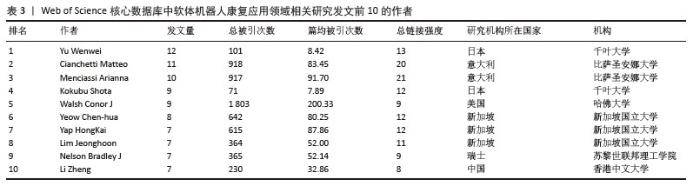
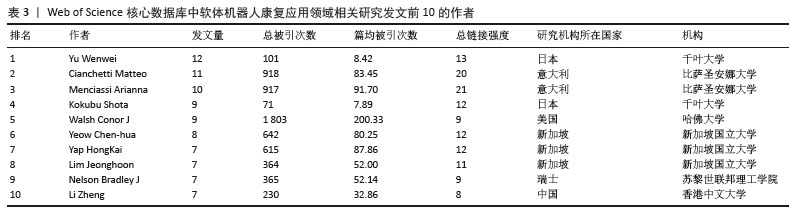
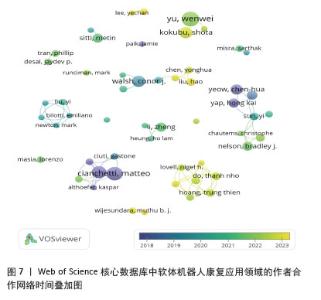
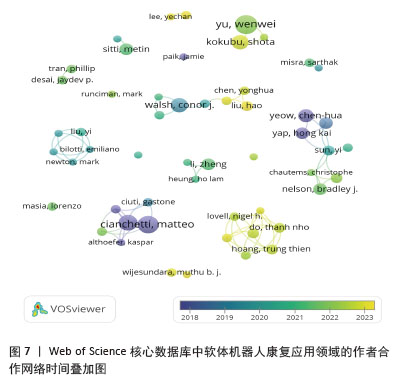
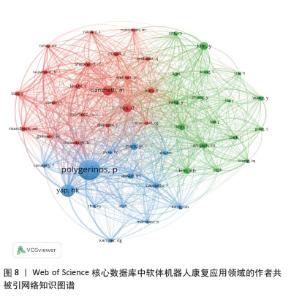
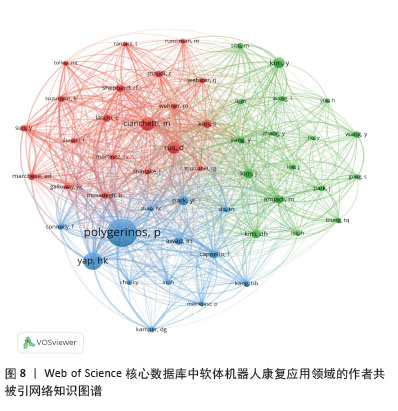
2.4 作者分析 数据显示,共有2 879位作者参与了该领域的研究。如表3所示,发文量排名前3的作者分别是Yu Wenwei(12篇)、Cianchetti Matteo(11篇)和Menciassi Arianna(10篇)。进一步分析表明,发文前10的作者所在机构均位于发文量排名前10的国家中,这表明国家政策和平台资源在该领域研究中的重要性。图7展示了在该领域发表论文不少于4篇的作者的合作网络以及平均发表时间。值得注意的是,该领域的早期研究主要得益于Menciassi Arianna、Cianchetti Matteo和Yeow Chen-hua等杰出作者的贡献,而近年来,Liu Hao、Singh Inderjeet和Park Hyung-soon等作者的贡献显著增加。图8展示了被引频次不少于50次的作者共被引网络。每个节点代表一位被引作者,节点大小与被引频次呈正比,节点之间的连接表示共被引关系,不同颜色表示不同的聚类[11]。作者共被引网络分析表明Polygerinos Panagiotis、Yap Hong Kai与Cianchetti Matteo作为高被引核心学者,聚焦气动驱动、可穿戴康复及仿生结构开发,其紧密聚类凸显软体机器人技术在材料科学、临床医学和人工智能的跨学科协同中的枢纽作用,推动康复设备向智能化与个性化演进。表3显示,Yu Wenwei以12篇论文(2.01%)位居发文量第一。Walsh Conor J在总被引次数(1 803篇)和篇均被引次数(200.33)方面排名第一,而Menciassi Arianna则拥有最高的总链接强度(21)。 "
"
"
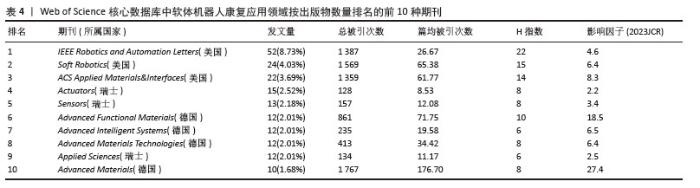
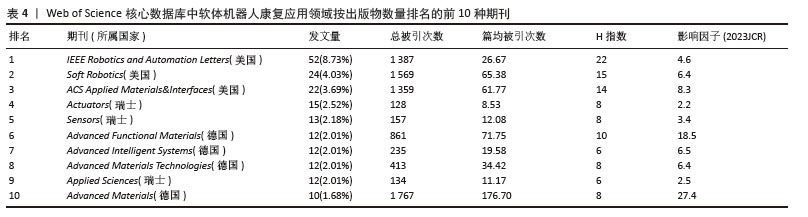
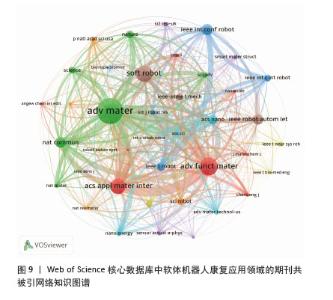
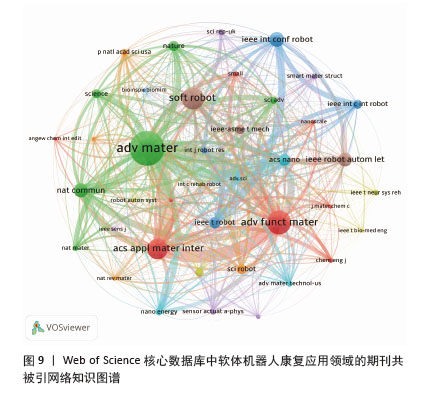
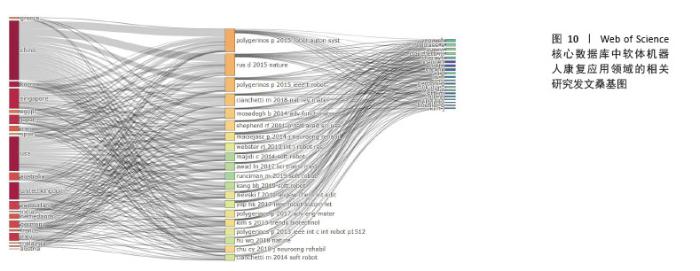
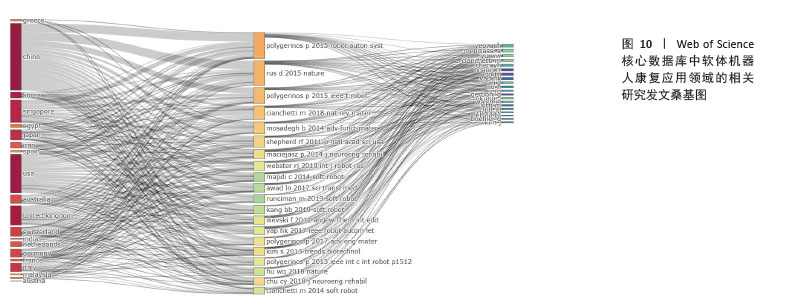
2.5 发文期刊分析 对Web of Science文献以机构为节点进行分析,数据显示共有191种期刊发表了相关文献。表4列出了在软体机器人康复应用领域主要发文期刊的相关信息,并按发表数量进行排序。《IEEE Robotics and Automation Letters》以52篇(8.73%)的发文量位居该领域首位,同时H指数(22)也排名第一。其次是《Soft Robotics》(24篇,4.03%)和《ACS Applied Materials&Interfaces》(22篇,3.69%),这两本期刊在总被引次数、篇均被引次数和H指数方面均表现突出。《Advanced Materials》以10篇(1.68%)的发文量排名第10,但在总被引次数(1 767次)、篇均被引次数(176.70)和影响因子(27.4)方面的表现位居所有期刊之首,体现了该期刊在该领域的较高学术质量和影响力。图9显示了共被引次数大于120次的40本期刊之间的共引关系,《Advanced Materials》和《Advanced Functional Materials》是引用频率和总链接强度最高的2本期刊。此外,《Nature》是一份高被引的高质量期刊。图10桑基图直观显示了发文国家、期刊和作者之间的关系。结果表明,发文量较多的国家通常会在文献量大、影响力高的期刊上发表文章,这些期刊与核心作者之间也存在较强的关联[12]。 "
"
"
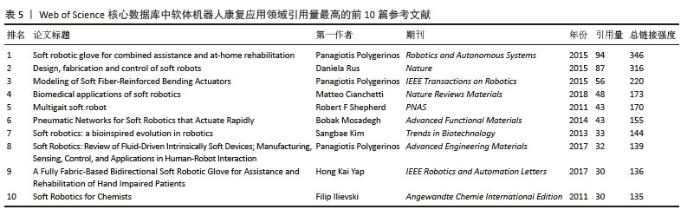
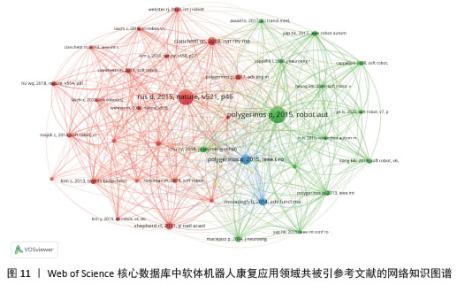
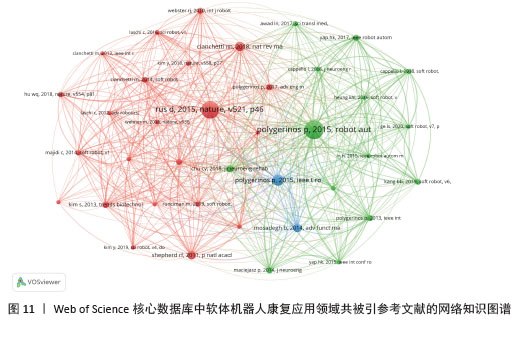
2.6 共被引参考文献分析 文献共被引分析是一种衡量文献间关联程度的方法,当两篇或更多论文同时被一篇或多篇其他论文引用时,它们之间就形成了共被引关系。图11展示了38篇被引用次数不少于20次的参考文献的共被引网络。其中,2015年POLYGERINOS等[13]在《Robotics and Autonomous Systems》期刊上发表的题为“Soft robotic glove for combined assistance and at-home rehabilitation”的论文被引用次数最高,达94次;其次是2015年RUS等[14]在《Nature》上发表的“Design, fabrication and control of soft robots”,被引用87次。共被引频次高的文献能够有效揭示该领域的研究热点与前沿方向。 表5为排名前10位的共被引参考文献,通过分析可以发现医疗康复与辅助设备是软体机器人研究的核心领域。驱动机制与材料创新是支撑该领域的技术基础,制造工艺与系统集成是实现产业化的关键环节,而建模和控制则是推动该领域智能化发展的核心技术。 "

"
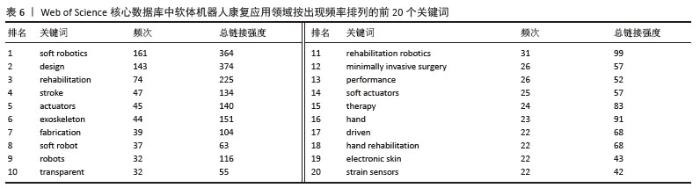
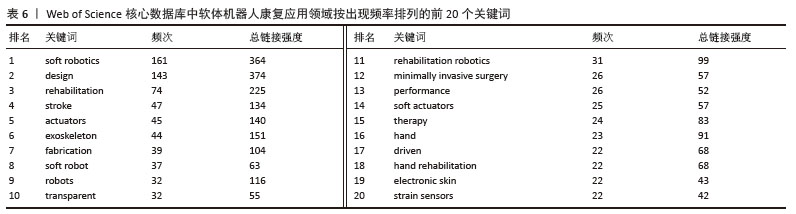
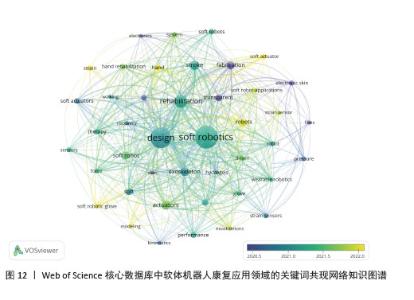
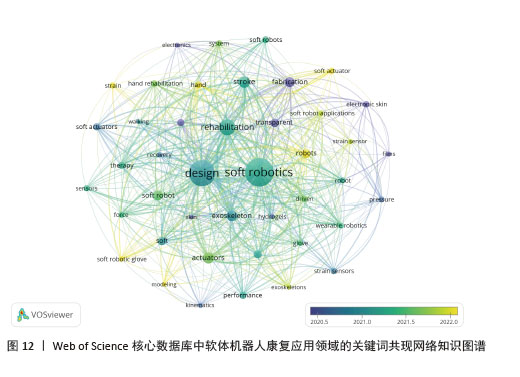
2.7 关键词分析 关键词是文章核心内容的高度概括,精准反映了文献所涵盖的各个主题及其相互关系,使读者能够迅速把握特定研究领域内的主要研究内容和热门话题,进而深入了解该领域的学术前沿与研究动态[15]。 2.7.1 关键词共现分析 图12展示了关键词出现频次不低于15次的共现关系和平均出现时间。根据分析结果,可以观察到由于研究重点的不同,minimally invasive surgery、fabrication和electronic skin等关键词较早出现,而soft actuators、modeling和hand等关键词则在近年来频繁出现。高频关键词的平均出现时间集中在2020-2022年之间。此外,表6列出了前20个高频关键词及总链接强度值。研究表明,软体机器人康复应用领域的研究方向呈现多样性,执行器、驱动、应变传感器和建模等关键词主要反映了软体机器人技术的关键应用领域;而康复机器人、手部康复、电子皮肤、外骨骼、中风等则聚焦于该领域的疾病应用和医疗设备研究。这些结果从一定程度上反映了软体机器人领域的主要研究内容及其热点话题。"
"
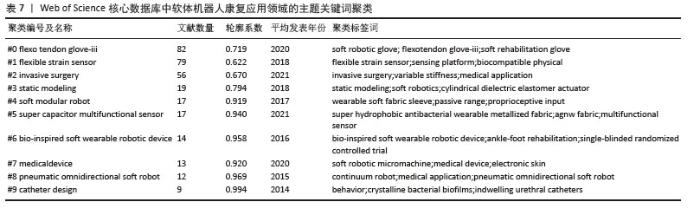
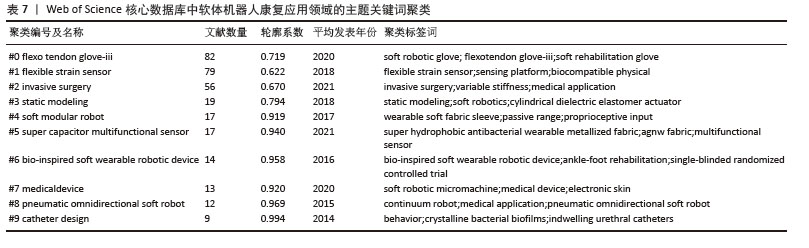
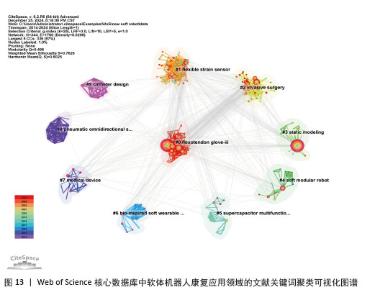
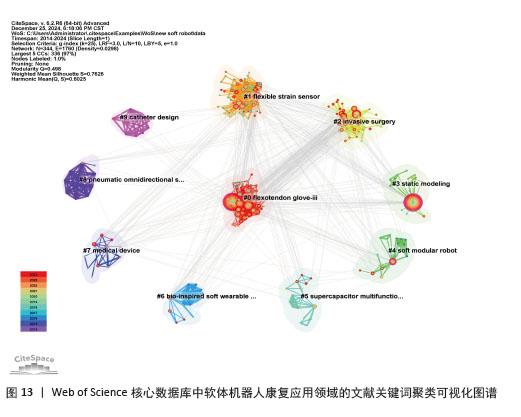
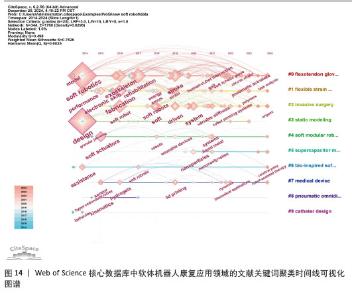
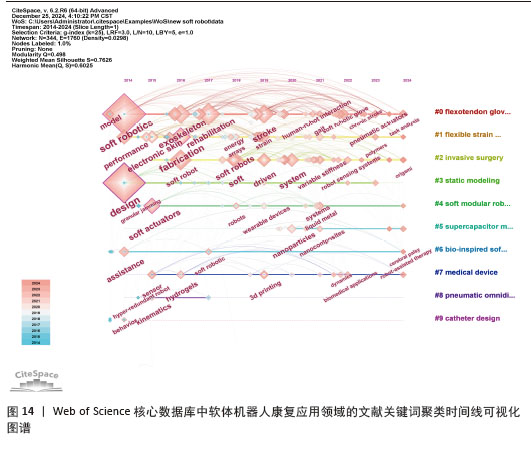
2.7.2 关键词聚类分析 关键词聚类分析可了解该领域的知识结构与动态演变过程。聚类序号由大变小代表该类的节点数由少变多,节点越多研究热点越高。 使用CiteSpace软件对关键词进行聚类分析,生成关键词聚类图谱,见图13。Q值=0.498(> 0.3),表示聚类有效,S值=0.762 6(> 0.7),说明聚类结构显著,聚类合理[16]。根据潜在语义索引算法,可得出不同的聚类标签排名前3的关键词,见表7。将10个具有代表性的聚类标签进一步归纳、分析、总结,可将其分为软体康复设备应用研究和关键技术研究2个方面。在软体康复辅助设备方面,研究主要集中在开发适用于患者康复的软体机器人,如手部康复手套、仿生可穿戴设备以及气动软体机器人,这些设备结合柔性传感器和创新驱动技术,旨在提高康复效果和患者舒适度。而在关键技术研究方面,研究则集中在软体机器人核心技术的突破,如静态建模、模块化设计、多功能传感器、医疗设备应用等领域,这些技术为软体机器人的实际应用提供了技术支持和理论基础,从而推动了该领域的创新和发展。 图14为关键词聚类时间线可视化图谱,纵轴为聚类名称,横轴为文献发表年份,节点的出现时间表示关键词首次出现的年份。该图谱展示了各聚类内关键词节点随时间变化的研究进展,能够揭示各聚类的出现、结束及时间趋势,反映其重要性及时间跨度[17]。特别是soft robotics、soft actuators和electronic skin等关键词呈现明显增长趋势,表明这些领域在机器人技术与医疗设备中的应用受到日益关注。此外,assistive devices、nanocomposites和3D printing等技术也逐渐兴起,显示其在软体机器人及智能医疗设备中的重要作用。图谱中的节点和连线揭示了关键词间的密切关系,反映了这些技术的交叉与融合,如flexible strain、invasive surgery和bio-inspired design等领域的紧密结合。排名区域中的新兴热点,如“flexotendon glove”和“supercapacitor”,标志着软体机器人领域正向更先进的材料、驱动技术及医疗应用方向发展。总体而言,该图谱不仅展示了软体机器人领域的快速进展,还体现了多学科技术的交织与创新。 "
"
"
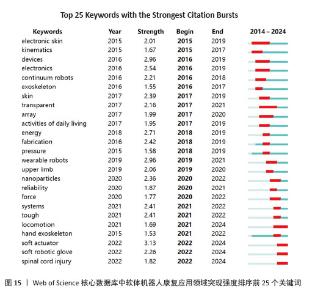
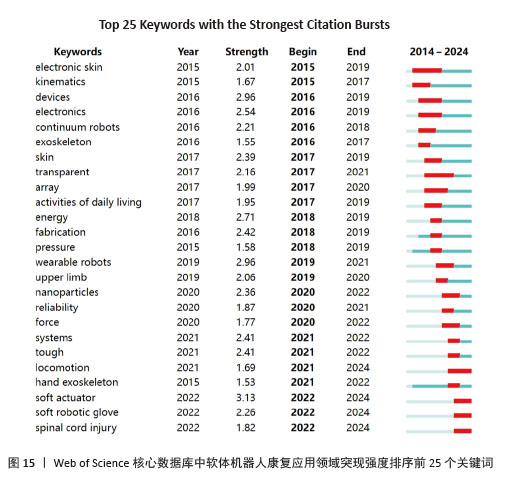
2.7.3 关键词突现分析 通过关键词突现性分析,计算出在一定时间内频次变化率高、增长速度快的关键词,以揭示该领域的研究热点和发展趋势。通过设置最短爆发持续时间为3年,检测到25个爆发强度最高的关键词,见图15。2014-2016年,kinematics、devices、electronics和exoskeleton是陆续兴起的研究主题。技术层面的突现词包括electronic skin和continuum robots,表明此阶段研究重点为新型交互电子设备的开发、复杂运动系统的理解、电子设备性能提升以及外骨骼的设计应用。2017-2019年,新增了skin、transparent、array和activities of daily living等研究主题。此阶段研究聚焦软体机器人皮肤、透明材料、阵列技术、日常生活辅助设备、能量效率和制造工艺,表明研究者们开始关注机器人的适应性和交互性、透明电子设备的开发、能源优化以及制造技术改进。2020-2024年,soft actuator、soft robotic glove和spinal cord injury成为新的研究热点,其中soft actuator的突现强度高达3.13,一直是软体机器人研究的核心。该阶段研究重点为软体机器人在医疗康复和辅助设备中的应用,特别是软体执行器和软体机器人手套的研究。此外,nanoparticles等新兴技术也在软体机器人发展中发挥重要作用。上述关键词的突现反映了软体机器人在康复应用领域的广泛应用和快速进展。 "
| [1] 励建安,陈立典.新年新机遇,共绘康复梦[J].中国康复医学杂志,2025,40(1):1-4. [2] 马骏.中国人口老龄化及其政策应对研究[M].南京:南京大学出版社,2023:321. [3] ZHOU M, WANG H, ZENG X, et al. Mortality, morbidity, and risk factors in China and its provinces, 1990-2017: a systematic analysis for the Global Burden of Disease Study 2017. Lancet. 2019;394(10204):1145-1158. [4] ZHANG Y, KONG D, SHI Y, et al. Recent progress on underwater soft robots: adhesion, grabbing, actuating, and sensing. Front Bioeng Biotechnol. 2023;11:1196922. [5] ZHOU Z, LIANG B, HUANG G, et al. Individualized Gait Generation for Rehabilitation Robots Based on Recurrent Neural Networks. IEEE Trans Neural Syst Rehabil Eng. 2021;29:273-281. [6] ZHANG L, XING S, YIN H, et al. Skin-inspired, sensory robots for electronic implants. Nat Commun. 2024;15(1):4777. [7] HOU Z, WANG W, SU S, et al. Bibliometric and Visualization Analysis of Biomechanical Research on Lumbar Intervertebral Disc. J Pain Res. 2023; 16:3441-3462. [8] YANG Z, FAN Z, WANG D, et al. Bibliometric and visualization analysis of stem cell therapy for meniscal regeneration from 2012 to 2022. Front Bioeng Biotechnol. 2023;11:1107209. [9] HUANG P, FENG Z, SHU X, et al. A bibliometric and visual analysis of publications on artificial intelligence in colorectal cancer (2002-2022). Front Oncol. 2023;13:1077539. [10] DESAI N, VERAS L, GOSAIN A. Using Bradford’s law of scattering to identify the core journals of pediatric surgery. J Surg Res. 2018;229:90-95. [11] TANG F, JIANG C, CHEN J, et al. Global hotspots and trends in Myofascial Pain Syndrome research from 1956 to 2022: A bibliometric analysis. Medicine (Baltimore). 2023;102(12):e33347. [12] GLOVER RE, AL-HABOUBI M, PETTICREW MP, et al. Sankey diagrams can clarify ‘evidence attrition’: A systematic review and meta-analysis of the effectiveness of rapid diagnostic tests for antimicrobial resistance. J Clin Epidemiol. 2022;144:173-184. [13] POLYGERINOS P, WANG Z, GALLOWAY KC, et al. Soft robotic glove for combined assistance and at-home rehabilitation. Rob Auton Syst. 2015;73: 135-143. [14] RUS D, TOLLEY MT. Design, fabrication and control of soft robots. Nature. 2015; 521(7553):467-475. [15] ZHANG G, SONG J, FENG Z, et al. Artificial intelligence applicated in gastric cancer: A bibliometric and visual analysis via CiteSpace. Front Oncol. 2023;12:1075974. [16] 章琦,李宝珍,郑雪梅,等.2000—2020年中国多重耐药菌研究热点的可视化分析[J].中国全科医学,2022,25(24):2960-2964. [17] WU J, WANG Y, CHENG Y, et al. Comprehensive landscape and future perspectives of non-coding RNAs in esophageal squamous cell carcinoma, a bibliometric analysis from 2008 to 2023. Pathol Oncol Res. 2024;30:1611595. [18] 王成军,亓杨杰.软体机器人在医学领域的应用[J].中国医学物理学杂志,2022,39(7):898-906. [19] 吴苡婷.让瘫痪者再次站立和行走[N].上海科技报,2025-03-07(001). [20] SOUZA LBO, SANTOS MRN, GARCIA RP, et al. Characterization of an austenitic stainless steel preform deposited by wire arc additive manufacturing. Int J Adv Manuf Technol. 2022; 123(9):3673-3686. [21] HAGHI B, AFLALO T, KELLIS S, et al. Enhanced control of a brain-computer interface by tetraplegic participants via neural-network-mediated feature extraction. Nat Biomed Eng. 2024. doi: 10.1038/s41551-024-01297-1. [22] 赵宇豪,赵慧,谭代彬.软体机器人流体驱动方式综述[J].液压与气动,2021,45(4):135-145. [23] 李笑,李亚鹏.形状记忆合金驱动的人工逼尿肌系统[J].华南理工大学学报(自然科学版), 2024,52(6):73-80. [24] RAHMAN MH, WERTH H, GOLDMAN A, et al. Recent progress on electroactive polymers: Synthesis, properties and applications. Ceramics. 2021;4(3):516-541. [25] ARMANINI C, BOYER F, MATHEW AT, et al. Soft robots modeling: A structured overview. IEEE Trans Robot. 2023;39(3):1728-1748. [26] HANNAN MW, WALKER ID. Kinematics and the implementation of an elephant’s trunk manipulator and other continuum style robots. J Robot Syst. 2003;20(2):45-63. [27] MAHL T, HILDEBRANDT A, SAWODNY O. A variable curvature continuum kinematics for kinematic control of the bionic handling assistant. IEEE Trans Robot. 2014;30(4):935-949. [28] HABER HE, KANE GL. The search for supersymmetry: probing physics beyond the standard model. Phys Rep. 1985;117(2-4):75-263. [29] O’REILLY OM. Modeling nonlinear problems in the mechanics of strings and rods Cham: Springer International Publishing, 2017. [30] QIU Z, ZHANG S, XUE Y, et al. An empirical model of soft bellows actuator. Sci Rep. 2024;14(1):28681. [31] SHI C, LIU Z, TIAN Z, et al. Fabrication of 3D MXene@ graphene hydrogel with high ion accessibility via Al-induced self-assembly and reduction for high-performance supercapacitors. Electrochim Acta. 2023;464:142892. [32] XIN C, REN Z, ZHANG L, et al. Light-triggered multi-joint microactuator fabricated by two-in-one femtosecond laser writing. Nat Commun. 2023;14(1):4273. [33] SHI X, YANG L, LI S, et al. Magnetic-field-driven switchable adhesion of NdFeB/PDMS composite with gecko-like surface. Nano Res. 2023;16(5):6840-6848. [34] GAO Z, WANG Y, MAO X, et al. Polydopamine/Carbon Black/Carbon Nanofiber/Thermoplastic Polyurethane Composite Nanofiber Strain Sensor with Ultrahigh Loading Rate for Human Activity Monitoring. ACS Appl Nano Mater. 2024; 7(10):11690-11703. [35] ABOLHOSEN AMR, LEE S, FUKUDA K, et al. Functional soft robotic composites based on organic photovoltaic and dielectric elastomer actuator. Sci Rep. 2024;14(1):9953. [36] LEE KH, FU DKC, LEONG MCW, et al. Nonparametric Online Learning Control for Soft Continuum Robot: An Enabling Technique for Effective Endoscopic Navigation. Soft Robot. 2017; 4(4):324-337. [37] CHEN T, YANG X, ZHANG B, et al. Scale-inspired programmable robotic structures with concurrent shape morphing and stiffness variation. Sci Robot. 2024;9(92):eadl0307. [38] GAFFORD J, DING Y, HARRIS A, et al. Shape deposition manufacturing of a soft, atraumatic, and deployable surgical grasper. J Mech Robot. 2015;7(2):021006. [39] LOW JH, DELGADO-MARTINEZ I, YEOW CH. Customizable soft pneumatic chamber–gripper devices for delicate surgical manipulation. J Med Device. 2014;8(4):044504. [40] CHEN X, CHEN H, ZHU L, et al. Nanoparticle-Patch System for Localized, Effective, and Sustained miRNA Administration into Infarcted Myocardium to Alleviate Myocardial Ischemia-Reperfusion Injury. ACS Nano. 2024. doi: 10.1021/acsnano.3c08811. [41] CHEN J, JIN D, WANG Q, et al. Programming ferromagnetic soft materials for miniature soft robots: Design, fabrication, and applications. J Mate Sci Technol. 2025;219:271-287. [42] LIU Y, HUANG J, LIU C, et al. Soft Millirobot Capable of Switching Motion Modes on the Fly for Targeted Drug Delivery in the Oviduct. ACS Nano. 2024;18(12):8694-8705. [43] HAO B, WANG X, DONG Y, et al. Focused ultrasound enables selective actuation and Newton-level force output of untethered soft robots. Nat Commun. 2024;15(1):5197. [44] SUI M, OUYANG Y, JIN H, et al. A soft-packaged and portable rehabilitation glove capable of closed-loop fine motor skills. Nat Mach Intell. 2023;5(10):1149-1160. [45] HUANG J, TU X, HE J. Design and evaluation of the RUPERT wearable upper extremity exoskeleton robot for clinical and in-home therapies. IEEE Trans Syst Man Cybern Syst. 2015;46(7):926-935. [46] DI LALLO A, YU S, SLIGHTAM JE, et al. Untethered Fluidic Engine for High‐Force Soft Wearable Robots. Adv Intell Syst. 2024;6(11):2400171. |
| [1] | Xu Canli, He Wenxing, Wang Yuping, Ba Yinying, Chi Li, Wang Wenjuan, Wang Jiajia. Research context and trend of TBK1 in autoimmunity, signaling pathways, gene expression, tumor prevention and treatment [J]. Chinese Journal of Tissue Engineering Research, 2026, 30(在线): 1-11. |
| [2] | Zhu Xiaolong, Zhang Wei, Yang Yang. Visualization analysis of research hotspots and cutting-edge information in the field of intervertebral disc regeneration and repair [J]. Chinese Journal of Tissue Engineering Research, 2026, 30(9): 2391-2402. |
| [3] | Wen Fayan, Li Yan, Qiang Tianming, Yang Chen, Shen Linming, Li Yadong, Liu Yongming. Unilateral biportal endoscopic technology for treatment of lumbar degenerative diseases: global research status and changing trends [J]. Chinese Journal of Tissue Engineering Research, 2026, 30(9): 2380-2390. |
| [4] | Huang Jie, Zeng Hao, Wang Wenchi, Lyu Zhucheng, Cui Wei. Visualization analysis of literature on the effect of lipid metabolism on osteoporosis [J]. Chinese Journal of Tissue Engineering Research, 2026, 30(6): 1558-1568. |
| [5] | Bei Chaoyong, Zhu Jialin, Yu Zhengze, Shi Niujin, Li Huarui, Peng Fenglin. Visualization analysis of research hotspots and trends in the treatment of knee osteoarthritis [J]. Chinese Journal of Tissue Engineering Research, 2026, 30(36): 9632-9639. |
| [6] | Wang Quan, Tang Zhenglong. Visualization analysis of literature on medication-related osteonecrosis of the jaw [J]. Chinese Journal of Tissue Engineering Research, 2026, 30(35): 9327-9335. |
| [7] | Chen Xiaoxia, Zhao Lihua, Li Taowen, Qin Yimei, Liang Jinyu. Postmenopausal cognitive impairment: a bibliometric analysis of developmental context and hot trends [J]. Chinese Journal of Tissue Engineering Research, 2026, 30(35): 9336-9344. |
| [8] | He Renda, Ma Wei, Sun Yongsi, Mo Xueni. Future medical research on brain organoids: interdisciplinary training, bioengineering technologies, and optimized model maturity [J]. Chinese Journal of Tissue Engineering Research, 2026, 30(34): 9088-9094. |
| [9] | Bu Fanchen, Hua Zhen, , Li Xiaolong, Lyu Jinye, Man Hao, Wang Jianwei, . Triangular fibrocartilage complex injuries: a visualization analysis of treatment hotspots and frontiers [J]. Chinese Journal of Tissue Engineering Research, 2026, 30(34): 9095-9102. |
| [10] | Zhang Zhanyue, Zhao Lijun, Zhang Chunyang, Zhang Zhongqi, Fu Kang, Zhang Zhihong. Application and development of polyetheretherketone material in skull defect repair [J]. Chinese Journal of Tissue Engineering Research, 2026, 30(32): 8569-8576. |
| [11] | Tong Man, Wang Yue, Wang Ruoyu, Wang Zhe, Fang Yanhua, Liang Shanshan . Bibliometric analysis of studies on organoid air-liquid interface culture [J]. Chinese Journal of Tissue Engineering Research, 2026, 30(31): 8302-8308. |
| [12] | Huang Jie, Zeng Hao, Zhang Zhenhao, Wang Wenchi, Cui Xianqin, Zhu Lifeng, Cui Wei. Body mass index and knee osteoarthritis: a bibliometric analysis based on the Web of Science Core Collection database [J]. Chinese Journal of Tissue Engineering Research, 2026, 30(31): 8282-8292. |
| [13] | Jiao Ziyi, Enhejirigala, Shi Guopeng, Yan Dayang, Wang Wei, Wang Xing, Liu Fuling, Wang Haiyan, Li Xiaohe. Bone tissue repair with animal/human-derived exosomes: visualization analysis of development trends [J]. Chinese Journal of Tissue Engineering Research, 2026, 30(31): 8293-8301. |
| [14] | Peng Hao, Chen Qigang, Shen Zhen. A visual analysis of research hotspots of H-type vessels in various bone diseases [J]. Chinese Journal of Tissue Engineering Research, 2026, 30(3): 760-769. |
| [15] | Wang Degang, Mei Junhua, Wang Junli, Zheng Li, Chen Guohua. Bibliometric and visualization analysis of the mechanism of osteogenic factors and neurotransmitters in the bone-brain axis [J]. Chinese Journal of Tissue Engineering Research, 2026, 30(29): 7724-7731. |
| Viewed | ||||||
|
Full text |
|
|||||
|
Abstract |
|
|||||