Chinese Journal of Tissue Engineering Research ›› 2026, Vol. 30 ›› Issue (31): 8146-8153.doi: 10.12307/2026.792
Previous Articles Next Articles
Action mechanism of Jingu Tongxiao Pill containing serum exosomes in regulating chondrocyte autophagy
Li Jianqiang1, Li Feng2, Kou Longwei2, Shao Yunbo2, Zhang Jiali1, Guo Jiayi2
- 1Graduate School of Hunan University of Chinese Medicine, Changsha 410000, Hunan Province, China; 2Luoyang Orthopedic Hospital of Henan Province (Henan Orthopedic Hospital), Luoyang 471000, Henan Province, China
-
Received:2025-07-09Accepted:2025-12-17Online:2026-11-08Published:2026-05-23 -
Contact:Guo Jiayi, MS, Professor, Chief physician, Master’s supervisor, Luoyang Orthopedic Hospital of Henan Province (Henan Orthopedic Hospital), Luoyang 471000, Henan Province, China -
About author:Li Jianqiang, Master candidate, Graduate School of Hunan University of Chinese Medicine, Changsha 410000, Hunan Province, China -
Supported by:2022 Henan Province Traditional Chinese Medicine Scientific Research Special Project, No. 2022ZYZD17 (to GJY); Henan Province Traditional Chinese Medicine Inheritance and Innovation Talent Project (Zhongjing Project) Outstanding Talent in Traditional Chinese Medicine, No. 2021 15 (to GJY); Science and Technology Project of the National Administration of Traditional Chinese Medicine in 2023, No. GZY-KJS-2023-012 (to GJY)

CLC Number:
Cite this article
Li Jianqiang, Li Feng, Kou Longwei, Shao Yunbo, Zhang Jiali, Guo Jiayi. Action mechanism of Jingu Tongxiao Pill containing serum exosomes in regulating chondrocyte autophagy[J]. Chinese Journal of Tissue Engineering Research, 2026, 30(31): 8146-8153.
share this article
Add to citation manager EndNote|Reference Manager|ProCite|BibTeX|RefWorks
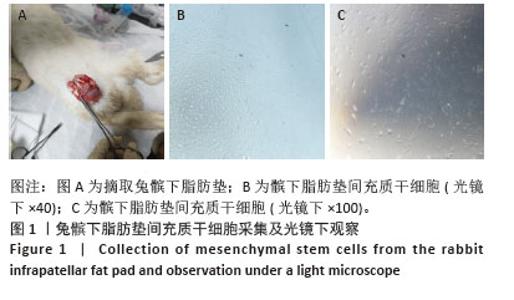
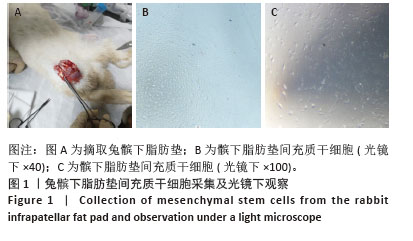
2.1 髌下脂肪垫间充质干细胞光镜下观察 经标准分离技术获得原代髌下脂肪垫来源间充质干细胞后,建立体外培养体系。每日通过倒置光学显微镜动态监测细胞生长状态,接种24 h后即可观察到散在贴壁细胞,经14 d体外扩增后,细胞融合度达80%左右,按1∶3比例进行消化传代。经传代培养的细胞群体呈现均一的成纤维样形态特征,表现为典型的长梭形结构(见图1),其增殖活力显著提升。鉴于连续传代可能引发细胞老化效应,此研究选择第3代细胞群体(P3)用于后续功能实验,以维持细胞最佳生物学特性。 "
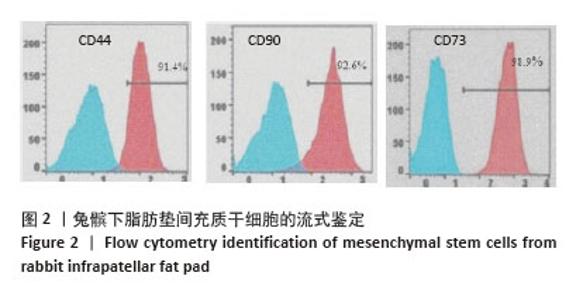
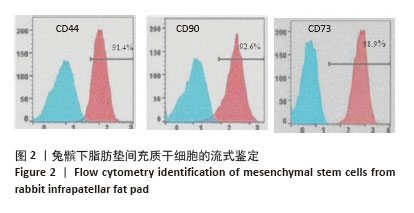
2.2 髌下脂肪垫间充质干细胞流式鉴定 经免疫表型鉴定验证髌下脂肪垫间充质干细胞生物学特性,选取P3代处于对数生长期的细胞样本,参照国际细胞治疗协会标准实施流式细胞术分析。检测数据显示:间充质干细胞特征性表面标记物CD44、CD90、CD73阳性表达率均呈现高表达,阳性率分别为91.4%,92.6%,98.9%,见图2。 "
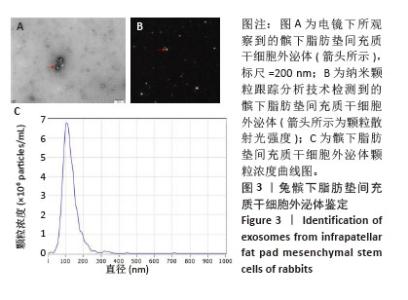
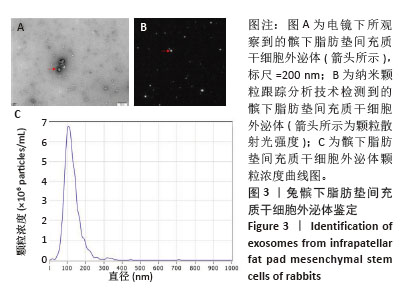
2.3 髌下脂肪垫间充质干细胞外泌体电镜观察与纳米颗粒跟踪分析 在电镜观察中,兔髌下脂肪垫间充质干细胞外泌体展现出均一的大小,形态为圆形或椭圆形,具有脂质双分子层结构的囊泡特征(见图3A),与外泌体在电镜下的典型表现相符。进一步运用纳米颗粒跟踪分析技术检测,结果显示髌下脂肪垫间充质干细胞外泌体的粒径分布范围为79.7-175.8 nm,平均直径126.5 nm,颗粒浓度6.8×10? particles/mL,其直径分布及颗粒浓度的追踪分析结果见图3B,C。 "
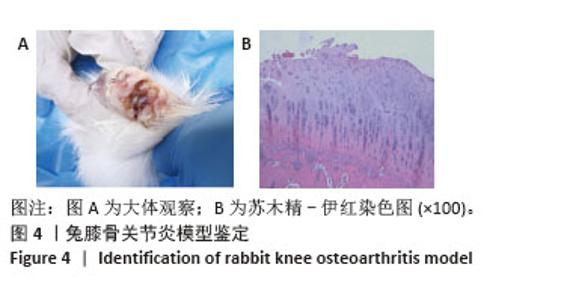
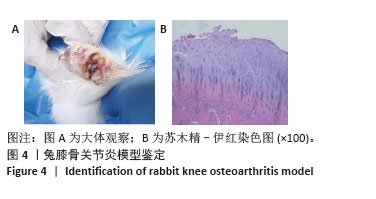
2.4 膝骨关节炎动物模型验证 2.4.1 实验动物数量分析 实验选用30只兔,分为5组,随机从造模的4组中抽取1只进行模型鉴定,其余兔实验过程均无死亡,对照组随机选取5,其余4组每组5只,共25只进入结果分析。 2.4.2 模型鉴定结果 造模2周后,模型兔膝关节出现肿胀,关节面平整度欠佳,色泽相较于正常状态有所暗沉,整体呈现出较为粗糙的质感,滑膜增厚,滑膜颜色趋向于黄色。与膝骨关节炎的典型病理特征相符。兔造模侧膝关节软骨苏木精-伊红染色观显示:软骨变薄,层次排列紊乱不清,软骨细胞排列紊乱,分布异常,符合膝骨关节炎中早期的病理学改变,见图4。 "
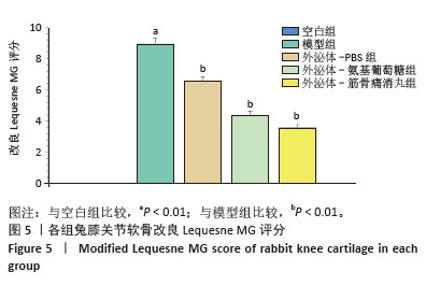
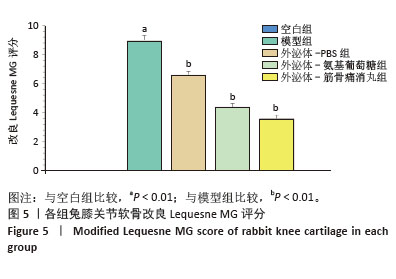
2.5 改良Lequesne MG评分结果 相应干预后第6周,对各组兔膝关节软骨实施改良Lequesne MG评分。与空白组相比,模型组兔改良Lequesne MG评分呈现显著升高趋势(P < 0.01);与模型组相比,外泌体-PBS组、外泌体-氨基葡萄糖组、筋骨痛消丸组兔的改良Lequesne MG评分均有不同程度降低(P < 0.01),见图5。 "
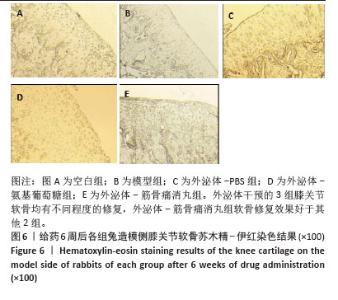
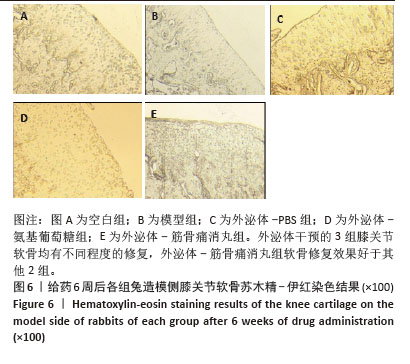
2.6 各组兔膝关节软骨病理学观察 空白组软骨结构完整,细胞形态正常,无变薄或排列紊乱现象,未见病理性改变;模型组关节软骨厚度显著变薄,软骨细胞数量急剧减少,细胞排列严重紊乱,可见局部基质降解;外泌体-PBS组软骨厚度中度减薄,细胞数量减少,部分区域软骨细胞呈异常簇集状排列,提示修复响应不足;外泌体-氨基葡萄糖组软骨表面偶见轻微缺损,厚度轻度变薄,细胞数量略减少,但整体排列基本有序,基质结构相对完整;外泌体-筋骨痛消丸组软骨厚度轻度变薄,细胞数量轻微减少,细胞排列规整有序,未见明显结构破坏,见图6。 "
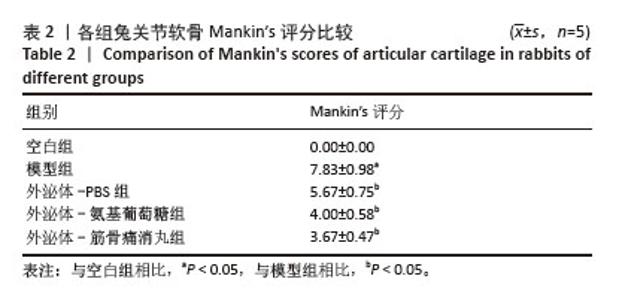
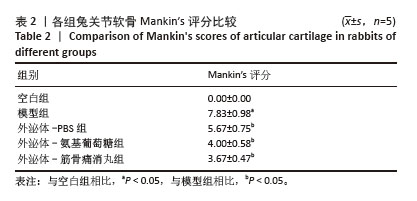
2.7 各组软骨切片Mankin’s 评分比较 结果显示:与空白组相比,模型组兔的Mankin’s 评分显著上升(P < 0.05);与模型组相比, 外泌体-PBS组、外泌体-筋骨痛消丸组以及外泌体-氨基葡萄糖组兔的Mankin’s 评分均显著降低(P < 0.05)。相较于外泌体-氨基葡萄糖组,外泌体-筋骨痛消丸组兔的Mankin’s 评分略低,差异无显著性意义(P > 0.05),见表2。 "
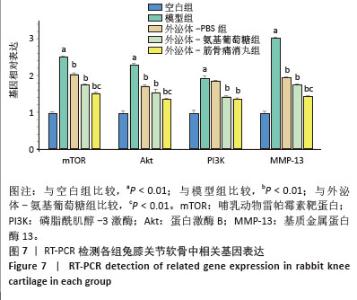
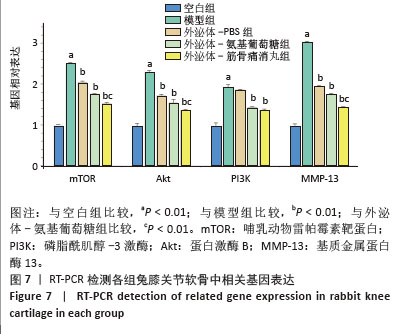
2.8 膝关节软骨相关基因的表达 RT-PCR检测结果显示,各组兔软骨组织中均有mTOR、PI3K、AKT、基质金属蛋白酶13 mRNA的表达。与空白组相比,模型组软骨组织中mTOR、PI3K、AKT mRNA表达水平均上调(P < 0.05),表明模型组软骨细胞中PI3K/AKT/mTOR信号通路被激活,软骨自噬能力受到抑制,同时基质金属蛋白酶13 mRNA表达上调(P < 0.05),表明软骨病理性降解能力增强。与模型组相比,外泌体-PBS组、外泌体-氨基葡萄糖组、外泌体-筋骨痛消丸组软骨组织中mTOR、PI3K、基质金属蛋白酶13 mRNA表达水平均下调(P < 0.05)。整体而言,外泌体-氨基葡萄糖组与外泌体-筋骨痛消丸组软骨组织中mTOR、PI3K、AKT mRNA表达水平下调最为显著,见图7。 "
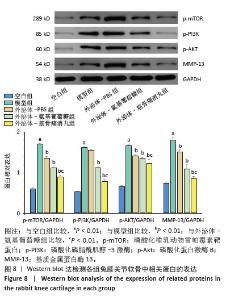
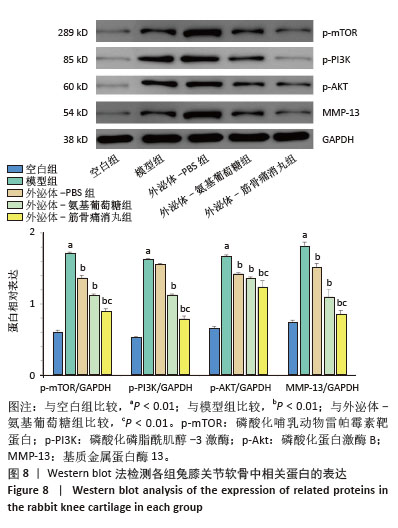
2.9 膝关节软骨中相关蛋白表达 Western blot检测结果显示,与空白组相比,模型组兔软骨组织中p-mTOR、p-PI3K、p-AKT、基质金属蛋白酶13蛋白的表达水平均显著上升(P < 0.01);与模型组相比,外泌体-筋骨痛消丸组以及外泌体-氨基葡萄糖组兔软骨组织中上述蛋白的表达水平均显著降低(P < 0.01)。在自噬相关蛋白的表达方面,外泌体-筋骨痛消丸组的促自噬效果显著高于模型组,这一结果进一步验证了自噬基因表达的差异性,见图8。 "
| [1] MOTTA F, BARONE E, SICA A. Inflammaging and Osteoarthritis. Clin Rev Allergy Immunol. 2023;64(2):222-238. [2] MARTEL-PELLETIER J, BARR AJ, CICUTTINI FM, et al. Osteoarthritis. Nat Rev Dis Primers. 2016;2:16072. [3] GIORGINO R, ALBANO D, FUSCO S,et al.Knee Osteoarthritis: Epidemiology, Pathogenesis, and Mesenchymal Stem Cells: What Else Is New? An Update. Int J Mol Sci. 2023;24(7):6405. [4] KONG P, AHMAD RE, ZULKIFLI A, et al. The role of autophagy in mitigating osteoarthritis progression via regulation of chondrocyte apoptosis: A review. Joint Bone Spine. 2024;91(3):105642. [5] XU K, HE Y, MOQBEL S, et al. SIRT3 ameliorates osteoarthritis via regulating chondrocyte autophagy and apoptosis through the PI3K/Akt/mTOR pathway. Int J Biol Macromol. 2021;175:351-360. [6] ZHANG H, YANG Y, WU Y, et al. Unveiling the potential of MSC extracellular vesicles: MiR-122-5p enhancing chondrocyte regeneration in osteoarthritis via autophagy mechanism. Stem Cell Res Ther. 2025;16(1):289. [7] LU H, JIA C, WU D, et al. Fibroblast growth factor 21 (FGF21) alleviates senescence, apoptosis, and extracellular matrix degradation in osteoarthritis via the SIRT1-mTOR signaling pathway. Cell Death Dis. 2021;12(10):865. [8] ZHANG C, LI Z, LI L, et al. Achyranthoside D (AD) improve intervertebral disc degeneration through affect the autophagy and the activation of PI3K/Akt/mTOR pathway. J Orthop Surg (Hong Kong). 2022;30(3):10225536221135474. [9] LI J, JIANG M, YU Z, et al. Artemisinin relieves osteoarthritis by activating mitochondrial autophagy through reducing TNFSF11 expression and inhibiting PI3K/AKT/mTOR signaling in cartilage. Cell Mol Biol Lett. 2022;27(1): 62. [10] CAO W, LI J, YANG K, et al. An overview of autophagy: Mechanism, regulation and research progress. Bull Cancer. 2021;108(3):304-322. [11] WU Y, HOU M, DENG Y, et al. Swimming exercise induces redox-lipid crosstalk to ameliorate osteoarthritis progression. Redox Biol. 2025;81:103535. [12] LIU Y, HUANG K, ZHOU SL, et al. Engineered exosomal miR140 modulates mitophagy of chondrocytes through targeting CAPN1 to alleviate osteoarthritis. Sci China Life Sci. 2025. doi: 10.1007/s11427-024-2843-7. [13] MEI Z, LI H, HUANG C, et al. Extracellular vesicles from adipose-derived stromal/stem cells reprogram dendritic cells to alleviate rat TMJOA by transferring mitochondria. J Nanobiotechnology. 2025;23(1):389. [14] LU M, LOU A, GAO J, et al. Quercetin-primed MSC exosomes synergistically attenuate osteoarthritis progression. J Orthop Surg Res. 2025;20(1):373. [15] KOUROUPIS D, KAPLAN LD, BEST TM. Human infrapatellar fat pad mesenchymal stem cells show immunomodulatory exosomal signatures. Sci Rep. 2022;12(1):3609. [16] 赵洪涛, 王自力, 倘艳峰. 筋骨痛消丸与关节镜联用治疗膝骨关节炎(寒凝血瘀证)的临床研究[J]. 中华中医药学刊,2025,43(12):126-129. [17] 曹坤燕, 谭新访, 郭艳幸,等. 采用网络药理学与分子对接技术研究筋骨痛消丸治疗髌骨软化症的作用机制[J]. 中国医药导刊,2022,24(9):856-865. [18] 刘源, 李峰, 史鹏博,等. 筋骨痛消丸调控MLT/SIRT1介导的信号通路治疗膝骨关节炎模型大鼠的研究[J]. 世界中西医结合杂志,2024,19(4):637-642+653. [19] NAIR AB, JACOB S. A simple practice guide for dose conversion between animals and human. J Basic Clin Pharm. 2016;7(2):27-31. [20] 张太平, 姚干. 最适麻醉剂量、方式的实验研究[J]. 青海医药杂志,2001,34(3): 8-9. [21] 车兆义, 邹悦, 宋清斌. 大鼠实验中几种常用的采血方法探讨[J]. 局解手术学杂志,2008(2):84-85. [22] MICHAEL JW, SCHLÜTER-BRUST KU, EYSEL P. The epidemiology, etiology, diagnosis, and treatment of osteoarthritis of the knee. Dtsch Arztebl Int. 2010; 107(9):152-162. [23] ETTINGER WH JR, AFABLE RF. Physical disability from knee osteoarthritis: the role of exercise as an intervention. Med Sci Sports Exerc. 1994;26(12):1435-1440. [24] KATZ JN, ARANT KR, LOESER RF. Diagnosis and Treatment of Hip and Knee Osteoarthritis: A Review. JAMA. 2021;325(6):568-578. [25] BIJLSMA JW, KNAHR K. Strategies for the prevention and management of osteoarthritis of the hip and knee. Best Pract Res Clin Rheumatol. 2007;21(1):59-76. [26] 谭婉俊, 吴官保, 彭兴宁, 等. 补肾活血汤含药血清调控髓核细胞外泌体中miR-222-3p抑制髓核细胞凋亡的研究[J]. 湖南中医药大学学报,2025,45(3): 425-431. [27] DANTAS LO, SALVINI TF, MCALINDON TE. Knee osteoarthritis: key treatments and implications for physical therapy. Braz J Phys Ther. 2021;25(2):135-146. [28] KAN HS, CHAN PK, CHIU KY, et al. Non-surgical treatment of knee osteoarthritis. Hong Kong Med J. 2019;25(2):127-133. [29] RESTUCCIA R, RUGGIERI D, MAGAUDDA L, et al. The preventive and therapeutic role of physical activity in knee osteoarthritis. Reumatismo. 2022;74(1). doi: 10.4081/reumatismo.2022.1466. [30] SHTROBLIA V, PETAKH P, KAMYSHNA I, et al. Recent advances in the management of knee osteoarthritis: a narrative review. Front Med (Lausanne). 2025;12: 1523027. [31] WEI P, BAO R. Intra-Articular Mesenchymal Stem Cell Injection for Knee Osteoarthritis: Mechanisms and Clinical Evidence. Int J Mol Sci. 2022;24(1):59. [32] WU CL, HARASYMOWICZ NS, KLIMAK MA, et al. The role of macrophages in osteoarthritis and cartilage repair. Osteoarthritis Cartilage. 2020;28(5):544-554. [33] ROSETI L, DESANDO G, CAVALLO C, et al. Articular Cartilage Regeneration in Osteoarthritis. Cells. 2019;8(11):1305. [34] JIN Y, LI S, YU Q, et al.Application of stem cells in regeneration medicine. MedComm (2020). 2023;4(4):e291. [35] 工程化组织构建研究热点[J]. 中国组织工程研究,2026,30(5):封底. [36] WANG Z, LI X, YANG J, et al. Single-cell RNA sequencing deconvolutes the in vivo heterogeneity of human bone marrow-derived mesenchymal stem cells. Int J Biol Sci. 2021;17(15):4192-4206. [37] PRIMORAC D, MOLNAR V, TSOUKAS D, et al. Tissue engineering and future directions in regenerative medicine for knee cartilage repair: a comprehensive review. Croat Med J. 2024;65(3):268-287. [38] 陈闻波, 蔡江瑜, 孙亚英,等. 应用干细胞旁分泌效应治疗膝部骨关节炎的研究进展[J]. 中国修复重建外科杂志,2019,33(11):1446-1451. [39] LI T, LI X, HAN G, et al. The Therapeutic Potential and Clinical Significance of Exosomes as Carriers of Drug Delivery System. Pharmaceutics. 2022;15(1):21. [40] ZENG H, GUO S, REN X, et al. Current Strategies for Exosome Cargo Loading and Targeting Delivery. Cells. 2023;12(10):1416. [41] XIONG M, ZHANG Q, HU W, et al. Exosomes From Adipose-Derived Stem Cells: The Emerging Roles and Applications in Tissue Regeneration of Plastic and Cosmetic Surgery. Front Cell Dev Biol. 2020;8:574223. [42] WU J, KUANG L, CHEN C, et al. miR-100-5p-abundant exosomes derived from infrapatellar fat pad MSCs protect articular cartilage and ameliorate gait abnormalities via inhibition of mTOR in osteoarthritis. Biomaterials. 2019;206: 87-100. [43] DASHTI A, HOSSEINI HM, MIRHOSSEINI SA. Epsilon toxin induces cytotoxicity by mediating autophagy and apoptosis via the PI3K/AKT/mTOR signaling pathway in A549 cells. Mol Biol Rep. 2025;52(1):403. [44] ZHANG HP, JIANG RY, ZHU JY, et al. PI3K/AKT/mTOR signaling pathway: an important driver and therapeutic target in triple-negative breast cancer. Breast Cancer. 2024;31(4):539-551. [45] OMOLEKAN TO, CHAMCHEU JC, BUERGER C, et al. PI3K/AKT/mTOR Signaling Network in Human Health and Diseases. Cells. 2024;13(17):1500. [46] VERSARI I, SALUCCI S, BAVELLONI A, et al. The Emerging Role and Clinical Significance of PI3K-Akt-mTOR in Rhabdomyosarcoma.Biomolecules. 2025; 15(3):334. [47] WANG H, SUN P, YUAN X, et al. Autophagy in tumor immune escape and immunotherapy. Mol Cancer. 2025;24(1):85. [48] KIM J, KUNDU M, VIOLLET B, et al.AMPK and mTOR regulate autophagy through direct phosphorylation of Ulk1. Nat Cell Biol. 2011;13(2):132-141. [49] HOLCZER M, HAJDÚ B, LŐRINCZ T, et al. Fine-tuning of AMPK-ULK1-mTORC1 regulatory triangle is crucial for autophagy oscillation. Sci Rep. 2020;10(1):17803. [50] XU J, WANG G, HOU Y, et al. RICTOR-mediated activation of AKT/mTOR signaling and autophagy inhibition promote osteoarthritis. Int Immunopharmacol. 2025; 144:113681. |
| [1] | Chen Qiuhan, Yang Long, Yuan Daizhu, Wu Zhanyu, Zou Zihao, Ye Chuan. Peri-knee osteotomy for treatment of knee osteoarthritis: optimization of treatment strategies [J]. Chinese Journal of Tissue Engineering Research, 2026, 30(9): 2303-2312. |
| [2] | Han Teng, Ma Hong, Yang Ruoyi, Luo Yi, Li Chao. Oral squamous cell carcinoma-derived exosomal delivery of angiopoietin-2 is involved in tumor angiogenesis [J]. Chinese Journal of Tissue Engineering Research, 2026, 30(7): 1755-1767. |
| [3] | Huang Jiawen, Pan Zhiyi, Xue Wenjun, Lian Yuanpei, Xu Jianda. Plant-derived vesicles and malignant tumor therapy: cross-species communication and modulation of host cell responses [J]. Chinese Journal of Tissue Engineering Research, 2026, 30(7): 1828-1838. |
| [4] | Wang Baiyan, Yang Shu, Wang Yiming, Wu Mengqing, Xiao Yu, Guo Zixuan, Zhang Boyi, Feng Shuying. Exosome-delivered CRISPR/Cas system enables gene editing in target cells [J]. Chinese Journal of Tissue Engineering Research, 2026, 30(7): 1839-1849. |
| [5] | Wang Zhenze, Liu Fende, Zhang Rui, Li Wujun. Mesenchymal stem cells in treatment of arteriosclerosis obliterans of lower extremities: systematic review and meta-analysis [J]. Chinese Journal of Tissue Engineering Research, 2026, 30(7): 1869-1876. |
| [6] | Song Puzhen, Ma Hebin, Chen Hongguang, Zhang Yadong. Effect of bone marrow mesenchymal stem cell-derived exosomes combined with transforming growth factor beta 1 on macrophages [J]. Chinese Journal of Tissue Engineering Research, 2026, 30(7): 1616-1623. |
| [7] | He Jiale, Huang Xi, Dong Hongfei, Chen Lang, Zhong Fangyu, Li Xianhui. Acellular dermal matrix combined with adipose-derived stem cell exosomes promotes burn wound healing [J]. Chinese Journal of Tissue Engineering Research, 2026, 30(7): 1699-1710. |
| [8] | Xia Linfeng, Wang Lu, Long Qianfa, Tang Rongwu, Luo Haodong, Tang Yi, Zhong Jun, Liu Yang. Human umbilical cord mesenchymal stem cell-derived exosomes alleviate blood-brain barrier damage in mice with septic encephalopathy [J]. Chinese Journal of Tissue Engineering Research, 2026, 30(7): 1711-1719. |
| [9] | Chen Yulin, He Yingying, Hu Kai, Chen Zhifan, Nie Sha Meng Yanhui, Li Runzhen, Zhang Xiaoduo , Li Yuxi, Tang Yaoping. Effect and mechanism of exosome-like vesicles derived from Trichosanthes kirilowii Maxim. in preventing and treating atherosclerosis [J]. Chinese Journal of Tissue Engineering Research, 2026, 30(7): 1768-1781. |
| [10] | Li Linzhen, Jiao Hongzhuo, Chen Weinan, Zhang Mingzhe, Wang Jianlong, Zhang Juntao. Effect of icariin-containing serum on lipopolysaccharide-induced inflammatory damage in human chondrocytes [J]. Chinese Journal of Tissue Engineering Research, 2026, 30(6): 1368-1374. |
| [11] | Jia Jinwen, Airefate·Ainiwaer, Zhang Juan. Effects of EP300 on autophagy and apoptosis related to allergic rhinitis in rats [J]. Chinese Journal of Tissue Engineering Research, 2026, 30(6): 1439-1449. |
| [12] | Li Hao, Tao Hongcheng, Zeng Ping, Liu Jinfu, Ding Qiang, Niu Chicheng, Huang Kai, Kang Hongyu. Mitogen-activated protein kinase signaling pathway regulates the development of osteoarthritis: guiding targeted therapy with traditional Chinese medicine [J]. Chinese Journal of Tissue Engineering Research, 2026, 30(6): 1476-1485. |
| [13] | You Huijuan, Wu Shuzhen, Rong Rong, Chen Liyuan, Zhao Yuqing, Wang Qinglu, Ou Xiaowei, Yang Fengying. Macrophage autophagy in lung diseases: two-sided effects [J]. Chinese Journal of Tissue Engineering Research, 2026, 30(6): 1516-1526. |
| [14] | Liu Kexin, , Hao Kaimin, Zhuang Wenyue, , Li Zhengyi. Autophagy-related gene expression in pulmonary fibrosis models: bioinformatic analysis and experimental validation [J]. Chinese Journal of Tissue Engineering Research, 2026, 30(5): 1129-1138. |
| [15] | Hu Jing, Zhu Ling, Xie Juan, Kong Deying, Liu Doudou. Autophagy regulates early embryonic development in mice via affecting H3K4me3 modification [J]. Chinese Journal of Tissue Engineering Research, 2026, 30(5): 1147-1155. |
| Viewed | ||||||
|
Full text |
|
|||||
|
Abstract |
|
|||||