Chinese Journal of Tissue Engineering Research ›› 2026, Vol. 30 ›› Issue (31): 8084-8091.doi: 10.12307/2026.780
Previous Articles Next Articles
Stepwise differentiation of human adipose-derived stem cells into motor neuron-like cells via a small molecule-based approach
Zhang Suifeng, Wang Kai, Zhang Fuqiang, Sun Dongliang, Kang Guan, Cheng Qinghao, Guo Hongzhang
- Department of Orthopedics, Gansu Provincial Hospital, Lanzhou 730000, Gansu Province, China
-
Received:2025-09-05Accepted:2025-11-11Online:2026-11-08Published:2026-05-22 -
Contact:Guo Hongzhang, Chief physician, Master’s supervisor, Department of Orthopedics, Gansu Provincial Hospital, Lanzhou 730000, Gansu Province, China -
About author:Zhang Suifeng, MS, Attending physician, Department of Orthopedics, Gansu Provincial Hospital, Lanzhou 730000, Gansu Province, China -
Supported by:Gansu Province Youth Science and Technology Fund Project, No. 22JR11RA247 (to ZSF); Lanzhou City Science and Technology Plan Project, No. 2024-9-24 (to ZSF); Gansu Provincial People's Hospital In-hospital Research Fund Project, No. 23GSSYE-3 (to ZSF)

CLC Number:
Cite this article
Zhang Suifeng, Wang Kai, Zhang Fuqiang, Sun Dongliang, Kang Guan, Cheng Qinghao, Guo Hongzhang. Stepwise differentiation of human adipose-derived stem cells into motor neuron-like cells via a small molecule-based approach[J]. Chinese Journal of Tissue Engineering Research, 2026, 30(31): 8084-8091.
share this article
Add to citation manager EndNote|Reference Manager|ProCite|BibTeX|RefWorks
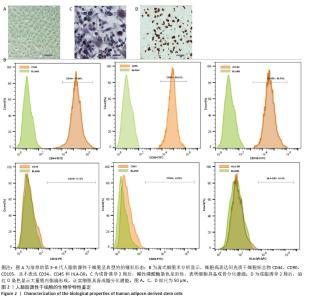
2.1 人脂肪源性干细胞的生物学特性鉴定结果 成功分离培养的人脂肪源性干细胞表现出间充质干细胞的典型生物学特性。在标准培养条件下,细胞呈梭形或多角形,增殖性强,可稳定传代(图2A)。流式细胞术分析结果证实,所培养的细胞符合国际细胞治疗协会(ISCT)的标准[11]:细胞高表达间充质干细胞标志物CD44 (97.84±1.25)%、CD90 (99.43±0.52)%及CD105 (98.74±0.86)%,同时几乎不表达造血干细胞标志物CD34 (0.15±0.08)%、CD45 (0.23±0.11)%和HLA-DR (0.14±0.07)% (图2B)。此外,人脂肪源性干细胞表现出明确的多向分化潜能[11]。经成骨诱导2周后,碱性磷酸酶染色呈强阳性(图2C);经成脂诱导2周后,油红O染色可见大量胞内脂滴形成(图2D)。综上所述,成功获得并鉴定了一批高纯度、具有多向分化能力的人脂肪源性干细胞,为后续的神经定向分化实验提供了可靠的细胞来源。 "
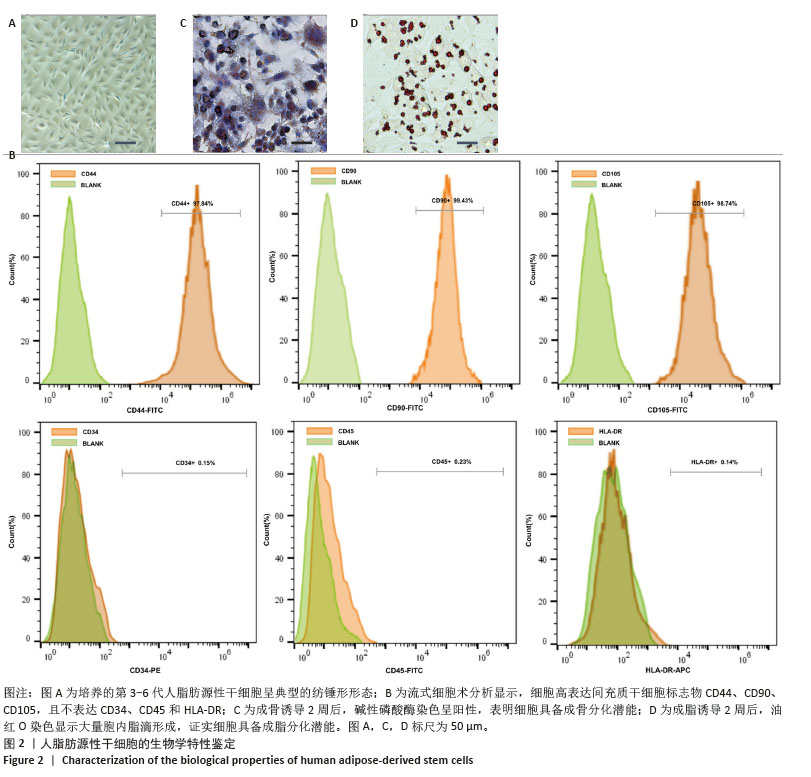
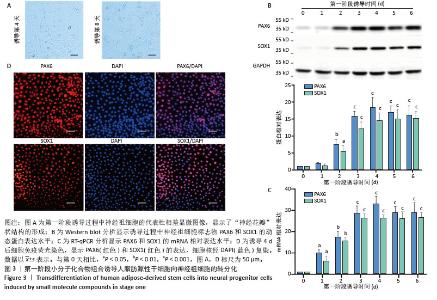
2.2 第一阶段诱导将人脂肪源性干细胞转分化为神经祖细胞 在第一阶段诱导过程中,人脂肪源性干细胞的形态发生了显著的神经谱系转变。诱导4 d后,细胞逐渐由梭形变为紧凑的聚集形态,并形成了典型的“神经花瓣”状结构[13](图3A)。 与形态学变化一致,分子水平检测也证实了细胞向神经祖细胞的成功转化。Western blot和RT-qPCR分析显示,神经祖细胞关键标志物PAX6和SOX1的蛋白与mRNA表达水平均从诱导第2天起显著上调,并在第4天达到峰值(P < 0.001),随后维持在较高水平(图3B,C)。 为精准评估转分化效率,免疫荧光染色结果显示,在诱导第4天,细胞群体已高表达PAX6和SOX1,且蛋白主要定位于细胞核。定量分析表明,PAX6阳性细胞率高达(85.33±6.27)%,SOX1阳性细胞率为(83.12±5.81)%(图3D)。 综上,形态学、分子生物学及细胞化学证据共同表明,Dorsomorphin、CHIR99021和SB431542组合能够将人脂肪源性干细胞诱导为神经祖细胞。 "
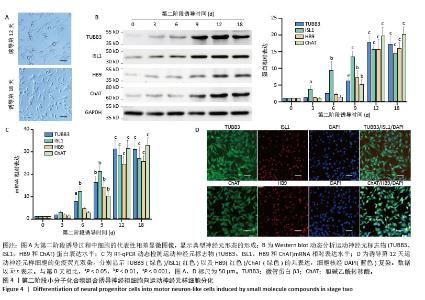
2.3 第二阶段诱导促使神经祖细胞成功分化为运动神经元样细胞 进入第二阶段诱导后,神经祖细胞逐渐分化为成熟的神经元形态[14]。至第12天,细胞胞体变圆或呈多角形,并伸出长度可达胞体直径5-10倍的复杂神经突起,部分细胞间形成初步的网络连接(图4A)。 分子水平的表达变化与形态学转变同步。Western blot和RT-qPCR分析均显示,运动神经元标志物(微管蛋白β3、ISL1、HB9和胆碱乙酰转移酶)的蛋白与mRNA表达水平在诱导过程中显著上调,并于第12天达到表达高峰(P < 0.001),随后维持在较高水平(图4B,C)。 为进一步验证分化效率与特异性,于诱导第12天进行了免疫荧光双染(图4D),结果显示,细胞群体中高比例共表达关键运动神经元标志物:(78.56±7.32)%的细胞共表达微管蛋白β3和ISL1,同时(75.04±6.81)%的细胞共表达HB9和胆碱乙酰转移酶。这些数据表明,第二阶段的CHIR99021、维甲酸和Purmorphamine组合能够特异性驱动神经祖细胞向运动神经元样细胞高效分化。 "
| [1] GBD 2021 NERVOUS SYSTEM DISORDERS COLLABORATORS. Global, regional, and national burden of disorders affecting the nervous system, 1990-2021: a systematic analysis for the Global Burden of Disease Study 2021. Lancet Neurol. 2024;23(4):344-381. [2] SONG XY, FAN CX, RAHMAN AU, et al. Neuro-regeneration or Repair: Cell Therapy of Neurological Disorders as A Way Forward. Curr Neuropharmacol. 2024;22(14):2272-2283. [3] ALDALI F, DENG C, NIE M, et al. Advances in therapies using mesenchymal stem cells and their exosomes for treatment of peripheral nerve injury: state of the art and future perspectives. Neural Regen Res. 2025;20(11):3151-3171. [4] SHEYKHHASAN M, WONG J, SEIFALIAN AM. Human Adipose-Derived Stem Cells with Great Therapeutic Potential. Curr Stem Cell Res Ther. 2019;14(7):532-548. [5] WU SH, LIAO YT, HSUEH KK, et al. Adipose-Derived Mesenchymal Stem Cells From a Hypoxic Culture Improve Neuronal Differentiation and Nerve Repair. Front Cell Dev Biol. 2021;9:658099. [6] GAO S, GUO X, ZHAO S, et al. Differentiation of human adipose-derived stem cells into neuron/motoneuron-like cells for cell replacement therapy of spinal cord injury. Cell Death Dis. 2019;10(8):597. [7] BAI T, DUAN H, ZHANG B, et al. Neuronal differentiation and functional maturation of neurons from neural stem cells induced by bFGF-chitosan controlled release system. Drug Deliv Transl Res. 2023;13(9):2378-2393. [8] WANG J, CHEN S, PAN C, et al. Application of Small Molecules in the Central Nervous System Direct Neuronal Reprogramming. Front Bioeng Biotechnol. 2022;10:799152. [9] HU Y, LI X, HUANG G, et al. Fasudil may induce the differentiation of bone marrow mesenchymal stem cells into neuron like cells via the Wnt/β catenin pathway. Mol Med Rep. 2019;19(4):3095-3104. [10] WEN B, ZHANG G, ZHAN C, et al. The 2024 revision of the Declaration of Helsinki: a modern ethical framework for medical research. Postgrad Med J. 2025;101(1194):371-382. [11] WANG JM, GU Y, PAN CJ, et al. Isolation, culture and identification of human adipose-derived stem cells. Exp Ther Med. 2017;13(3):1039-1043. [12] HAZRA A, GOGTAY N. Biostatistics Series Module 3: Comparing Groups: Numerical Variables. Indian J Dermatol. 2016;61(3):251-260. [13] BANDA E, MCKINSEY A, GERMAIN N, et al. Cell polarity and neurogenesis in embryonic stem cell-derived neural rosettes. Stem Cells Dev. 2015;24(8): 1022-1033. [14] TELIAS M, BEN-YOSEF D. Pharmacological Manipulation of Wnt/β-Catenin Signaling Pathway in Human Neural Precursor Cells Alters Their Differentiation Potential and Neuronal Yield. Front Mol Neurosci. 2021;14:680018. [15] WAREHAM LK, LIDDELOW SA, TEMPLE S, et al. Solving neurodegeneration: common mechanisms and strategies for new treatments. Mol Neurodegener. 2022;17(1):23. [16] JEON YJ, KIM J, CHO JH, et al. Comparative Analysis of Human Mesenchymal Stem Cells Derived From Bone Marrow, Placenta, and Adipose Tissue as Sources of Cell Therapy. J Cell Biochem. 2016;117(5):1112-1125. [17] ZHIDU S, YING T, RUI J, et al. Translational potential of mesenchymal stem cells in regenerative therapies for human diseases: challenges and opportunities. Stem Cell Res Ther. 2024;15(1):266. [18] LUO L, HE Y, WANG X, et al. Potential Roles of Dental Pulp Stem Cells in Neural Regeneration and Repair. Stem Cells Int. 2018;2018:1731289. [19] BACAKOVA L, ZARUBOVA J, TRAVNICKOVA M, et al. Stem cells: their source, potency and use in regenerative therapies with focus on adipose- derived stem cells - a review. Biotechnol Adv. 2018;36(4):1111-1126. [20] GIOVANNELLI L, BARI E, JOMMI C, et al. Mesenchymal stem cell secretome and extracellular vesicles for neurodegenerative diseases: Risk-benefit profile and next steps for the market access. Bioact Mater. 2023;29:16-35. [21] XIE X, FU Y, LIU J. Chemical reprogramming and transdifferentiation. Curr Opin Genet Dev. 2017;46:104-113. [22] NAKAJI-HIRABAYASHI T, FUJIMOTO K, KATO Y, et al. Advantages of anchoring growth factors to materials for neural stem/progenitor cell proliferation. J Mater Chem B. 2016;4(37):6213-6220. [23] YANG L, LI H, HAN Y, et al. CRISPR/Cas9 Gene Editing System Can Alter Gene Expression and Induce DNA Damage Accumulation. Genes (Basel). 2023; 14(4):806. [24] LU C, GARIPLER G, DAI C, et al. Essential transcription factors for induced neuron differentiation. Nat Commun. 2023;14(1):8362. [25] SHI W, BIAN L, LV D, et al. Enhanced neural differentiation of neural stem cells by sustained release of Shh from TG2 gene-modified EMSC co-culture in vitro. Amino Acids. 2021;53(1):11-22. [26] KOH J, LIU J, POON CH, et al. Transplantation of Neural Progenitor Cells Derived from Stem Cells from Apical Papilla Through Small-Molecule Induction in a Rat Model of Sciatic Nerve Injury. Tissue Eng Regen Med. 2024;21(6):867-879. [27] ZENTELYTĖ A, ŽUKAUSKAITĖ D, JACERYTĖ I, et al. Small Molecule Treatments Improve Differentiation Potential of Human Amniotic Fluid Stem Cells. Front Bioeng Biotechnol. 2021;9:623886. [28] HACKLAND J, FRITH T, THOMPSON O, et al. Top-Down Inhibition of BMP Signaling Enables Robust Induction of hPSCs Into Neural Crest in Fully Defined, Xeno-free Conditions. Stem Cell Reports. 2017;9(4):1043-1052. [29] SONG Y, LEE S, JHO EH. Enhancement of neuronal differentiation by using small molecules modulating Nodal/Smad, Wnt/β-catenin, and FGF signaling. Biochem Biophys Res Commun. 2018;503(1):352-358. [30] KIM HM, NOH HB, LEE SH, et al. Fine-tuning of dual-SMAD inhibition to differentiate human pluripotent stem cells into neural crest stem cells. Cell Prolif. 2021;54(9):e13103. [31] DELEPINE C, PHAM VA, TSANG HWS, et al. GSK3ß inhibitor CHIR 99021 modulates cerebral organoid development through dose-dependent regulation of apoptosis, proliferation, differentiation and migration. PLoS One. 2021;16(5):e0251173. [32] STOYANOVA II, KLYMENKO A, WILLMS J, et al. Ghrelin Regulates Expression of the Transcription Factor Pax6 in Hypoxic Brain Progenitor Cells and Neurons. Cells. 2022;11(5):782. [33] LIN YL, LIN YW, NHIEU J, et al. Sonic Hedgehog-Gli1 Signaling and Cellular Retinoic Acid Binding Protein 1 Gene Regulation in Motor Neuron Differentiation and Diseases. Int J Mol Sci. 2020;21(11):4125. [34] CHEN F, WANG H, XIANG X, et al. Curcumin increased the differentiation rate of neurons in neural stem cells via wnt signaling in vitro study. J Surg Res. 2014; 192(2):298-304. [35] GUPTA R, MEHAN S, CHHABRA S, et al. Role of Sonic Hedgehog Signaling Activation in the Prevention of Neurological Abnormalities Associated with Obsessive-Compulsive Disorder. Neurotox Res. 2022; 40(6):1718-1738. [36] PURI D, BARRY BJ, ENGLE EC. TUBB3 and KIF21A in neurodevelopment and disease. Front Neurosci. 2023;17:1226181. [37] SMITH NC, WILKINSON-WHITE LE, KWAN AHY, et al. Contrasting DNA-binding behaviour by ISL1 and LHX3 underpins differential gene targeting in neuronal cell specification. J Struct Biol X. 2020;5:100043. [38] LETCHUMAN S, TUCKER A, MIRANDA D, et al. Transcription Factor Hb9 Is Expressed in Glial Cell Lineages in the Developing Mouse Spinal Cord. eNeuro. 2022;9(6):ENEURO.0214-22.2022. [39] MILLE T, QUILGARS C, CAZALETS JR, et al. Acetylcholine and spinal locomotor networks: The insider. Physiol Rep. 2021;9(3):e14736. |
| [1] | Zhou Rui, Zhang Xuesong, Yang Donghong, Jin Yinan, Yang Yuqi, Ye Zhihui. Overexpression of collagen triple helix repeat-containing protein 1 promotes proliferation and osteogenic differentiation of human periodontal ligament stem cells [J]. Chinese Journal of Tissue Engineering Research, 2026, 30(19): 4918-4925. |
| [2] | Zhang Shilei, Qin Chuanhong, Wang Jianxu, Sun Shui. Osteogenic-adipogenic differentiation imbalance of bone marrow mesenchymal stem cells and osteonecrosis of the femoral head: from molecular mechanisms to therapeutic strategies [J]. Chinese Journal of Tissue Engineering Research, 2026, 30(13): 3350-3358. |
| [3] | Liu Ziwei, Nijati·Tursun, Yin Rui, Li Shuhui, Zhou Jing. Effect of cannabinoid type I receptors on neuronal differentiation of human apical papilla stem cells [J]. Chinese Journal of Tissue Engineering Research, 2026, 30(1): 93-100. |
| [4] | Yuan Weiyuan, Lei Qinhui, Li Xiuqi, Lu Tiezhu, Fu Ziwen, Liang Zhili, Ji Shaoyang, Li Yijia, Ren Yu . Therapeutic effects of adipose-derived mesenchymal stem cells and their exosomes on dexamethasone-induced sarcopenia in mice [J]. Chinese Journal of Tissue Engineering Research, 2026, 30(1): 58-67. |
| [5] | Yuan Xiao, Liang Songlin, Xie Yanan, Guan Dongmei, Fan Longyu, Yin Xiaoxuan. Mesenchymal stem cells from different sources in treatment of inflammatory bowel disease [J]. Chinese Journal of Tissue Engineering Research, 2025, 29(31): 6811-6820. |
| [6] | Xu Jie, Jiu Jingwei, Liu Haifeng, Zhao Bin. Bio-3D printed bionic scaffold promotes healing after rotator cuff injury [J]. Chinese Journal of Tissue Engineering Research, 2025, 29(22): 4761-4770. |
| [7] | Zhang Qijian, Xu Ximing. Acquisition and application of ectodermal mesenchymal stem cells [J]. Chinese Journal of Tissue Engineering Research, 2023, 27(6): 928-934. |
| [8] | Cheng Xi, Sun Baolan, Xie Yuanyuan, Zhang Yuquan. Transamniotic stem cell therapy: a novel strategy for prenatal treatment of multiple congenital diseases [J]. Chinese Journal of Tissue Engineering Research, 2023, 27(24): 3892-3900. |
| [9] | Zheng Xiaohan, Wei Yanzhao, Huang Ting, Wei Xufang, Sun Shengtong, Wang Tan, Zhao Zhenqiang. Role of macrophage migration inhibitory factor for stem cells [J]. Chinese Journal of Tissue Engineering Research, 2023, 27(15): 2395-2403. |
| [10] | Ma Yujiu, Zhang Xudong, Tan Jichun. Application status and prospect of menstrual blood-derived stem cells and their exosomes [J]. Chinese Journal of Tissue Engineering Research, 2023, 27(15): 2427-2434. |
| [11] | Xi Hualei, Xue Bing, Xu Wanqiu, Xu Xiaohang, Yao Lihong, Wang Xiumei. Neural differentiation and neural biomarker expression of dental pulp stem cells [J]. Chinese Journal of Tissue Engineering Research, 2023, 27(1): 91-98. |
| [12] | Xuan Juanjuan, Bai Hongtai, Zhang Jixiang, Wang Yaoquan, Chen Guoyong, Wei Sidong. Role of regulatory T cell subsets in liver transplantation and progress in clinical application [J]. Chinese Journal of Tissue Engineering Research, 2022, 26(7): 1143-1148. |
| [13] | He Jiachen, Liu Chang, Chen Chichi, Shi Qin. Preparation and in vitro evaluation of injectable microspheres loaded with cells [J]. Chinese Journal of Tissue Engineering Research, 2022, 26(28): 4483-4488. |
| [14] | Wang Kang, Zhi Xiaodong, Wang Wei. Effect and mechanism of human amniotic epithelial cells on nerve injury repair [J]. Chinese Journal of Tissue Engineering Research, 2022, 26(25): 4046-4051. |
| [15] | Zeng Rui, Hai Bing. Impact of nicotine on stem cells [J]. Chinese Journal of Tissue Engineering Research, 2022, 26(25): 4070-4075. |
| Viewed | ||||||
|
Full text |
|
|||||
|
Abstract |
|
|||||