Chinese Journal of Tissue Engineering Research ›› 2026, Vol. 30 ›› Issue (27): 7101-7107.doi: 10.12307/2026.856
Previous Articles Next Articles
Impact of HoloLens 2–assisted navigation for precision acetabular cup placement on the learning curve of surgeons with different levels of experience
Xia Qingquan, Wu Xuhua, Yin Yelin, Xu Qing, Meng Xiangchao, Rong Ke
- Department of Orthopedics of Minhang Hospital Affiliated to Fudan University, Department of Orthopedics of Minhang District Central Hospital, Fudan University School of Medicine, Shanghai 201199, China
-
Received:2025-10-29Accepted:2026-01-21Online:2026-09-28Published:2026-05-14 -
Contact:Meng Xiangchao, MD, Attending physician, Department of Orthopedics of Minhang Hospital Affiliated to Fudan University, Department of Orthopedics of Minhang District Central Hospital, Fudan University School of Medicine, Shanghai 201199, China Rong Ke, MD, Chief physician, Department of Orthopedics of Minhang Hospital Affiliated to Fudan University, Department of Orthopedics of Minhang District Central Hospital, Fudan University School of Medicine, Shanghai 201199, China -
About author:Xia Qingquan, MS, Associate chief physician, Department of Orthopedics of Minhang Hospital Affiliated to Fudan University, Department of Orthopedics of Minhang District Central Hospital, Fudan University School of Medicine, Shanghai 201199, China -
Supported by:Shanghai Minhang District Natural Science Research Project, No. 2025MHZ084 (to RK); 2025 China University-Industry-Research Innovation Fund - Industry Association Smart Healthcare Innovation Project, 2025XH025 (to RK)

CLC Number:
Cite this article
Xia Qingquan, Wu Xuhua, Yin Yelin, Xu Qing, Meng Xiangchao, Rong Ke. Impact of HoloLens 2–assisted navigation for precision acetabular cup placement on the learning curve of surgeons with different levels of experience[J]. Chinese Journal of Tissue Engineering Research, 2026, 30(27): 7101-7107.
share this article
Add to citation manager EndNote|Reference Manager|ProCite|BibTeX|RefWorks
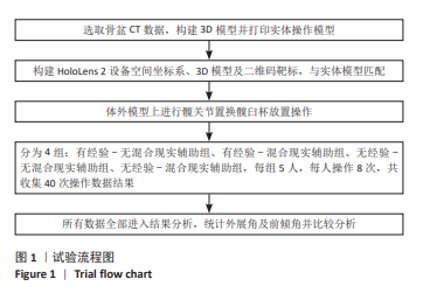
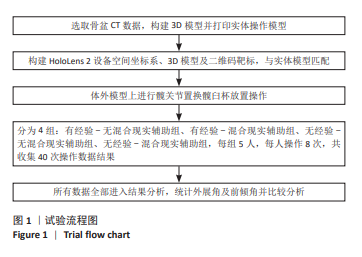
2.1 参与者数量分析 纳入操作者20人共分4组,其中有经验-无混合现实辅助组5人、有经验-混合现实辅助组5人、无经验-无混合现实辅助组5人、无经验-混合现实辅助组5人,每人操作8次,记录8次结果数据,共收集40次操作数据结果,无交叉干预。 2.2 试验流程图 见图1。"
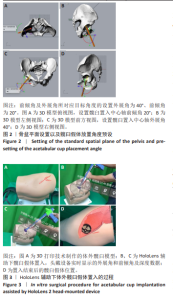
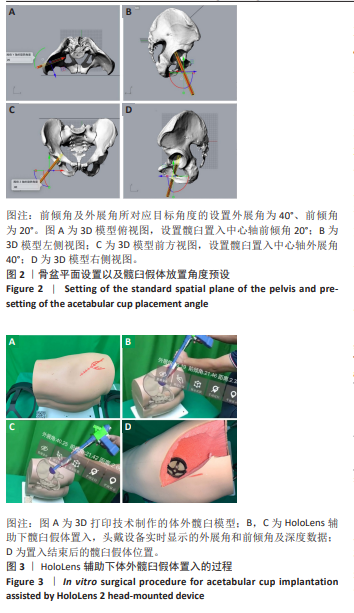
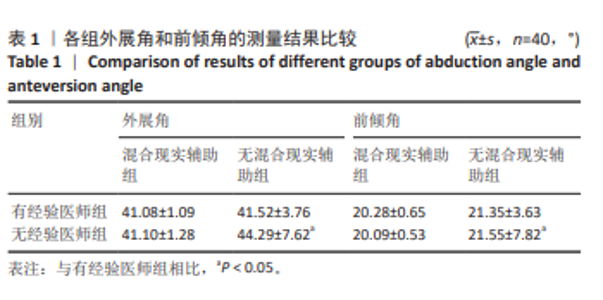
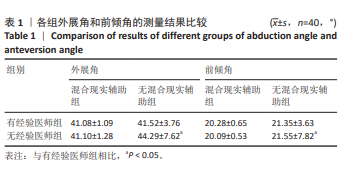
2.3 体外模型打印和混合现实辅助的实时观察 构建体外的骨盆髋臼模型,通过术前对骨盆平面及假体置入的位置方向进行参数设定后,采用常规后外侧入路,进行髋臼假体的置入模拟手术(图2,3),利用固定平台及二维码标识进行标准匹配,使HoloLens设备中的虚拟图像与现实体外模型相匹配(图3)。在HoloLens设备辅助下,操作者可以透过模型的皮肤覆盖物观察内部髋关节的结构,从而能够比较准确地定位切口位置及减少切口长度,减少手术创伤。 2.4 不同组别在髋臼假体体外放置中外展角和前倾角结果比较 表1结果提示,在徒手操作的条件下,有经验医师组、无经验医师组测量的外展角、前倾角相比有显著性差异(P < 0.05);而在混合现实设备辅助下,有经验医师组、无经验医师组测量的外展角和前倾角相比无显著性差异(P > 0.05)。"
"
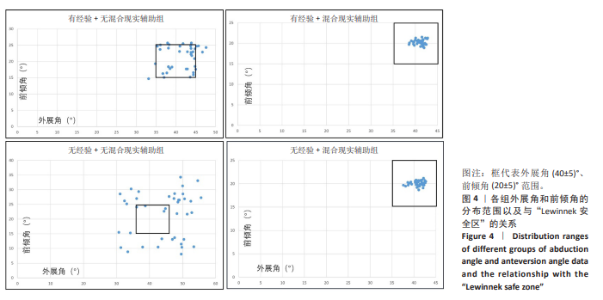
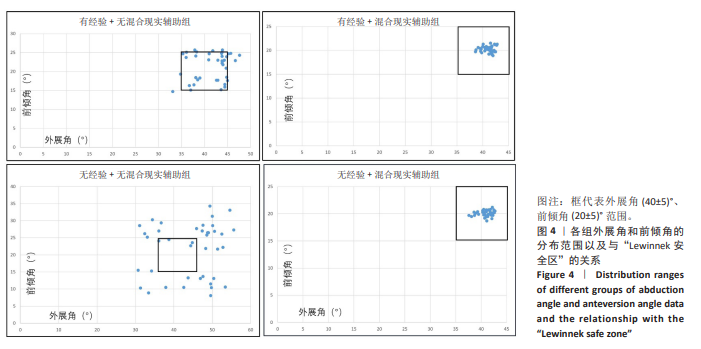
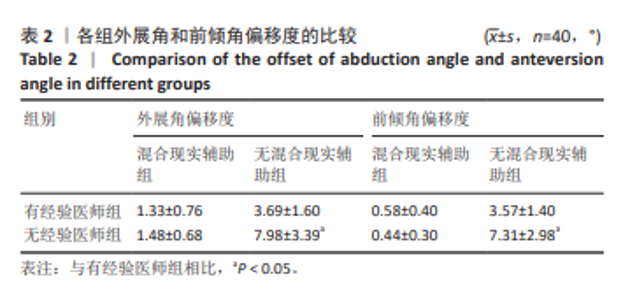
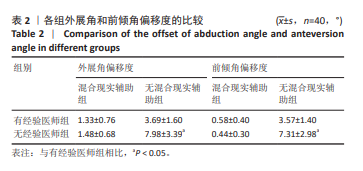
以上结果说明在徒手操作情况下,有经验医师组对假体的放置角度相对更集中,而无经验医师组结果分布比较离散(图4A,C)。但是在混合现实设备辅助下,两组医师放置的角度均在安全区框架内(图4B,D)。对于无经验医师组,与徒手操作条件相比,在混合现实设备辅助下假体放置的准确度明显提高,差异有显著性意义(P < 0.05),说明混合现实设备能够明显提高无经验医师组放置假体的准确度(图5)。 2.5 混合现实技术辅助对髋臼假体中外展角和前倾角偏移度的影响 为了进一步明确HoloLens对关节置换术操作的影响,采用外展角和前倾角的偏移度来评价髋臼假体放置角度与参照标准角度的偏差情况,以外展角40°、前倾角20°作为参照标准。如表2所示,无HoloLens设备辅助时,有经验医师组的准确性明显优于无经验医师组(P < 0.001);使用HoloLens设备辅助后,两组医师在假体臼杯放置的准确性都有所提高,无经验医师组的准确性明显提高,与有经验医师组放置结果的准确性无显著性差异。"
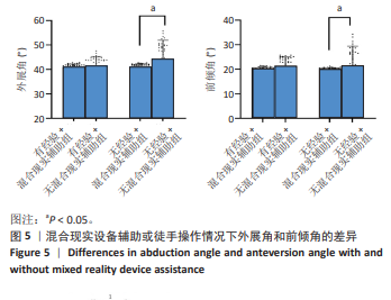
"
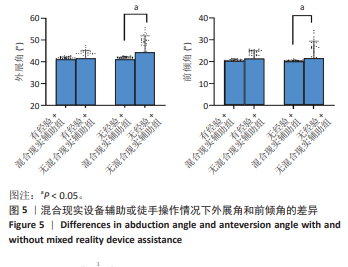
"
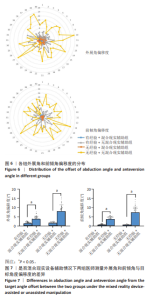
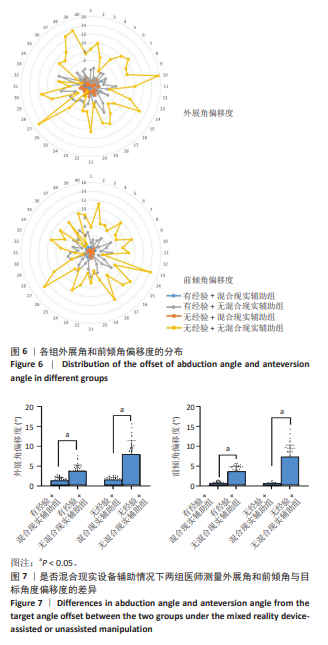
如图6所示,有混合现实技术辅助时,两组外展角偏移度所显示的雷达图面积均较小,且比较接近,说明两组操作的精确度较高;无混合现实技术辅助时,有经验医师组的外展角偏移度雷达图面积相对增大,无经验医师组外展角偏移度雷达图面积最大,提示其偏离目标的差异最明显。另外,有混合现实技术辅助时,两组医师放置的前倾角偏移度所显示的雷达图面积均较小,说明两组操作的精确度较高;无混合现实技术辅助时,有经验医师放置的前倾角偏移度的雷达图面积相对增大,而无经验医师放置的外展角偏移度雷达图面积最大,说明放置的精确度低于混合现实辅助组。 无论对于有经验医师组还是无经验医师组,与徒手操作条件相比,在混合现实设备辅助下假体放置的准确度明显提高,差异有显著性意义(P < 0.05),见图7。"
| [1] LEARMONTH ID, YOUNG C, RORABECK C. The operation of the century: total hip replacement. Lancet. 2007;370:1508-1519. [2] DANOFF JR, BOBMAN JT, CUNN G, et al. Redefining the Acetabular Component Safe Zone for Posterior Approach Total Hip Arthroplasty. J Arthroplasty. 2016;31: 506-511. [3] FERGUSON RJ, PALMER AJ, TAYLOR A, et al. Hip replacement. Lancet. 2018;392: 1662-1671. [4] GENG X, DONG Z, LI Y, et al. Precise Acetabular Prosthesis Positioning Using a Novel Robot-Assisted Total Hip Arthroplasty System: A Multicenter, Randomized Controlled Trial. Orthop Surg. 2025;17:141-150. [5] KUNZE KN, BOVONRATWET P, POLCE EM, et al. Comparison of Surgical Time, Short-term Adverse Events, and Implant Placement Accuracy Between Manual, Robotic-assisted, and Computer-navigated Total Hip Arthroplasty: A Network Meta-analysis of Randomized Controlled Trials. J Am Acad Orthop Surg Glob Res Rev. 2022;6(4):e21.00200 [6] LEWINNEK GE, LEWIS JL, TARR R, et al. Dislocations after total hip-replacement arthroplasties. J Bone Joint Surg Am. 1978;60:217-220. [7] WEBER M, VON KUNOW F, INNMANN M, et al. Which Safe Zone Is Safe in Total Hip Arthroplasty? The Effect of Bony Impingement. J Pers Med. 2022;12(5):812. [8] WANG Y. Current concepts in developmental dysplasia of the hip and Total hip arthroplasty. Arthroplasty. 2019;1(1):2. [9] OZAKI Y, YAMAMOTO T, KIMURA S, et al. Accuracy of Cup Placement Angle, Leg Lengthening, and Offset Measurement Using an AR-Based Portable Navigation System: Validation in Supine and Lateral Decubitus Positions for Total Hip Arthroplasty. Medicina (Kaunas). 2024;60(10):1721. [10] BAINS SS, DUBIN JA, SALIB CG, et al. The Epidemiology of the Revision Total Hip Arthroplasty in the United States From 2016 to 2022. Arthroplast Today. 2024; 30:101517. [11] SU H, YU S, HUANG H, et al. Importance of hip capsular repair in total hip arthroplasty (THA) via the posterior lateral approach: a five year retrospective cohort study. Int Orthop. 2024;48:2567-2577. [12] SWARTZ GN, BAINS SS, DUBIN JA, et al. Robotic-Assistance in Total Hip Arthroplasty Is Associated With Decreased Dislocation Rates. Arthroplast Today. 2024;30:101473. [13] HEIMANN AF, MURPHY WS, SUN DC, et al. Accuracy of Acetabular Component Positioning Using a Mixed Reality-Guided Navigation System During Total Hip Arthroplasty. JB JS Open Access. 2025;10(1):e24.00144. [14] KUMAR V, PATEL S, BABURAJ V, et al. Does robotic-assisted surgery improve outcomes of total hip arthroplasty compared to manual technique? A systematic review and meta-analysis. Postgrad Med J. 2023;99:375-383. [15] CONDINO S, TURINI G, PARCHI PD, et al. How to Build a Patient-Specific Hybrid Simulator for Orthopaedic Open Surgery: Benefits and Limits of Mixed-Reality Using the Microsoft HoloLens. J Healthc Eng. 2018;2018:5435097. [16] DILBONE ES, HEIMANN AF, LEAL J, et al. Evaluating the Accuracy of a Computed Tomography-Based Mixed-Reality Navigation Tool for Acetabular Component Positioning in Total Hip Arthroplasty. J Arthroplasty. 2025;40:s179-s185. [17] JUAN MC, HIDALDO C, MIFSUT D. A mixed reality application for total hip arthroplasty. Virtual Reality. 2024;28:39. [18] LUO F, HU Y, LIU S, et al. XR (extended reality: virtual reality, augmented reality, mixed reality) technology applications in orthopedic field. Medicine (Baltimore). 2025;104:e42956. [19] CHYTAS D, NIKOLAOU VS. Mixed reality for visualization of orthopedic surgical anatomy. World J Orthop. 2021;12:727-731. [20] RYAN SP, COCHRANE N, BOLOGNESI MP, et al. Enhanced Total Hip Arthroplasty Education Using Augmented Reality: A Survey From a Tertiary Center. Orthopedics. 2024;47:e157-e160. [21] WU L, SEIBOLD M, CAVALCANTI NA, et al. A novel augmented reality-based simulator for enhancing orthopedic surgical training. Comput Biol Med. 2025; 185:109536. [22] NAVACCHIA A, PAGKALOS J, DAVIS ET. Defining the optimal position of the lipped liner in combination with cup orientation and stem version. Bone Joint Res. 2023; 12:571-579. [23] WIDMER KH. The Impingement-free, Prosthesis-specific, and Anatomy-adjusted Combined Target Zone for Component Positioning in THA Depends on Design and Implantation Parameters of both Components. Clin Orthop Relat Res. 2020;478: 1904-1918. [24] DE PIERI E, ATZORI F, FERGUSON SJ, et al. Contact force path in total hip arthroplasty: effect of cup medialisation in a whole-body simulation. Hip Int. 2021;31:624-631. [25] DAMM P, BENDER A, WALDHEIM V, et al. Surgical cup placement affects the heating up of total joint hip replacements. Sci Rep. 2021;11:15851. [26] PETIS S, HOWARD JL, LANTING BL, et al. Surgical approach in primary total hip arthroplasty: anatomy, technique and clinical outcomes. Can J Surg. 2015;58: 128-139. [27] PINCUS D, JENKINSON R, PATERSON M, et al. Association Between Surgical Approach and Major Surgical Complications in Patients Undergoing Total Hip Arthroplasty. Jama. 2020;323:1070-1076. [28] TEZUKA T, HECKMANN ND, BODNER RJ, et al. Functional Safe Zone Is Superior to the Lewinnek Safe Zone for Total Hip Arthroplasty: Why the Lewinnek Safe Zone Is Not Always Predictive of Stability. J Arthroplasty. 2019;34:3-8. [29] SAIKKO V. Effect of wear, acetabular cup inclination angle, load and serum degradation on the friction of a large diameter metal-on-metal hip prosthesis. Clin Biomech (Bristol). 2019;63:1-9. [30] HINZ N, DEHOUST J, MÜNCH M, et al. Biomechanical analysis of fixation methods in acetabular fractures: a systematic review of test setups. Eur J Trauma Emerg Surg. 2022;48(5):3541-3560. [31] BULLER L, SMITH T, BRYAN J, et al. The use of patient-specific instrumentation improves the accuracy of acetabular component placement. J Arthroplasty. 2013; 28:631-636. [32] SNIJDERS T, VAN GAALEN SM, DE GAST A. Precision and accuracy of imageless navigation versus freehand implantation of total hip arthroplasty: A systematic review and meta-analysis. Int J Med Robot. 2017;13(4). doi: 10.1002/rcs.1843. [33] LU L, WANG H, LIU P, et al. Applications of Mixed Reality Technology in Orthopedics Surgery: A Pilot Study. Front Bioeng Biotechnol. 2022;10:740507. [34] STEFANIAK J, STUPNICKI S, TUCZYŃSKI P, et al. Mixed reality guidance in osteotomy provides superior precision and accuracy: validation and comparative study. Int Orthop. 2025;49:1801-1810. [35] CHEN Y, ZHANG B. 3D printing-assisted total hip arthroplasty and internal fixation for the treatment of fresh acetabular fracture and femoral head necrosis: A case report. Medicine (Baltimore). 2023;102:e36832. [36] KUMAR P, VATSYA P, RAJNISH RK, et al. Application of 3D Printing in Hip and Knee Arthroplasty: A Narrative Review. Indian J Orthop. 2021;55:14-26. [37] MARTIN DP 2ND, LAKE S, BEHUN M, et al. Intraoperative physician assessment during total hip arthroplasty correlates with DXA parameters. Osteoporos Int. 2024;35:2145-2151. [38] PANSARD E, VIGAN M, BAUER T. Do the sizes of total hip arthroplasty implants match between 3D planning software and 2D templating? Orthop Traumatol Surg Res. 2024;110:103744. [39] TUNG WS, DONNELLEY C, ESLAM POUR A, et al. Simulating movements of daily living in robot-assisted total hip arthroplasty with 3D modelling. Bone Jt Open. 2023;4:416-423. [40] JING C, STEIN MK, DECKEY DG, et al. Evaluating the Impact of Mixed-Reality Technology on Operating Room Time in Total Hip Arthroplasty: A Comparative Study. Arthroplast Today. 2025;33:101734. [41] KERKHOF E, THABIT A, BENMAHDJOUB M, et al. Depth-based registration of 3D preoperative models to intraoperative patient anatomy using the HoloLens 2. Int J Comput Assist Radiol Surg. 2025;20:901-912. [42] SCHENK VK, KÜPER MA, MENGER MM, et al. Augmented reality in pelvic surgery: using an AR-headset as intraoperative radiation-free navigation tool. Int J Comput Assist Radiol Surg. 2025;20(12):2553-2563. [43] ANDRIOLLO L, PICCHI A, IADEMARCO G, et al. The Role of Artificial Intelligence and Emerging Technologies in Advancing Total Hip Arthroplasty. J Pers Med. 2025; 15(1):21. [44] SHAIKH HJF, HASAN SS, WOO JJ, et al. Exposure to Extended Reality and Artificial Intelligence-Based Manifestations: A Primer on the Future of Hip and Knee Arthroplasty. J Arthroplasty. 2023;38:2096-2104. [45] HAZARIKA A, RAHMATI M. Towards an Evolved Immersive Experience: Exploring 5G- and Beyond-Enabled Ultra-Low-Latency Communications for Augmented and Virtual Reality. Sensors (Basel). 2023;23(7):3682. [46] VERDE S, MARCON M, MILANI S, et al. Advanced Assistive Maintenance Based on Augmented Reality and 5G Networking. Sensors (Basel). 2020;20(24):7157. [47] WANG M, JI H, JIA M, et al. Method and application of information sharing throughout the emergency rescue process based on 5G and AR wearable devices. Sci Rep. 2023;13:6353. [48] ZHU LY, HOU JC, YANG L, et al. Application value of mixed reality in hepatectomy for hepatocellular carcinoma. World J Gastrointest Surg. 2022;14:36-45. [49] SUN P, ZHAO Y, MEN J, et al. Application of Virtual and Augmented Reality Technology in Hip Surgery: Systematic Review. J Med Internet Res. 2023;25: e37599. [50] BENDER J, KWE J, HOEH B, et al. An augmented reality overlay for navigated prostatectomy using fiducial-free 2D-3D registration. Int J Comput Assist Radiol Surg. 2025;20:1265-1272. [51] SCHWIMMBECK M, KHAJARIAN S, AUER C, et al. Towards a zero-shot low-latency navigation for open surgery augmented reality applications. Int J Comput Assist Radiol Surg. 2025;20(12):2513-2521. [52] WU LN, WU JX, XU HT, et al. Exploring the Application of HoloLens Mixed Reality Combined with Eye Tracking and Visual Perception Technologies in Pediatric Orthopedic 3D Education. J Med Syst. 2025;49(1):192. [53] NOWAK R, NOWAK M, RĘKAS M, et al. Intraoperative use of mixed reality (MR) in humans across surgical disciplines: a major review. 3D Print Med. 2025;11(1):59. [54] KONOVALOV A, KIRICHENKO A, OKISHEV D, et al. Augmented reality and 3D modeling for preoperative planning in microsurgical resection of brain arteriovenous malformations: A proof-of-concept study. Surg Neurol Int. 2025; 16:485. [55] JAVAHERI H, FORTES REY V, LUKOWICZ P, et al. Assessing the Feasibility of Using Apple Vision Pro While Performing Medical Precision Tasks: Controlled User Study. JMIR XR Spat Comput. 2025;2:e73574. [56] GURUGE K, HERATH HMKKMB, MADUSANKA N, et al. Advancing Medical Training with Mixed Reality and Haptic Feedback Simulator for Acupuncture Needling. Sensors (Basel). 2025;25(22):6934. |
| [1] | Fang Fengchao, Yang Wenwu, Wu Hongtao, Peng Peng, Liang Zhiye, Jiang Tao, Chen Weijian, Liu Wengang, Zhao Chuanxi. Association between mitochondrial dynamics imbalance and cartilage degeneration in osteoarthritis [J]. Chinese Journal of Tissue Engineering Research, 2026, 30(在线): 1-8. |
| [2] | Zhu Xiaolong, Zhang Wei, Yang Yang. Visualization analysis of research hotspots and cutting-edge information in the field of intervertebral disc regeneration and repair [J]. Chinese Journal of Tissue Engineering Research, 2026, 30(9): 2391-2402. |
| [3] | Xinjiang Branch of China Trauma Rescue & Treatment Association. Expert consensus on diagnosis and treatment of brucellar osteoarthritis [J]. Chinese Journal of Tissue Engineering Research, 2026, 30(9): 2403-2412. |
| [4] | Wen Fayan, Li Yan, Qiang Tianming, Yang Chen, Shen Linming, Li Yadong, Liu Yongming. Unilateral biportal endoscopic technology for treatment of lumbar degenerative diseases: global research status and changing trends [J]. Chinese Journal of Tissue Engineering Research, 2026, 30(9): 2380-2390. |
| [5] | Wang Nan, Chen Shuang, Xi Zhipeng, Qian Yuzhang, Zhang Xiaoyu, Gu Jun, Kang Ran, Xie Lin. MRI evaluation of nerve root subsidence sign affecting efficacy of percutaneous endoscopic decompression in lumbar spinal stenosis [J]. Chinese Journal of Tissue Engineering Research, 2026, 30(9): 2262-2268. |
| [6] | Li Zhifei, Han Bin, Liu Qiuli, Zhang Zhanming, Wei Haokai, Zuo Kuangshi, Zhang Yisheng. Cervical motion characteristics in patients with cervical spondylotic radiculopathy based on motion capture technology [J]. Chinese Journal of Tissue Engineering Research, 2026, 30(9): 2286-2293. |
| [7] | Wang Songpeng, Liu Yusan, Yu Huanying, Gao Xiaoli, Xu Yingjiang, Zhang Xiaoming, Liu Min. Bidirectional regulation of reactive oxygen species based on zeolitic imidazolate framework-8 nanomaterials: from tumor therapy and antibacterial activity to cytoprotection [J]. Chinese Journal of Tissue Engineering Research, 2026, 30(8): 2033-2013. |
| [8] | Yang Xuetao, Zhu Menghan, Zhang Chenxi, Sun Yimin, Ye Ling. Applications and limitations of antioxidant nanomaterials in oral cavity [J]. Chinese Journal of Tissue Engineering Research, 2026, 30(8): 2044-2053. |
| [9] | Wang Qisa, Lu Yuzheng, Han Xiufeng, Zhao Wenling, Shi Haitao, Xu Zhe. Cytocompatibility of 3D printed methyl acrylated hyaluronic acid/decellularized skin hydrogel scaffolds [J]. Chinese Journal of Tissue Engineering Research, 2026, 30(8): 1912-1920. |
| [10] | Gao Yanguo, Guo Xu, Li Xiaohan, Chen Shiqi, Zhu Haitao, Huang Liangyong, Ye Fang, Lu Wei Wang Qibin, Zheng Tao, Chen Li. Optimization of prescription ratio of “Honghuangbai” gel by orthogonal test in diabetic skin wound mouse models [J]. Chinese Journal of Tissue Engineering Research, 2026, 30(8): 1921-1928. |
| [11] | Liu Hongjie, Mu Qiuju, Shen Yuxue, Liang Fei, Zhu Lili. Metal organic framework/carboxymethyl chitosan-oxidized sodium alginate/platelet-rich plasma hydrogel promotes healing of diabetic infected wounds [J]. Chinese Journal of Tissue Engineering Research, 2026, 30(8): 1929-1939. |
| [12] | Min Changqin, Huang Ying. Construction of pH/near-infrared laser stimuli-responsive drug delivery system and its application in treatment of oral squamous cell carcinoma [J]. Chinese Journal of Tissue Engineering Research, 2026, 30(8): 1940-1951. |
| [13] | Shao Ziyu, Li Qian, Qumanguli·Abudukelimu, Han Youjun, Hu Yang. Preparation and characterization properties of three different ratios of biphasic calcium phosphate [J]. Chinese Journal of Tissue Engineering Research, 2026, 30(8): 1952-1961. |
| [14] | Zheng Xuying, Hu Hongcheng, Xu Libing, Han Jianmin, Di Ping. Stress magnitude and distribution in two-piece cement-retained zirconia implants under different loading conditions and with varying internal connection shapes [J]. Chinese Journal of Tissue Engineering Research, 2026, 30(8): 1979-1987. |
| [15] | Zhou Hongli, Wang Xiaolong, Guo Rui, Yao Xuanxuan, Guo Ru, Zhou Xiongtao, He Xiangyi. Fabrication and characterization of nanohydroxyapatite/sodium alginate/polycaprolactone/alendronate scaffold [J]. Chinese Journal of Tissue Engineering Research, 2026, 30(8): 1962-1970. |
| Viewed | ||||||
|
Full text |
|
|||||
|
Abstract |
|
|||||