Chinese Journal of Tissue Engineering Research ›› 2026, Vol. 30 ›› Issue (27): 7095-7100.doi: 10.12307/2026.864
Previous Articles Next Articles
Supercapsular percutaneously assisted total hip approach combined with local and intravenous tranexamic acid reduces perioperative hidden blood loss in hemiarthroplasty
Wang Yijun, Zhang Weicheng, Wu Xiaoyang, Ju Zhengye, Zhu Feng, Zhou Jun, Li Rongqun, Xu Yaozeng, Zhang Lianfang
- Department of Orthopedics, First Affiliated Hospital, Soochow University, Suzhou 215006, Jiangsu Province, China
-
Received:2025-10-15Accepted:2026-01-22Online:2026-09-28Published:2026-05-14 -
Contact:Zhang Lianfang, MD, Associate chief physician, Department of Orthopedics, First Affiliated Hospital, Soochow University, Suzhou 215006, Jiangsu Province, China -
About author:Wang Yijun, MS, Attending physician, Department of Orthopedics, First Affiliated Hospital, Soochow University, Suzhou 215006, Jiangsu Province, China -
Supported by:National Natural Science Foundation of China (Youth Program), No. 81601865 (to ZLF)

CLC Number:
Cite this article
Wang Yijun, Zhang Weicheng, Wu Xiaoyang, Ju Zhengye, Zhu Feng, Zhou Jun, Li Rongqun, Xu Yaozeng, Zhang Lianfang. Supercapsular percutaneously assisted total hip approach combined with local and intravenous tranexamic acid reduces perioperative hidden blood loss in hemiarthroplasty[J]. Chinese Journal of Tissue Engineering Research, 2026, 30(27): 7095-7100.
share this article
Add to citation manager EndNote|Reference Manager|ProCite|BibTeX|RefWorks
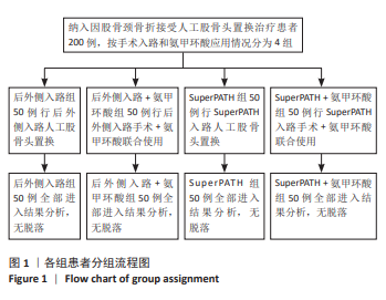
2.1 参与者数量分析 共对231例人工股骨头置换患者进行筛选和评估,31例不符合纳入标准,最终200例患者纳入试验,根据手术入路和氨甲环酸应用情况分组,共分为4组,每组50例,无脱落病例。 2.2 试验流程图 见图1。"
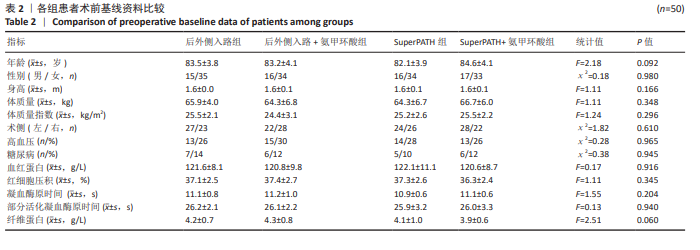
2.3 基线资料比较 4组患者的年龄、性别、身高、体质量、体质量指数、术侧和基础疾病等基线资料相比,差异均无显著性意义(P > 0.05)。4组患者术前血液学指标血红蛋白、红细胞压积、纤维蛋白、凝血酶原时间和部分活化凝血酶原时间组间差异无显著性意义(P > 0.05)。见表2。"
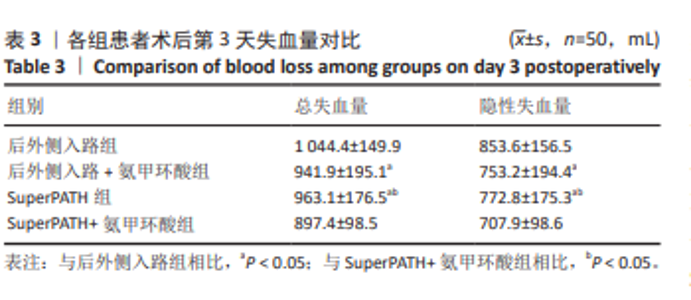
2.4 手术情况 SuperPATH组的手术时间(66.0±13.4) min较后外侧入路组(73.7±12.7) min减少,差异有显著性意义(P=0.004)。 如表3所示,SuperPATH组术后总失血量和隐性失血量均低于后外侧入路组,差异均有显著性意义(P=0.015,0.017)。后外侧入路手术结合使用氨甲环酸组的术后总失血量和隐性失血量均低于未使用氨甲环酸的后外侧入路组,差异均有显著性意义(P=0.004,0.005)。SuperPATH手术结合使用氨甲环酸组的术后总失血量和隐性失血量均低于未使用氨甲环酸的SuperPATH组,差异均有显著性意义(P=0.024,0.025)。外侧入路手术结合使用氨甲环酸组的术后总失血量和隐性失血量与SuperPATH手术结合使用氨甲环酸组相比,差异无显著性意义(P > 0.05)。"
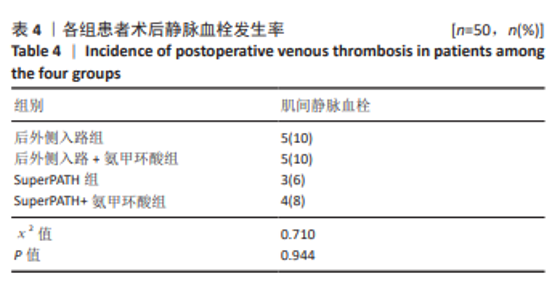
2.5 并发症 各组患者术后常规行双下肢血管彩超检查,均无下肢深静脉血栓形成,各组间下肢肌间静脉血栓形成率相比差异均无显著性意义,见表4。各组植入物生物相容性良好,未见植入物周围感染、过敏反应及排斥反应。"
| [1] 中华医学会骨科学分会. 骨质疏松性骨折诊疗指南(2022年版)[J]. 中华骨科杂志,2022,42(33):1473-1491. [2] SU Y, ZHOU B, KWOK T. Fracture risk prediction in old chinese people-a narrative review. Arch Osteoporos. 2023;19(1):3. [3] REID IR, MCCLUNG MR. Osteopenia: A key target for fracture prevention. Lancet Diabetes Endocrinol. 2024;12(11):856-864. [4] REID IR. A broader strategy for osteoporosis interventions. Nat Rev Endocrinol. 2020;16(6):333-339. [5] O’CONNOR MI, SWITZER JA. Aaos clinical practice guideline summary: Management of hip fractures in older adults. J Am Acad Orthop Surg. 2022; 30(20):e1291-e1296. [6] HATANO M, SASABUCHI Y, ISOGAI T, et al. Increased early complications after total hip arthroplasty compared with hemiarthroplasty in older adults with a femoral neck fracture. Bone Joint J. 2024;106-B(9):986-993. [7] HUNGERER S, HINTERWIMMER F, LEISTER I, et al. Hemi-versus total hip arthroplasty in femoral neck fractures? Predicting failure on a 10-year data analysis of the german arthroplasty registry (eprd). J Clin Med. 2025;14(5):1457. [8] HONG WS, ZHANG YX, LIN Q, et al. Risk factors analysis and the establishment of nomogram prediction model of hidden blood loss after total hip arthroplasty for femoral neck fracture in elderly women. Clin Interv Aging. 2022;17:707-715. [9] MUKASA F, BABA T, HAYASHI K, et al. Effects of preoperative systemic administration of tranexamic acid alone on postoperative inflammation and pain in total hip arthroplasty: A retrospective cohort study. Arthroplasty. 2025;7(1):35. [10] CHOW J, PENENBERG B, MURPHY S. Modified micro-superior percutaneously-assisted total hip: Early experiences & case reports. Curr Rev Musculoskelet Med. 2011;4(3):146-150. [11] RAMADANOV N, JOZWIAK K, MARINOVA-KICHIKOVA P, et al. Hemiarthroplasty through superpath versus hemiarthroplasty through conventional approaches in patients with femoral neck fractures: A systematic review and meta-analysis of randomized controlled trials. Sci Rep. 2023;13(1):22861. [12] 潘沨, 张骏, 严贤科, 等. Superpath与后外侧入路全髋关节置换术比较[J]. 中国矫形外科杂志,2020,28(13):1176-1180. [13] YAN L, GE L, DONG S, et al. Evaluation of comparative efficacy and safety of surgical approaches for total hip arthroplasty: A systematic review and network meta-analysis. JAMA Netw Open. 2023;6(1):e2253942. [14] RAMADANOV N, VOSS M, HABLE R, et al. Patient-related predictors for the functional outcome of superpath hemiarthroplasty versus conventional approach hemiarthroplasty: A systematic review and meta-regression analysis of randomized controlled trials. Orthop Surg. 2024;16(4):791-801. [15] XU K, ANWAIER D, HE R, et al. Hidden blood loss after hip hemiarthroplasty using the superpath approach: A retrospective study. Injury. 2019;50(12):2282-2286. [16] FILIPPINI M, BORTOLI M, MONTANARI A, et al. Does surgical approach influence complication rate of hip hemiarthroplasty for femoral neck fractures? A literature review and meta-analysis. Medicina (Kaunas). 2023;59(7):1220. [17] 吴良浩, 禹宝庆, 陈帆成. Superpath微创入路人工股骨头置换治疗老年股骨颈骨折:前瞻性、开放性、随机对照临床试验[J]. 中国组织工程研究, 2017,21(7):1009-1014. [18] 季冬, 夏良政, 江云云, 等. 常规器械superpath入路与前外侧入路行股骨头置换:随机对照疗效比较[J]. 中国组织工程研究,2021,25(3):4833-4838. [19] GROUP UKRCTAISI, GROCOTT MPW, MURPHY M, et al. Tranexamic acid for safer surgery: The time is now. Br J Anaesth. 2022;129(4):459-461. [20] 张成欢, 刘云, 赵建宁, 等. 静脉滴注联合局部应用氨甲环酸可减少全髋关节置换后隐性失血[J]. 中国组织工程研究,2015,19(44):7071-7076. [21] 岳辰, 谢锦伟, 蔡东峰, 等. 静脉联合局部应用氨甲环酸减少初次全髋关节置换术围手术期失血的有效性及安全性研究[J]. 中华骨与关节外科杂志, 2015,8(1):44-48. [22] 赵洪顺, 阿尖措, 高顺红, 等. 全髋关节置换局部应用氨甲环酸术中术后失血及白细胞介素6和c-反应蛋白的变化[J]. 中国组织工程研究,2019,23(4): 493-498. [23] LI J, ZHU H, LIAO R. Enhanced recovery after surgery (eras) pathway for primary hip and knee arthroplasty: Study protocol for a randomized controlled trial. Trials. 2019;20(1):599. [24] NISKANEN RO, KORKALA OL. Tranexamic acid reduces blood loss in cemented hip arthroplasty: A randomized, double-blind study of 39 patients with osteoarthritis. Acta Orthop. 2005;76(6):829-832. [25] NADLER SB, HIDALGO JH, BLOCH T. Prediction of blood volume in normal human adults. Surgery. 1962;51(2):224-232. [26] GROSS JB. Estimating allowable blood loss: Corrected for dilution. Anesthesiology. 1983;58(3):277-280. [27] RIDHA M, AL-JABRI T, STELZHAMMER T, et al. Osteosynthesis, hemiarthroplasty, total hip arthroplasty in hip fractures: All i need to know. Injury. 2024;55(3):111377. [28] 中华人民共和国国家卫生健康委员会医政司. 老年髋部骨折诊疗与管理指南(2022年版)[J]. 中华创伤骨科杂志,2023,25(4):277-283. [29] XIE J, ZHANG H, WANG L, et al. Comparison of supercapsular percutaneously assisted approach total hip versus conventional posterior approach for total hip arthroplasty: A prospective, randomized controlled trial. J Orthop Surg Res. 2017; 12(1):138. [30] QUITMANN H. Supercapsular percutaneously assisted (superpath) approach in total hip arthroplasty : Surgical technique and preliminary results. Oper Orthop Traumatol. 2019;31(6):536-546. [31] GOFTON W, CHOW J, OLSEN KD, et al. Thirty-day readmission rate and discharge status following total hip arthroplasty using the supercapsular percutaneously-assisted total hip surgical technique. Int Orthop. 2015;39(5):847-851. [32] DELLA TORRE PK, FITCH DA, CHOW JC. Supercapsular percutaneously-assisted total hip arthroplasty: Radiographic outcomes and surgical technique. Ann Transl Med. 2015;3(13):180. [33] CRONIN MD, GOFTON W, ERWIN L, et al. Early surgical and functional outcomes comparison of the supercapsular percutaneously-assisted total hip and traditional posterior surgical techniques for total hip arthroplasty: Protocol for a randomized, controlled study. Ann Transl Med. 2015;3(21):335. [34] GOFTON W, FITCH DA. In-hospital cost comparison between the standard lateral and supercapsular percutaneously-assisted total hip surgical techniques for total hip replacement. Int Orthop. 2016;40(3):481-485. [35] RASULI KJ, GOFTON W. Percutaneously assisted total hip (path) and supercapsular percutaneously assisted total hip (superpath) arthroplasty: Learning curves and early outcomes. Ann Transl Med. 2015;3(13):179. [36] HU Y, WANG MC, WANG T, et al. Less blood loss in supercapsular percutaneously assisted versus posterolateral total hip arthroplasty. J Orthop Surg Res. 2021; 16(1):217. [37] MIAO K, NI S, ZHOU X, et al. Hidden blood loss and its influential factors after total hip arthroplasty. J Orthop Surg Res. 2015;10:36. [38] MENG W, HUANG Z, WANG H, et al. Supercapsular percutaneously-assisted total hip (superpath) versus posterolateral total hip arthroplasty in bilateral osteonecrosis of the femoral head: A pilot clinical trial. BMC Musculoskelet Disord. 2019;21(1):2. [39] AKTI S, ZEYBEK H, BILEKLI AB, et al. The effect of tranexamic acid on hidden blood loss in total hip arthroplasty. Jt Dis Relat Surg. 2022;33(1):102-108. [40] YUAN T, YANG S, LAI C, et al. Pathologic mechanism of hidden blood loss after total knee arthroplasty: Oxidative stress induced by free fatty acids. Int J Clin Exp Pathol. 2022;15(3):88-96. [41] ROSENCHER N, KERKKAMP HE, MACHERAS G, et al. Orthopedic surgery transfusion hemoglobin european overview (ostheo) study: Blood management in elective knee and hip arthroplasty in europe. Transfusion. 2003;43(4): 459-469. [42] FENWICK A, PFANN M, MAYR J, et al. Anticoagulants and fracture morphology have a significant influence on total blood loss after proximal femur fractures. Eur J Trauma Emerg Surg. 2023;49(1):173-179. [43] ZHAO HY, YEERSHENG R, KANG XW, et al. The effect of tourniquet uses on total blood loss, early function, and pain after primary total knee arthroplasty: A prospective, randomized controlled trial. Bone Joint Res. 2020;9(6):322-332. [44] DIRI D, ALASAAD H, ABOU ALI MHANA S, et al. Blood loss in primary unilateral total knee arthroplasty with limited tourniquet application: A randomized controlled trial. JB JS Open Access. 2023;8(4):e23.00020. [45] WANG HY, YUAN MC, PEI FX, et al. Finding the optimal control level of intraoperative blood pressure in no tourniquet primary total knee arthroplasty combine with tranexamic acid: A retrospective cohort study which supports the enhanced recovery strategy. J Orthop Surg Res. 2020;15(1):350. [46] ZHAO J, LI J, ZHENG W, et al. Low body mass index and blood loss in primary total hip arthroplasty: Results from 236 consecutive ankylosing spondylitis patients. Biomed Res Int. 2014;2014:742393. [47] LIU X, LIU J, SUN G. A comparison of combined intravenous and topical administration of tranexamic acid with intravenous tranexamic acid alone for blood loss reduction after total hip arthroplasty: A meta-analysis. Int J Surg. 2017; 41:34-43. [48] ASTEDT B. Clinical pharmacology of tranexamic acid. Scand J Gastroenterol Suppl. 1987;137:22-25. [49] ZHANG S, XIE J, CAO G, et al. Six-dose intravenous tranexamic acid regimen further inhibits postoperative fibrinolysis and reduces hidden blood loss following total knee arthroplasty. J Knee Surg. 2021;34(2):224-232. [50] ANDERSSON L, ERIKSSON O, HEDLUND PO, et al. Special considerations with regard to the dosage of tranexamic acid in patients with chronic renal diseases. Urol Res. 1978;6(2):83-88. |
| [1] | Fang Fengchao, Yang Wenwu, Wu Hongtao, Peng Peng, Liang Zhiye, Jiang Tao, Chen Weijian, Liu Wengang, Zhao Chuanxi. Association between mitochondrial dynamics imbalance and cartilage degeneration in osteoarthritis [J]. Chinese Journal of Tissue Engineering Research, 2026, 30(在线): 1-8. |
| [2] | Xinjiang Branch of China Trauma Rescue & Treatment Association. Expert consensus on diagnosis and treatment of brucellar osteoarthritis [J]. Chinese Journal of Tissue Engineering Research, 2026, 30(9): 2403-2412. |
| [3] | He Yixiang, Qiao Wanjia, Wang Wenji. Effectiveness and safety of tranexamic acid versus epsilon-aminocaproic acid in total hip and knee arthroplasties: a meta-analysis [J]. Chinese Journal of Tissue Engineering Research, 2026, 30(9): 2361-2369. |
| [4] | Zhu Xiaolong, Zhang Wei, Yang Yang. Visualization analysis of research hotspots and cutting-edge information in the field of intervertebral disc regeneration and repair [J]. Chinese Journal of Tissue Engineering Research, 2026, 30(9): 2391-2402. |
| [5] | Wen Fayan, Li Yan, Qiang Tianming, Yang Chen, Shen Linming, Li Yadong, Liu Yongming. Unilateral biportal endoscopic technology for treatment of lumbar degenerative diseases: global research status and changing trends [J]. Chinese Journal of Tissue Engineering Research, 2026, 30(9): 2380-2390. |
| [6] | Li Zhifei, Han Bin, Liu Qiuli, Zhang Zhanming, Wei Haokai, Zuo Kuangshi, Zhang Yisheng. Cervical motion characteristics in patients with cervical spondylotic radiculopathy based on motion capture technology [J]. Chinese Journal of Tissue Engineering Research, 2026, 30(9): 2286-2293. |
| [7] | Wang Nan, Chen Shuang, Xi Zhipeng, Qian Yuzhang, Zhang Xiaoyu, Gu Jun, Kang Ran, Xie Lin. MRI evaluation of nerve root subsidence sign affecting efficacy of percutaneous endoscopic decompression in lumbar spinal stenosis [J]. Chinese Journal of Tissue Engineering Research, 2026, 30(9): 2262-2268. |
| [8] | Chen Haojie, Wang Dai, Shen Shan. Immune inflammatory microenvironment mechanisms in peri-implantitis [J]. Chinese Journal of Tissue Engineering Research, 2026, 30(8): 2054-2062. |
| [9] | Yang Qiongqiong, Liu Wei. Comparison of performance and clinical effects of zirconia and titanium implants [J]. Chinese Journal of Tissue Engineering Research, 2026, 30(8): 2063-2071. |
| [10] | Liu Yang, Liu Donghui , Xu Lei, Zhan Xu, Sun Haobo, Kang Kai. Role and trend of stimuli-responsive injectable hydrogels in precise myocardial infarction therapy [J]. Chinese Journal of Tissue Engineering Research, 2026, 30(8): 2072-2080. |
| [11] | Wang Zheng, Cheng Ji, Yu Jinlong, Liu Wenhong, Wang Zhaohong, Zhou Luxing. Progress and future perspectives on the application of hydrogel materials in stroke therapy [J]. Chinese Journal of Tissue Engineering Research, 2026, 30(8): 2081-2090. |
| [12] | Guo Yuchao, Ni Qianwei, Yin Chen, Jigeer·Saiyilihan, Gao Zhan . Quaternized chitosan hemostatic materials: synthesis, mechanism, and application [J]. Chinese Journal of Tissue Engineering Research, 2026, 30(8): 2091-2100. |
| [13] | Liu Dawei, Cui Yingying, Wang Fanghui, Wang Zixuan, Chen Yuhan, Li Yourui, Zhang Ronghe. Epigallocatechin gallate-mediated bidirectional regulation of reactive oxygen species and its application in nanomaterials [J]. Chinese Journal of Tissue Engineering Research, 2026, 30(8): 2101-2112. |
| [14] | Lai Yu, Chen Yueping, Zhang Xiaoyun. Research hotspots and frontier trends of bioactive materials in treating bone infections [J]. Chinese Journal of Tissue Engineering Research, 2026, 30(8): 2132-2144. |
| [15] | Yang Xuetao, Zhu Menghan, Zhang Chenxi, Sun Yimin, Ye Ling. Applications and limitations of antioxidant nanomaterials in oral cavity [J]. Chinese Journal of Tissue Engineering Research, 2026, 30(8): 2044-2053. |
| Viewed | ||||||
|
Full text |
|
|||||
|
Abstract |
|
|||||