Chinese Journal of Tissue Engineering Research ›› 2026, Vol. 30 ›› Issue (25): 6691-6700.doi: 10.12307/2026.402
Diabetes mellitus and ferroptosis: a visual analysis of related research literature
Chen Xianxian1, 2, Xu Chengfeng1, Huang Wenyi1, 2, Yang Chenfan1, Su Tongshan1, 2, Li Yu1, Yan Yu1, Li Chun3
- 1School of Nursing, 2Research Center for Integrated Traditional Chinese and Western Medicine, School of Basic Medical Sciences, 3Academic Affairs Office, Guangzhou University of Chinese Medicine, Guangzhou 510006, Guangdong Province, China
-
Received:2025-08-14Revised:2025-11-07Online:2026-09-08Published:2026-04-24 -
Contact:Li Chun, Professor, Master's supervisor, Academic Affairs Office, Guangzhou University of Chinese Medicine, Guangzhou 510006, Guangdong Province, China Co-corresponding author: Yan Yu, Lecturer, School of Nursing, Guangzhou University of Chinese Medicine, Guangzhou 510006, Guangdong Province, China -
About author:Chen Xianxian, MS candidate, School of Nursing, Guangzhou University of Chinese Medicine, Guangzhou 510006, Guangdong Province, China; Research Center for Integrated Traditional Chinese and Western Medicine, School of Basic Medical Sciences, Guangzhou University of Chinese Medicine, Guangzhou 510006, Guangdong Province, China -
Supported by:Guangdong Provincial Higher Education Research Platform and Project, No. 2022KTSCX025 (to LC); Guangzhou University of Chinese Medicine 2025 “Strengthening the Root” Project for Enhancing Discipline Capabilities, No. GZY2025GB0907 (to LC); Science and Technology Plan Project of Guangzhou, No. 202201011394 (to YY); Guangzhou University of Chinese Medicine 2025 “Strengthening the Root” Project for Enhancing Discipline Capabilities Discipline Capacity Enhancement Project, No. GZY2025GB0915 (to YY).

CLC Number:
Cite this article
Chen Xianxian, Xu Chengfeng, Huang Wenyi, Yang Chenfan, Su Tongshan, Li Yu, Yan Yu, Li Chun. Diabetes mellitus and ferroptosis: a visual analysis of related research literature[J]. Chinese Journal of Tissue Engineering Research, 2026, 30(25): 6691-6700.
share this article
Add to citation manager EndNote|Reference Manager|ProCite|BibTeX|RefWorks
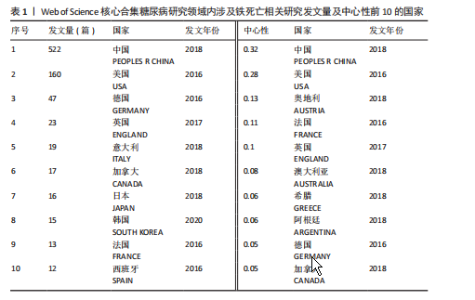
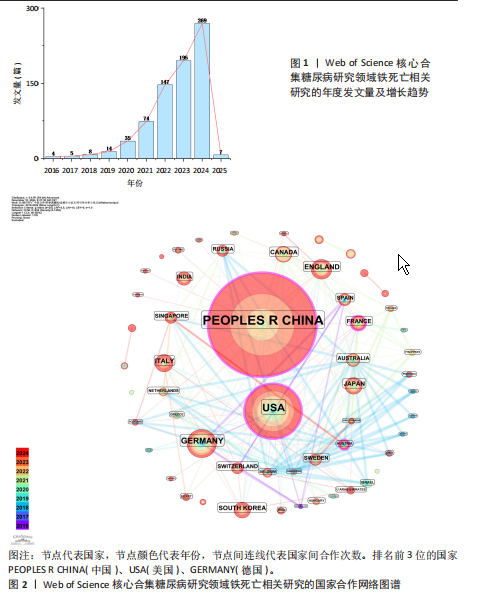
2.1 发文量与发文趋势分析 自2012年提出铁死亡概念后,铁死亡发文量几乎以每年1.5-2.0倍的速率猛增[21]。WoSCC数据库中出版年份(Publication Years)数据统计显示,铁死亡参与糖尿病伤口研究领域文献发表可追溯至2016年,2016年发文量只有4篇,随后发文量呈直线上升趋势,2024年最高达269篇,2025年预发表4篇,如图1所示。总体而言,铁死亡在糖尿病研究领域的发文量呈稳定增长的趋势,反映了铁死亡在糖尿病领域的研究热度逐渐增高,尚未到达拐点,持续增长的学术成果反映了铁死亡在糖尿病领域的未知性且具有潜在临床指导意义。 2.2 发文国家分析 使用Citespace对文献发文国家及机构进行共引分析,近10年铁死亡参与糖尿病领域相关研究发文量前三的国家分别为中国、美国、德国,随后包括英国、意大利、加拿大、日本、韩国、法国和西班牙。如图2及表1所示,中国发文量有522篇,美国其次"
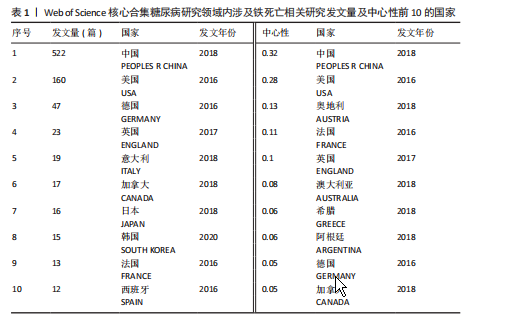
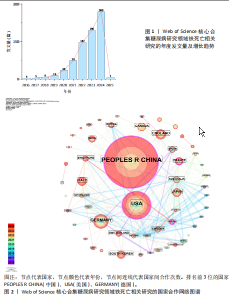
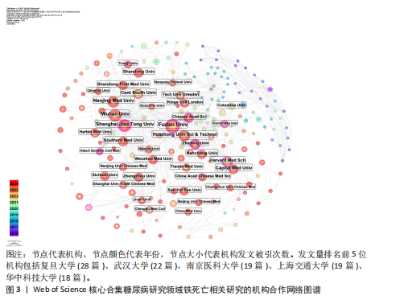
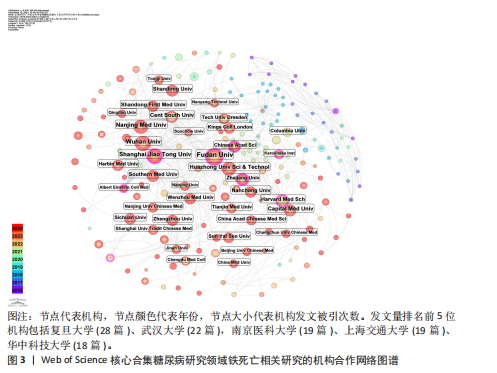
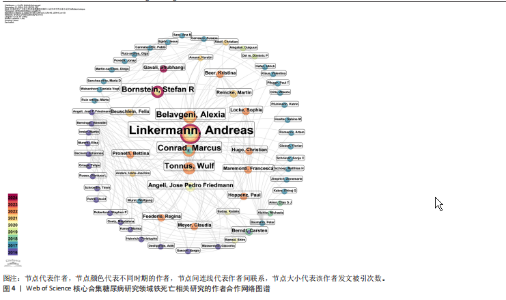
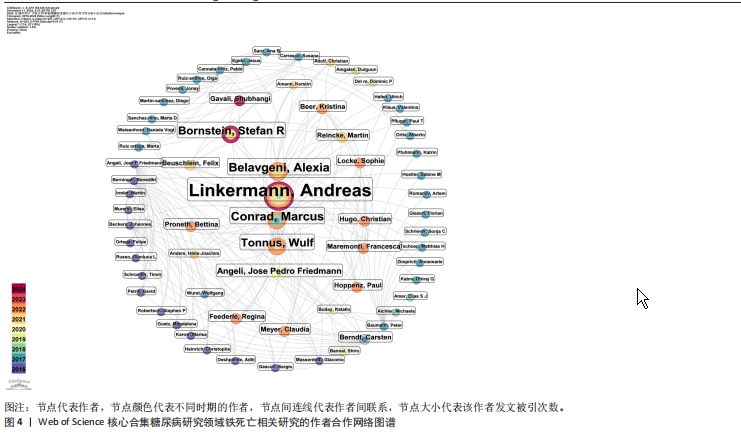
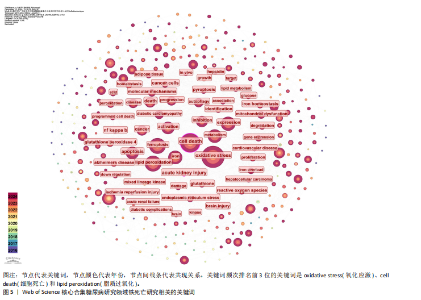
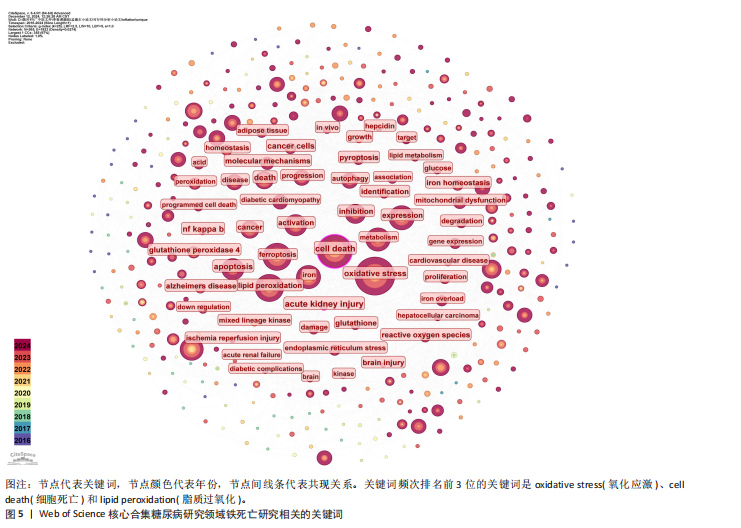
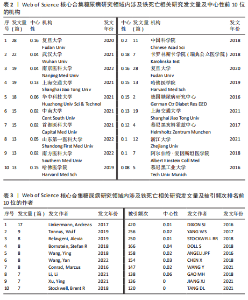
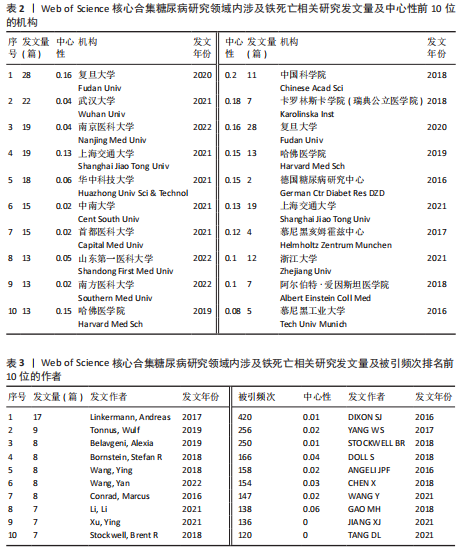
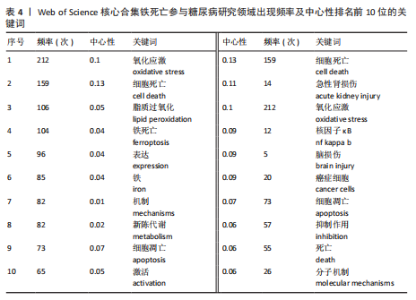
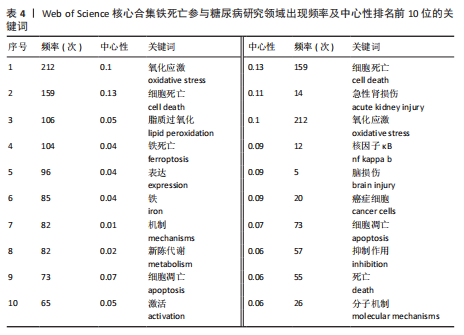
(160篇),德国最后(47篇),这3个国家在该研究领域和文献出版中占据了主导地位。网络中心性分析显示,中国(0.32)在该领域具有较强的影响力,其次是美国(0.28)。尽管中国(2018年)发文年份稍晚于美国(2016年),但是综合发文量及中心性而言,该领域越来越受到中国学者的高度关注,由此奠定了中国在该领域的主导地位。 2.3 发文机构分析 基于CiteSpace的机构共现网络分析显示,糖尿病领域铁死亡相关研究呈现显著的地缘知识生产特征:在发文量前10位的学术产出机构中,中国机构占据前9席(复旦大学以28篇居首),而哈佛医学院作为唯一非中国机构以13篇位列第10。网络中心性分析显示,中国科学院(0.20)、卡罗林斯卡学院(0.18)及复旦大学(0.16)构成跨区域知识三角枢纽,协同美国(哈佛医学院0.15)、德国(糖尿病研究中心0.15)形成多极化学术合作网络,如图3及表2所示。 值得注意的是,中国院校机构自2018年开始在该研究领域展现了较强的研究实力,但发文量较多,应尽量提升单篇文章的重要性,瑞典和德国等研究机构则研究质量较高。多家院校之间进行交流合作,有利于推动科学研究的发展。 2.4 发文作者和作者被引分析 用Excel软件对第一作者纳入去重,纳入的760篇文献由672位作者发表,调整节点筛选方式g-index,设置k=66,作者共现分析显示作者之间的合作次数为1 614次,证明该领域部分作者间已经形成了紧密协作的学术共同体。 经CiteSpace软件构建作者可视化图谱(k=25),如图4及表3所示。核心作者群分析显示德国基尔大学的Linkermann,Andreas教 授[22-25],以17篇发文量暂居榜首。美国斯坦福大学学者Scott J Dixon以累计被引频次420次成为关键枢纽[26-27],其次是美国哥伦比亚大学学者Wan Seok Yang 和Brent R Stockwell[26-28],说明这些学者的相关研究在糖尿病铁死亡研究领域具有出色的研究基础和学术成就,得到业界的广泛认可。 2.5 关键词分析 2.5.1 关键词共现分析 关键词共现网络分析作为文献计量学的核心方法,通过其语义聚类特征与突现轨迹,不仅实现了对糖尿病铁死亡研究领域知识结构的精准概括,还可以让读者更好地把握糖尿病领域中铁死亡相关研究的研究热点。数据分析共得到365个有效关键词,共现频率最高的关键词为oxidative stress(氧化应激,频率为212次),其次是cell death(细胞死亡,频率为159次)和lipid peroxidation(脂质过氧化,频率为106次),中心性最高的关键词是cell death(细胞死亡,中心性为0.13),其次是acute kidney injury(急性肾损伤,中心性为0.11)和oxidative stress(氧化应激,中心性为0.10),如表4及图5所示。值得注意的是,急性肾损伤(中心性0.11)与核因子κB(中心性0.08)的强关联性映射出该领域两大前沿方向——铁死亡介导的糖尿病肾病分子机制及炎症信号通路调控网络。"
"
"
"
"
"
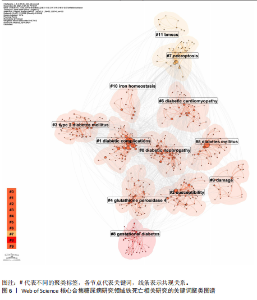
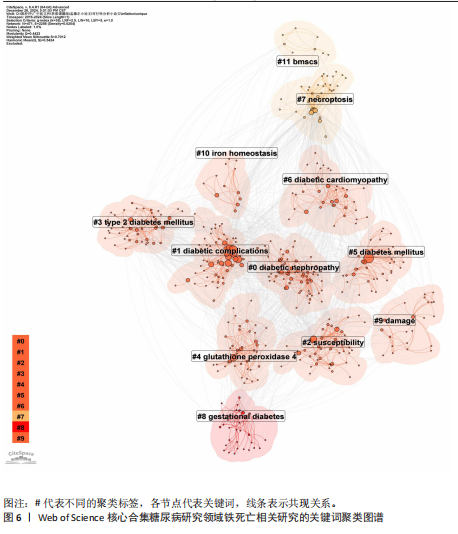
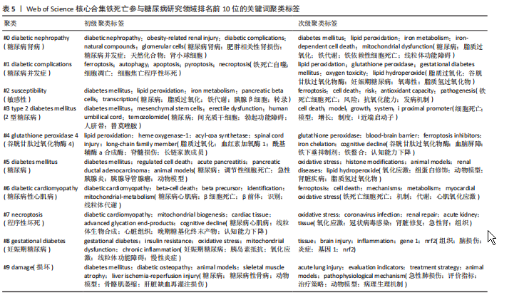
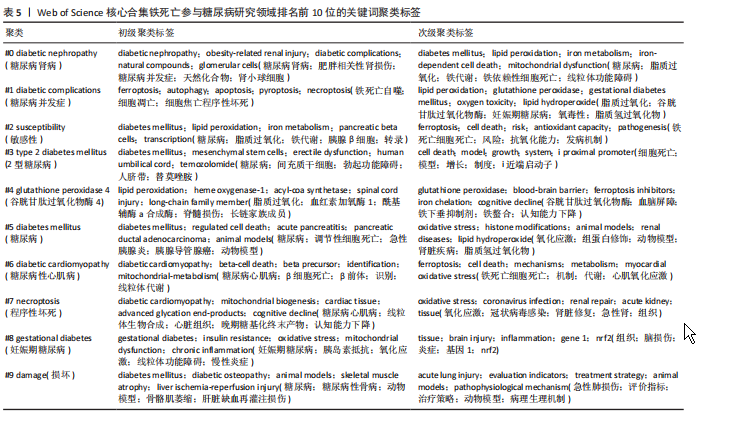
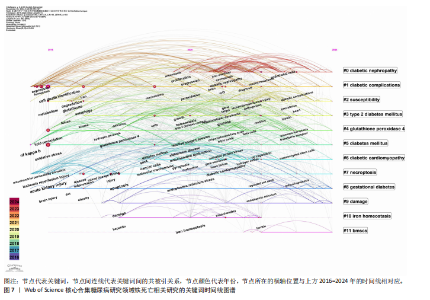
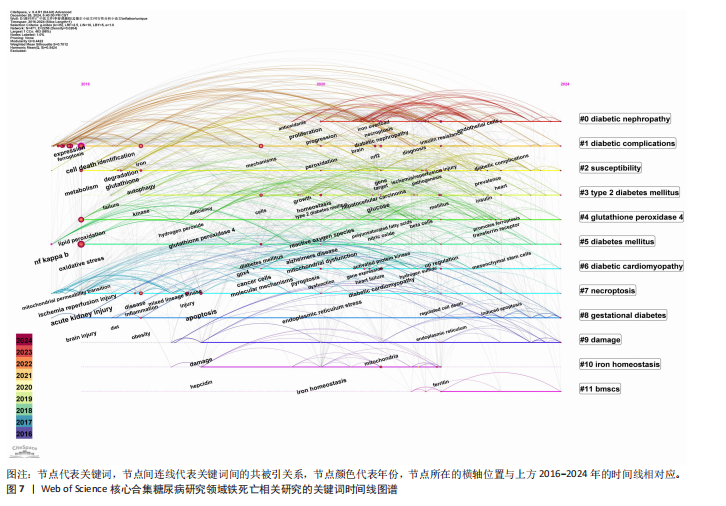
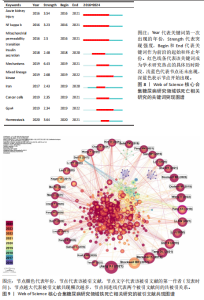
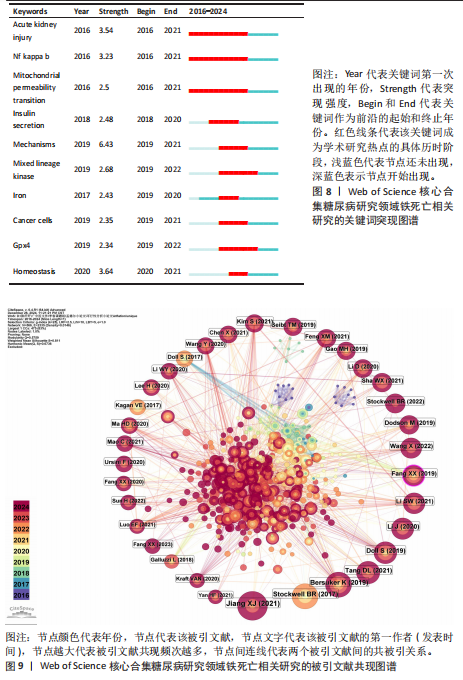
2.5.2 关键词聚类分析 关键词聚类分析常以聚类模块值(Q)和平均轮廓值(S)作为聚类分析可信度和真实性的判断标准,Q > 0.30代表聚类结构显著,S > 0.70代表聚类结构高效合理[29]。此次关键词共现聚类的Q=0.44,S=0.70(k=25),说明该研究聚类结构显著,聚类具有可信度。选取排名前10的聚类,见图6。聚类#0反映了铁死亡在糖尿病肾病方面的研究;聚类#1、聚类#2反映了铁死亡通过调控脂质过氧化在糖尿病并发症中的相关研究;聚类#3反映了间充质干细胞在糖尿病调控铁死亡方面的研究;聚类#4反映了干预措施通过调控谷胱甘肽过氧化酶4以调节糖尿病中铁死亡方面的研究;聚类#5反映了通过调控氧化应激以调节糖尿病中铁死亡方面的研究;聚类#6、聚类#7都反映了铁死亡在糖尿病心肌病疾病方面的研究,聚类#7则另外包含了部分铁死亡在糖尿病相关肾损伤方面的研究;聚类#8反映了铁死亡在妊娠期糖尿病方面的研究;聚类#9反映了铁死亡对糖尿病患者各器官损伤方面的研究,见表5。 2.5.3 关键词时间线分析 使用软件对糖尿病研究领域内涉及铁死亡相关研究的文献关键词按时间线进行聚类分析,基于聚类的时间线可以清楚地观察不同聚类的时间跨度,见图7。如图所示,绝大部分研究从2016年开始,铁死亡调控下brain injury(脑损伤)与聚类#8 gestational diabetes(妊娠期糖尿病)的关系被广泛研究,时间跨度从2016至今,是持续时间最长的聚类,说明该聚类标签已形成稳定的研究方向,是该领域研究的持续热点。聚类#0 diabetic nephropathy(糖尿病肾病)和聚类#6 diabetic cardiomyopathy(糖尿病性心肌病)作为两种具有代表性的糖尿病并发症,可能是该领域的研究热门疾病。此外,根据关键词聚类分析和关键词时间线图谱可以明确该领域的研究方向及趋势,endothelial cells(内皮细胞)、mesenchymal stem cells(间充质干细胞)、induced apoptisis(诱导性凋亡)和ferrituin(铁素体)为该领域的最新研究前沿。 2.5.4 关键词突现分析 突现分析通过一定时间段内关键词引用量的突现变化来反映这段时间学者对糖尿病领域铁死亡相关研究的关注重点变化,见图8。 如图所示,acute kidney injury(急性肾损伤)、nf kappa b(核因子κB)和mitochondrial permeability transition(线粒体渗透性转换),从2016年开始急剧上升,在2021年达到峰值。其中是反映线粒体膜完整和功能的重要指标的被引用量。homeostasis(稳态)、resistance(抵抗)关键词分别在2020-2021年、2018-2019年和2021-2022年间显示了引用强度的突现,反映了该领域在不同时间段内对特定生物过程和机制进行了深入研究。铁死亡是依赖于细胞内铁的累积而引起毒性脂质过氧化物活性氧升高的非凋亡细胞死亡形式,谷胱甘肽过氧化物酶4的失活则是铁死亡的主要发生机制,是后期出现且持续时间较长的突现关键词,表明其对于铁死亡参与糖尿病研究的重要性,且在未来可能还会持续增加。 2.6 文献共被引分析 文献共被引分析是文献计量学中的常用方法之一,通过分析文献之间的共同引用关系揭示学科领域内的期刊之间的联系结构[30]。对纳入文献进行共被引分析,得到566个节点、2 335条连线、密度为0.014 6的被引文献共现图谱,见图9。"
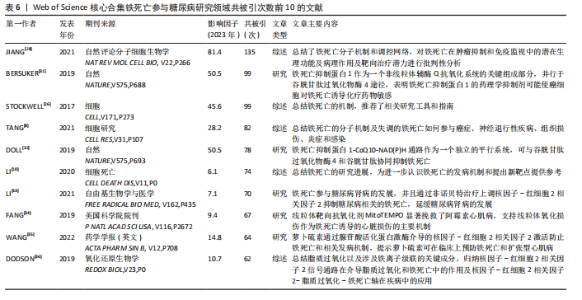
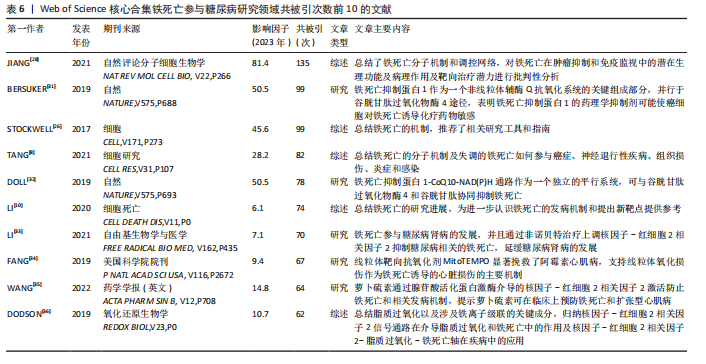
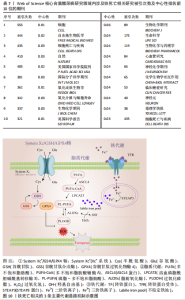
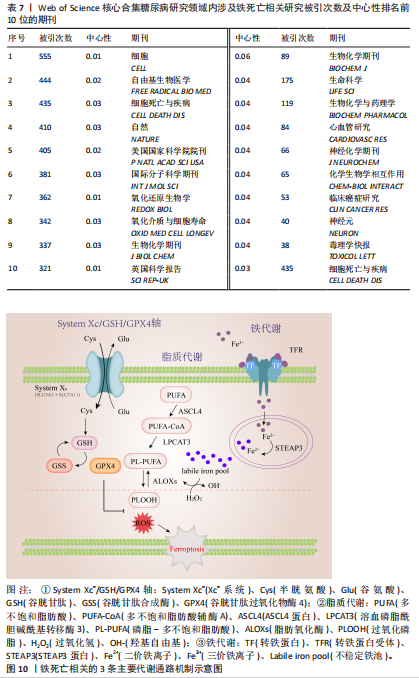
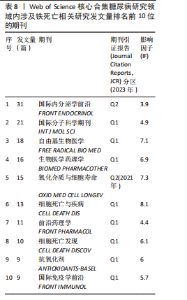
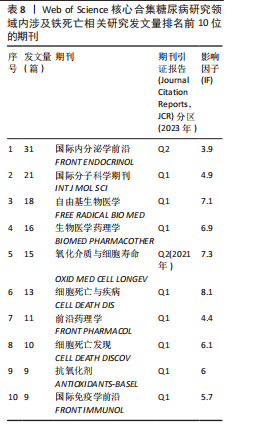
在共被引频次排名前10的文献中,共有5篇综述类文献和5篇实验研究类文章,其中,4篇文献深入探讨了铁死亡的相关机制并为相应的应用提供了指南;2篇文献探讨了铁死亡相关的新靶点或新通路,并为其在疾病中的应用提供了新思路;1篇文献总结了核因子-红细胞2相关因子2信号通路在介导脂质过氧化和铁死亡中的作用;3篇文献探讨了通过铁死亡相关通路应用药物治疗糖尿病肾病和预防心肌病的作用。具体统计和总结见表6[8,10,26,28,31-36]。 2.7 发文期刊和期刊被引分析 通过Excel软件去重发现该领域研究文献共发表在349种期刊上。发文量最高的期刊是《FRONT ENDOCRINOL》,2023年JCR分区Q2且影响因子=3.9,按发文量排名的随后9本期刊除了《OXID MED CELL LONGEV》2023年未被收录外,均为JCR分区Q1。共引频次前10的期刊如表7所示,被引次数最多的是555次,期刊为《CELL》。被引期刊中影响因子最高的期刊是《NATURE》(50.5),是全球最顶尖的综合性期刊,在各个领域有巨大的影响力,但其中心性仅为0.03,而《BIOCHEM J》期刊中心性最高为0.06,表明文献质量被众多学者认可,是该领域中较有影响力的期刊,见表8。综合发文期刊和被引期刊分析来看,《FREE RADICAL BIO MED》和《OXID MED CELL LONGEV》《CELL DEATH DIS》在发文量和共引量中均排名前10,是该领域中较有影响力的期刊。"
"
"
"
"
"
| [1] 尹经霞, 余丽, 蒲丹岚, 等. 《中国糖尿病防治指南(2024版)》解读[J]. 重庆医科大学学报, 2025,50(5):557-564. [2] WANG L, PENG W, ZHAO Z, et al. Prevalence and Treatment of Diabetes in China, 2013-2018. Jama. 2021;326(24):2498-2506. [3] MAGLIANO DJ, BOYKO EJ, COMMITTEE IDFDATES. IDF Diabetes Atlas. Idf diabetes atlas. Brussels: International Diabetes Federation© International Diabetes Federation, 2021. [4] Urgent action needed as global diabetes cases increase four-fold over past decades. 13 November 2024 [cited 2025 January 31]; Available from: https://www.who.int/news/item/13-11-2024-urgent-action-needed-as-global-diabetes-cases-increase-four-fold-over-past-decades. [5] 赵佩伊, 费思佳, 乔修琪, 等. 微循环检测在糖尿病微血管并发症评估中的新进展[J]. 中国医学前沿杂志(电子版),2025,17(1): 21-27. [6] 翟佳羽, 冯存玉, 高雪峰, 等. 组蛋白去乙酰化酶3在糖尿病及其并发症中的作用及其抑制剂的研究进展[J]. 药学学报,2025,60(1):1-11. [7] LIU C, LI X, LIN M, et al. A cross-sectional study on diabetes epidemiology among people aged 40 years and above in Shenyang, China Sci Rep. 2020;10(1):17742. [8] TANG D, CHEN X, KANG R, et al. Ferroptosis: molecular mechanisms and health implications. Cell Res. 2021;31(2):107-125. [9] LIANG D, MINIKES AM, JIANG X. Ferroptosis at the intersection of lipid metabolism and cellular signaling. Mol Cell. 2022;82(12): 2215-2227. [10] LI J, CAO F, YIN HL, et al. Ferroptosis: past, present and future. Cell Death Dis. 2020;11(2):88. [11] MIAO R, FANG X, ZHANG Y, et al. Iron metabolism and ferroptosis in type 2 diabetes mellitus and complications: mechanisms and therapeutic opportunities. Cell Death Dis. 2023;14(3):186. [12] LIU P, ZHANG Z, CAI Y, et al. Ferroptosis: Mechanisms and role in diabetes mellitus and its complications. Ageing Res Rev. 2024;94: 102201. [13] 吴茂兰, 翁家俊, 曹清雨, 等. 铁脂代谢与代谢性疾病及其天然产物防治研究进展[J]. 中国现代应用药学,2024,41(11):1568-1576. [14] 孙靖烨, 萧文泽, 周艳雯, 等. 基于抗氧化蛋白探讨中医药改善糖尿病肾病铁死亡的潜在靶点[J]. 中药新药与临床药理,2024,35(9):1445-1452. [15] BACKE MB, MOEN IW, ELLERVIK C, et al. Iron Regulation of Pancreatic Beta-Cell Functions and Oxidative Stress. Annu Rev Nutr. 2016;36:241-273. [16] GAO H, JIN Z, BANDYOPADHYAY G, et al. Aberrant iron distribution via hepatocyte-stellate cell axis drives liver lipogenesis and fibrosis. Cell Metab. 2022;34(8):1201-1213. e5. [17] ZHANG Z, FUNCKE JB, ZI Z, et al. Adipocyte iron levels impinge on a fat-gut crosstalk to regulate intestinal lipid absorption and mediate protection from obesity. Cell Metab. 2021;33(8):1624-1639. e9. [18] XIONG L, HU F, LI Z, et al. The research trends of ferroptosis in diabetes: a bibliometric analysis. Front Public Health. 2024;12:365828. [19] ZHANG L, ZHENG H, JIANG ST, et al. Worldwide research trends on tumor burden and immunotherapy: a bibliometric analysis. Int J Surg. 2024;110(3):1699-1710. [20] 宋秀芳, 迟培娟. Vosviewer与Citespace应用比较研究[J]. 情报科学,2016,34(7):108-112+146. [21] 李志一, 贺鹏程, 边天月, 等. 铁死亡机制研究的文献计量学与可视化分析[J]. 中国组织工程研究,2022,26(8):1202-1209. [22] MAREMONTI F, TONNUS W, GAVALI S, et al. Ferroptosis-based advanced therapies as treatment approaches for metabolic and cardiovascular diseases. Cell Death Differ. 2024; 31(9):1104-1112. [23] MÄSSENHAUSEN AV, SCHLECHT MN, BEER K, et al. Treatment with siRNAs is commonly associated with GPX4 up-regulation and target knockdown-independent sensitization to ferroptosis. Sci Adv. 2024;10(11):eadk7329. [24] YANG Y, TETTI M, VOHRA T, et al. BEX1 Is Differentially Expressed in Aldosterone-Producing Adenomas and Protects Human Adrenocortical Cells From Ferroptosis. Hypertension. 2021;77(5): 1647-1658. [25] TONNUS W, MAREMONTI F, BELAVGENI A, et al. Gasdermin D-deficient mice are hypersensitive to acute kidney injury. Cell Death Dis. 2022; 13(9):792. [26] STOCKWELL BR, FRIEDMANN ANGELI JP, BAYIR H, et al. Ferroptosis: A Regulated Cell Death Nexus Linking Metabolism, Redox Biology, and Disease. Cell. 2017;171(2):273-285. [27] DIXON SJ, LEMBERG KM, LAMPRECHT MR, et al. Ferroptosis: an iron-dependent form of nonapoptotic cell death. Cell. 2012;149(5):1060-1072. [28] JIANG X, STOCKWELL BR, CONRAD M. Ferroptosis: mechanisms, biology and role in disease. Nat Rev Mol Cell Biol. 2021;22(4): 266-282. [29] 赵晓璇, 刘帅祎, 邢政, 等. 周围神经损伤领域组织工程技术应用的研究热点与趋势变化[J]. 中国组织工程研究,2025,29(30):6591-6600. [30] YANG L, HAN L, LIU N, et al. A new approach to journal co-citation matrix construction based on the number of co-cited articles in journals. Scientometrics. 2019;120(2):507-517. [31] BERSUKER K, HENDRICKS JM, LI Z, et al. The CoQ oxidoreductase FSP1 acts parallel to GPX4 to inhibit ferroptosis. Nature. 2019;575(7784):688-692. [32] DOLL S, FREITAS FP, SHAH R, et al. FSP1 is a glutathione-independent ferroptosis suppressor. Nature. 2019;575(7784):693-698. [33] LI S, ZHENG L, ZHANG J, et al. Inhibition of ferroptosis by up-regulating Nrf2 delayed the progression of diabetic nephropathy. Free Radic Biol Med. 2021;162:435-449. [34] FANG X, WANG H, HAN D, et al. Ferroptosis as a target for protection against cardiomyopathy. Proc Natl Acad Sci U S A. 2019;116(7):2672-2680. [35] WANG X, CHEN X, ZHOU W, et al. Ferroptosis is essential for diabetic cardiomyopathy and is prevented by sulforaphane via AMPK/NRF2 pathways. Acta Pharm Sin B. 2022;12(2):708-722. [36] DODSON M, CASTRO-PORTUGUEZ R, ZHANG DD. NRF2 plays a critical role in mitigating lipid peroxidation and ferroptosis. Redox Biol. 2019; 23:101107. [37] CONRAD M, PRATT DA. The chemical basis of ferroptosis. Nat Chem Biol. 2019;15(12):1137-1147. [38] CHEN J, OU Z, GAO T, et al. Ginkgolide B alleviates oxidative stress and ferroptosis by inhibiting GPX4 ubiquitination to improve diabetic nephropathy. Biomed Pharmacother. 2022;156:113953. [39] 李衡, 毛逸伦, 赵颐堃, 等. 铁死亡在器官缺血再灌注损伤中的作用机制研究进展[J]. 中国普通外科杂志,2024,33(6):988-995. [40] 朱秀萍, 徐亚萍, 陆扬, 等. 铁死亡及其抑制剂研究进展[J]. 中国现代应用药学,2025,42(11): 1985-1996. [41] CHEN GH, SONG CC, PANTOPOULOS K, et al. Mitochondrial oxidative stress mediated Fe-induced ferroptosis via the NRF2-ARE pathway. Free Radic Biol Med. 2022;180:95-107. [42] WANG Y, BI R, QUAN F, et al. Ferroptosis involves in renal tubular cell death in diabetic nephropathy. Eur J Pharmacol. 2020;888:173574. [43] WANG N, MA H, LI J, et al. HSF1 functions as a key defender against palmitic acid-induced ferroptosis in cardiomyocytes. J Mol Cell Cardiol. 2021;150:65-76. [44] 樊俐慧, 王志刚, 杨霞, 等. 基于铁死亡的糖尿病肾病发病机制及中药干预的研究进展[J].中药新药与临床药理,2024,35(6):917-927. [45] 陈欣雨, 孟鑫雨, 贺驿婷, 等. 中药活性成分干预铁死亡治疗糖尿病肾病研究进展[J]. 中国中医药信息杂志,2025,32(3):192-197. [46] 侯媛媛, 房城, 焦月华, 等. 铁死亡与糖尿病心肌病关系的研究进展[J]. 中国老年学杂志, 2025,45(1):241-244. [47] 易希善, 柏婷燕, 肖国庆, 等. 糖尿病心肌病铁死亡作用机制及中医药治疗进展[J]. 中国现代应用药学,2024,41(23):3415-3423. [48] ZHENG J, CONRAD M. The Metabolic Underpinnings of Ferroptosis. Cell Metab. 2020; 32(6):920-937. [49] LEI G, ZHUANG L, GAN B. Targeting ferroptosis as a vulnerability in cancer. Nat Rev Cancer. 2022; 22(7):381-396. [50] CHEN X, YU C, KANG R, et al. Iron Metabolism in Ferroptosis. Front Cell Dev Biol. 2020;8:590226. [51] ALVAREZ SW, SVIDERSKIY VO, TERZI EM, et al. NFS1 undergoes positive selection in lung tumours and protects cells from ferroptosis. Nature. 2017; 551(7682):639-643. [52] 杨璐, 梁蓓蓓. 靶向线粒体代谢的抗肿瘤研究进展[J]. 中国肿瘤生物治疗杂志,2024,31(12): 1248-1253. [53] 时丽聪, 严梦思, 牟连伟. 线粒体–细胞核逆向通讯的分子机制研究进展[J]. 中国运动医学杂志,2024,43(11):914-922. [54] 王冠晨, 陈同生. 活细胞中亚细胞器的超分辨结构特征[J]. 中国激光,2022,49(20):92-100. [55] 吕忱聪, 罗再, 黄陈. 线粒体依赖性铁死亡在胃肠肿瘤中的作用及治疗[J]. 中国生物化学与分子生物学报,2024,40(12):1649-1658. [56] LI J, JIA YC, DING YX, et al. The crosstalk between ferroptosis and mitochondrial dynamic regulatory networks. Int J Biol Sci. 2023;19(9):2756-2771. [57] KARAA A, GOLDSTEIN A. The spectrum of clinical presentation, diagnosis, and management of mitochondrial forms of diabetes. Pediatr Diabetes. 2015;16(1):1-9. [58] FORBES JM, THORBURN DR. Mitochondrial dysfunction in diabetic kidney disease. Nat Rev Nephrol. 2018;14(5):291-312. [59] 张学武, 李军, 林登梅, 等. 探讨葛花解酲方调控铁死亡抑制EMT干预肝细胞癌的作用及机制研究[J]. 中药药理与临床,2025,41(6):12-19. [60] 魏爽, 郝峰, 章文春, 等. 黄芪-葛根配伍对T2DM胰岛素抵抗大鼠铁死亡的影响及机制研究[J]. 中国药房,2025,36(1):57-63. [61] 吴源陶, 王智槟, 傅馨莹, 等. 参芪地黄汤介导ACSL4/LPCAT3/ALOX15轴抑制花生四烯酸相关性铁死亡改善小鼠糖尿病肾病肾功能[J]. 中国实验方剂学杂志,2025,31(12):140-149. |
| [1] | Xu Canli, He Wenxing, Wang Yuping, Ba Yinying, Chi Li, Wang Wenjuan, Wang Jiajia. Research context and trend of TBK1 in autoimmunity, signaling pathways, gene expression, tumor prevention and treatment [J]. Chinese Journal of Tissue Engineering Research, 2026, 30(在线): 1-11. |
| [2] | Zhu Xiaolong, Zhang Wei, Yang Yang. Visualization analysis of research hotspots and cutting-edge information in the field of intervertebral disc regeneration and repair [J]. Chinese Journal of Tissue Engineering Research, 2026, 30(9): 2391-2402. |
| [3] | Wen Fayan, Li Yan, Qiang Tianming, Yang Chen, Shen Linming, Li Yadong, Liu Yongming. Unilateral biportal endoscopic technology for treatment of lumbar degenerative diseases: global research status and changing trends [J]. Chinese Journal of Tissue Engineering Research, 2026, 30(9): 2380-2390. |
| [4] | Yang Xuetao, Zhu Menghan, Zhang Chenxi, Sun Yimin, Ye Ling. Applications and limitations of antioxidant nanomaterials in oral cavity [J]. Chinese Journal of Tissue Engineering Research, 2026, 30(8): 2044-2053. |
| [5] |
Dong Chunyang, Zhou Tianen, Mo Mengxue, Lyu Wenquan, Gao Ming, Zhu Ruikai, Gao Zhiwei.
Action mechanism of metformin combined with Eomecon chionantha Hance dressing in treatment of deep second-degree burn wounds#br#
#br#
[J]. Chinese Journal of Tissue Engineering Research, 2026, 30(8): 2001-2013.
|
| [6] | Liu Anting, Lu Jiangtao, Zhang Wenjie, He Ling, Tang Zongsheng, Chen Xiaoling. Regulation of AMP-activated protein kinase by platelet lysate inhibits cadmium-induced neuronal apoptosis [J]. Chinese Journal of Tissue Engineering Research, 2026, 30(7): 1800-1807. |
| [7] | Huang Jie, Zeng Hao, Wang Wenchi, Lyu Zhucheng, Cui Wei. Visualization analysis of literature on the effect of lipid metabolism on osteoporosis [J]. Chinese Journal of Tissue Engineering Research, 2026, 30(6): 1558-1568. |
| [8] | Zhang Haiwen, Zhang Xian, Xu Taichuan, Li Chao. Bibliometric and visual analysis of the research status and trends of senescence in osteoporosis [J]. Chinese Journal of Tissue Engineering Research, 2026, 30(6): 1580-1591. |
| [9] | Lyu Guoqing, Aizimaitijiang·Rouzi, Xiong Daohai. Irisin inhibits ferroptosis in human articular chondrocytes: roles and mechanisms [J]. Chinese Journal of Tissue Engineering Research, 2026, 30(6): 1359-1367. |
| [10] | Yang Zeyu, Zhi Liang, Wang Jia, Zhang Jingyi, Zhang Qingfang, Wang Yulong, Long Jianjun. A visualized analysis of research hotspots in high-frequency repetitive transcranial magnetic stimulation from the macroscopic perspective [J]. Chinese Journal of Tissue Engineering Research, 2026, 30(5): 1320-1330. |
| [11] | Zou Rongji, Yu Fangfang, Wang Maolin, Jia Zhuopeng. Triptolide inhibits ferroptosis and improves cerebral ischemia-reperfusion injury in a rat model of cerebral artery occlusion/reperfusion [J]. Chinese Journal of Tissue Engineering Research, 2026, 30(4): 873-881. |
| [12] | Yang Xiao, Bai Yuehui, Zhao Tiantian, Wang Donghao, Zhao Chen, Yuan Shuo. Cartilage degeneration in temporomandibular joint osteoarthritis: mechanisms and regenerative challenges [J]. Chinese Journal of Tissue Engineering Research, 2026, 30(4): 926-935. |
| [13] | Mu Bingtao, Guo Minfang, Hu Fenqi, Liu Qiyuan, Jia Hui, Xu Mingyuan, Chen Jiayuan, Zhang Huiyu, Meng Tao, Yu Jiezhong. Mitochondrial kinetic mechanism by which triptolide alleviates hydrogen peroxide-induced apoptosis in SH-SY5Y cells [J]. Chinese Journal of Tissue Engineering Research, 2026, 30(34): 8986-8993. |
| [14] | He Renda, Ma Wei, Sun Yongsi, Mo Xueni. Future medical research on brain organoids: interdisciplinary training, bioengineering technologies, and optimized model maturity [J]. Chinese Journal of Tissue Engineering Research, 2026, 30(34): 9088-9094. |
| [15] | Bu Fanchen, Hua Zhen, , Li Xiaolong, Lyu Jinye, Man Hao, Wang Jianwei, . Triangular fibrocartilage complex injuries: a visualization analysis of treatment hotspots and frontiers [J]. Chinese Journal of Tissue Engineering Research, 2026, 30(34): 9095-9102. |
| Viewed | ||||||
|
Full text |
|
|||||
|
Abstract |
|
|||||