Chinese Journal of Tissue Engineering Research ›› 2026, Vol. 30 ›› Issue (25): 6533-6543.doi: 10.12307/2026.259
Previous Articles Next Articles
Yanggan Roujin Decoction delays intervertebral disc degeneration: network pharmacological analysis and experimental validation in rat models
Chen Chaoqi, Liu Fei, Song Chao, Shen Baoxin, Huang Wutao, Chen Feng, Yang Lei
- Ruikang Clinical Medical College, Guangxi University of Chinese Medicine, Nanning 530011, Guangxi Zhuang Autonomous Region, China
-
Received:2025-08-06Revised:2025-12-29Online:2026-09-08Published:2026-04-22 -
Contact:Chen Feng, Professor, Doctoral supervisor, Ruikang Clinical Medical College, Guangxi University of Chinese Medicine, Nanning 530011, Guangxi Zhuang Autonomous Region, China Co-corresponding author: Yang Lei, PhD candidate, Ruikang Clinical Medical College, Guangxi University of Chinese Medicine, Nanning 530011, Guangxi Zhuang Autonomous Region, China -
About author:Chen Chaoqi, MS candidate, Ruikang Clinical Medical College, Guangxi University of Chinese Medicine, Nanning 530011, Guangxi Zhuang Autonomous Region, China -
Supported by:the Innovation Plan Project for Postgraduate Education of Guangxi University of Chinese Medicine in 2024, No. YCBZ2024155 (to LF)

CLC Number:
Cite this article
Chen Chaoqi, Liu Fei, Song Chao, Shen Baoxin, Huang Wutao, Chen Feng, Yang Lei. Yanggan Roujin Decoction delays intervertebral disc degeneration: network pharmacological analysis and experimental validation in rat models[J]. Chinese Journal of Tissue Engineering Research, 2026, 30(25): 6533-6543.
share this article
Add to citation manager EndNote|Reference Manager|ProCite|BibTeX|RefWorks
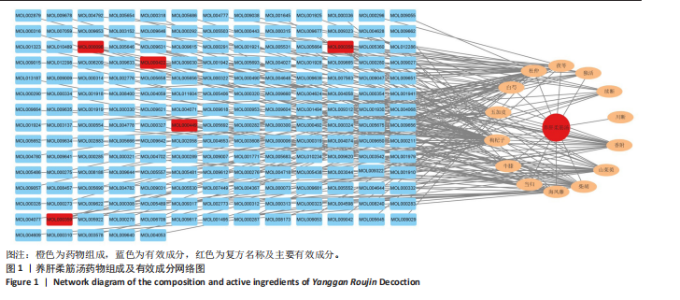
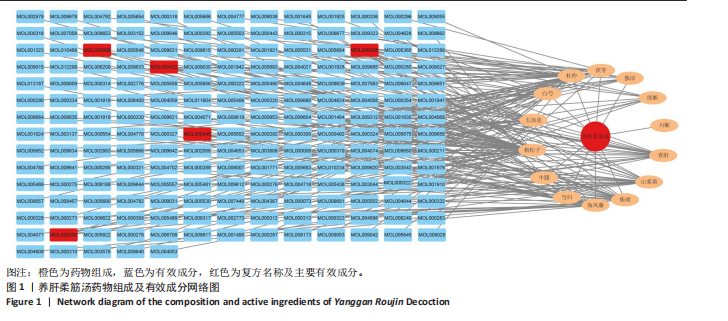
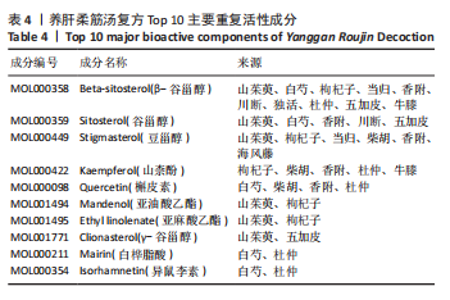
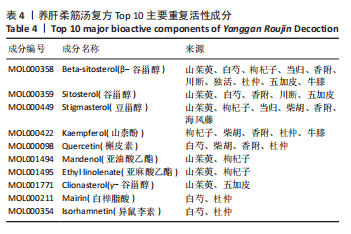
2.1 网络药理学分析结果 2.1.1 养肝柔筋汤活性成分、靶点数据 通过相关数据库筛选可获得山茱萸有效成分20种,茯苓有效成分15种,白芍有效成分13种,枸杞子有效成分45种,当归有效成分2种,柴胡有效成分17种,香附有效成分18种,续断有效成分8种,独活有效成分9种,杜仲有效成分28种,五加皮有效成分17种,牛膝有效成分3种,海风藤有效成分21种,去除药物的重复成分总共获得187种有效活性成分(图1)。排名前10的重复活性成分见表4,其中Beta-sitosterol(β-谷甾醇)、Sitosterol(谷固醇)、Stigmasterol(豆甾醇)、quercetin(槲皮素)、kaempferol(山柰酚)等存在于多种草药中,可能发挥主要作用。针对有效成分,在本草组鉴收集药物的作用靶点,经过筛选、删除重复靶点,最终获得养肝柔筋汤的有效作用靶点共389个。"
"
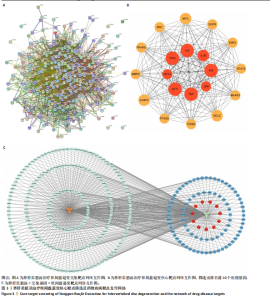
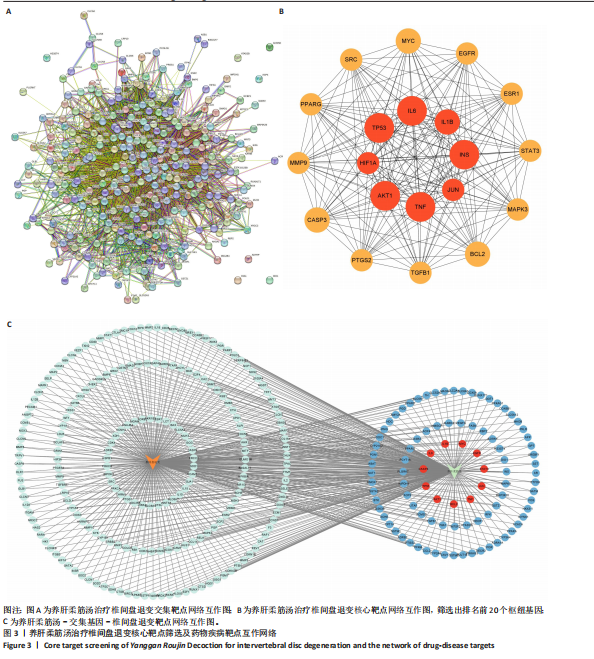
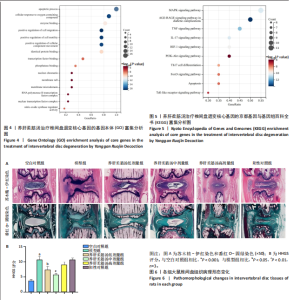
2.1.2 养肝柔筋汤治疗椎间盘退变作用靶点筛选及网络构建 通过疾病相关数据库检索共获得椎间盘退变的作用靶点14 318个,其中GeneCards 1 120个、DisGeNet database 10个、CTD 12 762个,去除重复后获得椎间盘退变的作用靶点13 805个(图2A)。通过维恩在线工具分析,最终获得养肝柔筋汤延缓椎间盘退变交集基因298个(图2B)。 2.1.3 养肝柔筋汤治疗椎间盘退变的蛋白互作网络构建 将298个交集基因导入String在线数据分析工具,获得养肝柔筋汤延缓椎间盘退变的网络互作蛋白图,298个基因之间一共5 049条边,平均节点33.9,平均节点聚类系数0.589(图3A)。为了进一步获取核心基因,使用Cytoscope 3.9.1,CytoHubba算法,筛选出排名前20个枢纽基因(AKT1、TP53、TNF、IL6、INS、IL1B、JUN、BCL2、CASP3、MYC、STAT3、EGFR、HIF1A、ESR1、PTGS2、MMP9、MAPK3、TGFB1、SRC、PPARG)(图3B)。最后使用Cytoscope 3.9.1构建了“养肝柔筋汤-交集基因-椎间盘退变”效应网络图(图3C)。 2.1.4 富集分析结果 将20个枢纽基因进行GO分子功能分析和KEGG通路富集分析。GO功能富集分析共确定3 046个条目,其中生物学过程相关的条目2 827个,主要涉及酶结合、蛋白质结合、磷酸酶结合、一氧化氮合酶调节活性等;分子生物功能相关的条目164个,主要涉及酶结合、蛋白结合、核受体活性、转录共激活因子结合、细胞因子活性等;细胞组分相关的条目54个,主要涉及RNA聚合酶Ⅱ转录因子复合体、核染色质、膜筏、膜微结构域等。对每个类别前5个条目进行可视化分析(图4)。KEGG数据分析共得到141条相关通路,以富集得分降序排列,获取前10位关联度最高的通路(图5),包括丝裂原活化蛋白激酶信号通路、肿瘤坏死因子信号通路、白细胞介素17信号通路、缺氧诱导因子1信号通路、细胞凋亡等。 2.2 实验验证结果 2.2.1 实验动物数量分析 此次实验共构建尾椎间盘退变模型大鼠50只,其中在模型构建麻醉过程中死亡1只;灌胃过程中操作不当,导致误吸从而引发窒息死亡2只(养肝柔筋汤中剂量组、养肝柔筋汤高剂量组各死亡1只);实验结束剩余鼠57只:空白对照组10只,模型组9只,养肝柔筋汤低剂量组10只,养肝柔筋汤中剂量组9只,养肝柔筋汤中剂量组9只,阳性对照组10只。"
2.2.2 苏木精-伊红染色和番红O-固绿染色结果 见图6。与空白对照组相比,模型组椎间盘结构破坏严重,纤维环破裂,板层结构消失,髓核与纤维环分界不清,失去正常形态,全部被纤维组织取代;模型组HHGS评分明显高于空白对照组(P < 0.01);与模型组相比,养肝柔筋汤低剂量组椎间盘结构破坏明显,纤维环排列稀疏,出现分层裂隙,板层结构完整,与髓核分界清楚,髓核细胞丢失,排列稀疏,可见大量成纤维组织;养肝柔筋汤低剂量组HHGS评分低于模型组(P < 0.05);养肝柔筋汤中剂量组椎间盘结构完整,纤维环排列紧凑,可见少量分层裂隙,板层结构完整,髓核与纤维环分界清楚,髓核细胞丢失,排列稀疏,可见少量成纤维组织,养肝柔筋汤中剂量组HHGS评分显著低于模型组(P < 0.01);养肝柔筋汤高剂量组椎间盘结构破"
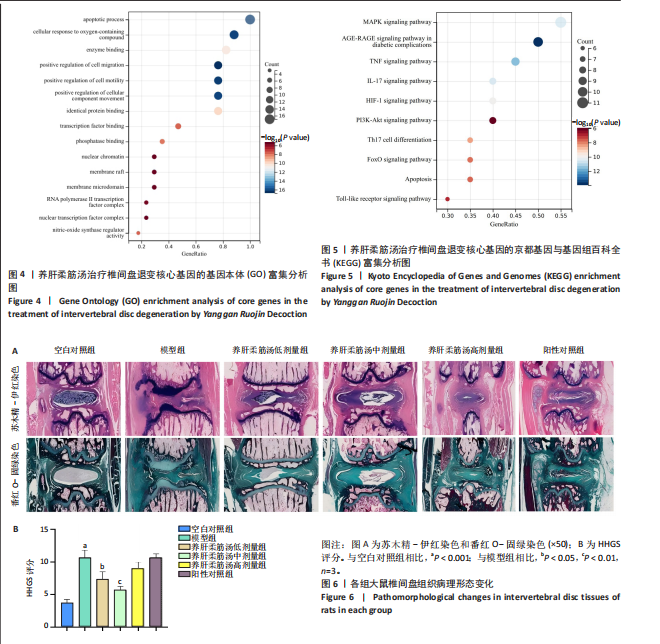
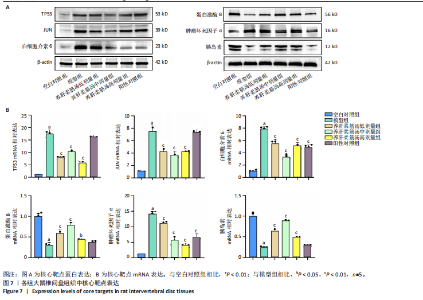
坏明显,纤维环排列紧密,出现分层裂隙,板层结构完整,与髓核分界清楚,髓核细胞大量丢失,排列稀疏,可见大量成纤维组织;养肝柔筋汤高剂量组HHGS评分与模型组无明显差异(P > 0.05);阳性对照组椎间盘结构破坏严重,纤维环排列稀疏,出现分层裂隙,髓核细胞被纤维组织取代,与纤维环分界不清,板层结构完整,阳性对照组HHGS评分与模型组无明显差异(P > 0.05)。 2.2.3 Western blot检测各组核心靶点蛋白表达变化 见图7A。与空白对照组比较,模型组大鼠椎间盘组织TP53、JUN、白细胞介素6、肿瘤坏死因子α蛋白表达明显升高(P < 0.01),而蛋白激酶B、胰岛素蛋白表达明显降低(P < 0.01);与模型组相比,养肝柔筋汤干预后大鼠椎间盘组织TP53、JUN、白细胞介素6、肿瘤坏死因子α蛋白表达明显降低(P < 0.01),而蛋白激酶B、胰岛素蛋白表达升高(P < 0.05),其中养肝柔筋汤中剂量组趋势最为明显。与模型组相比,双氯芬酸钠干预后白细胞介素6、肿瘤坏死因子α蛋白表达明显降低(P < 0.01),TP53、JUN、蛋白激酶B、胰岛素蛋白表达量无明显差异(P > 0.05)。 2.2.4 RT-qPCR检测各组核心靶点mRNA转录变化 见图7B。与空白对照组比较,模型组大鼠椎间盘组织TP53、JUN、白细胞介素6、肿瘤坏死因子α mRNA表达明显升高(P < 0.01),而蛋白激酶B、胰岛素mRNA表达明显降低(P < 0.01);与模型组相比,养肝柔筋汤干预后大鼠椎间盘组织TP53、JUN、白细胞介素6、肿瘤坏死因子α mRNA表达明显降低(P < 0.01),而蛋"
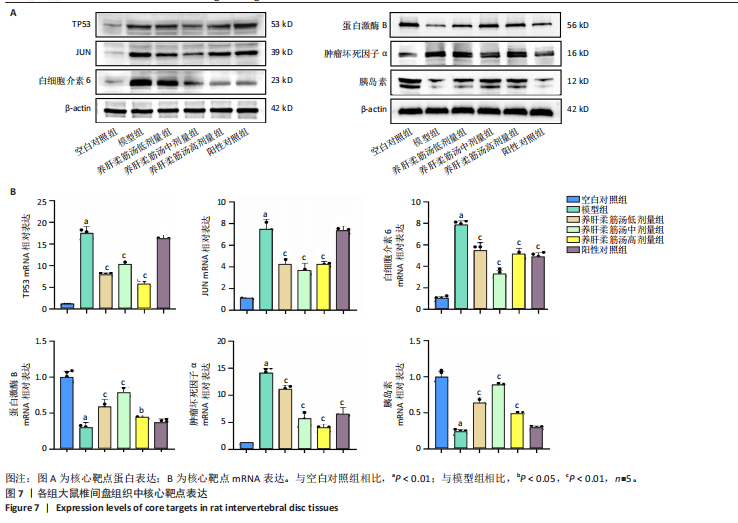
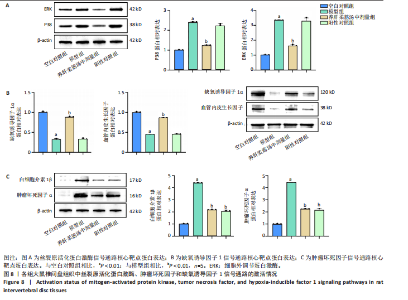
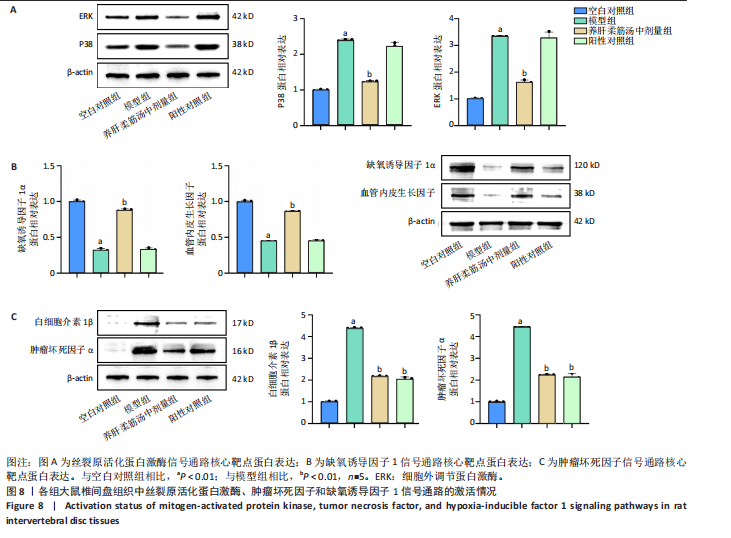
白激酶B、胰岛素mRNA表达升高(P < 0.05),其中养肝柔筋汤中剂量组趋势最为明显。与模型组相比,双氯芬酸钠干预后白细胞介素6、肿瘤坏死因子α mRNA表达明显降低(P < 0.01),TP53、JUN、蛋白激酶B、胰岛素mRNA表达量无明显差异(P > 0.05)。 2.2.5 Western blot检测信号通路中代表性基因蛋白激活情况 见图8。为了进一步阐明养肝柔筋汤缓解椎间盘退变进程的作用机制,评估空白对照组、模型组、养肝柔筋汤中剂量组与双氯芬酸钠组的丝裂原活化蛋白激酶、肿瘤坏死因子和缺氧诱导因子1信号通路激活情况。与空白对照组相比,模型组丝裂原活化蛋白激酶信号通路中代表性基因P38、细胞外调节蛋白激酶和肿瘤坏死因子信号通路中代表性基因白细胞介素1β、肿瘤坏死因子α蛋白表达量升高(P < 0.01),缺氧诱导因子1信号通路中代表性基因缺氧诱导因子1α、血管内皮生长因子蛋白表达量降低(P < 0.01)。与模型组相比,养肝柔筋汤干预后,丝裂原活化蛋白激酶信号通路中代表性基因P38、细胞外调节蛋白激酶和肿瘤坏死因子信号通路中代表性基因白细胞介素1β、肿瘤坏死因子α蛋白表达量降低(P < 0.01),缺氧诱导因子1信号通路中代表性基因缺氧诱导因子1α、血管内皮生长因子蛋白表达量升高(P < 0.01)。与模型组相比,双氯芬酸钠干预后肿瘤坏死因子信号通路中代表性基因白细胞介素1β、肿瘤坏死因子α蛋白表达量降低(P < 0.01),丝裂原活化蛋白激酶信号通路中代表性基因P38、细胞外调节蛋白激酶和缺氧诱导因子1信号通路中代表性基因缺氧诱导因子1α、血管内皮生长因子蛋白表达量无明显差异(P > 0.05)。"
| [1] UPENIEKS A, MONTGOMERY-SONG A, SANTERRE JP, et al. Development of a Perfusion Reactor for Intervertebral Disk Regeneration. Tissue Eng Part C Methods. 2022;28(1):12-22. [2] HARTVIGSEN J, HANCOCK MJ, KONGSTED A, et al. What low back pain is and why we need to pay attention. Lancet. 2018;391(10137):2356-2367. [3] HOY D, BROOKS P, BLYTH F, et al. The Epidemiology of low back pain. Best Pract Res Clin Rheumatol. 2010;24(6):769-781. [4] MAHER C, UNDERWOOD M, BUCHBINDER R. Non-specific low back pain. Lancet. 2017;389(10070):736-747. [5] HU YC, ZHANG XB, LIN MQ, et al. Nanoscale Treatment of Intervertebral Disc Degeneration: Mesenchymal Stem Cell Exosome Transplantation. Curr Stem Cell Res Ther. 2023;18(2):163-173. [6] STEFFEN F, BERTOLO A, AFFENTRANGER R, et al. Treatment of Naturally Degenerated Canine Lumbosacral Intervertebral Discs with Autologous Mesenchymal Stromal Cells and Collagen Microcarriers: A Prospective Clinical Study. Cell Transplant. 2019;28(2):201-211. [7] VO NV, HARTMAN RA, PATIL PR, et al. Molecular mechanisms of biological aging in intervertebral discs. J Orthop Res. 2016;34(8):1289-1306. [8] 韩涛,于杰,金哲峰,等.中药干预椎间盘退变治疗腰椎间盘突出症作用机制研究进展[J].世界中医药,2023,18(21):3042-3046. [9] 张峰,董宝强,林星星.腰痛的“经脉病”与“经筋病”辨析[J].中医学报,2022,37(10):2088-2091. [10] 陈舰舰,周临东,谢林.基于“肝主筋”理论治疗椎间盘退变探讨[J].浙江中医药大学学报,2013,37(6):832-834. [11] 王子正,董宝强,林星星.从整体观角度探讨经筋与中医肝系统关系[J].辽宁中医药大学学报,2017,19(8):119-121. [12] 李治,覃杰,陈锋,等.名中医陈锋从“肝主筋、为罢极之本”论治腰椎间盘突出症经验[J].陕西中医,2024,45(2):248-252. [13] ZHANG P, ZHANG D, ZHOU W, et al. Network pharmacology: towards the artificial intelligence-based precision traditional Chinese medicine. Brief Bioinform. 2023;25(1):bbad518. [14] 沈路凡,徐静,马睿玲,等.武威汉简瘀方靶向Sirt1抑制PI3K/AKT信号通路对高血压肾损伤的影响[J].中药药理与临床,2025,41(11):21-26. [15] MA Z, CHEN X, XIONG M, et al. Cyberpharmacology uncover the mechanism of the total Rhizoma Coptidis extracts ameliorate chronic atrophic gastritis. J Ethnopharmacol. 2024;335:118644. [16] 杜瑞环,张警,李忠海.腰椎间盘退变动物模型的研究进展[J].中国脊柱脊髓杂志,2023,33(9):847-853. [17] SU S, WU X, LI B, et al. Inhibition of ERK1/2 mediated activation of Drp1 alleviates intervertebral disc degeneration via suppressing pyroptosis and apoptosis in nucleus pulposus cells. J Orthop Translat. 2025;51:163-175. [18] 孙孝先,白雪,刘孟敏,等.双上肢去势联合椎间盘刺破诱导建立大鼠椎间盘退变模型[J].中国组织工程研究,2023,27(35):5616-5621. [19] 周文明,林一峰,张震,等.补肾壮督方对大鼠退变椎间盘细胞线粒体凋亡通路的影响[J].中国实验方剂学杂志,2019,25(19):25-31. [20] 刘振龙,满振涛,张继英,等.利用HHGS和OOCHAS评分评价兔前交叉韧带断裂后膝骨关节炎软骨损伤程度的研究[J].中国运动医学杂志, 2015,34(2):103-110. [21] BRINJIKJI W, DIEHN FE, JARVIK JG, et al. MRI Findings of Disc Degeneration are More Prevalent in Adults with Low Back Pain than in Asymptomatic Controls: A Systematic Review and Meta-Analysis. AJNR Am J Neuroradiol. 2015;36(12):2394-2399. [22] SAMANTA A, LUFKIN T, KRAUS P. Intervertebral disc degeneration-Current therapeutic options and challenges. Front Public Health. 2023;11:1156749. [23] BABU S, JAYARAMAN S. An update on β-sitosterol: A potential herbal nutraceutical for diabetic management. Biomed Pharmacother. 2020;131: 110702. [24] 谷慧敏,孟庆良,左瑞庭,等.β-谷甾醇对类风湿性关节炎滑膜成纤维细胞功能的影响及机制[J].中国药房,2023,34(15):1847-1852. [25] 冯思敏,宁可,邵平,等.β-谷甾醇和豆甾醇对小鼠急性结肠炎的治疗作用研究[J].中国粮油学报,2018,33(12):80-86+94. [26] QIAN K, ZHENG XX, WANG C, et al. β-Sitosterol Inhibits Rheumatoid Synovial Angiogenesis Through Suppressing VEGF Signaling Pathway. Front Pharmacol. 2021;12:816477. [27] 于春,马学莉,马燕花.豆甾醇抗肿瘤作用机制的研究进展[J].华西药学杂志,2024,39(6):737-740. [28] LI L, JIANG W, YU B, et al. Quercetin improves cerebral ischemia/reperfusion injury by promoting microglia/macrophages M2 polarization via regulating PI3K/Akt/NF-κB signaling pathway. Biomed Pharmacother. 2023;168:115653. [29] ZHAO WJ, LIU X, HU M, et al. Quercetin ameliorates oxidative stress-induced senescence in rat nucleus pulposus-derived mesenchymal stem cells via the miR-34a-5p/SIRT1 axis. World J Stem Cells. 2023;15(8):842-865. [30] 王莹,张婧如,田伟,等.菟丝子及其提取物药理机制研究进展[J].中国中医基础医学杂志,2023,29(11):1961-1964. [31] 汪陈莫及,吴亚东,梁松林,等.基于p38 MAPK信号通路探讨山柰酚对椎间盘退变的作用机制[J].中国中药杂志,2024,49(21):5721-5729. [32] FANG W, ZHOU X, WANG J, et al. Wogonin mitigates intervertebral disc degeneration through the Nrf2/ARE and MAPK signaling pathways. Int Immunopharmacol. 2018;65:539-549. [33] HU J, YAN Q, JIANG H, et al. A decrease in IL-33 regulates matrix degradation and apoptosis in intervertebral disc degeneration via HIF-1alpha. Am J Transl Res. 2021;13(11):12724-12733. [34] LIU Z, ZHENG J, DING T, et al. HIF-1α protects nucleus pulposus cells from oxidative stress-induced mitochondrial impairment through PDK-1. Free Radic Biol Med. 2024;224:39-49. [35] WANG Y, CHE M, XIN J, et al. The role of IL-1β and TNF-α in intervertebral disc degeneration. Biomed Pharmacother. 2020;131:110660. [36] ZHANG S, LIANG W, ABULIZI Y, et al. Quercetin Alleviates Intervertebral Disc Degeneration by Modulating p38 MAPK-Mediated Autophagy. Biomed Res Int. 2021;2021:6631562. [37] ZHANG HJ, LIAO HY, BAI DY, et al. MAPK /ERK signaling pathway: A potential target for the treatment of intervertebral disc degeneration. Biomed Pharmacother. 2021;143:112170. [38] ZHOU MH, ZHANG H, XU WJ, et al. Effect of PI3K/AKT/HIF-1α signaling pathway on oxidative stress and apoptosis in nucleus pulposus cells. Eur Rev Med Pharmacol Sci. 2024;28(2):446-456. [39] 梁楚婷,郭炜骅,谭理,等.低氧诱导因子-1:细胞适应氧供应改变的关键蛋白[J].生物化学与生物物理进展,2019,46(11):1041-1049. [40] KIM JW, AN HJ, YEO H, et al. Activation of Hypoxia-Inducible Factor-1α Signaling Pathway Has the Protective Effect of Intervertebral Disc Degeneration. Int J Mol Sci. 2021;22(21):11355. [41] LI Y, CHEN L, GAO Y, et al. Oxidative Stress and Intervertebral Disc Degeneration: Pathophysiology, Signaling Pathway, and Therapy. Oxid Med Cell Longev. 2022;2022:1984742. [42] 刘志超,张帆,祝永刚,等.身痛逐瘀汤方对椎间盘退变中PI3K/AKT通路影响的研究[J].中国中医骨伤科杂志,2018,26(10):14-19. [43] 刘汝银,彭晓艳,岳宗进,等.当归对大鼠椎间盘髓核细胞自噬及氧化应激损伤的作用及机制研究[J].中国脊柱脊髓杂志,2018,28(2): 176-182. [44] LIU ZQ, ZHAO S, FU WQ. Insulin-like growth factor 1 antagonizes lumbar disc degeneration through enhanced autophagy. Am J Transl Res. 2016; 8(10):4346-4353. [45] 王善金,徐浩伟,赵卫东,等.糖尿病与腰椎间盘退变相关性研究进展[J].中国矫形外科杂志,2020,28(9):828-831. [46] TIAN D, LIU J, CHEN L, et al. The protective effects of PI3K/Akt pathway on human nucleus pulposus mesenchymal stem cells against hypoxia and nutrition deficiency. J Orthop Surg Res. 2020;15(1):29. [47] WANG Y, HU S, ZHANG W, et al. Emerging role and therapeutic implications of p53 in intervertebral disc degeneration. Cell Death Discov. 2023;9(1):433. [48] 张震.血浆miRNA与腰椎间盘退变的相关性及补肾壮督方的干预研究[D].广州:广州中医药大学,2017. [49] 韩畅畅,万福生. AP-1的研究进展[J].中国细胞生物学学报,2017,39(10): 1357-1362. |
| [1] | Zhu Xiaolong, Zhang Wei, Yang Yang. Visualization analysis of research hotspots and cutting-edge information in the field of intervertebral disc regeneration and repair [J]. Chinese Journal of Tissue Engineering Research, 2026, 30(9): 2391-2402. |
| [2] | Zhou Sirui, Xu Yukun, Zhao Kewei. Ideas and methods of anti-melanogenesis of Angelica dahurica extracellular vesicles [J]. Chinese Journal of Tissue Engineering Research, 2026, 30(7): 1747-1754. |
| [3] | Cai Ziming, Yu Qinghe, Ma Pengfei, Zhang Xin, Zhou Longqian, Zhang Chongyang, Lin Wenping. Heme oxygenase-1 alleviates lipopolysaccharide-induced inflammatory response in nucleus pulposus mesenchymal stem cells [J]. Chinese Journal of Tissue Engineering Research, 2026, 30(7): 1624-1631. |
| [4] | Chen Yulin, He Yingying, Hu Kai, Chen Zhifan, Nie Sha Meng Yanhui, Li Runzhen, Zhang Xiaoduo , Li Yuxi, Tang Yaoping. Effect and mechanism of exosome-like vesicles derived from Trichosanthes kirilowii Maxim. in preventing and treating atherosclerosis [J]. Chinese Journal of Tissue Engineering Research, 2026, 30(7): 1768-1781. |
| [5] | Peng Zhiwei, Chen Lei, Tong Lei. Luteolin promotes wound healing in diabetic mice: roles and mechanisms [J]. Chinese Journal of Tissue Engineering Research, 2026, 30(6): 1398-1406. |
| [6] | Chen Yixian, Chen Chen, Lu Liheng, Tang Jinpeng, Yu Xiaowei. Triptolide in the treatment of osteoarthritis: network pharmacology analysis and animal model validation [J]. Chinese Journal of Tissue Engineering Research, 2026, 30(4): 805-815. |
| [7] | Zhao Canbin, Zeng Ping, Shi Weiqi, Liu Jinfu, Ding Qiang, Guo Liang, Wang Weiwei, Tao Hongcheng, Guo Yafeng, Qin Ying. Mechanism by which luteolin regulates macrophage polarization in the treatment of knee osteoarthritis [J]. Chinese Journal of Tissue Engineering Research, 2026, 30(34): 8868-8877. |
| [8] | Jing Kun, Wang Yulu, Liang Hao, Huo Yuhang, Cong Longxu, . Mechanisms by which mangiferin alleviates pain in osteoarthritis: integration of microarray data analysis, network pharmacology, and experimental validation in a rat model [J]. Chinese Journal of Tissue Engineering Research, 2026, 30(34): 8953- 8961. |
| [9] | Yuan Jingjing, Zhang Xiaomin, Du Pengyang, Wang Weifeng. Mazdutide improves cognitive function in APP/PS1/Tau triple transgenic mice [J]. Chinese Journal of Tissue Engineering Research, 2026, 30(34): 8962-8969. |
| [10] | Wang Peng, Li Zhijun, Zhang Shaojie, Wu Yimin. Intervertebral disc rehydration after posterior lumbar dynamic internal fixation [J]. Chinese Journal of Tissue Engineering Research, 2026, 30(3): 711-720. |
| [11] | Du Yaxin, Zhao Xiaojuan, Wu Ruixia, Dong Yizhi, Song Xinyue, Fu Hongyang, She Yitong, Zhang Jialin, Zhu Yong. Interaction between vascular-lymphatic system imbalance and immune microenvironment in intervertebral disc degeneration [J]. Chinese Journal of Tissue Engineering Research, 2026, 30(29): 7612-7618. |
| [12] | He Long, Gao Shuang, Chen Chao, Qin Guozhong, Ran Qingsen, Wang Zhengchun, Yang Yafeng, Ren Hang, Qiu Yunkai, Yang Yang, Li Wei. A new strategy for preventing and treating orthopedic diseases by regulating ferroptosis through signaling pathways [J]. Chinese Journal of Tissue Engineering Research, 2026, 30(29): 7619-7631. |
| [13] | Zhang Zhilong, Wang Haiying, Ma Fenghua, Hou Yanjie. Regulating mitochondrial dynamics balance in nucleus pulposus cells inhibits cell apoptosis [J]. Chinese Journal of Tissue Engineering Research, 2026, 30(29): 7520-7528. |
| [14] | Wang Chenmoji, Wu Yadong, Gao Di, Wang Hao, Li Nianhu. Mechanism by which kaempferol inhibits intervertebral disc degeneration in rats by regulating mitophagy levels [J]. Chinese Journal of Tissue Engineering Research, 2026, 30(29): 7529-7538. |
| [15] | Qi Yuxin, Dang Yifan, Dai Liming, Zhang Xiaoling. Function and molecular mechanism of physcion in regulating bone homeostasis [J]. Chinese Journal of Tissue Engineering Research, 2026, 30(28): 7237-7244. |
| Viewed | ||||||
|
Full text |
|
|||||
|
Abstract |
|
|||||