Chinese Journal of Tissue Engineering Research ›› 2026, Vol. 30 ›› Issue (25): 6446-6454.doi: 10.12307/2026.479
Previous Articles Next Articles
Transcriptomic analysis of expression and function of differential genes in traditional Chinese medicine syndromes of postmenopausal osteoporosis
He Yanyan1, 2, Ge Jirong1, 2, Li Shengqiang1, 2, Chen Xuan1, 2, Huang Jingwen1, 2, Huang Xiaobin1, 2, Xue Lipeng1, 2
- 1Key Research Laboratory of Osteoporosis Symptom Genomics, Fujian Academy of Chinese Medical Sciences, Fuzhou 350003, Fujian Province, China; 2Fujian Key Laboratory of Integrative Medicine for Osteoporosis Prevention and Control (Fujian Academy of Chinese Medical Sciences, Rehabilitation Hospital Affiliated to Fujian University of Traditional Chinese Medicine), Fuzhou 350003, Fujian Province, China
-
Received:2025-10-29Revised:2026-03-10Online:2026-09-08Published:2026-04-17 -
Contact:Ge Jirong, PhD, Key Research Laboratory of Osteoporosis Symptom Genomics, Fujian Academy of Chinese Medical Sciences, Fuzhou 350003, Fujian Province, China; Fujian Key Laboratory of Integrative Medicine for Osteoporosis Prevention and Control (Fujian Academy of Chinese Medical Sciences, Rehabilitation Hospital Affiliated to Fujian University of Traditional Chinese Medicine), Fuzhou 350003, Fujian Province, China -
About author:He Yanyan, MS, Assistant experimentalist, Physician, Key Research Laboratory of Osteoporosis Symptom Genomics, Fujian Academy of Chinese Medical Sciences, Fuzhou 350003, Fujian Province, China; Fujian Key Laboratory of Integrative Medicine for Osteoporosis Prevention and Control (Fujian Academy of Chinese Medical Sciences, Rehabilitation Hospital Affiliated to Fujian University of Traditional Chinese Medicine), Fuzhou 350003, Fujian Province, China -
Supported by:Basic Scientific Research Special Project of Fujian Provincial Department of Science and Technology for Provincial Public Welfare Research Institutes, No. 2023R1003002 (to HYY); Natural Science Foundation Project of Fujian Provincial Department of Science and Technology, No. 2025J01922 (to HYY); Basic Scientific Research Special Project of Fujian Provincial Department of Science and Technology for Provincial Public Welfare Research Institutes, No. 2023R1003001 (to XLP); Natural Science Foundation Project of Fujian Provincial Department of Science and Technology, No. 2023J01854 (to HXB); Open Project of the Orthopedics and Traumatology of Traditional Chinese Medicine, Fujian University of Traditional Chinese Medicine, No. XGS2023016 (to HXB)

CLC Number:
Cite this article
He Yanyan, Ge Jirong, Li Shengqiang, Chen Xuan, Huang Jingwen, Huang Xiaobin, Xue Lipeng. Transcriptomic analysis of expression and function of differential genes in traditional Chinese medicine syndromes of postmenopausal osteoporosis[J]. Chinese Journal of Tissue Engineering Research, 2026, 30(25): 6446-6454.
share this article
Add to citation manager EndNote|Reference Manager|ProCite|BibTeX|RefWorks
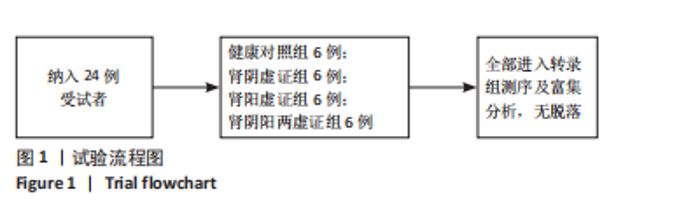
2.1 参与者数量分析 纳入24例受试者,分为4组,每组6例,全部进入结果分析,无脱落。图表中出现编号中断的原因:质控时有出现个别血样RNA浓度不达标被排除,后重新补充血样并接续编号,故部分中间编号缺失。 2.2 试验流程图 见图1。"
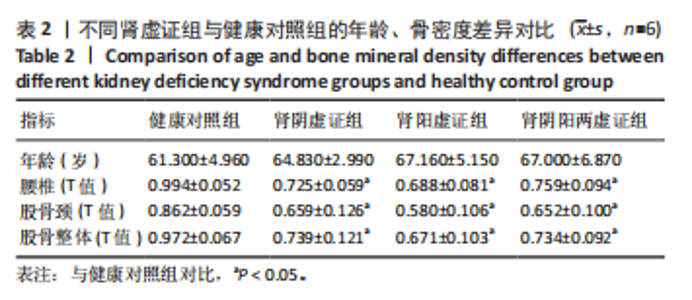
2.3 基线资料比较 与健康对照组比较,不同肾虚证组的年龄分布无统计学差异(P > 0.05),但腰椎、股骨颈及股骨整体骨密度有差异降低(P < 0.05),见表2。"
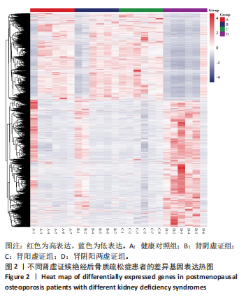
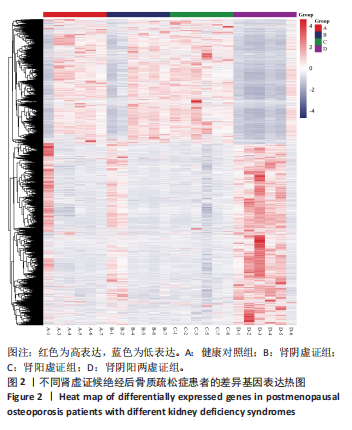
2.4 基因表达组间差异 如图2所示,肾阴阳两虚证组与健康对照组、肾阴虚证组、肾阳虚证组之间存在明显的基因表达差异。肾阴阳两虚证组中较多基因呈现高表达状态,表明绝经后骨质疏松症肾阴阳两虚证在基因表达层面具有独特性,与正常状态存在显著区别。同组样本虽属同一分组,但样本本身存在个体差异,导致基因表达天然波动。"
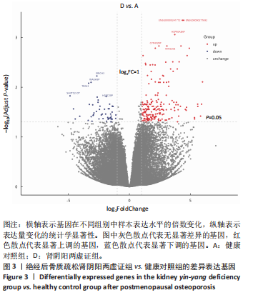
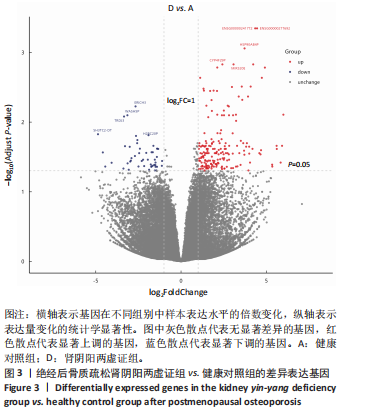
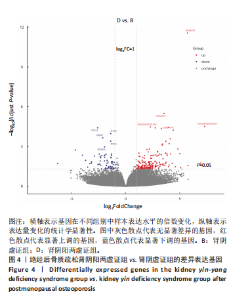
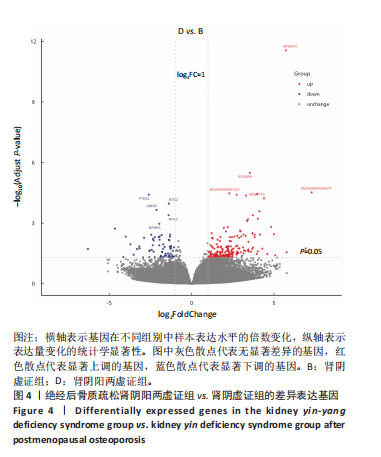
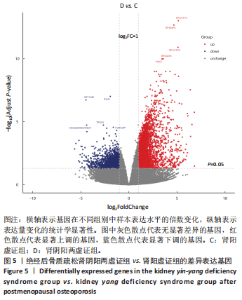
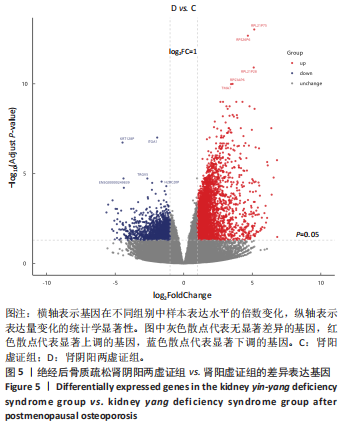
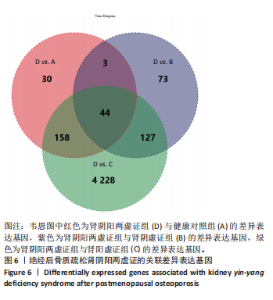
2.5 绝经后骨质疏松症肾阴阳虚证差异表达基因的筛选 如图3-5所示,绝经后骨质疏松症肾阴阳两虚证组与健康对照组相比,筛选差异表达基因235个,其中表达上调185个,表达下调50个;与肾阴虚证组相比,筛选差异表达基因247个,其中表达上调 182个,表达下调65个;与肾阳虚证组相比,筛选差异表达基因4 557个,其中表达上调2 866个,表达下调1 691个。绝经后骨质疏松症肾阴阳两虚证组与其他3组的差异基因中,"
"
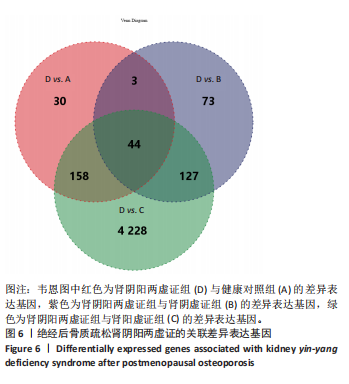
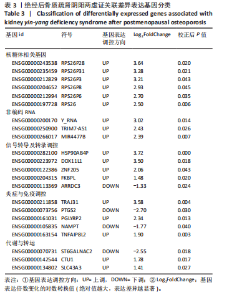
筛选出肾阴阳两虚证组的关联差异表达基因22个(实际初筛44个,其中22个基因未关联基因符号且多为未被数据库注释的新型转录本),其中上调的18个,下调的4个,见图6、表3。"
"
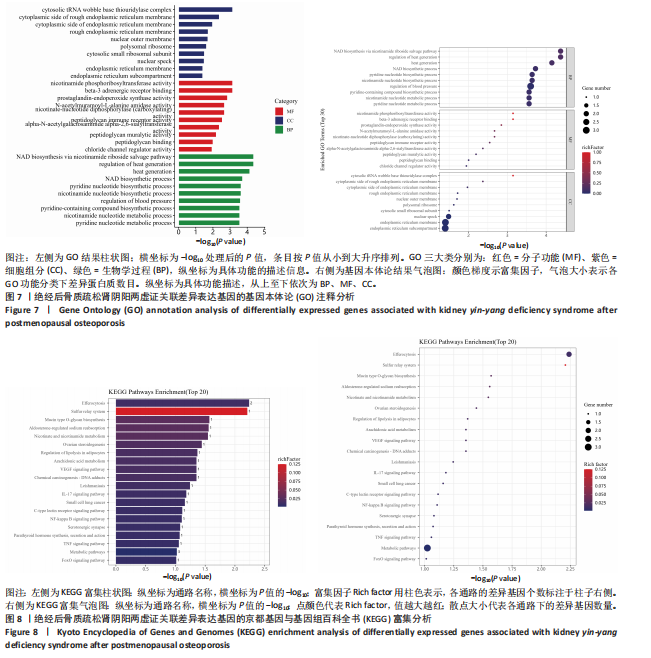
2.6 肾阴阳两虚证差异表达基因作用机制和信号通路分析结果 2.6.1 基因本体论分析结果 见图7。 基因本体论分析得到条目1 090个,其中生物过程899个,分子功能107个,细胞组分84个,生物学过程主要围绕烟酰胺腺嘌呤二核苷酸生物合成(含补救途径及相关核苷酸合成)、代谢过程(吡啶/烟酰胺核苷酸及含吡啶化合物)、生理调节(产"
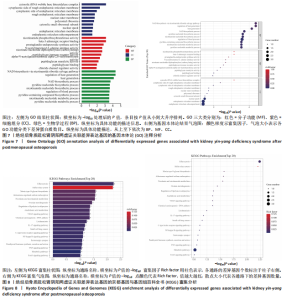
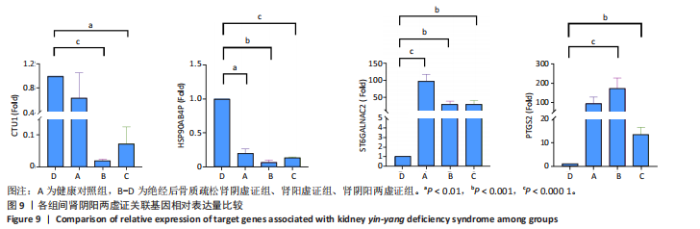
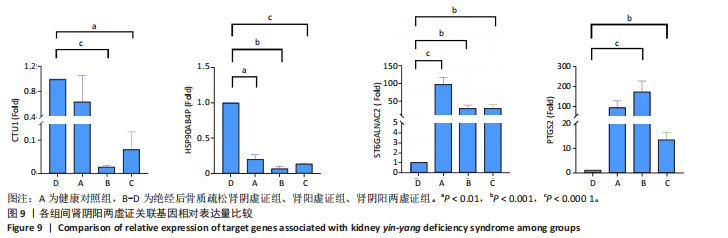
热及血压)等。分子功能主要涉及:①免疫防御与病原体清除(肽聚糖免疫受体活性、肽聚糖胞壁质分解活性、肽聚糖结合、N-乙酰胞壁酰-L-丙氨酸酰胺酶活性);②代谢调控与能量平衡(烟酰胺磷酸核糖转移酶活性、烟酸核苷酸二磷酸化酶(羧化)活性、β-3肾上腺素能受体结合);③炎症与细胞信号传导:前列腺素内过氧化物合酶活性、α-N-乙酰半乳糖胺α-2,6-唾液酸转移酶活性;④离子通道与生理功能调节(氯离子通道调节活性)。细胞组分主要涉及:①内质网相关结构(粗面内质网膜细胞质侧、内质网膜细胞质侧、粗面内质网膜、内质网膜、内质网亚区室);②细胞核相关结构(核外膜、核斑);③核糖体相关结构:多核糖体、细胞质小核糖体亚基;④细胞质基质功能复合体:细胞质基质转运RNA摆动碱基硫尿苷酰化酶复合体。 2.6.2 京都基因与基因组百科全书富集结果分析 富集到60条通路,主要涉及凋亡细胞清除、核因子κB信号通路、肿瘤坏死因子信号通路、白细胞介素17信号通路、血管内皮生长因子信号通路、小细胞肺癌相关通路、叉头框蛋白O信号通路、代谢通路等,见图8。 2.6.3 肾阴阳两虚证关联差异表达基因qRT-PCR验证结果 通过qRT-PCR验证高通量测序结果得出以下结论:①上调基因:与其他3组对比,基因CTU1、HSP90AB4P在肾阴阳两虚组中的表达量呈上调趋势;②下调基因:与其他3组对比,基因ST6GALNAC2、 PTGS2在肾阴阳两虚组中的表达量呈下调趋势。4个目标基因的上下调趋势与转录组测序结果一致。见图9。"
"
| [1] 冯秀芝,吴继雷,任艳玲.基于肾之“精气”“阴阳”理论探析绝经后骨质疏松症的病机变化[J].中国骨质疏松杂志,2021,27(3):418-420+425. [2] 葛继荣,王和鸣,郑洪新,等. 中医药防治原发性骨质疏松症专家共识(2020) [J]. 中国骨质疏松杂志,2020,26(12):1717-1725. [3] SCHURCH NJ, SCHOFIELD P, GIERLIŃSKI M, et al. How many biological replicates are needed in an RNA-seq experiment and which differential expression tool should you use? RNA. 2016;22(6):839-51. [4] 原发性骨质疏松症诊疗指南(2022)[J].中华骨质疏松和骨矿盐疾病杂志, 2022,15(6):573-611. [5] 沈自尹,王文健.中医虚证辨证参考标准[J].中西医结合杂志,1986,6(10): 598. [6] KANG J, BRAJANOVSKI N, CHAN KT, et al. Ribosomal proteins and human diseases: Molecular mechanisms and tar geted therapy. Signal Transduct Target Ther. 2021;6(1): 323. [7] 王枭宇,梁超,方肇勤.核糖体蛋白S26的研究进展[J].生命科学研究, 2017,21(5):450-453. [8] 刘沛,蒋宜伟,周玉英,等. p53在骨质疏松症中的作用机制及中医药干预研究进展[J].中国骨质疏松杂志,2023,29(7):1021-1026. [9] 朱换平,石敏,张维平,等.杜仲腰痛丸调控p53对老年骨质疏松症患者骨密度、骨代谢及骨形成影响的作用机制[J].中国骨质疏松杂志, 2021,27(2):257-262. [10] 王瀚,马紫童,龙玉婷,等. 淫羊藿与女贞子配伍对自噬激活状态ASMCs的影响[J].医学研究杂志,2023,52(12):36-40+70. [11] 于玟路,张虹.含活性成分中药材对骨质疏松症的作用机制研究现状[J].中国医药科学,2024,14(21):32-35+39. [12] GULÌA C, SIGNORE F, GAFFI M, et al. Y RNA: An Overview of Their Role as Potential Biomarkers and Molecular Targets in Human Cancers. Cancers (Basel). 2020;12(5):1238. [13] VALKOV N, DAS S. Y RNAs: Biogenesis, Function and Implications for the Cardiovascular System. Adv Exp Med Biol. 2020;1229:327-342. [14] FAN W, MAR KB, SARI L, et al. TRIM7 inhibits enterovirus replication and promotes emergence of a viral variant with increased pathogenicity. Cell. 2021;184(13):3410-3425.e17. [15] HE X, CHENG G, XIAO F, et al. MIR-4477b gene as a novel pathogenic mutation occurring during the transformation of colorectal adenoma into colorectal cancer. J Gastrointest Oncol. 2021;12(1):69-78. [16] 杨一秋,李兰,赵娜,等.PI3K/AKT信号通路与骨质疏松关系的研究进展[J].中国老年学杂志,2022,42(24):6144-6148. [17] 胡涛,钱海兵.PI3K/AKT信号通路在骨质疏松症中作用及中药干预研究进展[J].贵州中医药大学学报,2022,44(6):57-63 [18] 叶凡,张舒怡,刘佳乐,等.左归丸调控PI3K/AKT信号通路的研究进展[J].河南中医,2024,44(3):445-452. [19] 杨濛,王璐,张紫佳,等.基于PI3K/Akt通路探讨仙茅改善去势大鼠肾阳虚的作用机制[J].中国实验方剂学杂志,2024,30(20):46-53.. [20] 侯静文,王晓宇,詹添,等. FK506结合蛋白样蛋白在疾病中的作用的研究进展[J].医学分子生物学杂志,2023,20(6):536-539+546. [21] 程鉥泺,陶雪芬,赵荣,等. TLR4/NF-κB通路与骨质疏松症关系的研究进展[J].中国骨质疏松杂志,2023,29(7):1037-1042. [22] 何姣姣,陈以发,陈玉林,等. 绝经后骨质疏松的骨免疫学机制[J].中国骨质疏松杂志,2023,29(7):1032-1036. [23] VAN OOSTEN-HAWLE P. Organismal Roles of Hsp90. Biomolecules. 2023; 13(2):251. [24] ORTIZ NR, GUY N, GARCIA YA, et al. Functions of the Hsp90-Binding FKBP Immunophilins. Subcell Biochem. 2023;101:41-80. [25] ZHONG N, WANG C, WENG G, et al. ZNF205 positively regulates RLR antiviral signaling by targeting RIG-I. Acta Biochim Biophys Sin (Shanghai). 2023;55(10):1582-1591. [26] WEDEGAERTNER H, PAN WA, GONZALEZ CC, et al. The α-Arrestin ARRDC3 Is an Emerging Multifunctional Adaptor Protein in Cancer. Antioxid Redox Signal. 2022;36(13-15):1066-1079. [27] 刘雅利,封俨宸,党雪,等.免疫细胞介导的炎症与骨质疏松症的机制与作用途径[J].中国骨质疏松杂志,2024,30(6):863-868. [28] 许嘉木,杨城,李玮民,等.细胞焦亡与炎症因子在骨质疏松症发生中的作用与机制[J].中国组织工程研究,2026,30(3):691-700. [29] 李生强,冯尔宥,张怡元,等. 原发性骨质疏松症肾阴虚证骨组织基因表达谱研究[J]. 中国骨质疏松杂志,2013,19(12):1215-1218+1253. [30] 葛继荣,谢丽华,陈可,等. 绝经后骨质疏松症肾阳虚证差异表达基因分析[J]. 中国骨质疏松杂志,2012,18(2):134-138. [31] 罗鸣然,范文豪,李鑫,等. 靶向调控前列腺素内过氧化物合成酶2基因抑制MC3T3-E1细胞的增殖和成骨分化[J].中国组织工程研究, 2022,26(12):1888-1893. [32] PILBEAM C. Prostaglandins and Bone. Handb Exp Pharmacol. 2020;262:157-175. [33] 綦向军,陈国铭,史佩玉,等.基于网络药理学探讨仙灵骨葆胶囊治疗骨质疏松症的作用机制[J].中国骨质疏松杂志,2020,26(5):710-718+730. [34] 冯宜蒀,来积芳,董万涛,等.基于网络药理学的“淫羊藿-熟地黄”配伍治疗骨质疏松症作用机制研究[J].中国骨质疏松杂志,2021,27(6): 875-881. [35] 刘亚,张刚,苏君,等. NAMPT抑制IL-1β诱导的骨关节炎模型的分子机制研究[J].南开大学学报(自然科学版),2025,58(4):61-65. [36] HE S, ZHANG H, LU Y, et al. Nampt promotes osteogenic differentiation and lipopolysaccharide-induced interleukin-6 secretion in osteoblastic MC3T3-E1 cells. Aging (Albany NY). 2021;13(4):5150-5163. [37] HASSAN B, BAROUKH B, LLORENS A, et al. NAMPT expression in osteoblasts controls osteoclast recruitment in alveolar bone remodeling. J Cell Physiol. 2018;233(9):7402-7414. [38] XU L, PAN F, GUO Z. TIPE2: A Candidate for Targeting Antitumor Immunotherapy. J Immunol. 2024;212(5):755-763. [39] MAUKI DH, LI P, LANG S, et al. Unveiling TNFAIP8L2-related immune evasion mechanisms in colorectal cancer. Comput Struct Biotechnol Rep. 2025;2:100041. [40] 王嘉玉,颜春鲁,安方玉,等. 基于Th17/Treg平衡探讨骨质疏松症研究进展[J].中国免疫学杂志,2024,40(6):1283-1291. [41] 马金聪,张冬梅.唾液酸转移酶ST6GalNAc家族在肿瘤发生发展中作用的研究进展[J].大连医科大学学报,2024,46(5):437-442. [42] SUZUKI H, MOLDOVEANU Z, JULIAN BA, et al.Autoantibodies Specific for Galactose-Deficient IgA1 in IgA Vasculitis With Nephritis. Kidney Int Rep. 2019;4(12):1717-1724. [43] MIAO X, ZHAO Y. ST6GalNAcII mediates tumor invasion through PI3K/Akt/NF-κB signaling pathway in follicular thyroid carcinoma. Oncol Rep. 2016; 35(4):2131-2140. [44] 刘桂敏,孙建辉,李建良,等.肾虚证临床与动物实验研究进展[J].中国实验方剂学杂志,2024,30(23):269-280. [45] YU Y, WANG C, WANG Y, et al. The conserved wobble uridine tRNA thiolase Ctu1 is required for angiogenesis and embryonic development. PLoS One. 2024;19(12):e0315854. [46] TAKENAKA R, YASUJIMA T, FURUKAWA J, et al.Functional Analysis of the Role of Equilibrative Nucleobase Transporter 1 (ENBT1/SLC43A3) in Adenine Transport in HepG2 Cells. J Pharm Sci. 2020;109(8):2622-2628. [47] 许云腾,张欣,段辛威,等. 基于“神经-内分泌-免疫”功能网络探讨从肾论治绝经后骨质疏松症的科学内涵[J].中华中医药杂志, 2023,20(3):974-978. [48] 苏海燕,刘俊宏,王柏清,等.基于代谢组学探讨中医肾虚证物质基础研究概况[J].中国中医药信息杂志,2024,31(5):172-177. |
| [1] | Yang Zhijie, Zhao Rui, Yang Haolin, Li Xiaoyun, Li Yangbo, Huang Jiachun, Lin Yanping, Wan Lei, HuangHongxing. Postmenopausal osteoporosis: predictive values of muscle mass, grip strength, and appendicular skeletal muscle index [J]. Chinese Journal of Tissue Engineering Research, 2026, 30(5): 1073-1080. |
| [2] | Chen Cai, Hong Zhongyuan, Deng Huaidong, Zeng Qin, Chen Jiancong. Therapeutic targets for knee osteoarthritis: identification via a bioinformatics approach [J]. Chinese Journal of Tissue Engineering Research, 2026, 30(34): 8878-8888. |
| [3] | Li Haojie, Xie Tongliang, Li Rui, Sun Zuyan, Deng Jiang, Xu Lin, Huang Wenliang. Transcriptome sequencing analysis of tibial transverse transport in a rabbit model of diabetic foot ulcers [J]. Chinese Journal of Tissue Engineering Research, 2026, 30(25): 6455-6462. |
| [4] | Zhong Zhuolan, Peng Zhina, Tian Xiaohong, Han Cuifei, Zhang Zihan, Chu Jiaqi. Acanthopanax exosome-like nanovesicles promote osteogenic differentiation of human bone marrow mesenchymal stem cells [J]. Chinese Journal of Tissue Engineering Research, 2026, 30(19): 4825-4835. |
| [5] | Zan Bingxin, Zhao Yu, Dai Qinggang. Effect of raloxifene on alveolar bone resorption in ovariectomized rats [J]. Chinese Journal of Tissue Engineering Research, 2026, 30(18): 4594-4601. |
| [6] | Zou Shunyi, Yi Jin, Zeng Hao, Li Jianqi, Wu Zhongping. Postmenopausal osteoporosis: visualization analysis of related signaling pathways [J]. Chinese Journal of Tissue Engineering Research, 2026, 30(16): 4229-4239. |
| [7] | De Ji, Suo Langda, Wei Yuchen, Wang Bin, Awangcuoji, Renqingcuomu, Cui Jiuzeng, Zhang Lei, Ba Gui. Comprehensive analysis of genes related to endometrial receptivity and alternative splicing events in northwest Tibetan cashmere goats [J]. Chinese Journal of Tissue Engineering Research, 2025, 29(7): 1429-1436. |
| [8] | Hao Maochen, Ma Chao, Liu Kai, Liu Kexin, Meng Lingting, Wang Xingru, Wang Jianzhong. Bioinformatics screening of key genes for endoplasmic reticulum stress in osteoarthritis and experimental validation [J]. Chinese Journal of Tissue Engineering Research, 2025, 29(26): 5632-5641. |
| [9] | Liu Yantong, Wang Shixuan, Zhao Shuangli, Wei Wei, Wang Donghai, Jiang Zongkun, Liu Hongfei. Transcriptional profiling and experimental validation of acupotomy for knee osteoarthritis in rats [J]. Chinese Journal of Tissue Engineering Research, 2025, 29(20): 4239-4248. |
| [10] | Tian Liangliang, Zhou Rui, Cao Guangzhao, Zhang Jingjing. Action mechanism of Coptidis Rhizoma Alkaloids against cerebral ischemia based on transcriptome sequencing [J]. Chinese Journal of Tissue Engineering Research, 2025, 29(19): 4161-4171. |
| [11] | Sun Chengtao, Sun Guangjiang , Qi Xiaonan , Cheng Ming , Yao Xiaosheng. Applications and advances of single-cell transcriptome sequencing technology in osteoporosis research [J]. Chinese Journal of Tissue Engineering Research, 2025, 29(13): 2812-2821. |
| [12] | Tang Lulu, Pan Xiaojia, Lai Yingtao, Wang Li. Regulatory mechanism of ferroptosis on pressure ulcers: bioinformatics analysis and experimental validation [J]. Chinese Journal of Tissue Engineering Research, 2024, 28(35): 5656-5661. |
| [13] | Huang Ting, Liu Xia, Wang Zhu, Chen Ting, Chen Bin, Bai Guohui, Wu Jiayuan, Tian Yuan. Screening and analysis of differentially expressed genes for calcium homeostasis in ameloblasts with high fluoride intervention [J]. Chinese Journal of Tissue Engineering Research, 2024, 28(16): 2481-2487. |
| [14] | Zhang Li, Yang Wenjun, Sang Xiaohong, Han Yuanyuan, Mao Zhijie, Wang Shun, Lu Chen. Effect of overexpression of protein phosphatase 2Cm on transcriptome of human renal tubular epithelial cells [J]. Chinese Journal of Tissue Engineering Research, 2024, 28(1): 68-73. |
| [15] | Guo Shuhui, Yang Ye, Jiang Yangyang, Xu Jianwen. Screening and validation of neurogenic bladder miRNA-mRNA regulatory network [J]. Chinese Journal of Tissue Engineering Research, 2023, 27(在线): 1-8. |
| Viewed | ||||||
|
Full text |
|
|||||
|
Abstract |
|
|||||