Chinese Journal of Tissue Engineering Research ›› 2026, Vol. 30 ›› Issue (15): 3983-3992.doi: 10.12307/2026.356
Previous Articles Next Articles
Risk factors for axial symptoms following posterior cervical laminoplasty: a systematic review and meta-analysis
Ma Le1, 2, Song Yuke1, 2, Zhong Xianxing1, 2, Zhang Wensheng1, 2
- 1Department of Orthopedics, The Third Affiliated Hospital of Guangzhou University of Chinese Medicine, Guangzhou 510378, Guangdong Province, China; 2Guangdong Institute of Traditional Chinese Orthopedics and Traumatology, Guangzhou 510378, Guangdong Province, China
-
Accepted:2025-07-09Online:2026-05-28Published:2025-11-10 -
Contact:Zhang Wensheng, MS, Attending physician, Department of Orthopedics, The Third Affiliated Hospital of Guangzhou University of Chinese Medicine, Guangzhou 510378, Guangdong Province, China; Guangdong Institute of Traditional Chinese Orthopedics and Traumatology, Guangzhou 510378, Guangdong Province, China -
About author:Ma Le, MS, Attending physician, Department of Orthopedics, The Third Affiliated Hospital of Guangzhou University of Chinese Medicine, Guangzhou 510378, Guangdong Province, China; Guangdong Institute of Traditional Chinese Orthopedics and Traumatology, Guangzhou 510378, Guangdong Province, China -
Supported by:Scientific Research and Innovation Fund of the Third Affiliated Hospital of Guangzhou University of Chinese Medicine, No. Sy2023005 (to ML); Scientific Research and Innovation Fund of the Third Affiliated Hospital of Guangzhou University of Chinese Medicine, No. Sy2023002 (to ZWS); Scientific Research Project of Guangdong Provincial Administration of Traditional Chinese Medicine (Special Research Platform), No. 20254086 (to ZWS)

CLC Number:
Cite this article
Ma Le, Song Yuke, Zhong Xianxing, Zhang Wensheng. Risk factors for axial symptoms following posterior cervical laminoplasty: a systematic review and meta-analysis[J]. Chinese Journal of Tissue Engineering Research, 2026, 30(15): 3983-3992.
share this article
Add to citation manager EndNote|Reference Manager|ProCite|BibTeX|RefWorks
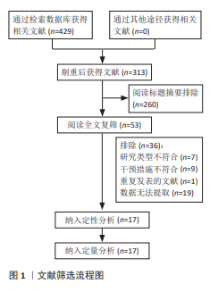
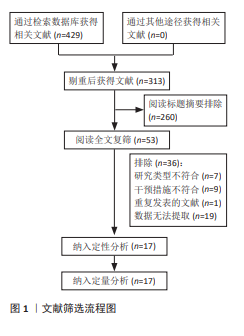
2.1 文献筛选流程及结果 共从数据库中检索出429篇文献,其中PubMed(n=50)、Cochrane Library (n=2)、Web of Science(n=93)、Embase (n=120)、中国知网(n=19)、万方(n=113)、维普(n=9)及中国生物医学文献数据库(n=23)。最终纳入17篇文献,其中英文文献7篇、中文文献10篇。文献筛选流程及结果见图1。"
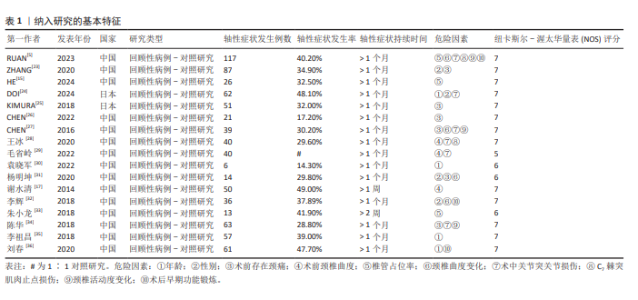
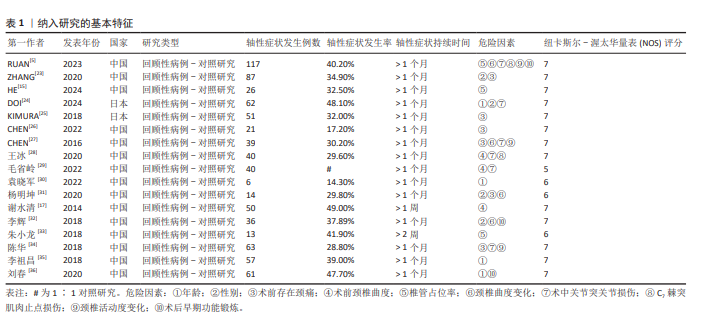
2.2 纳入研究的基本特征和质量评价 此次研究共纳入17篇文献,总样本量为2 156例,其中轴性症状组783例,非轴性症状组1 373例,轴性症状的总发生率为34.88%。文献的基本特征见表1。"
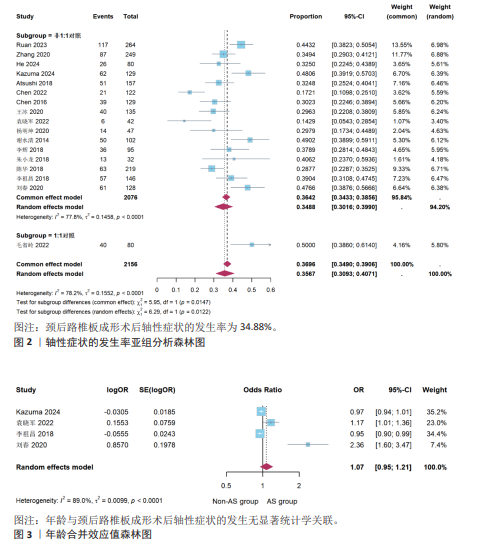
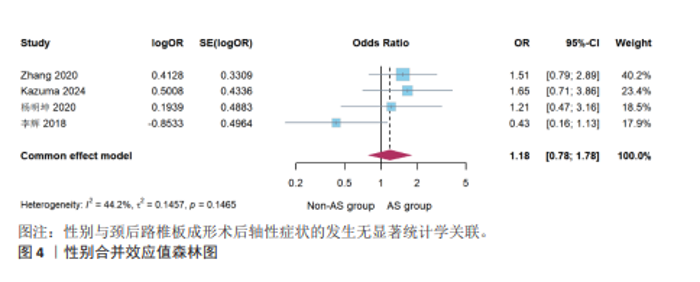
2.3 Meta分析结果 2.3.1 颈后路椎板成形术后轴性症状的发生率 共有17项研究报告了颈后路椎板成形术后轴性症状的发生率[5,15,17,23-36]。结果显示,研究间存在显著异质性,为了进一步探讨异质性的来源,基于文献中是否按照1∶1比例纳入对照组,进行亚组分析,然而,由于1∶1对照组中研究仅为1项,异质性结果仍然较高。此外,由于1∶1对照组在选取患者时严格遵循了与轴性症状组等比例的原则,这可能导致其结果无法准确反映实际发生率。因此,最终分析中将该亚组予以排除。为评估结果的稳定性,进行了敏感性分析,结果显示剔除任意单项研究后,结果均无显著变化。分析结果显示,颈后路椎板成形术后轴性症状的发生率为34.88%(95%CI:0.301 6-0.399 0),结果见图2。 2.3.2 年龄 共有4项研究纳入了年龄这一变量[24,30,35-36]。异质性检验结果显示,I2=89%,P < 0.000 1,提示研究间存在较高的异质性。为进一步探讨异质性的来源,采用逐一排除法对单项研究进行敏感性分析,结果显示剔除任一研究后异质性均未发生显著变化,因此,最终采用随机效应模型对效应值进行合并分析。Meta分析结果显示,年龄与颈后路椎板成形术后轴性症状的发生无显著统计学关联(OR=1.07,95%CI:0.95-1.21,P=0.25),结果见图3。 "
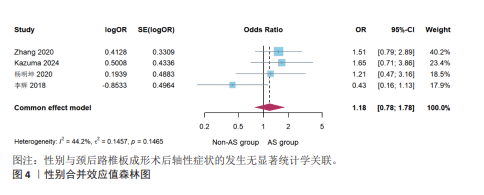
2.3.3 性别 共有4项研究纳入了性别这一变量[23-24,31-32]。异质性检验结果显示,I2=44.2%,P=0.146 5,提示研究间异质性较低。为验证结果的稳健性,采用逐一排除法进行敏感性分析,结果表明剔除任一研究后异质性未出现显著变化,因此,最终采用固定效应模型对效应值进行合并分析。Meta分析结果显示,性别与颈后路椎板成形术后轴性症状的发生无显著统计学关联(OR=1.18,95%CI:0.78-1.78,P=0.68),结果见图4。"
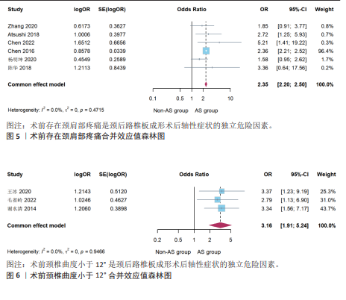
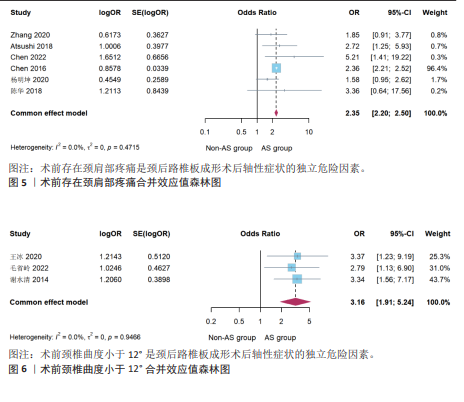
2.3.4 术前存在颈肩部疼痛 共有6项研究纳入了术前存在颈肩部疼痛这一变量[23,25-27,31,34]。异质性检验结果显示,I2=0%,P=0.471 5,提示研究间无显著异质性。为了进一步验证结果的稳定性,采用逐一排除法对单项研究进行敏感性分析,结果表明剔除任一研究后异质性均未发生显著变化,因此,最终采用固定效应模型对效应值进行合并。Meta分析结果显示,术前存在颈肩部疼痛是颈后路椎板成形术后轴性症状的独立危险因素(OR=2.35,95%CI:2.20-2.50,P < 0.000 1),结果见图5。 2.3.5 术前颈椎曲度小于12° 共有3项研究纳入了术前颈椎曲度小于12°这一变量[17,28-29]。异质性检验结果显示,I2=0%,P=0.946 6,提示研究间无显著异质性。为验证分析结果的稳健性,采用逐一排除法对单项研究进行敏感性分析,结果显示剔除任一研究后异质性均未发生显著变化,因此,最终采用固定效应模型对效应值进行合并分析。Meta分析结果显示,术前颈椎曲度小于12°是颈后路椎板成形术后轴性症状的独立危险因素(OR=3.16,95%CI:1.91-5.24,P < 0.000 1),结果见图6。 "
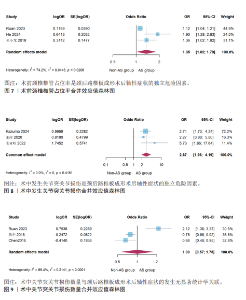
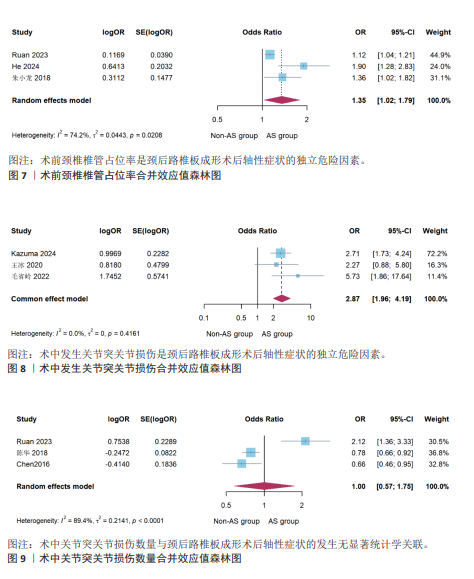
2.3.6 术前颈椎椎管占位率 共有3项研究纳入了术前颈椎椎管占位率这一变量[5,15,33]。异质性检验结果显示,I2=74.2%,P=0.020 8,提示研究间存在较高异质性。为探讨异质性的潜在来源,采用逐一排除法进行敏感性分析,结果显示剔除任一研究后异质性未发生显著变化,分析结果稳定,因此,最终采用随机效应模型对效应值进行合并分析。Meta分析结果表明,术前颈椎椎管占位率是颈后路椎板成形术后轴性症状的独立危险因素(OR=1.35,95%CI:1.02-1.79,P=0.034 0),结果见图7。 2.3.7 术中发生关节突关节损伤 共有3项研究纳入了术中发生关节突关节损伤这一变量的分析[24,28-29]。异质性检验结果显示,I2=0.00%,P=0.416 1,提示研究间无显著异质性。为验证分析结果的稳健性,采用逐一排除法对单项研究进行敏感性分析,结果表明剔除任一研究后异质性未发生显著变化,分析结果仍保持稳定,因此,采用固定效应模型对效应值进行合并分析。Meta分析结果显示,术中发生关节突关节损伤是颈后路椎板成形术后轴性症状的独立危险因素(OR=2.87,95%CI:1.96-4.19,P < 0.000 1),结果见图8。 2.3.8 术中关节突关节损伤数量 共有3项研究纳入了术中关节突关节损伤数量这一变量的分析[5,27,34]。异质性检验结果显示,I2=89.4%,P < 0.000 1,提示研究间存在较高异质性。为探讨异质性的潜在来源,进行了逐一排除法的敏感性分析,结果表明剔除任一研究后异质性未发生显著变化,分析结果稳定,因此,采用随机效应模型对效应值进行合并分析。Meta分析结果显示,术中关节突关节损伤数量与颈后路椎板成形术后轴性症状的发生无显著统计学关联(OR=1.00,95%CI:0.57-1.75,P=0.991),结果见图9。 "
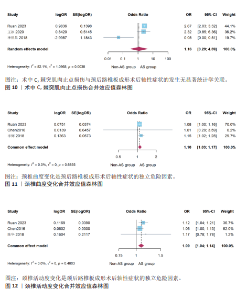
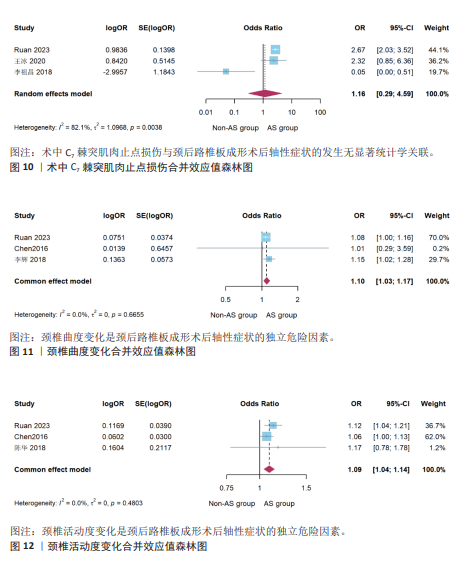
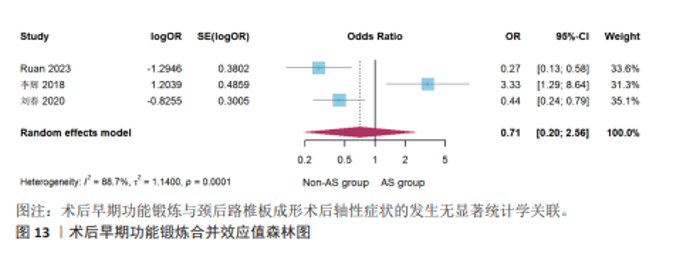
2.3.9 术中C7棘突肌肉止点损伤 共有3项研究纳入了术中C7棘突肌肉止点损伤这一变量的分析[5,28,35]。异质性检验结果显示,I2=82.1%,P=0.003 8,提示研究间存在较高异质性。为进一步探讨异质性的潜在来源,采用逐一排除法对单项研究进行敏感性分析,结果表明剔除任一研究后异质性未发生显著变化,分析结果稳定,因此,最终采用随机效应模型对效应值进行合并分析。Meta分析结果显示,术中C7棘突肌肉止点损伤与颈后路椎板成形术后轴性症状的发生无显著统计学关联(OR=1.16,95%CI:0.29-4.59,P=0.832 8),结果见图10。 2.3.10 颈椎曲度变化 共有4项研究纳入了该变量的分析[5,27,31-32],初步结果显示异质性较大。为明确异质性来源,采用逐一排除法进行敏感性分析,结果表明剔除杨明坤等[31]的研究后,异质性显著降低(I2=0%,P=0.665 5),因此,选用固定效应模型对效应值进行合并分析。分析结果显示,颈椎曲度变化是颈后路椎板成形术后轴性症状的独立危险因素(OR=1.10,95%CI=1.03-1.17,P= 0.002 9)。结果见图11。 2.3.11 颈椎活动度变化 共有3项研究纳入了颈椎活动度变化这一变量的分析[5,27,34]。异质性检验结果显示,I2=0%,P=0.480 3,提示研究间无显著异质性。通过逐一排除法进行敏感性分析,结果表明剔除任一研究后异质性未发生显著变化,分析结果稳定,因此,采用固定效应模型对效应值进行合并分析。Meta分析结果显示,颈椎活动度变化是颈后路椎板成形术后轴性症状的独立危险因素(OR=1.09,95%CI:1.04-1.14,P=0.000 5),结果见图12。 "
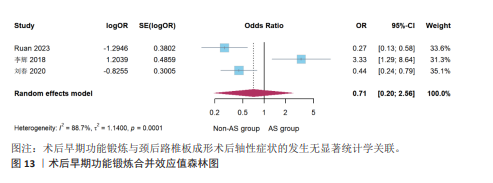
2.3.12 术后早期功能锻炼 共有3项研究纳入了术后早期功能锻炼这一变量的分析[5,32,36]。异质性检验结果显示,I2=88.7%,P=0.000 1,提示研究间存在较高异质性。通过逐一排除法进行敏感性分析,结果表明剔除任一研究后异质性并未显著降低,分析结果稳定,因此,采用随机效应模型对效应值进行合并分析。Meta分析结果显示,术后早期功能锻炼与颈后路椎板成形术后轴性症状的发生无显著统计学关联(OR=0.71,95%CI:0.20-2.56,P=0.597 4),结果见图13。"
"
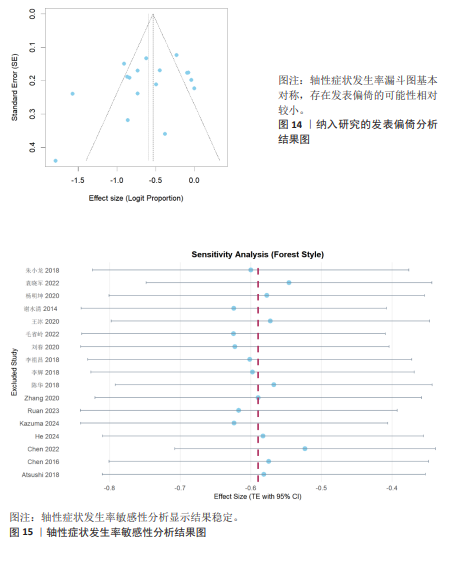
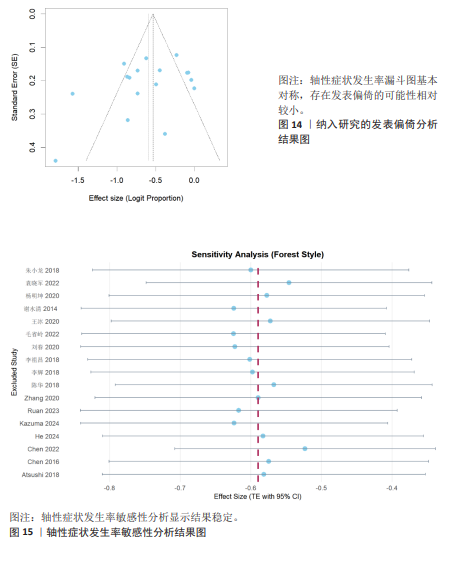
2.4 发表偏倚分析 在纳入的17项研究中,对颈后路椎板成形术后轴性症状的发生率进行发表偏倚分析,结果显示,Egger’s检验结果为P=0.048 6< 0.05,提示无显著的发表偏倚;而Begg’s检验结果为P=0.165 3> 0.05,提示无显著的发表偏倚。进一步结合漏斗图分析发现,除2项研究效应量分布相对离散外,其余研究的效应量分布基本对称,提示存在发表偏倚的可能性较低,结果见图14。此外,通过逐一剔除研究进行敏感性分析,发现结果无显著改变,进一步表明结果具有高度稳定性。结果见图15。"
| [1] STEPHENS BF, RHEE JM, NEUSTEIN TM, et al. Laminoplasty Does not Lead to Worsening Axial Neck Pain in the Properly Selected Patient With Cervical Myelopathy: A Comparison With Laminectomy and Fusion. Spine. 2017;42(24):1844-1850. [2] ZHANG X, GAO Y, GAO K, et al. Factors associated with postoperative axial symptom after expansive open-door laminoplasty: retrospective study using multivariable analysis. Eur Spine J. 2020; 29(11):2838-2844. [3] HOSONO N, YONENOBU K, ONO K. Neck and shoulder pain after laminoplasty. A noticeable complication. Spine. 1996; 21(17):1969-1973. [4] ZHENG B, GUO C, ZHAO C, et al. Global Tendencies and Frontier Topics in Cervical Laminoplasty: A Bibliometric Analysis from 1982 to 2023. World Neurosurg. 2024;191: 91-101. [5] RUAN C, JIANG W, LU W, et al. Analysis of risk factors for axial symptoms after posterior cervical open-door laminoplasty. J Orthop Surg Res. 2023;18(1):954. [6] CHIBA K, OGAWA Y, ISHII K, et al. Long-term results of expansive open-door laminoplasty for cervical myelopathy--average 14-year follow-up study. Spine. 2006;31(26): 2998-3005. [7] LIN CR, TSAI SHL, TSAI PA, et al. What is the best strategy for C3 in open-door laminoplasty: laminectomy versus laminoplasty-a systematic review and meta-analysis. Spine J. 2025;25(7):1440-1454. [8] 仇子叶, 马昱堃, 俞兴, 等. 颈椎术后轴性症状与影像学评价指标相关性的研究进展[J]. 生物骨科材料与临床研究, 2023,20(1):80-84. [9] 单杰. 颈椎单开门术后轴性症状的危险因素分析[D]. 乌鲁木齐:新疆医科大学, 2023. [10] LIU FJ, DING XK, CHAI Y, et al. Influence of fixed titanium plate position on the effectiveness of open-door laminoplasty for cervical spondylotic myelopathy. J Orthop Surg Res. 2022;17(1):297. [11] DU W, WANG S, WANG H, et al. Cervical alignment and clinical outcome of open-door laminoplasty vs. laminectomy and instrumentation in kyphotic multilevel cervical degenerative myelopathy. Arch Orthop Trauma Surg. 2023;143(3): 1429-1440. [12] LI Z, LIANG Q, LI H, et al. Fatty infiltration of the cervical multifidus musculature and its clinical correlation to cervical spondylosis. BMC Musculoskelet Disord. 2023;24(1):613. [13] ZHENG B, ZHU Z, LIANG Y, et al. Cervical Subcutaneous Fat Thickness and Its Association with Sagittal Parameters and Clinical Outcomes Following Laminoplasty in Patients with Cervical Spondylotic Myelopathy. World Neurosurg. 2025;199:124069. [14] JIANG Z, FU X, DU W, et al. Changes in cervical sagittal parameters and the impact on axial symptoms after two types of posterior single-door cervical decompression surgeries. J Clin Neurosci. 2025;137:111293. [15] HE W, PAN J. Influencing factors for axial symptoms after modified expansive open-door laminoplasty. Ceska a Slovenska Neurologie a Neurochirurgie. 2024;87(4): 264-268. [16] KIM AH, AVENDANO JP, GREENBERG M, et al. The Impact of Cervical Laminoplasty and Cervical Foraminotomy on Axial Neck Pain: A Systematic Review and Meta-Analysis. Global Spine J. 2025;15(6): 21925682251319544. [17] 谢水清, 孙天威, 田融, 等. 脊髓型颈椎病单开门椎板成形术后轴性症状的危险因素分析[J]. 中国修复重建外科杂志, 2014,28(5):620-624. [18] STANG A. Critical evaluation of the Newcastle-Ottawa scale for the assessment of the quality of nonrandomized studies in meta-analyses. Eur J Epidemiol. 2010; 25(9):603-605. [19] LI C, TANG X, ZHENG X, et al. Global Prevalence and Incidence Estimates of Oral Lichen Planus: A Systematic Review and Meta-analysis. JAMA Dermatol. 2020;156(2):172-181. [20] PETIT CB, HUSSAIN ZB, MCPHERSON A, et al. Graft Failure in Pediatric Patients After Bone-Patellar Tendon-Bone, Hamstring Tendon, or Quadriceps Tendon Autograft ACLR: A Systematic Review and Meta-analysis. Orthop J Sports Med. 2024;12(11):23259671241289140. [21] ZHAO H, QI C, ZHANG Y, et al. Correlation between uric acid levels and bone mineral density in patients with type 2 diabetes mellitus: a systematic review and meta-analysis. Front Endocrinol (Lausanne). 2025;16:1415550. [22] HUANG T, LI C, CHEN F, et al. Prevalence and risk factors of osteosarcopenia: a systematic review and meta-analysis. BMC Geriatr. 2023;23(1):369. [23] ZHANG X, GAO Y, GAO K, et al. Factors associated with postoperative axial symptom after expansive open-door laminoplasty: retrospective study using multivariable analysis. Eur Spine J. 2020; 29(11):2838-2844. [24] DOI K, OKAZAKI T, TANI S, et al. The new proposal of the relationship between axial pain and hinge fracture and facet involvement after open-door laminoplasty with titanium spacers. J Craniovertebr Junction Spine. 2024;15(3):321-325. [25] KIMURA A, SHIRAISHI Y, INOUE H, et al. Predictors of Persistent Axial Neck Pain After Cervical Laminoplasty. Spine. 2018;43(1): 10-15. [26] CHEN K, YU J, NIE C, et al. Preoperative dynamic quantitative sensory testing in remote pain-free areas is associated with axial pain after posterior cervical spinal surgeries. BMC Musculoskelet Disord. 2022;23(1): 409. [27] CHEN H, LIU H, DENG Y, et al. Multivariate Analysis of Factors Associated With Axial Symptoms in Unilateral Expansive Open-Door Cervical Laminoplasty With Miniplate Fixation. Medicine. 2016;95(2):e2292. [28] 王冰, 刘涛. 单开门椎板成形钢板内固定术后轴性疼痛相关因素分析[J]. 颈腰痛杂志, 2020,41(1):26-28. [29] 毛省岭, 肖江岭. 多节段脊髓型颈椎病患者后路单开门椎管扩大成形术后发生颈椎轴性痛的影响因素分析[J]. 四川解剖学杂志,2022,30(2):11-13. [30] 袁晓军, 徐文华, 林军明, 等. 多裂肌萎缩与颈后路单开门术后轴性症状发生的相关性研究[J]. 宜春学院学报,2022, 44(12):48-51. [31] 杨明坤, 张旭, 刘川, 等. 改良椎管扩大成形术术后发生轴性症状的危险因素分析[J]. 国际骨科学杂志,2020,41(5): 318-322. [32] 李辉, 郝定均, 刘鹏, 等. 颈后路单开门椎板成形术后轴性症状的危险因素分析[J]. 临床医学研究与实践, 2018,3(30): 99-102. [33] 朱小龙, 徐卫星, 丁伟国, 等. 颈椎单开门椎板成形术术后轴性症状的影响因素分析[J]. 中国骨伤,2018,31(11): 1022-1026. [34] 陈华, 刘浩, 龚全, 等. 颈椎单开门椎管扩大椎板成形微型钢板内固定术后轴性疼痛的危险因素[J]. 中国脊柱脊髓杂志, 2018,28(2):111-117. [35] 李祖昌, 蒋继乐, 田伟, 等. 颈椎后路双开门椎管成形术后发生轴性症状的危险因素分析[J]. 中华骨科杂志,2018,38(16): 1009-1015. [36] 刘春, 亢志强, 杨辉, 等. 慢性压迫性颈脊髓病患者行C3-C7单开门椎板成形术后发生轴性症状影响因素分析[J]. 中国药物与临床,2020,20(15):2509-2513. [37] YOSHIDA M, TAMAKI T, KAWAKAMI M, et al. Does reconstruction of posterior ligamentous complex with extensor musculature decrease axial symptoms after cervical laminoplasty? Spine. 2002; 27(13):1414-1418. [38] PINTER ZW, MIKULA AL, REED R, et al. Is Severe Neck Pain a Contraindication to Performing Laminoplasty in Patients With Cervical Spondylotic Myelopathy? Clin Spine Surg. 2023;36(3):127-133. [39] WANG H, XU H, WANG X, et al. Imbalance of Muscles Around the Cervical Spine in Patients with Degenerative Cervical Spondylotic Kyphosis and Myelopathy. World Neurosurg. 2025;195:123605. [40] 张黎龙, 邵睿, 耿彦南, 等. 术前C7/T1椎间孔面积对后路单开门椎管扩大成形术治疗脊髓型颈椎病疗效的影响[J]. 中国脊柱脊髓杂志,2024,34(5): 458-462. [41] WANG LN, WANG L, SONG YM, et al. Clinical and radiographic outcome of unilateral open-door laminoplasty with alternative levels centerpiece mini-plate fixation for cervical compressive myelopathy: a five-year follow-up study. Int Orthop. 2016; 40(6):1267-1274. [42] KOBAYASHI H, NIKAIDO T, WATANABE K, et al. Impact of Cervical Micro-Endoscopic Laminotomy on Postoperative Neck Pain and Range of Motion: A Case-Control Study. Spine. 2025. doi: 10.1097/BRS.0000000000005305. [43] 崔致尧, 闫景龙, 姬烨. 颈椎椎管扩大成形术的研究进展[J]. 实用骨科杂志, 2021,27(9):811-814+858. [44] 江仲超, 韩晓辉, 袁宇飞, 等. 颈椎单开门椎管扩大成形术中重建伸肌附着点及保留C7棘突开槽式减压的临床疗效观察[J]. 科学技术与工程,2022,22(19): 8248-8252. [45] SHANGGUAN Z, CHEN G, LIU W, et al. Clinical outcomes of modified versus traditional expansive open-door laminoplasty for cervical spondylotic myelopathy: A single-institution experience. J Orthop Surg (Hong Kong). 2023;31(3):10225536231209556. [46] 王晓岩, 徐公平, 王新涛, 等. C2穹隆减压术联合棘突悬吊椎管扩大成形术治疗颈椎高位后纵韧带骨化症[J]. 中华骨与关节外科杂志,2024,17(12):1057-1062. [47] COHEN SP, HUANG JH, BRUMMETT C. Facet joint pain--advances in patient selection and treatment. Nat Rev Rheumatol. 2013; 9(2):101-116. [48] MACHINO M, YUKAWA Y, HIDA T, et al. Cervical alignment and range of motion after laminoplasty: radiographical data from more than 500 cases with cervical spondylotic myelopathy and a review of the literature. Spine. 2012;37(20):E1243-1250. [49] YU Q, REN Y, WANG Z, et al. The Effect of a Cervical Brace on Postoperative Axial Symptoms Following Single-level Anterior Cervical Discectomy and Fusion. Clin Spine Surg. 2025;38(3):E181-E185. [50] TAKEUCHI K, YOKOYAMA T, ABURAKAWA S, et al. Axial symptoms after cervical laminoplasty with C3 laminectomy compared with conventional C3-C7 laminoplasty: a modified laminoplasty preserving the semispinalis cervicis inserted into axis. Spine. 2005;30(22):2544-2549. |
| [1] | Shi Yaozhou, Jia Fanglin, Zhang Heling, Song Hanlin, Gao Haoran, Gao Xiao, Sun Wei, Feng Hu. Establishment and validation of a prediction model for axial symptoms after laminectomy with lateral mass screw fixation [J]. Chinese Journal of Tissue Engineering Research, 2026, 30(9): 2269-2277. |
| [2] | Zhang Zizheng, Luo Wang, Liu Changlu. Application value of finite element analysis on unicompartmental knee arthroplasty for medial knee compartmental osteoarthritis [J]. Chinese Journal of Tissue Engineering Research, 2026, 30(9): 2313-2322. |
| [3] | Zhao Feifan, Cao Yujing. Risk factors and coping strategies of internal fixation failure in treatment of intertrochanteric fracture with proximal femoral nail antirotation [J]. Chinese Journal of Tissue Engineering Research, 2026, 30(9): 2323-2333. |
| [4] | He Yixiang, Qiao Wanjia, Wang Wenji. Effectiveness and safety of tranexamic acid versus epsilon-aminocaproic acid in total hip and knee arthroplasties: a meta-analysis [J]. Chinese Journal of Tissue Engineering Research, 2026, 30(9): 2361-2369. |
| [5] | Liu Jinlong, Abuduwupuer·Haibier, Bai Zhen, Su Danyang, Miao Xin, Li Fei, Yang Xiaopeng. Efficacy of different nonsurgical treatments for adolescent idiopathic scoliosis: a systematic review and network meta-analysis [J]. Chinese Journal of Tissue Engineering Research, 2026, 30(9): 2370-2379. |
| [6] | Li Qingbin, Lin Jianhui, Huang Wenjie, Wang Mingshuang, Du Jiankai, Lao Yongqiang. Bone cement filling after enlarged curettage of giant cell tumor around the knee joint: a comparison of subchondral bone grafting and non-grafting [J]. Chinese Journal of Tissue Engineering Research, 2026, 30(8): 1896-1902. |
| [7] | Gao Feng, Zhang Jun, Yu Wenjun, Chanyu Yujing, Zhao Le, Hu Yuting, Wang Junhua, Liu Yongfu. Effects of wrist-hand orthosis on hand dysfunction in stroke patients: a meta-analysis [J]. Chinese Journal of Tissue Engineering Research, 2026, 30(8): 2124-2131. |
| [8] | Wang Zhenze, Liu Fende, Zhang Rui, Li Wujun. Mesenchymal stem cells in treatment of arteriosclerosis obliterans of lower extremities: systematic review and meta-analysis [J]. Chinese Journal of Tissue Engineering Research, 2026, 30(7): 1869-1876. |
| [9] | Zheng Yin, Wu Zhenhua, Zhang Cheng, Ruan Kexin, Gang Xiaolin, Ji Hong. Safety and efficacy of immunoadsorption therapy for rheumatoid arthritis: a network meta-analysis and systematic review [J]. Chinese Journal of Tissue Engineering Research, 2026, 30(5): 1260-1268. |
| [10] | Chen Qiang, Wu Wenjuan, Jiang Shuhua, Huang Da. Physical exercise improves physical function in burn patients: a systematic review and meta-analysis [J]. Chinese Journal of Tissue Engineering Research, 2026, 30(5): 1269-1281. |
| [11] | Leng Xiaoxuan, Zhao Yuxin, Liu Xihua. Effects of different neuromodulatory stimulation modalities on non-motor symptoms in Parkinson’s patients: a network meta-analysis [J]. Chinese Journal of Tissue Engineering Research, 2026, 30(5): 1282-1293. |
| [12] | Wen Xiaolong, Weng Xiquan, Feng Yao, Cao Wenyan, Liu Yuqian, Wang Haitao. Effects of inflammation on serum hepcidin and iron metabolism related parameters in patients with type 2 diabetes mellitus: a meta-analysis [J]. Chinese Journal of Tissue Engineering Research, 2026, 30(5): 1294-1301. |
| [13] | Jiang Yang, Peng Hao, Song Yanping, Yao Na, Song Yueyu, Yin Xingxiao, Li Yanqi, Chen Qigang. Isometric exercise reduces resting blood pressure: a meta-analysis of moderating factors and dose effects [J]. Chinese Journal of Tissue Engineering Research, 2026, 30(4): 975-986. |
| [14] | Li Hanyue, Li Yini, Xiang Linmei, Li Sen. Effects of resistance exercise therapy on pain and function in patients with cervical spondylotic radiculopathy: a meta-analysis [J]. Chinese Journal of Tissue Engineering Research, 2026, 30(4): 987-996. |
| [15] | Sun Jiahe, Shi Jipeng, Zhu Tianrui, Quan Helong, Xu Hongqi. Effect of exercise intervention in elderly individuals with sarcopenia and its comorbidities: a meta-analysis [J]. Chinese Journal of Tissue Engineering Research, 2026, 30(4): 997-1007. |
| Viewed | ||||||
|
Full text |
|
|||||
|
Abstract |
|
|||||