Chinese Journal of Tissue Engineering Research ›› 2026, Vol. 30 ›› Issue (15): 3993-4009.doi: 10.12307/2026.738
Previous Articles Next Articles
Network meta-analysis of core decompression combined with various therapies for early and mid-stage osteonecrosis of the femoral head
Guo Yuqi1, Li Jiacheng2, Lu Bowen1, Zhang Jiahao1, Li Gang2
- 1First Clinical Medical College, Shandong University of Traditional Chinese Medicine, Jinan 250014, Shandong Province, China; 2Department of Orthopedics and Traumatology, Affiliated Hospital of Shandong University of Traditional Chinese Medicine, Jinan 250014, Shandong Province, China
-
Accepted:2025-07-09Online:2026-05-28Published:2025-11-10 -
Contact:Li Gang, MD, Professor, Chief physician, Doctoral supervisor, Department of Orthopedics and Traumatology, Affiliated Hospital of Shandong University of Traditional Chinese Medicine, Jinan 250014, Shandong Province, China -
About author:Guo Yuqi, Master candidate, First Clinical Medical College, Shandong University of Traditional Chinese Medicine, Jinan 250014, Shandong Province, China -
Supported by:Taishan Scholar Distinguished Expert (Selected in the Year 2025-Li Gang) Project, No. tsxztpzj-02 (to LG); Shandong Provincial Key Research & Development Program (Major Scientific and Technological Innovation Project), No. 2021CXGC010501 (to LG); Shandong Provincial Natural Science Foundation, No. ZR2022LZY003 (to LJC)

CLC Number:
Cite this article
Guo Yuqi, Li Jiacheng, Lu Bowen, Zhang Jiahao, Li Gang. Network meta-analysis of core decompression combined with various therapies for early and mid-stage osteonecrosis of the femoral head[J]. Chinese Journal of Tissue Engineering Research, 2026, 30(15): 3993-4009.
share this article
Add to citation manager EndNote|Reference Manager|ProCite|BibTeX|RefWorks
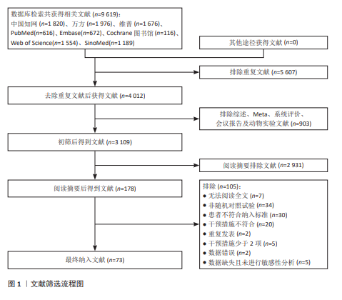
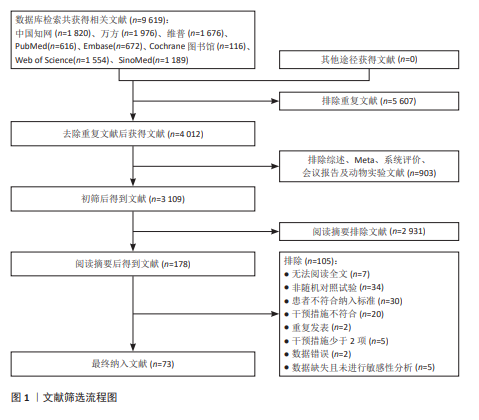
2.1 文献检索 共检索获得相关文献9 619篇,去重后保留4 012篇。阅读标题初筛,排除不符合类型或主题的文献903篇,剩余3 109篇进入进一步筛查。通过阅读摘要筛选排除2 931篇后,获取178篇需阅读全文的文献。复筛过程中,因不符合纳入标准、干预或人群不符、数据错误或重复发表等原因,再排除105篇。最终共纳入73篇随机对照试验用于Meta分析。文献筛选流程见图1。"
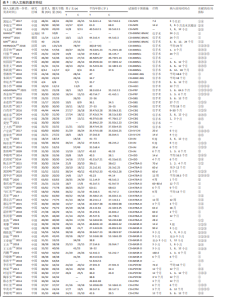
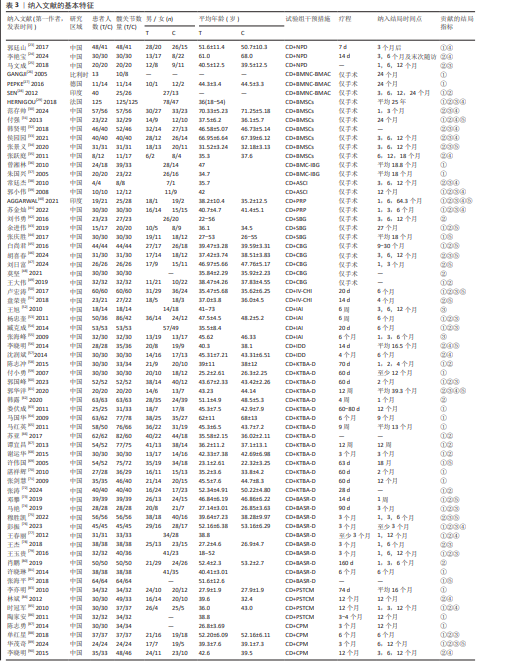
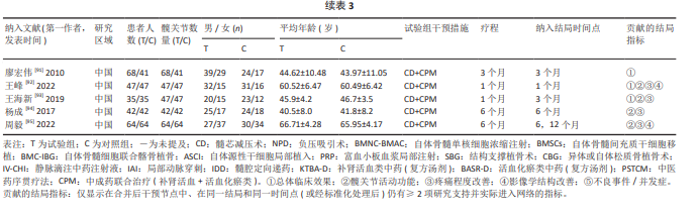
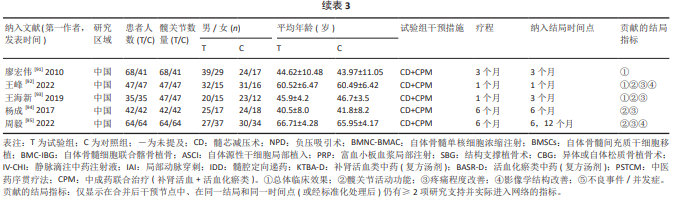
2.2 文献基本特征 共纳入73项随机对照试验[23-95],均为双臂设计,研究对象包括5 148例患者,共计5 777个髋关节,其中试验组2 975髋,对照组2 802髋。所有干预措施均为髓芯减压术联合其他治疗方式,共计15种,包括髓芯减压术+负压吸引术(negative pressure drainage,NPD)3篇[23-25]、髓芯减压术+自体骨髓单核细胞浓缩注射(bone marrow aspirate concentrate of mononuclear cells,BMNC-BMAC)3篇[26-28]、髓芯减压术+自体骨髓间充质干细胞移植(bone marrow mesenchymal stem cell ransplantation,BMSCs)7篇[29-35]、髓芯减压术+自体骨髓细胞联合髂骨植骨(bone marrow cells and iliac bone grafting,BMC-IBG)2篇[36-37]、髓芯减压术+自体源性干细胞局部植入(autologous stem cell implantation,ASCI)2篇[38-39]、髓芯减压术+富血小板血浆局部注射(platelet-rich plasma injection,PRP)2篇[40-41]、髓芯减压术+结构支撑植骨术(structural bone grafting,SBG)3篇[42-44]、髓芯减压术+异体或自体松质骨植骨术(cancellous bone grafting,CBG)5篇[45-49]、髓芯减压术+静脉滴注中药注射液(intravenous Chinese herbal injection,IV-CHI)2篇[50-51]、髓芯减压术+局部动脉穿刺注射治疗(intra-arterial infusion,IAI)4篇[52-55]、髓芯减压术+髓腔定向递药治疗(intramedullary targeted drug delivery,IDD)2篇[56-57]、髓芯减压术+补肾活血类中药(复方汤剂)(kidney-tonifying and blood-activating decoction,KTBA-D)15篇[58-72]、髓芯减压术+活血化瘀类中药(复方汤剂)(blood-activating and stasis-resolving decoction,BASR-D)10篇[73-82]、髓芯减压术+中医药序贯治疗(sequential traditional Chinese medicine therapy,PSTCM)4篇[83-86]、髓芯减压术+中成药联合治疗(补肾活血+活血化瘀)(compound proprietary medicine treatment,CPM)9篇[87-95]。所有研究发表时间为2005-2024年,其中中文文献68篇,英文文献5篇。纳入文献的基本特征见表3。"
"
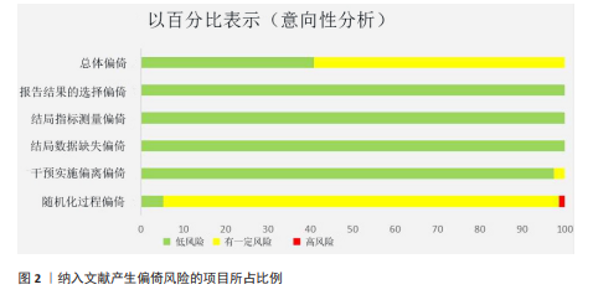
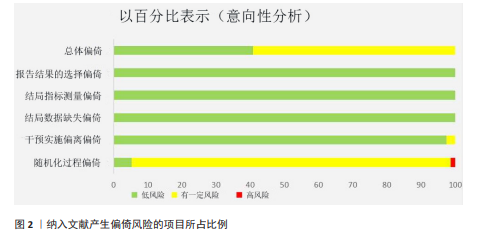
2.3 文献质量评价 研究采用Cochrane推荐的RoB 2.0工具对纳入的73项随机对照试验进行偏倚风险评估。在随机过程方面,共有24篇文献采用随机数字表法进行分组[30,33-34,39-40,43,45,52,55,58-60,62,64,69,71,73,75-76,85,90,92,94-95],1篇采用抽签法[47],2篇采用信封法[57,24],5篇依据就诊顺序随机编号分组[51,61,67,86,89],1篇虽未说明随机方法但实施双盲设计[26],评为低风险,其余40篇未报告具体随机方法,评为有一定风险。在盲法方面,1篇提及单盲[91]、2篇提及双盲[26,31],评为低风险;69篇未提及分配隐藏,评为有一定风险;1篇提及不设盲[34],评为高风险。所有文献均具有完整的结局数据,未出现剔除与脱落,评为低风险。所有文献全面报告了明确的结局指标,且报告了结局指标有无统计学意义,评为低风险。所有文献结局数据均采用恰当的测量方法,评为低风险。所有文献均无结果选择性报告偏倚,评为低风险。总体来看,文献质量较好,偏倚主要集中在随机方法和盲法信息的报告不足,见图2。"
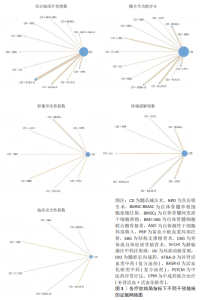
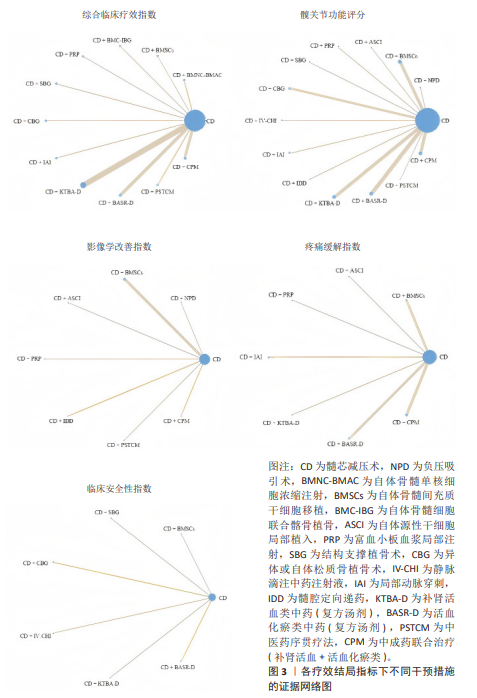
2.4 证据网络与模型选择 图3展示了15种髓芯减压术联合干预在5项疗效结局指标(综合临床疗效指数、髋关节功能评分、影像学改善指数、疼痛缓解指数、临床安全性指数)下构建的证据网络。图中节点代表各干预措施,节点大小与样本量相关,连线粗细则反映干预间直接比较研究的数量,体现证据的丰富程度。表4汇总了各结局指标在固定效应与随机效应模型下的一致性模型拟合情况,包括偏差信息准则(DIC)和有效参数数目(effective number of parameters,pD)及异质性评估结果:异质性指数(inconsistency index,I2)和潜在尺度缩减因子(PSRF)。综合模型拟合优度与异质性指标,为每项结局确定最优模型以供后续分析使用。"
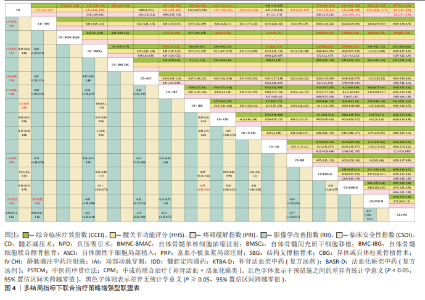
2.5 网状Meta分析 44篇随机对照试验报告了综合临床疗效指数[26-29,31,36-37,40-41,43-45,49,53-54,58-60,63-74,76-77,79,81-83,85-89,91-93],涉及11种联合治疗策略。网状Meta分析结果表明,在改善综合临床疗效指数方面,髓芯减压术联合多种治疗策略均显示出优于单纯髓芯减压术治疗的疗效。其中,髓芯减压术+自体骨髓单核细胞浓缩注射[SMD=-1.71,95%CrI(-2.27,-1.16)]、髓芯减压术+自体骨髓间充质干细胞移植[SMD= -1.19,95%CrI(-1.48,-0.90)]、髓芯减压术+自体骨髓细胞联合髂骨植骨[SMD=-1.29,95%CrI (-2.13,-0.44)]、髓芯减压术+富血小板血浆局部注射[SMD=-0.59,95%CrI(-1.08, -0.11)]以及髓芯减压术+结构支撑植骨术[SMD=-1.18,95%CrI(-2.04,-0.32)]在提高综合临床疗效指数方面均具有统计学意义。此外,干预措施之间亦存在差异。髓芯减压术+自体骨髓间充质干细胞移植与髓芯减压术+富血小板血浆局部注射[SMD= 0.59,95%CrI(0.03,1.16)]和髓芯减压术+异体或自体松质骨植骨术[SMD=0.56,95%CrI(0.02,1.13)]的比较中显示出更优的临床疗效,且髓芯减压术+异体或自体松质骨植骨术亦优于髓芯减压术+结构支撑植骨术[SMD=0.65,95%CrI(0.32,1.63)],具有统计学意义。尽管髓芯减压术+局部动脉穿刺与髓芯减压术+自体骨髓单核细胞浓缩注射[SMD=-0.48,95%CrI(-1.03,0.07)]未达到显著性水平,但髓芯减压术+补肾活血类中药(复方汤剂) [SMD=-0.74,95%CrI(-0.96,-0.51)]、髓芯减压术+活血化瘀类中药(复方汤剂)[SMD=-0.69,95%CrI (-1.01,-0.38)]以及髓芯减压术+中医药序贯疗法[SMD=-0.63,95%CrI(-1.13,-0.13)]相较于髓芯减压术单独治疗更具优势且具有统计学意义。值得注意的是,髓芯减压术+中成药联合治疗在与多个干预方案的比较中均表现出更优的疗效,其相较于髓芯减压术[SMD= -0.77,95%CrI(-1.10,-0.44)]和髓芯减压术+富血小板血浆局部注射[SMD=-0.52,95%CrI(-0.39,-1.34)]均具有统计学意义。综上,自体骨髓单核细胞浓缩注射、自体骨髓间充质干细胞移植、自体骨髓细胞联合髂骨植骨、结构支撑植骨术及中成药联合治疗等联合治疗方案在提升综合临床疗效指数方面具有显著优势,见图4。"
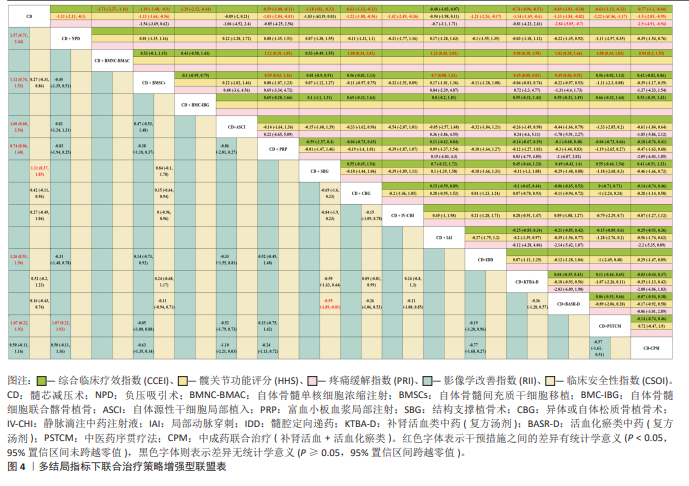
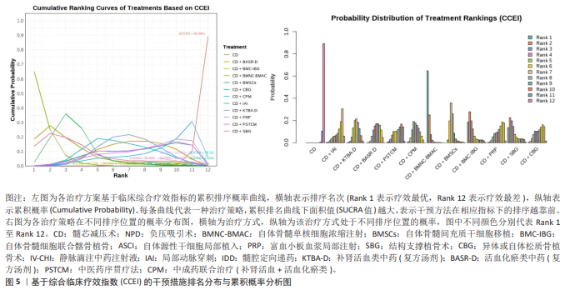
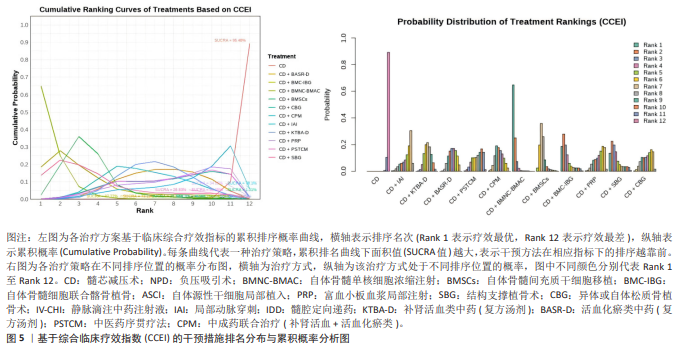
50篇随机对照试验报告了髋关节功能评分[24-25,29-35,38-43,45-51,53-54,56-58,60,62,66-68,72-80,84-85,88-90,92-95],涉及13种联合治疗策略。网状Meta分析结果显示,在改善髋关节功能评分方面,髓芯减压术联合多种治疗策略较单纯髓芯减压术表现出更优的疗效,其中髓芯减压术+负压吸引术[SMD=-1.11,95%CrI(-2.13,-0.10)]、 髓芯减压术+自体骨髓间充质干细胞移植[SMD=-1.11,95%CrI (-1.66,-0.56)]、髓芯减压术+富血小板血浆局部注射[SMD= -1.03,95%CrI(-2.04,-0.01)]、髓芯减压术+结构支撑植骨术[SMD=-1.03,95%CrI(-2.09,-0.03)]、髓芯减压术+异体或自体松质骨植骨术[SMD=-1.22,95%CrI(-1.88,-0.56)]、髓芯减压术+静脉滴注中药注射液[SMD=-1.42,95%CrI(-2.49,-0.36)]、 髓芯减压术+活血化瘀类中药(复方汤剂)[SMD=-1.33,95%CrI(-1.84,-0.82)]、 髓芯减压术+中医药序贯疗法[SMD=-2.22,95%CI(-3.27,-1.17)]及髓芯减压术+中成药联合治疗[SMD=-1.50, 95%CI(-2.05,-0.95)]均可显著提高患者的髋关节功能,差异有统计学意义。在不同联合治疗方案的相互比较中,髓芯减压术+中医药序贯疗法相较于髓芯减压术+补肾活血类中药(复方汤剂) [SMD=-1.33,95%CrI(-2.65,-0.27)]、髓芯减压术+活血化瘀类中药(复方汤剂)[SMD=-1.33,95%CrI (-2.68,-0.03)]以及髓芯减压术+中成药联合治疗[SMD=-1.28,95%CrI(-2.24,-0.24)]均显示出显著优势。髓芯减压术+中成药联合治疗亦在部分干预方法对比中表现较好,例如相较于髓芯减压术+富血小板血浆局部注射[SMD=-0.61,95%CrI (-1.84,0.64)]和髓芯减压术+髓腔定向递药[SMD= -0.29,95%CrI(-1.47,0.89)]显示出改善趋势,虽部分差异未达统计学显著性,但潜在的临床价值仍具参考意义,见图4。 26篇随机对照试验报告了疼痛缓解指数[29-30,32-34,38-41,52-55,60-61,74-76,78-79,88-89,92-95], 涉及7种联合治疗策略。网状Meta分析结果显示,在疼痛缓解指数方面,与单独采用髓芯减压术相比,多种联合治疗策略均表现出不同程度的优势。具体而言,髓芯减压术+自体骨髓间充质干细胞移植[SMD=-1.54,95%CrI(-3.69,0.62)]、髓芯减压术+自体源性干细胞局部植入[SMD= -1.06,95%CrI(-4.52,2.40)]、髓芯减压术+富血小板血浆局部注射[SMD=-0.85,95%CrI(-4.25,2.56)]、髓芯减压术+局部动脉穿刺[SMD=-0.70,95%CrI(-3.10,1.71)]、髓芯减压术+补肾活血类中药(复方汤剂)[SMD=-0.81,95%CrI(-4.23,2.61)]、髓芯减压术+活血化瘀类中药(复方汤剂)[SMD=-2.84,95%CrI(-5.05,-0.70)]以及髓芯减压术+中成药联合治疗[SMD=-2.90,95%CrI(-4.91,-0.94)]均显示出疼痛缓解的趋势。其中,髓芯减压术+活血化瘀类中药(复方汤剂)与髓芯减压术+中成药联合治疗的比较差异有统计学意义,提示其在疼痛控制方面具有明确优势。进一步的干预间比较结果显示,髓芯减压术+ 中成药联合治疗相较于髓芯减压术+自体骨髓间充质干细胞移植[SMD=-1.37,95%CrI(-4.33,1.54)]、髓芯减压术+自体源性干细胞局部植入[SMD=-1.85,95%CrI(-5.86,2.15)]以及髓芯减压术+富血小板血浆局部注射[SMD=-2.05,95%CrI(-6.03,1.85)]等在减轻疼痛方面呈现出更为显著的改善趋势。髓芯减压术+活血化瘀类中药(复方汤剂)在与髓芯减压术+富血小板血浆局部注射[SMD=-1.78,95%CrI(-5.91,2.27)]及髓芯减压术+自体骨髓间充质干细胞移植[SMD=-1.31,95%CrI (-4.64,1.73)]的比较中亦展现出一致的疗效优势。尽管部分置信区间较宽,存在一定统计不确定性,但整体疗效趋势明确,见图4。 19篇随机对照试验报告了影像学改善指数[23-24,29-33,35,38-41,76-77,84-85,90,92,95], 涉及7种联合治疗策略。网状Meta分析结果显示,在改善影像学改善指数方面,与单纯髓芯减压术相比,多种联合干预方案在不同程度上呈现出影像结构修复的潜在优势。具体而言,髓芯减压术+负压吸引术[SMD=-1.57,95%CrI(-2.44,0.71)]、髓芯减压术+自体骨髓间充质干细胞移植[SMD=-1.12,95%CrI(-1.53,0.74)]、髓芯减压术+富血小板血浆局部注射[SMD=-0.74,95%CrI(-1.40,0.06)]、髓芯减压术+髓腔定向递药[SMD=-1.26,95%CrI(-1.96,0.51)]、髓芯减压术+中医药序贯疗法[SMD=-1.07,95%CrI(-1.93,0.22)]以及髓芯减压术+中成药联合治疗[SMD=-0.50,95%CrI(-1.16,0.11)]均较常规髓芯减压术表现出更优趋势,尽管差异未达统计学显著性。值得关注的是,髓芯减压术+自体源性干细胞局部植入[SMD=-1.60,95%CrI(-2.54,-0.68)] 为唯一在统计学上具有显著差异的干预组合,提示其在促进骨结构重建方面可能具有确切疗效。进一步的干预间比较结果亦显示,髓芯减压术+中成药联合治疗相较于髓芯减压术+自体源性干细胞局部植入[SMD=1.11,95%CrI(-0.03,2.21)]与髓芯减压术+自体骨髓间充质干细胞移植[SMD=0.63,95%CrI(-0.14,1.46)]表现出一定的结构改善趋势;髓芯减压术+中医药序贯疗法与髓芯减压术+自体源性干细胞局部植入[SMD=0.52,95%CrI(-0.73,1.79)]之间亦呈现出类似正向变化,尽管均未达到统计学显著性,见图4。 14篇随机对照试验报告了临床安全性指数[31,34,43-47,50-51,61,69,73,75,82], 涉及6种联合治疗策略。网状Meta分析结果显示,在降低临床安全性指数方面,髓芯减压术联合不同干预措施在大多数比较中并未展现出统计学显著优势,但部分方案在安全性方面显示出相对良好的趋势。具体来看,髓芯减压术+自体骨髓间充质干细胞移植[SMD=0.27,95%CrI(-0.31,0.86)]、髓芯减压术+结构支撑植骨术[SMD=1.11,95%CrI(0.37,1.85)]、髓芯减压术+异体或自体松质骨植骨术[SMD=0.42,95%CrI(-0.11,0.96)]、髓芯减压术+静脉滴注中药注射液[SMD=0.27,95%CrI (-0.49,1.04)]、髓芯减压术+补肾活血类中药(复方汤剂) [SMD=0.52,95%CrI(-0.20,1.23)]以及髓芯减压术+活血化瘀类中药(复方汤剂)[SMD=0.16,95%CrI(-0.43,0.74)]在减少临床安全性指数方面均未达到统计学显著性,提示联合干预在安全性方面与常规髓芯减压术相近。其中,髓芯减压术+结构支撑植骨术呈现出较高标准化均数差,但置信区间包含0,且上限较宽。进一步的干预间比较结果显示,髓芯减压术+自体骨髓间充质干细胞移植在与髓芯减压术+结构支撑植骨术[SMD=0.84,95%CrI(-0.10,1.78)]、髓芯减压术+异体自体松质骨植骨术[SMD= 0.15,95%CrI(-0.64,0.94)]及其他方案比较中,未见显著差异;而髓芯减压术+结构支撑植骨术相较于髓芯减压术+活血化瘀类中药(复方汤剂)[SMD=-0.95,95%CrI(-1.89,-0.01)]有统计学差异,提示髓芯减压术+活血化瘀类中药(复方汤剂)在降低不良反应方面可能更具安全优势。此外,髓芯减压术+补肾活血类中药(复方汤剂) 与其他组合之间如髓芯减压术+静脉滴注中药注射液[SMD=-0.36,95%CrI(-1.28,0.57)]亦未表现出显著差异,见图4。 2.6 SUCRA排序 为进一步明确不同干预措施在各结局指标上的综合排名,绘制了基于综合临床疗效指数的SUCRA累计排名曲线与干预措施的秩位概率分布图(图5)。 综合临床疗效指数方面:髓芯减压术+自体骨髓单核细胞浓缩注射显示出最优的干预效果。根据SUCRA值排序,髓芯减压术+自体骨髓单核细胞浓缩注射(96.23%)在所有干预措施中占据首位,其后依次为髓芯减压术+自体骨髓间充质干细胞移植(80.23%)、髓芯减压术+自体骨髓细胞联合髂骨植骨(78.95%)、髓芯减压术+结构支撑植骨术(73.53%)、髓芯减压术+中成药联合治疗(49.35%)、髓芯减压术+补肾活血类中药(复方汤剂) (46.23%)、髓芯减压术+活血化瘀类中药(复方汤剂)(41.82%)、髓芯减压术+异体或自体松质骨植骨术(36.83%)、髓芯减压术+中医药序贯疗法(36.67%)、髓芯减压术+富血小板血浆局部注射(33.54%)、髓芯减压术+局部动脉穿刺(25.98%),而单纯髓芯减压术的干预效果最低(0.62%)。 髋关节功能评分方面:髓芯减压术+中医药序贯疗法显示出最优的干预效果。根据SUCRA值排序,髓芯减压术+中医药序贯疗法(93.85%)在所有干预措施中占据首位,其后依次为髓芯减压术+中成药联合治疗(72.46%)、髓芯减压术+静脉滴注中药注射液(64.16%)、髓芯减压术+活血化瘀类中药(复方汤剂)(61.37%)、髓芯减压术+异体或自体松质骨植骨术(53.33%)、髓芯减压术+髓腔定向递药(52.98%)、髓芯减压术+局部动脉穿刺(48.02%)、髓芯减压术+负压吸引术(47.20%)、髓芯减压术+自体骨髓间充质干细胞移植(45.38%)、髓芯减压术+结构支撑植骨术(43.13%)、髓芯减压术+富血小板血浆局部注射(42.77%)、髓芯减压术+自体骨髓单核细胞浓缩注射(37.94%)、髓芯减压术+自体源性干细胞局部植入(36.05%),而单纯髓芯减压术的干预效果最低(1.38%)。 疼痛缓解指数方面:髓芯减压术+中成药联合治疗显示出最优的干预效果。根据SUCRA值排序,髓芯减压术+中成药联合治疗(83.21%)在所有干预措施中占据首位,其后依次为髓芯减压术+活血化瘀类中药(复方汤剂)(81.65%)、髓芯减压术+自体骨髓间充质干细胞移植(55.53%)、髓芯减压术+自体源性干细胞局部植入(44.98%)、髓芯减压术+富血小板血浆局部注射(40.55%)、髓芯减压术+补肾活血类中药(复方汤剂) (40.14%)、髓芯减压术+局部动脉穿刺(36.64%),而单纯髓芯减压术的干预效果最低(17.58%)。 影像学改善指数方面:髓芯减压术+自体源性干细胞局部植入显示出最优的干预效果。根据SUCRA值排序,髓芯减压术+自体源性干细胞局部植入(82.56%)在所有干预措施中占据首位,其后依次为髓芯减压术+负压吸引术(82.02%)、髓芯减压术+髓腔定向递药(66.27%)、髓芯减压术+自体骨髓间充质干细胞移植(57.91%)、髓芯减压术+中医药序贯疗法(54.22%)、髓芯减压术+富血小板血浆局部注射(33.81%)、髓芯减压术+中成药联合治疗(22.09%),而单纯髓芯减压术的干预效果最低(1.12%)。 临床安全性指数方面:髓芯减压术+结构支撑植骨术显示出最优的干预效果。根据SUCRA值排序,髓芯减压术+结构支撑植骨术(94.56%)在所有干预措施中占据首位,其后依次为髓芯减压术+补肾活血类中药(复方汤剂) (63.06%)、髓芯减压术+异体或自体松质骨植骨术(57.38%)、髓芯减压术+自体骨髓间充质干细胞移植(43.73%)、髓芯减压术+静脉滴注中药注射液(43.41%)、髓芯减压术+活血化瘀类中药(复方汤剂)(33.49%),而单纯髓芯减压术的干预效果最低(14.37%)。"
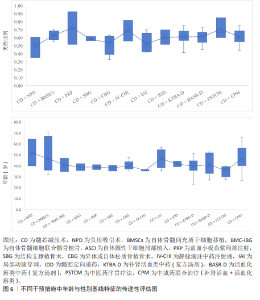
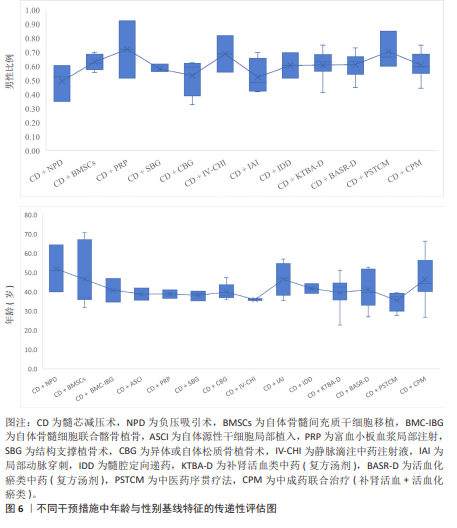
2.7 传递性评估 由于网状证据图中未形成闭合环,各干预措施之间仅存在间接比较关系,因此进一步对传递性假设进行检验。考虑到协变量在不同干预组间分布的潜在差异可能影响间接比较的可靠性,选取年龄作为关键基线变量,采用箱线图对各干预措施下患者年龄的分布情况进行可视化分析,以评估研究人群的可比性。结果显示,大多数干预措施均提供了完整的年龄数据,研究对象的平均年龄主要集中于35-50岁之间,各组间分布相对集中,未见明显结构性差异,支持传递性假设的成立。需要说明的是,部分干预措施(如髓芯减压术+自体骨髓单核细胞浓缩注射)由于未提供完整的年龄信息,未被纳入此次评估。同时,结合性别协变量进一步评估传递性。分析显示,各干预组中男性比例大多分布在50%-70%之间,组间构成相对均衡,未见系统性偏离,提示纳入研究在性别基线特征上具备较好的可比性,见图6。"
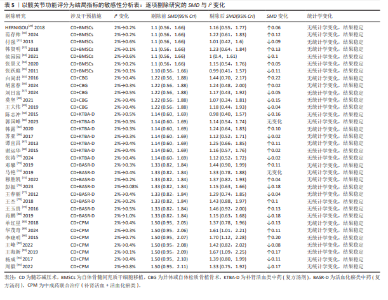
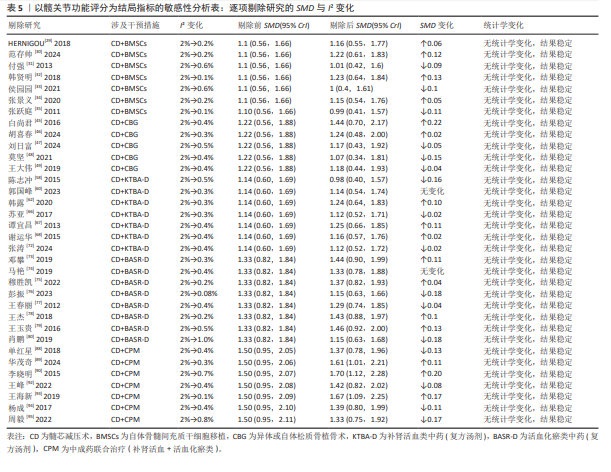
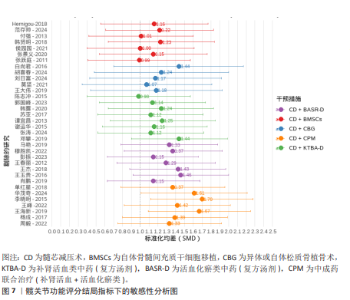
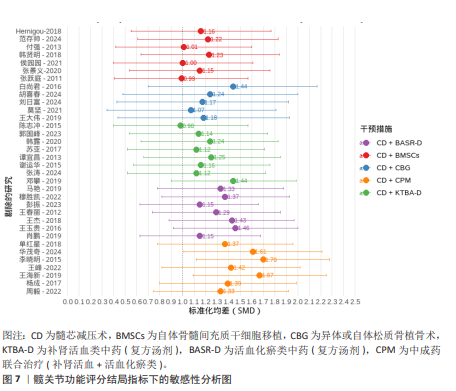
2.8 敏感性分析 以髋关节功能评分为例,对纳入文献数不少于3篇的干预措施进行敏感性分析。采用逐一排除法逐项剔除研究,以检验模型对单个研究的依赖程度及结果的稳定性。由于网状证据图呈现出典型的星状结构,髓芯减压术为主要的比较枢纽节点,因此所有干预措施均与髓芯减压术进行直接效应比较。在以髋关节功能评分为结局指标的贝叶斯网状模型中,每剔除一项研究,均重新构建模型,并在保持MCMC迭代次数一致的前提下,评估各干预措施相对于髓芯减压术的标准化均数差变化。分析结果显示,无论剔除哪项研究,标准化均数差及其95%CrI的估计值均保持稳定,未见明显偏倚,提示模型具备良好的鲁棒性,研究结论稳健可靠,见表5与图7。"
"
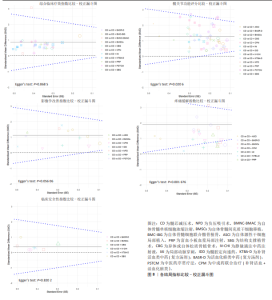
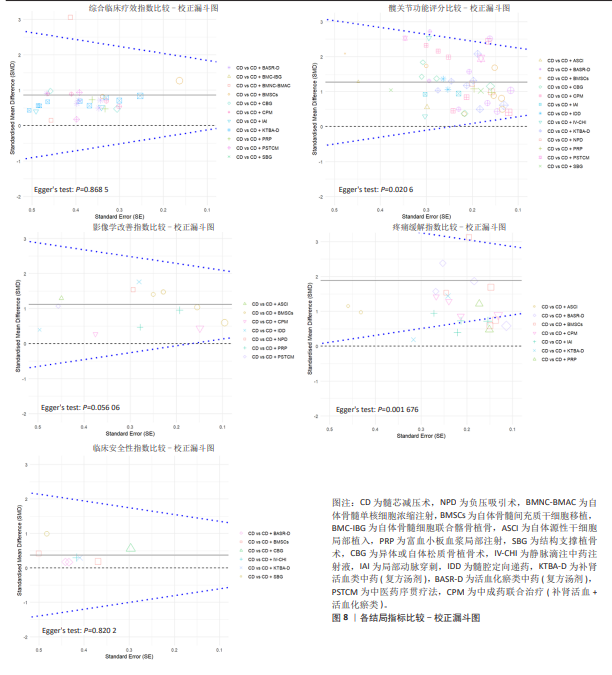
2.9 发表偏倚 采用Egger’s回归检验及比较调整漏斗图对各结局指标的发表偏倚进行系统评估。图中圆点代表纳入的文献,横轴为标准误,纵轴为标准化均数差。结果显示,部分结局指标的漏斗图分布不对称,提示可能存在发表偏倚或小样本效应。具体而言,髋关节功能评分(P=0.020 6)与疼痛缓解指数(P=0.001 7)结局的Egger’s检验结果具有统计学意义,图中右上象限显著效应聚集,反映低标准误区域内阳性研究被发表的概率更高,提示存在报告偏倚的可能性。相较之下,综合临床疗效指数(P=0.868 5)、临床安全性指数(P=0.820 2)与影像学改善指数(P=0.056 1)结局的漏斗图分布较为对称,Egger’s检验亦未显示显著性差异,表明当前纳入研究中尚未观察到明显发表偏倚。但需注意,影像学改善指数结果接近统计学阈值,潜在偏倚风险不容忽视。综上,髋关节功能评分与疼痛缓解指数等主观性较强或测量标准异质性较高的结局更易受选择性报告影响,结果见图8。 2.10 证据总结 GRADE评估结果显示,多数干预措施在主要结局指标中具备中等等级证据支持[96],部分结局指标为高等级证据,未发现低或极低等级证据,研究结论的证据基础较为稳固,具备较高可信度。"
| [1] 张长青,冯勇.加强科普宣传与教育以提升股骨头坏死早期诊治水平[J].骨科临床与研究杂志,2024,9(2):65-67. [2] WEN Z, LI Y, CAI Z, et al. Global Trends and Current Status in Osteonecrosis of the Femoral Head: A Bibliometric Analysis of Publications in the Last 30 Years. Front Endocrinol (Lausanne). 2022;13:897439. [3] ZHU J, SUN X, ZHANG L, et al. A nomogram for predicting contralateral femoral head collapse after unilateral replacement of bilateral femoral head necrosis. Sci Rep. 2025;15(1):5983. [4] WANG Z, WANG Y, WANG T, et al. Micro femoral head prosthesis in applications to collapsed femoral head necrosis in the weight-bearing dome (ARCO III): A case series with short-term follow-up. Chin Med J (Engl). 2024;137(6):737-739. [5] ZHAO D, ZHANG F, WANG B, et al. Guidelines for clinical diagnosis and treatment of osteonecrosis of the femoral head in adults (2019 version). J Orthop Translat. 2020;21: 100-110. [6] ZALAVRAS CG, LIEBERMAN JR. Osteonecrosis of the femoral head: evaluation and treatment. J Am Acad Orthop Surg. 2014; 22(7):455-464. [7] HOPKINS C, GENANT HK. Editorial for Guidelines for clinical diagnosis and treatment of osteonecrosis of the femoral head in adults (2019 version). J Orthop Translat. 2020;21:A1. [8] HUA KC, YANG XG, FENG JT, et al. The efficacy and safety of core decompression for the treatment of femoral head necrosis: a systematic review and meta-analysis. J Orthop Surg Res. 2019;14(1):306. [9] 王章正,莫亮,周驰,等.股骨头坏死保髋手术对后续全髋关节置换的影响[J]. 中国组织工程研究,2023,27(22): 3594-3601. [10] LIU J, HAN X, QU L, et al. Identification of key ferroptosis-related biomarkers in steroid-induced osteonecrosis of the femoral head based on machine learning. J Orthop Surg Res. 2023;18(1):327. [11] KLONTZAS ME, STATHIS I, SPANAKIS K, et al. Deep Learning for the Differential Diagnosis between Transient Osteoporosis and Avascular Necrosis of the Hip. Diagnostics (Basel). 2022;12(8):1870. [12] PAGE MJ, MOHER D, BOSSUYT PM, et al. PRISMA 2020 explanation and elaboration: updated guidance and exemplars for reporting systematic reviews. BMJ. 2021; 372:n160. [13] 中国医师协会骨科医师分会骨循环与骨坏死专业委员会,中华医学会骨科分会骨显微修复学组,国际骨循环学会中国区. 中国成人股骨头坏死临床诊疗指南(2020)[J]. 中华骨科杂志,2020,40(20): 1365-1376. [14] 孙伟,高福强,李子荣.股骨头坏死临床诊疗技术专家共识(2022年)[J].中国修复重建外科杂志,2022,36(11):1319-1326. [15] YOON BH, MONT MA, KOO KH, et al. The 2019 Revised Version of Association Research Circulation Osseous Staging System of Osteonecrosis of the Femoral Head. J Arthroplasty. 2020;35(4):933-940. [16] 中华医学会骨科分会显微修复学组,中国修复重建外科专业委员会骨缺损及骨坏死学组.成人股骨头坏死诊疗标准专家共识(2012年版)[J].中华骨科杂志,2012, 32(6):606-610. [17] 陈卫衡,何伟,赵德伟,等.股骨头坏死中医疗效评价标准(2019年版)[J].中医正骨,2019,31(6):3-6. [18] FERREIRA-GONZÁLEZ I, BUSSE JW, HEELS-ANSDELL D, et al. Problems with use of composite end points in cardiovascular trials: systematic review of randomised controlled trials. BMJ. 2007;334(7597):786. [19] FREEMANTLE N, CALVERT M, WOOD J, et al. Composite outcomes in randomized trials: greater precision but with greater uncertainty? JAMA. 2003;289(19): 2554-2559. [20] STERNE JAC, SAVOVIĆ J, PAGE MJ, et al. RoB 2: a revised tool for assessing risk of bias in randomised trials. BMJ. 2019;366:l4898. [21] CHINN S. A simple method for converting an odds ratio to effect size for use in meta-analysis. Stat Med. 2000;19(22): 3127-3131. [22] WEBER F, KNAPP G, ICKSTADT K, et al. Zero-cell corrections in random-effects meta-analyses. Res Synth Methods. 2020; 11(6):913-919. [23] 郭廷山.早期股骨头坏死机理及治疗的临床研究[J].世界最新医学信息文摘, 2017,17(72):43,98. [24] 李艳宝,袁宇飞,任志鑫,等.髓芯减压联合负压吸引术治疗股骨颈骨折术后股骨头坏死的临床分析[J].科学技术与工程,2024,24(24):10194-10198. [25] 马文成.评价髓芯减压联合负压吸引术治疗早期股骨头坏死的临床疗效[J].智慧健康,2018,4(10):122-123. [26] GANGJI V, HAUZEUR JP. Treatment of osteonecrosis of the femoral head with implantation of autologous bone-marrow cells. Surgical technique. J Bone Joint Surg Am. 2005;87 Suppl 1(Pt 1):106-112. [27] PEPKE W, KASTEN P, BECKMANN NA, et al. Core Decompression and Autologous Bone Marrow Concentrate for Treatment of Femoral Head Osteonecrosis: A Randomized Prospective Study. Orthop Rev (Pavia). 2016;8(1):6162. [28] SEN RK, TRIPATHY SK, AGGARWAL S, et al. Early results of core decompression and autologous bone marrow mononuclear cells instillation in femoral head osteonecrosis: a randomized control study. J Arthroplasty. 2012;27(5):679-686. [29] HERNIGOU P, DUBORY A, HOMMA Y, et al. Cell therapy versus simultaneous contralateral decompression in symptomatic corticosteroid osteonecrosis: a thirty year follow-up prospective randomized study of one hundred and twenty five adult patients. Int Orthop. 2018;42(7):1639-1649. [30] 范存帅.自体骨髓间充质干细胞移植在老年股骨头坏死髓芯减压术中的应用价值[J].中国医学工程,2024,32(7):80-84. [31] 付强,闫世杰,王江泳,等.髓芯减压联合自体骨髓间充质干细胞治疗45例股骨头无菌性坏死的临床疗效分析[J].现代生物医学进展,2013,13(25):4925-4928. [32] 韩贤明.髓心减压联合自体骨髓间充质干细胞移植对股骨头坏死患者术后血流动力学的影响[J].中外医学研究,2018, 16(35):51-53. [33] 侯园园,闫灿,吴建军,等.自体骨髓间充质干细胞移植联合髓心减压术对老年缺血性股骨头坏死的临床疗效及作用机制[J].中国老年学杂志,2021,41(17): 3686-3690. [34] 张景义,海国栋,杨昊飞,等.富集自体骨髓干细胞移植与髓芯减压治疗缺血性股骨头坏死患者血清成纤维细胞生长因子2、缺氧诱导因子1α、血管内皮生长因子的变化[J].中国组织工程研究, 2020,24(1):14-19. [35] 张跃庭,李平.MRI导引靶向注射间充质干细胞治疗股骨头坏死的临床应用[J]. 中外健康文摘,2011,8(6):46-48. [36] 曾湘林,来全忠.自体骨髓细胞加自体髂骨结合髓芯减压术与单纯髓芯减压术治疗早期股骨头缺血性坏死疗效分析[J]. 中国医学创新,2010,7(11):154-155. [37] 朱国兴,陶波,黄慧娟.骨髓移植治疗早期股骨头缺血性坏死的临床研究[J].齐齐哈尔医学院学报,2005,26(1):46-47. [38] 常廷杰,唐康来,陶旭,等.自体血清培养BMSCs移植结合髓芯减压治疗早期股骨头缺血性坏死的初步应用[J].中国修复重建外科杂志,2010,24(6):739-743. [39] 郭小伟,吴卫新,洪云飞,等.髓芯减压并自体骨髓干细胞移植治疗股骨头缺血性坏死[J].医药论坛杂志,2008,29(5):19-21. [40] AGGARWAL AK, POORNALINGAM K, JAIN A, et al. Combining Platelet-Rich Plasma Instillation With Core Decompression Improves Functional Outcome and Delays Progression in Early-Stage Avascular Necrosis of Femoral Head: a 4.5- to 6-Year Prospective Randomized Comparative Study. J Arthroplasty. 2021;36(1):54-61. [41] 苏金灿,方斌,傅淑君,等.富含血小板血浆单纯灌注与联合髓芯减压治疗ARCOⅠ~Ⅲa期股骨头坏死的临床疗效[J].现代实用医学,2022,34(12):1569-1571, 1584. [42] 刘书勇,马晓燕.多孔钽棒置入联合髓芯减压对早期股骨头坏死的近期疗效[J].临床医学,2016,36(7):58-59. [43] 余进伟,张雁儒,郭甲瑞,等.髓芯减压联合陶瓷骨植入治疗中早期股骨头坏死的临床研究[J].宁波大学学报(理工版), 2019,32(6):6-10. [44] 张庆胜,闫广辉,靳宪辉,等.髓芯减压植骨结合骼金骨笼置入治疗早期非创伤性股骨头坏死的短期疗效观察[J].生物骨科材料与临床研究,2017,14(1):36-38. [45] 白尚君.髓芯减压联合同种异体骨打压植骨治疗早期股骨头坏死的效果[J].今日健康,2016,15(10):51,73. [46] 胡喜春,黄长明,范华强,等.髓芯减压同种异体骨植入治疗早中期股骨头坏死[J].中国骨与关节损伤杂志,2024, 39(6):635-638. [47] 刘日富,谭元奇,信鑫鑫,等.髓芯减压术加选择性松质骨植骨术治疗股骨头坏死的临床结局观察[J].中华养生保健, 2024,42(11):60-63. [48] 莫坚,韩杰,苏波,等.髓芯减压+同种异体骨打压植骨治疗早期股骨头坏死的疗效观察[J].自我保健,2021(1):68. [49] 王大伟,张娟.髓芯减压联合同种异体骨打压植骨治疗早期股骨头坏死的效果探讨[J].黑龙江医学,2019,43(8):926-927. [50] 卢宏涛,李虹静,刘康.川芎嗪注射液联合髓芯减压术治疗Steinberg Ⅱ期股骨头坏死60例[J].西部中医药,2017,30(8): 111-113. [51] 盘荣贵,腾居赞,朱江龙,等.灯盏细辛注射液对早期股骨头坏死髓心减压术后血液流变学及血脂影响的临床观察[J].现代中西医结合杂志,2018,27(1):64-66. [52] 王旭,詹海夫.髓芯减压配合丹参注射液动脉灌注治疗股骨头缺血性坏死18例[J].中国中医急症,2010,19(11):1974-1975. [53] 杨忠奎,郭祥,唐学锋,等.髓心减压配合丹参注射液动脉灌注治疗股骨头缺血性坏死[J].中国实验方剂学杂志,2011, 17(16):267-268. [54] 臧克成. 钻孔减压结合金葡液治疗股骨头坏死的临床疗效观察[J]. 临床心身疾病杂志,2014(z1):49. [55] 张海峰,张舒雁,刘晋闽.丹参穴位注射对股骨头缺血性坏死患者髋关节功能的影响[J].针刺研究,2009,34(1):57-60. [56] 李晓明,郭东辉,石国君,等.钻孔减压联合丹参酮Ⅱ-a治疗早期股骨头坏死的疗效分析[J].医学美学美容(中旬刊), 2014(10):213-213. [57] 沈润斌,张倩,李晓明,等.钻孔减压配合髓腔内药物灌注治疗塌陷前股骨头坏死的早期临床观察[J].中国中医骨伤科杂志,2014,22(2):31-33. [58] 陈志冲,李彬,李金郑,等.四君子汤合桃红四物汤辅助髓芯减压术治疗早期股骨头缺血性坏死30例临床观察[J].中医药导报,2015,21(10):85-87. [59] 付小勇,高万里,王松.中西医结合治疗成人股骨头缺血性坏死30例[J].江西中医药,2007,38(4):45-46. [60] 郭国峰.补肾活血通络祛湿汤辅助钻孔减压治疗早期股骨头坏死临床研究[J].沈阳医学院学报,2023,25(3):256-260. [61] 郭华洋,王金刚,聂勇,等.髓心减压联合补肾活血方治疗股骨头坏死疗效观察[J].中医药临床杂志,2020,32(8): 1549-1553. [62] 韩露,袁华兵,汪元成.益肾复活通络汤联合髓芯减压术治疗早期气滞血瘀型股骨头坏死的效果观察[J].中国医院用药评价与分析,2020,20(5):559-562,566. [63] 娄伏成.中药配合髓芯减压治疗早中期股骨头缺血性坏死[J].吉林医学,2011, 32(14):2783-2784. [64] 马国华.补肾活血方配合髓芯减压术治疗早期股骨头缺血性坏死临床观察[J].中国中医急症,2009,18(4):547-548. [65] 马红英,牟成林,张均喜,等.补肾活血汤配合髓芯减压术治疗早期成人股骨头缺血性坏死疗效观察[J].现代中西医结合杂志,2011,20(16):1988-1989. [66] 苏亚.补肾活血汤结合钻孔减压术治疗早期成人股骨头坏死临床研究[J].亚太传统医药,2017,13(15):133-134. [67] 谭宜昌,黎常胜.温通活血方联合钻孔减压术治疗早期股骨头缺血性坏死的疗效分析[J].白求恩军医学院学报,2013, 11(3):230-231. [68] 谢运华,李升.经皮多通道减压合补肾活血汤加减治疗早期股骨头缺血性坏死30例临床观察[J].湖南中医杂志,2015, 31(7):81-83. [69] 许伟国,凌云.中西医结合治疗成人股骨头无菌性坏死54例临床观察[J].中医药导报,2005,11(7):52-54. [70] 湛祥辉.中西医结合治疗Ⅰ-Ⅱ型股骨头缺血性坏死27例临床观察[J].中医药导报,2010,16(8):54-55. [71] 张剑慧.中西医结合治疗股骨头缺血性坏死35例临床观察[J].中医药导报,2009, 15(4):51-52. [72] 张涛.益肾复活通络汤联合髓芯减压术治疗早期气滞血瘀型股骨头坏死的效果观察[J].中文科技期刊数据库(文摘版)医药卫生,2024(5):122-125. [73] 邓攀,王星,纪海,等.桃红四物汤加减对股骨头坏死临床疗效及部分机制探讨[J].世界中医药,2019,14(9):2339-2343. [74] 马艳.髓芯减压配合通络生骨汤治疗早期股骨头坏死临床观察[J].现代诊断与治疗,2019,30(16):2750-2751. [75] 穆胜凯,郝连升,刘士凯.骨蚀Ⅰ号方联合髓芯减压术治疗早期非创伤性股骨头坏死的临床观察[J].中国民间疗法, 2022,30(15):82-84. [76] 彭振,韩崇涛.髓心减压术结合桃红四物汤治疗股骨头缺血性坏死疗效观察[J].实用中医药杂志,2023,39(7):1359-1361. [77] 王春丽.活络骨康丸联合髓芯减压治疗股骨头坏死的临床研究[J].中国实用医药,2012,7(30):148-149. [78] 王杰,王红杰.通络生骨汤联合髓芯减压治疗早期股骨头坏死临床疗效分析[J]. 首都食品与医药,2018,25(23):176. [79] 王玉贵,郝阳泉.通络生骨汤联合髓芯减压治疗早期股骨头坏死的疗效观察[J].世界最新医学信息文摘,2016,16(93):68-69. [80] 肖鹏,张影.桃红四物汤加减联合针灸治疗早期股骨头坏死疗效研究[J].临床医药文献电子杂志,2019,6(97):92. [81] 许晓琳.活络骨康丸联合股骨头髓心减压治疗股骨头缺血性坏死的临床疗效[J].中医临床研究,2014,6(31):106-107. [82] 张海平.通络生骨汤联合髓芯减压治疗早期股骨头坏死的疗效分析[J].医学新知杂志,2018,28(z1):133-134. [83] 李亦明,周文峰,邹艳明.中西医结合治疗早期股骨头缺血坏死的疗效观察[J].中外健康文摘,2010,7(6):275-277. [84] 林斌.早期股骨头坏死的临床治疗分析[J].中外医学研究,2012(34):35. [85] 时冠军,刘世敬,张景僚.钻孔减压术加服中药治疗早期股骨头坏死30例[J].云南中医学院学报,2010,33(4):42-44,46. [86] 陶家安.髓芯减压配合中药分型治疗股骨头缺血性坏死[J].中国民族民间医药, 2011,20(16):89,93. [87] 陈志勇.应用髓芯减压术联合通络生骨胶囊治疗早期股骨头坏死疗效观察[J].河南外科学杂志,2014,20(4):98-99. [88] 单红星.髓芯减压配合鹿龟生骨丸治疗早期股骨头坏死临床观察[J].山西中医, 2018,34(4):14-15,17. [89] 华茂奇,沈锦涛.舒筋活血胶囊联合髓芯减压治疗早期股骨头坏死的临床疗效[J].当代医学,2024,30(1):111-114. [90] 李晓明,郭东辉,石国君,等.髓芯减压配合鹿龟生骨丸治疗早期股骨头坏死近期疗效分析[J].中国中西医结合外科杂志,2015,21(2):173-175. [91] 廖宏伟,张建福.复阳活骨丸配合髓芯减压术治疗早期股骨头坏死68例[J].中医研究,2010,23(5):42-43. [92] 王峰,宋景光,苑宏飞.髓芯减压术联合复方仙灵骨葆胶囊在股骨头坏死患者治疗中的效果观察[J].当代医学,2022, 28(8):24-27. [93] 王海新,张传科,李明.髓芯减压术后应用仙灵骨葆胶囊治疗早期股骨头坏死的临床研究[J].海峡药学,2019,31(3): 175-176. [94] 杨成.钻孔减压术配合强骨胶囊治疗成人股骨头缺血性坏死疗效观察[J].实用中医药杂志,2017,33(5):493-494. [95] 周毅,陈日高,江中潮,等.川骨片联合髓芯减压术治疗早期激素性股骨头坏死的临床疗效观察[J].中药与临床,2022, 13(1):48-50. [96] PUHAN MA, SCHÜNEMANN HJ, MURAD MH, et al. A GRADE Working Group approach for rating the quality of treatment effect estimates from network meta-analysis. BMJ. 2014;349:g5630. [97] ZHAO J, HE W, ZHENG H, et al. Bone Regeneration and Angiogenesis by Co-transplantation of Angiotensin II-Pretreated Mesenchymal Stem Cells and Endothelial Cells in Early Steroid-Induced Osteonecrosis of the Femoral Head. Cell Transplant. 2022; 31:9636897221086965. [98] ZHANG S, WANG H, MENG Q, et al. Recent advances in osteonecrosis of the femoral head: a focus on mesenchymal stem cells and adipocytes. J Transl Med. 2025;23(1):592. [99] XIA W, WANG W, QIN Y, et al. Crosstalk between bone and vasculature within bone. Fundam Res. 2025. https://doi.org/10.1016/j.fmre.2024.12.021 [100] LI S, CAI X, GUO J, et al. Cell communication and relevant signaling pathways in osteogenesis-angiogenesis coupling. Bone Res. 2025;13(1):45. [101] LI W, LIU Q, SHI J, et al. The role of TNF-α in the fate regulation and functional reprogramming of mesenchymal stem cells in an inflammatory microenvironment. Front Immunol. 2023;14:1074863. [102] GERAMI MH, KHORRAM R, RASOOLZADEGAN S, et al. Emerging role of mesenchymal stem/stromal cells (MSCs) and MSCs-derived exosomes in bone- and joint-associated musculoskeletal disorders: a new frontier. Eur J Med Res. 2023;28(1):86. [103] SU H, WANG Z, ZHOU L, et al. Regulation of the Nrf2/HO-1 axis by mesenchymal stem cells-derived extracellular vesicles: implications for disease treatment. Front Cell Dev Biol. 2024;12:1397954. [104] TANG H, LING T, ZHAO E, et al. The efficacy of core decompression combined with regenerative therapy in early femoral head necrosis: a systematic review and meta-analysis involving 954 subjects. Front Pharmacol. 2025;15:1501590. [105] 祖振岳,门晶,孙慕梵.论“肝肾亏虚”型股骨头坏死的病因病机分析及相关治疗[J].临床医学进展,2023,13(9): 14451-14456. [106] WANG X, WU L, LUO D, et al. Mechanism of action of Salvia miltiorrhiza on avascular necrosis of the femoral head determined by integrated network pharmacology and molecular dynamics simulation. Sci Rep. 2024;14(1):28479. [107] ILYAS S, LEE J, LEE D. Emerging Roles of Natural Compounds in Osteoporosis: Regulation, Molecular Mechanisms and Bone Regeneration. Pharmaceuticals (Basel). 2024;17(8):984. [108] DUAN Y, SU YT, REN J, et al. Kidney tonifying traditional Chinese medicine: Potential implications for the prevention and treatment of osteoporosis. Front Pharmacol. 2023;13:1063899. [109] LIAO Y, WANG J, GUO C, et al. Combination of Systems Pharmacology and Experimental Evaluation to Explore the Mechanism of Synergistic Action of Frankincense-Myrrh in the Treatment of Cerebrovascular Diseases. Front Pharmacol. 2022;12:796224. [110] HU ZC, XIE ZJ, TANG Q, et al. Hydroxysafflor yellow A (HSYA) targets the NF-κB and MAPK pathways and ameliorates the development of osteoarthritis. Food Funct. 2018;9(8):4443-4456. [111] WANG L, WANG S, DAI X, et al. Salvia miltiorrhiza in osteoporosis: a review of its phytochemistry, traditional clinical uses and preclinical studies (2014-2024). Front Pharmacol. 2024;15:1483431. [112] SURUCHI, TIWARI M, GUPTA AK, et al. Phytochemistry, pharmacological potential, and network-based insights of eucommia ulmoides in traditional chinese medicine. Pharmacol Res-Modern Chinese Medicine. 2025;15:100633. [113] LIU X, ZHANG H, YAN J, et al. Deciphering the Efficacy and Mechanism of Astragalus membranaceus on High Altitude Polycythemia by Integrating Network Pharmacology and In Vivo Experiments. Nutrients. 2022;14(23):4968. [114] WANG G, MA C, MO L, et al. Cycloastragenol prevents bone loss via inhibiting osteoclast activity in glucocorticoid-induced osteonecrosis of the femoral head: An in vivo study. J Orthop Translat. 2024;45: 178-187. |
| [1] | Liu Jinlong, Abuduwupuer·Haibier, Bai Zhen, Su Danyang, Miao Xin, Li Fei, Yang Xiaopeng. Efficacy of different nonsurgical treatments for adolescent idiopathic scoliosis: a systematic review and network meta-analysis [J]. Chinese Journal of Tissue Engineering Research, 2026, 30(9): 2370-2379. |
| [2] | Wang Zhenze, Liu Fende, Zhang Rui, Li Wujun. Mesenchymal stem cells in treatment of arteriosclerosis obliterans of lower extremities: systematic review and meta-analysis [J]. Chinese Journal of Tissue Engineering Research, 2026, 30(7): 1869-1876. |
| [3] | Wang Zhengye, Liu Wanlin, Zhao Zhenqun. Advance in the mechanisms underlying miRNAs in steroid-induced osteonecrosis of the femoral head [J]. Chinese Journal of Tissue Engineering Research, 2026, 30(5): 1207-1214. |
| [4] | Bu Yangyang, Ning Xinli, Zhao Chen. Intra-articular injections for the treatment of osteoarthritis of the temporomandibular joint: different drugs with multiple combined treatment options [J]. Chinese Journal of Tissue Engineering Research, 2026, 30(5): 1215-1224. |
| [5] | Zheng Yin, Wu Zhenhua, Zhang Cheng, Ruan Kexin, Gang Xiaolin, Ji Hong. Safety and efficacy of immunoadsorption therapy for rheumatoid arthritis: a network meta-analysis and systematic review [J]. Chinese Journal of Tissue Engineering Research, 2026, 30(5): 1260-1268. |
| [6] | Leng Xiaoxuan, Zhao Yuxin, Liu Xihua. Effects of different neuromodulatory stimulation modalities on non-motor symptoms in Parkinson’s patients: a network meta-analysis [J]. Chinese Journal of Tissue Engineering Research, 2026, 30(5): 1282-1293. |
| [7] | Li Hanyue, Li Yini, Xiang Linmei, Li Sen. Effects of resistance exercise therapy on pain and function in patients with cervical spondylotic radiculopathy: a meta-analysis [J]. Chinese Journal of Tissue Engineering Research, 2026, 30(4): 987-996. |
| [8] | Sun Jiahe, Shi Jipeng, Zhu Tianrui, Quan Helong, Xu Hongqi. Effect of exercise intervention in elderly individuals with sarcopenia and its comorbidities: a meta-analysis [J]. Chinese Journal of Tissue Engineering Research, 2026, 30(4): 997-1007. |
| [9] | Yang Yuanyuan, Zhou Shanshan, Cheng Xiaofei, Feng Luye, Tang Jiqin. Network meta-analysis of non-invasive brain stimulation in the treatment of lower limb motor dysfunction after stroke [J]. Chinese Journal of Tissue Engineering Research, 2026, 30(4): 1008-1018. |
| [10] | Wang Zhengye, Liu Wanlin, Zhao Zhenqun. Mechanism by which vascular endothelial growth factor A targets regulation of angiogenesis in the treatment of steroid-induced osteonecrosis of the femoral head [J]. Chinese Journal of Tissue Engineering Research, 2026, 30(3): 671-679. |
| [11] | Zhou Zixiang, Zhao Baoxiang. Research progress in the relationship between nontraumatic necrosis of the femoral head and lipid metabolism and its treatment [J]. Chinese Journal of Tissue Engineering Research, 2026, 30(3): 680-690. |
| [12] | Yao Kexin, Yang Yidan, Li Yapeng, Zhu Xuanye, Wang Qiuyuan, Guo Jiayi, Liu Youwen, Yue Chen. A controlled analysis of phenomenon of acupoint sensitization in osteonecrosis of the femoral head [J]. Chinese Journal of Tissue Engineering Research, 2026, 30(15): 3913-3919. |
| [13] | Zan Yongfeng, Song Keguan, Liu Yuda. Glutamine regulates the effect of hormones on the apoptosis of bone microvascular endothelial cells [J]. Chinese Journal of Tissue Engineering Research, 2026, 30(12): 2965-2974. |
| [14] | Chen Ping, Du Jinchao, Wang Hongying, Zhang Hui, Wang Haixia. Different inspiratory muscle training methods improve exercise and cardiopulmonary function of patients after cardiac surgery: a network meta-analysis [J]. Chinese Journal of Tissue Engineering Research, 2026, 30(12): 3134-3144. |
| [15] | Gao Shiai, Yu Zifu, Chen Jinhui, Cao Xinyan, Leng Xiaoxuan, Liu Xihua. Efficacy of non-invasive neuromodulation techniques on autism spectrum disorder: a network meta-analysis [J]. Chinese Journal of Tissue Engineering Research, 2026, 30(10): 2550-2559. |
| Viewed | ||||||
|
Full text |
|
|||||
|
Abstract |
|
|||||