Chinese Journal of Tissue Engineering Research ›› 2026, Vol. 30 ›› Issue (15): 4010-4020.doi: 10.12307/2026.194
Stepwise surgical treatment of knee osteoarthritis and the application trends of three surgical procedures: a bibliometric analysis
Wang Jingyi1, An Shuai1, Li Daoqin1, He Tao1, Feng Mingli1, La Gaoyan2, Li Zheng1, Cheng Jingbo1
- 1Department of Orthopedics, 2Department of Rehabilitation, Xuanwu Hospital, Capital Medical University, Beijing 100053, China
-
Accepted:2025-08-04Online:2026-05-28Published:2025-11-10 -
Contact:An Shuai, MD, Associate chief physician, Department of Orthopedics, Xuanwu Hospital, Capital Medical University, Beijing 100053, China -
About author:Wang Jingyi, Department of Orthopedics, Xuanwu Hospital, Capital Medical University, Beijing 100053, China -
Supported by:Capital Health Development Scientific Research Special Project, No. 2024-2-2015 (to AS); Hebei Provincial Health Commission Medical Science Research Project, No. 20261349 (to AS); Xuanwu Hospital "Talent Training Program", No. YC20250201 (to AS)

CLC Number:
Cite this article
Wang Jingyi, An Shuai, Li Daoqin, He Tao, Feng Mingli, La Gaoyan, Li Zheng, Cheng Jingbo. Stepwise surgical treatment of knee osteoarthritis and the application trends of three surgical procedures: a bibliometric analysis[J]. Chinese Journal of Tissue Engineering Research, 2026, 30(15): 4010-4020.
share this article
Add to citation manager EndNote|Reference Manager|ProCite|BibTeX|RefWorks
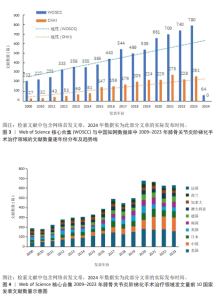
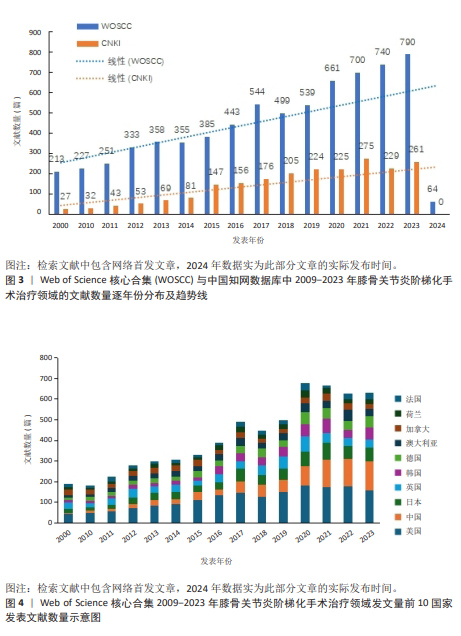
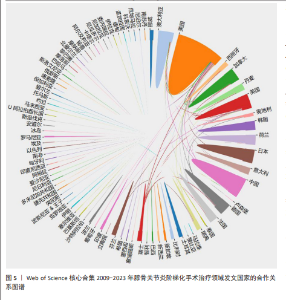
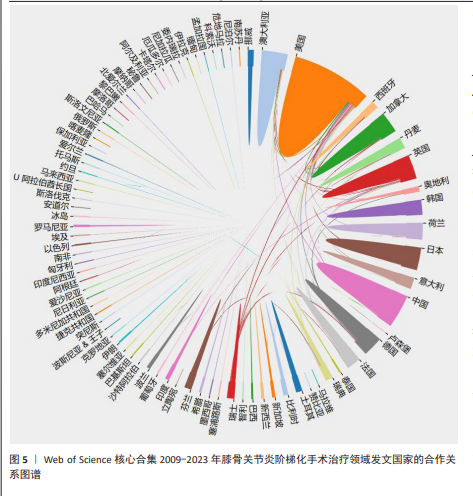
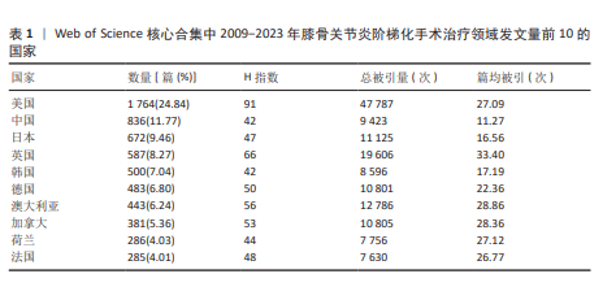
2.1 总文献数量及趋势的分析 2009-2023年此领域文献数量基本呈现逐年上升趋势。WOS核心合集中发文量自2009年为213篇,至2023年上涨为790篇,为前者的3.7倍;自2019年发文539篇起,连续4年发文量大于500篇。CNKI数据库中发文量自2009年发表27篇起,至2023年上涨为261篇,为前者的9.7倍,2018-2023年5年间发文量大于200篇(图3)。 2.2 各国发文量及合著分析 分析WOS数据库2009-2023年间中国发文量逐年上升,在当今全球发文量前10的国家排名中从末位升至第2名(图4)。但在发文量、H指数和被引用数据等方面的横向对比中,中国与英美两国差距尚存,仍具有相当的提升空间。北美洲以美国为主导、亚洲以中日韩为主导和欧洲以英德法荷为主导,是全球该领域研究的3大核心区域,合计贡献了全球绝大部分的论文产出;其中北美在数量和质量上均占优势,亚洲在数量上领先于欧洲,但北美和欧洲的平均篇均被引次数显著更强(表1)。中国与美国、澳大利亚合作多,而美国与世界上多个国家存在密切合作(图5)。"
"
"
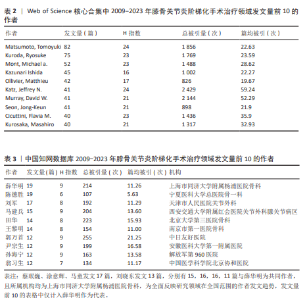
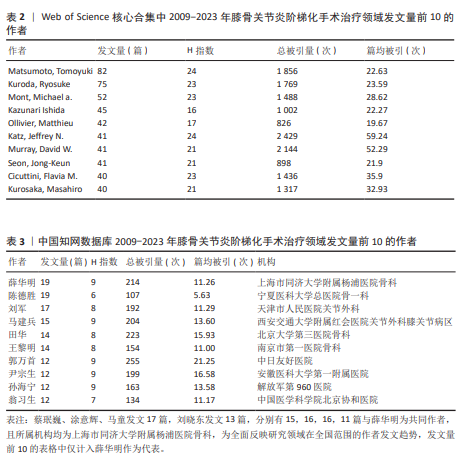
2.3 作者分析 WOS核心合集中,发文量前10的作者共发表499篇,占全部发文量的7.03%。发文量位列前3的分别是Matsumoto Tomoyuki发表82篇、Kuroda Ryosuke发表75篇、Mont, Michael a.发表52篇;代表影响力的前3位H指数分别是Matsumoto Tomoyuki和Katz, Jeffrey N.的24,Kuroda, Ryosuke、Mont, Michael a.及Cicuttini, Flavia M.的23,Murray, David W.、Seon, Jong-Keun及Kurosaka, Masahiro的21(表2)。在研究内容方面,检索作者被引用量排名靠前的文章发现,Matsumoto Tomoyuki和Kuroda Ryosuke的研究特别关注于全膝置换术和单髁置换术,涵盖了膝骨关节炎手术治疗的多个方面,包括手术技术的比较、术后功能恢复、软组织平衡的评估以及特定手术技术如机器人辅助手术的应用;Mont, Michael a.关注全膝置换术的不同技术的比较,包括机器人辅助和传统手动技术,以及单髁置换术和定制全膝置换术的应用。此外还涉及到了术后远程监测和康复的新方法。 CNKI数据库中,发文前10位作者共发文146篇,占全部发文量的6.63%。薛华明、陈德胜发表19篇,刘军发表17篇,位列前三;5人H指数为9,3人为8,其中篇均被引最高为郭万首的21.25次,其次是尹宗生16.58次和田华15.93次(表3)。薛华明、郭万首、尹宗生聚焦于单髁置换术,关注疗效与并发症、适应证及与全膝关节置换的疗效对比;陈德胜、刘军、田华则以全膝关节置换为核心,研究围术期管理、技术精准化、与单髁置换的疗效对比和指标对比等。分析可知,多位作者聚焦单髁置换与全膝关节置换的优劣,对比疗效、创伤与成本;研究关注点从传统全膝关节置换转向精准化技术如3D打印、计算机导航和个体化方案;围术期管理如止血策略、镇痛方案、抗凝安全性等系统性优化成为共同关注点;多项研究强调中长期疗效追踪,验证如活动平台假体等新技术的持久性。"
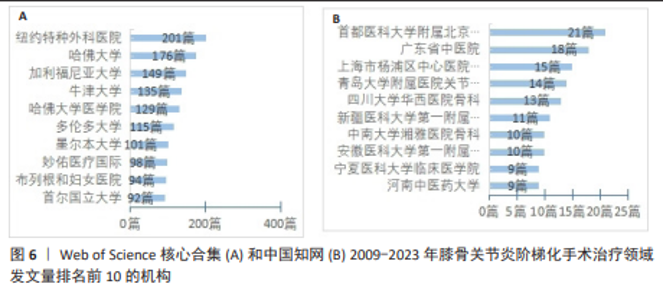
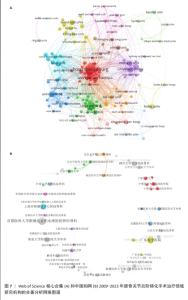
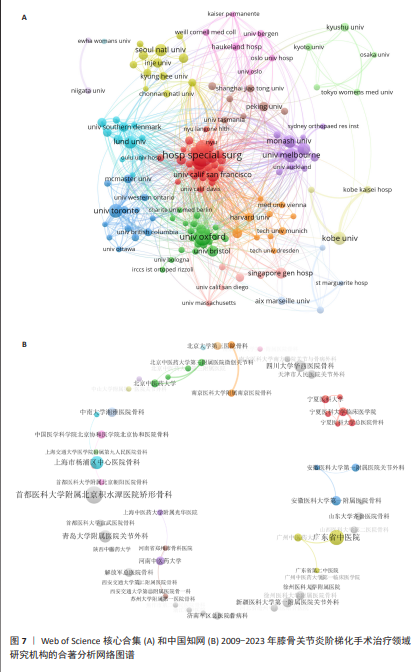
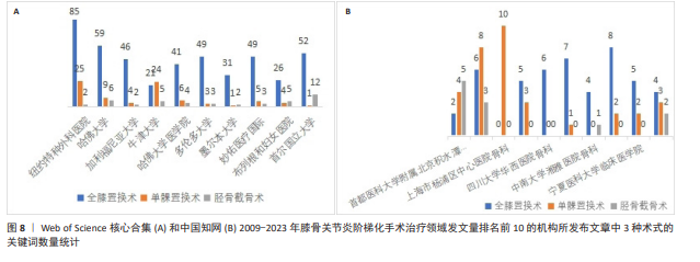
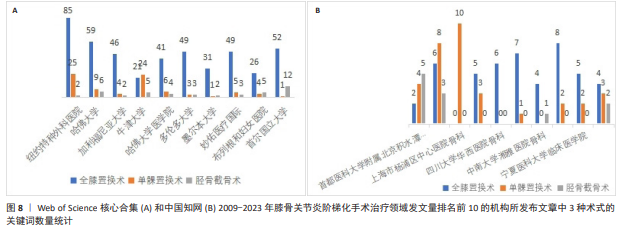
2.4 机构分析 WOS核心合集数据显示,机构中发文量最多的是纽约特种外科医院发表201篇,其次哈佛大学发表176篇,加利福尼亚大学发表149篇(图6)。266所机构发文20篇以上,各机构之间合作联系较多(图7)。 分别分析各机构发表文献的关键词出现数量,各机构发布全膝关节置换研究的数量均较多,纽约特种外科医院和牛津大学发表的单髁置换研究较多,首尔国立大学发表的胫骨截骨术研究较多(图8)。 CNKI数据库中,发文量首位是首都医科大学附属北京积水潭医院矫形骨科发文21篇,广东省中医院发表18篇,上海市杨浦区中心医院骨科发表15篇,分别位居第二和第三。院内骨科与关节外科合作较多,医学院校与附属医院合作较多,附属医院间亦有合作。"
"
"
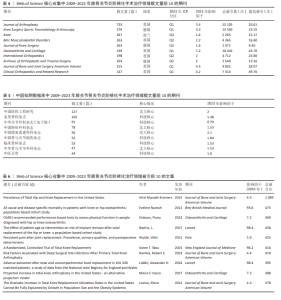
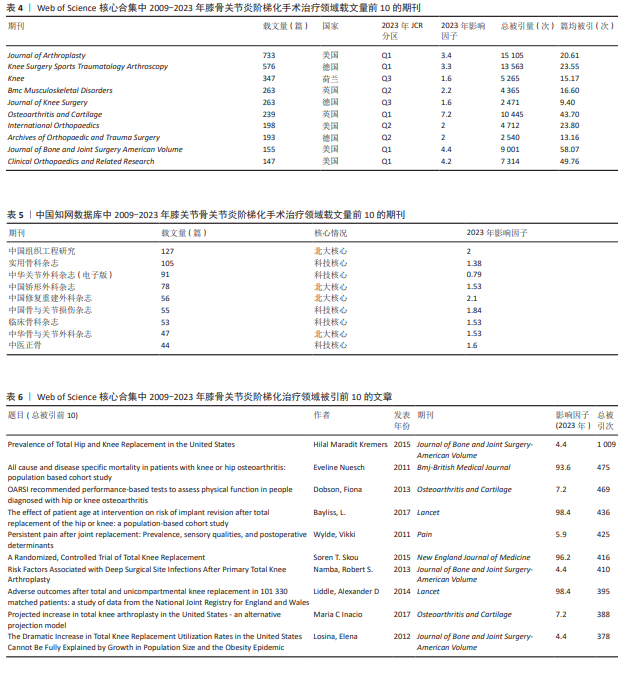
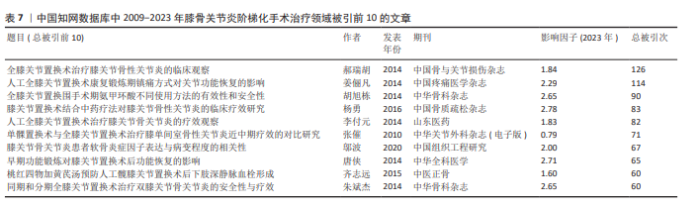
2.5 期刊分析 检索WOS核心合集,Journal of Arthroplasty发表733篇,是研究领域中载文量最多的期刊;其次是Knee Surgery Sports Traumatology Arthroscopy载文576篇、Knee载文347篇、Bmc Musculoskeletal Disorders载文263篇。研究领域里载文量前十的期刊,属于美国的有4种,德国3种,英国2种,荷兰1种;JCR分区在Q1的有5种。Osteoarthritis and Cartilage的影响因子7.2为最高,Journal of Bone and Joint Surgery American Volume的篇均被引最高,为58.07次(表4)。 检索CNKI,《中国组织工程研究》载文量最多,共127篇;《实用骨科杂志》载文量第二,共105篇。4本期刊为北大核心期刊,分别是《中国组织工程研究》《中国矫形外科杂志》《中国修复重建外科杂志》《中华骨与关节外科杂志》,其余为科技核心期刊(表5)。 2.6 文章分析 排序得到WOS合集总被引量前10的文章,其中5篇来自载文量前10的期刊,3篇来自Journal of Bone and Joint Surgery American Volume,2篇来自Osteoarthritis and Cartilage。排名第一的文章来自Journal of Bone and Joint Surgery-American Volume,在总被引用频率方面以1 009次位居榜首(表6)。 排序得到CNKI数据库中总被引量前10的文章,2篇来自《中华骨科杂志》,分别位居第3和第10;6篇发于2014年、2015年、2016年、2010年、2020年分别发表1篇。载于《中国骨与关节损伤杂志》的文章被引量126次,排名第一(表7)。 "
"
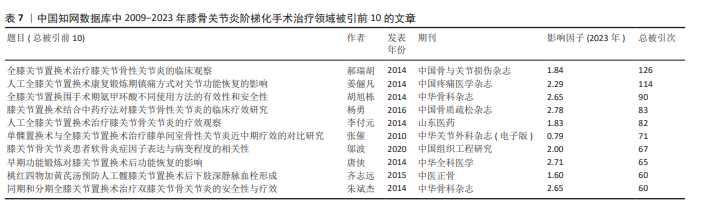
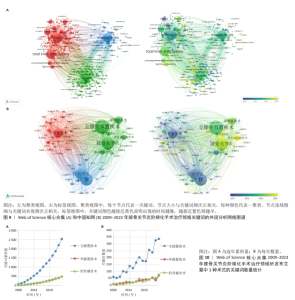
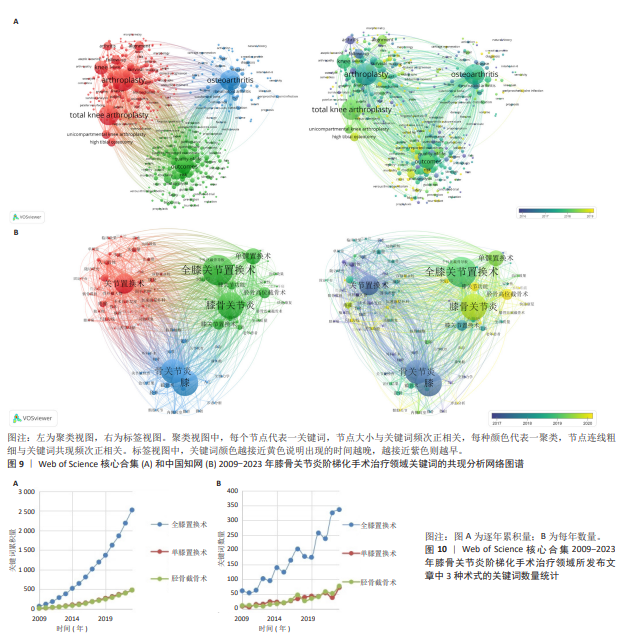
2.7 共现分析 分别对从WOS核心合集和CNKI数据库导出的关键词进行共现分析。 WOS核心合集包括至少出现20次的关键词432个,分为术式与疗效评估、疾病分类与病理机制、跨关节治疗与综合评估3类。第一组常用关键词有“置换术”“全膝关节置换术”“膝”“随访”“对线”“单髁置换术”“存活率”“胫骨截骨术”;第二组常用关键词“骨关节炎”“膝骨关节炎”“类风湿关节炎”“软骨”“关联”“关节软骨”“进展”“疾病”;第三组常用关键词“疗效”“髋”“全髋关节置换术”“疼痛”“膝关节置换术”“手术”“生活质量”“风险”。从时间维度观察这些关键词,2017年以前常用的关键词有“骨关节炎”“随访”“生活质量”“假体”“人口”“髌骨高度”“障碍”;2017年以后常用关键词有“全膝置换术”“疗效”“风险”“对线”“单髁置换术”“并发症”“胫骨截骨术”(图9)。 CNKI数据库资料显示,至少出现10次的关键词有94个,聚类分为三部分:一为围术期管理与手术材料技术,代表性关键词“膝”“疼痛”“失血量”“氨甲环酸”“疼痛”“骨科植入物”“人工假体”“关节成形术”;二为核心术式与技术创新,代表性关键词“全膝关节置换术”“单髁置换术”“胫骨高位截骨术”“关节镜”“3D打印”“疗效”“并发症”“膝骨关节炎”;三为病因解剖与疗效评估,代表性关键词“骨关节炎”“膝内翻”“内侧间室”“外科手术”“治疗结果”“随访研究”“截骨术”。2017年及以前,“膝”“骨关节炎”等高权重关键词表明已开始基础病理机制的研究,成为后续技术发展的基石。2018-2019年“全膝关节置换术”“单髁置换术”“疼痛管理”“氨甲环酸”等关键词权重高,为持续研究热点方向。2020-2021年及以后,“胫骨高位截骨术” “3D打印” “个性截骨导板” “加速康复外科”等关键词表明今年热点在个体化、微创化治疗和术后管理(图9)。 2.8 各种术式对比分析 随着阶梯化手术治疗原则的被认可与普及,发表文献中相关的术式关键词出现频次也有改变,分析WOS核心合集可知在全膝关节置换逐年增长的趋势下,胫骨截骨术和单髁置换逐年增长,其中胫骨截骨术累计出现频率的增长也呈现出追平单髁置换的趋势(图10),反映出胫骨截骨术、单髁置换相关研究数量日益丰富,阶梯化手术治疗领域的研究越来越受到重视。 结合关键词共现数据进一步分析。全膝关节置换持续占据研究主导地位,核心热点不仅包含围术期管理,包括氨甲环酸止血、疼痛控制、抗凝策略、加速康复;还有技术创新,如机器人辅助手术、疗效评估如长期假体存活率和感染或翻修风险等。单髁置换关键词平均出现时间较晚而研究量逐年增长,核心热点聚焦适应证优化,筛选单间室病变患者;关注疗效对比,与全膝关节置换创伤、成本、功能恢复的差异;同样关注技术改进如微创入路、活动平台假体设计。胫骨截骨术关键词增速显著,反映“保膝”理念兴起,研究热点包括其保膝价值,手术更适用于年轻患者,以及力线矫正、改善生物力学分布等。"
| [1] 中国骨关节炎诊疗指南专家组,中国老年保健协会疼痛病学分会,黄东,等. 中国骨关节炎诊疗指南(2024版)[J]. 中华疼痛学杂志,2024,20(3):323-338. [2] KATZ JN, ARANT KR, LOESER RF. Diagnosis and Treatment of Hip and Knee Osteoarthritis: A Review. JAMA. 2021; 325(6):568-578. [3] SKOU ST, ROOS EM, LAURSEN MB, et al. A Randomized, Controlled Trial of Total Knee Replacement. New Eng J Med. 2015; 373(17):1597-1606. [4] BESWICK AD, WYLDE V, GOOBERMAN-HILL R, et al. What proportion of patients report long-term pain after total hip or knee replacement for osteoarthritis? A systematic review of prospective studies in unselected patients. BMJ Open. 2012;2(1):e000435. [5] SIPAHI S, ÇELIK KEK, DOĞAN N, et al. Global Trends and Developments in Diet and Longevity Research: A Bibliometric Analysis. Nutrients. 2025;17(13):2119. [6] SUN HL, BAI W, LI XH, et al. Schizophrenia and Inflammation Research: A Bibliometric Analysis. Front Immunol. 2022;13:907851. [7] MARADIT KH, LARSON DR, CROWSON CS, et al. Prevalence of Total Hip and Knee Replacement in the United States. J Bone Joint Surg Am. 2015;97(17):1386-1397. [8] NÜESCH E, DIEPPE P, REICHENBACH S, et al. All cause and disease specific mortality in patients with knee or hip osteoarthritis: population based cohort study. BMJ. 2011; 342:d1165. [9] DOBSON F, HINMAN RS, ROOS EM, et al. OARSI recommended performance-based tests to assess physical function in people diagnosed with hip or knee osteoarthritis. Osteoarthritis Cartilage. 2013;21(8): 1042-1052. [10] BAYLISS LE, CULLIFORD D, MONK AP, et al. The effect of patient age at intervention on risk of implant revision after total replacement of the hip or knee: a population-based cohort study. Lancet. 2017;389(10077):1424-1430. [11] WYLDE V, HEWLETT S, LEARMONTH ID, et al. Persistent pain after joint replacement: prevalence, sensory qualities, and postoperative determinants. Pain. 2011;152(3):566-572. [12] NAMBA RS, INACIO MC, PAXTON EW. Risk factors associated with deep surgical site infections after primary total knee arthroplasty: an analysis of 56,216 knees. J Bone Joint Surg Am. 2013;95(9):775-782. [13] LIDDLE AD, JUDGE A, PANDIT H, et al. Adverse outcomes after total and unicompartmental knee replacement in 101,330 matched patients: a study of data from the National Joint Registry for England and Wales. Lancet. 2014;384(9952): 1437-1445. [14] INACIO MCS, PAXTON EW, GRAVES SE, et al. Projected increase in total knee arthroplasty in the United States - an alternative projection model. Osteoarthritis Cartilage. 2017;25(11):1797-1803. [15] LOSINA E, THORNHILL TS, ROME BN, et al. The dramatic increase in total knee replacement utilization rates in the United States cannot be fully explained by growth in population size and the obesity epidemic. J Bone Joint Surg Am. 2012;94(3):201-107. [16] 郝瑞胡,郭林,李丽丽,等.全膝关节置换术治疗膝关节骨性关节炎的临床观察[J].中国骨与关节损伤杂志,2014,29(6): 544-546. [17] 姜俪凡,冯艺,安海燕.人工全膝关节置换术康复锻炼期镇痛方式对关节功能恢复的影响[J].中国疼痛医学杂志,2014, 20(2):90-94. [18] 胡旭栋,周宗科,裴福兴,等.全膝关节置换围手术期氨甲环酸不同使用方法的有效性和安全性[J].中华骨科杂志,2014, 34(6):599-604. [19] 杨勇,赵良虎,黄金.膝关节置换术结合中药疗法对膝关节骨性关节炎的临床疗效研究[J].中国骨质疏松杂志,2016, 22(7):837-841. [20] 李付元,冯世庆,周恒星,等.人工全膝关节置换术治疗膝关节骨关节炎的疗效观察[J].山东医药,2014,54(5):71-73. [21] 张催,陈游,张春雷,等.单髁置换术与全膝关节置换术治疗膝单间室骨性关节炎近中期疗效的对比研究[J].中华关节外科杂志(电子版),2010,4(2):192-197. [22] 邬波,马旭,柳椰,等.膝关节骨关节炎患者软骨炎症因子表达与病变程度的相关性[J].中国组织工程研究,2020,24(2): 236-241. [23] 唐侠.早期功能锻炼对膝关节置换术后功能恢复的影响[J].中华全科医学,2014, 12(8):1331-1332+1343. [24] 齐志远,陈秀民,王在斌,等.桃红四物加黄芪汤预防人工髋膝关节置换术后下肢深静脉血栓形成[J].中医正骨,2015, 27(3):71-72+75. [25] 朱斌杰, 陈哲峰, 刘锋, 等. 同期和分期全膝关节置换术治疗双膝关节骨关节炎的安全性与疗效 [J] . 中华骨科杂志,2014, 34(6): 619-623. [26] ZHAO R, REN H, LI P, et al. Research trends and frontiers in rehabilitation after total knee arthroplasty: based on bibliometric and visualization analysis. J Orthop Surg Res. 2024;19(1):897. [27] HE J, HE L, GENG B, et al. Bibliometric Analysis of the Top-Cited Articles on Unicompartmental Knee Arthroplasty. J Arthroplasty. 2021;36(5):1810-1818.e3. [28] HOU W, XIAO F, PENG P, et al. Osteotomy for treating knee osteoarthritis from 2012 to 2023: Bibliometric analysis and global trends. Medicine. 2024; 103(7):e37036. [29] KOW RY, ABDUL RR, MOHAMAD NAZARALLAH MH, et al. Robotic-Assisted Hip and Knee Arthroplasty: A Bibliometric Analysis Using the Scopus Database. Cureus. 2024;16(3):e56617. [30] LIU P, ZHANG C, LU Z, et al. Global research status and trends of UKA for knee osteoarthritis: a bibliometric analysis. Arthroplasty (London, England). 2020; 2(1):20. [31] 庞凤祥,龚水帝,陈立新,等.胫骨高位截骨术研究现状的文献计量学和可视化分析[J].骨科,2020,11(2):131-139. [32] HUANG C, HOU Y, YANG Y, et al. A bibliometric analysis of the application of physical therapy in knee osteoarthritis from 2013 to 2022. Front Med. 2024;11:1418433 [33] 赵盾,祁令臣,徐金凡,等.膝骨关节炎疼痛领域热点与前沿的可视化分析[J].中国组织工程研究,2025,29(15): 3280-3289. |
| [1] | Xu Canli, He Wenxing, Wang Yuping, Ba Yinying, Chi Li, Wang Wenjuan, Wang Jiajia. Research context and trend of TBK1 in autoimmunity, signaling pathways, gene expression, tumor prevention and treatment [J]. Chinese Journal of Tissue Engineering Research, 2026, 30(在线): 1-11. |
| [2] | Zhu Xiaolong, Zhang Wei, Yang Yang. Visualization analysis of research hotspots and cutting-edge information in the field of intervertebral disc regeneration and repair [J]. Chinese Journal of Tissue Engineering Research, 2026, 30(9): 2391-2402. |
| [3] | Wen Fayan, Li Yan, Qiang Tianming, Yang Chen, Shen Linming, Li Yadong, Liu Yongming. Unilateral biportal endoscopic technology for treatment of lumbar degenerative diseases: global research status and changing trends [J]. Chinese Journal of Tissue Engineering Research, 2026, 30(9): 2380-2390. |
| [4] | Huang Jie, Zeng Hao, Wang Wenchi, Lyu Zhucheng, Cui Wei. Visualization analysis of literature on the effect of lipid metabolism on osteoporosis [J]. Chinese Journal of Tissue Engineering Research, 2026, 30(6): 1558-1568. |
| [5] | Jiang Kan, Alimujiang·Abudourousuli, Shalayiding·Aierxiding, Aikebaierjiang·Aisaiti, Kutiluke·Shoukeer, Aikeremujiang·Muheremu. Biomaterials and bone regeneration: research hotspots and analysis of 500 influential papers [J]. Chinese Journal of Tissue Engineering Research, 2026, 30(2): 528-536. |
| [6] | Li Kanglin, Jiang Yongdong, Wu Yufeng. Visualization analysis of piriformis syndrome: research trends and hotspots [J]. Chinese Journal of Tissue Engineering Research, 2026, 30(11): 2886-2895. |
| [7] | Wang Jiaying, Xu Chun, Mayila · Abudukelimu. Global research status, trends and hotspots of anxiety/depression in chronic obstructive pulmonary disease [J]. Chinese Journal of Tissue Engineering Research, 2026, 30(11): 2920-2932. |
| [8] | Liu Tongyan, Li Yuan, Sun Wei, Yao Bing, Fang Shanshan, Zhou Lingyun. Current status and hotspot analysis of experimental research on electroacupuncture intervention for peripheral nerve regeneration: electroacupuncture parameters, acupuncture effects and molecular mechanisms [J]. Chinese Journal of Tissue Engineering Research, 2026, 30(10): 2608-2617. |
| [9] | Huang Hailun, Wei Yatao, Liu Yongai, Wu Junzhe, Gao Heng, Sun Kui, Cao Zhenwen. Visualization analysis of lumbar spondylolisthesis treatment research from a bibliometric perspective [J]. Chinese Journal of Tissue Engineering Research, 2026, 30(10): 2618-2628. |
| [10] | Jiao Jingya, Zhang Yeting. Analysis of thematic evolution pathways in the field of physical activity and neurogenesis [J]. Chinese Journal of Tissue Engineering Research, 2026, 30(10): 2653-2661. |
| [11] | Zhao Qianwei, Sun Guangyuan . Intestinal organoids: a bibliometric analysis of the latest trends in tissue/organ biology, disease modeling, and clinical applications [J]. Chinese Journal of Tissue Engineering Research, 2026, 30(1): 238-247. |
| [12] | Liang Haobo, Wang Zeyu, Ma Wenlong, Liu Hao, Liu Youwen. Hot issues in the field of joint revision: infection, rehabilitation nursing, bone defect, and prosthesis loosening [J]. Chinese Journal of Tissue Engineering Research, 2025, 29(9): 1963-1971. |
| [13] | Xie Liugang, Cui Shuke, Guo Nannan, Li Aoyu, Zhang Jingrui. Research hotspots and frontiers of stem cells for Alzheimer’s disease [J]. Chinese Journal of Tissue Engineering Research, 2025, 29(7): 1475-1485. |
| [14] | Chang Jinxia, Liu Yufei, Niu Shaohui, Wang Chang, Cao Jianchun. Visualization analysis of macrophage polarization in tissue repair process [J]. Chinese Journal of Tissue Engineering Research, 2025, 29(7): 1486-1496. |
| [15] | Li Huijun, Li Huangyan, Zhang Yeting. Physical activity and cognition in older adults: research hotspot and topic evolution [J]. Chinese Journal of Tissue Engineering Research, 2025, 29(5): 1073-1080. |
| Viewed | ||||||
|
Full text |
|
|||||
|
Abstract |
|
|||||