Chinese Journal of Tissue Engineering Research ›› 2013, Vol. 17 ›› Issue (28): 5216-5222.doi: 10.3969/j.issn.2095-4344.2013.28.019
Previous Articles Next Articles
Alpha-lipoic acid inhibits mitochondrial oxidative stress in the rat skeletal muscle with chronic hypoxia exposure
Xiao Pin1, 2, Pang Yi-hui3, Peng Peng1, Bo Hai1
- 1Department of Military Training Medicine, Logistics University of Chinese People’s Armed Police Force, Tianjin 300162, China; 2Department of Pharmacy, Jiangxi Provincial Corps Hospital of Chinese People’s Armed Police Force, Nanchang 330001, Jiangxi Province, China;
3Department of Remote Education, Logistics University of Chinese People’s Armed Police Force, Tianjin 300162, China
-
Online:2013-07-09Published:2013-07-29 -
Contact:Bo Hai, M.D., Lecturer, Department of Military Training Medicine, Logistics University of Chinese People’s Armed Police Force, Tianjin 300162, China bohaixd@126.com -
About author:Xiao Pin, Department of Pharmacy, Jiangxi Provincial Corps Hospital of Chinese People’s Armed Police Force, Nanchang 330001, Jiangxi Province, China; Department of Pharmacy, Jiangxi Provincial Corps Hospital of Chinese People’s Armed Police Force, Nanchang 330001, Jiangxi Province, China zpchen_5500@126.com -
Supported by:Youth Foundation of Application Basis and Front Technology Research of Tianjin, No. 12JCQNJC07900*;
Science and Technology Research Foundation of Logistics University of Chinese People’s Armed Police Force, No. WYB201106*

CLC Number:
Cite this article
Xiao Pin, Pang Yi-hui, Peng Peng, Bo Hai. Alpha-lipoic acid inhibits mitochondrial oxidative stress in the rat skeletal muscle with chronic hypoxia exposure[J]. Chinese Journal of Tissue Engineering Research, 2013, 17(28): 5216-5222.
share this article
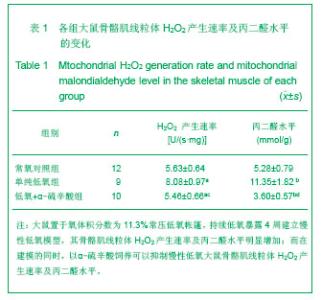
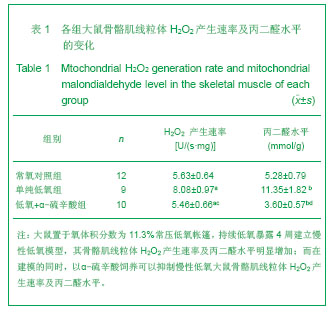
2.1 实验动物数量分析 实验纳入大鼠36只,由于不能耐受低氧以及长期用药,单纯低氧组死亡3只,低氧+α-硫辛酸组死亡2只,最终有31只大鼠进入结果分析。 2.2 各组大鼠骨骼肌线粒体H2O2产生速率及丙二醛水平的变化 单纯低氧组骨骼肌线粒体H2O2产生速率及丙二醛水平显著高于常氧对照组(P < 0.05,P < 0.01)。与单纯低氧组比较,低氧+α-硫辛酸组骨骼肌线粒体H2O2产生速率及丙二醛水平明显降低(P < 0.05,P < 0.01),见表1。 "
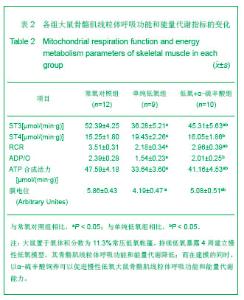
2.3 各组大鼠骨骼肌线粒体呼吸功能和能量代谢指标的变化 见表2。"
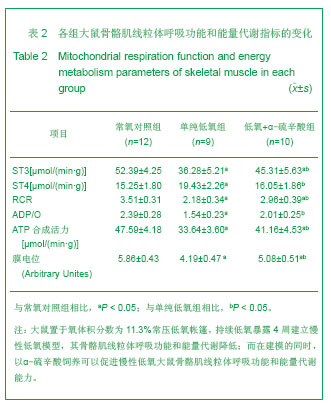
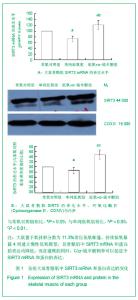
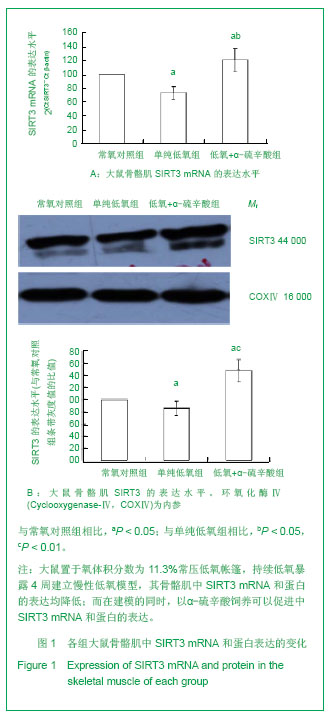
单纯低氧组大鼠骨骼肌线粒体ST3,RCR,ADP/O,ATP合成活力、膜电位显著低于常氧对照组 (P < 0.05),而大鼠骨骼肌线粒体ST4显著高于常氧对照组(P < 0.05)。与单纯低氧组比较,单纯低氧+α-硫辛酸组大鼠骨骼肌线粒体ST3,RCR,ADP/O,ATP合成活力、膜电位明显升高(P < 0.05),ST4显著降低 (P < 0.05)。 2.4 各组大鼠骨骼肌SIRT3 mRNA和蛋白表达的变化 单纯低氧组大鼠骨骼肌SIRT3 mRNA和蛋白表达均显著低于常氧对照组(P < 0.05)。与单纯低氧组比较,单纯低氧+α-硫辛酸组大鼠骨骼肌SIRT3 mRNA和蛋白表达明显升高(P < 0.05,P < 0.01),见图1。"
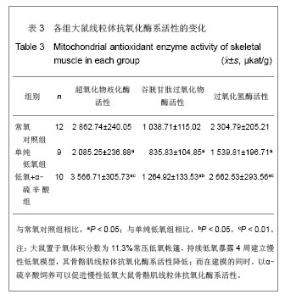
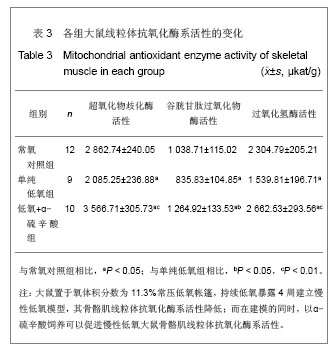
2.5 各组大鼠骨骼肌线粒体抗氧化酶系活性的变化 单纯低氧组大鼠骨骼肌线粒体锰超氧化物歧化酶、谷胱甘肽过氧化物酶、过氧化氢酶活性显著低于常氧对照组(P < 0.05)。与单纯低氧组比较,单纯低氧+α-硫辛酸组大鼠骨骼肌线粒体锰超氧化物歧化酶、谷胱甘肽过氧化物酶、过氧化氢酶活性明显升高(P < 0.05, P < 0.01),见表3。"
| [1]Lenihan CR, Taylor CT. The impact of hypoxia on cell death pathways. Biochem Soc Trans. 2013;41(2):657-663. [2]Luo Y, Lu G, Chen Y, et al. Long-term cycles of hypoxia and normoxia increase the contents of liver mitochondrial DNA in rats. Eur J Appl Physiol. 2013;113(1):223-232. [3]Jang MK, Son Y, Jung MH. ATF3 plays a role in adipocyte hypoxia-mediated mitochondria dysfunction in obesity. Biochem Biophys Res Commun. 2013;431(3):421-427.[4]Lundby C, Calbet JA, Robach P. The response of human skeletal muscle tissue to hypoxia. Cell Mol Life Sci. 2009; 66(22):3615-3623. [5]Levett DZ, Radford EJ, Menassa DA, et al. Acclimatization of skeletal muscle mitochondria to high-altitude hypoxia during an ascent of Everest. FASEB J. 2012;26(4):1431-1441. [6]Gamboa JL, Andrade FH. Muscle endurance and mitochondrial function after chronic normobaric hypoxia: contrast of respiratory and limb muscles. Pflugers Arch. 2012;463(2):327-338. [7]Pialoux V, Mounier R. Hypoxia-induced oxidative stress in health disorders. Oxid Med Cell Longev. 2012;2012:940121. [8]Venditti P, Di Stefano L, Di Meo S. Mitochondrial metabolism of reactive oxygen species. Mitochondrion. 2013;13(2):71-82. [9]Jezek P, Plecitá-Hlavatá L. Mitochondrial reticulum network dynamics in relation to oxidative stress, redox regulation, and hypoxia. Int J Biochem Cell Biol. 2009;41(10):1790-1804. [10]Solaini G, Baracca A, Lenaz G, et al. Hypoxia and mitochondrial oxidative metabolism. Biochim Biophys Acta. 2010;1797(6-7):1171-1177. [11]Cui H, Kong Y, Zhang H. Oxidative stress, mitochondrial dysfunction, and aging. J Signal Transduct. 2012;2012: 646354. [12]薄海,张红英,李海英,等.低氧复合运动通过NO-ATF1通路上调大鼠骨骼肌线粒体解偶联蛋白3表达[J].中国组织工程研究与临床康复,2010, 14(41):7643-7648.[13]Storm J, Müller S. Lipoic acid metabolism of Plasmodium--a suitable drug target. Curr Pharm Des. 2012;18(24): 3480-3489.[14]Gor?ca A, Huk-Kolega H, Piechota A, et al. Lipoic acid - biological activity and therapeutic potential. Pharmacol Rep. 2011;63(4):849-858.[15]薄海,张红英,李海英,等.低氧复合运动对大鼠骨骼肌解偶联蛋白3表达及线粒体功能的影响[J].中国康复医学杂志,2012, 27(1): 16-21. [16]Gupte AA, Bomhoff GL, Morris JK, et al. Lipoic acid increases heat shock protein expression and inhibits stress kinase activation to improve insulin signaling in skeletal muscle from high-fat-fed rats. J Appl Physiol. 2009;106(4):1425-1434.[17]Bo H, Wang YH, Li HY, et al. Endurance training attenuates the bioenergetics alterations of rat skeletal muscle mitochondria submitted to acute hypoxia: role of ROS and UCP3. Sheng Li Xue Bao. 2008;60(6):767-776.[18]Bo H, Jiang N, Ma G, et al. Regulation of mitochondrial uncoupling respiration during exercise in rat heart: role of reactive oxygen species (ROS) and uncoupling protein 2. Free Radic Biol Med. 2008;44(7):1373-1381. [19]Jiang N, Zhang G, Bo H, et al. Upregulation of uncoupling protein-3 in skeletal muscle during exercise: a potential antioxidant function. Free Radic Biol Med. 2009;46(2): 138-145. [20]Keil VC, Funke F, Zeug A, et al. Ratiometric high-resolution imaging of JC-1 fluorescence reveals the subcellular heterogeneity of astrocytic mitochondria. Pflugers Arch. 2011; 462(5):693-708. [21]侯伊玲,薄海,刘子泉,等.缺血预处理抑制大鼠胰腺移植缺血再灌注胰腺细胞凋亡:活性氧与线粒体DNA修复酶的作用[J].中国组织工程研究与临床康复,2010,14(18):3279-3285.[22]Souza AC, Ferreira RC, Gonçalves SS, et al. Accurate identification of Candida parapsilosis (sensu lato) by use of mitochondrial DNA and real-time PCR. J Clin Microbiol. 2012;50(7):2310-2314. [23]Jing E, Emanuelli B, Hirschey MD, et al. Sirtuin-3 (Sirt3) regulates skeletal muscle metabolism and insulin signaling via altered mitochondrial oxidation and reactive oxygen species production. Proc Natl Acad Sci U S A. 2011;108 (35):14608-14613.[24]Votion DM, Gnaiger E, Lemieux H, et al. Physical fitness and mitochondrial respiratory capacity in horse skeletal muscle. PLoS One. 2012;7(4):e34890. [25]Chen J, Gao Y, Liao W, et al. Hypoxia affects mitochondrial protein expression in rat skeletal muscle. OMICS. 2012; 16(3):98-104. [26]Waypa GB, Marks JD, Guzy RD, et al. Superoxide generated at mitochondrial complex III triggers acute responses to hypoxia in the pulmonary circulation. Am J Respir Crit Care Med. 2013;187(4):424-432. [27]Wang L, Wu CG, Fang CQ, et al. The protective effect of α-Lipoic acid on mitochondria in the kidney of diabetic rats. Int J Clin Exp Med. 2013;6(2):90-97. [28]Valdecantos MP, Pérez-Matute P, González-Muniesa P, et al. Lipoic acid administration prevents nonalcoholic steatosis linked to long-term high-fat feeding by modulating mitochondrial function. J Nutr Biochem. 2012;23(12): 1676-1684. [29]Padmalayam I. Targeting mitochondrial oxidative stress through lipoic acid synthase: a novel strategy to manage diabetic cardiovascular disease. Cardiovasc Hematol Agents Med Chem. 2012;10(3):223-233.[30]Deschermeier C, Hecht LS, Bach F, et al. Mitochondrial lipoic acid scavenging is essential for Plasmodium berghei liver stage development. Cell Microbiol. 2012;14(3):416-430.[31]Hebert AS, Dittenhafer-Reed KE, Yu W, et al. Calorie restriction and SIRT3 trigger global reprogramming of the mitochondrial protein acetylome. Mol Cell. 2013;49(1): 186-199. [32]Green MF, Hirschey MD. SIRT3 weighs heavily in the metabolic balance: a new role for SIRT3 in metabolic syndrome. J Gerontol A Biol Sci Med Sci. 2013;68(2):105-107. [33]Pellegrini L, Pucci B, Villanova L, et al. SIRT3 protects from hypoxia and staurosporine-mediated cell death by maintaining mitochondrial membrane potential and intracellular pH. Cell Death Differ. 2012;19(11):1815-1825. [34]Valdecantos MP, Pérez-Matute P, González-Muniesa P, et al. Lipoic acid improves mitochondrial function in nonalcoholic steatosis through the stimulation of sirtuin 1 and sirtuin 3. Obesity (Silver Spring). 2012;20(10):1974-1983. [35]Wagner AE, Ernst IM, Birringer M, et al. A combination of lipoic acid plus coenzyme Q10 induces PGC1α, a master switch of energy metabolism, improves stress response, and increases cellular glutathione levels in cultured C2C12 skeletal muscle cells. Oxid Med Cell Longev. 2012;2012: 835970. [36]Qiu X, Brown K, Hirschey MD, et al. Calorie restriction reduces oxidative stress by SIRT3-mediated SOD2 activation. Cell Metab. 2010;12(6):662-667. [37]Levett DZ, Radford EJ, Menassa DA, et al. Acclimatization of skeletal muscle mitochondria to high-altitude hypoxia during an ascent of Everest. FASEB J. 2012;26(4):1431-1441.[38]Wagner AE, Ernst IM, Birringer M, et al. A combination of lipoic acid plus coenzyme Q10 induces PGC1α, a master switch of energy metabolism, improves stress response, and increases cellular glutathione levels in cultured C2C12 skeletal muscle cells. Oxid Med Cell Longev. 2012;2012: 835970. [39]Bo H, Zhang Y, Ji LL. Redefining the role of mitochondria in exercise: a dynamic remodeling. Ann N Y Acad Sci. 2010; 1201:121-128. [40]Song W, Song Y, Kincaid B, et al. Mutant SOD1G93A triggers mitochondrial fragmentation in spinal cord motor neurons: neuroprotection by SIRT3 and PGC-1α. Neurobiol Dis. 2013; 51:72-81.[41]Haigis MC, Deng CX, Finley LW, et al. SIRT3 is a mitochondrial tumor suppressor: a scientific tale that connects aberrant cellular ROS, the Warburg effect, and carcinogenesis. Cancer Res. 2012;72(10):2468-2472. [42]Giralt A, Villarroya F. SIRT3, a pivotal actor in mitochondrial functions: metabolism, cell death and aging. Biochem J. 2012;444(1):1-10. [43]Giralt A, Hondares E, Villena JA, et al. Peroxisome proliferator-activated receptor-gamma coactivator-1alpha controls transcription of the Sirt3 gene, an essential component of the thermogenic brown adipocyte phenotype. J Biol Chem. 2011;286(19):16958-16966.[44]Kong X, Wang R, Xue Y, et al. Sirtuin 3, a new target of PGC-1alpha, plays an important role in the suppression of ROS and mitochondrial biogenesis. PLoS One. 2010;5(7):e11707. [45]Jacobs KM, Pennington JD, Bisht KS, et al. SIRT3 interacts with the daf-16 homolog FOXO3a in the mitochondria, as well as increases FOXO3a dependent gene expression. Int J Biol Sci. 2008;4(5):291-299.[46]Giusti S, Converso DP, Poderoso JJ, et al. Hypoxia induces complex I inhibition and ultrastructural damage by increasing mitochondrial nitric oxide in developing CNS. Eur J Neurosci. 2008;27(1):123-131. [47]Ahn BH, Kim HS, Song S, et al. A role for the mitochondrial deacetylase Sirt3 in regulating energy homeostasis. Proc Natl Acad Sci U S A. 2008;105(38):14447-14452. [48]Sack MN. The role of SIRT3 in mitochondrial homeostasis and cardiac adaptation to hypertrophy and aging. J Mol Cell Cardiol. 2012;52(3):520-525. [49]Kendrick AA, Choudhury M, Rahman SM, et al. Fatty liver is associated with reduced SIRT3 activity and mitochondrial protein hyperacetylation. Biochem J. 2011;433(3):505-514. [50]Iwahara T, Bonasio R, Narendra V, et al. SIRT3 functions in the nucleus in the control of stress-related gene expression. Mol Cell Biol. 2012;32(24):5022-5034. |
| [1] | Fang Fengchao, Yang Wenwu, Wu Hongtao, Peng Peng, Liang Zhiye, Jiang Tao, Chen Weijian, Liu Wengang, Zhao Chuanxi. Association between mitochondrial dynamics imbalance and cartilage degeneration in osteoarthritis [J]. Chinese Journal of Tissue Engineering Research, 2026, 30(在线): 1-8. |
| [2] | Li Zhifei, Han Bin, Liu Qiuli, Zhang Zhanming, Wei Haokai, Zuo Kuangshi, Zhang Yisheng. Cervical motion characteristics in patients with cervical spondylotic radiculopathy based on motion capture technology [J]. Chinese Journal of Tissue Engineering Research, 2026, 30(9): 2286-2293. |
| [3] |
Dong Chunyang, Zhou Tianen, Mo Mengxue, Lyu Wenquan, Gao Ming, Zhu Ruikai, Gao Zhiwei.
Action mechanism of metformin combined with Eomecon chionantha Hance dressing in treatment of deep second-degree burn wounds#br#
#br#
[J]. Chinese Journal of Tissue Engineering Research, 2026, 30(8): 2001-2013.
|
| [4] | Yang Xuetao, Zhu Menghan, Zhang Chenxi, Sun Yimin, Ye Ling. Applications and limitations of antioxidant nanomaterials in oral cavity [J]. Chinese Journal of Tissue Engineering Research, 2026, 30(8): 2044-2053. |
| [5] | Pan Dong, Yang Jialing, Tian Wei, Wang Dongji, Zhu Zheng, Ma Wenchao, Liu Na, Fu Changxi. Resistance exercise activates skeletal muscle satellite cells in aged rats: role of adiponectin receptor 1 pathway [J]. Chinese Journal of Tissue Engineering Research, 2026, 30(7): 1736-1746. |
| [6] | Liu Anting, Lu Jiangtao, Zhang Wenjie, He Ling, Tang Zongsheng, Chen Xiaoling. Regulation of AMP-activated protein kinase by platelet lysate inhibits cadmium-induced neuronal apoptosis [J]. Chinese Journal of Tissue Engineering Research, 2026, 30(7): 1800-1807. |
| [7] | Cao Yong, Teng Hongliang, Tai Pengfei, Li Junda, Zhu Tengqi, Li Zhaojin. Interactions between cytokines and satellite cells in muscle regeneration [J]. Chinese Journal of Tissue Engineering Research, 2026, 30(7): 1808-1817. |
| [8] | Lyu Xiaofan, Huang Yi, Ding Liucheng . Mitochondrial mechanism and intervention therapy in diabetic cystopathy [J]. Chinese Journal of Tissue Engineering Research, 2026, 30(6): 1508-1515. |
| [9] | Cao Xinyan, Yu Zifu, Leng Xiaoxuan, Gao Shiai, Chen Jinhui, Liu Xihua. Effect of repetitive transcranial magnetic stimulation and transcranial direct current stimulation on motor function and gait in children with cerebral palsy: a network meta-analysis [J]. Chinese Journal of Tissue Engineering Research, 2026, 30(6): 1539-1548. |
| [10] | Guo Ying, Tian Feng, Wang Chunfang. Potential drug targets for the treatment of rheumatoid arthritis: large sample analysis from European databases [J]. Chinese Journal of Tissue Engineering Research, 2026, 30(6): 1549-1557. |
| [11] | Pan Hongfei, Zhuang Zhenbing, Xu Baiyun, Yang Zhangyang, Lin Kairui, Zhan Bingqing, Lan Jinghan, Gao Heng, Zhang Nanbo, Lin Jiayu. Inhibitory effects of different concentrations of auranofin on M1 macrophage function and its therapeutic potential in diabetic wound healing [J]. Chinese Journal of Tissue Engineering Research, 2026, 30(6): 1390-1397. |
| [12] | Peng Zhiwei, Chen Lei, Tong Lei. Luteolin promotes wound healing in diabetic mice: roles and mechanisms [J]. Chinese Journal of Tissue Engineering Research, 2026, 30(6): 1398-1406. |
| [13] | Hou Chaowen, Li Zhaojin, Kong Jianda, Zhang Shuli. Main physiological changes in skeletal muscle aging and the multimechanism regulatory role of exercise [J]. Chinese Journal of Tissue Engineering Research, 2026, 30(6): 1464-1475. |
| [14] | Chen Ju, Zheng Jinchang, Liang Zhen, Huang Chengshuo, Lin Hao, Zeng Li. Effect and mechanism of beta-caryophyllene in mice with osteoarthritis [J]. Chinese Journal of Tissue Engineering Research, 2026, 30(6): 1341-1347. |
| [15] | Wen Guangwei, Zhen Yinghao, Zheng Taikeng, Zhou Shuyi, Mo Guoye, Zhou Tengpeng, Li Haishan, Lai Yiyi. Effects and mechanisms of isoginkgetin on osteoclastogenesis [J]. Chinese Journal of Tissue Engineering Research, 2026, 30(6): 1348-1358. |
| Viewed | ||||||
|
Full text |
|
|||||
|
Abstract |
|
|||||