Chinese Journal of Tissue Engineering Research ›› 2026, Vol. 30 ›› Issue (13): 3226-3232.doi: 10.12307/2026.583
Previous Articles Next Articles
Extracellular matrix stiffness affects the proliferation activity of bone marrow stromal stem cells
Gao Feng1, Wang Jiliang1, Wang Hongbo1, Yang Yongsheng1, Liu Yuan1, Fu Su2
- 1Inner Mongolia Hospital of Traditional Chinese Medicine, Hohhot 010000, Inner Mongolia Autonomous Region, China; 2Department of Orthopedics, First Affiliated Hospital of Zhengzhou University, Zhengzhou 450000, Henan Province, China
-
Received:2025-02-20Revised:2025-04-25Accepted:2025-05-29Online:2026-05-08Published:2025-12-24 -
Contact:Gao Feng, MD, Attending physician, Inner Mongolia Hospital of Traditional Chinese Medicine, Hohhot 010000, Inner Mongolia Autonomous Region, China -
About author:Gao Feng, MD, Attending physician, Inner Mongolia Hospital of Traditional Chinese Medicine, Hohhot 010000, Inner Mongolia Autonomous Region, China -
Supported by:China Postdoctoral Science Foundation (General Project), No. 2020M682359 (to FS)

CLC Number:
Cite this article
Gao Feng, Wang Jiliang, Wang Hongbo, Yang Yongsheng, Liu Yuan, Fu Su. Extracellular matrix stiffness affects the proliferation activity of bone marrow stromal stem cells[J]. Chinese Journal of Tissue Engineering Research, 2026, 30(13): 3226-3232.
share this article
Add to citation manager EndNote|Reference Manager|ProCite|BibTeX|RefWorks
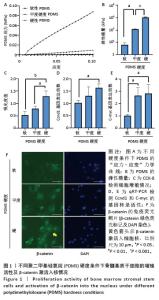
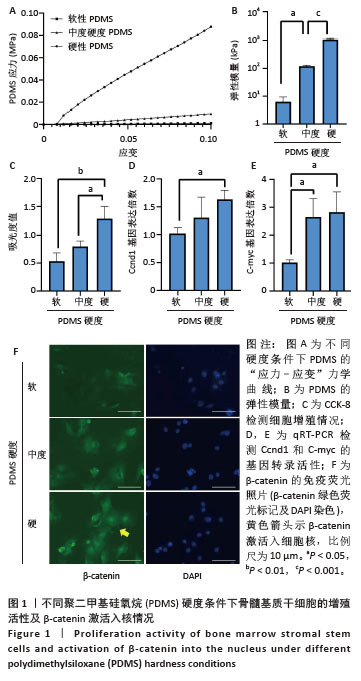
2.1 聚二甲基硅氧烷硬度对骨髓基质干细胞增殖活性的影响 首先对3组聚二甲基硅氧烷的弹性硬度进行测定,通过生物力学仪器加载10%应变后,3种聚二甲基硅氧烷的应力-应变曲线如图1A所示,力学反应性差异明显。软性聚二甲基硅氧烷的弹性模量为(6.3±3.1) kPa,中等硬度聚二甲基硅氧烷的弹性模量为(120.7±7.3) kPa,硬性聚二甲基硅氧烷的弹性模量为(1 057±70.7) kPa,3组之间差异性明显(F=590.4,P < 0.001),软性聚二甲基硅氧烷的弹性模量低于中等硬度性聚二甲基硅氧烷(P=0.03),而中等硬度聚二甲基硅氧烷的弹性模量低于硬性聚二甲基硅氧烷(P < 0.001),见图1B。 在不同硬度聚二甲基硅氧烷上培养7 d进行CCK-8检测,结果发现,硬性聚二甲基硅氧烷组细胞增殖活性强于软性和中等硬度聚二甲基硅氧烷组(P=0.02和P=0.01),见图1C。qRT-PCR结果显示:硬性聚二甲基硅氧烷组的Ccnd1和C-myc转录活性均高于软性聚二甲基硅氧烷组(P=0.046和P=0.029),中等硬度聚二甲基硅氧烷组的C-myc转录活性也高于软性聚二甲基硅氧烷组(P=0.019),见图1D,E。 由于Ccnd1和C-myc是经典Wnt/β-catenin通路的下游基因,进一步通过免疫荧光染色(β-catenin及DAPI染色)确认β-catenin的激活及转移入核情况,如图1F所示,软性聚二甲基硅氧烷组β-catenin未明显定位于细胞核内;中等硬度聚二甲基硅氧烷组β-catenin部分激活,与DAPI有共同定位表现;硬性聚二甲基硅氧烷组β-catenin较多激活,与细胞核定位一致(黄色箭头)。以上结果说明硬性聚二甲基硅氧烷条件下细胞增殖活性提高,伴随β-catenin激活入细胞核和Ccnd1、C-myc转录活性提高。 "
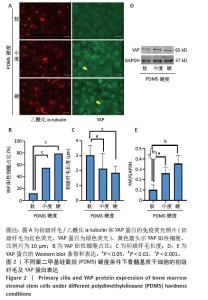
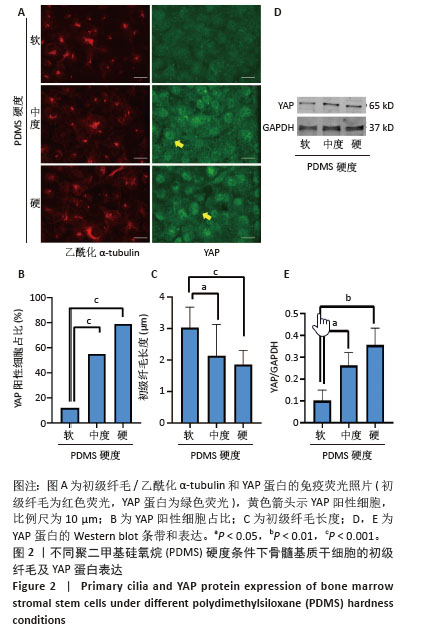
2.2 不同聚二甲基硅氧烷硬度条件下初级纤毛及YAP表达分析 初级纤毛通过乙酰化α-tubulin染色(红色荧光标记)进行标记,YAP蛋白通过绿色荧光标记,见图2A。硬性聚二甲基硅氧烷培养条件下,细胞核内YAP蛋白标记明显,视为YAP阳性细胞(黄色箭头)。图2B为YAP阳性细胞占比的统计结果,硬性聚二甲基硅氧烷组的YAP阳性细胞占比为79%,显著高于中等硬度聚二甲基硅氧烷组(P < 0.001)和软性聚二甲基硅氧烷组(P < 0.001)。与此同时,硬性聚二甲基硅氧烷组细胞的初级纤毛长度显著低于软性聚二甲基硅氧烷组(P < 0.001),中等硬度聚二甲基硅氧烷组也低于软性聚二甲基硅氧烷组(P=0.013)。见图2C。 Western blot检测结果显示,软性聚二甲基硅氧烷组的YAP蛋白表达低于中等硬度聚二甲基硅氧烷组(P=0.041)和硬性聚二甲基硅氧烷组(P=0.005),见图2D,E。以上结果说明随着聚二甲基硅氧烷硬度提高,YAP阳性细胞占比增多、YAP蛋白表达提高,伴随着初级纤毛长度缩短,二者可能具有相关性。 "
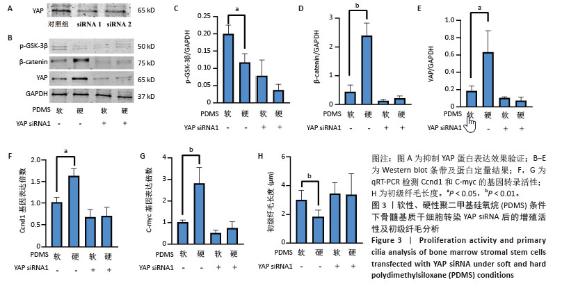
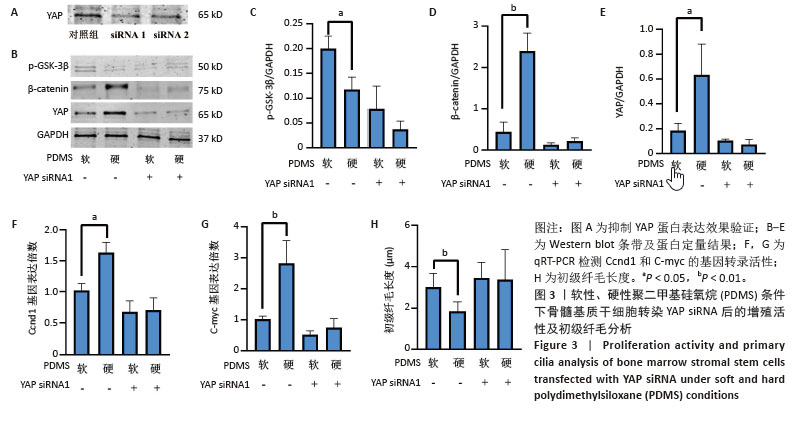
2.3 通过siRNA抑制YAP表达后骨髓基质干细胞的相关指标变化 首先通过Western blot分析siRNA抑制YAP蛋白表达的效果,图3A示siRNA1干预后YAP蛋白表达显著减低。骨髓基质干细胞分别培养于软性及硬性聚二甲基硅氧烷表面,分别给予对照siRNA和YAP siRNA1干预,3 d后通过Western blot进行蛋白定量分析,见图3B,其中反映Wnt/β-catenin通路激活情况的磷酸化GSK-3β和β-catenin蛋白定量如图3C,D所示。软性及硬性聚二甲基硅氧烷条件下,磷酸化GSK-3β和β-catenin蛋白表达存在统计学差异(P=0.039和P=0.004),而YAP受到siRNA1抑制后,磷酸化GSK-3β和β-catenin蛋白表达则无统计学差异(P > 0.05)。 YAP蛋白的表达与前一部分实验趋势一致,即硬性聚二甲基硅氧烷引起YAP蛋白表达提高(P=0.011,图3E),而siRNA干预后YAP蛋白表达降低且软性与硬性聚二甲基硅氧烷条件下无统计学差异(P > 0.05,图3E)。通过qRT-PCR进一步揭示通路的下游基因转录活性,结果显示相较于软性聚二甲基硅氧烷组,硬性聚二甲基硅氧烷组Ccnd1和C-myc的转录活性显著增强(P=0.033和P=0.003,图3F和图3G),而YAP siRNA干预后统计学差异消失(P > 0.05,图3F和图3G)。 初级纤毛测量结果显示,硬性聚二甲基硅氧烷组细胞的初级纤毛长度显著低于软性聚二甲基硅氧烷 (P=0.004,图3H),YAP siRNA干预后初级纤毛长度差异消失(P > 0.05,图3H)。 "
| [1] 侯建飞,王福科,杨桂然,等.羟基磷灰石表面改性作为组织工程骨支架的应用优势[J].中国组织工程研究,2022,26(10):1610-1614. [2] 钟思扬,廖晴,周星宇,等.骨微环境对组织工程骨再生过程的影响[J].中国组织工程研究,2024,28(15):2452-2460. [3] 马春燕,潘清,何磊,等.细胞外基质PDMS硬度对牙髓干细胞增殖和成骨分化的影响[J].上海口腔医学,2021,30(3):253-257. [4] 郑力恒,吴昊,尚玉攀,等.组织工程支架材料性质对干细胞分化的影响[J].中国组织工程研究,2017,21(14):2274-2279. [5] HE S, LEI P, KANG W, et al. Stiffness Restricts the Stemness of the Intestinal Stem Cells and Skews Their Differentiation Toward Goblet Cells. Gastroenterology. 2023;164(7):1137-1151.e15. [6] PAN JX, XIONG L, ZHAO K, et al. YAP promotes osteogenesis and suppresses adipogenic differentiation by regulating β-catenin signaling. Bone Res. 2018;6:18. [7] SUN K, GUO J, GUO Z, et al. The roles of the Hippo-YAP signalling pathway in Cartilage and Osteoarthritis. Ageing Res Rev. 2023;90: 102015. [8] MENG H, FU S, FERREIRA MB, et al. YAP activation inhibits inflammatory signalling and cartilage breakdown associated with reduced primary cilia expression. Osteoarthritis Cartilage. 2023;31(5):600-612. [9] MELI VS, ATCHA H, VEERASUBRAMANIAN PK, et al. YAP-mediated mechanotransduction tunes the macrophage inflammatory response. Sci Adv. 2020;6(49):eabb8471. [10] SALES FCP, ARIATI RM, NORONHA VT, et al. Mechanical Characterization of PDMS with Different Mixing Ratios. Procedia Structural Integrity. 2022;37:383-388. [11] LEE M, CHU K, CHAKRABORTY M, et al. PDMS hydrogel-coated tissue culture plates for studying the impact of substrate stiffness on dendritic cell function. STAR Protoc. 2022;3(2):101233. [12] KRETSCHMER M, MAMISTVALOV R, SPRINZAK D, et al. Matrix stiffness regulates Notch signaling activity in endothelial cells. J Cell Sci. 2023; 136(2):jcs260442. [13] KONG MJ, HAN SJ, SEU SY, et al. Shortening of primary cilia length is associated with urine concentration in the kidneys. Kidney Res Clin Pract. 2023;42(3):312-324. [14] MACARELLI V, LEVENTEA E, MERKLE FT. Regulation of the length of neuronal primary cilia and its potential effects on signalling. Trends Cell Biol. 2023;33(11):979-990. [15] 闵子洋,穆妮热·艾力,郑耘昊,等.细胞外基质力学微环境与细胞间相互作用的机制与特征[J].中国组织工程研究,2022,26(25): 4034-4045. [16] AREFIN AME, LAHOWETZ M, EGAN PF. Simulated tissue growth in tetragonal lattices with mechanical stiffness tuned for bone tissue engineering. Comput Biol Med. 2021;138:104913. [17] ZHANG J, WEHRLE E, ADAMEK P, et al. Optimization of mechanical stiffness and cell density of 3D bioprinted cell-laden scaffolds improves extracellular matrix mineralization and cellular organization for bone tissue engineering. Acta Biomater. 2020;114:307-322. [18] MA C, DU T, NIU X, et al. Biomechanics and mechanobiology of the bone matrix. Bone Res. 2022;10(1):59. [19] WU D, ISAKSSON P, FERGUSON SJ, et al. Young’s modulus of trabecular bone at the tissue level: A review. Acta Biomater. 2018;78:1-12. [20] CLAUSING RJ, STILLER A, KUHN F, et al. Measuring Young’s modulus of single trabeculae in cancellous bone using a two-point bending test. Clin Biomech (Bristol). 2023;102:105875. [21] FAN L, CHEN S, YANG M, et al. Metallic Materials for Bone Repair. Adv Healthc Mater. 2024;13(3):e2302132. [22] CHEN G, DONG C, YANG L, et al. 3D Scaffolds with Different Stiffness but the Same Microstructure for Bone Tissue Engineering. ACS Appl Mater Interfaces. 2015;7(29):15790-15802. [23] HILGENDORF KI, MYERS BR, REITER JF. Emerging mechanistic understanding of cilia function in cellular signalling. Nat Rev Mol Cell Biol. 2024;25(7):555-573. [24] VERBRUGGEN SW, SITTICHOKECHAIWUT A, REILLY GC. Osteocytes and Primary Cilia. Curr Osteoporos Rep. 2023;21(6):719-730. [25] WANG W, JACK BM, WANG HH, et al. Intraflagellar Transport Proteins as Regulators of Primary Cilia Length. Front Cell Dev Biol. 2021;9:661350. [26] LACEY SE, PIGINO G. The intraflagellar transport cycle. Nat Rev Mol Cell Biol. 2025;26(3):175-192. [27] ZHOU H, WU S, LING H, et al. Primary Cilia: A Cellular Regulator of Articular Cartilage Degeneration. Stem Cells Int. 2022;2022:2560441. [28] 王巧玲,吴志卯,完迪迪,等.初级纤毛发生起始的分子机制[J].中国细胞生物学学报,2023,45(11):1731-1744. [29] RIDDLE RC, TAYLOR AF, ROGERS JR, et al. ATP release mediates fluid flow-induced proliferation of human bone marrow stromal cells. J Bone Miner Res. 2007;22(4):589-600. [30] MANSINI AP, PEIXOTO E, JIN S, et al. The Chemosensory Function of Primary Cilia Regulates Cholangiocyte Migration, Invasion, and Tumor Growth. Hepatology. 2019;69(4):1582-1598. [31] MA W, WEI L, JIN L, et al. YAP/Aurora A-mediated ciliogenesis regulates ionizing radiation-induced senescence via Hedgehog pathway in tumor cells. Biochim Biophys Acta Mol Basis Dis. 2024;1870(4):167062. [32] CHEN H, XIAO H, WU B, et al. The effects of primary cilia-mediated mechanical stimulation on nestin+-BMSCs during bone-tendon healing. J Adv Res. 2024. doi: 10.1016/j.jare.2024.09.012. [33] CROZET F, LEVAYER R. Emerging roles and mechanisms of ERK pathway mechanosensing. Cell Mol Life Sci. 2023;80(12):355. [34] LIU L, GUO J, TONG X, et al. Mechanical strain regulates osteogenesis via Antxr1/LncRNA H19/Wnt/β-catenin axis. J Cell Physiol. 2024;239(5): e31214. [35] CAI S, ZOU Y, ZHAO Y, et al. Mechanical stress reduces secreted frizzled-related protein expression and promotes temporomandibular joint osteoarthritis via Wnt/β-catenin signaling. Bone. 2022;161:116445. [36] KAMETANI Y, TANAKA S, WADA Y, et al. Yes-associated protein activation potentiates glycogen synthase kinase-3 inhibitor-induced proliferation of neonatal cardiomyocytes and iPS cell-derived cardiomyocytes. J Cell Physiol. 2022;237(5):2539-2549. [37] BERNATIK O, PACLIKOVA P, KOTRBOVA A, et al. Primary Cilia Formation Does Not Rely on WNT/β-Catenin Signaling. Front Cell Dev Biol. 2021;9: 623753. [38] NIEHRS C, DA SILVA F, SEIDL C. Cilia as Wnt signaling organelles. Trends Cell Biol. 2025;35(1):24-32. [39] Berbari NF, O’Connor AK, Haycraft CJ, et al. The primary cilium as a complex signaling center. Curr Biol. 2009;19(13):R526-535. [40] ZHANG K, DA SILVA F, SEIDL C, et al. Primary cilia are WNT-transducing organelles whose biogenesis is controlled by a WNT-PP1 axis. Dev Cell. 2023;58(2):139-154.e8. |
| [1] | Sun Lei, Zhang Qi, Zhang Yu. Pro-osteoblastic effect of chlorogenic acid protein microsphere/polycaprolactone electrospinning membrane [J]. Chinese Journal of Tissue Engineering Research, 2026, 30(8): 1877-1884. |
| [2] | Wang Qisa, Lu Yuzheng, Han Xiufeng, Zhao Wenling, Shi Haitao, Xu Zhe. Cytocompatibility of 3D printed methyl acrylated hyaluronic acid/decellularized skin hydrogel scaffolds [J]. Chinese Journal of Tissue Engineering Research, 2026, 30(8): 1912-1920. |
| [3] | Yuan Xiaoshuang, Yang Xu, Yang Bo, Chen Xiaoxu, Tian Ting, Wang Feiqing, Li Yanju, Liu Yang, Yang Wenxiu. Effect of conditioned medium of diffuse large B-cell lymphoma cells on proliferation and apoptosis of human bone marrow mesenchymal stem cells [J]. Chinese Journal of Tissue Engineering Research, 2026, 30(7): 1632-1640. |
| [4] | Jin Dongsheng, Zhao Zhanghong, Zhu Ziyin, Zhang Sen, Sun Zuyan, Deng Jiang. Effects of icariin-loaded microsphere-three-dimensional scaffold on osteogenic differentiation of rabbit bone marrow mesenchymal stem cells [J]. Chinese Journal of Tissue Engineering Research, 2026, 30(7): 1658-1668. |
| [5] | Hou Chaowen, Li Zhaojin, Kong Jianda, Zhang Shuli. Main physiological changes in skeletal muscle aging and the multimechanism regulatory role of exercise [J]. Chinese Journal of Tissue Engineering Research, 2026, 30(6): 1464-1475. |
| [6] | Huang Liuyan, Zhang Wenxi, Chen Shuwen, Yu Shimei, Dai Zhong, Zuo Changqing. Forskolin promotes C2C12 myoblast differentiation via regulating the ERK and Akt signaling pathways [J]. Chinese Journal of Tissue Engineering Research, 2026, 30(5): 1114-1121. |
| [7] | Bao Zhuoma, Hou Ziming, Jiang Lu, Li Weiyi, Zhang Zongxing, Liu Daozhong, Yuan Lin. Effect and mechanism by which Pterocarya hupehensis skan total flavonoids regulates the proliferation, migration and apoptosis of fibroblast-like synoviocytes [J]. Chinese Journal of Tissue Engineering Research, 2026, 30(4): 816-823. |
| [8] | Chen Ying, Sun Xuheng, Liu Qing, Xiao Cong, Jiang Hongjing, Lin Zhanyi. A serum-free culture medium for the early-stage formation of tissue-engineered vascular grafts [J]. Chinese Journal of Tissue Engineering Research, 2026, 30(20): 5093-5102. |
| [9] | Xu Yixuan, Yao Jun, Liu Xulu, Li Xinlian, Liu Zhixiong, Zhang Zhihong. Vancomycin-containing porcine skin acellular extracellular matrix hydrogel promotes wound healing in skin infections [J]. Chinese Journal of Tissue Engineering Research, 2026, 30(20): 5214-5228. |
| [10] | Chen Ling, Mao Qiuhua, Xu Pu, Zhang Wenbo. Effect of water-soluble matrix of nano-pearl powder on proliferation, migration and apoptosis of mouse fibroblasts#br# [J]. Chinese Journal of Tissue Engineering Research, 2026, 30(2): 338-344. |
| [11] | Gu Jianmei, Yuan Kunshan, Zhou Qiang, Zhang Haijun, , . Application of laser microporous decellularized scaffolds in tissue regeneration [J]. Chinese Journal of Tissue Engineering Research, 2026, 30(2): 499-507. |
| [12] | Li Pengli, Yang Yanmei, Hu Yawen, Liu Hongqi, Wang Manyi, Yan Jianfei, Gu Bin. Effect of zoledronic acid on jaw bone marrow mesenchymal stem cells in mice with bisphosphonate-related osteonecrosis of the jaw [J]. Chinese Journal of Tissue Engineering Research, 2026, 30(13): 3217-3225. |
| [13] | Shi Yuxin, Kaiwusail · Tursun, Liu Jia. Effects of basic fibroblast growth factor-loaded composite bioscaffold on angiogenesis of dental pulp stem cells [J]. Chinese Journal of Tissue Engineering Research, 2026, 30(13): 3343-3349. |
| [14] | Liu Ziwei, Nijati·Tursun, Yin Rui, Li Shuhui, Zhou Jing. Effect of cannabinoid type I receptors on neuronal differentiation of human apical papilla stem cells [J]. Chinese Journal of Tissue Engineering Research, 2026, 30(1): 93-100. |
| [15] | Zhao Yang, Li Jialin, Wu Xiao, Zou Yourui, Liu Yang, Ma Hui. Choline kinase alpha silencing affects proliferation and apoptosis in glioma cells by inducing mitochondrial dysfunction [J]. Chinese Journal of Tissue Engineering Research, 2026, 30(1): 130-138. |
| Viewed | ||||||
|
Full text |
|
|||||
|
Abstract |
|
|||||