Chinese Journal of Tissue Engineering Research ›› 2026, Vol. 30 ›› Issue (33): 8618-8630.doi: 10.12307/2026.285
Previous Articles Next Articles
Epimedium in the treatment of alcohol-induced osteonecrosis of the femoral head: action mechanism through network pharmacology and molecular dynamics simulation
Lai Yu1, 2, Chen Yueping2, Zhang Xiaoyun2, Zhuo Yinghong2
- 1Guangxi University of Chinese Medicine, Nanning 530001, Guangxi Zhuang Autonomous Region, China; 2Ruikang Hospital, Guangxi University of Chinese Medicine, Nanning 530001, Guangxi Zhuang Autonomous Region, China
-
Received:2025-08-21Revised:2026-01-27Online:2026-11-28Published:2026-06-09 -
Contact:Chen Yueping, PhD, Chief physician, Doctoral supervisor, Ruikang Hospital, Guangxi University of Chinese Medicine, Nanning 530001, Guangxi Zhuang Autonomous Region, China -
About author:Lai Yu, PhD, Physician, Guangxi University of Chinese Medicine, Nanning 530001, Guangxi Zhuang Autonomous Region, China; Ruikang Hospital, Guangxi University of Chinese Medicine, Nanning 530001, Guangxi Zhuang Autonomous Region, China -
Supported by:Clinical Key Specialty of Guangxi Zhuang Autonomous Region (Trauma Surgery) Construction Project, No. [2021]17 (to CYP); Guangxi University of Chinese Medicine Class A “Guangxi Traditional Chinese Medicine Inheritance and Innovation Team”, No. 2022A004 (to CYP); Graduate Education Innovation Program Project of Guangxi University of Chinese Medicine, No. YCBXJ2023025 (to LY); Youth Fund Project of Guangxi University of Chinese Medicine, No. 2020QN013 (to ZYH)

CLC Number:
Cite this article
Lai Yu, Chen Yueping, Zhang Xiaoyun, Zhuo Yinghong. Epimedium in the treatment of alcohol-induced osteonecrosis of the femoral head: action mechanism through network pharmacology and molecular dynamics simulation[J]. Chinese Journal of Tissue Engineering Research, 2026, 30(33): 8618-8630.
share this article
Add to citation manager EndNote|Reference Manager|ProCite|BibTeX|RefWorks
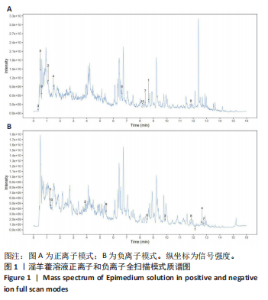
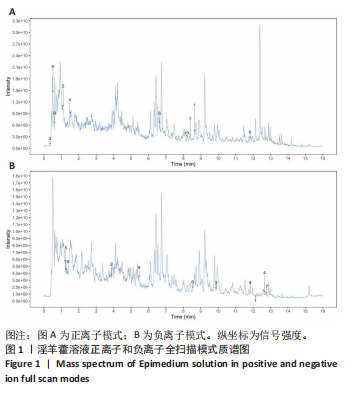
2.1 淫羊藿非靶标代谢组学检测结果 淫羊藿溶液正离子和负离子全扫描模式质谱图见图1。根据质谱检测结果得到质谱碎片,将理论值与实测值进行比对(计算相对误差),正、负离子模式下共鉴别出2 734个主要成分。"
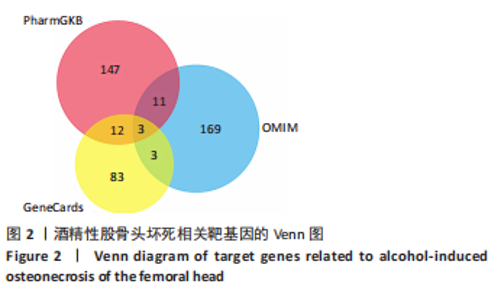
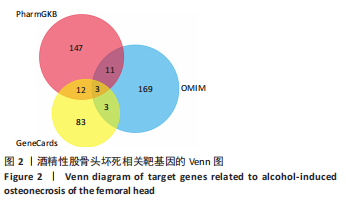
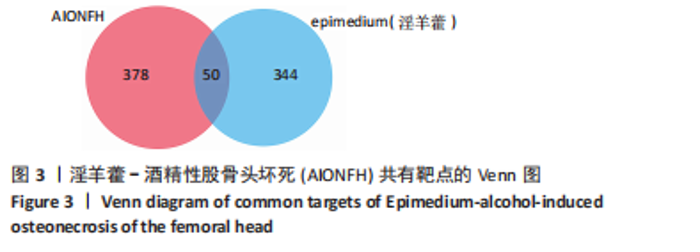
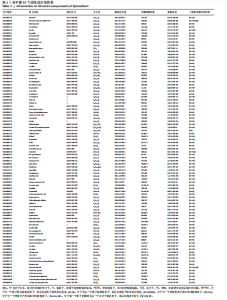
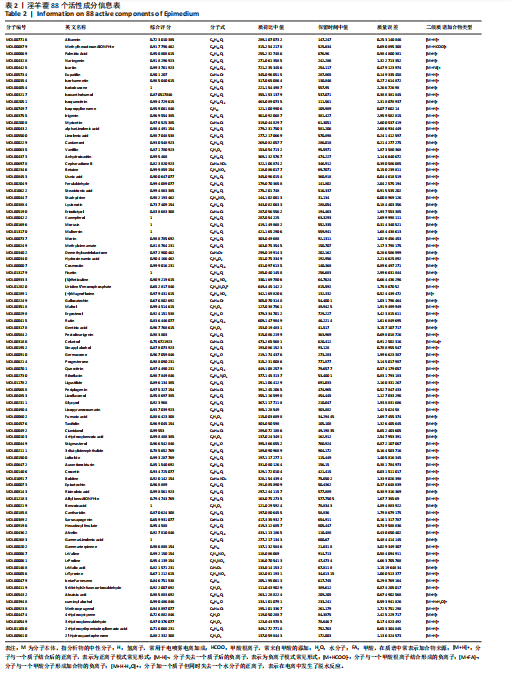
2.2 网络药理学分析结果 2.2.1 淫羊藿活性成分靶点和酒精性股骨头坏死靶点的预测 在TCMSP数据库中导入2 734个淫羊藿主要成分后,经过筛选排除了2 646个不符合标准的成分,最终确定88个具有活性的化合物,见表2。通过整合这些活性成分的靶点蛋白,并借助Uniprot数据库查询其对应基因名称,共鉴定出394个活性成分靶点。对GeneCards、OMIM和PharmGKB数据库中的靶点数据进行整合,经过去重处理后,获得428个与酒精性股骨头坏死相关的靶基因,见图2。进一步采用Venn图分析方法,对淫羊藿与酒精性股骨头坏死的共有靶点进行预测。分析结果显示,淫羊藿的394个靶基因与酒精性股骨头坏死相关的428个靶基因存在交叉映射关系,最终鉴定出50个共有靶点,见图3。"
"
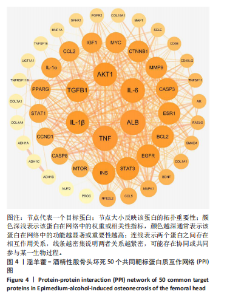
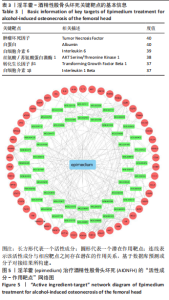
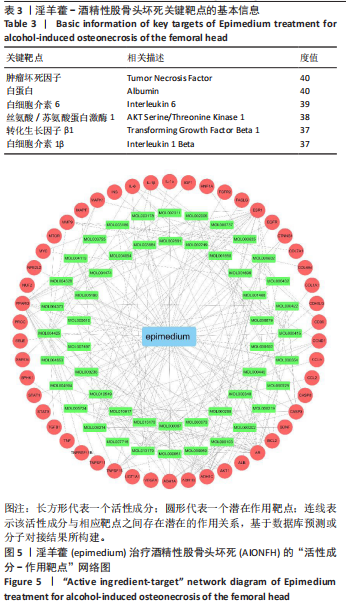
2.2.2 蛋白质互作网络分析及 “活性成分-作用靶点”网络构建 通过STRING数据库对50个共同靶标进行蛋白质相互作用网络的构建,并借助Cytoscape软件实现网络可视化,见图4。该网络图谱包含603条相互作用关系及50个蛋白质节点。基于节点度值分析,确定了肿瘤坏死因子(TNF)、白蛋白(ALB)、白细胞介素6(IL-6)、丝氨酸/苏氨酸蛋白激酶1(AKT1)、转化生长因子β1(TGFB1)和白细胞介素1β(IL-1β)这6个核心蛋白基因,这些关键因子在蛋白质互作网络中占据重要地位,可能是淫羊藿干预酒精性股骨头坏死的潜在作用靶点,其详细参数信息可参见表3。进一步地,利用Cytoscape软件整合活性成分与共同靶标间的相互作用关系,构建了淫羊藿治疗酒精性股骨头坏死的“成分-靶点”调控网络,见图5。该网络中,度值排名前5的活性成分分别为淫羊藿苷(Icariin)、非瑟酮(Fisetin)、孕酮(Progesterone)、杨梅素(Myricetin)和山奈酚(Kaempferol)。这些活性成分被认为是该网络的关键成分,可能在治疗酒精性股骨头坏死中发挥重要作用。"

"
"
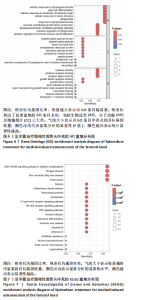
2.2.3 富集分析 GO富集分析关键靶点的功能过程中,共确定1 321个条目,其中1 286条代表生物过程(biological process,BP),主要涉及cellular response to lipopolysaccharide、glial cell differentiation、cellular response to molecule of bacterial origin、cellular response to biotic stimulus等方面;8条代表细胞成分(cellular component,CC),主要涉及platelet alpha granule lumen、platelet alpha granule、blood microparticle、endoplasmic reticulum lumen;27条代表分子功能(molecular function,MF),主要涉及cytokine activity、cytokine receptor binding、receptor ligand activity、growth factor receptor binding。GO分析结果得出的生物过程、细胞成分及分子功能与酒精性股骨头坏死的发生发展过程密切相关,见图6。KEGG富集分析关键靶点共确定了79个条目,主要涉及晚期糖基化终产物受体信号通路(AGE-RAGE signaling pathwa)、C型凝集素受体信号通路(C-type lectin receptor signaling pathway)、Toll样受体信号通路(Toll-like receptor signaling pathway)、肿瘤坏死因子信号通路(TNF signaling pathway,见图7。"

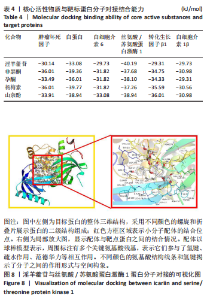
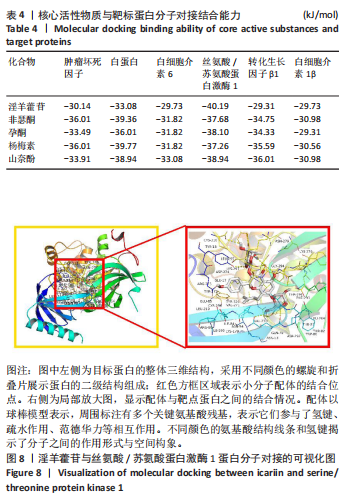
2.3 分子对接及分子动力学模拟结果 2.3.1 分子对接 通过AutoDock等计算工具,对核心活性物质与重要靶标蛋白实施分子对接分析。当相互作用能呈现负值时,表明配体与受体能够自发结合,且结合构象的稳定性与结合能数值呈负相关。实验数据显示,当结合能≤-17.782 kJ/mol时,表明配体与受体存在初步结合能力;若结合能≤-20.92 kJ/mol,则显示两者具有较好的结合性能;当结合能≤-29.288 kJ/mol时,则证明配体与受体间存在显著的结合活性[16]。此次研究中所有样本的结合能均低于-29.288 kJ/mol,证实了核心活性物质与重要靶标蛋白间存在强烈的相互作用,这一发现支持了预测结果的可靠性,具体数据详见表4。值得注意的是,淫羊藿苷与丝氨酸/苏氨酸蛋白激酶1蛋白表现出最强的亲和力,其分子对接的具体构象已在图8中详细展示。"
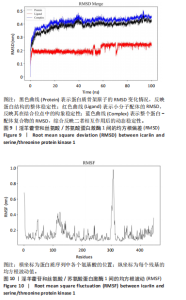
2.3.2 分子动力学模拟 为了评估淫羊藿苷与丝氨酸/苏氨酸蛋白激酶1复合物的稳定性和灵活性,研究使用分子动力学模拟技术对其相互作用进行了深入分析。 (1)均方根偏差是评估蛋白质结构变化的指标:模拟中计算了淫羊藿苷与丝氨酸/苏氨酸蛋白激酶1之间的均方根偏差值,见图9。在100 ns的模拟过程中,淫羊藿苷与丝氨酸/苏氨酸蛋白激酶1之间的均方根偏差值初期较大,但在5 ns后逐渐趋于平稳。整体来看,均方根偏差值维持在较小的范围内( < 0.6 nm),表明淫羊藿苷与丝氨酸/苏氨酸蛋白激酶1的结合较为稳定(2)均方根波动是评估蛋白质动态性的指标:模拟中计算了淫羊藿苷与丝氨酸/苏氨酸蛋白激酶1之间的均方根波动值,见图10。结果显示,丝氨酸/苏氨酸蛋白激酶1在结合部分的均方根波动值较小,而在非结合部分则较大,表明淫羊藿苷的结合增强了丝氨酸/苏氨酸蛋白激酶1某些区域的柔性,可能使其更加容易发生构象变化。"

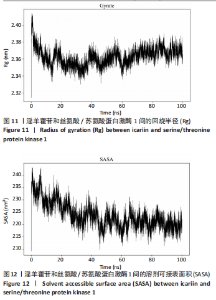
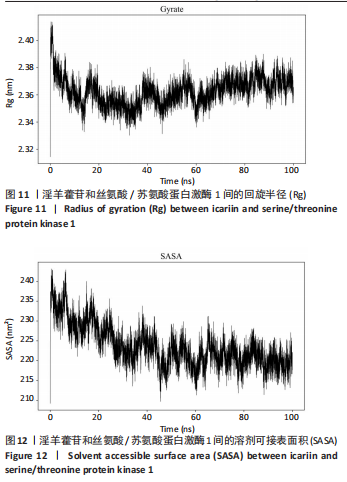
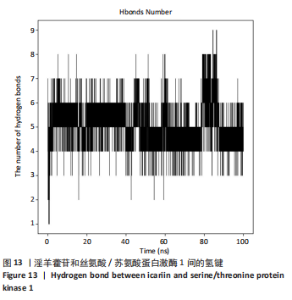
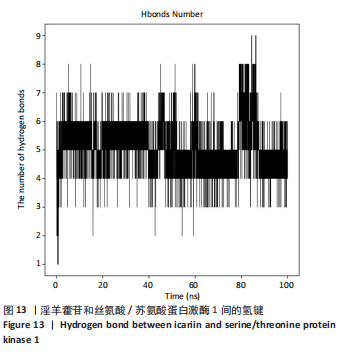
(3)回旋半径用于评估蛋白质的整体紧凑程度:模拟中计算了淫羊藿苷与丝氨酸/苏氨酸蛋白激酶1之间的回旋半径值,见图11。结果显示,淫羊藿苷与丝氨酸/苏氨酸蛋白激酶1结合后,其回旋半径值较单独丝氨酸/苏氨酸蛋白激酶1有所下降,说明淫羊藿苷的结合使丝氨酸/苏氨酸蛋白激酶1更加紧凑。 (4)溶剂可接表面积用于评估蛋白质的表面面积:模拟中计算了淫羊藿苷与丝氨酸/苏氨酸蛋白激酶1之间的溶剂可接表面积值,见图12。结果表明,丝氨酸/苏氨酸蛋白激酶1与淫羊藿苷结合前,溶剂可接表面积值较大;而结合后,溶剂可接表面积值有所下降,表明淫羊藿苷的结合减小了丝氨酸/苏氨酸蛋白激酶1的表面面积。 (5)氢键是评估蛋白质与小分子之间氢键的指标:模拟中计算了淫羊藿苷与丝氨酸/苏氨酸蛋白激酶1之间的氢键数量,见图13。结果显示,在模拟过程中,淫羊藿苷与丝氨酸/苏氨酸蛋白激酶1之间形成了多个氢键,主要来自丝氨酸/苏氨酸蛋白激酶1中的关键残基与小分子中的重要基团之间的相互作用。"
"
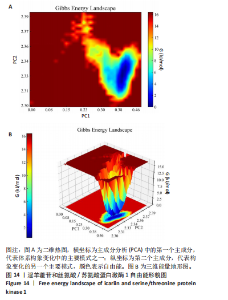
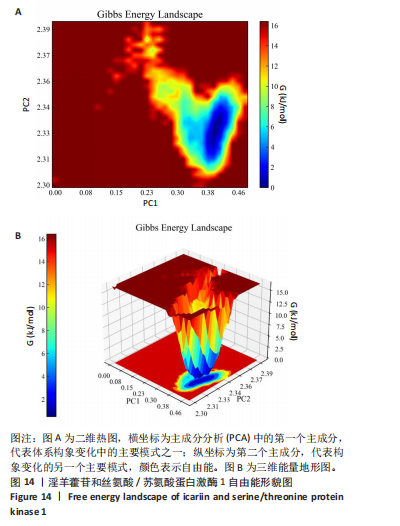
(6)自由能形貌分析:见图14,研究对体系内分子间作用力及能量分布特征进行了系统考察。分析结果表明,分子构象在90 ns左右呈现出显著的低能态分布,这一现象暗示了分子在该时间区间可能进入相对平衡构象。值得注意的是,该构象与初始结构具有较高的相似性,且分子倾向于在此构象下保持较长时间的稳态,从而展现出优异的构象稳定性特征。"
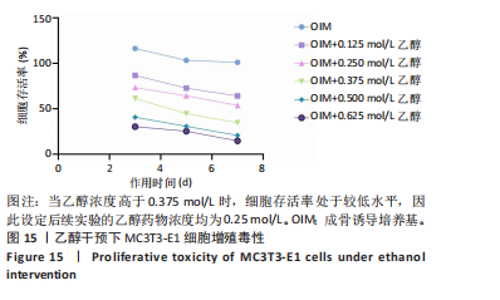
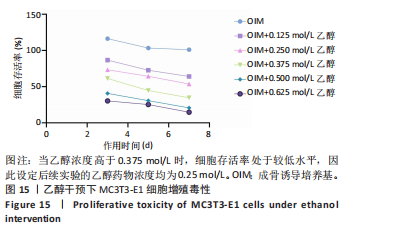
2.4 淫羊藿苷调控乙醇干预下MC3T3-E1细胞丝氨酸/苏氨酸蛋白激酶1磷酸化表达 2.4.1 CCK-8检测乙醇及淫羊藿苷对MC3T3-E1细胞增殖毒性影响 结果表明,在各浓度乙醇干预成骨诱导的MC3T3-E1细胞3,5,7 d后,细胞存活率随着时间增长而降低,乙醇抑制细胞增殖,而且随着乙醇浓度的提升,这种抑制效果变得更加明显,见图15。根据整体结果可知,当乙醇浓度高于0.375 mol/L时,细胞存活率处于较低水平,因此在后续研究及检测中,实验使用的乙醇药物浓度均为0.25 mol/L。"
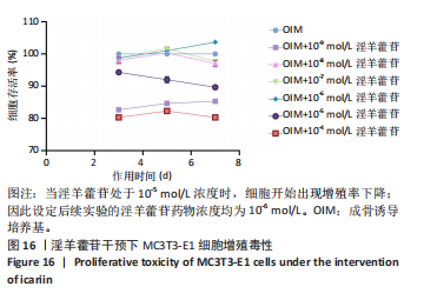
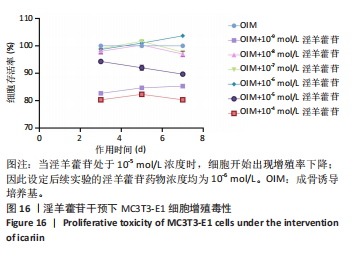
在各浓度淫羊藿苷干预成骨诱导MC3T3-E1细胞的过程中,细胞存活率随着时间增长而增长,一定浓度范围内(10-8-10-5 mol/L),淫羊藿苷对细胞的增殖能力没有显著影响,但在10-9 mol/L时轻度抑制细胞增殖,10-4 mol/L浓度时抑制细胞增殖明显,见图16。根据整体结果可知,当淫羊藿苷处于10-5 mol/L浓度时,细胞开始出现增殖率下降,因此在后续研究及检测中,实验使用的淫羊藿苷药物浓度均为10-6 mol/L。"
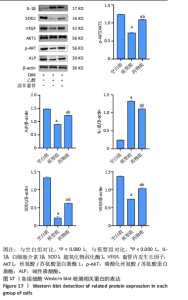
2.4.2 Western blot检测淫羊藿苷调控乙醇干预下丝氨酸/苏氨酸蛋白激酶1、ALP、白细胞介素1β、超氧化物歧化酶1、血管内皮生长因子表达 见图17。 (1)丝氨酸/苏氨酸蛋白激酶1的表达:同空白组对比,模型组与药物组丝氨酸/苏氨酸蛋白激酶1蛋白磷酸化表达下降(P < 0.000 1);同模型组对比,药物组丝氨酸/苏氨酸蛋白激酶1蛋白磷酸化表达升高(P < 0.000 1)。说明乙醇抑制了丝氨酸/苏氨酸蛋白激酶1的磷酸化表达,但淫羊藿苷可降低其抑制作用。 (2) ALP的表达:同空白组对比,模型组与药物组ALP表达下降(P < 0.000 1);同模型组对比,药物组ALP蛋白表达升高(P < 0.000 1)。说明乙醇抑制了ALP表达,但淫羊藿苷可降低其抑制作用。 (3)白细胞介素1β的表达:同空白组对比,模型组与药物组白细胞介素1β表达上升(P < 0.000 1);同模型组对比,药物组白细胞介素1β蛋白表达降低(P < 0.000 1)。说明乙醇促进机体炎性增长,但淫羊藿苷可抑制其作用,减少炎性因子的释放。 (4)超氧化物歧化酶1的表达:同空白组对比,模型组与药物组超氧化物歧化酶1表达下降(P < 0.000 1);同模型组对比,药物组超氧化物歧化酶1蛋白表达升高,结果具有统计学意义。说明乙醇促进机体氧化应激反应,但淫羊藿苷可缓解其作用,降低氧化应激反应。 (5)对血管内皮生长因子的表达:同空白组对比,模型组与药物组血管内皮生长因子表达下降(P < 0.000 1);同模型组对比,药物组血管内皮生长因子蛋白表达升高(P < 0.000 1)。说明乙醇抑制机体血管内皮生长,但淫羊藿苷可降低其抑制作用,促进内皮细胞生长。"
| [1] 丁强,刘金富,田照,等.补肾通蚀丸通过调控Nrf2/SLC7A11/GPX4通路介导铁死亡对酒精性股骨头坏死大鼠成骨功能障碍的影响[J].中华中医药杂志,2024,39(5):2316-2322. [2] XIONG J, NIU Y, LIU W, et al. Effect of L3MBTL3/PTPN9 polymorphisms on risk to alcohol-induced ONFH in Chinese Han population. Neurol Sci. 2022;43(4):2823-2830. [3] 邓鑫,苏云,富雨田,等.酒精性股骨头坏死研究现状及趋势的可视化分析[J].中国医药导刊,2025,27(3):257-265. [4] 刘华,蔡志刚,徐通生,等.双合汤联合微创保髋术治疗围塌陷期酒精性股骨头坏死的临床疗效观察[J].中药药理与临床,2024,40(10):69-73. [5] NJOKU I, PASQUALINI I, HUFFMAN N, et al. Osteonecrosis of the Femoral Head: Core Decompression Systems. Surg Technol Int. 2024;45:sti45/1845. [6] 邓鑫,苏云,富雨田,等.酒精性股骨头坏死研究现状及趋势的可视化分析[J].中国医药导刊,2025,27(3):257-265. [7] LI X, SUN Z, SHANG X, et al. Sequential delivery of IL-10 and icariin using nanoparticle/hydrogel hybrid system for prompting bone defect repair. Mater Today Bio. 2024;3;29:101374. [8] 宋世雷.淫羊藿苷通过Ca2+-CaM/CaMKⅡ信号介导LAP及典型自噬对酒精干预下破骨细胞的影响机制研究[D].南宁:广西中医药大学,2024. [9] 曾麒,陈跃平,宋世雷,等.淫羊藿苷调控LAP自噬促进酒精抑制的MC3T3-E1细胞成骨分化[J].中国中药杂志,2025,50(3):590-599. [10] ZHANG XY, CHEN YP, ZHANG C, et al. Icariin Accelerates Fracture Healing via Activation of the WNT1/β-catenin Osteogenic Signaling Pathway. Curr Pharm Biotechnol. 2020;21(15):1645-1653. [11] BAI L, LIU Y, ZHANG X, et al. Osteoporosis remission via an anti-inflammaging effect by icariin activated autophagy. Biomaterials. 2023;297:122125. [12] MA D, ZHU Z, TAN X, et al. Validation of Peripheral Neuromodulation Mechanisms of Icariin in Knee Osteoarthritis-Related Chronic Pain. J Cell Mol Med. 2024;28(23):e70223. [13] OPRITA EI, IOSAGEANU A, CRACIUNESCU O. Progress in Composite Hydrogels and Scaffolds Enriched with Icariin for Osteochondral Defect Healing. Gels. 2022;12;8(10):648. [14] DING J, XUE Q, GUO W, et al. Mechanism of astragaloside A against lung adenocarcinoma based on network pharmacology combined with molecular dynamics simulation technique. Sci Rep. 2025;15(1):12033. [15] 陈跃平,陈锋,彭清林,等.三七治疗骨关节炎机制:基于UHPLC-QE-MS、网络药理学及分子动力学模拟[J].中国组织工程研究,2025, 29(8):1751-1760. [16] WANG Y, TAO X, GAO Y, et al. Study on the mechanism of Shujin Tongluo granules in treating cervical spondylosis based on network pharmacology and molecular docking. Medicine (Baltimore). 2023;102(29):e34030. [17] CAO Y, YAO W, YANG T, et al. Elucidating the mechanisms of Buyang Huanwu Decoction in treating chronic cerebral ischemia: A combined approach using network pharmacology, molecular docking, and in vivo validation. Phytomedicine. 2024;132:155820. [18] SONG LJ, HAN QX, DING ZB,et al. Icariin ameliorates the cuprizone-induced demyelination associated with antioxidation and anti-inflammation. Inflammopharmacology. 2024;32(1):809-823. [19] REN Q, GUO F, TAO S, et al. Flavonoid fisetin alleviates kidney inflammation and apoptosis via inhibiting Src-mediated NF-κB p65 and MAPK signaling pathways in septic AKI mice. Biomed Pharmacother. 2020;122:109772. [20] FENG R, QIN X, LI Q, et al. Progesterone regulates inflammation and receptivity of cells via the NF-κB and LIF/STAT3 pathways. Theriogenology. 2022;186:50-59. [21] PAN H, HE J, YANG Z, et al. Myricetin possesses the potency against SARS-CoV-2 infection through blocking viral-entry facilitators and suppressing inflammation in rats and mice. Phytomedicine. 2023;116:154858. [22] HOSSEINI A, ALIPOUR A, BARADARAN RAHIMI V, et al. A comprehensive and mechanistic review on protective effects of kaempferol against natural and chemical toxins: Role of NF-κB inhibition and Nrf2 activation. Biofactors. 2023;49(2):322-350. [23] PARK JY, LEE SJ. Myricetin alleviates the mechanism of IL-1β production caused by the endocrine-disrupting chemical Di(2-ethylhexyl) phthalate in RAW 264.7 cells. Tissue Cell. 2024;93:102683. [24] YAN Q, LIU H, SUN S, et al. Adipose-derived stem cell exosomes loaded with icariin alleviates rheumatoid arthritis by modulating macrophage polarization in rats. J Nanobiotechnology. 2024;18;22(1):423. [25] INKIELEWICZ-STEPNIAK I, RADOMSKI MW, WOZNIAK M. Fisetin prevents fluoride- and dexamethasone-induced oxidative damage in osteoblast and hippocampal cells. Food Chem Toxicol. 2012;50(3-4):583-589. [26] VERMA A, AGGARWAL K, AGRAWAL R, et al. Molecular mechanisms regulating the pharmacological actions of icariin with special focus on PI3K-AKT and Nrf-2 signaling pathways. Mol Biol Rep. 2022;49(9):9023-9032. [27] HU WH, WANG HY, XIA YT, et al. Kaempferol, a Major Flavonoid in Ginkgo Folium, Potentiates Angiogenic Functions in Cultured Endothelial Cells by Binding to Vascular Endothelial Growth Factor. Front Pharmacol. 2020; 28;11:526. [28] XU X, FAN X, WU X, et al. Protective effect of Kaempferol on endothelial cell injury in glucocorticoid induced osteonecrosis of the femoral head. Zhongguo Xiu Fu Chong Jian Wai Ke Za Zhi. 2022;36(10):1277-1287. [29] 汤建成,张悦,姜睿琛,等.淫羊藿苷对激素诱导大鼠骨微血管内皮细胞铁死亡的影响[J].中国实验方剂学杂志,2025,31(5):131-140. [30] LUO XH, LIAO EY, SU X. Progesterone upregulates TGF-b isoforms (b1, b2, and b3) expression in normal human osteoblast-like cells. Calcif Tissue Int. 2002;71(4):329-334. [31] 张亚奇,蒋言坤,孙国源,等.淫羊藿苷调控TGF-β1/Smad通路诱导人骨微内皮细胞自噬的作用机制[J].中国实验方剂学杂志,2025,31(5): 123-130. [32] YUAN Z, WAN Z, WEI P, et al. Dual-Controlled Release of Icariin/Mg2+ from Biodegradable Microspheres and Their Synergistic Upregulation Effect on Bone Regeneration. Adv Healthc Mater. 2020;9(11):e2000211. [33] TAO X, SHI H, CAO A, et al. Understanding of physicochemical properties and antioxidant activity of ovalbumin-sodium alginate composite nanoparticle-encapsulated kaempferol/tannin acid. RSC Adv. 2022;12(28):18115-18126. [34] GRANEL H, BOSSARD C, COLLIGNON AM, et al. Osteogenic Effect of Fisetin Doping in Bioactive Glass/Poly(caprolactone) Hybrid Scaffolds. ACS Omega. 2022;7(26):22279-22290. [35] BYUN K, BAYARSAIKHAN D, BAYARSAIKHAN E, et al. Microglial AGE-albumin is critical in promoting alcohol-induced neurodegeneration in rats and humans. PLoS One. 2014;9(8):e104699. [36] LIU T, WANG Y, QIAN B, et al. Potential Metabolic Pathways Involved in Osteoporosis and Evaluation of Fracture Risk in Individuals with Diabetes. Biomed Res Int. 2024;2024:6640796. [37] REIS E SOUSA C, YAMASAKI S, BROWN GD. Myeloid C-type lectin receptors in innate immune recognition. Immunity. 2024;57(4):700-717. [38] YE W, LIAO Y, LIU X, et al. Dectin-2 depletion alleviates osteoclast-induced bone loss in periodontitis via Syk/NOX2/ROS signaling. Free Radic Biol Med. 2025;229:13-29. [39] KIM JW, ROH YS, JEONG H, et al. Spliceosome-Associated Protein 130 Exacerbates Alcohol-Induced Liver Injury by Inducing NLRP3 Inflammasome-Mediated IL-1β in Mice. Am J Pathol. 2018;188(4):967-980. [40] DUAN T, DU Y, XING C, et al. Toll-Like Receptor Signaling and Its Role in Cell-Mediated Immunity. Front Immunol. 2022;13:812774. [41] HUANG RL, YUAN Y, ZOU GM, et al. LPS-stimulated inflammatory environment inhibits BMP-2-induced osteoblastic differentiation through crosstalk between TLR4/MyD88/NF-κB and BMP/Smad signaling. Stem Cells Dev. 2014;23(3):277-289. [42] HENNING P, KASSEM A, WESTERLUND A,et al. Toll-like receptor-2 induced inflammation causes local bone formation and activates canonical Wnt signaling. Front Immunol. 2024;15:1383113. [43] ZHAO Z, DU Y, YAN K, et al. Exercise and osteoimmunology in bone remodeling. FASEB J. 2024;38(7):e23554. [44] FANG Z, TONG X, SHI G, et al. MicroRNA-31 regulates TNF-α and IL-17A co-induced-endothelial cell apoptosis by repressing E2F6. Biochem Biophys Res Commun. 2023; 666:76-82. [45] XU Y, JIANG Y, XIA C, et al. Stem cell therapy for osteonecrosis of femoral head: Opportunities and challenges. Regen Ther. 2020;15:295-304. [46] SINGH D, SINGH R. Pharmacological and Therapeutic Potential of a Natural Flavonoid Icariside II in Human Complication. Curr Drug Targets. 2025;26(5):320-330. [47] YAO W, TAO R, WANG K, et al. Icariin attenuates vascular endothelial dysfunction by inhibiting inflammation through GPER/Sirt1/HMGB1 signaling pathway in type 1 diabetic rats. Chin J Nat Med. 2024;22(4):293-306. [48] FILIPE HAL, LOURA LMS. Molecular Dynamics Simulations: Advances and Applications. Molecules. 2022;27(7):2105. [49] LUO Z, DONG J, WU J. Impact of Icariin and its derivatives on inflammatory diseases and relevant signaling pathways. Int Immunopharmacol. 2022; 108:108861. [50] XIANG S, ZHAO L, TANG C, et al. Icariin inhibits osteoblast ferroptosis via Nrf2/HO-1 signaling and enhances healing of osteoporotic fractures. Eur J Pharmacol. 2024;965:176244. [51] CHEN S, WANG Z, ZHOU H, et al. Icariin reduces high glucose-induced endothelial progenitor cell dysfunction via inhibiting the p38/CREB pathway and activating the Akt/eNOS/NO pathway. Exp Ther Med. 2019;18(6):4774-4780. |
| [1] | Guo Ying, Tian Feng, Wang Chunfang. Potential drug targets for the treatment of rheumatoid arthritis: large sample analysis from European databases [J]. Chinese Journal of Tissue Engineering Research, 2026, 30(6): 1549-1557. |
| [2] | Su Gangling, Liu Chunying, Cui Yangqing, Zhou Shaohu, Liu Shiyong, Wu Zhimin. Molecular docking and network pharmacology analyses of Shalin Decoction in regulating crystal homeostasis: active components and multi-target mechanisms [J]. Chinese Journal of Tissue Engineering Research, 2026, 30(36): 9613-9620. |
| [3] | Lin Kun, He Xianshun, Zhang Junjiao, Han Mingli, He Mincong, Wei Qiushi. Mechanism underlying Qu Shi Jie Du Formula for treating hyperuricemia in mice: an analysis integrating UHPLC-QE-MS with network pharmacology [J]. Chinese Journal of Tissue Engineering Research, 2026, 30(36): 9621-9631. |
| [4] | Chen Cai, Hong Zhongyuan, Deng Huaidong, Zeng Qin, Chen Jiancong. Therapeutic targets for knee osteoarthritis: identification via a bioinformatics approach [J]. Chinese Journal of Tissue Engineering Research, 2026, 30(34): 8878-8888. |
| [5] | Li Zhengpeng, Shao Weigang, Zeng Hao, Xiang Kelin, Zhang Botao, Zou Shunyi, Chen Sheng, Qi Wen. Osteoarthritis characteristic genes and prediction of targeted food-medicine homology traditional Chinese medicine: bioinformatics analysis and kinetic simulation [J]. Chinese Journal of Tissue Engineering Research, 2026, 30(29): 7739-7748. |
| [6] | Zhao Ruikai, Wang Yu, Guo Xiaohui, Sun Zehua, Wang Xu. Mendelian randomization analysis identifies potential drug targets for spinal osteoarthritis [J]. Chinese Journal of Tissue Engineering Research, 2026, 30(29): 7749-7754. |
| [7] | Deng Qian, Peng Zining, Meng Fanyu, Huang Yuanbo, Liu Nian, Yan Weitian, Li Zhaofu, Peng Jiangyun. Molecular mechanisms of Toddalia asiatica against rheumatoid arthritis: bioinformatics and molecular dynamics simulation [J]. Chinese Journal of Tissue Engineering Research, 2026, 30(28): 7267-7279. |
| [8] | He Wenyang, Chen Weijian, Ran Qingzhi, Huang Yidie, Lin Xiaodong, Xu Xuemeng, Guo Meirong, Liu Wengang. Action mechanisms of Bushen Qiangjin capsule in regulating inflammatory signaling pathways and improving knee osteoarthritis [J]. Chinese Journal of Tissue Engineering Research, 2026, 30(25): 6632-6642. |
| [9] | Wang Shili, Luo Yuan, Qiao Li, Yang Yonghong, Zhang Yujie, Zhang Shun. Relationship between blood drug concentration and safety of vancomycin in patients with orthopedic infection determined by ultra-performance liquid chromatography-tandem mass spectrometry [J]. Chinese Journal of Tissue Engineering Research, 2026, 30(21): 5494-5502. |
| [10] | Mi Baolai, Liu Yufei, Yang Qiaoli, Kang Yanlan, Yuan Liang, Cao Jianchun. Limb lymphedema: network pharmacology and molecular docking analysis of core drug mechanisms in traditional Chinese medicine treatment [J]. Chinese Journal of Tissue Engineering Research, 2026, 30(18): 4814-4824. |
| [11] | Zhou Wu, Zhang Jingxin, Liu Yuancheng, Hu Chenglong, Wang Siqi, Xu Jianxia, Huang Hai, Wei Sixi. Treatment of acute myeloid leukemia with corynoline: network pharmacology analysis of potential mechanisms and experimental validation [J]. Chinese Journal of Tissue Engineering Research, 2026, 30(16): 4088-4104. |
| [12] | Cao Lifang, Chen Tao, Shou Jiayin, Fan Fangfang. Hot spot and current status of single-cell RNA sequencing in stroke field [J]. Chinese Journal of Tissue Engineering Research, 2026, 30(13): 3446-3457. |
| [13] | Jiang Huanhuan, Mu Sheng, Ma Wenxin, Liu Chang, Liu Ziyu, Pu Jing, Zhu Xiangdong, Hui Hong, Ma Huiming. Mechanism of multi-target intervention of the active ingredient of Allii Tuberosi Semen in rats with oligoasthenozoospermia [J]. Chinese Journal of Tissue Engineering Research, 2026, 30(12): 3044-3057. |
| [14] | Cheng Le, Zhu Caifeng, Zhou Bingyuan, Gao Dahong, Cui Xiaoya, Li Jing, Wang Xuewei, Yang Gaoshang, Chen Xiyang. Mechanisms of stroke therapy targeting inflammatory cytokines: a big data analysis based on the IEU Open GWAS [J]. Chinese Journal of Tissue Engineering Research, 2026, 30(12): 3198-3216. |
| [15] | Xu Sheng, Zhang Wenwen, Zhang Weiwei, Wang Hongtao, Zhang Jun, Yang Ruisheng, Yuan Yuan, Wang Li, Hao Haihu. Network pharmacological analysis and experimental verification of semen cuscutae in treating postmenopausal osteoporosis [J]. Chinese Journal of Tissue Engineering Research, 2026, 30(11): 2702-2711. |
| Viewed | ||||||
|
Full text |
|
|||||
|
Abstract |
|
|||||