Chinese Journal of Tissue Engineering Research ›› 2026, Vol. 30 ›› Issue (19): 4942-4948.doi: 10.12307/2026.246
Previous Articles Next Articles
miR-9 regulates the differentiation of neural stem cells in mouse cerebral cortex
Liu Yingzhao1, Ma Yanxia2, Lin Yaofa1, Zhang Guoqiao1, Miao Weiliang1, Jia Yanli1, Chi Chenshen1, Song Wangsheng1, Li Di3, Liu Chenglong4, Zhang Haonan1
- 1Jiading Hospital (Jiangqiao Hospital), Shanghai General Hospital, Shanghai 201803, China; 2Institute of Orthopedics, Soochow University, Suzhou 215006, Jiangsu Province, China; 3Department of Neurosurgery, The First Affiliated Hospital of Soochow University, Suzhou 215000, Jiangsu Province, China; 4Department of Anesthesiology, Gaoyou People’s Hospital, Gaoyou 225600, Jiangsu Province, China
-
Received:2025-09-02Accepted:2025-11-28Online:2026-07-08Published:2026-02-14 -
Contact:Zhang Haonan, MS, Physician, Jiading Hospital (Jiangqiao Hospital), Shanghai General Hospital, Shanghai 201803, China; Co-corresponding author: Liu Chenglong, MD, Chief physician, Department of Anesthesiology, Gaoyou People’s Hospital, Gaoyou 225600, Jiangsu Province, China -
About author:Liu Yingzhao, MS, Associate chief physician, Jiading Hospital (Jiangqiao Hospital), Shanghai General Hospital, Shanghai 201803, China; Ma Yanxia, MS, Experimentalist, Institute of Orthopedics, Soochow University, Suzhou 215006, Jiangsu Province, China. Liu Yingzhao and Ma Yanxia contributed equally to this article. -
Supported by:Shanghai Jiading District Natural Science Research Project, No. JDKW-2024-0037 (to LYZ); Clinical Medicine Science and Technology Development Fund Project of Jiangsu University, No. JLY20180167 (to LCL); National Natural Science Foundation of China (Youth Project), No. 81801238 (to LD)

CLC Number:
Cite this article
Liu Yingzhao, Ma Yanxia, Lin Yaofa, Zhang Guoqiao, Miao Weiliang, Jia Yanli, Chi Chenshen, Song Wangsheng, Li Di, Liu Chenglong, Zhang Haonan. miR-9 regulates the differentiation of neural stem cells in mouse cerebral cortex[J]. Chinese Journal of Tissue Engineering Research, 2026, 30(19): 4942-4948.
share this article
Add to citation manager EndNote|Reference Manager|ProCite|BibTeX|RefWorks
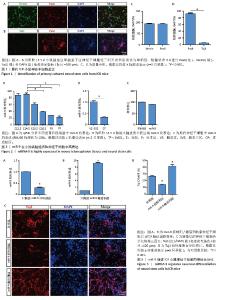
2.1 脑室区和脑室下区神经干细胞体外培养及鉴定结果 将组织消化成单细胞悬液并培养三四天后形成神经球,再将神经球消化成单细胞接种于载玻片培养3 d后进行免疫荧光检测,结果显示:绝大多数DAPI阳性细胞共表达神经干细胞标志物Pax6/Nestin(图1A,C);Pax6/Tuj1双染显示Pax6+细胞占96%,仅< 5%为Tuj1+神经元(图1B,D)。这些数据证实所培养的神经干细胞保持高度未分化状态,表明原代培养成功。 2.2 miR-9在小鼠端脑组织和神经干细胞中高表达 通过RT-qPCR检测不同发育阶段(胚胎12.5 d至出生后7 d)小鼠端脑中miR-9的表达,发现miR-9在早期(胚胎12.5 d-14.5 d)表达最高,并随发育(胚胎16.5 d至出生后7 d)逐渐降低(图2A)。进一步分析胚胎14.5 d小鼠大脑皮质不同区域miR-9的表达,发现在神经干细胞富集的脑室区和脑室下区miR-9表达显著高于皮质板区(图2B)。体外培养的胚胎14.5 d脑室区和脑室下来源神经干细胞中,miR-9表达水平接近内参RNU6B表达水平的90%(图2C)。这些结果表明,miR-9在发育早期的神经干细胞中高度富集,提示miR-9可能调控大脑皮质的神经发生过程。 2.3 miR-9促进神经干细胞向神经元分化 为研究miR-9对神经干细胞分化的调控作用,在神经干细胞中分别转染miR-9抑制剂(反义互补序列)和激活剂。经转染原代神经干细胞后验证,抑制剂组miR-9表达显著降低,而激活剂组miR-9表达显著升高(图3A,B),证实了工具的有效性。通过免疫荧光检测发现:在分化条件下,与对照组相比,miR-9抑制组Tuj1阳性神经元比例显著降低,而激活组Tuj1阳性神经元比例显著增加(图3C,D)。结果表明,miR-9能促进神经干细胞向神经元分化。"

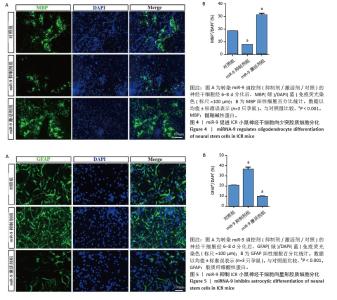
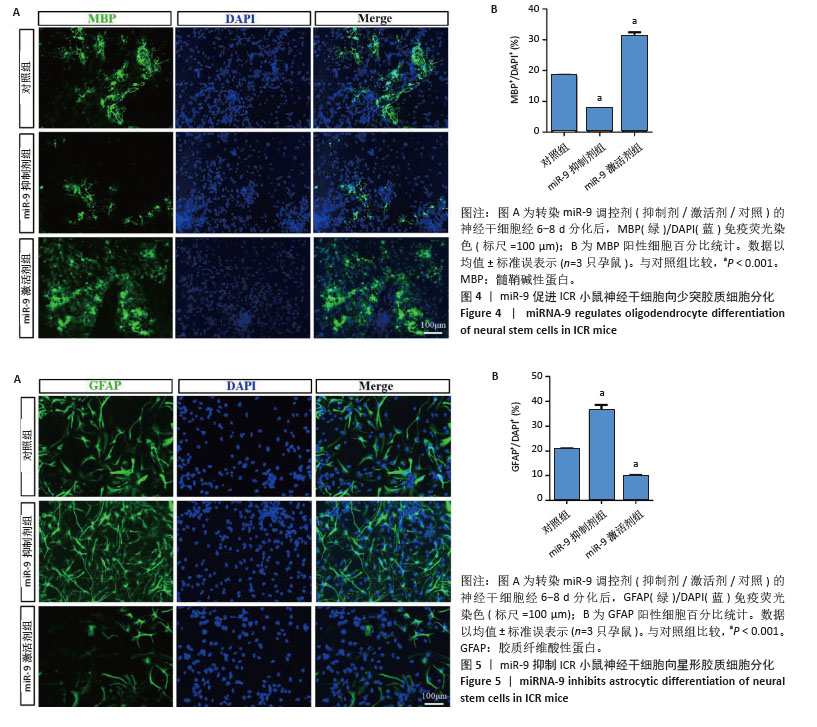
2.4 miR-9促进神经干细胞向少突胶质细胞分化 为探究miR-9对少突胶质细胞分化的影响,在神经干细胞中分别转染miR-9抑制剂或激活剂。分化培养6-8 d后,髓鞘碱性蛋白免疫荧光染色显示:与对照组相比,抑制剂组髓鞘碱性蛋白阳性细胞比例显著降低,而激活剂组显著升高(图4A,B)。结果表明,miR-9可促进神经干细胞向少突胶质细胞分化。 2.5 miR-9抑制星形胶质细胞产生 通过转染miR-9调控剂(抑制剂/激活剂)处理神经干细胞,分化6-8 d后胶质纤维酸性蛋白免疫荧光检测显示:与对照组相比,抑制剂组胶质纤维酸性蛋白阳性细胞比例显著增加,而激活剂组显著降低(图5A,B)。结果表明,miR-9抑制神经干细胞向星形胶质细胞分化。 "
| [1] SHU P, WU C, RUAN X, et al. Opposing Gradients of MicroRNA Expression Temporally Pattern Layer Formation in the Developing Neocortex. Dev Cell. 2019;49(5):764-785.e4. [2] ELKIN AM, ROBBINS S, BARROS CS, et al. The Critical Balance Between Quiescence and Reactivation of Neural Stem Cells. Biomolecules. 2025;15(5):672. [3] HAN JS, FISHMAN-WILLIAMS E, DECKER SC, et al. Notch directs telencephalic development and controls neocortical neuron fate determination by regulating microRNA levels. Development. 2023;150(11):dev201408. [4] ROYALL LN, MACHADO D, JESSBERGER S, et al. Asymmetric inheritance of centrosomes maintains stem cell properties in human neural progenitor cells. Elife. 2023;12:e83157. [5] CEBRIAN-SILLA A, NASCIMENTO MA, MANCIA W, et al. Neural stem cell relay from B1 to B2 cells in the adult mouse ventricular-subventricular zone. Cell Rep. 2025;44(3):115264. [6] DEL PUERTO A, LOPEZ-FONSECA C, SIMÓN-GARCÍA A, et al. Kidins220 sets the threshold for survival of neural stem cells and progenitors to sustain adult neurogenesis. Cell Death Dis. 2023;14(8):500. [7] JIMÉNEZ-MADRONA E, MORADO-DÍAZ CJ, TALAVERÓN R, et al. Antiproliferative effect of boldine on neural progenitor cells and on glioblastoma cells. Front Neurosci. 2023;17:1211467. [8] BUTH JE, DYEVICH CE, RUBIN A, et al. Foxp1 suppresses cortical angiogenesis and attenuates HIF-1alpha signaling to promote neural progenitor cell maintenance. EMBO Rep. 2024;25(5):2202-2219. [9] KANDEL P, SEMERCI F, MISHRA R, et al. Oleic acid is an endogenous ligand of TLX/NR2E1 that triggers hippocampal neurogenesis. Proc Natl Acad Sci U S A. 2022;119(13):e2023784119. [10] WANG K, LIU XY, LIU SF, et al. Rbm24/Notch1 signaling regulates adult neurogenesis in the subventricular zone and mediates Parkinson-associated olfactory dysfunction. Theranostics. 2024;14(11):4499-4518. [11] DONG X, PEI G, YANG Z, et al. Flavonoid chrysin activates both TrkB and FGFR1 receptors while upregulates their endogenous ligands such as brain derived neurotrophic factor to promote human neurogenesis. Cell Prolif. 2025; 58(1):e13732. [12] CHAROU D, ROGDAKIS T, LATORRATA A, et al. Comprehensive characterization of the neurogenic and neuroprotective action of a novel TrkB agonist using mouse and human stem cell models of Alzheimer’s disease. Stem Cell Res Ther. 2024;15(1):200. [13] ABBATE C. The Adult Neurogenesis Theory of Alzheimer’s Disease. J Alzheimers Dis. 2023;93(4):1237-1276. [14] WEI Y, LEI J, PENG Y, et al. Expression characteristics and potential function of non-coding RNA in mouse cortical cells. Front Mol Neurosci. 2024;17:1365978. [15] WANG S, JIANG G, WANG S. Neuroprotective Role of MiRNA-9 in Neurological Diseases: A Mini Review. Curr Mol Med. 2023;23(10):1007-1011. [16] KURIAKOSE D, ZHU HM, ZHAO YL, et al. Upstream regulation of microRNA-9 through a complex cellular machinery during neurogenesis. Brain Res. 2025;1848: 149328. [17] DENLI AM, CAO X, GAGE FH. miR-9 and TLX: chasing tails in neural stem cells. Nat Struct Mol Biol. 2009;16(4):346-347. [18] ZHEN J, ZHANG H, DONG H, et al. miR-9-3p inhibits glioma cell proliferation and apoptosis by directly targeting FOXG1. Oncol Lett. 2020;20(2):2007-2015. [19] WU H, JIANG X, FAN H, et al. Inhibition of circALPK2 enhances proliferation and therapeutic potential of human pluripotent stem cell-derived cardiomyocytes in myocardial infarction. Stem Cell Res Ther. 2025;16(1):107. [20] LUO X, XU M, GUO W. Adult neurogenesis research in China. Dev Growth Differ. 2023;65(9):534-545. [21] AWAD R, AVITAL A, SOSNIK A. Polymeric nanocarriers for nose-to-brain drug delivery in neurodegenerative diseases and neurodevelopmental disorders. Acta Pharm Sin B. 2023;13(5):1866-1886. [22] LI Y, XUE J, MA Y, et al. The complex roles of m 6 A modifications in neural stem cell proliferation, differentiation, and self-renewal and implications for memory and neurodegenerative diseases. Neural Regen Res. 2025;20(6):1582-1598. [23] ALWIN PREM ANAND A, HUBER C, ASNET MARY J, et al. Expression and function of microRNA-9 in the mid-hindbrain area of embryonic chick. BMC Dev Biol. 2018;18(1):3. [24] LU YL, LIU Y, MCCOY MJ, et al. MiR-124 synergism with ELAVL3 enhances target gene expression to promote neuronal maturity. Proc Natl Acad Sci U S A. 2021; 118(22):e2015454118. [25] WU J, LI H, HE J, et al. Downregulation of microRNA-9-5p promotes synaptic remodeling in the chronic phase after traumatic brain injury. Cell Death Dis. 2021;12(1):9. [26] SHEN Y, CHEN X, SONG Z, et al. MicroRNA-9 promotes axon regeneration of mauthner-cell in zebrafish via her6/ calcium activity pathway. Cell Mol Life Sci. 2024;81(1):104. [27] ROESE-KOERNER B, STAPPERT L, BERGER T, et al. Reciprocal Regulation between Bifunctional miR-9/9(*) and its Transcriptional Modulator Notch in Human Neural Stem Cell Self-Renewal and Differentiation. Stem Cell Reports. 2016;7(2):207-219. [28] BONEV B, PISCO A, PAPALOPULU N. MicroRNA-9 reveals regional diversity of neural progenitors along the anterior-posterior axis. Dev Cell. 2011;20(1):19-32. [29] BURBACH KF, WU S, YOO AS. Notch inhibition enhances morphological reprogramming of microRNA-induced human neurons. Stem Cells. 2025;43(2): sxae079. [30] ZHANG H, CHANG Y, ZHANG L, et al. Upregulation of MicroRNA miR-9 Is Associated with Microcephaly and Zika Virus Infection in Mice. Mol Neurobiol. 2019;56(6):4072-4085. [31] ARAI Y, TAVERNA E. Neural Progenitor Cell Polarity and Cortical Development. Front Cell Neurosci. 2017;11:384. [32] DORI M, CAVALLI D, LESCHE M, et al. MicroRNA profiling of mouse cortical progenitors and neurons reveals miR-486-5p as a regulator of neurogenesis. Development. 2020;147(9):dev190520. [33] XU S, LI Y, ZHANG J, et al. LINC01116 Regulates the Proliferation and Apoptosis of Nucleus Pulposus Cells through miR-9-5p-mediated ZIC5 and the Wnt Pathway and Affects the Progression of Intervertebral Disc Degeneration. Curr Stem Cell Res Ther. 2023;18(7):979-992. [34] SUN Q, ZENG J, LIU Y, et al. microRNA-9 and -29a regulate the progression of diabetic peripheral neuropathy via ISL1-mediated sonic hedgehog signaling pathway. Aging (Albany NY). 2020;12(12):11446-11465. [35] YUAN P, DING L, CHEN H, et al. Neural Stem Cell-Derived Exosomes Regulate Neural Stem Cell Differentiation Through miR-9-Hes1 Axis. Front Cell Dev Biol. 2021;9:601600. [36] DING L, SHEN Y, WANG A, et al. Construction of a novel miRNA regulatory network and identification of target genes in gestational diabetes mellitus by integrated analysis. Front Genet. 2022;13:966296. [37] HU Y, LUO M, NI N, et al. Reciprocal actions of microRNA-9 and TLX in the proliferation and differentiation of retinal progenitor cells. Stem Cells Dev. 2014;23(22):2771-2781. [38] SHIBATA M, NAKAO H, KIYONARI H, et al. MicroRNA-9 regulates neurogenesis in mouse telencephalon by targeting multiple transcription factors. J Neurosci. 2011;31(9):3407-3422. [39] WEI X, LI H, MIAO J, et al. miR-9*- and miR-124a-Mediated switching of chromatin remodelling complexes is altered in rat spina bifida aperta. Neurochem Res. 2013;38(8):1605-1615. [40] YU J, GE Z, CHEN S, et al. miR-26a-5p Suppresses Wnt/β-Catenin Signaling Pathway by Inhibiting DNMT3A-Mediated SFRP1 Methylation and Inhibits Cancer Stem Cell-Like Properties of NSCLC. Dis Markers. 2022;2022:7926483. [41] YANG R, YANG B, LIU W, et al. Emerging role of non-coding RNAs in neuroinflammation mediated by microglia and astrocytes. J Neuroinflammation. 2023;20(1):173. [42] SHEN Y, XUE C, YOU G, et al. miR-9 alleviated the inflammatory response and apoptosis in caerulein-induced acute pancreatitis by regulating FGF10 and the NF-κB signaling pathway. Exp Ther Med. 2021;22(2):795. [43] ZHANG J, JIA J, ZHAO L, et al. Down-regulation of microRNA-9 leads to activation of IL-6/Jak/STAT3 pathway through directly targeting IL-6 in HeLa cell. Mol Carcinog. 2016;55(5):732-742. |
| [1] | Sun Lei, Zhang Qi, Zhang Yu. Pro-osteoblastic effect of chlorogenic acid protein microsphere/polycaprolactone electrospinning membrane [J]. Chinese Journal of Tissue Engineering Research, 2026, 30(8): 1877-1884. |
| [2] | Wu Yanting, Li Yu, Liao Jinfeng. Magnesium oxide nanoparticles regulate osteogenesis- and angiogenesis-related gene expressions to promote bone defect healing [J]. Chinese Journal of Tissue Engineering Research, 2026, 30(8): 1885-1895. |
| [3] | Li Zhenyu, Zhang Siming, Bai Jiaxiang, Zhu Chen. Osthole improves osteogenic differentiation function of bone marrow mesenchymal stem cells under high-glucose conditions [J]. Chinese Journal of Tissue Engineering Research, 2026, 30(7): 1641-1648. |
| [4] | Jin Dongsheng, Zhao Zhanghong, Zhu Ziyin, Zhang Sen, Sun Zuyan, Deng Jiang. Effects of icariin-loaded microsphere-three-dimensional scaffold on osteogenic differentiation of rabbit bone marrow mesenchymal stem cells [J]. Chinese Journal of Tissue Engineering Research, 2026, 30(7): 1658-1668. |
| [5] | Zou Yulian, Chen Chaopei, Huang Haixia, Lan Yuyan, Liu Min, Huang Ting. Resveratrol promotes osteogenic differentiation of bone marrow mesenchymal stem cells in an inflammatory microenvironment [J]. Chinese Journal of Tissue Engineering Research, 2026, 30(7): 1669-1678. |
| [6] | Wang Qiuhua, Du Ziwei, Wang Wenshuang, Zhao Dongmei, Zhang Xiaoqing. Differences in metabolism, proliferation, differentiation of adipose-derived mesenchymal stem cells, and differentiation into vascular smooth muscle cells between male and female rats [J]. Chinese Journal of Tissue Engineering Research, 2026, 30(7): 1687-1698. |
| [7] | Zhang Di, Zhao Jun, Ma Guangyue, Sun Hui, Jiang Rong. Mechanism of depression-like behavior in chronic social defeat stress mice based on high-throughput sequencing [J]. Chinese Journal of Tissue Engineering Research, 2026, 30(5): 1139-1146. |
| [8] | Huang Liuyan, Zhang Wenxi, Chen Shuwen, Yu Shimei, Dai Zhong, Zuo Changqing. Forskolin promotes C2C12 myoblast differentiation via regulating the ERK and Akt signaling pathways [J]. Chinese Journal of Tissue Engineering Research, 2026, 30(5): 1114-1121. |
| [9] | Zhang Jiuxuan, Zhang Jinnan, Sui Xiaofan, Pei Xiaxia, Wei Jianhong, Su Qiang, Li Tian. Effects of ammonia poisoning on cognitive behavior and hippocampal synaptic damage in mice [J]. Chinese Journal of Tissue Engineering Research, 2026, 30(5): 1122-1128. |
| [10] | Ma Hong, Ding Xueling, Wang Qi, Lyu Hui, Asya Albusm, Cheng Xinyi, Ma Xiang. Expression and significance of tumor necrosis factor alpha, nuclear factor kappaB and ionized calcium binding adaptor molecule-1 in the hippocampus of mice with aortic dissection [J]. Chinese Journal of Tissue Engineering Research, 2026, 30(4): 858-863. |
| [11] | Zhou Zixiang, Zhao Baoxiang. Research progress in the relationship between nontraumatic necrosis of the femoral head and lipid metabolism and its treatment [J]. Chinese Journal of Tissue Engineering Research, 2026, 30(3): 680-690. |
| [12] | Tian Tan, Bao Shanjun. Hedgehog signaling pathway and diabetic osteoporosis: a potential target for specific drug therapy [J]. Chinese Journal of Tissue Engineering Research, 2026, 30(28): 7340-7346. |
| [13] | Wang Zhengye, Liu Wanlin, Zhao Zhenqun. Mechanisms of miRNAs involved in cartilage development: new strategies and targets [J]. Chinese Journal of Tissue Engineering Research, 2026, 30(24): 6289-6296. |
| [14] | Sun Danhe, Guo Xiaoling, Zhao Lingzhou. Construction and osteogenic activity of titanium dioxide nanotube and polydopamine composite coating on titanium implants [J]. Chinese Journal of Tissue Engineering Research, 2026, 30(20): 5167-5177. |
| [15] | Zhong Zhuolan, Peng Zhina, Tian Xiaohong, Han Cuifei, Zhang Zihan, Chu Jiaqi. Acanthopanax exosome-like nanovesicles promote osteogenic differentiation of human bone marrow mesenchymal stem cells [J]. Chinese Journal of Tissue Engineering Research, 2026, 30(19): 4825-4835. |
| Viewed | ||||||
|
Full text |
|
|||||
|
Abstract |
|
|||||