Chinese Journal of Tissue Engineering Research ›› 2026, Vol. 30 ›› Issue (27): 7115-7122.doi: 10.12307/2026.241
Previous Articles Next Articles
Effect of CYP3A4*1G gene polymorphism on pharmacokinetics and pain threshold of sufentanil after joint replacement in elderly patients
Peng Changsheng1, Zhou Jianjun1, Hu Xuhua1, Jin Ming1, Xie Wenlong2
- 1Department of Anesthesiology, Xiantao First People's Hospital, Xiantao 433000, Hubei Province, China; 2Department of Anesthesiology, Xiantao First People's Hospital Affiliated to Yangtze University, Xiantao 433000, Hubei Province, China
-
Received:2025-09-02Accepted:2025-11-19Online:2026-09-28Published:2026-05-15 -
Contact:Xie Wenlong, Attending physician, Department of Anesthesiology, Xiantao First People's Hospital Affiliated to Yangtze University, Xiantao 433000, Hubei Province, China -
About author:Peng Changsheng, Attending physician, Department of Anesthesiology, Xiantao First People's Hospital, Xiantao 433000, Hubei Province, China

CLC Number:
Cite this article
Peng Changsheng, Zhou Jianjun, Hu Xuhua, Jin Ming, Xie Wenlong. Effect of CYP3A4*1G gene polymorphism on pharmacokinetics and pain threshold of sufentanil after joint replacement in elderly patients[J]. Chinese Journal of Tissue Engineering Research, 2026, 30(27): 7115-7122.
share this article
Add to citation manager EndNote|Reference Manager|ProCite|BibTeX|RefWorks
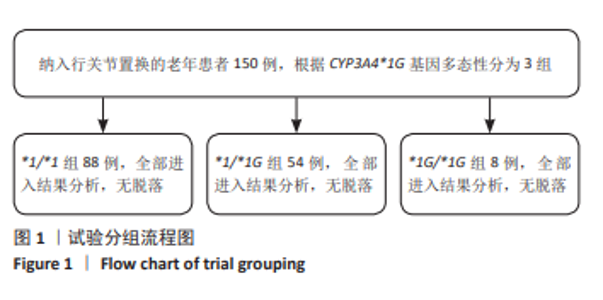
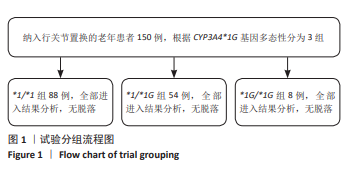
2.1 参与者数量分析 根据150例老年关节置换患者CYP3A4*1G基因检测结果,*1/*1基因型88例,*1/*1G基因型54例,*1G/*1G基因型8例,全部进入结果分析,无脱落。 2.2 试验流程图 见图1。"
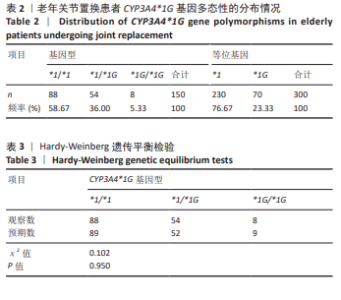
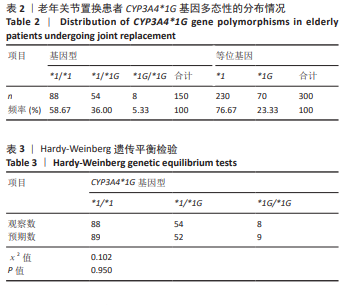
2.3 CYP3A4*1G基因型和等位基因频率关联分析 150例入组患者中,88例为野生纯合子组(CYP3A4*1/*1),54例为突变杂合子组(CYP3A4*1/*1G),8例为突变纯合子组(CYP3A4*1G/*1G)。CYP3A4*1G等位基因突变率为23.33%,见表2。等位基因分布符合Hardy-Weinberg遗传平衡检验(χ2=0.102,P=0.950),见表3。"
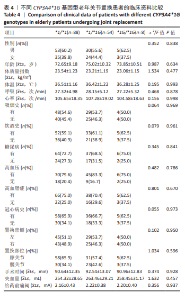
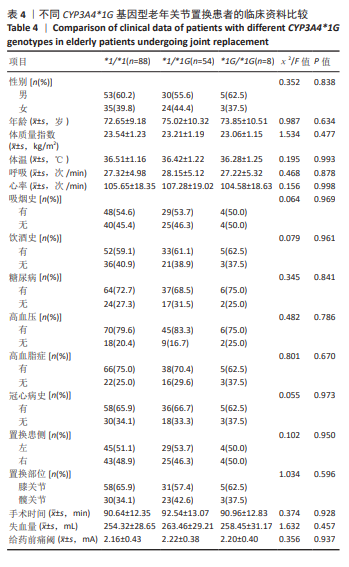
2.4 不同基因型患者临床资料比较 不同基因型患者临床资料包括性别、年龄、体质量指数、体温、呼吸、心率、吸烟史、饮酒史、糖尿病、高血压、高血脂症、冠心病史、置换患侧、置换部位、手术时间、失血量、给药前痛阈比较,差异均无显著性意义 (P > 0.05),具有可比性,见表4。"

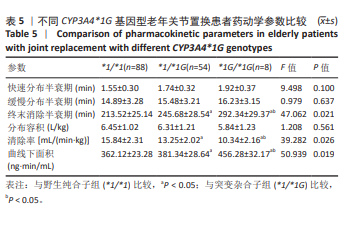
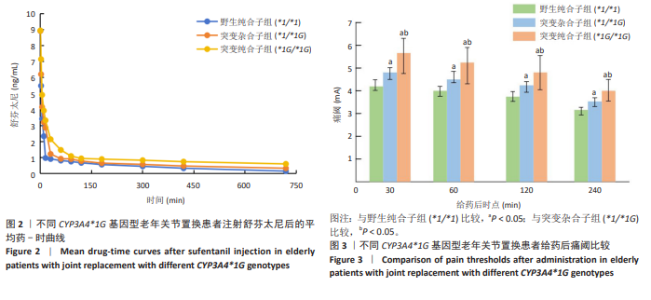
2.5 不同基因型患者药动学参数比较 不同基因型患者注射舒芬太尼后平均药-时曲线见图2。不同基因型患者终末消除半衰期、清除率、曲线下面积比较,差异有显著性意义(P < 0.05)。与野生纯合子组(*1/*1)相比,突变杂合子组(*1/*1G)和突变纯合子组(*1G/*1G)患者终末消除半衰期、曲线下面积显著增加(P < 0.05),清除率显著降低(P < 0.05)。与突变杂合子组(*1/*1G)比较,突变纯合子组(*1G/*1G)患者终末消除半衰期、曲线下面积显著增加(P < 0.05),清除率显著降低(P < 0.05)。见表5。"
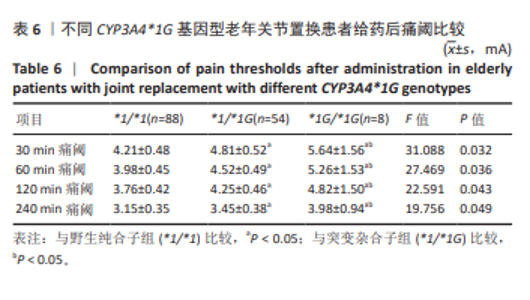
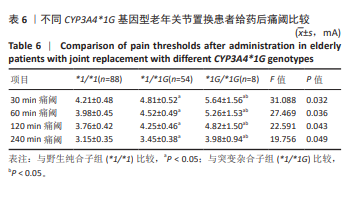
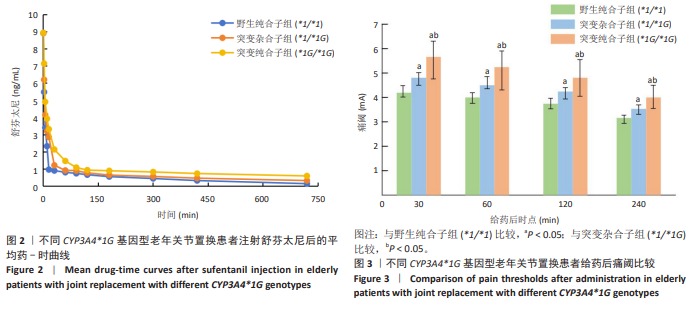
2.6 不同基因型患者给药后痛阈比较 不同基因型患者给药后各时点痛阈比较,差异有显著性意义(P < 0.05)。与野生纯合子组(*1/*1)比较,突变杂合子组(*1/*1G)和突变纯合子组(*1G/*1G)患者各时点痛阈显著增加(P < 0.05)。与突变杂合子组(*1/*1G)比较,突变纯合子组(*1G/*1G)患者各时点痛阈显著增加(P < 0.05)。见表6及图3。"
"
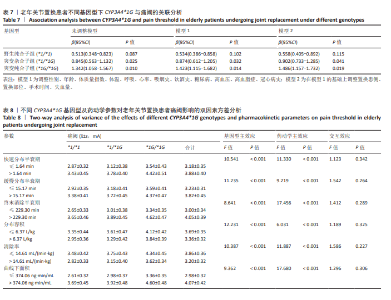
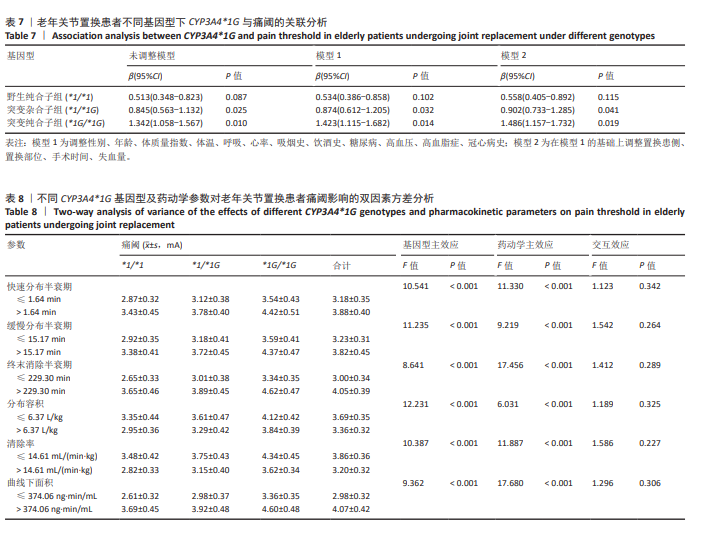
2.7 不同基因型下CYP3A4*1G与痛阈的关联分析 CYP3A4*1G基因多态性与患者痛阈水平在突变纯合子(*1G/*1G)和突变杂合子(*1/*1G)中显著关联(P < 0.05),见表7。 2.8 不同基因型及药动学参数对痛阈的双因素方差分析 无论药动学参数如何,不同基因型组间的痛阈差异有显著性意义(P < 0.001),突变纯合子(*1G/*1G)痛阈 > 突变杂合子(*1/*1G)痛阈 > 野生纯合子(*1/*1)痛阈。但基因型和药动学参数对痛阈影响的交互效应不明显(P > 0.05),见表8。"
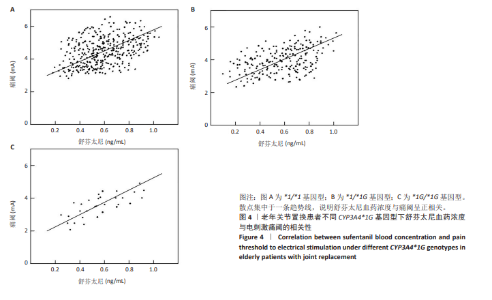
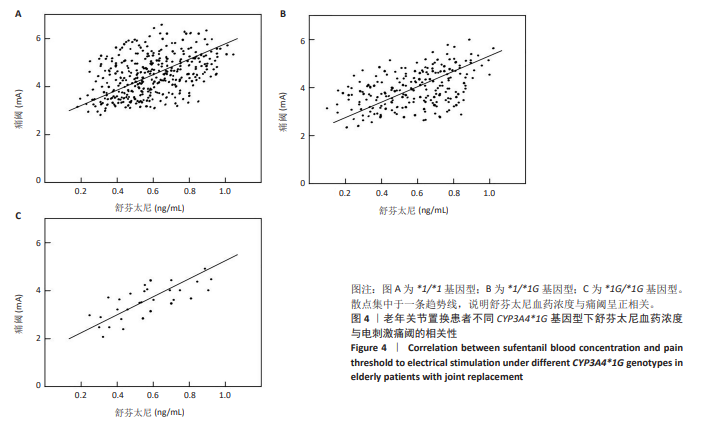
2.9 不同基因型下舒芬太尼血药浓度与痛阈的相关性 不同基因型下(*1/*1、*1/*1G、*1G/*1G)痛阈在注射舒芬太尼后均较给药前增加,且随着血药浓度的下降而下降,具有良好的相关性(r=0.81,0.89,0.86,P均< 0.05),见图4。"
| [1] LI Q, ZHANG L, ZHOU HM, et al. Ultrasound-guided erector spinae plane block in elderly patients undergoing total hip arthroplasty: A triple-blind, randomized controlled trial. J Arthroplasty. 2025;40(4):999-1004. [2] CASTINE AM, ROBINSON CL, FAIR RN, et al. Left infrapatellar branch of the saphenous peripheral nerve stimulation relieves refractory pain following total knee replacement. Cureus. 2024;16(8):67223. [3] SAFA B, TRINH H, LANSDOWN A, et al. Ultrasound-guided suprainguinal fascia iliaca compartment block and early postoperative analgesia after total hip arthroplasty: a randomised controlled trial. Br J Anaesth. 2024;133(1): 46-151. [4] MONTELEONE G, TASSO F, DE ANGELIS A, et al. Sublingual sufentanil tablet system (SSTS) versus a single shot peri-nervous injection of ropivacaine for the management of postoperative pain after total knee arthroplasty: a single-center randomized trial. Musculoskelet Surg. 2024;108(3):297-303. [5] 李福梅, 贾珍, 郭延洪, 等. 活血止痛胶囊联合舒芬太尼对老年全髋关节置换术后镇痛的疗效及对血流动力学, 血液流变学及炎性因子的影响[J]. 中华中医药学刊,2022,40(2):190-193. [6] 李玉婷, 梁琪, 魏勇. 纳布啡联合舒芬太尼用于髋关节置换术老年患者术后镇痛对PI3K-Akt信号通路的影响[J]. 临床和实验医学杂志,2024,23(19): 2123-2127. [7] SHU X, YAN Y, YU J, et al. Cytochrome P4503A4 gene polymorphisms guide safe sufentanil analgesic doses in pregnant Chinese mothers: a multicenter, randomized, prospective study. Pharmacogenet Genomics. 2024;34(1):8-15. [8] HAN J, ZHANG Z, LIU X, et al. Prediction of pharmacokinetics for CYP3A4-metabolized drugs in pediatrics and geriatrics using dynamic age-dependent physiologically based pharmacokinetic models. Pharmaceutics. 2025;17(2):214. [9] NI L, CAO Z, JIANG J, et al. Evaluating drug interactions between ritonavir and opioid analgesics: Implications from physiologically based pharmacokinetic simulation. Pharmaceuticals (Basel). 2024;17(5):640. [10] 林映雪, 崔海鹏, 姚银辉. CYP3A4^(*)1G基因多态性与舒芬太尼药物代谢的相关性研究[J]. 中国临床药学杂志,2022,31(11):846-849. [11] 张奕, 张秋丽. 芬太尼基因多态性对腹腔镜术后舒芬太尼麻醉镇痛效果的相关性研究[J]. 中国处方药,2025,23(1):101-103. [12] 张奕, 韩强, 阿卜杜拉·阿卜迪艾尼, 等. 基因多态性对腹腔镜术后舒芬太尼用量的预测效能[J]. 中国药业,2024,33(8):39-43. [13] 曹蕾, 周琰, 黄剑, 等. CYP3A4*1G,OPRM1 A118G基因多态性与腹腔镜结肠肿瘤根治术患者围术期芬太尼用量和VAS评分的关系分析[J]. 检验医学与临床,2023,20(12):1670-1676. [14] SAADAT M. Evaluation of Hardy-Weinberg equilibrium in genetic association studies. Int J Immunogenet. 2024;51(3):183-186. [15] NEAMATZADEH H, DASTGHEIB SA, MAZAHERI M, et al. Hardy-Weinberg equilibrium in meta-analysis studies and large-scale genomic sequencing era. Asian Pac J Cancer Prev. 2024;25(7):2229-2235. [16] SAADAT M. The importance of examining the Hardy-Weinberg equilibrium in genetic association studies. Mol Biol Res Commun. 2024;13(1):1-2. [17] 和浩杰, 杨建新, 南官江, 等. 基于多个基因多态性的术后舒芬太尼镇痛效应[J]. 山西医科大学学报,2023,54(9):1274-1279. [18] HOCH M, HUTH F, MANLEY PW, et al. Clinical pharmacology of asciminib: A review. Clin Pharmacokinet. 2024;63(11):1513-1528. [19] 李碧莲, 王思怡, 张欢欢, 等. 右美托咪定对先天性心脏病儿童舒芬太尼药代动力学的影响[J]. 实用医学杂志,2021,37(13):1732-1736. [20] 界中平, 张雪松, 俞立奇, 等. 单剂量舒芬太尼给药在HIV感染者行椎管内麻醉的药代动力学实验[J]. 黑龙江医药科学,2023,46(2):64-66. [21] MYKKÄNEN AJH, TARKIAINEN EK, TASKINEN S, et al. Genome-wide association study of atorvastatin pharmacokinetics: Associations with SLCO1B1, UGT1A3, and LPP. Clin Pharmacol Ther. 2024;115(6):1428-1440. [22] ZAMEK-GLISZCZYNSKI MJ, KENWORTHY D, BERSHAS DA, et al. Pharmacokinetics and ADME Characterization of Intravenous and Oral [14C]-Linerixibat in Healthy Male Volunteers. Drug Metab Dispos. 2021;49(12):1109-1117. [23] 王仲建, 陈夏霖, 张侠, 等. 贝达喹啉治疗药物浓度监测方法的建立与应用[J]. 药学与临床研究,2024,32(1):20-25. [24] 张颖, 郭志芳, 王晶晶, 等. 成人重型血友病A患者凝血因子Ⅷ药代动力学研究[J]. 中国实验血液学杂志,2024,32(5):1509-1517. [25] 谢建芬, 汤凌凯, 徐草梅, 等. 不同浓度罗哌卡因用于前锯肌平面阻滞在胸腔镜肺叶切除术中的药动药效学研究[J]. 中国医院药学杂志,2025,45(10): 1101-1105. [26] XIANG XB, WU YY, FANG Z, et al. Stellate ganglion block for visceral pain in elderly patients undergoing video-assisted thoracoscopic lung cancer surgery: a randomized, controlled trial. Int J Surg. 2024;110(11):6996-7002. [27] 陈秋宇, 孙一午, 周敏, 等. 术中持续泵注艾司氯胺酮对肺部手术患者术后痛觉过敏的影响[J]. 临床麻醉学杂志,2024,40(12):1281-1286. [28] CHEN Y, CHEN Q, CAI C, et al. Effect of OPRM1/COMT gene polymorphisms on sufentanil labor analgesia: a cohort study based on propensity score matching. Pharmacogenomics. 2023;24(12):675-684. [29] 谢建芬, 汤凌凯, 徐草梅, 等. 不同浓度罗哌卡因用于前锯肌平面阻滞在胸腔镜肺叶切除术中的药动药效学研究[J]. 中国医院药学杂志,2025,45(10): 1101-1105. [30] QI Y, YANG H, WANG S, et al. Identification and functional assessment of eight CYP3A4 allelic variants *39-*46 detected in the chinese han population. Drug Metab Dispos. 2024;52(3):218-227. [31] DONG L, ZHUANG X, YANG T, et al. A physiologically based pharmacokinetic model of voriconazole in human CNS-Integrating time-dependent inhibition of CYP3A4, genetic polymorphisms of CYP2C19 and possible transporter mechanisms. Int J Antimicrob Agents. 2024;64(4):107310. [32] ZHANG H, ZHAO L, LU X, et al. Multimodal covarying brain patterns mediate genetic and psychological contributions to individual differences in pain sensitivity. Pain. 2024;165(5):1074-1085. [33] SOARES FFC, FERREIRA DMAO, RAIMUNDINI AA, et al. Influence of genetic polymorphisms on mechanical pain sensitivity and endogenous pain modulation of trigeminal and spinal areas. J Oral Rehabil. 2023;50(1):39-53. [34] VAN EERDEN RAG, IJZERMAN NS, VAN MEEKEREN M, et al. CYP3A4*22 genotype-guided Dosing of kinase inhibitors in cancer patients. Clin Pharmacokinet. 2023;62(8):1129-1139. [35] VERSYCK B, VERMEYLEN K, WILLEMSE J, et al. Serum concentrations of local anesthetics after unilateral interpectoral-pectoserratus plane block in breast cancer surgery: a pharmacokinetic study. Reg Anesth Pain Med. 2023;48(8): 399-402. [36] 岳静, 王世军. 薏苡仁及其组分对佐剂性关节炎大鼠抗炎镇痛的作用及其机制[J]. 中国组织工程研究,2023,27(26):4187-4192. [37] 余沐洋, 杨兴东, 徐溢明, 等. 骨内局部给药在全膝关节置换术中的应用研究进展[J]. 中华骨科杂志,2024,44(5):322-328. [38] 刘璐萍, 黄剑, 方芳, 等. CYP3A4,CYP3A5,COMT及OPRM1基因多态性对术后芬太尼镇痛剂量的影响[J]. 中国临床医学,2023,30(5):785-791. [39] GUAN Z, LIANG Y, ZHU Z, et al. Genetic effects of ITPK1 polymorphisms on the risk of neural tube defects: a population-based study. Reprod Sci. 2023;30(5): 1585-1593. [40] HOWARTH ERI, SZOTT ID, WITHAM CL, et al. Genetic polymorphisms in the serotonin, dopamine and opioid pathways influence social attention in rhesus macaques (Macaca mulatta). PLoS One. 2023;18(8):e0288108. [41] 范子强, 贺轲渝, 薛昀, 等. 靶控输注阿芬太尼抑制女性患者气管内插管反应的量-效关系[J]. 临床麻醉学杂志,2024,40(3):324-326. |
| [1] | Ma Zaichao, Maimaitiyibubaji·Abudukadier Lyu Qing, Yang Zengqiang, Li Biao, Cui Yong. Application of anatomical biomimetic reconstruction of the external rotators combined with repair of the zona orbicularis in unilateral artificial femoral head replacement [J]. Chinese Journal of Tissue Engineering Research, 2026, 30(27): 7088-7094. |
| [2] | Huang Rui, Wang Jie, Zhang Ye, Liao Jian. Association between peri-implantitis and cytokine gene polymorphisms [J]. Chinese Journal of Tissue Engineering Research, 2026, 30(14): 3745-3752. |
| [3] | Guo Huanxuan, Kang Zhijie, Bai Xiaolong, Tian Xiaoyan, Jin Feng. Characteristics and advantages in finite element analysis techniques in knee biomechanics [J]. Chinese Journal of Tissue Engineering Research, 2025, 29(15): 3253-3261. |
| [4] | Yao Yuan, Zhang Shizhen, Jin Lei, Yang Yunxiao, Yu Wenqiang, Xu Yuanjing, Wang Jinwu. Effect of photon cervical vertebra massage instrument on improving neck pain and related functions in patients with chronic neck pain [J]. Chinese Journal of Tissue Engineering Research, 2024, 28(30): 4876-4880. |
| [5] | Shen Chengkai, Liu Kun, Liu Weiliang, Lyu Chengyu, Zhao Haijun. Association between interleukin-1B gene linkage disequilibrium and susceptibility to primary frozen shoulder [J]. Chinese Journal of Tissue Engineering Research, 2024, 28(27): 4367-4372. |
| [6] | Yang Yunxiao, Huang Chenglan, Hou Yutong, Yao Yuan, Zhao Yu Xu, Yuanjing, Yang Zezheng, Wang Jinwu. Correlation between sagittal curvature parameters and pain threshold for neck-shoulder muscles in degenerative cervical spondylosis [J]. Chinese Journal of Tissue Engineering Research, 2024, 28(24): 3879-3884. |
| [7] | Zhang Qiang, Xu Yan, Ma Zhuangzhuang, Zhang Hao, Li Zihao, Liu Senhan, Chen Wei. Effect of povidone-iodine on the immersion and flushing of wound tissue in rabbits [J]. Chinese Journal of Tissue Engineering Research, 2024, 28(23): 3669-3673. |
| [8] | Zeng Zijun, He Wei, Wei Qiushi, He Mincong. Treatment of periprosthetic joint infection after hip and knee arthroplasty [J]. Chinese Journal of Tissue Engineering Research, 2024, 28(12): 1937-1943. |
| [9] | Zhu Ruizhi, Qu Qiang, Cui Pengfei, Liu Dong, Zhang Yongtao, Wang Changyao. Efficacy of joint replacement versus closed reduction and internal fixation in treatment of unstable intertrochanteric fractures combined with osteoporosis [J]. Chinese Journal of Tissue Engineering Research, 2024, 28(12): 1869-1874. |
| [10] | He Yinhao, Li Xiaosheng, Chen Hongwen, Chen Tiezhu. 3D printed porous tantalum metal in the treatment of developmental dysplasia of the hip: current status and application prospect [J]. Chinese Journal of Tissue Engineering Research, 2023, 27(9): 1455-1461. |
| [11] | Zhou Yinan, Yang Kun, Jiang Jiayi, Zhang Sizhuo, Zhu Yingwen. The relationship between glucose transporter 1/4 gene polymorphisms and athletic ability [J]. Chinese Journal of Tissue Engineering Research, 2023, 27(5): 745-750. |
| [12] | Zhu Junjie, Wang Haihuang, Li Jianmin, Zhang Yuxin, Liu Junjie. Meta-analysis of the association between methylenetetrahydrofolate reductase gene polymorphisms and hemorrhagic stroke [J]. Chinese Journal of Tissue Engineering Research, 2023, 27(23): 3763-3772. |
| [13] | Yao Yuan, Xu Yuanjing, Ren Fuchao, Miao Weiqiang, Wang Jinwu. Small-sized attached transcutaneous nerve electrical stimulation in the treatment of chronic cervical pain [J]. Chinese Journal of Tissue Engineering Research, 2023, 27(21): 3332-3336. |
| [14] | Li Yang, Lyu Hui, Huang Denghua, Zou Longfei, Zhang Zhongjie, Tan Meiyun. Initial stability of integrated prosthesis or combined prosthesis in the treatment of Crowe III-IV developmental dysplasia of the hip [J]. Chinese Journal of Tissue Engineering Research, 2022, 26(18): 2839-2843. |
| [15] | Zhang Yu, Tian Shaoqi, Zeng Guobo, Hu Chuan. Risk factors for myocardial infarction following primary total joint arthroplasty [J]. Chinese Journal of Tissue Engineering Research, 2021, 25(9): 1340-1345. |
| Viewed | ||||||
|
Full text |
|
|||||
|
Abstract |
|
|||||