Chinese Journal of Tissue Engineering Research ›› 2014, Vol. 18 ›› Issue (53): 8666-8671.doi: 10.3969/j.issn.2095-4344.2014.53.026

Previous Articles     Next Articles

Vertebral column resection osteotomy combined with step correction in treatment of stiff angular kyphosis: spine-pelvis parameters

Lu Ming, Wang Xiao-ping, Ma Hua-song, Yue Chun-sheng, Chen Zhi-ming, Yuan Wei, Xu Qi-ming, Ren Dong-yun, Ma Wei, Zhao Song-hua   

  1. Department of Orthopedics, the 306 Hospital of Chinese PLA, Beijing 100101, China
  • Revised:2014-12-03 Online:2014-12-24 Published:2014-12-24
  • Contact: Wang Xiao-ping, Associate chief physician, Department of Orthopedics, the 306 Hospital of Chinese PLA, Beijing 100101, China
  • About author:Lu Ming, M.D., Associate chief physician, Department of Orthopedics, the 306 Hospital of Chinese PLA, Beijing 100101, China

Abstract:

BACKGROUND: The evaluation and the correction of sagittal plane balance are attributed to the good restoration effect of kyphosis deformity, and the measurement method of spinal-pelvis parameters are one of the effective method for assessing spinal imbalance.
OBJECTIVE: To measure spine-pelvis parameters in stiff angular kyphosis patients treated with posterior vertebral column resection osteotomy combined with step correction, design surgical scheme, analyze postoperative biomechanical characteristics of lumber vertebra, and evaluate long-term prognosis.
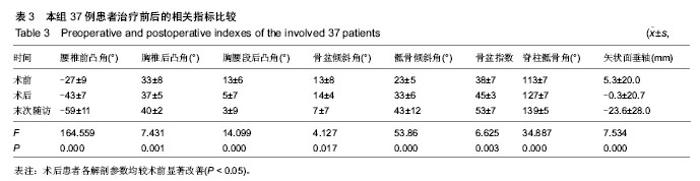
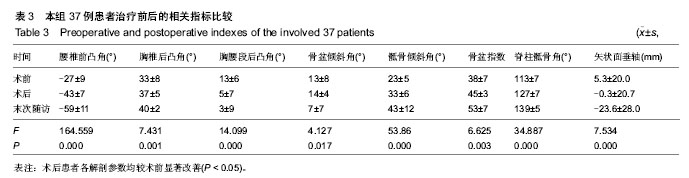
METHODS: Thirty-seven patients with severe angular kyphosis deformity treated with posterior vertebral column resection osteotomy, bilateral screw-rob combined with echelon tight closure for spinal cord shortening, and internal fixation in the Department of Orthopedics at the 306 Hospital of Chinese PLA. The lumbar lordosis angle, thoracic vertebrae kyphosis angle, thoracic waist kyphosis angle, pelvic tilt angle, sacrum tilt angle, pelvic index, spine-sacrum angle, saggital plane vertebral axis were measured before surgery, after surgery and at the final follow-up. The spinal kyphosis angle, spinal sagittal plane imbalance, lateral trunk shift rate, operation time, intraoperative blood loss, follow-up time, kyphosis correction angle, and correction of lateral trunk shift were recorded before and after surgery.
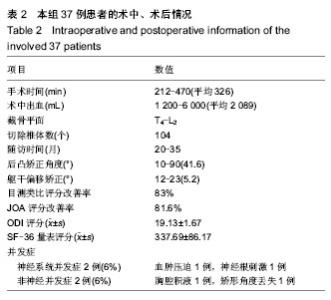
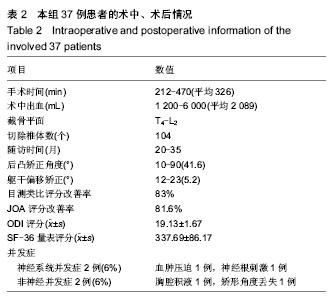
RESULTS AND CONCLUSION: The average operation time was 326 min (212-470 min), intraoperative blood loss was 2 089 mL (1 200-6 000 mL), the number of resected vertebral bodies was 104, and the osteotomy plane was localized at T4-L2. All the patients were followed up for 20-35 months. The average postoperative spinal kyphosis angle was 41.6° (10°-90°) and the correction rate was 65%. The average distance of C7 plumb line lateral to the posterior upper edge of S1 was 5.2 mm (-12 mm to 23 mm) after surgery, the correction rate was 73%. Two cases appeared neurological complications, accounting for 6%; and two cases appeared non-neurological complications, accounting for 6%.The anatomical parameters of the involved patients were significantly improved after surgery, compared with before surgery (P < 0.05). During the follow-ups, the osteotomy segments achieved bony fusion, no spinal cord injury and other complication were observed, and no loss of correction rate was found. Preoperative and postoperative measurement of the spine-pelvis parameters in patients with stiff spinal angular kyphosis can contribute to the understandings of spine-pelvis sequence and trunk anteroposterior balance, obtain technical parameters of osteotomy angle, achieve preoperation design, and make appropriate choice of osteotomy plane, so the restoration effect is more close to the biomechanical characteristics of human spine and lumbar vertebrae.


中国组织工程研究杂志出版内容重点:人工关节;骨植入物;脊柱骨折;内固定;数字化骨科;组织工程


全文链接:

Key words: spinal kyphosis, internal fixators, osteotomy, biomechanics, anatomy

CLC Number: