Chinese Journal of Tissue Engineering Research ›› 2014, Vol. 18 ›› Issue (26): 4212-4218.doi: 10.3969/j.issn.2095-4344.2014.26.021
Previous Articles Next Articles
Minimally invasive versus open pedicle screw fixation for repair of thoracolumbar fractures
Peng Xiao-zhong, Xiao Kan-kan
- Department of Spine Surgery, Liuzhou Worker’s Hospital, Liuzhou 545005, Guangxi Zhuang Autonomous Region, China
-
Online:2014-06-25Published:2014-06-25 -
Contact:Xiao Kan-kan, Studying for doctorate, Physician, Department of Spine Surgery, Liuzhou Worker’s Hospital, Liuzhou 545005, Guangxi Zhuang Autonomous Region, China -
About author:Peng Xiao-zhong, Associate chief physician, Department of Spine Surgery, Liuzhou Worker’s Hospital, Liuzhou 545005, Guangxi Zhuang Autonomous Region, China

CLC Number:
Cite this article
Peng Xiao-zhong, Xiao Kan-kan . Minimally invasive versus open pedicle screw fixation for repair of thoracolumbar fractures[J]. Chinese Journal of Tissue Engineering Research, 2014, 18(26): 4212-4218.
share this article
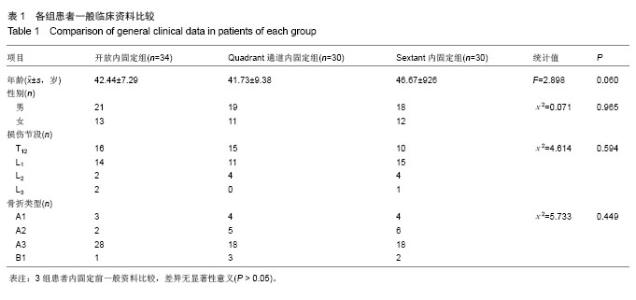
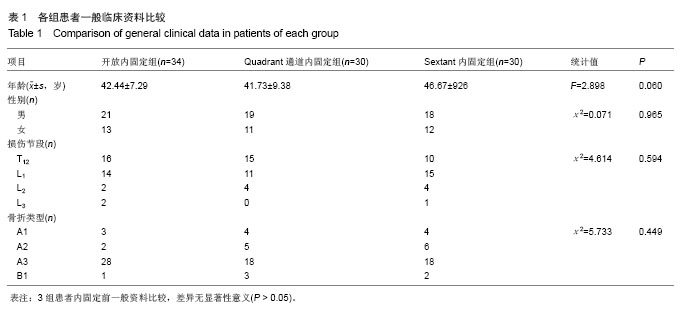
2.1 参与者数量分析 按意向性分析,纳入94例单节段无神经症状胸腰椎骨折患者,分为3组,全部进入结果分析,无脱落。所有患者随访6个月。 2.2 基线资料比较 3组患者例数相仿,开放内固定组34例,Quadrant通道内固定组30例,Sextant内固定组30例。受伤平均年龄超过40岁,男性(57例)多于女性(37例)。受伤最多部位在T12(41例)和L1(40例),L2及L3较少,分别为10例和3例。骨折主要为A3型骨折,即爆散型骨折,达64例;其他骨折类型A1型11例,A2型13例,B1型6例。 3组患者内固定前一般资料,包括年龄、性别、损伤节段、骨折类型比较,差异无显著性意义(P > 0.05,表1)。"
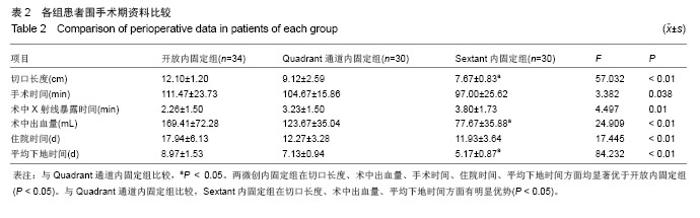
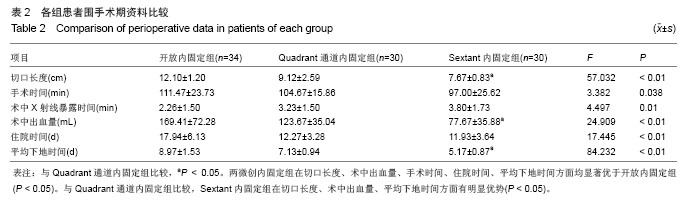
2.3 围手术期结果比较 3组手术方式的切口长度均数,开放内固定组最长,Quadrant通道内固定组次之,Sextant内固定组最短。平均手术时间,开放内固定组手术时间最长。术中出血量Sextant内固定组最少。在这3组病例中,没有进行输血治疗。术中X射线暴露时间最短为开放内固定组,Sextant内固定组最长。在平均住院时间方面,Sextant内固定组最短,开放内固定组最长。平均下地时间,Sextant内固定组最短。 微创与开放内固定组围手术期指标比较,Quadrant通道内固定组、Sextant内固定组在切口长度、术中出血量、手术时间、住院时间、平均下地时间方面均显著优于开放内固定组(P < 0.05,表2)。"
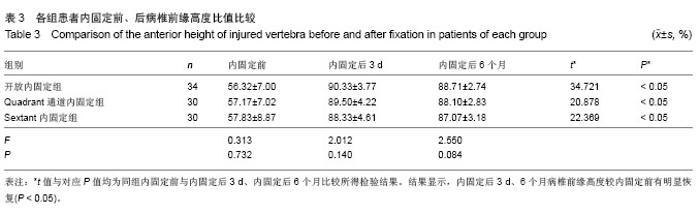
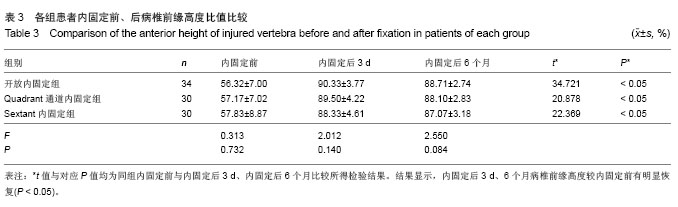
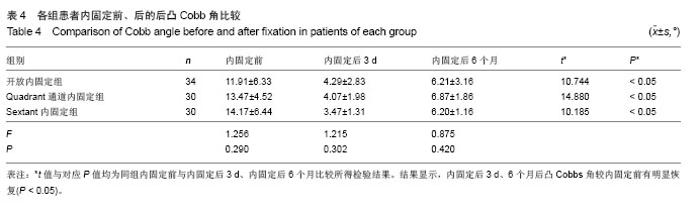
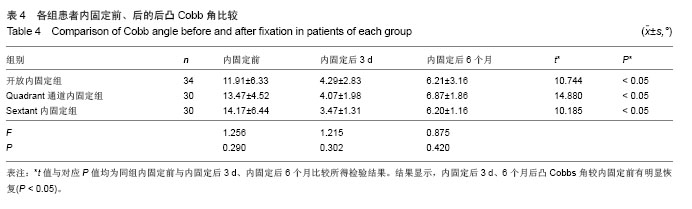
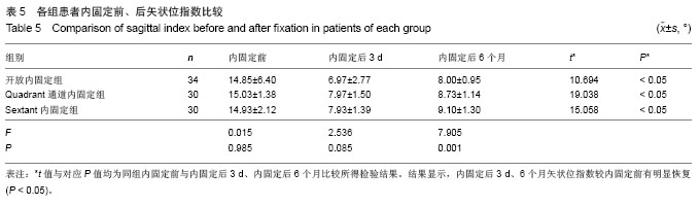
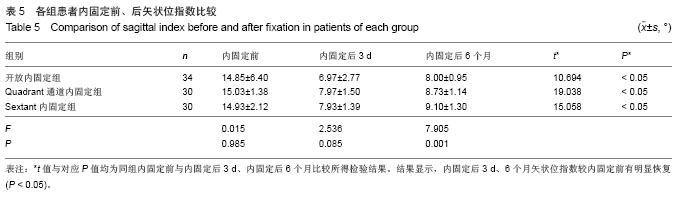
2.4 影像学结果比较 影像学指标比较,3组患者内固定后3 d复查X射线及CT,病椎前缘高度、Cobbs角、矢状位指数较内固定前有明显恢复(P < 0.01)。内固定后6个月复查以上影像学指标较内固定后3 d有下降。但是3组间内固定前、内固定后3 d及内固定后6个月的病椎前缘高度、Cobbs角、矢状位指数比较差异无显著性意义(P > 0.05,表3-5)。以上3组患者内固定后均无神经症状。内固定后6个月复查影像学期间,内固定在位,无脱钉、断钉现象。"
"
"
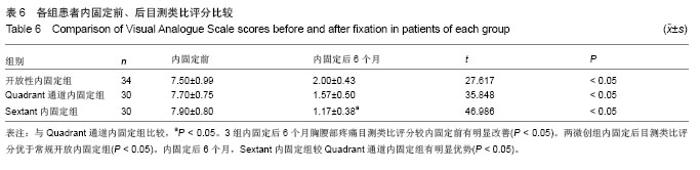
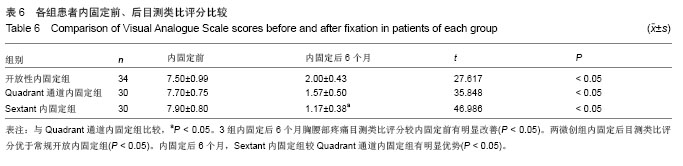
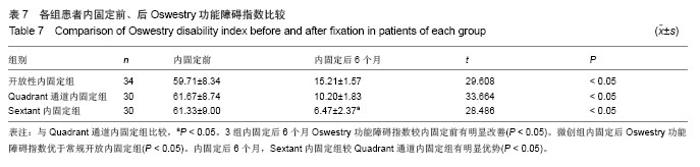
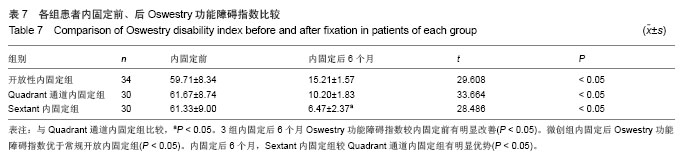
2.5 临床疗效结果比较 内固定后6个月全部患者均有恢复,胸腰部疼痛目测类比评分、Oswestry功能障碍指数均下降。临床疗效指标比较,内固定后6个月胸腰部疼痛目测类比评分、Oswestry功能障碍指数较内固定前有明显改善,差异有显著性意义(P < 0.05)。内固定后6个月,Quadrant通道内固定组、Sextant内固定组与开放性内固定组比较,差异有显著性意义(P < 0.05,表6,7)。 2.6 两微创组之间指标比较 Quadrant通道内固定组与Sextant内固定组围手术期指标比较:与Quadrant通道内固定组比较,Sextant内固定组在切口长度、术中出血量、平均下地时间方面有明显优势(P < 0.05,见表2)。 Quadrant通道内固定组与Sextant内固定组目测类比评分及Oswestry功能障碍指数比较:对于目测类比评分及Oswestry功能障碍指数,两组间内固定前差异无显著性意义(P > 0.05);而内固定后6个月比较,Sextant内固定组较Quadrant通道内固定组有明显优势(P < 0.05,见表6,7)。 2.7 不良事件 所有病例未出现脊髓、神经根、血管或者脏器损伤的情况。内固定后3 d复查CT椎弓根位置,开放内固定组螺钉破椎弓根壁约2例,Quadrant通道内固定组破椎弓根内侧壁1例,Sextant内固定组破椎弓根外侧壁1例。 "
"
| [1]曾忠友,黄伟,张建乔,等.椎弓根螺钉系统同时经伤椎置钉固定治疗胸腰椎骨折[J].中国脊柱脊髓杂志,2009,19(8):609-613.
[2]邓万祥,赵胡瑞,刘华,等.经伤椎置钉治疗胸腰椎骨折的临床研究[J].中国骨伤,2011,24(7):541-543.
[3]Frangen TM, Ruppert S, Muhr G, et al. The beneficial effects of early stabilization of thoracic spine fractures depend on trauma severity. J Trauma. 2010;68(5):1208-1212.
[4]McLain RF, Benson DR. Urgent surgical stabilization of spinal fractures in polytrauma patients. Spine. 1999;24(16):1646- 1654.
[5]Kim DY, Lee SH, Chung SK, et al. Comparison of multifidus muscle atrophy and trunk extension muscle strength: percutaneous versus open pedicle screw fixation. Spine. 2005;30(1):123-129.
[6]Huang TJ, Hsu RW, Li YY, et al. Less systemic cytokine response in patients following microendoscopic versus open lumbar discectomy. J Orthop Res. 2005;23(2):406-411.
[7]Oppenheimer JH, DeCastro I, McDonnell DE. Minimally invasive spine technology and minimally invasive spine surgery: a historical review. Neurosurg Focus. 2009;27(3):E9.
[8]Payer M."Minimally invasive" lumbar spine surgery: a critical review. Acta Neurochir (Wien). 2011;153(7):1455-1459.
[9]Reinhold M, Knop C, Beisse R, et al. [Operative treatment of traumatic fractures of the thoracic and lumbar spinal column.: Part III: Follow up data]. Unfallchirurg. 2009;112:294-316.
[10]朱康平,祝建雯,曲恒磊.国外生物医用钛合金的发展现状[J].稀有金属材料与工程,2012,41(11) :2058-2063.
[11]German JW, Foley KT. Minimal access surgical techniques in the management of the painful lumbar motion segment. Spine. 2005;30(16 Suppl):S52-59.
[12]Singh K, Vaccaro AR, Eichenbaum MD, et al. The surgical management of thoracolumbar injuries. J Spinal Cord Med. 2004;27(2):95-101.
[13]Shaffrey CI, Shaffrey ME, Whitehill R, et al. Surgical treatment of thoracolumbar fractures. Neurosurg Clin N Am. 1997;8(4): 519-540.
[14]彭潭安,谭述军,陈强.创伤性脊柱、脊髓损伤的手术治疗(附115例报告)[J].中国医师杂志,2006,8(S1):174-176.
[15]罗飞,徐建中.胸腰椎骨折诊疗中的几个常见问题[J].中华创伤杂志,2012,28(6):484-487.
[16]毛伟洪. MAST Quadrant微创通道下伤椎置钉固定治疗胸腰椎骨折[J].中医正骨,2012,24(12):68-70.
[17]张英泽,李宝俊,张奇,等.胸腰椎骨折椎弓根内固定术后失败原因探讨[J].中华骨科杂志,2009,29(1):7-11.
[18]张立海,杜海龙,梁永辉,等.胸腰椎骨折经椎弓根内固定失败原因分析[J].中华创伤杂志,2010,26(5):403-406.
[19]Anekstein Y, Brosh T, Mirovsky Y. Intermediate screws in short segment pedicular fixation for thoracic and lumbar fractures: a biomechanical study. J Spinal Disord Tech. 2007; 20(1):72-77.
[20]Gelb D, Ludwig S, Karp JE, et al. Successful treatment of thoracolumbar fractures with short-segment pedicle instrumentation. J Spinal Disord Tech. 2010;23(5):293-301.
[21]Vaccaro AR, Baron E, Sanfilippo J, et al. Reliability of a novel classification system for thoracolumbar injuries: the Thoracolumbar Injury Severity Score. Spine. 2006;31(11): 62-69.
[22]Weber BR, Grob D, Dvorák J, et al. Posterior surgical approach to the lumbar spine and its effect on the multifidus muscle. Spine. 1997;22(15):1765-1772.
[23]Sihvonen T, Herno A, Paljärvi L, et al. Local denervation atrophy of paraspinal muscles in postoperative failed back syndrome. Spine. 1993;18(5):575-581.
[24]Stevens KJ, Spenciner DB, Griffiths KL, et al. Comparison of minimally invasive and conventional open posterolateral lumbar fusion using magnetic resonance imaging and retraction pressure studies. J Spinal Disord Tech. 2006;19(2):77-86.
[25]Krüger A1, Rammler K, Ziring E, et al. Percutaneous minimally invasive instrumentation for traumatic thoracic and lumbar fractures: a prospective analysis. Acta Orthop Belg. 2012;78(3):376-381.
[26]滕海军,王亮,郭志良,等.Quadrant通道下单节段固定治疗胸腰椎骨折初步研究[J].中华创伤骨科杂志,2010,12(2):188-189.
[27]张思胜,赵卫红,刘扬,等.经皮椎弓根螺钉内固定并伤椎植骨成形治疗胸腰椎骨折[J].实用医学杂志,2011,27(4):648-649.
[28]叶军,于志勇,白龙,等.微创术式与传统术式治疗胸腰椎骨折的对照研究[J].中国现代医生,2012,50 (23):144-145.
[29]王洪伟,李长青,周跃,等.微创与传统开放附加伤椎经椎弓根螺钉内固定手术治疗胸腰椎骨折的疗效比较[J].中国脊柱脊髓杂志, 2010,20(2):112-116.
[30]Prokop A, Löhlein F, Chmielnicki M, et al.Minimally invasive percutaneous instrumentation for spine fractures. Unfallchirurg. 2009;112(7):621-628.
[31]Schmidt O, Strasser S, Kaufmann V, et al. Role of early minimal-invasive spine fixation in acute thoracic and lumbar spine trauma. Indian J Orthop. 2007;41(4):374-380.
[32]Mariscalco MW, Yamashita T, Steinmetz MP, et al. Radiation exposure to the surgeon during open lumbar microdiscectomy and minimally invasive microdiscectomy: a prospective, controlled trial. Spine. 2011;36(3):255-260.
[33]谢振宇,白龙,于志勇.伤椎置钉短节段内固定治疗胸腰椎骨折的疗效评价[J].中国现代医生.2011,49(23):56-57.
[34]王洪伟,李长青,周跃,等.附加伤椎固定的微创经皮椎弓根螺钉(Sextant)治疗胸腰椎骨折[J].中华创伤骨科杂志,2010,12(2): 126-130. |
| [1] | Fang Yi, Zhao Wenzhi, Pan Deyue, Han Xin, Zhang Lu, He Hongtao, Shi Feng, Tian Tingxiao. Acromioclavicular joint dislocation: how to achieve anatomical reduction, sustained stability and micro-motion [J]. Chinese Journal of Tissue Engineering Research, 2020, 24(5): 796-802. |
| [2] | Fu Jiaxin, Xiao Lianping, Wang Shusen, Li Xiaodong, Han Liqiang, Wang Tonghao. Therapeutic effects of paraspinal approach combined with internal fixation through pedicle of fractured vertebra versus traditional AF screw-rod system for thoracolumbar fractures [J]. Chinese Journal of Tissue Engineering Research, 2019, 23(8): 1177-1181. |
| [3] | Qiu Zhongpeng, Li Ke, Li Gang, Liu Keyu, Du Xinhui, Meng Defeng, Shi Chenhui, Wang Weishan. Different treatments for two-part and three-part proximal humeral fractures by Neer classification: follow-up results analyzed using clinical economics [J]. Chinese Journal of Tissue Engineering Research, 2019, 23(8): 1188-1195. |
| [4] | Ke Wei, Li Ke, Wang Sibo, Du Xinhui, Qiu Zhongpeng, Kang Zhilin, Wang Weishan, Li Gang . Open reduction and plate fixation versus closed reduction and external fixation for distal radius fractures: scores and linear regression analysis [J]. Chinese Journal of Tissue Engineering Research, 2019, 23(8): 1196-1202. |
| [5] | Fan Zhirong, Peng Jiajie, Zhong Degui, Zhou Lin, Su Haitao, Huang Yongquan, Wu Jianglin, Liang Yihao. Suture anchor combined with open reduction and internal fixation versus open reduction and internal fixation for ankle fracture combined with deltoid ligament injury: a meta-analysis [J]. Chinese Journal of Tissue Engineering Research, 2019, 23(8): 1307-1312. |
| [6] | Wang Xuefeng, Shang Xifu . Curative effects of three filling materials in the treatment of osteoporotic thoracolumbar fractures [J]. Chinese Journal of Tissue Engineering Research, 2019, 23(6): 863-869. |
| [7] | Zhou Yu, Liu Yuehong, Liu Shuping, Chen Xi, Qin Wei, Li Qifeng. Spinal stability of intervertebral grafting reinforced by five or six augmenting screws versus transvertebral grafting reinforced by four augmenting screws for thoracolumbar vertebral fractures [J]. Chinese Journal of Tissue Engineering Research, 2019, 23(4): 505-511. |
| [8] | Li Xianzhou, Wang Qian, Zhang Cunxin . Lumbar spondylolisthesis: status and prospects of implant treatment [J]. Chinese Journal of Tissue Engineering Research, 2019, 23(4): 621-627. |
| [9] | Yin Hao, Zhou Enchang, Pan Zhengjun, Chen Guang, Jiang Hua. Finite element analysis of the four and three cannulated screws combined with buttress plate fixation for the treatment of Pauwels III femoral neck fractures [J]. Chinese Journal of Tissue Engineering Research, 2019, 23(32): 5133-5137. |
| [10] |
Wang Lei, Li Zilong, Yuan Binbin, Wu Qingwei, Tang Fengming.
Clinical effect of locking plate versus anterograde intramedullary nail in the treatment of adult humeral shaft fractures: a meta-analysis
[J]. Chinese Journal of Tissue Engineering Research, 2019, 23(24): 3924-3930.
|
| [11] | Hao Liang, Zhang Zhonglin, Wang Baodong, Bi Zhenggang. Intertrochanteric fracture of the femur: improvement of internal fixation device, surgical changes and related disputes [J]. Chinese Journal of Tissue Engineering Research, 2019, 23(18): 2927-2935. |
| [12] | Yao Liquan, Ling Qinjie, Li Jiaying, Zhong Letian, Zhou Xingping, Liu Jintao, He Erxing, Yin Zhixun. Antibiotic artificial bone implantation for treating pyogenic spondylodiscitis [J]. Chinese Journal of Tissue Engineering Research, 2019, 23(14): 2133-2139. |
| [13] | Gong Zhibing, Wu Zhaoke, Zhang Huantang, Xu Zhiqing, Zhuang Zhikun, Zhang Qianjin. Allogeneic cortical bone plate combined with locking plate for Vancouver type B1 and C osteoporotic periprosthetic femoral fractures after hip arthroplasty in older adults [J]. Chinese Journal of Tissue Engineering Research, 2019, 23(12): 1812-1817. |
| [14] | Li Xiaofeng, Xie Furong, Zhan Long, Yang Yuan. Design of locking compression plate through transoral approach [J]. Chinese Journal of Tissue Engineering Research, 2019, 23(12): 1824-1828. |
| [15] | Tian Youyong, Wang Zhiyong. Short-term follow-up of dynamic hip screw versus proximal femoral nail anti-rotation for type AO/OTA A1 intertrochanteric femoral fracture in older adults [J]. Chinese Journal of Tissue Engineering Research, 2019, 23(12): 1834-1839. |
| Viewed | ||||||
|
Full text |
|
|||||
|
Abstract |
|
|||||