Chinese Journal of Tissue Engineering Research ›› 2014, Vol. 18 ›› Issue (20): 3178-3183.doi: 10.3969/j.issn.2095-4344.2014.20.012
Previous Articles Next Articles
Correlation of canal flare index of the proximal femur with bone mineral density of the femoral neck
Li Yi-zhong1, Zhuang Hua-feng1, Cai Si-qing2, Lin Jin-kuang1, Yao Xue-dong1, Pan Yuan-cheng1, Yu Hai-ming1
- 1Department of Orthopedics, Second Affiliated Hospital of Fujian Medical University, Quanzhou 362000, Fujian Province, China; 2Department of Radiology, Second Affiliated Hospital of Fujian Medical University, Quanzhou 362000, Fujian Province, China
-
Received:2014-03-05Online:2014-05-14Published:2014-05-14 -
About author:Li Yi-zhong, Master, Professor, Chief physician, Department of Orthopedics, Second Affiliated Hospital of Fujian Medical University, Quanzhou 362000, Fujian Province, China

CLC Number:
Cite this article
Li Yi-zhong, Zhuang Hua-feng, Cai Si-qing, Lin Jin-kuang, Yao Xue-dong, Pan Yuan-cheng, . Correlation of canal flare index of the proximal femur with bone mineral density of the femoral neck[J]. Chinese Journal of Tissue Engineering Research, 2014, 18(20): 3178-3183.
share this article
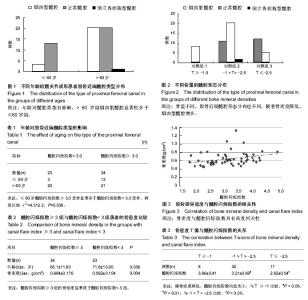
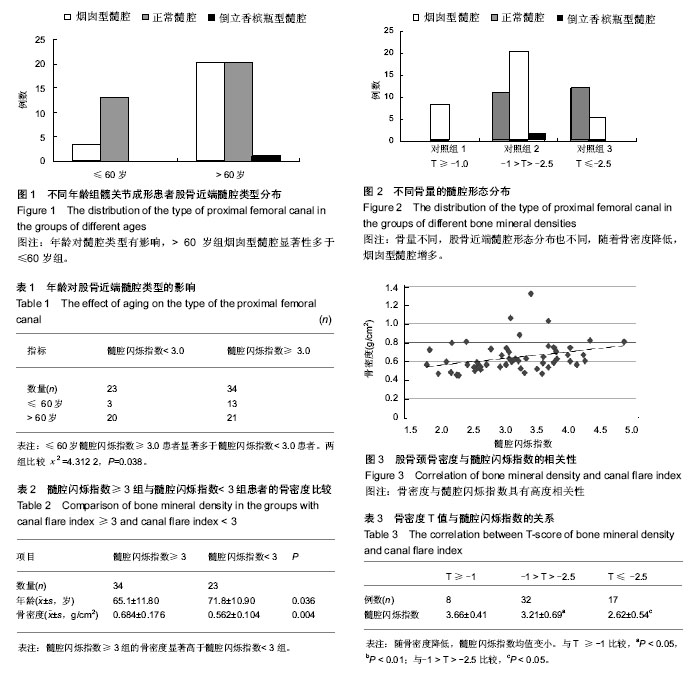
2.1 髓腔闪烁指数 57例髋关节成形患者的股骨近端髓腔闪烁指数为1.8-4.8,均值3.1±0.7。 髓腔闪烁指数< 3者23例,呈烟囱型髓腔;髓腔闪烁指数为3-4.7者33例,呈正常髓腔型;髓腔闪烁指数> 4.7者1例,呈倒立香槟瓶型。 年龄对髓腔类型有影响,> 60岁组烟囱型髓腔显著性多于≤ 60岁组,见图1,表1。 根据髓腔闪烁指数值分为髓腔闪烁指数< 3组23例,髓腔闪烁指数≥ 3组34例。髓腔闪烁指数≥ 3组的骨密度非常显著高于髓腔闪烁指数< 3组,见表2。"
| [1] 喻飞,李强,杨波,等.年龄对股骨形态参数影响100例测量分析:对假体选择及设计的意义[J].中国组织工程研究与临床康复, 2009,13(39): 7627-7631. [2] 刘勤,王慧娟,李秀平,等.中国人股骨近端参数统计[J].解剖与临床,2005,(1):25-27. [3] 徐丛,赵国军,李连泰,等.不同性别Singh指数与双能X射线骨密度仪测量骨密度的相关性[J].中国组织工程研究与临床康复, 2010,14(28):5305-5308. [4] Gass M,Dawson-Hughes B.Preventing osteoporosis-related fracture:an overview.Am J Med.2006;119 (4 Suppl 1): s3-s11. [5] Stevenson M, Jones ML, De Nigris E,et al. A systematic review and economic evaluation of alendronate, etidronate, risedronate, raloxifene and teriparatide for the prevention and treatment of postmenopausal osteoporosis.Health Technol Assess. 2005;9(22):1-160. [6] 李毅中,庄华烽,林金矿,等.年龄对股骨颈骨密度和皮质厚度的影响[J].中国骨质疏松杂志,2012,2(18):143-145. [7] 蔡思清,任晓静,颜建湘,等.年龄对股骨近端几何结构的影响及意义[J].重庆医科大学学报,2012,37(7):54-57. [8] Kobayashi S, Takaoka K, Saito N, et al. Factors affecting aseptic failure of fixation after primary Charnley total hip arthroplasty. Multivariate survival analysis . J Bone Joint Surg Am.1997;79(11):1618-1627. [9] Toossi N, Adeli B, Timperley AJ,et al.Acetabular components in total hip arthroplasty: is there evidence that cementless fixation is better?J Bone Joint Surg Am. 2013; 95(2):168-174. [10] Bjørgul K, Novicoff WM, Andersen ST,et al. No differences in outcomes between cemented and uncemented acetabular components after 12-14 years: results from a randomized controlled trial comparing Duraloc with Charnley cups.J Orthop Traumatol. 2010;11(1):37-45. [11] Mäkinen TJ, Alm JJ, Laine H, et al. The incidence of osteopenia and osteoporosis in women with hip osteoarthritis scheduled for cementless total joint replacement. Bone. 2007; 40(4):1041-1047. [12] Breijawi N, Eckardt A, Pitton MB, et al. Bone mineral density and vitamin D status in female and male patients with osteoarthritis of the knee or hip.Eur Surg Res. 2009;42(1): 1-10. [13] Dequeker J, Aerssens J, Luyten FP. Osteoarthritis and osteoporosis: clinical and research evidence of inverse relationship.Aging Clin Exp Res. 2003;15(5):426-439. [14] Lingard EA, Mitchell SY, Francis RM, et al. The prevalence of osteoporosis in patients with severe hip and knee osteoarthritis awaiting joint arthroplasty. Age Ageing. 2010; 39(2):234-239. [15] Wu XP, Liao EY, Zhang H, et al. Determination of age-specific bone mineral density and comparison of diagnosis and prevalence of primary osteoporosis in Chinese women based on both Chinese and World Health Organization criteria.J Bone Miner Metab. 2004;22(4):382-391. [16] Fukushima W, Fujioka M, Kubo T, et al. Nationwide epidemiologic survey of idiopathic osteonecrosis of the femoral head. Clin Orthop Relat Res. 2010;468(10): 2715-2724. [17] Fukushima W, Yamamoto T, Takahashi S,et al. The effect of alcohol intake and the use of oral corticosteroids on the risk of idiopathic osteonecrosis of the femoral head: a case-control study in Japan.Bone Joint J. 2013;95-B(3):320-325. [18] Hirota Y, Hirohata T, Fukuda K, et al. Association of alcohol intake, cigarette smoking, and occupational status with the risk of idiopathic osteonecrosis of the femoral head.Am J Epidemiol. 1993;137(5):530-538. [19] Xia WB, He SL, Xu L, et al. Rapidly increasing rates of hip fracture in Beijing, J Bone Miner Res. 2012;27(1):125-129. [20] Cheng SY, Levy AR, Lefaivre KA,et al. Geographic trends in incidence of hip fractures: a comprehensive literature review. Osteoporos Int. 2011;22(10):2575-2586. [21] Cooper C, Cole ZA, Holroyd CR, et al. Secular trends in the incidence of hip and other osteoporotic fractures. Osteoporos Int. 2011;22(5):1277-1288. [22] Adams AL, Shi J, Takayanagi M,et al. Ten-year hip fracture incidence rate trends in a large California population, 1997-2006.Osteoporos Int. 2013;24(1):373-376. [23] Johnell O, Kanis JA. An estimate of the worldwide prevalence and disability associated with osteoporotic fractures. teoporos Int. 2006;17(12):1726-1733. [24] Papanastassiou ID, Filis A, Aghayev K, et al. Adverse prognostic factors and optimal intervention time for kyphoplasty/vertebroplasty in osteoporotic fractures.Biomed Res Int. 2014;2014:925683. [25] 李毅中,陈献南,李炎川.高龄老人股骨颈骨质疏松性骨折的治疗[J].中国骨质疏松杂志,2005,11(3):342-343. [26] 李毅中,陈献南,李炎川. 80岁以上髋部骨折患者的治疗[J].福建医科大学学报, 2003,37(3):321-322. [27] Leung F, Blauth M, Bavonratanavech S. Surgery for fragility hip fracture-streamlining the process. Osteoporos Int. 2010; 21(Suppl 4):S519-521. [28] Zhu QL, Yan MH, Zhao LL, et al. Analysis of treatment of osteoporotic intertrochanteric fracture of femur with the locking compression plate (LCP).Zhongguo Gu Shang. 2011; 24(5):378-381. [29] Kanis JA, BorgstromF, De Laet C,et al. Assessment of fracture risk. Osteoporos Int. 2005;16(6):581-589. [30] Gorai I.Daily practice using the guidelines for prevention and treatment of osteoporosis. Use of clinical risk factors for osteoporotic fractures in the evaluation of risk of future fracture.Clin Calcium. 2008;18(8):1135-1140. [31] Czerwiński E, Badurski JE, Marcinowska-Suchowierska E,et al.Current understanding of osteoporosis according to the position of the World Health Organization (WHO) and International Osteoporosis Foundation.Ortop Traumatol Rehabil. 2007;9(4):337-356. [32] Vega-Morales T, Sosa-Ferrera Z, Santana-Rodríguez JJ. Evaluation of the presence of endocrine-disrupting compounds in dissolved and solid wastewater treatment plant samples of gran canaria island (Spain). Biomed Res Int. 2013;2013:790570. [33] Guedes-Alonso R, Afonso-Olivares C, Montesdeoca- Esponda S, et al.An assessment of the concentrations of pharmaceutical compounds in wastewater treatment plants on the island of Gran Canaria (Spain). Springerplus. 2013; 2(1):24. [34] 庄华烽,李毅中,林金矿,等. 脆性股骨颈骨折患者股骨颈骨密度及结构的变化[J].中华老年医学杂志,2014,33(3):282-285. [35] Ward KA, Adams JE, Hangartner TN. Recommendations for thresholds for cortical bone geometry and density measurement by peripheral quantitative computed tomography. Calcif Tissue Int. 2005;77(5):275-280. [36] Li YZ, Zhuang HF, Lin JK, et al. Age-related changes in the bone mineral density and cortical thickness of femoral neck. Osteoporos Int. 2012;23(Suppl 7):S772. [37] 李毅中,李建龙,林金矿,等.应用CT扫描观察老年股骨近端皮质骨变化的初步研究[J].中国骨质疏松杂志,2010,16(10): 738-741. [38] Ito M, Nakata T, Nishida A,et al. Age-related changes in bone density, geometry and biomechanical properties of the proximal femur: CT-based 3D hip structure analysis in normal postmenopausal women.Bone. 2011;48(3):627-630. [39] 李毅中,庄华烽,林金矿,等.脆性股骨颈骨折的皮质骨变化[J].中国骨质疏松杂志,2011,17(6):508-510. [40] 庄华烽,李毅中,林金矿,等.脆性股骨颈骨折的股骨近端几何结构分析[J].中国骨质疏松杂志,2011,17(4):324-327. [41] Cai SQ, Li YZ, Li HJ, et al. Effect of ageing on the proximal femur geometry and its clinical significance in the women aged more than 50 years. Osteoporos Int. 2012; 23 (Suppl 7): S801-802. [42] 蔡思清,蔡东鹭,颜丽笙,等. 股骨近端结构测量指导髋部骨折术前方案[J].中国组织工程研究,2013,17(9):1625-1632. [43] 李毅中,李建龙,林金矿,等.股骨峡部在非骨水泥型全髋关节置换中的作用[J].中国组织工程研究与临床康复,2010,14(9): 1586-1590. [44] 李毅中,李建龙,林金矿,等.股骨颈内侧径测量法术前选择股骨假体型号[J].中国组织工程研究与临床康复,2010,14(30): 5535-5538. [45] Noble PC, Box GG, Kamaric E, et al. The effect of aging on the shape of the proximal femur. lin Orthop Relat Res. 1995; (316):31-44. [46] Atilla B, Oznur A, Ca?lar O,et al. Osteometry of the femora in Turkish individuals: a morphometric study in 114 cadaveric femora as an anatomic basis of femoral component design.Acta Orthop Traumatol Turc. 2007;41(1):64-68. [47] 李永恩,赖玉树,郑诚功.近端股骨髓腔几何形状的改变对人工髋关节置换术后存活率的影响[J].中华关节外科杂志(电子版), 2009,3(4):420-426. [48] Kadir MR,Kamsah N. The effect of bone properties due to skeletal diseases on stability of cementless hip stems . Am J Applied Sci. 2009;6(12):1988-1994. [49] Li YZ, Zhuang HF, Lin JK, et al. Comparison of proximal femur geometry among the patients with or without fragile fracture of femoral neck. Osteoporos Int. 2011;22(Suppl 5):S710. [50] 李毅中,李建龙,林金矿,等.髓腔闪烁指数在全髋关节置换病人的测量及意义[J].中国组织工程研究,2012,16(52):9702-9706. [51] Lyles KW, Colón-Emeric CS, Magaziner JS, et al. Zoledronic acid and clinicalfractures and mortality after hip fracture. N Engl J Med. 2007;357(18):1799-809. [52] Prieto-Alhambra D, Javaid MK, Judge A, et al. Hormone replacement therapy and mid-term implant survival following knee or hip arthroplasty for osteoarthritis: a population-based cohort study.Ann Rheum Dis. 2014. [Epub ahead of print] [53] Prieto-Alhambra D, Javaid MK, Judge A, et al. Association between bisphosphonate use and implant survival after primary total arthroplasty of the knee or hip: population based retrospective cohort study. BMJ. 2011;343:d7222. |
| [1] | Wei Wei, Li Jian, Huang Linhai, Lan Mindong, Lu Xianwei, Huang Shaodong. Factors affecting fall fear in the first movement of elderly patients after total knee or hip arthroplasty [J]. Chinese Journal of Tissue Engineering Research, 2021, 25(9): 1351-1355. |
| [2] | Wang Jinjun, Deng Zengfa, Liu Kang, He Zhiyong, Yu Xinping, Liang Jianji, Li Chen, Guo Zhouyang. Hemostatic effect and safety of intravenous drip of tranexamic acid combined with topical application of cocktail containing tranexamic acid in total knee arthroplasty [J]. Chinese Journal of Tissue Engineering Research, 2021, 25(9): 1356-1361. |
| [3] | Xiao Guoqing, Liu Xuanze, Yan Yuhao, Zhong Xihong. Influencing factors of knee flexion limitation after total knee arthroplasty with posterior stabilized prostheses [J]. Chinese Journal of Tissue Engineering Research, 2021, 25(9): 1362-1367. |
| [4] | Huang Zexiao, Yang Mei, Lin Shiwei, He Heyu. Correlation between the level of serum n-3 polyunsaturated fatty acids and quadriceps weakness in the early stage after total knee arthroplasty [J]. Chinese Journal of Tissue Engineering Research, 2021, 25(9): 1375-1380. |
| [5] | Zhang Chong, Liu Zhiang, Yao Shuaihui, Gao Junsheng, Jiang Yan, Zhang Lu. Safety and effectiveness of topical application of tranexamic acid to reduce drainage of elderly femoral neck fractures after total hip arthroplasty [J]. Chinese Journal of Tissue Engineering Research, 2021, 25(9): 1381-1386. |
| [6] | Chen Junming, Yue Chen, He Peilin, Zhang Juntao, Sun Moyuan, Liu Youwen. Hip arthroplasty versus proximal femoral nail antirotation for intertrochanteric fractures in older adults: a meta-analysis [J]. Chinese Journal of Tissue Engineering Research, 2021, 25(9): 1452-1457. |
| [7] | Tang Hui, Yao Zhihao, Luo Daowen, Peng Shuanglin, Yang Shuanglin, Wang Lang, Xiao Jingang. High fat and high sugar diet combined with streptozotocin to establish a rat model of type 2 diabetic osteoporosis [J]. Chinese Journal of Tissue Engineering Research, 2021, 25(8): 1207-1211. |
| [8] | Li Zhongfeng, Chen Minghai, Fan Yinuo, Wei Qiushi, He Wei, Chen Zhenqiu. Mechanism of Yougui Yin for steroid-induced femoral head necrosis based on network pharmacology [J]. Chinese Journal of Tissue Engineering Research, 2021, 25(8): 1256-1263. |
| [9] | Zhao Zhongyi, Li Yongzhen, Chen Feng, Ji Aiyu. Comparison of total knee arthroplasty and unicompartmental knee arthroplasty in treatment of traumatic osteoarthritis [J]. Chinese Journal of Tissue Engineering Research, 2021, 25(6): 854-859. |
| [10] | Liu Shaohua, Zhou Guanming, Chen Xicong, Xiao Keming, Cai Jian, Liu Xiaofang. Influence of anterior cruciate ligament defect on the mid-term outcome of fixed-bearing unicompartmental knee arthroplasty [J]. Chinese Journal of Tissue Engineering Research, 2021, 25(6): 860-865. |
| [11] | Zhang Nianjun, Chen Ru. Analgesic effect of cocktail therapy combined with femoral nerve block on total knee arthroplasty [J]. Chinese Journal of Tissue Engineering Research, 2021, 25(6): 866-872. |
| [12] | Yuan Jun, Yang Jiafu. Hemostatic effect of topical tranexamic acid infiltration in cementless total knee arthroplasty [J]. Chinese Journal of Tissue Engineering Research, 2021, 25(6): 873-877. |
| [13] | Hou Guangyuan, Zhang Jixue, Zhang Zhijun, Meng Xianghui, Duan Wen, Gao Weilu. Bone cement pedicle screw fixation and fusion in the treatment of degenerative spinal disease with osteoporosis: one-year follow-up [J]. Chinese Journal of Tissue Engineering Research, 2021, 25(6): 878-883. |
| [14] | Li Shibin, Lai Yu, Zhou Yi, Liao Jianzhao, Zhang Xiaoyun, Zhang Xuan. Pathogenesis of hormonal osteonecrosis of the femoral head and the target effect of related signaling pathways [J]. Chinese Journal of Tissue Engineering Research, 2021, 25(6): 935-941. |
| [15] | Li Yan, Wang Pei, Deng Donghuan, Yan Wei, Li Lei, Jiang Hongjiang. Electroacupuncture for pain control after total knee arthroplasty: a meta-analysis [J]. Chinese Journal of Tissue Engineering Research, 2021, 25(6): 957-963. |
| Viewed | ||||||
|
Full text |
|
|||||
|
Abstract |
|
|||||