Chinese Journal of Tissue Engineering Research ›› 2026, Vol. 30 ›› Issue (31): 8054-8059.doi: 10.12307/2026.855
Previous Articles Next Articles
Bone marrow mesenchymal stem cell exosomes improve bleomycin-induced mouse pulmonary fibrosis
Huang Ying, Xu Fang, Wang Aili, Yuan Wensheng
- Wuhan First Hospital (Wuhan Integrated Traditional Chinese and Western Medicine Hospital), Wuhan 430022, Hubei Province, China
-
Received:2025-09-20Accepted:2026-01-18Online:2026-11-08Published:2026-05-21 -
Contact:Yuan Wensheng, MS, Associate chief physician, Wuhan First Hospital (Wuhan Integrated Traditional Chinese and Western Medicine Hospital), Wuhan 430022, Hubei Province, China -
About author:Huang Ying, MS, Associate chief physician, Wuhan First Hospital (Wuhan Integrated Traditional Chinese and Western Medicine Hospital), Wuhan 430022, Hubei Province, China -
Supported by:Hubei Provincial Natural Science Foundation-General Program, No. 2024AFB1032 (to WAL)

CLC Number:
Cite this article
Huang Ying, Xu Fang, Wang Aili, Yuan Wensheng. Bone marrow mesenchymal stem cell exosomes improve bleomycin-induced mouse pulmonary fibrosis[J]. Chinese Journal of Tissue Engineering Research, 2026, 30(31): 8054-8059.
share this article
Add to citation manager EndNote|Reference Manager|ProCite|BibTeX|RefWorks
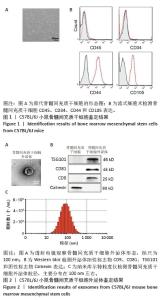
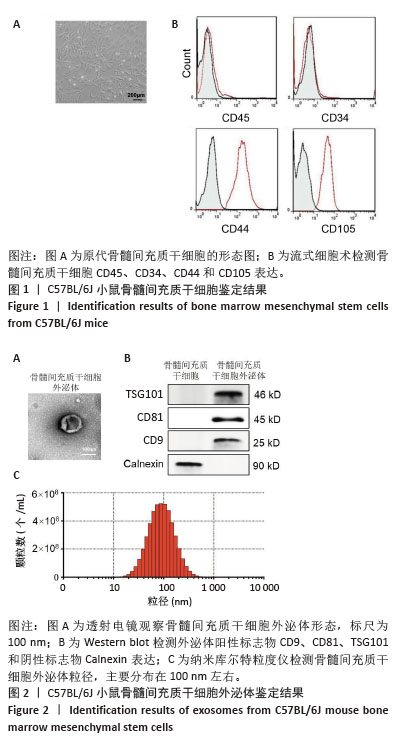
2.1 骨髓间充质干细胞及外泌体鉴定结果 如图1A所示,原代骨髓间充质干细胞培养3 d时,细胞贴壁且呈梭形,符合间充质干细胞的结构特征。流式细胞术检测结果(图1B)显示,提取的骨髓间充质干细胞高表达标志物CD44和CD105,不表达CD45和CD34。透射电镜(图2A)和Western blot(图2B)检测结果显示,差速离心法提取的骨髓间充质干细胞外泌体为双层膜,呈“杯托”样,并且表达外泌体标志物TSG101、CD9和CD81,外泌体粒径检测结果(图2C)显示,骨髓间充质干细胞外泌体粒径主要分布在100 nm左右,符合外泌体的粒径特征。 "
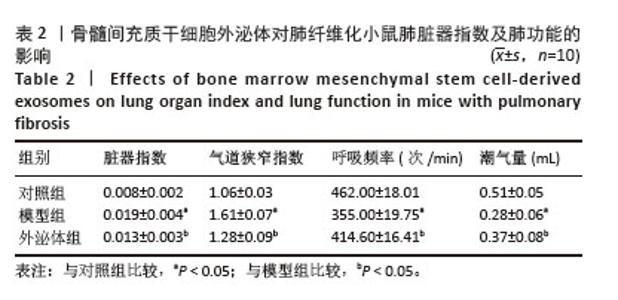
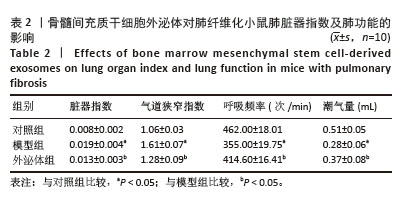
2.2 实验动物数量分析 实验共纳入35只C57BL/6J小鼠,5小鼠用于分离骨髓间充质干细胞;30只小鼠进行分组,每组10只,共3组,均进入结果分析。 2.3 骨髓间充质干细胞外泌体缓解肺纤维化小鼠肺功能 模型组小鼠肺组织脏器指数显著高于对照组(P < 0.05),外泌体组小鼠肺组织脏器指数显著低于模型组(P < 0.05)。肺功能检测结果显示,与对照组相比,模型组小鼠气道狭窄指数值显著增加(P < 0.05),呼吸频率和潮气量值均显著降低(P < 0.05),而外泌体组小鼠气道狭窄指数值显著低于模型组(P < 0.05),呼吸频率和潮气量值均显著高于模型组(P < 0.05),说明骨髓间充质干细胞外泌体可改善肺纤维化小鼠肺功能,见表2。"
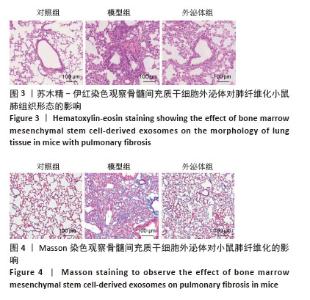
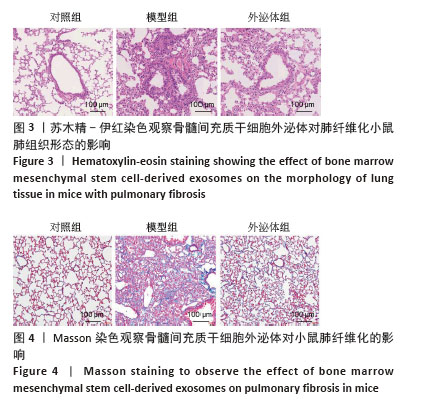
2.4 骨髓间充质干细胞外泌体缓解博来霉素诱导的小鼠肺纤维化 苏木精-伊红染色和Masson染色结果显示,对照组小鼠肺组织结构完整正常,肺泡腔形态规则,间隔正常,无间质增生,亦无明显的免疫细胞浸润,无病理损伤。模型组小鼠肺组织肺泡腔形态紊乱且显著萎缩,肺泡壁小叶间质增厚,胶原纤维沉积明显,伴有大量的炎症细胞浸润,说明小鼠肺纤维化造模成功。与模型组相比,外泌体组小鼠肺组织肺泡形态及肺泡壁小叶间质形态均明显改善,胶原纤维沉积减少,炎症细胞浸润减少,说明骨髓间充质干细胞外泌体可缓解博来霉素诱导的小鼠肺纤维化。结果见图3和图4。 "
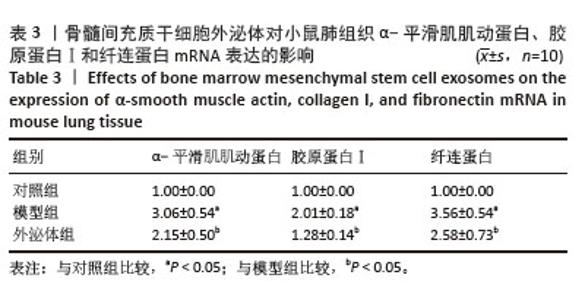
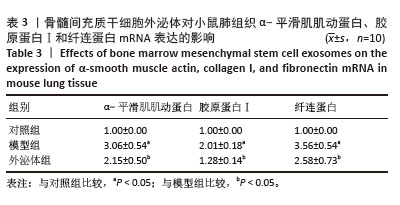
2.5 骨髓间充质干细胞外泌体下调肺纤维化小鼠肺组织α-平滑肌肌动蛋白、胶原蛋白Ⅰ和纤连蛋白表达 qRT-PCR检测结果显示,模型组小鼠肺组织α-平滑肌肌动蛋白、胶原蛋白Ⅰ和纤连蛋白 mRNA表达显著高于对照组(P < 0.05),外泌体组小鼠肺组织α-平滑肌肌动蛋白、胶原蛋白Ⅰ和纤连蛋白 mRNA表达显著低于模型组(P < 0.05),说明骨髓间充质干细胞外泌体可下调小鼠肺组织α-平滑肌肌动蛋白、胶原蛋白Ⅰ和纤连蛋白mRNA表达,即缓解肺部纤维化,见表3。 "
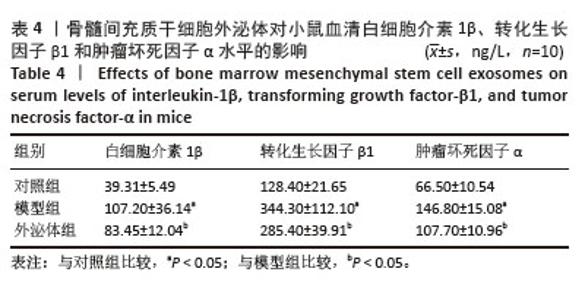
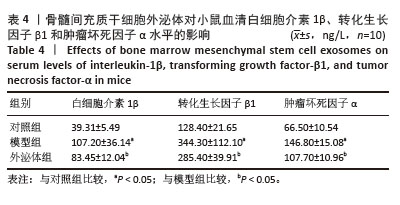
2.6 骨髓间充质干细胞外泌体抑制肺纤维化小鼠血清羟脯氨酸水平 模型组小鼠血清羟脯氨酸水平显著高于对照组[(6.15±0.34) μg/mL,(4.88±0.57) μg/mL,P < 0.05],外泌体组小鼠血清羟脯氨酸水平显著低于模型组[(4.91±0.13) μg/mL,(6.15±0.34) μg/mL,P < 0.05],说明骨髓间充质干细胞外泌体可抑制肺纤维化小鼠体内羟脯氨酸水平。 2.7 骨髓间充质干细胞外泌体抑制肺纤维化小鼠血清炎症因子水平 酶联免疫吸附实验检测结果显示,模型组小鼠血清白细胞介素1β、转化生长因子β1和肿瘤坏死因子α水平显著高于对照组(P < 0.05),而外泌体组小鼠血清白细胞介素1β、转化生长因子β1和肿瘤坏死因子α水平显著低于模型组(P < 0.05),即骨髓间充质干细胞外泌体可缓解肺纤维化小鼠体内炎症反应,见表4。 "
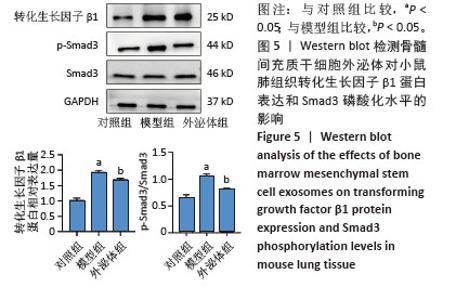
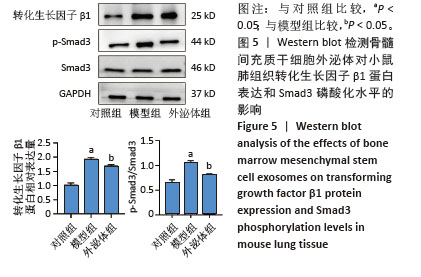
2.8 骨髓间充质干细胞外泌体抑制肺纤维化小鼠肺组织转化生长因子β1/Smad3信号通路 Western blot结果显示,模型组小鼠肺组织中转化生长因子β1蛋白表达显著上调(P < 0.05),Smad3磷酸化水平显著增加(P < 0.05),说明博来霉素诱导纤维化后显著激活转化生长因子β1/Smad3信号通路。与模型组相比,外泌体组小鼠肺组织中转化生长因子β1蛋白表达显著下调(P < 0.05),Smad3磷酸化水平显著降低(P < 0.05),即转化生长因子β1/Smad3信号通路被显著抑制,见图5。"
| [1] CAPORARELLO N, LIGRESTI G. Vascular Contribution to Lung Repair and Fibrosis. Am J Respir Cell Mol Biol. 2023;69(2):135-146. [2] KOUDSTAAL T, FUNKE-CHAMBOUR M, KREUTER M, et al. Pulmonary fibrosis: from pathogenesis to clinical decision-making. Trends Mol Med. 2023;29(12):1076-1087. [3] WANG X, ZHOU J, LI X, et al. The Role of Macrophages in Lung Fibrosis and the Signaling Pathway. Cell Biochem Biophys. 2024;82(2):479-488. [4] BEHR J, SALISBURY ML, WALSH SLF, et al. The Role of Inflammation and Fibrosis in Interstitial Lung Disease Treatment Decisions. Am J Respir Crit Care Med. 2024;210(4):392-400. [5] DOWMAN LM, HOLLAND AE. Pulmonary rehabilitation in idiopathic pulmonary fibrosis. Curr Opin Pulm Med. 2024;30(5):516-522. [6] JIANG M, BU W, WANG X, et al. Pulmonary fibrosis: from mechanisms to therapies. J Transl Med. 2025;23(1):515. [7] CHEN S, SONG X, LV C. Macrophages and Pulmonary Fibrosis. Curr Mol Med. 2025;25(4):416-430. [8] WU KC, CHANG YH, DING DC, et al. Mesenchymal Stromal Cells for Aging Cartilage Regeneration: A Review. Int J Mol Sci. 2024;25(23):12911. [9] SHAN Y, ZHANG M, TAO E, et al. Pharmacokinetic characteristics of mesenchymal stem cells in translational challenges. Signal Transduct Target Ther. 2024;9(1):242. [10] LI M, LI J, WANG Y, et al. Umbilical cord-derived mesenchymal stem cells preferentially modulate macrophages to alleviate pulmonary fibrosis. Stem Cell Res Ther. 2024;15(1):475. [11] XIAO K, LIU C, WANG H, et al. Umbilical cord mesenchymal stem cells overexpressing CXCR7 facilitate treatment of ARDS-associated pulmonary fibrosis via inhibition of Notch/Jag1 mediated by the Wnt/β-catenin pathway. Biomed Pharmacother. 2023;165:115124. [12] FARGE D, LOISEL S, LANSIAUX P, et al. Mesenchymal stromal cells for systemic sclerosis treatment. Autoimmun Rev. 2021;20(3):102755-102767. [13] ZHOU C, ZHANG B, YANG Y, et al. Stem cell-derived exosomes: emerging therapeutic opportunities for wound healing. Stem Cell Res Ther. 2023;14(1):107-124. [14] WANG J, ZHANG H, LI J, et al. Exosome-derived proteins in gastric cancer progression, drug resistance, and immune response. Cell Mol Biol Lett. 2024; 29(1):157. [15] SONAR S, DAS A, KALELE K, et al. Exosome-based cancer vaccine: a cell-free approach. Mol Biol Rep. 2025;52(1):421. [16] ZONOUZ AM, RAHBARDAR MG, ALIBOLANDI M. Exosome-based platforms for treatment of multiple sclerosis. Brain Res Bull. 2025;222:111256. [17] MATSUZAKA Y, YASHIRO R. Therapeutic Strategy of Mesenchymal-Stem-Cell-Derived Extracellular Vesicles as Regenerative Medicine. Int J Mol Sci. 2022; 23(12):6480. [18] LI H, BAI L. Advances in mesenchymal stem cell and exosome-based therapies for aging and age-related diseases. Stem Cell Res Ther. 2025;16(1):401. [19] LI Y, SHEN Z, JIANG X, et al. Mouse mesenchymal stem cell-derived exosomal miR-466f-3p reverses EMT process through inhibiting AKT/GSK3β pathway via c-MET in radiation-induced lung injury. J Exp Clin Cancer Res. 2022;41(1):128. [20] HAO X, LI P, WANG Y, et al. Mesenchymal Stem Cell-Exosomal miR-99a Attenuate Silica-Induced Lung Fibrosis by Inhibiting Pulmonary Fibroblast Transdifferentiation. Int J Mol Sci. 2024;25(23):12626. [21] SUN Q, HU J, YU P, et al. Peptide PD29 treats bleomycin-induced pulmonary fibrosis by inhibiting the TGF-β/smad signaling pathway. Exp Lung Res. 2019; 45(5-6):123-134. [22] NEMOTO M, KOO CW, SCANLON PD, et al. Combined Pulmonary Fibrosis and Emphysema: A Narrative Review. Mayo Clin Proc. 2023;98(11):1685-1696. [23] SAVIN IA, ZENKOVA MA, SEN’KOVA AV. Pulmonary Fibrosis as a Result of Acute Lung Inflammation: Molecular Mechanisms, Relevant In Vivo Models, Prognostic and Therapeutic Approaches. Int J Mol Sci. 2022;23(23):14959. [24] DUAN R, HONG CG, WANG X, et al. Olfactory mucosa mesenchymal stem cells alleviate pulmonary fibrosis via the immunomodulation and reduction of inflammation. BMC Pulm Med. 2024;24(1):14. [25] LEE H, JEONG OY, PARK HJ, et al. Promising Therapeutic Effects of Embryonic Stem Cells-Origin Mesenchymal Stem Cells in Experimental Pulmonary Fibrosis Models: Immunomodulatory and Anti-Apoptotic Mechanisms. Immune Netw. 2023;23(6):e45. [26] CHATTOPADHYAY S, RAJENDRAN RL, CHATTERJEE G, et al. Mesenchymal stem cell-derived exosomes: A paradigm shift in clinical therapeutics. Exp Cell Res. 2025;450(1):114616. [27] SUN ZL, YOU T, ZHANG BH, et al. Bone marrow mesenchymal stem cell-derived exosomes miR-202-5p inhibited pyroptosis to alleviate lung ischemic-reperfusion injury by targeting CMPK2. Kaohsiung J Med Sci. 2023;39(7):688-698. [28] REN Q, XU Y, XU L, et al. Hypoxic bone marrow mesenchymal stem cell-derived exosomal lncRNA XIST attenuates lipopolysaccharide-induced acute lung injury via the miR-455-3p/Claudin-4 axis. Int Immunopharmacol. 2023;125(Pt A):111066. [29] SHARMA A, WAIRKAR S. Flavonoids for treating pulmonary fibrosis: Present status and future prospects. Phytother Res. 2024;38(9):4406-4423. [30] ZHU X, ZENG B, WU C, et al. Inhibition of TGF-β2-Induced Trabecular Meshwork Fibrosis by Pirfenidone. Transl Vis Sci Technol. 2023;12(11):21. [31] ISHIDA Y, KUNINAKA Y, MUKAIDA N, et al. Immune Mechanisms of Pulmonary Fibrosis with Bleomycin. Int J Mol Sci. 2023;24(4):3149. [32] CHEN W, PENG J, TANG X, et al. MSC-derived exosome ameliorates pulmonary fibrosis by modulating NOD 1/NLRP3-mediated epithelial-mesenchymal transition and inflammation. Heliyon. 2024;11(2):e41436. [33] GIFFORD CC, TANG J, COSTELLO A, et al. Negative regulators of TGF-β1 signaling in renal fibrosis; pathological mechanisms and novel therapeutic opportunities. Clin Sci. 2021;35(2):275-303. [34] JI Z, LIN S, GUI S, et al. Overexpressed Poldip2 Incurs Retinal Fibrosis via the TGF-β1/SMAD3 Signaling Pathway in Diabetic Retinopathy. Diabetes. 2024;73(10): 1742-1755. [35] WANG J, XIA Z, QING B, et al. DsbA-L activates TGF-β1/SMAD3 signaling and M2 macrophage polarization by stimulating AKT1 and NLRP3 to promote pulmonary fibrosis. Mol Med. 2024;30(1):228. [36] SONG J, SUN DL, LI CY, et al. TL1A Promotes Fibrogenesis in Colonic Fibroblasts via the TGF-β1/Smad3 Signaling Pathway. Curr Med Sci. 2024;44(3):519-528. [37] ZHU D, ZHANG Q, LI Q, et al. Inhibition of AHNAK nucleoprotein 2 alleviates pulmonary fibrosis by downregulating the TGF-β1/Smad3 signaling pathway. J Gene Med. 2022;24(9):e3442. [38] LEE JS, CHO HG, LEE JW, et al. Influence of Transforming Growth Factors beta 1 and beta 3 in the Scar Formation Process. J Craniofac Surg. 2023;34(3):904-909. [39] YAO F, XU M, DONG L, et al. Sinomenine attenuates pulmonary fibrosis by downregulating TGF-β1/Smad3, PI3K/Akt and NF-κB signaling pathways. BMC Pulm Med. 2024;24(1):229-246. [40] AN B, FANG Y, WANG L, et al. Inhibition of TGF-β1/Smad3 signaling by compound 5aa: A potential treatment for idiopathic pulmonary fibrosis. Bioorg Chem. 2024;14(7):107374-107382. [41] LIANG Y, TANG X, ZHANG X, et al. Adipose Mesenchymal Stromal Cell-Derived Exosomes Carrying MiR-122-5p Antagonize the Inhibitory Effect of Dihydrotestosterone on Hair Follicles by Targeting the TGF-β1/SMAD3 Signaling Pathway. Int J Mol Sci. 2023;24(6):5703. [42] DU J, WU J, SONG Q, et al. Mesenchymal stem cell exosomes regulate TGFβ/Smad3 by decreasing the METTL3-NEAT1 axis to inhibit scar progression after breast surgery. J Mol Histol. 2025;56(3):161. |
| [1] | Haonan Yang, Zhengwei Yuan, Junpeng Xu, Zhiqi Mao, Jianning Zhang. Preliminary study on the mechanisms and efficacy of deep brain stimulation in treating depression [J]. Chinese Journal of Tissue Engineering Research, 2026, 30(在线): 1-9. |
| [2] | Song Puzhen, Ma Hebin, Chen Hongguang, Zhang Yadong. Effect of bone marrow mesenchymal stem cell-derived exosomes combined with transforming growth factor beta 1 on macrophages [J]. Chinese Journal of Tissue Engineering Research, 2026, 30(7): 1616-1623. |
| [3] | Cai Ziming, Yu Qinghe, Ma Pengfei, Zhang Xin, Zhou Longqian, Zhang Chongyang, Lin Wenping. Heme oxygenase-1 alleviates lipopolysaccharide-induced inflammatory response in nucleus pulposus mesenchymal stem cells [J]. Chinese Journal of Tissue Engineering Research, 2026, 30(7): 1624-1631. |
| [4] | He Jiale, Huang Xi, Dong Hongfei, Chen Lang, Zhong Fangyu, Li Xianhui. Acellular dermal matrix combined with adipose-derived stem cell exosomes promotes burn wound healing [J]. Chinese Journal of Tissue Engineering Research, 2026, 30(7): 1699-1710. |
| [5] | Xia Linfeng, Wang Lu, Long Qianfa, Tang Rongwu, Luo Haodong, Tang Yi, Zhong Jun, Liu Yang. Human umbilical cord mesenchymal stem cell-derived exosomes alleviate blood-brain barrier damage in mice with septic encephalopathy [J]. Chinese Journal of Tissue Engineering Research, 2026, 30(7): 1711-1719. |
| [6] | Cui Lianxu, Li Haomin, Xu Junrong, Tan Baodong, Lu Dahong, Peng Siwei, Wang Jinhui. Effect of umbilical cord mesenchymal stem cell conditioned medium on tissue repair after traumatic craniocerebral injury in miniature pigs [J]. Chinese Journal of Tissue Engineering Research, 2026, 30(7): 1730-1735. |
| [7] | Chen Yulin, He Yingying, Hu Kai, Chen Zhifan, Nie Sha Meng Yanhui, Li Runzhen, Zhang Xiaoduo , Li Yuxi, Tang Yaoping. Effect and mechanism of exosome-like vesicles derived from Trichosanthes kirilowii Maxim. in preventing and treating atherosclerosis [J]. Chinese Journal of Tissue Engineering Research, 2026, 30(7): 1768-1781. |
| [8] | Han Teng, Ma Hong, Yang Ruoyi, Luo Yi, Li Chao. Oral squamous cell carcinoma-derived exosomal delivery of angiopoietin-2 is involved in tumor angiogenesis [J]. Chinese Journal of Tissue Engineering Research, 2026, 30(7): 1755-1767. |
| [9] | Cao Yong, Teng Hongliang, Tai Pengfei, Li Junda, Zhu Tengqi, Li Zhaojin. Interactions between cytokines and satellite cells in muscle regeneration [J]. Chinese Journal of Tissue Engineering Research, 2026, 30(7): 1808-1817. |
| [10] | Huang Jiawen, Pan Zhiyi, Xue Wenjun, Lian Yuanpei, Xu Jianda. Plant-derived vesicles and malignant tumor therapy: cross-species communication and modulation of host cell responses [J]. Chinese Journal of Tissue Engineering Research, 2026, 30(7): 1828-1838. |
| [11] | Wang Baiyan, Yang Shu, Wang Yiming, Wu Mengqing, Xiao Yu, Guo Zixuan, Zhang Boyi, Feng Shuying. Exosome-delivered CRISPR/Cas system enables gene editing in target cells [J]. Chinese Journal of Tissue Engineering Research, 2026, 30(7): 1839-1849. |
| [12] | Wang Zhenze, Liu Fende, Zhang Rui, Li Wujun. Mesenchymal stem cells in treatment of arteriosclerosis obliterans of lower extremities: systematic review and meta-analysis [J]. Chinese Journal of Tissue Engineering Research, 2026, 30(7): 1869-1876. |
| [13] | Chen Ju, Zheng Jinchang, Liang Zhen, Huang Chengshuo, Lin Hao, Zeng Li. Effect and mechanism of beta-caryophyllene in mice with osteoarthritis [J]. Chinese Journal of Tissue Engineering Research, 2026, 30(6): 1341-1347. |
| [14] | Zhong Caihong, Xiao Xiaoge, Li Ming, Lin Jianhong, Hong Jing. Biomechanical mechanism of sports-related patellar tendinitis [J]. Chinese Journal of Tissue Engineering Research, 2026, 30(6): 1417-1423. |
| [15] | Zhu Kuicheng, Du Chunyan, Zhang Jintao. Mechanism by which hairless gene mutation promotes white adipose tissue browning in hairless mice [J]. Chinese Journal of Tissue Engineering Research, 2026, 30(6): 1424-1430. |
| Viewed | ||||||
|
Full text |
|
|||||
|
Abstract |
|
|||||