Chinese Journal of Tissue Engineering Research ›› 2026, Vol. 30 ›› Issue (35): 9120-9127.doi: 10.12307/2026.260
Previous Articles Next Articles
Nimbolide relieves osteoporosis by regulating osteoclast differentiation and apoptosis
Li Wenhao, Zhang Wei, Li Wenming, Xia Wenyu, Wu Zebin, Geng Dechun
- Department of Orthopedics, The First Affiliated Hospital of Soochow University, Suzhou 215006, Jiangsu Province, China
-
Received:2025-08-24Revised:2026-01-04Online:2026-12-18Published:2026-04-24 -
Contact:Geng Dechun, PhD, Researcher, Department of Orthopedics, The First Affiliated Hospital of Soochow University, Suzhou 215006, Jiangsu Province, China -
About author:Li Wenhao, MS, Department of Orthopedics, The First Affiliated Hospital of Soochow University, Suzhou 215006, Jiangsu Province, China -
Supported by:Graduate Research and Practice Innovation Program of Jiangsu Province, No. KYCX243339 (to LWM)

CLC Number:
Cite this article
Li Wenhao, Zhang Wei, Li Wenming, Xia Wenyu, Wu Zebin, Geng Dechun. Nimbolide relieves osteoporosis by regulating osteoclast differentiation and apoptosis[J]. Chinese Journal of Tissue Engineering Research, 2026, 30(35): 9120-9127.
share this article
Add to citation manager EndNote|Reference Manager|ProCite|BibTeX|RefWorks
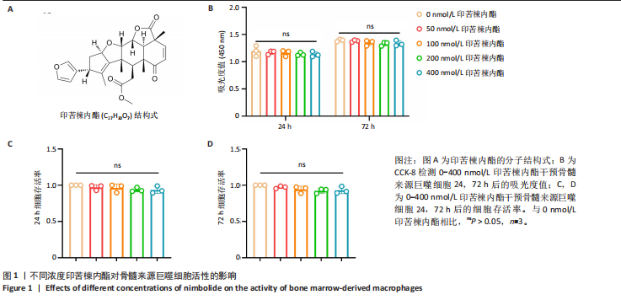
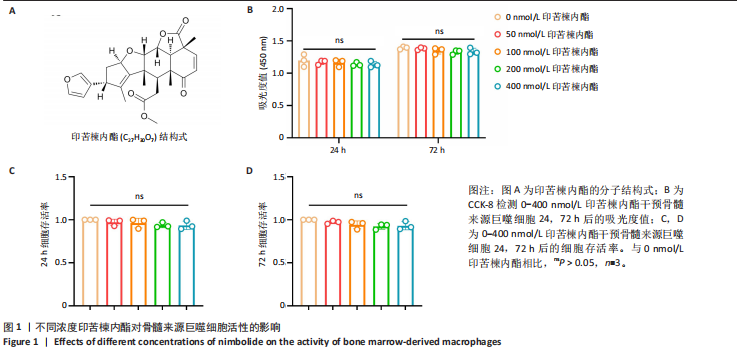
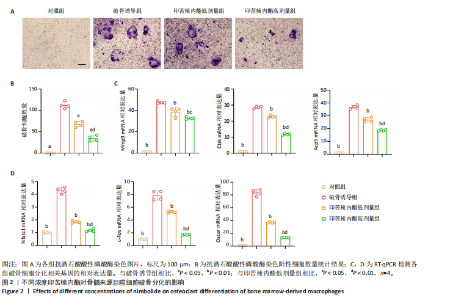
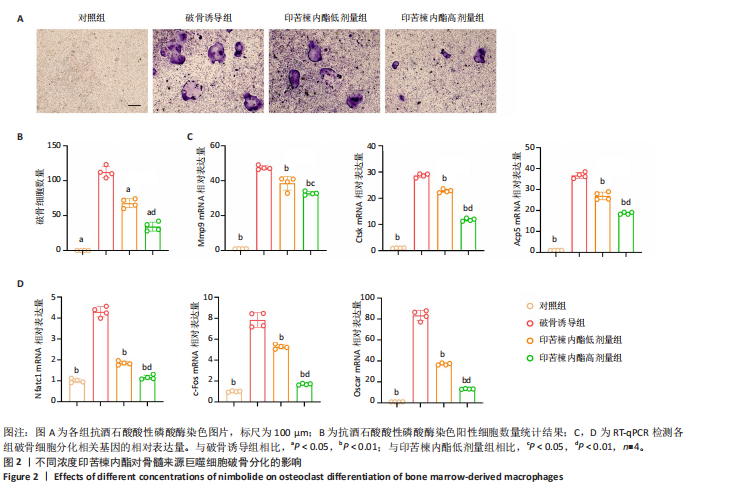
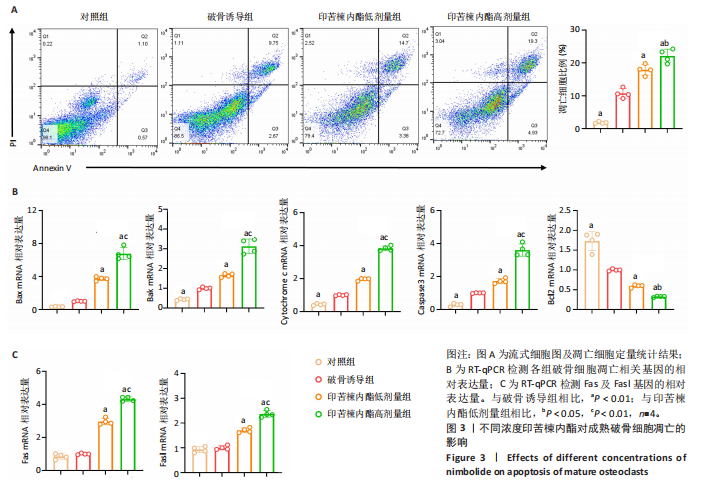
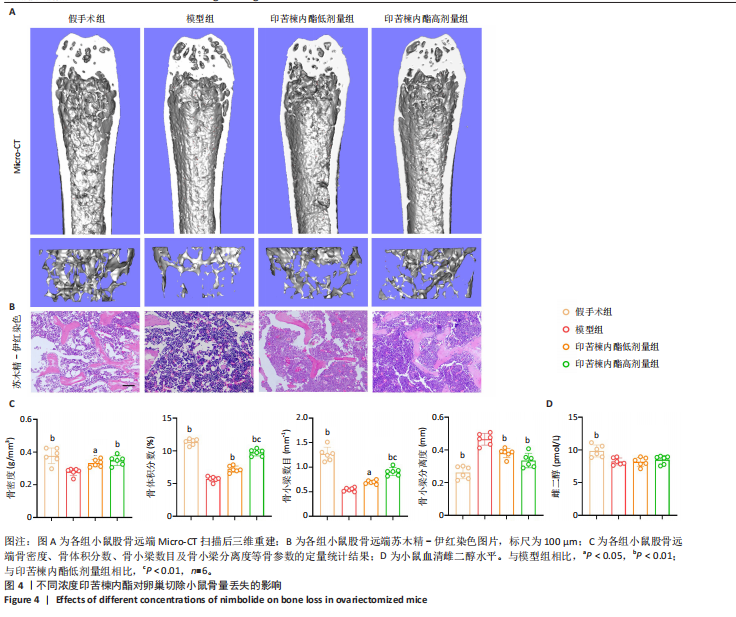
2.1 印苦楝内酯对骨髓来源巨噬细胞毒性的影响 印苦楝内酯是从印楝中分离出的一种分子式为C27H30O7、相对分子质量为466.52的三类活性化合物(图1A)。为了确定印苦楝内酯干预浓度对骨髓来源巨噬细胞活性是否有影响,将骨髓来源巨噬细胞分别暴露于不同浓度(0,50,100,200,400 nmol/L)的印苦楝内酯中培养24,72 h,采用CCK-8实验检测印苦楝内酯对细胞的毒性。实验结果显示,400 nmol/L浓度以下的印苦楝内酯干预24,72 h对吸光度值没有显著影响(图1B),对细胞存活率也无显著影响(图1C,D)。综上所述,此研究选取的印苦楝内酯干预浓度对细胞没有毒性。因此,将100 nmol/L和200 nmol/L确定为印苦楝内酯的体外细胞干预浓度。 2.2 印苦楝内酯抑制核因子κB受体活化因子配体诱导骨髓来源巨噬细胞向破骨细胞分化 干预5 d后,抗酒石酸酸性磷酸酶染色结果显示,破骨诱导组骨髓来源巨噬细胞融合成大量抗酒石酸酸性磷酸酶阳性的多核破骨细胞(图2A)。与破骨诱导组相比,印苦楝内酯干预后破骨细胞形成显著减少,且200 nmol/L印苦楝内酯的抑制效果明显优于100 nmol/L印苦楝内酯(图2B)。此外,进一步采用RT-qPCR检测印苦楝内酯对破骨细胞相关基因Mmp9、Ctsk、Acp5、Nfatc1、c-Fos以及Oscar表达的影响。干预3 d后,破骨诱导组上述破骨细胞相关基因表达较对照组显著增加,而印苦楝内酯干预显著抑制了上述破骨细胞相关基因的表达,且这种效应具有浓度依赖性(图2C,D)。结果表明,印苦楝内酯可以在体外抑制破骨细胞分化。 2.3 印苦楝内酯可以促进成熟破骨细胞凋亡 与破骨诱导组相比,印苦楝内酯干预明显促进了成熟破骨细胞的凋亡,且200 nmol/L印苦楝内酯促凋亡效果明显优于100 nmol/L印苦楝内酯(图3A)。进一步采用RT-qPCR检测凋亡相关基因的表达,印苦楝内酯干预显著促进了Bax、Bak、Cytochrome c和Caspase3的表达,同时抑制了Bcl2的表达,且呈现浓度依赖性(图3B);此外,印苦楝内酯干预显著促进了Fas及Fasl的表达,同样呈现浓度依赖性(图3C)。上述结果表明,印苦楝内酯可以在体外通过激活Fas/Fasl信号通路促进成熟破骨细胞的凋亡。 2.4 印苦楝内酯干预抑制雌激素缺乏引发的过量骨丢失 骨小梁区域三维重建结果显示,与假手术组相比,模型组小鼠骨小梁结构稀疏程度明显增加,表明双侧卵巢去势成功诱导了小鼠的骨质疏松症状。而在印苦楝内酯干预后,骨小梁结构得到部分恢复,疏松程度也得到明显改善(图4A)。苏木精-伊红染色也观察到骨小梁结构增加(图4B)。对感兴趣区域的骨参数进行分析发现,模型组小鼠骨密度、骨体积分数和骨小梁数目均显著下降,同时骨小梁分离度显著增加;印苦楝内酯干预后,小鼠骨密度、骨体积分数、骨小梁数目以及骨小梁分离度均得到显著改善。然而,印苦楝内酯低、高剂量组仅骨体积分数和骨小梁数目指标存在显著性差异(图4C)。此外,小鼠血清雌二醇水平检测结果显示,与假手术组相比,模型组小鼠血清雌二醇水平明显下降,而印苦楝内酯干预对小鼠血清雌二醇水平无显著影响(图4D)。以上实验结果表明,印苦楝内酯可以减少卵巢去势小鼠骨质丢失。"
"
"

"
| [1] LIANG B, BURLEY G, LIN S, et al. Osteoporosis pathogenesis and treatment: existing and emerging avenues. Cell Mol Biol Lett. 2022;27(1):72. [2] VAN DEN BERGH JP, VAN GEEL TA, GEUSENS PP. Osteoporosis, frailty and fracture: implications for case finding and therapy. Nat Rev Rheumatol. 2012; 8(3):163-172. [3] HÄNDEL MN, CARDOSO I, VON BÜLOW C, et al. Fracture risk reduction and safety by osteoporosis treatment compared with placebo or active comparator in postmenopausal women: systematic review, network meta-analysis, and meta-regression analysis of randomised clinical trials. BMJ. 2023;381:e068033. [4] 祁雨心,党一凡,戴黎鸣,等.大黄素甲醚调节骨稳态的功能及分子机制[J].中国组织工程研究,2026,30(28):7237-7244. [5] HUANG M, ZHOU J, LI X, et al. Mechanical protein polycystin-1 directly regulates osteoclastogenesis and bone resorption. Sci Bull (Beijing). 2024;69(12):1964-1979. [6] BALLANE G, CAULEY JA, LUCKEY MM, et al. Worldwide prevalence and incidence of osteoporotic vertebral fractures. Osteoporos Int. 2017;28(5):1531-1542. [7] SUGIYAMA T, KIM YT, ODA H. Osteoporosis therapy: a novel insight from natural homeostatic system in the skeleton. Osteoporos Int. 2015;26(2): 443-447. [8] ZHANG H, GU JM, CHAO AJ, et al. A phase III randomized, double-blind, placebo-controlled trial of the denosumab biosimilar QL1206 in postmenopausal Chinese women with osteoporosis and high fracture risk. Acta Pharmacol Sin. 2023;44(2):446-453. [9] LEBOFF MS, CHOU SH, RATLIFF KA, et al. Supplemental Vitamin D and Incident Fractures in Midlife and Older Adults. N Engl J Med. 2022;387(4):299-309. [10] BRENT MB. Pharmaceutical treatment of bone loss: From animal models and drug development to future treatment strategies. Pharmacol Ther. 2023;244:108383. [11] REID IR, HORNE AM, MIHOV B, et al. Duration of fracture prevention after zoledronate treatment in women with osteopenia: observational follow-up of a 6-year randomised controlled trial to 10 years. Lancet Diabetes Endocrinol. 2024;12(4):247-256. [12] CHAMBERS TJ. Regulation of the differentiation and function of osteoclasts. J Pathol. 2000;192(1):4-13. [13] YANG S, HE Z, WU T, et al. Glycobiology in osteoclast differentiation and function. Bone Res. 2023;11(1):55. [14] ELSON A, ANUJ A, BARNEA-ZOHAR M, et al. The origins and formation of bone-resorbing osteoclasts. Bone. 2022;164:116538. [15] TAKEGAHARA N, KIM H, CHOI Y. Unraveling the intricacies of osteoclast differentiation and maturation: insight into novel therapeutic strategies for bone-destructive diseases. Exp Mol Med. 2024;56(2):264-272. [16] LI Z, LI D, CHEN R, et al. Cell death regulation: A new way for natural products to treat osteoporosis. Pharmacol Res. 2023;187:106635. [17] 张文胜,郭海威,翁汭,等.甘草苷抑制破骨细胞分化缓解骨丢失[J].中国组织工程研究,2025,29(12):2429-2437. [18] NAGINI S, NIVETHA R, PALRASU M, et al. Nimbolide, a Neem Limonoid, Is a Promising Candidate for the Anticancer Drug Arsenal. J Med Chem. 2021;64(7): 3560-3577. [19] SHAHEEN S, KHALID S, AALIYA K, et al. Insights into Nimbolide molecular crosstalk and its anticancer properties. Med Oncol. 2024;41(6):158. [20] ISRAR M, NASEEM N, AKHTAR T, et al. Nimbolide attenuates complete Freund’s adjuvant induced arthritis through expression regulation of toll-like receptors signaling pathway. Phytother Res. 2023;37(3):903-912. [21] KATOLA FO, OLAJIDE OA. Nimbolide Targets Multiple Signalling Pathways to Reduce Neuroinflammation in BV-2 Microglia. Mol Neurobiol. 2023;60(9):5450-5467. [22] ZHANG H, ZHAO X, WEI W, et al. Nimbolide protects against diabetic cardiomyopathy by regulating endoplasmic reticulum stress and mitochondrial function via the Akt/mTOR pathway. Tissue Cell. 2024;90:102478. [23] YU W, ZHONG L, YAO L, et al. Bone marrow adipogenic lineage precursors promote osteoclastogenesis in bone remodeling and pathologic bone loss. J Clin Invest. 2021;131(2):e140214. [24] KIM JM, LIN C, STAVRE Z, et al. Osteoblast-Osteoclast Communication and Bone Homeostasis. Cells. 2020;9(9):2073. [25] ARMAS LA, RECKER RR. Pathophysiology of osteoporosis: new mechanistic insights. Endocrinol Metab Clin North Am. 2012;41(3):475-486. [26] HANSEN MS, MADSEN K, PRICE M, et al. Transcriptional reprogramming during human osteoclast differentiation identifies regulators of osteoclast activity. Bone Res. 2024;12(1):5. [27] KIM SC, GU DR, YANG H, et al. Polysaccharides from Psoralea corylifolia seeds suppress osteoclastogenesis and alleviate osteoporosis. Int J Biol Macromol. 2025;315(Pt 2):144423. [28] EDWARDS JR, MUNDY GR. Advances in osteoclast biology: old findings and new insights from mouse models. Nat Rev Rheumatol. 2011;7(4):235-243. [29] VEIS DJ, O’BRIEN CA. Osteoclasts, Master Sculptors of Bone. Annu Rev Pathol. 2023;18:257-281. [30] PARK Y, SATO T, LEE J. Functional and analytical recapitulation of osteoclast biology on demineralized bone paper. Nat Commun. 2023;14(1):8092. [31] REID IR, BILLINGTON EO. Drug therapy for osteoporosis in older adults. Lancet. 2022;399(10329):1080-1092. [32] LEE CC, WANG CY, YEN HK, et al. Zoledronate Sequential Therapy After Denosumab Discontinuation to Prevent Bone Mineral Density Reduction: A Randomized Clinical Trial. JAMA Netw Open. 2024;7(11):e2443899. [33] BELLIDO T. Bisphosphonates for osteoporosis: from bench to clinic. J Clin Invest. 2024;134(6):e179942. [34] SONG S, GUO Y, YANG Y, et al. Advances in pathogenesis and therapeutic strategies for osteoporosis. Pharmacol Ther. 2022;237:108168. [35] KENDLER DL, COSMAN F, STAD RK, et al. Denosumab in the Treatment of Osteoporosis: 10 Years Later: A Narrative Review. Adv Ther. 2022;39(1):58-74. [36] BONE HG, WAGMAN RB, BRANDI ML, et al. 10 years of denosumab treatment in postmenopausal women with osteoporosis: results from the phase 3 randomised FREEDOM trial and open-label extension. Lancet Diabetes Endocrinol. 2017; 5(7):513-523. [37] JOGI M, ASNANI H, SINGH S, et al. Nimbolide: A Potential Phytochemical Agent in Multimodal Pancreatic Cancer Therapies. Mini Rev Med Chem. 2025;25(1):27-41. [38] ANCHI P, SWAMY V, GODUGU C. Nimbolide exerts protective effects in complete Freund’s adjuvant induced inflammatory arthritis via abrogation of STAT-3/NF-κB/Notch-1 signaling. Life Sci. 2021;266:118911. [39] ANCHI P, PANDA B, MAHAJAN RB, et al. Co-treatment of Nimbolide augmented the anti-arthritic effects of methotrexate while protecting against organ toxicities. Life Sci. 2022;295:120372. [40] WU Q, LIANG H, WANG C, et al. Tetrahydroberberine Prevents Ovariectomy-Induced Bone Loss by Inhibiting RANKL-Induced Osteoclastogenesis and Promoting Osteoclast Apoptosis. J Agric Food Chem. 2024;72(37):20383-20395. [41] LIU CL, HO TL, FANG SY, et al. Ugonin L inhibits osteoclast formation and promotes osteoclast apoptosis by inhibiting the MAPK and NF-κB pathways. Biomed Pharmacother. 2023;166:115392. [42] HUO J, DING Y, WEI X, et al. Antiosteoporosis and bone protective effect of nimbolide in steroid-induced osteoporosis rats. J Biochem Mol Toxicol. 2022; 36(12):e23209. |
| [1] | Liu Wenlong, Dong Lei, Xiao Zhengzheng, Nie Yu. Finite element analysis of tibial prosthesis loosening after fixed-bearing unicompartmental knee arthroplasty for osteoporosis [J]. Chinese Journal of Tissue Engineering Research, 2026, 30(9): 2191-2198. |
| [2] | Chen Long, Wang Xiaozhen, Xi Jintao, Lu Qilin. Biomechanical performance of short-segment screw fixation combined with expandable polyetheretherketone vertebral body replacement in osteoporotic vertebrae [J]. Chinese Journal of Tissue Engineering Research, 2026, 30(9): 2226-2235. |
| [3] | Chen Huiting, Zeng Weiquan, Zhou Jianhong, Wang Jie, Zhuang Congying, Chen Peiyou, Liang Zeqian, Deng Weiming. Tail anchoring technique of vertebroplasty in treatment of osteoporotic vertebral compression fractures with intravertebral cleft: a finite element analysis [J]. Chinese Journal of Tissue Engineering Research, 2026, 30(9): 2145-2152. |
| [4] | Zeng Xuan, Weng Rui, Ye Shicheng, Tang Jiadong, Mo Ling, Li Wenchao. Two lumbar rotary manipulation techniques in treating lumbar disc herniation: a finite element analysis of biomechanical differences [J]. Chinese Journal of Tissue Engineering Research, 2026, 30(9): 2153-2161. |
| [5] | Cheng Qisheng, Julaiti·Maitirouzi, Xiao Yang, Zhang Chenwei, Paerhati·Rexiti. Finite element analysis of novel variable-diameter screws in modified cortical bone trajectory of lumbar vertebrae [J]. Chinese Journal of Tissue Engineering Research, 2026, 30(9): 2162-2171. |
| [6] | Hu Xiongke, Liu Shaohua, Tan Qian, Liu Kun, Zhu Guanghui. Shikonin intervention with bone marrow mesenchymal stem cells improves microstructure of femur in aged mice [J]. Chinese Journal of Tissue Engineering Research, 2026, 30(7): 1609-1615. |
| [7] | Wen Guangwei, Zhen Yinghao, Zheng Taikeng, Zhou Shuyi, Mo Guoye, Zhou Tengpeng, Li Haishan, Lai Yiyi. Effects and mechanisms of isoginkgetin on osteoclastogenesis [J]. Chinese Journal of Tissue Engineering Research, 2026, 30(6): 1348-1358. |
| [8] | Wu Zhilin, , He Qin, Wang Pingxi, Shi Xian, Yuan Song, Zhang Jun, Wang Hao . DYRK2: a novel therapeutic target for rheumatoid arthritis combined with osteoporosis based on East Asian and European populations [J]. Chinese Journal of Tissue Engineering Research, 2026, 30(6): 1569-1579. |
| [9] | Zhang Haiwen, Zhang Xian, Xu Taichuan, Li Chao. Bibliometric and visual analysis of the research status and trends of senescence in osteoporosis [J]. Chinese Journal of Tissue Engineering Research, 2026, 30(6): 1580-1591. |
| [10] | Huang Jie, Zeng Hao, Wang Wenchi, Lyu Zhucheng, Cui Wei. Visualization analysis of literature on the effect of lipid metabolism on osteoporosis [J]. Chinese Journal of Tissue Engineering Research, 2026, 30(6): 1558-1568. |
| [11] | Yang Zhijie, Zhao Rui, Yang Haolin, Li Xiaoyun, Li Yangbo, Huang Jiachun, Lin Yanping, Wan Lei, HuangHongxing. Postmenopausal osteoporosis: predictive values of muscle mass, grip strength, and appendicular skeletal muscle index [J]. Chinese Journal of Tissue Engineering Research, 2026, 30(5): 1073-1080. |
| [12] | Zhou Jian, Zhang Tao, Zhou Weili, Zhao Xingcheng, Wang Jun, Shen Jie, Qian Li, Lu Ming. Effects of resistance training on quadriceps mass and knee joint function in patients with osteoporosis and sarcopenia [J]. Chinese Journal of Tissue Engineering Research, 2026, 30(5): 1081-1088. |
| [13] | Cao Wenqi, Feng Xiuzhi, Zhao Yi, Wang Zhimin, Chen Yiran, Yang Xiao, Ren Yanling. Effect of macrophage polarization on osteogenesis-angiogenesis coupling in type 2 diabetic osteoporosis [J]. Chinese Journal of Tissue Engineering Research, 2026, 30(4): 917-925. |
| [14] | Zeng Hao, Sun Pengcheng, Chai Yuan, Huang Yourong, Zhang Chi, Zhang Xiaoyun. Association between thyroid function and osteoporosis: genome-wide data analysis of European populations [J]. Chinese Journal of Tissue Engineering Research, 2026, 30(4): 1019-1027. |
| [15] | Xu Hongtao, Wang Jianping, Xu Yuehong, Li Qin, Qi Qihua, Xia Qipeng. Asiaticoside promotes osteogenic differentiation in osteoporotic rats [J]. Chinese Journal of Tissue Engineering Research, 2026, 30(35): 9113-9119. |
| Viewed | ||||||
|
Full text |
|
|||||
|
Abstract |
|
|||||