Chinese Journal of Tissue Engineering Research ›› 2026, Vol. 30 ›› Issue (25): 6643-6653.doi: 10.12307/2026.291
Visualization analysis on research literature about animal models for osteonecrosis of the femoral head
Bai Ruokun, Mo Jian, Han Jie, Li Kunjian, Nie Xiayu, Chen Shuai
- Department of Orthopedics, Ruikang Hospital Affiliated to Guangxi University of Chinese Medicine, Nanning 530011, Guangxi Zhuang Autonomous Region, China
-
Received:2025-10-15Revised:2025-12-21Online:2026-09-08Published:2026-04-23 -
Contact:Mo Jian, MD candidate, Chief physician, Master's supervisor, Department of Orthopedics, Ruikang Hospital Affiliated to Guangxi University of Chinese Medicine, Nanning 530011, Guangxi Zhuang Autonomous Region, China -
About author:Bai Ruokun, MS candidate, Department of Orthopedics, Ruikang Hospital Affiliated to Guangxi University of Chinese Medicine, Nanning 530011, Guangxi Zhuang Autonomous Region, China -
Supported by:Guangxi Natural Science Foundation Project (General Program), No. 2024GXNSFAA010370 (to MJ); National Natural Science Foundation of China, No. 82260858 (to HJ)

CLC Number:
Cite this article
Bai Ruokun, Mo Jian, Han Jie, Li Kunjian, Nie Xiayu, Chen Shuai. Visualization analysis on research literature about animal models for osteonecrosis of the femoral head[J]. Chinese Journal of Tissue Engineering Research, 2026, 30(25): 6643-6653.
share this article
Add to citation manager EndNote|Reference Manager|ProCite|BibTeX|RefWorks
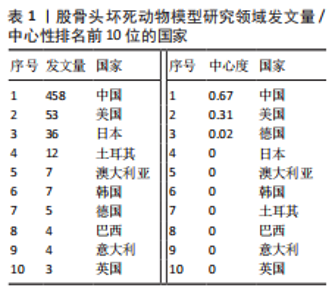
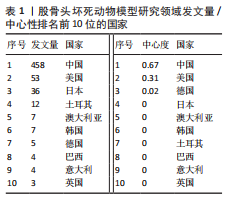
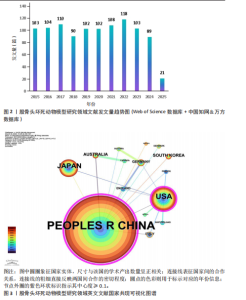
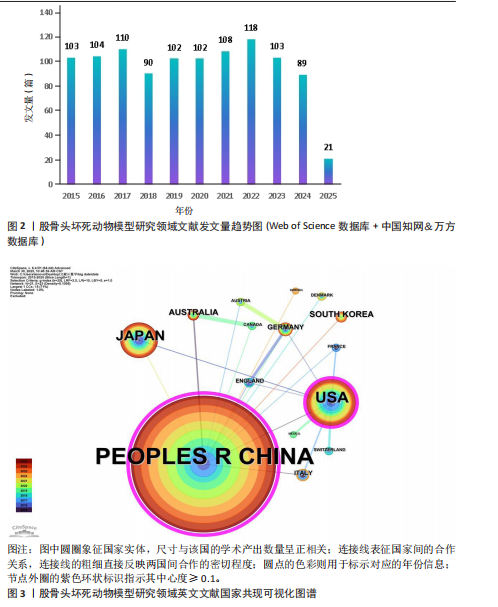
2.1 发文量分析 经2位研究者独立检索与交叉校验,最终纳入符合标准的英文文献556篇、中文文献494篇。进行时序分析显示该领域发文量呈现三阶段特征:①2015-2017是初始爬升期,发文量从103篇逐年增至110篇;②2018-2021是平台波动期,发文量在经历2018年回调后稳定于102-108篇区间,2021年达阶段峰值108篇;③2022-2024是转折收缩期,发文数量以2022年反常跃升至118篇为节点,此后连续2年下行至2024年89篇,累计降幅24.6%。而2025年因仅统计至3月数据暂不参与趋势评估。值得注意的是,2022年单年9.3%的异常增幅打破此前7年4.9%的缓增常态,其后的快速收缩印证该领域研究热度正向效率化、国际化方向迁移(图2)。 2.2 发文国家分析 基于英文文献的国家共现网络分析,近11年股骨头坏死动物模型领域研究产出呈现多极化分布特征,学术产出量前10的国家依次为中国(458篇)、美国(53篇)、日本(36篇)、土耳其(12篇)、澳大利亚(7篇)、韩国(7篇)、德国(5篇)、巴西(4篇)、意大利(4篇)、英国(3篇)。从发文数上可以看出中美两国在该领域的研究热度最为高涨。从科研网络中心性看,中国展现出显著的跨区域学术辐射能力(中心性0.67),远超其他国家,尽管中美日等国主导了主流研究方向,但部分国家通过聚焦专精化研究方向有望形成新的差异化研究优势;伴随全球科研资源协同网络的深化及创新生态的持续优化,这些潜在学术增长可能在未来实现影响力的梯度式跃升(图3,表1)。"
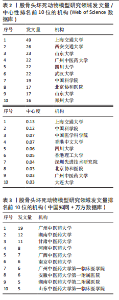
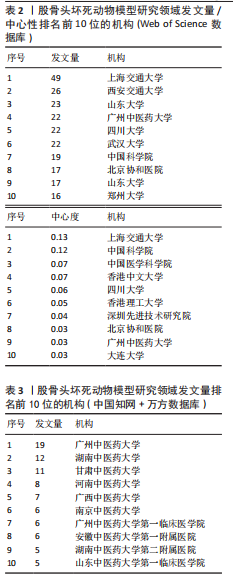
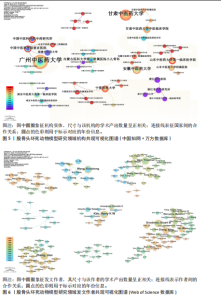
2.3 发文机构分析 股骨头坏死动物模型研究的机构分布呈现显著载体分化特征:国际发表(英文文献)前10的机构均来自中国,依次为上海交通大学(49篇)、西安交通大学(26篇)、山东大学(23篇)、广州中医药大学(22篇)等,其中上海交通大学(中心性0.18)与中国科学院(0.13)构成跨机构知识流动核心枢纽,但其余高产机构中心度普遍低于0.1,反映“高产出集聚-低协作效能”生态;而中文文献领域则完全由中医药体系主导,广州中医药大学(19篇)、湖南中医药大学(12篇)、甘肃中医药大学(11篇)等机构包揽前10,且超半数单位为临床医学院(如安徽中医药大学第一临床医学院),体现中医领域“临床-科研一体化”研究范式。该分化格局揭示双重现象:一方面中国综合型高校通过政策驱动形成国际发表绝对优势,另一方面中医机构研究相对独立,两类载体间机构重叠度不足20%,仅广州中医药大学双轨并行,见图4,5及表2,3。 2.4 合作作者和作者被共引分析 在英文文献统计中,如表4所示,股骨头坏死动物模型"
"
研究领域中学术产出量位居前三的学者依次为Zhang Jian(19篇)、Kim,Harry K W(12篇)及Gao,Youshui(11篇),表明他们在领域内具有持续活跃的科研参与度。而基于合作作者共现网络分析(图6),研究领域存在6个具有显著独立性的协作集群,其中规模最大的团队以Zhang,Ning与Goodman Stuart B为学术枢纽。进一步统计显示,该核心团队内文献贡献量前三的成员为Goodman Stuart B(9篇)、Zhang,Ning(8篇)及He,Wei(8篇),值得注意的是,"
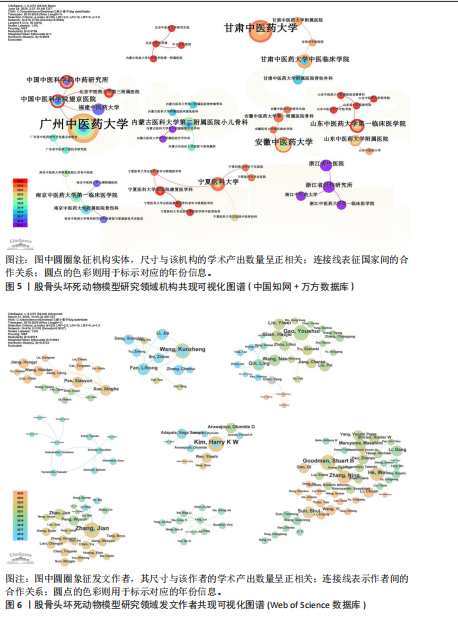
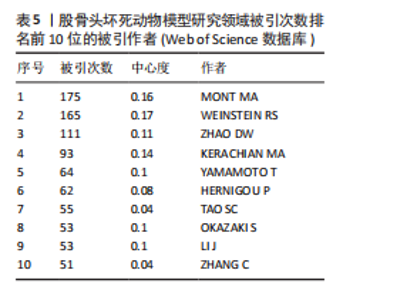
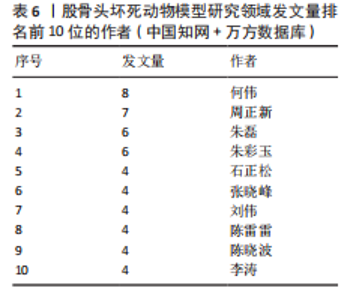
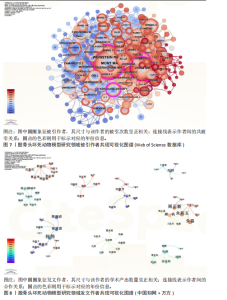
Zhang,Ning以0.02的中心度成为全网络拓扑结构中最关键的桥接节点,凸显其跨团队知识整合与协同创新的主导作用。此外,文献被引用次数最多的作者是MONT MA(175次),其次则是WEINSTEIN RS(165次)和ZHAO DW(111次),这说明他们的研究在领域内具有重要影响力,被多数学者所认可,见表5及图7。 而在中文文献统计中,如表6所示,股骨头坏死动物模型研究领域中学术产出量位居前三的学者依次为何伟(8篇)、周正新(7篇)及朱磊(6篇),这表明其在领域内科研参与很活跃。而基于合作作者共现网络分析(图8),研究领域中有9个具有独立的协作集群,其中规模最大的团队以何伟为枢纽。进一步统计显示,该核心团队内文献贡献量前三的成员为何伟(8篇)、陈雷雷(4篇)和陈晓波(4篇)。"
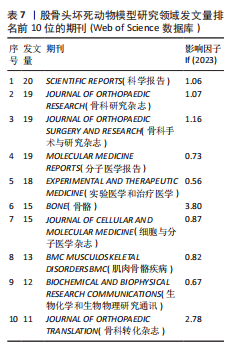
2.5 发文期刊和被引期刊分析 通过Web of Science网站的文献计量分析工具,对被引英文文献集合进行期刊发文量的量化统计,此文引"
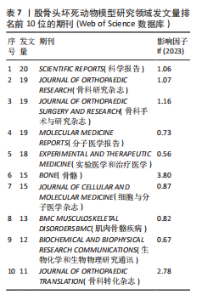
用的556篇文献共发布于395个期刊上,筛选出发文量位列前10的高频期刊,见表7,其中发文量最高的是期刊SCIENTIFIC REPORTS,共发文20篇。"
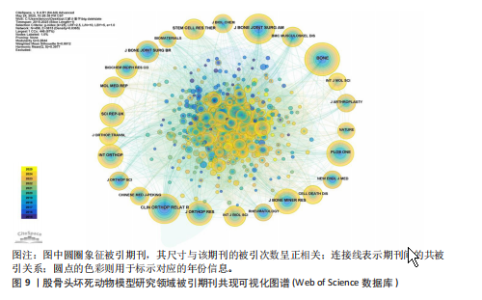
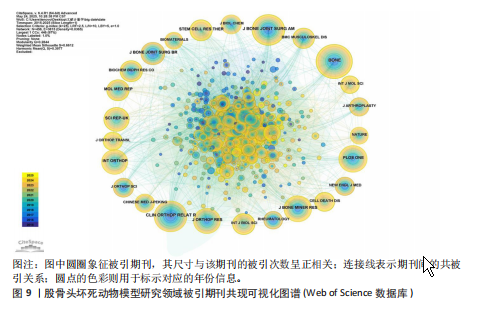
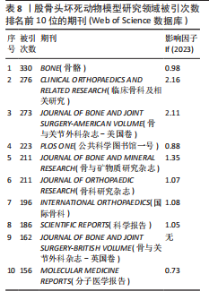
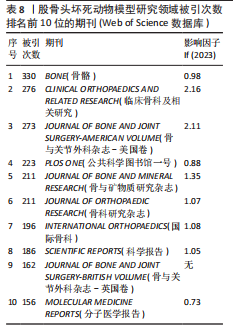
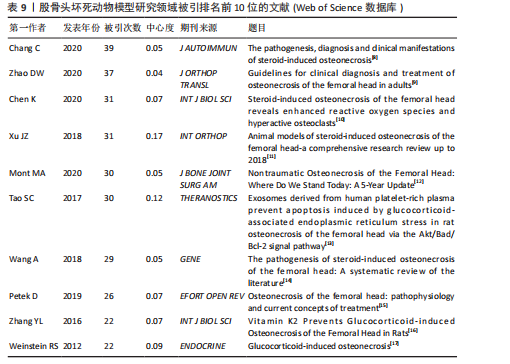
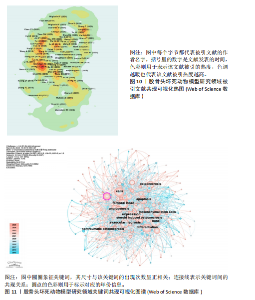
通过CiteSpace来构建被引期刊共现网络,将节点类型设定为“被引期刊”(Cited Journal),最终生成被引期刊共现图谱(图9)。而被引次数TOP10期刊统计显示:除《JOURNAL OF BONE AND JOINT SURGERY-BRITISH VOLUME》暂未列入JCR收录名录外,其余期刊均具有现行影响因子指标,其中《BONE》以330次共被引位列首位,彰显其在该领域的核心知识传播地位;而《CLINICAL ORTHOPAEDICS AND RELATED RESEARCH》虽共被引频次未居榜首,却以2.16的影响因子成为图谱中学术影响力最强的医学综合期刊,其跨学科辐射力在医学研究领域具有标杆意义,见表8。 2.6 被引文献分析 运用CiteSpace对引用的英文文献进行被共引分析[8],股骨头坏死动物模型研究领域被引排名前10位的文献中,有4篇探讨类固醇与股骨头坏死的关系、3篇探讨糖皮质激素与股骨头坏死的关系、3篇为股骨头坏死治疗的综述和指南(表9,图10)。"
"
"
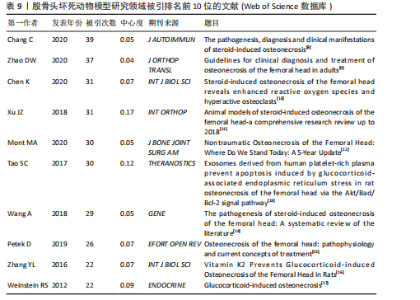
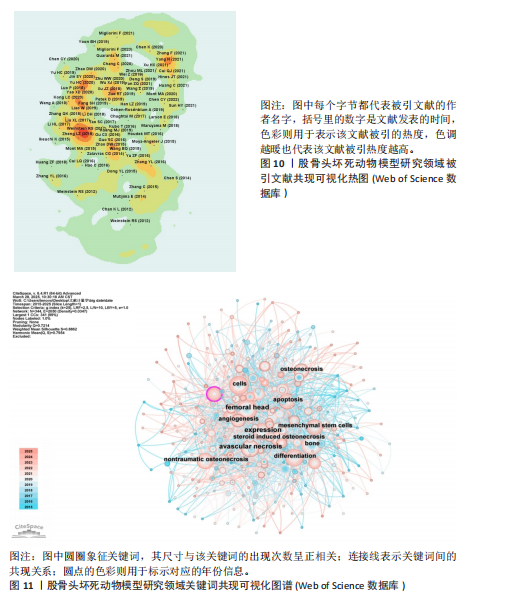
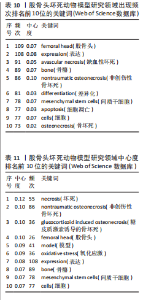
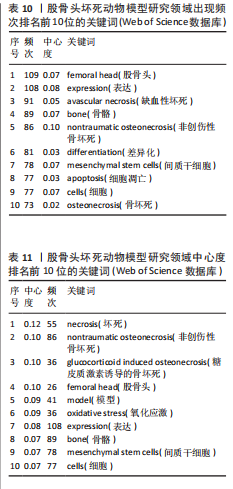
其中被引用最多的文献是Chang C于2020年发表的《The pathogenesis, diagnosis and clinical manifestations of steroid-induced osteonecrosis》,共被引用39次。该文章系统阐明了类固醇相关的骨坏死的病因病机、主要症状、早期诊断和治疗方法。中心度最高的被引文献则是CHEN等[18]于2014年发表在《International journal of molecular medicine》上的《Administration of erythropoietin exerts protective effects against glucocorticoid-induced osteonecrosis of the femoral head in rats》,其中心度高达0.24。该研究证明了促红细胞生成素对糖皮质激素诱导的大鼠股骨头骨坏死具有显著保护作用,其保护机制主要通过抑制骨细胞凋亡和增加骨坏死区血管内皮生长因子的表达来实现。 2.7 关键词分析 2.7.1 关键词共现 将节点设置为关键词 (Keywords),运行CiteSpace,得到股骨头坏死动物模型研究领域的英文文献关键词共现图谱,见图11。关键词是论文的知识核心单元,通过文献关键词共现网络可视化分析,可精准追踪动物模型在股骨头坏死研究中的热点迁移轨迹。此文纳入的英文文献中出现频次最高的关键词为femoral head(股骨头),共出现109次;其次是expression(表达)和avascular necrosis(缺血性坏死),分别出现了108次和92次。中心度最高的关键词是necrosis(坏死),中心度为0.12;其次是nontraumatic osteonecrosis(非创伤性骨坏死)、glucocorticoid induced osteonecrosis(糖皮质激素诱导的骨坏死)和femoral head(股骨头),中心度都是0.1。通过统计关键词的出现频率和中心度数值,并剔除与主题高度关联和表达模糊的关键词,最终确定股骨头坏死动物模型研究领域内英文文献的关键核心词为:avascular necrosis(缺血性坏死)、mesenchymal stem cells(间充质干细胞)和cells(细胞)。出现频次和中心度排名前10的关键词如表10,11所示。"
"
"
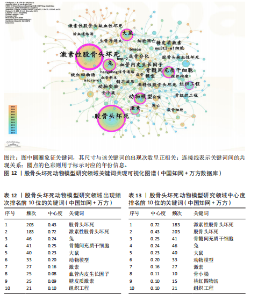
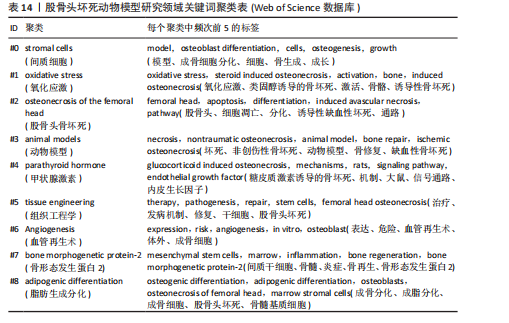
使用同样的方法运行CiteSpace,可得到股骨头坏死动物模型研究领域的中文文献关键词共现图谱,见图12。纳入的中文文献中出现频次最高的关键词为股骨头坏死,共出现203次;其次是激素性股骨头坏死和兔,分别出现了183次和46次。中心度最高的关键词是激素性股骨头坏死,中心度为0.72;其次是股骨头坏死和骨髓间充质干细胞,中心度分别为0.43和0.25。最终可以确定股骨头坏死动物模型研究领域内中文文献的关键核心词为股骨头坏死和激素性股骨头坏死。出现频次和中心度排名前10的关键词如表12,13所示。 2.7.2 关键词聚类分析 使用Citespace可以对英文文献关键词进行聚类分析,并构建知识图谱。在生成的聚类结构中,聚类序号与规模呈负相关:即序号越小的聚类(如#0、#1),其包含的关键词数量越多,表征该领域的研究体量越大。聚类质量的评价采用模块值(Modularity Q)和轮廓值(Silhouette S)双重指标:当Q值> 0.3时,表明网络模块化结构具有统计显著性;S值> 0.5说明聚类内部具有合理同质性,若S值> 0.7则表明该聚类不仅具有高度内聚性,同时与其他类别存在显著区分度,可视为高效且具有强解释力的知识单元划分。此次研究基于关键词共现聚类,得出聚类模块值(Modularity Q)=0.333 7,平均轮廓值(Silhouette S)=0.650 1,说明此次研究聚类结构显著,聚类具有合理同质性。可视化图谱呈现9个主要聚类,详见图"
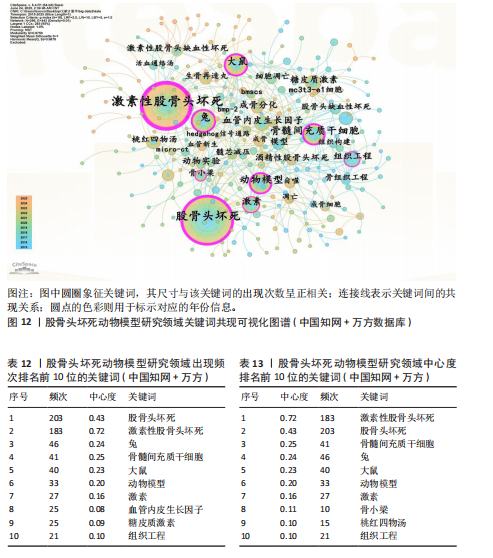
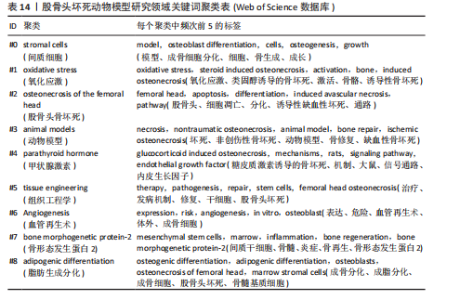
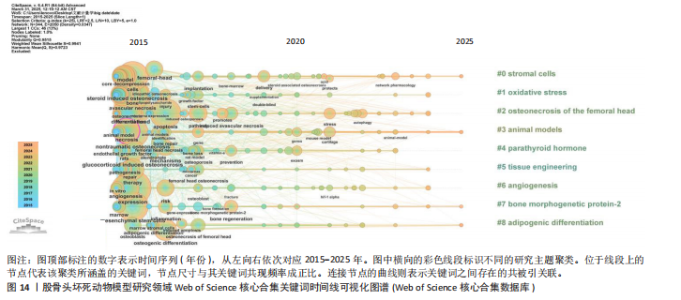
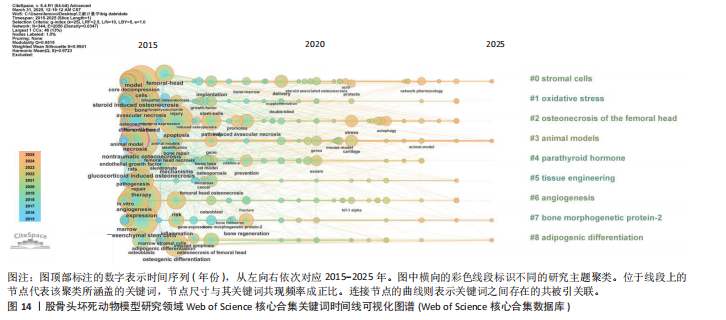
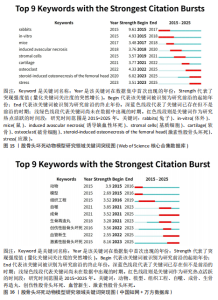
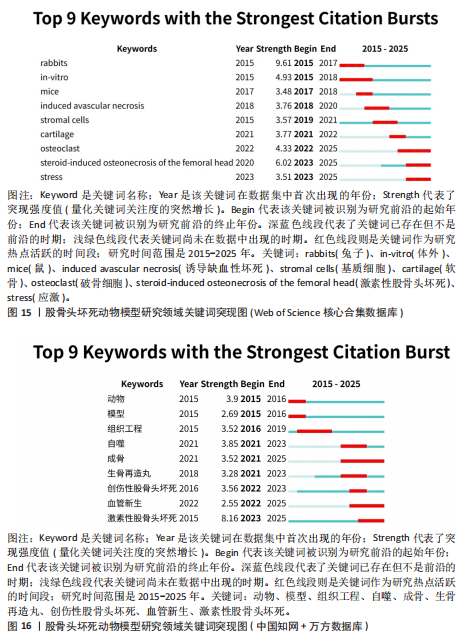
13。如图所示,聚类#0反映了间质细胞在股骨头坏死动物模型研究领域的研究;聚类#1反映了氧化应激在股骨头坏死动物模型研究领域的研究;聚类#2反映了股骨头坏死相关研究领域的研究;聚类#3反映了动物模型在股骨头坏死研究领域的研究;聚类#4反映了甲状腺激素在股骨头坏死动物模型研究领域的相关研究;聚类#5反映了组织工程学在股骨头坏死动物模型研究领域的相关研究;聚类#6反映了血管再生术在股骨头坏死动物模型研究领域的相关研究;聚类#7反映了骨形态发生蛋白2在股骨头坏死动物模型研究领域的相关研究;聚类#8反映了脂肪生成分化在股骨头坏死动物模型研究领域的相关研究,详见表14。 2.7.3 关键词时间线分析 采用Citespace软件对股骨头坏死动物模型研究领域的文献关键词进行时间线聚类分析。通过生成的时间线图谱,可以直观展示不同研究主题的时间跨度和演变趋势:例如,某些聚类可能从2015年持续至今,表明该方向具有长期研究热度;另一些聚类仅出现在近年,则提示新兴研究方向。这种可视化方法能帮助快速识别领域内关键主题的起始、延续或消退阶段,见图14。如图可见,聚类#0 stromal cells、聚类#3 animal models、聚类#7 bone morphogenetic protein-2、聚类#8 adipogenic differentiation这4个聚类的研究时间跨度从2015年延续至2025年,持续了整个被统计的时间段,且目前仍然是科研前沿。而如图也能发现随着时间推移,各聚类的关键词频率也越来越少,其中聚类#2 osteonecrosis of the femoral head和聚类#3 animal models在2020年后仍有复苏的迹象,是各个聚类中较为有活力的聚类。 2.7.4 关键词突现分析 关键词突现指特定关键词在文献中短时间内出现频次激增的现象。这种变化直接反映该时段内学者对某一研究方向的集中关注,可作为识别领域热点与新兴趋势的标志性信号。股骨头坏死动物模型研究领域英文文献的突现分析如图15所示, rabbits (兔)是历史突现强度最高的关键词,而关键词突现大致分为3个阶段:第一阶段是2015-2017年,这一阶段的关键词是rabbits(兔子)、in-vitro(体外)、mice(鼠);第二阶段是2018-2021年,这一阶段的关键词是induced avascular necrosis(诱导缺血性坏死)、stromal cells(基质细胞)、cartilage(软骨);第三阶段是2022-2025年,这阶段的关键词是osteoclast(破骨细胞)、steroid-induced osteonecrosis of the femoral head(激素性股骨头坏死)、stress(应激)。 股骨头坏死动物模型研究领域中文文献的突现分析如图16所示,激素性股骨头坏死是历史突现强度最高的关键词,而关键词突现同样可以分为3个阶段:第一阶段是2015-2017年,这一阶段的关键词是动物、模型、组织工程;第二阶段是2018-2021年,这阶段的关键词是自噬、成骨、生骨再造丸;第三阶段是2022-2025年,这一阶段的关键词是创伤性股骨头坏死、血管新生、激素性股骨头坏死。"
"
"
| [1] GEORGE G, LANE JM. Osteonecrosis of the Femoral Head. J Am Acad Orthop Surg Glob Res Rev. 2022;6(5):e21.00176. [2] LI Z, SHAO W, LV X, et al. Advances in experimental models of osteonecrosis of the femoral head. J Orthop Translat. 2023;39:88-99. [3] MCGREEVY JW, HAKIM CH, MCINTOSH MA, et al. Animal models of Duchenne muscular dystrophy: from basic mechanisms to gene therapy. Dis Model Mech. 2015;8(3): 195-213. [4] DU Q, ZHAO R, WAN Q, et al. Protocol for conducting bibliometric analysis in biomedicine and related research using CiteSpace and VOSviewer software. STAR Protoc. 2024;5(3): 103269. [5] MONDAL H, DEEPAK KK, GUPTA M, et al. The h-Index: Understanding its predictors, significance, and criticism. J Family Med Prim Care. 2023;12(11):2531-2537. [6] 魏锦强,曾宪中,曹学伟,等.基于CiteSpace的中医外治法治疗膝骨关节炎可视化分析[J].中医药导报,2021,27(8):154-159+184. [7] HASSAN W, DUARTE AE. Bibliometric analysis: A few suggestions. Curr Probl Cardiol. 2024; 49(8):102640. [8] CHANG C, GREENSPAN A, GERSHWIN ME. The pathogenesis, diagnosis and clinical manifestations of steroid-induced osteonecrosis. J Autoimmun. 2020;110: 102460. [9] ZHAO D, ZHANG F, WANG B, et al. Guidelines for clinical diagnosis and treatment of osteonecrosis of the femoral head in adults (2019 version). J Orthop Translat. 2020;21: 100-110. [10] CHEN K, LIU Y, HE J, et al. Steroid-induced osteonecrosis of the femoral head reveals enhanced reactive oxygen species and hyperactive osteoclasts. Int J Biol Sci. 2020; 16(11):1888-1900. [11] XU J, GONG H, LU S, et al. Animal models of steroid-induced osteonecrosis of the femoral head-a comprehensive research review up to 2018. Int Orthop. 2018;42(7):1729-1737. [12] MONT MA, SALEM HS, PIUZZI NS, et al. Nontraumatic Osteonecrosis of the Femoral Head: Where Do We Stand Today? A 5-Year Update. J Bone Joint Surg Am. 2020; 102(12):1084-1099. [13] TAO SC, YUAN T, RUI BY, et al. Exosomes derived from human platelet-rich plasma prevent apoptosis induced by glucocorticoid-associated endoplasmic reticulum stress in rat osteonecrosis of the femoral head via the Akt/Bad/Bcl-2 signal pathway. Theranostics. 2017;7(3):733-750. [14] WANG A, REN M, WANG J. The pathogenesis of steroid-induced osteonecrosis of the femoral head: A systematic review of the literature. Gene. 2018;671:103-109. [15] PETEK D, HANNOUCHE D, SUVA D. Osteonecrosis of the femoral head: pathophysiology and current concepts of treatment. EFORT Open Rev. 2019;4(3):85-97. [16] ZHANG YL, YIN JH, DING H, et al. Vitamin K2 Prevents Glucocorticoid-induced Osteonecrosis of the Femoral Head in Rats. Int J Biol Sci. 2016;12(4):347-358. [17] WEINSTEIN RS. Glucocorticoid-induced osteonecrosis. Endocrine. 2012:183-190. [18] CHEN S, LI J, PENG H, et al. Administration of erythropoietin exerts protective effects against glucocorticoid-induced osteonecrosis of the femoral head in rats. Int J Mol Med. 2014;33(4):840-848. [19] TSUBOSAKA M, MARUYAMA M, LUI E, et al. The efficiency of genetically modified mesenchymal stromal cells combined with a functionally graded scaffold for bone regeneration in corticosteroid-induced osteonecrosis of the femoral head in rabbits. J Biomed Mater Res A. 2023;111(8):1120-1134. [20] ZHANG N, CHOW SK, LEUNG KS, et al. Ultrasound as a stimulus for musculoskeletal disorders. J Orthop Translat. 2017;9:52-59. [21] KIM HK. Legg-Calvé-Perthes disease. J Am Acad Orthop Surg. 2010;18(11):676-686. [22] CHONG DY, SCHRADER T, LAINE JC, et al. Reliability and Validity of Visual Estimation of Femoral Head Hypoperfusion on Perfusion MRI in Legg-Calve-Perthes Disease. J Pediatr Orthop. 2021;41(9):e780-e786. [23] ZHU D, YU H, LIU P, et al. Calycosin modulates inflammation via suppressing TLR4/NF-κB pathway and promotes bone formation to ameliorate glucocorticoid-induced osteonecrosis of the femoral head in rat. Phytother Res. 2021;35(5):2824-2835. [24] YU H, ZHU D, LIU P, et al. Osthole stimulates bone formation, drives vascularization and retards adipogenesis to alleviate alcohol-induced osteonecrosis of the femoral head. J Cell Mol Med. 2020;24(8):4439-4451. [25] DUAN X, XING F, ZHANG J, et al. Bioinformatic analysis of related immune cell infiltration and key genes in the progression of osteonecrosis of the femoral head. Front Immunol. 2024;14: 1340446. [26] LIU G, CAO R, LIU Q, et al. M2 macrophages-derived exosomes for osteonecrosis of femoral head treatment: modulating neutrophil extracellular traps formation and endothelial phenotype transition. Bone Res. 2025;13(1):42. [27] MA HZ, ZHOU DS, LI D, et al. A histomorphometric study of necrotic femoral head in rabbits treated with extracorporeal shock waves. J Phys Ther Sci. 2017;29(1):24-28. [28] TUDISCO C, BOTTI F, BISICCHIA S, et al. Ischemic necrosis of the femoral head: an experimental rabbit model. J Orthop Res. 2015;33(4):535-541. [29] FU D, QIN K, YANG S, et al. Proper mechanical stress promotes femoral head recovery from steroid-induced osteonecrosis in rats through the OPG/RANK/RANKL system. BMC Musculoskelet Disord. 2020;21(1):281. [30] WANG QR, YANG ZY, ZHANG WL, et al. Abnormal hyperplasia of chondrocytes in a rat model of glucocorticoid-induced osteonecrosis of the femoral head. Eur Rev Med Pharmacol Sci. 2022;26(18): 6536-6549. [31] 陈卫衡,何伟,童培建,等.股骨头坏死中医辨证标准(2019年版)[J].中医正骨,2019, 31(6):1-2. [32] 魏秋实.股骨头坏死中医证候诊断的规范化研究[R].广东省,广州中医药大学第一附属医院,2021-06-21. [33] 张宗逸,吴港归,朱守旭,等.骨痹通消颗粒调控TGF-β1/Smads信号通路干预激素性股骨头坏死大鼠模型[J].安徽中医药大学学报,2025,44(2):88-93. [34] 方祥,周正新,朱磊,等.基于RANKL/RANK/OPG信号轴探讨骨痹通消颗粒对激素性股骨头坏死模型小鼠的治疗作用[J].中国现代医学杂志,2024,34(7):27-33. [35] 周正新,朱磊,李文华,等.中药骨痹通消颗粒通过调控Wnt/β-catenin通路治疗激素性股骨头坏死的实验研究[J].中华中医药学刊,2023,41(1):21-24. [36] 陈子锴,江蓉星,方锐洁,等.活血通络汤对激素性股骨头坏死造模兔PDGF、BMP-2及Notch3的影响[J].辽宁中医杂志,2019, 46(1):186-190+225. [37] 刘伟,江蓉星,陈子锴,等.活血通络汤预防激素性股骨头缺血性坏死兔造模过程中对AKP、Jagged1表达的影响[J].中华中医药杂志,2017,32(9):3989-3992. [38] 王敏,江蓉星,李涛,等.活血通络汤对SANFH兔造模过程中Notch2/DLL1/Hes1表达的影响[J].中国中西医结合杂志,2018, 38(11):1384-1388. [39] WANG QR, YANG ZY, ZHANG WL, et al. Abnormal hyperplasia of chondrocytes in a rat model of glucocorticoid-induced osteonecrosis of the femoral head. Eur Rev Med Pharmacol Sci. 2022;26(18):6536-6549. [40] PENG P, NIE Z, SUN F, et al. Glucocorticoids induce femoral head necrosis in rats through the ROS/JNK/c-Jun pathway. FEBS Open Bio. 2021;11(1):312-321. [41] FAN Y, CHEN Z, WANG H, et al. Isovitexin targets SIRT3 to prevent steroid-induced osteonecrosis of the femoral head by modulating mitophagy-mediated ferroptosis. Bone Res. 2025;13(1):18. [42] SHANG P, LIU Y, REN J, et al. Overexpression of miR-532-5p restrains oxidative stress response of chondrocytes in nontraumatic osteonecrosis of the femoral head by inhibiting ABL1. Open Med (Wars). 2024;19(1):20240943. [43] ZHU Z, ZHONG Y, HE R, et al. Mechanistic Insights into Salvigenin for Glucocorticoid-Induced Femoral Head Osteonecrosis: A Network Pharmacology and Experimental Study. Biomedicines. 2025;13(3):614. [44] LUO D, LIU H, LIANG XZ, et al. Analysis of the Potential Angiogenic Mechanisms of BuShenHuoXue Decoction against Osteonecrosis of the Femoral Head Based on Network Pharmacology and Experimental Validation. Orthop Surg. 2024;16(3):700-717. [45] LOU P, DENG X, HOU D. The effects of nano-hydroxyapatite/polyamide 66 scaffold on dog femoral head osteonecrosis model: a preclinical study. Biomed Mater. 2023;18(2). doi: 10.1088/1748-605X/acb7be. [46] ZHANG F, PENG WX, WANG L, et al. Role of FGF-2 Transfected Bone Marrow Mesenchymal Stem Cells in Engineered Bone Tissue for Repair of Avascular Necrosis of Femoral Head in Rabbits. Cell Physiol Biochem. 2018;48(2): 773-784. [47] PACKIALAKSHMI B, LIYANAGE R, LAY JO JR, et al. Proteomic Changes in the Plasma of Broiler Chickens with Femoral Head Necrosis. Biomark Insights. 2016;11:55-62. |
| [1] | Xu Canli, He Wenxing, Wang Yuping, Ba Yinying, Chi Li, Wang Wenjuan, Wang Jiajia. Research context and trend of TBK1 in autoimmunity, signaling pathways, gene expression, tumor prevention and treatment [J]. Chinese Journal of Tissue Engineering Research, 2026, 30(在线): 1-11. |
| [2] | Zhu Xiaolong, Zhang Wei, Yang Yang. Visualization analysis of research hotspots and cutting-edge information in the field of intervertebral disc regeneration and repair [J]. Chinese Journal of Tissue Engineering Research, 2026, 30(9): 2391-2402. |
| [3] | Wen Fayan, Li Yan, Qiang Tianming, Yang Chen, Shen Linming, Li Yadong, Liu Yongming. Unilateral biportal endoscopic technology for treatment of lumbar degenerative diseases: global research status and changing trends [J]. Chinese Journal of Tissue Engineering Research, 2026, 30(9): 2380-2390. |
| [4] | Zhang Haiwen, Zhang Xian, Xu Taichuan, Li Chao. Bibliometric and visual analysis of the research status and trends of senescence in osteoporosis [J]. Chinese Journal of Tissue Engineering Research, 2026, 30(6): 1580-1591. |
| [5] | Huang Jie, Zeng Hao, Wang Wenchi, Lyu Zhucheng, Cui Wei. Visualization analysis of literature on the effect of lipid metabolism on osteoporosis [J]. Chinese Journal of Tissue Engineering Research, 2026, 30(6): 1558-1568. |
| [6] | Yang Zeyu, Zhi Liang, Wang Jia, Zhang Jingyi, Zhang Qingfang, Wang Yulong, Long Jianjun. A visualized analysis of research hotspots in high-frequency repetitive transcranial magnetic stimulation from the macroscopic perspective [J]. Chinese Journal of Tissue Engineering Research, 2026, 30(5): 1320-1330. |
| [7] | He Renda, Ma Wei, Sun Yongsi, Mo Xueni. Future medical research on brain organoids: interdisciplinary training, bioengineering technologies, and optimized model maturity [J]. Chinese Journal of Tissue Engineering Research, 2026, 30(34): 9088-9094. |
| [8] | Bu Fanchen, Hua Zhen, , Li Xiaolong, Lyu Jinye, Man Hao, Wang Jianwei, . Triangular fibrocartilage complex injuries: a visualization analysis of treatment hotspots and frontiers [J]. Chinese Journal of Tissue Engineering Research, 2026, 30(34): 9095-9102. |
| [9] | Liu Yi, Fu Yuping, Cheng Qiannan. Global analysis and hotspot exploration of acne scarring: a bibliometric visualization approach [J]. Chinese Journal of Tissue Engineering Research, 2026, 30(34): 9103-9112. |
| [10] | Peng Hao, Chen Qigang, Shen Zhen. A visual analysis of research hotspots of H-type vessels in various bone diseases [J]. Chinese Journal of Tissue Engineering Research, 2026, 30(3): 760-769. |
| [11] | Zhang Anqi, Hua Haotian, Cai Tianyuan, Wang Zicheng, Meng Zhuo, Zhan Xiaoqian, Chen Guoqian . Pain after total knee arthroplasty: current status and trend analysis [J]. Chinese Journal of Tissue Engineering Research, 2026, 30(3): 795-804. |
| [12] | Wang Degang, Mei Junhua, Wang Junli, Zheng Li, Chen Guohua. Bibliometric and visualization analysis of the mechanism of osteogenic factors and neurotransmitters in the bone-brain axis [J]. Chinese Journal of Tissue Engineering Research, 2026, 30(29): 7724-7731. |
| [13] | Sun Kui, Huang Hailun, Wei Yatao, Liu Yongai, Gao Heng. Bibliometric analysis of exercise therapy interventions for adolescent idiopathic scoliosis [J]. Chinese Journal of Tissue Engineering Research, 2026, 30(29): 7755-7763. |
| [14] | Wang Lei, Hu Baoyang, Fang Fang. Bibliometric analysis of research hotspots on mitochondria and spinal cord injury treatment [J]. Chinese Journal of Tissue Engineering Research, 2026, 30(29): 7764-7772. |
| [15] | Liu Yan, Zuo Qingchun, Li Weiying, Wu Xubo. Research hotspots and trends of optogenetics in behavioral neuroscience [J]. Chinese Journal of Tissue Engineering Research, 2026, 30(28): 7396-7403. |
| Viewed | ||||||
|
Full text |
|
|||||
|
Abstract |
|
|||||