Chinese Journal of Tissue Engineering Research ›› 2026, Vol. 30 ›› Issue (29): 7539-7547.doi: 10.12307/2026.379
Previous Articles Next Articles
A customizable vascular network biomimetic design for nutrient supply in large-scale engineering tissues
He Chaomiao1, 2, Guan Yuheng3, Zheng Xiongfei1, Wang Heran1
- 1State Key Laboratory of Robotics, Shenyang Institute of Automation, Chinese Academy of Sciences, Shenyang 110016, Liaoning Province, China; 2University of Chinese Academy of Sciences, Beijing 100049, China; 3Harbin Institute of Technology, Harbin 150006, Heilongjiang Province, China
-
Received:2025-07-04Revised:2025-10-10Online:2026-10-18Published:2026-03-03 -
Contact:Wang Heran, PhD, Associate researcher, State Key Laboratory of Robotics, Shenyang Institute of Automation, Chinese Academy of Sciences, Shenyang 110016, Liaoning Province, China -
About author:He Chaomiao, MS candidate, State Key Laboratory of Robotics, Shenyang Institute of Automation, Chinese Academy of Sciences, Shenyang 110016, Liaoning Province, China; University of Chinese Academy of Sciences, Beijing 100049, China -
Supported by:Young Scientist Basic Research Project of Chinese Academy of Sciences, No. YSBR-041

CLC Number:
Cite this article
He Chaomiao, Guan Yuheng, Zheng Xiongfei, Wang Heran. A customizable vascular network biomimetic design for nutrient supply in large-scale engineering tissues[J]. Chinese Journal of Tissue Engineering Research, 2026, 30(29): 7539-7547.
share this article
Add to citation manager EndNote|Reference Manager|ProCite|BibTeX|RefWorks
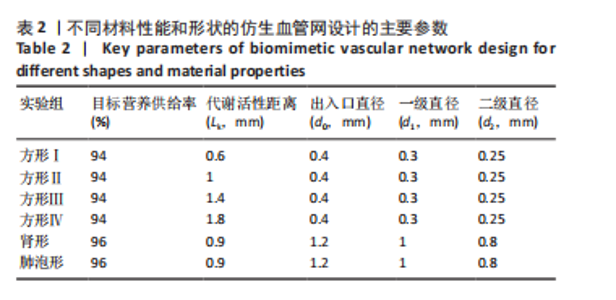
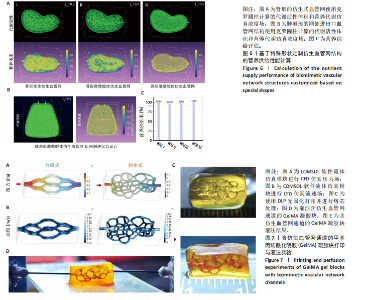
2.1 基于材料性能定制仿生血管网结构结果 为10 mm×5 mm×5 mm长方体形状工程组织模型定制不同代谢活性距离的仿生血管网,设置入口位置为Pin(0,2.5,2.5),出口位置为Pou(10,2.5,2.5),其余设计参数如表2所示。 仿生生成平均在8次内生成成功,生成的血管网结构均具有一定随机性。使用克罗圆柱计算的代谢活性体积和营养代谢仿真浓度场,如图4A所示。图4B表明营养供给率均高于设定值94%,图4C,D表明代谢活性距离与算法生成血管网的面体"
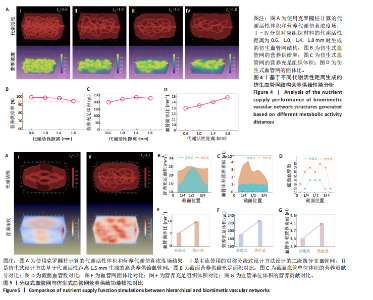
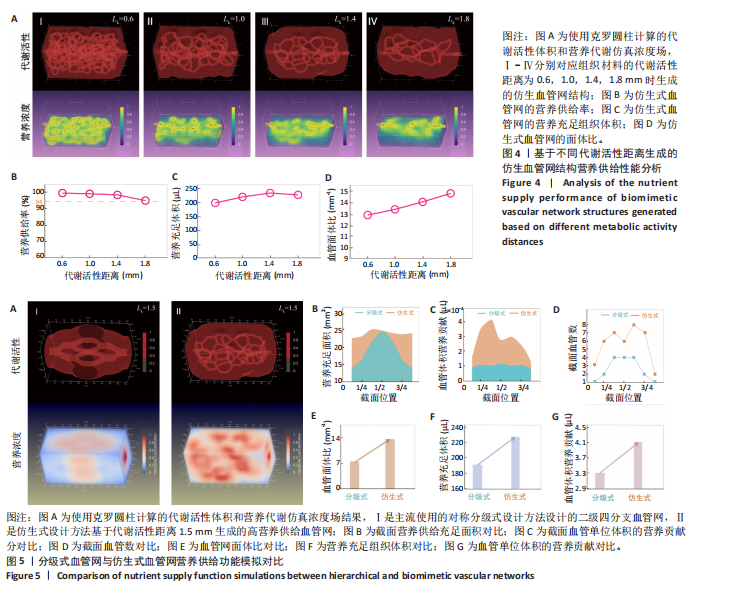
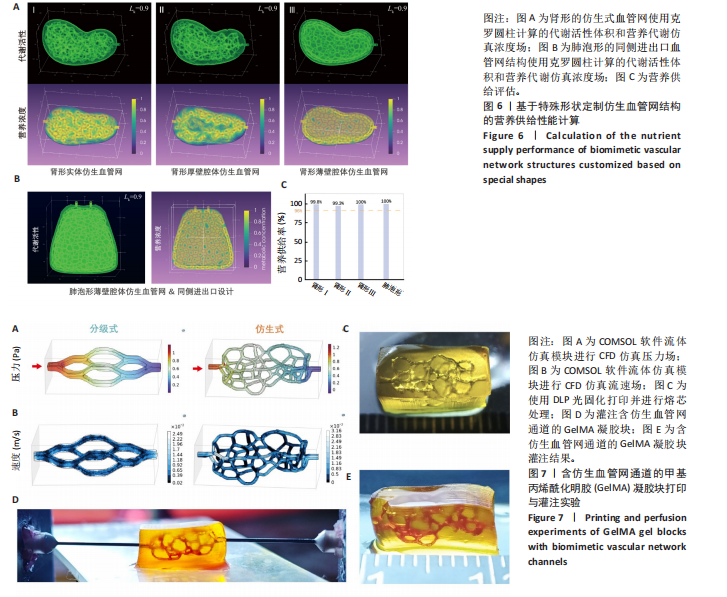
比和营养充足体积呈现一定正相关性。组织外形完整度> 0.9,组织内部扩散死区为0。 2.2 营养供给功能对比实验结果 基于10 mm×5 mm× 5 mm方形结构,对比了仿生式血管网结构与分级式血管网结构。入口位置为Pin (0,2.5,2.5),出口位置为Pou(10,2.5,2.5),两种血管网的其余设计参数如表1所示。 两种血管网模型具有相同的血管体积,其代谢活性体积和营养代谢仿真浓度场如图5A所示,分级式血管网的营养供给率为76.97%,仿生式血管网的营养供给率为96.79%,提高了25.74%;图5B-D表明仿生式血管网具有更高的截面营养充足面积,在两端的营养供给得到显著提高,同时具有更高血管体积营养贡献、更高的截面血管数。图5E-G表明整体上仿生式血管网面体比提高75.93%,营养充足体积、血管单位体积的营养贡献均提高25.53%。 2.3 基于特殊形状定制仿生血管网结构 基于50 mm× 30 mm×28 mm肾脏形结构,其入口和出口分别设置在左右两端,其余设计参数如表2所示,其代谢活性和营养浓度仿真如图6AⅠ所示。 通过三维形态学腐蚀指定的厚度(10,20层体素)得到一个缩小的肾形,对体素矩阵进行布尔减法运算得到肾形厚壁腔体结构和肾形薄壁腔体结构,其设计参数如表2所示,其代谢活性和营养浓度仿真如图6BⅡ-Ⅲ所示。 使用同样的方法建一个50 mm×30 mm×50 mm的肺泡形薄壁腔体结构,入口和出口管道均设置在上方,其余参数如表2所示。使用MATLAB软件将STL模型转为三维体素矩阵,通过三维形态学腐蚀和矩阵减法得到肺泡形空腔模型,其代谢活性和营养浓度仿真如图6B所示。 基于特殊形状定制血管化组织模型,生成的血管网结构均具有一定随机性,营养供给率均高于设定值96%,组织外形完整度> 0.9,组织内部扩散死区为0。 2.4 打印与灌流实验 用COMSOL软件对血管网结构进行计算流体动力学(CFD)仿真,设置进出口压力如图7A所示。图7B表明分级式模型的流速和仿生式模型均存在流速低于0.5×10⁻² m/s的分支。 对仿生血管网模型进出口进行后处理,使用Blender软件调整两端的进出口直径和形状使其与灌注器适配,并对部分分支进行了微调。使用GelMA通过DLP光固化打印含仿生式管道系统的水凝胶模型,管道实体部分为非光固化区,管道周围是光固化区[24]。 打印完成后先使用37 ℃温水浴加热,再使用抽吸泵去除熔芯,从而在模型内部形成可灌注的管道系统,如图7C所示。使用红色荧光剂灌注,如图7D所示,观察到管道系统成功灌通,灌注后的含仿生血管网通道的GelMA凝胶块如图7E所示。"
"
| [1] WANG H, LIU X, GU Q, et al. Vascularized organ bioprinting: From strategy to paradigm. Cell Proliferation. 2023;56(5):e13453. [2] CHAE S, HA DH, LEE H. 3D bioprinting strategy for engineering vascularized tissue models. IJB. 2023;9:748. [3] RYMA M, GENÇ H, NADERNEZHAD A, et al. A Print‐and‐Fuse Strategy for Sacrificial Filaments Enables Biomimetically Structured Perfusable Microvascular Networks with Functional Endothelium Inside 3D Hydrogels. Advanced Materials. 2022;34(28):2200653. [4] 张一帆, 徐铭恩, 王玲, 等. 利用同轴3D打印技术构建促内皮细胞生长类血管组织工程支架[J]. 中国生物医学工程学报,2020,39(2):206-214. [5] KINSTLINGER IS, SAXTON SH, CALDERON GA, et al. Generation of model tissues with dendritic vascular networks via sacrificial laser-sintered carbohydrate templates. Nat Biomed Eng. 2020;4(9):916-932. [6] MU X, GERHARD-HERMAN MD, ZHANG YS. Building Blood Vessel Chips with Enhanced Physiological Relevance. Adv Materials Technologies. 2023;8(7): 2201778. [7] KHAMASSI J, BIERWISCH C, PELZ P. Geometry optimization of branchings in vascular networks. Phys Rev E. 2016;93(6):062408. [8] TALOU GDM, SAFAEI S, HUNTER PJ, et al. Adaptive constrained constructive optimisation for complex vascularisation processes. Sci Rep. 2021;11(1):6180. [9] LARSEN EH, HOFFMANN E, HEDRICK MS, et al. August Krogh’s contribution to the rise of physiology during the first half the 20th century. Comp Biochem Physiol A Mol Integr Physiol. 2021;256:110931. [10] AHRENS L, TANAKA S, VONWIL D, et al. Generation of 3D Soluble Signal Gradients in Cell‐Laden Hydrogels Using Passive Diffusion. Adv Biosys. 2019; 3(1):1800237. [11] KROLL KT, HOMAN KA, UZEL SGM, et al. A perfusable, vascularized kidney organoid-on-chip model. Biofabrication. 2024;16(4):045003. [12] ROHAN E, LUKEŠ V, JONÁŠOVÁ A. Modeling of the contrast-enhanced perfusion test in liver based on the multi-compartment flow in porous media. J Math Biol. 2018;77(2):421-454. [13] LEE A, HUDSON AR, SHIWARSKI DJ, et al. 3D bioprinting of collagen to rebuild components of the human heart. Science. 2019;365(6452):482-487. [14] NOOR N, SHAPIRA A, EDRI R, et al. 3D Printing of Personalized Thick and Perfusable Cardiac Patches and Hearts. Adv Sci (Weinh). 2019;6(11):1900344. [15] GRIGORYAN B, PAULSEN SJ, CORBETT DC, et al. Multivascular networks and functional intravascular topologies within biocompatible hydrogels. Science. 2019;364(6439):458-464. [16] SKYLAR-SCOTT MA, MUELLER J, VISSER CW, et al. Voxelated soft matter via multimaterial multinozzle 3D printing. Nature. 2019;575(7782):330-335. [17] LU Y, HU D, YING W. A fast numerical method for oxygen supply in tissue with complex blood vessel network. PLoS One. 2021;16(2):e0247641. [18] KÖPPL T, VIDOTTO E, WOHLMUTH B. A 3D‐1D coupled blood flow and oxygen transport model to generate microvascular networks. Int J Numer Method Biomed Eng. 2020;36(10):e3386. [19] CHEN S, XIE C, LONG X, et al. Development of Electrospinning Setup for Vascular Tissue-Engineering Application with Thick-Hierarchical Fiber Alignment. Tissue Eng Regen Med. 2025;22(2):195-210. [20] WANG Y, LIU M, ZHANG W, et al. Mechanical strategies to promote vascularization for tissue engineering and regenerative medicine. Burns & Trauma. 2024;12: tkae039. [21] LEVATO R, DUDARYEVA O, GARCIAMENDEZ-MIJARES CE, et al. Light-based vat-polymerization bioprinting. Nat Rev Methods Primers. 2023;3(1):47. [22] YU K, ZHANG X, SUN Y, et al. Printability during projection-based 3D bioprinting. Bioact Mater. 2021;11:254-267. [23] BOCK N, DELBIANCO M, EDER M, et al. A materials science approach to extracellular matrices. Prog Mater Sci. 2025;149:101391. [24] LI YANG, MAO QIJIANG, YIN JUN, et al. Theoretical prediction and experimental validation of the digital light processing (DLP) working curve for photocurable materials. Additive Manufacturing. 2021;37:101716. [25] 张一帆, 张佳颖, 徐铭恩, 等. 基于同轴细胞打印双网络生物墨水优化及类血管支架的打印[J]. 中国组织工程研究,2020,24(22):3553-3558. [26] PG SULAIMAN DNH, SUHAIMI H, SHAMSUDDIN N. Estimating glucose diffusion coefficient of membranes for tissue engineering applications using Fick’s First Law. IOP Conf Ser: Mater Sci Eng. 2020;991(1):012103. [27] HAASE K,KAMM RD.Advances in On-Chip Vascularization. Regen Med. 2017; 12(3):285-302. [28] 罗志明, 邓国豪, 王祝兵, 等. 3D打印器官芯片研究进展[J]. 中国生物医学工程学报,2022,41(5):589-601. [29] KROLL KT, HOMAN KA, UZEL SGM, et al. A perfusable, vascularized kidney organoid-on-chip model. Biofabrication. 2024;16(4). doi: 10.1088/1758-5090/ad5ac0. [30] FANG Y, JI M, YANG Y, et al. 3D printing of vascularized hepatic tissues with a high cell density and heterogeneous microenvironment. Biofabrication. 2023;15: 045004. [31] 许克惠, 李娇娇, 李香玉, 等. 光固化3D打印软组织材料的性能研究进展[J]. 中国生物医学工程学报,2019,38(5):628-635. [32] MI CH, QI XY, ZHOU YW, et al. Advances in medical polyesters for vascular tissue engineering. Discov Nano. 2024;19(1):125. [33] YANG L, WANG X, XIONG M, et al. Electrospun silk fibroin/fibrin vascular scaffold with superior mechanical properties and biocompatibility for applications in tissue engineering. Sci Rep. 2024;14(1):3942. [34] FANG Z, MU H, SUN Z, et al. 3D printable elastomers with exceptional strength and toughness. Nature. 2024;631(8022):783-788. [35] SYNOFZIK J, HEENE S, JONCZYK R, et al. Ink-structing the future of vascular tissue engineering: a review of the physiological bioink design. Bio-des Manuf. 2024;7:181-205. [36] NERGER BA, KASHYAP K, DEVENEY BT, et al. Tuning porosity of macroporous hydrogels enables rapid rates of stress relaxation and promotes cell expansion and migration. Proc Natl Acad Sci USA. Proc Natl Acad Sci U S A. 2024;121(45): e2410806121. [37] MENG Q, LI Y, WANG Q, et al. Recent advances of electrospun nanofiber-enhanced hydrogel composite scaffolds in tissue engineering. J Manuf Process. 2024;123:112-27. [38] AHN SJ, LEE H, CHO KJ. 3D printing with a 3D printed digital material filament for programming functional gradients. Nat Commun. 2024;15(1):3605. [39] ZEENAT L, ZOLFAGHARIAN A, SRIYA Y, et al. 4D Printing for Vascular Tissue Engineering: Progress and Challenges. Adv Materials Technologies. 2023;8: 2300200. [40] KOTIKIAN A, WATKINS AA, BORDIGA G, et al. Liquid Crystal Elastomer Lattices with Thermally Programmable Deformation via Multi‐Material 3D Printing. Adv Mater. 2024;36(34):e2310743. [41] LI J, CAO J, BIAN R, et al. Multimaterial cryogenic printing of three-dimensional soft hydrogel machines. Nat Commun. 2025;16(1):185. [42] IQBAL MZ, RIAZ M, BIEDERMANN T, et al. Breathing new life into tissue engineering: exploring cutting-edge vascularization strategies for skin substitutes. Angiogenesis. 2024;27:587-621. [43] ZHOU W, NADARAJAH S, LI L, et al. 3D polycatenated architected materials.Science. 2025;387(6731):269-277. [44] WU N, MENG S, LI Z, et al. Tailoring the Heterogeneous Structure of Macro‐Fibers Assembled by Bacterial Cellulose Nanofibrils for Tissue Engineering Scaffolds. Small. 2024;20:2307603. [45] YANG H, LIU T, JIN L, et al. Tailoring smart hydrogels through manipulation of heterogeneous subdomains. Nat Commun. 2024;15(1):9268. [46] GUO K, WANG H, LI S, et al. Bioprinting of light-crosslinkable neutral-dissolved collagen to build implantable connective tissue with programmable cellular orientation. Biofabrication. 2023;15(3). doi: 10.1088/1758-5090/acc760. [47] 杨杰, 胡浩磊, 李硕, 等. 3D打印生物墨水在组织修复与再生医学中的应用[J]. 中国组织工程研究,2024,28(3):445-451. |
| [1] | Tan Jing, Li Li, Wang Liangliang, Qin Xiangyu. Bionic functional coating improves the integration of titanium implants and skin tissue interface [J]. Chinese Journal of Tissue Engineering Research, 2026, 30(8): 2014-2022. |
| [2] | Fu Lyupeng, Yu Peng, Liang Guoyan, Chang Yunbing. Electroactive materials applied in spinal surgery [J]. Chinese Journal of Tissue Engineering Research, 2026, 30(8): 2113-2123. |
| [3] | Peng Zhiwei, Chen Lei, Tong Lei. Luteolin promotes wound healing in diabetic mice: roles and mechanisms [J]. Chinese Journal of Tissue Engineering Research, 2026, 30(6): 1398-1406. |
| [4] | Yu Huifen, Mo Licun, Cheng Leping. The position and role of 5-hydroxytryptamine in the repair of tissue injury [J]. Chinese Journal of Tissue Engineering Research, 2026, 30(5): 1196-1206. |
| [5] | Cao Yuqing, Guo Meiling, Liu Feng, Wei Junchao. Preparation, classification and application of polysaccharide-based hydrogels in skin damage repair [J]. Chinese Journal of Tissue Engineering Research, 2026, 30(20): 5257-5269. |
| [6] | Diao Youlu, Gao Jia, Pan Guoqing. Recruitable tissue repair biomaterials: advantages of regulating cell and factor migration and improving tissue integration [J]. Chinese Journal of Tissue Engineering Research, 2026, 30(20): 5270-5281. |
| [7] | Wang Jieyan, Yao Jiayi, Xin Yingtong, Zhang Xinwen, Li Riwang, Liu Dahai. Chitosan hydrogel drug delivery system is a safer and more effective solution for treating oral ulcers [J]. Chinese Journal of Tissue Engineering Research, 2026, 30(20): 5331-5340. |
| [8] | Xu Yixuan, Yao Jun, Liu Xulu, Li Xinlian, Liu Zhixiong, Zhang Zhihong. Vancomycin-containing porcine skin acellular extracellular matrix hydrogel promotes wound healing in skin infections [J]. Chinese Journal of Tissue Engineering Research, 2026, 30(20): 5214-5228. |
| [9] | Wu Xianyuan, Zhang Nini, Huang Guilin. Gene transfection technology and tissue fibrosis repair [J]. Chinese Journal of Tissue Engineering Research, 2026, 30(13): 3424-3434. |
| [10] | Mao Sujie, Gao Jie, Pan Zhuangli. Immune cells synergistically regulate inflammatory response, muscle regeneration and metabolic homeostasis in training-induced stress responses [J]. Chinese Journal of Tissue Engineering Research, 2026, 30(10): 2671-2680. |
| [11] | Zhang Zhaowei, Chen Ouzile, Bai Mingru, Wang Chenglin. Therapeutic potential of bioactive substances secreted by dental mesenchymal stem cells for bone repair [J]. Chinese Journal of Tissue Engineering Research, 2026, 30(1): 163-174. |
| [12] | Luo Wenbin, Li Ruoyun, Pan Chaofan, Luo Changjiang. Engineered exosomes for repairing tissue damage: application potential, excellent biological stability, and targeting specificity [J]. Chinese Journal of Tissue Engineering Research, 2026, 30(1): 204-217. |
| [13] | Chang Jinxia, Liu Yufei, Niu Shaohui, Wang Chang, Cao Jianchun. Visualization analysis of macrophage polarization in tissue repair process [J]. Chinese Journal of Tissue Engineering Research, 2025, 29(7): 1486-1496. |
| [14] | Li Jialin, Zhang Yaodong, Lou Yanru, Yu Yang, Yang Rui. Molecular mechanisms underlying role of mesenchymal stem cell secretome [J]. Chinese Journal of Tissue Engineering Research, 2025, 29(7): 1512-1522. |
| [15] | Zhang Yu, Xu Ruian, Fang Lei, Li Longfei, Liu Shuyan, Ding Lingxue, Wang Yuexi, Guo Ziyan, Tian Feng, Xue Jiajia. Gradient artificial bone repair scaffold regulates skeletal system tissue repair and regeneration [J]. Chinese Journal of Tissue Engineering Research, 2025, 29(4): 846-855. |
| Viewed | ||||||
|
Full text |
|
|||||
|
Abstract |
|
|||||