Chinese Journal of Tissue Engineering Research ›› 2026, Vol. 30 ›› Issue (23): 6081-6091.doi: 10.12307/2026.376
Previous Articles Next Articles
Feng’s spinal manipulation for cervical spondylosis: kinematic changes
Gu Jiangpeng1, 2, Guo Wei1, 2, Chen Xujing2, Liu Xiaomin3, Liu Hongbo1, Sun Peng4, Ye Chaoqun5, Feng Wei1, Wang Fei1, 2
- 1Department of Orthopedics of Integrated Traditional Chinese and Western Medicine, 4Department of Radiology, 5Department of Rehabilitation, Air Force Medical Center of PLA, Beijing 100142, China; 2Fifth Clinical Medical College of Anhui Medical University, Hefei 230032, Anhui Province, China; 3School of Electronic Information and Control Engineering, Beijing University of Technology, Beijing 100024, China
-
Received:2025-06-30Accepted:2025-09-16Online:2026-08-18Published:2026-01-04 -
Contact:Wang Fei, MD, Associate chief physician, Master’s supervisor, Department of Orthopedics of Integrated Traditional Chinese and Western Medicine, Air Force Medical Center of PLA, Beijing 100142, China; Fifth Clinical Medical College of Anhui Medical University, Hefei 230032, Anhui Province, China -
About author:Gu Jiangpeng, MS candidate, Department of Orthopedics of Integrated Traditional Chinese and Western Medicine, Air Force Medical Center of PLA, Beijing 100142, China; Fifth Clinical Medical College of Anhui Medical University, Hefei 230032, Anhui Province, China -
Supported by:the Key Research Project of the Central Military Commission Logistics Department, No. BKJ20J004 (to WF); the Key Research Project of the Central Military Commission Logistics Department, No. BKJ23WS1J003(to YCQ); the Science and Technology Boosting Project of Air Force Medical Center of PLA, No. 2022ZTYB32 (to WF)

CLC Number:
Cite this article
Gu Jiangpeng, Guo Wei, Chen Xujing, Liu Xiaomin, Liu Hongbo, Sun Peng, Ye Chaoqun, Feng Wei, Wang Fei. Feng’s spinal manipulation for cervical spondylosis: kinematic changes[J]. Chinese Journal of Tissue Engineering Research, 2026, 30(23): 6081-6091.
share this article
Add to citation manager EndNote|Reference Manager|ProCite|BibTeX|RefWorks
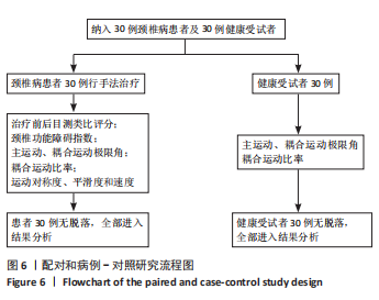
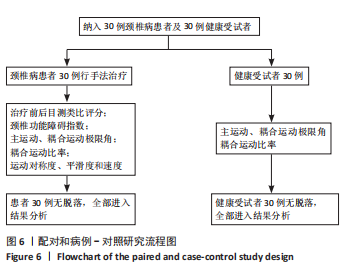
2.1 参与者数量分析 纳入颈椎病患者及健康受试者各30例,临床试验过程无脱落,全部进入结果分析。 2.2 试验流程图 见图6。"
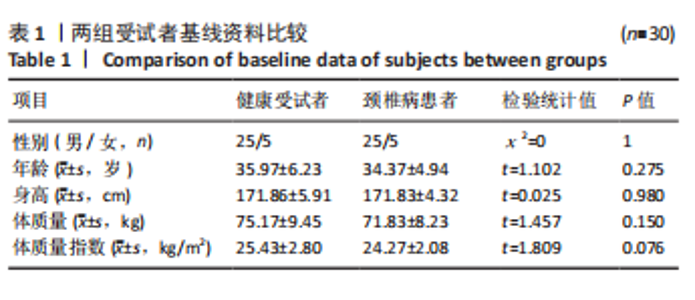
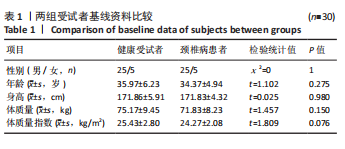
2.3 基线资料比较 经过统计分析,两组研究对象的性别、年龄、体质量指数等比较均差异无显著性意义(P > 0.05),见表1。"
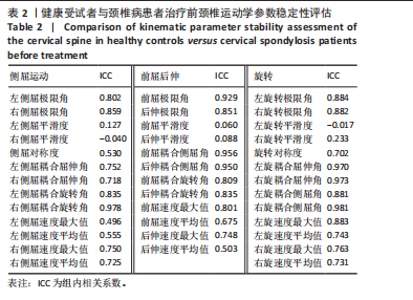
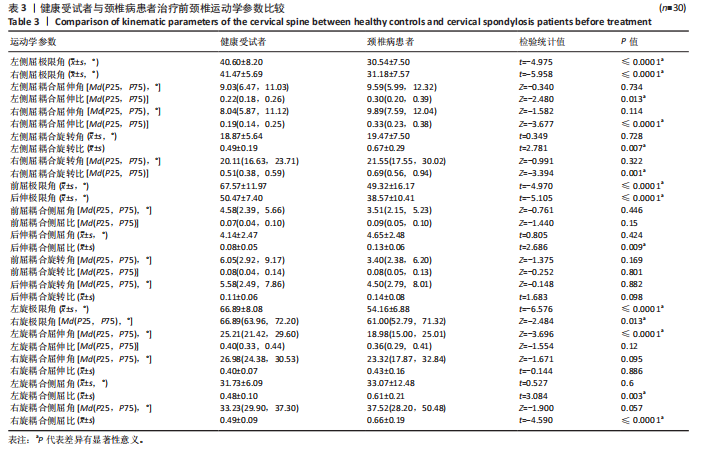
2.4 稳定性评估 选取两组受试者治疗前3次数据进行稳定性评估,见表2。颈椎左右侧屈极限角、左右侧屈耦合屈伸、左右侧屈耦合旋转、右侧屈速度的最大值和平均值、前屈后伸极限角、前屈后伸耦合侧屈、前屈后伸耦合旋转、前屈速度最大值和平均值、后伸速度最大值、左右旋转极限角、旋转对称度、左右旋转耦合屈伸、左右旋转耦合侧屈、左右旋转速度最大值和平均值一致性较好;颈椎侧屈对称度、左侧屈速度最大值和平均值、后伸速度平均值的一致性中等;颈椎左右侧屈、前屈后伸、左右旋转的平滑度一致性较差。 2.5 两组受试者颈椎运动学差异比较 见表3。健康受试者颈椎左右侧屈极限角、前屈后伸极限角、左右旋转极限角与颈椎病患者差异有显著性意义(P < "
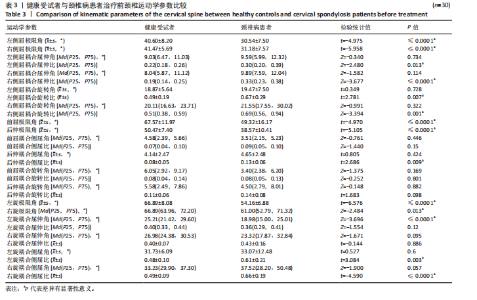
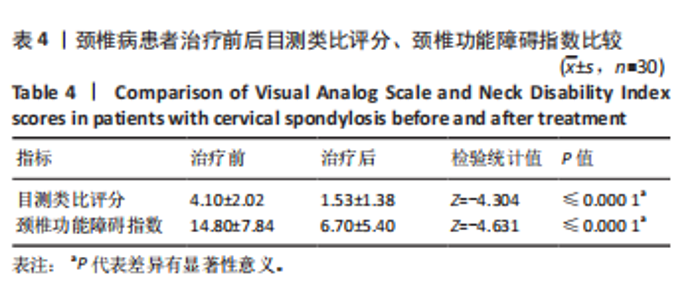
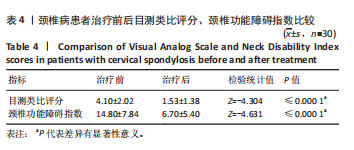
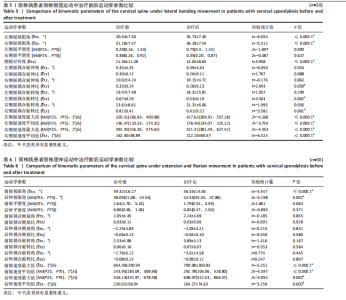
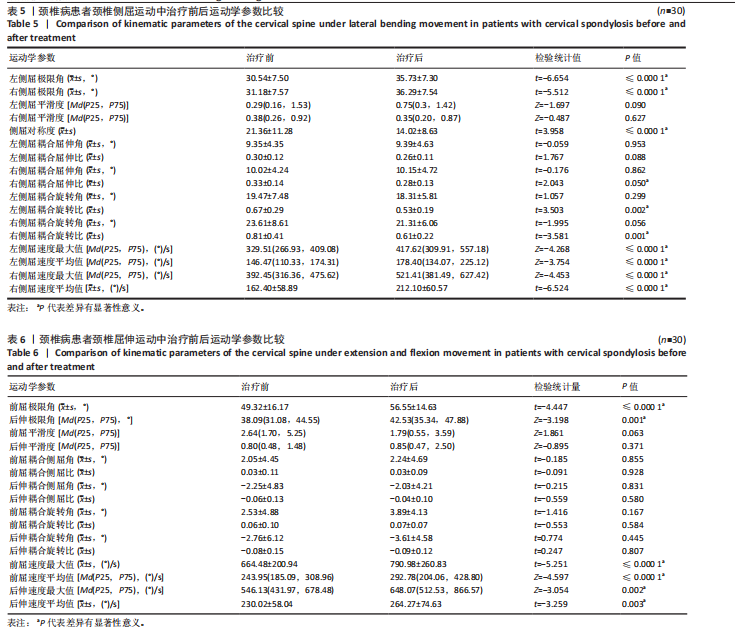
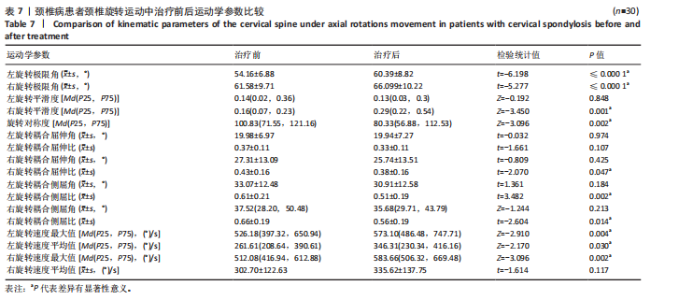
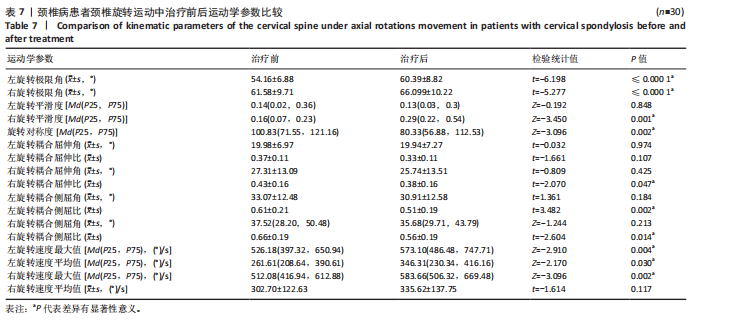
0.05)。健康受试者左旋耦合屈伸角与颈椎病患者差异有显著性意义(P < 0.05)。健康受试者左右侧屈耦合屈伸比率、左右侧屈耦合旋转比率、后伸耦合侧屈比率、左右旋耦合侧屈比率与颈椎病患者差异有显著性意义(P < 0.05)。 2.6 患者治疗前后比较 结果显示:患者目测类比评分、颈椎功能障碍指数治疗前后比较差异有显著性意义(P < 0.05),见表4。颈椎左右侧屈运动中,患者左侧屈极限角、右侧屈极限角、侧屈对称度、左侧屈速度最大值、左侧屈速度平均值、右侧屈速度最大值、右侧屈速度平均值治疗前后差异有显著性意义(P < 0.05)。颈椎前屈后伸运动中,患者前屈极限角、后伸极限角、前屈速度最大值、前屈速度平均值、后伸速度最大值、后伸速度平均值治疗前后差异有显著性意义(P < 0.05)。颈椎左右旋转运动中,患者左旋转极限角、右旋转极限角、右旋转平滑度、旋转对称度、左旋转速度最大值、左旋转速度平均值、右旋转速度最大值治疗前后差异有显著性意义(P < 0.05)。患者治疗前后耦合运动模式差异无显著性意义(P > 0.05),见表5。 颈椎左右侧屈运动中,患者右侧屈耦合屈伸与主运动的比率治疗前后差异有显著性意义(P < 0.05),左右侧屈耦合旋转与主运动比率治疗前后差异有显著性意义(P < 0.05)。颈椎前屈后伸运动中,患者耦合侧屈与主运动的比率及耦合旋转与主运动的比率差异无显著性意义(P > 0.05)。颈椎左右旋转运动中,左右旋转耦合侧屈与主运动的比率治疗前后差异有显著性意义(P < 0.05),右旋转耦合屈伸与主运动的比率治疗前后差异有显著性意义(P < 0.05),见表6,7。"
"
2.7 不良事件 两组受试者在进行颈椎运动数据采集过程中,均未发生颈椎扭伤、眩晕、跌倒等运动损伤或出现身体不适等不良反应。"
"
| [1] ZHANG Y, LI C, DONG Q, et al. Prevalence and distribution of cervical facet joint degeneration in patients with cervical spondylotic myelopathy without/with instability and ossification of the posterior longitudinal ligament-a comparative study. Eur Spine J. 2025;34(4):1229-1237. [2] TASO M, SOMMERNES JH, SUNDSETH J, et al. Surgical versus Nonsurgical Treatment for Cervical Radiculopathy. NEJM Evid. 2025; 4(4):EVIDoa2400404. [3] 王宝剑, 李俊海, 黄沪, 等. 北京市某三甲医院2018年-2020年颈椎病门诊患者临床流行病学特征分析[J]. 中国病案,2022,23(12): 40-43. [4] 包木龙, 王波, 丁岩, 等. 哈尔滨3~18岁儿童青少年颈椎病相关症状流行病学抽样调查[J]. 中国医药导报,2024,21(17):25-28. [5] LI J, ZHANG T. Comparison of clinical outcomes and complications of biportal and uniportal endoscopic decompression for the treatment of cervical spondylotic radiculopathy: A systematic review and meta-analysis. Jt Dis Relat Surg. 2024;35(3):583-593. [6] BORRELLA-ANDRÉS S, MARQUÉS-GARCÍA I, LUCHA-LÓPEZ MO, et al. Manual Therapy as a Management of Cervical Radiculopathy: A Systematic Review. BioMed Res Int. 2021;2021:9936981. [7] DU L B, WANG Y, WU J, et al. Head-Cervical Spine Motion Measurement in Healthy Population: Comparison of CROM Apparatus and“G-Plus”APP on iPhone. World Neurosurg. 2023;173:e442-e451. [8] 徐志豪, 张皓, 王圣文, 等. 颈椎活动度测量的研究进展[J]. 脊柱外科杂志,2025,23(3):202-207. [9] YU D, JEON I. Comparison of Radiological and Functional Changes After Multi-Level Laminoplasty Between Cervical Spondylotic Myelopathy and Ossification of the Posterior Longitudinal Ligament. Turk Neurosurg. 2021;31(3):432-440. [10] PETTERSSON S D, SKRZYPKOWSKA P, ALI S, et al. Predictors for cervical kyphotic deformity following laminoplasty: a systematic review and meta-analysis. J Neurosurg Spine. 2023;38(1):4-13. [11] 梁威. 正常人颈椎各节段在体耦合运动特点[D].天津:天津医科大学, 2017. [12] MALMSTRÖM EM, KARLBERG M, FRANSSON PA, et al. Primary and coupled cervical movements: the effect of age, gender, and body mass index. A 3-dimensional movement analysis of a population without symptoms of neck disorders. Spine. 2006;31(2):E44-50. [13] GHULAM HS, ALQHTANI RS, ALSHAHRANI A, et al. Efficacy of cervical mobilization with post-isometric relaxation in managing mechanical neck pain, ROM, and functional limitations associated with myofascial trigger points. Medicine. 2023;102(52):e36710. [14] RIFFITTS M, OH A, ALEMU A, et al. Functional range of motion of the cervical spine in cervical fusion patients during activities of daily living. J Biomech. 2023;152:111528. [15] 冯伟. 新医正骨疗法治疗难治型旋盆翘臀型腰椎间盘突出症的临床研究[J]. 空军医学杂志,2020,36(4):307-309. [16] 冯伟, 冯天有, 许奎, 等. 新医正骨疗法治疗Ⅲ、Ⅳ型腰椎间盘突出症[J]. 中医正骨,2015,27(5):62-64. [17] 神经根型颈椎病诊疗规范化研究专家组. 神经根型颈椎病诊疗规范化的专家共识[J]. 中华外科杂志,2015,53(11):812-814. [18] 冯天有.中西医结合治疗软组织损伤[M]. 北京: 中国科学技术出版社,2002. [19] 中华外科杂志编辑部.颈椎病的分型、诊断及非手术治疗专家共识(2018)[J].中华外科杂志,2018,56(6):401-402. [20] MACHINO M, NAKASHIMA H, ITO K, et al. Cervical disc degeneration is associated with a reduction in mobility: A cross-sectional study of 1211 asymptomatic healthy subjects. J Clin Neurosci. 2022;99:342-348. [21] WAN Z, WANG W, LI C, et al. Validation and application of a novel in vivo cervical spine kinematics analysis technique. Sci Rep. 2021;11(1):24266. [22] ZHOU C, WANG H, WANG C, et al. Intervertebral range of motion characteristics of normal cervical spinal segments (C0-T1) during in vivo neck motions. J Biomech. 2020;98:109418. [23] GUO R, ZHOU C, WANG C, et al. In vivo primary and coupled segmental motions of the healthy female head-neck complex during dynamic head axial rotation. J Biomech. 2021;123:110513. [24] FENG M, LIANG L, SUN W, et al. Measurements of cervical range of motion using an optical motion capture system: Repeatability and validity. Exp Ther Med. 2019;18(6):4193-4202. [25] 黄显兵, 利锦, 黎家鸿, 等. “上病下治”整脊法治疗神经根型颈椎病的疗效观察[J]. 广州中医药大学学报,2023,40(7):1729-1733. [26] 张芬, 刘陆晨, 王怀泽, 等. 痹祺胶囊联合针刺治疗气滞血瘀型神经根型颈椎病的疗效评价[J]. 中草药,2024,55(14):4803-4810. [27] 郑志鹏, 沈淋源. 魏氏伤科手法治疗神经根型颈椎病的回顾性分析[J]. 广州中医药大学学报,2022,39(2):284-289. [28] KAHLAEE AH, GHAMKHAR L, NOURBAKHSH MR, et al. Strength and Range of Motion in the Contralateral Side to Pain and Pain-Free Regions in Unilateral Chronic Nonspecific Neck Pain Patients. Am J of Phys Med Rehab. 2020;99(2):133-141. [29] WILLIAMS G, SARIG-BAHAT H, WILLIAMS K, et al. Cervical kinematics in patients with vestibular pathology vs. patients with neck pain: A pilot study. J Vestibul Res. 2017;27(2-3):137-145. [30] SARIG BAHAT H, CHEN X, REZNIK D, et al. Interactive cervical motion kinematics: sensitivity, specificity and clinically significant values for identifying kinematic impairments in patients with chronic neck pain. Man Ther. 2015;20(2):295-302. [31] RÖIJEZON U, DJUPSJÖBACKA M, BJÖRKLUND M, et al. Kinematics of fast cervical rotations in persons with chronic neck pain: a cross-sectional and reliability study. BMC Musculoskelet Disord. 2010;11:222. [32] 柳小林, 宋云龙, 范宇, 等. 神经根型颈椎病手法治疗前后颈段磁共振脊髓造影观察[J]. 现代中西医结合杂志,2012,21(4):380-382. [33] 柳小林, 赵平, 范宇, 等. 颈椎定点旋转复位法治疗神经根型颈椎病疗效观察[J]. 现代中西医结合杂志,2011,20(10):1194-1195. [34] 冯伟, 冯子鹤, 刘洪波, 等. 重建脊柱内外平衡治疗颈椎间盘突出症的临床研究[J]. 空军航空医学,2024,41(5):417-422. [35] 冯天有.中西医结合治疗软组织损伤的临床研究 [M]. 北京: 中国科学技术出版社,2002. [36] 符碧峰, 苏瑾, 张超, 等. 旋提手法预置体位中颈椎耦合运动研究[J]. 中国中医骨伤科杂志,2023,31(4):20-24. [37] GUO LY, LEE SY, LIN CF, et al. Three-dimensional characteristics of neck movements in subjects with mechanical neck disorder. J Back Musculoskelet. 2012;25(1):47-53. [38] ZHONG Y, ZHAN F, ZHANG Z, et al. An in vivo 3-dimensional kinematics study of the cervical vertebrae under physiological loads in patients with cervical spondylosis. Spine J. 2025;25(4):734-748. [39] LINDENMANN S, TSAGKARIS C, FARSHAD M, et al. Kinematics of the Cervical Spine Under Healthy and Degenerative Conditions: A Systematic Review. Ann Biomed Eng. 2022;50(12):1705-1733. [40] TANG B, YAO H, WANG S, et al. In vivo 3-Dimensional Kinematics Study of the Healthy Cervical Spine Based on CBCT Combined with 3D-3D Registration Technology. Spine. 2021;46(24):E1301-E1310. [41] COOK C, HEGEDUS E, SHOWALTER C, et al. Coupling behavior of the cervical spine: a systematic review of the literature. J Manip Physiol Ther. 2006;29(7):570-575. [42] KIM H, SHIN SH, KIM JK, et al. Cervical coupling motion characteristics in healthy people using a wireless inertial measurement unit. Evid-Based Compl Alt. 2013;2013:570428. [43] SEKEROZ S, TELCI EA, BUKE M, et al. Comparison of effectiveness of Mulligan mobilization technique and cervical stabilization training in patients with chronic neck pain: a single-blinded randomized controlled trial. Rehabilitation (Stuttg). 2025 Jun 16. doi: 10.1055/a-2618-6281. [44] KOUMANTAKIS GA, GKOUMA S, FLOKA C, et al. Reliability and Validity of the KFORCE Sens® Inertial Sensor for Measuring Cervical Spine Proprioception in Patients with Non-Specific Chronic Neck Pain. Brain Sci. 2024;14(12):1165. [45] ARVANITIDIS M, MAK H H K, MARTINEZ-VALDES E, et al. Validation of a Novel device for Assessing Neck Muscle Strength. Arch Physiother. 2025;15:148-157. [46] WALKER EM, HEINEMANN CM, WOLFF WL, et al. The effect of acute cervical traction on neck muscle stiffness: A case-control examination in individuals with idiopathic chronic neck pain. J Bodyw Mov Ther. 2025;43:21-27. [47] ENGIN O, KIZILIRMAK KARATAS AS, TASPINAR B, et al. Does the degree of stenosis affect cervical proprioception in patients with cervical pain?.J Back Musculoskelet Rehabil. 2025:19:10538127251343399. [48] BUKE M, SEKEROZ S, ISYAR B, et al. Effects of nonspecific chronic neck pain on balance, visuomotor reaction time and upper extremity explosive strength in young females. Musculoskelet Sci Pract. 2025;77: 103331. [49] 顾江鹏, 王飞, 冯伟, 等. 颈椎运动学评价指标研究进展[J]. 中国中医骨伤科杂志,2024,32(1):91-96. [50] VIKNE H, BAKKE ES, LIESTØL K, et al. The smoothness of unconstrained head movements is velocity-dependent. Hum Mov Sci. 2013;32(4): 540-554. [51] CARONNI A, ARCURI P, CARPINELLA I, et al. Smoothness of movement in idiopathic cervical dystonia Sci Rep. 2022;12(1):5090. [52] TSANG SMH, SZETO GPY, SO BCL, et al. Using cervical movement velocity to assist the prediction of pain and functional recovery for people with chronic mechanical neck pain. Clin Biomech. 2022;93: 105607. |
| [1] | Guo Zicheng, Meng Jingyuan, Zhang Jiechao, Ding Li, Tang Xiaoye, Tian Lichao, Wang Yilin, He Yong. Differences in scapular kinematics between healthy individuals and rotator cuff tear patients based on biplane X-ray [J]. Chinese Journal of Tissue Engineering Research, 2026, 30(3): 652-660. |
| [2] | Li Chunchao, Julaiti·Maitirouzi, Xie Xuechen, Zhang Le, Wang Yixi, Paerhati·Rexiti. Finite element analysis of effect of passive support of deep intrinsic lumbar muscle groups on the lumbar spine [J]. Chinese Journal of Tissue Engineering Research, 2026, 30(15): 3820-3831. |
| [3] | Liu Haoyang, Li Hongxu, Zhou Yu, Yue Debo, Wang Bailiang, Ma Jinhui. Differences in clinical function and imaging between robot-assisted and conventional total knee arthroplasty [J]. Chinese Journal of Tissue Engineering Research, 2026, 30(15): 3936-3945. |
| [4] | Li Xinke, Feng Ru, Rong Ke, Sun Xiaole, Zhou Zhipeng, Yang Chen. Effects of ankle taping on knee and ankle biomechanics of individuals with chronic ankle instability in the side-cutting and stop-jumping tasks [J]. Chinese Journal of Tissue Engineering Research, 2026, 30(10): 2422-2429. |
| [5] | Liu Mengling, Li Yongjie, Liu Hongju. Effect of increased stride length on knee kinematics and dynamics of asymmetric gait after anterior cruciate ligament reconstruction [J]. Chinese Journal of Tissue Engineering Research, 2025, 29(33): 7109-7115. |
| [6] | Jiang Tao, Zhang Chuankai, Hao Liang, Liu Yong. MAKO robot- and navigation-assisted knee replacement: comparison of lower limb force alignment and prosthesis position accuracy [J]. Chinese Journal of Tissue Engineering Research, 2025, 29(33): 7150-7157. |
| [7] | Liu Ning, Sun Yingjin, Huang Long, Feng Shuo, Chen Xiangyang. Optimal rotational alignment of the tibial component during Oxford unicompartmental knee arthroplasty [J]. Chinese Journal of Tissue Engineering Research, 2025, 29(33): 7158-7164. |
| [8] | Gao Yuan, Xiong Zheyu, Zheng Wei, Chen Haonan, Chen Fangyuqing. Lower extremity biomechanical characterization during step-down test in patients with patellofemoral pain [J]. Chinese Journal of Tissue Engineering Research, 2025, 29(32): 6913-6919. |
| [9] | Guo Ping, Wang Juan. Bilateral lower limb biomechanical abnormalities in patients with unilateral chronic ankle instability [J]. Chinese Journal of Tissue Engineering Research, 2025, 29(32): 6920-6926. |
| [10] | Gou Yanyun, Hou Meijin, Jiang Zheng, Chen Shaoqing, Chen Xiang, Gao Yuzhan, Wang Xiangbin. Biomechanical characteristics of walking in patients with idiopathic scoliosis: cross-sectional analysis of three-dimensional motion capture [J]. Chinese Journal of Tissue Engineering Research, 2025, 29(3): 471-477. |
| [11] | Wang Zilong, Meng Xin, Zhang Zhiqi, Xie Yu, Meng Lingyue, Zhang Qiuxia, Kong Lingyu. Biomechanical characteristics of lower extremities during counter movement jump in male patients with functional ankle instability [J]. Chinese Journal of Tissue Engineering Research, 2025, 29(3): 478-485. |
| [12] | Wang Jun, Zhang Hui, Li Zhengyuan, Hao Lin, Chen Shenghong, Yin Zongsheng. Assessment on initial effectiveness of a novel local infiltration anesthesia in total knee arthroplasty [J]. Chinese Journal of Tissue Engineering Research, 2025, 29(27): 5839-5844. |
| [13] | Dong Youqing, Wei Zixuan, Wu Haiou, Chen Ruixiong, Duan Peng, Chen Nan, Lin Xikai. Biomechanical characteristics of lower limbs in female patients with different types of patellofemoral pain syndrome [J]. Chinese Journal of Tissue Engineering Research, 2025, 29(21): 4458-4468. |
| [14] | Zhang Sizhuo, Liu Xiaoqian, Wang Guanglan. Effects of visual interference on biomechanical characteristics of lower limbs in athletes after anterior cruciate ligament reconstruction [J]. Chinese Journal of Tissue Engineering Research, 2025, 29(20): 4223-4229. |
| [15] | Shui Xiaoping, Li Chunying, Zhang xin, Li Bin, Feng Chao, Zhou Hongyu, Chen Ke, Liao Yingying. Effects and mechanisms of swimming for inhibiting traumatic joint contracture in a rat model [J]. Chinese Journal of Tissue Engineering Research, 2025, 29(2): 262-268. |
| Viewed | ||||||
|
Full text |
|
|||||
|
Abstract |
|
|||||