Chinese Journal of Tissue Engineering Research ›› 2026, Vol. 30 ›› Issue (15): 3862-3870.doi: 10.12307/2026.156
Previous Articles Next Articles
Accuracy of personalized 3D printed guide plate guided cortical bone trajectory screw placement during thoracolumbar spine surgery
Zhu Yin, Wang Liming, Sha Weiping, Song Jincheng, Lin Xiaolong, Cao Ze, Sheng Xiaolei
- Department of Orthopedics, Zhangjiagang Hospital Affiliated to Soochow University (Zhangjiagang First People’s Hospital), Zhangjiagang 215600, Jiangsu Province, China
-
Accepted:2025-05-20Online:2026-05-28Published:2025-11-06 -
Contact:Sheng Xiaolei, Associate chief physician, Department of Orthopedics, Zhangjiagang Hospital Affiliated to Soochow University (Zhangjiagang First People’s Hospital), Zhangjiagang 215600, Jiangsu Province, China -
About author:Zhu Yin, MS, Associate chief physician, Lecturer, Department of Orthopedics, Zhangjiagang Hospital Affiliated to Soochow University (Zhangjiagang First People’s Hospital), Zhangjiagang 215600, Jiangsu Province, China -
Supported by:Medical and Health Technology Innovation Guidance Project of Zhangjiagang City Science and Technology Bureau, No. ZKYL2243 (to ZY); Suzhou Science and Technology Development Program, No. SKYD2023052 (to ZY); Clinical Research Climbing Program of Zhangjiagang First People's Hospital, No. ZJGSYY003 (to ZY)

CLC Number:
Cite this article
Zhu Yin, Wang Liming, Sha Weiping, Song Jincheng, Lin Xiaolong, Cao Ze, Sheng Xiaolei. Accuracy of personalized 3D printed guide plate guided cortical bone trajectory screw placement during thoracolumbar spine surgery[J]. Chinese Journal of Tissue Engineering Research, 2026, 30(15): 3862-3870.
share this article
Add to citation manager EndNote|Reference Manager|ProCite|BibTeX|RefWorks
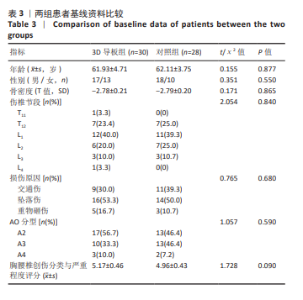
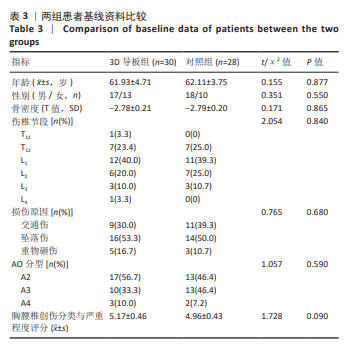
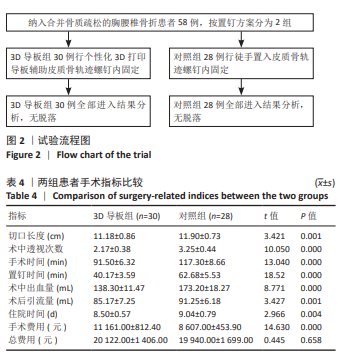
2.1 参与者数量分析 根据纳排标准共纳入合并骨质疏松的胸腰椎骨折患者 58例,按置钉方案分为2组,3D导板组30例和对照组28例,全部进入结果分析,无脱落。 2.2 试验流程图 见图2。 2.3 基线资料比较 两组患者年龄、性别、骨密度、伤椎节段、损伤原因、AO分型以及胸腰椎创伤分类与严重程度评分等一般资料比较,差异均无显著性意义 (P > 0.05),具有可比性,见表3。"
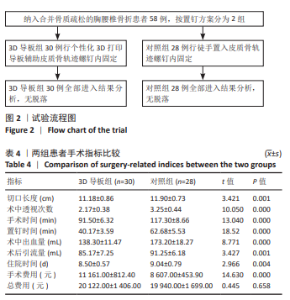
2.4 两组患者手术指标比较 与对照组比较,3D导板组在切口长度、术中透视次数、手术时间、置钉时间、术中出血量、术后引流量及住院时间上均显著减少,而手术费用显著增加,差异均有显著性意义 (P < 0.05)。但是两组的总费用相比差异无显著性意义(P > 0.05),见表4。"
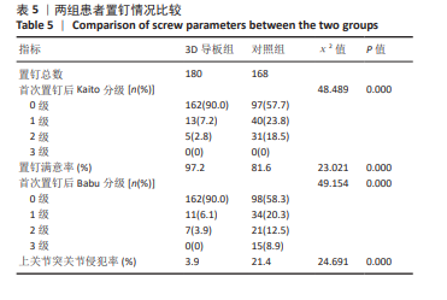
2.5 两组患者置钉情况比较 两组患者共置入348枚皮质骨轨迹螺钉,3D导板组置入180 枚,按Kaito分级0级162枚、1级13枚、2级5枚、3级0枚;按Babu分级0级162枚、1级11枚、2级7枚、3级0枚;对照组置入168枚,按Kaito分级0级97枚、1级40枚、2级31枚、3级0枚;按Babu分级0级98枚、1级34枚、2级21枚、3级15枚,两组比较差异有显著性意义(P < 0.05)。与对照组比较,3D导板组置钉满意率增高,上关节突关节侵犯率降低,差异均有显著性意义(P < 0.05),见表5。"
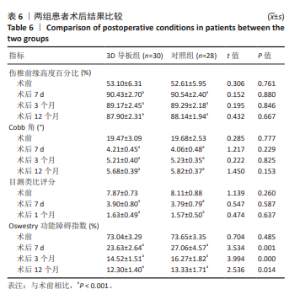
2.6 两组患者术后结果比较 与术前相比,术后两组在伤椎前缘高度百分比、Cobb角方面均获得显著改善 (P < 0.05);两组之间比较差异无显著性意义 (P > 0.05)。两组患者术后目测类比评分、Oswestry功能障碍指数均较术前明显改善,差异有显著性意义(P < 0.05);与对照组比较,3D导板组术后Oswestry功能障碍指数更低,差异有显著性意义(P < 0.05),而两组间目测类比评分比较无统计学差异(P > 0.05)。见表6。"
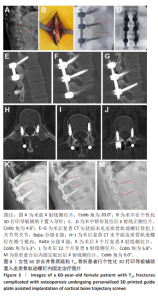
2.7 植入物置入后的不良反应 两组均未发生感染、血管神经损伤、脑脊液漏及螺钉松动或断裂等并发症;亦均无植入物过敏反应、免疫反应或排斥反应。 2.8 典型病例 女性患者,60岁,骨密度T值为-2.9 SD,因“车祸致胸腰部疼痛伴活动受限2 h”入院,诊断:合并骨质疏松T12骨折,行个性化3D打印导板辅助置入皮质骨轨迹螺钉内固定治疗,骨折椎体高度以及脊柱后凸Cobb角矫正良好,螺钉位于椎弓根内,评估为Kaito 0级、Babu 0级,螺钉未侵犯上关节突关节。术后3,12个月复查,椎体高度、后凸Cobb角度有效保持,未见螺钉松动或断裂。骨折愈合去除内固定后复查X射线片未见骨折椎体高度、后凸Cobb角度明显丢失,见图3。"
| [1] 赵宏涛, 宋霏, 韦祎, 等. 皮质骨轨迹螺钉与传统椎弓根螺钉固定对短节段腰椎融合术患者临床疗效影响的Meta分析[J]. 中国脊柱脊髓杂志,2022,32(11):1034-1044. [2] EL SAMAN A, MEIER S, SANDER A, et al. Reduced loosening rate and loss of correction following posterior stabilization with or without PMMA augmentation of pedicle screws in vertebral fractures in the elderly. Eur J Trauma Emerg Surg. 2013;39(5): 455-460. [3] 白璧辉, 谢兴文, 李鼎鹏, 等. 我国近5年来骨质疏松症流行病学研究现状[J]. 中国骨质疏松杂志,2018,24(2):253-258. [4] SKINNER R, MAYBEE J, TRANSFELDT E, et al. Experimental pullout testing and comparison of variables in transpedicular screw fixation. A biomechanical study. Spine (Phila Pa 1976). 1990;15(3):195-201. [5] CHANG MC, LIU CL, CHEN TH. Polymethylmethacrylate augmentation of pedicle screw for osteoporotic spinal surgery: a novel technique. Spine (Phila Pa 1976). 2008;33(10):E317-E324. [6] LI X, MA Y, DONG J, et al. Retrospective analysis of treatment of thoracolumbar burst fracture using mono-segment pedicle instrumentation compared with short-segment pedicle instru mentation. Eur Spine J. 2012;21(10):2034-2042. [7] SANTONI BG, HYNES RA, MCGILVRAY KC, et al. Cortical bone trajectory for lumbar pedicle screws. Spine J. 2009;9(5):366-373. [8] 穆怀昭, 赵佳佳, 杨朝昕, 等. 3-D打印技术结合经皮椎弓根螺钉内固定术治疗中老年胸腰椎爆裂骨折的疗效分析[J]. 中国中西医结合外科杂志,2019,25(6):1041-1045. [9] 蒋维利, 牛国旗, 周功, 等. 3D打印技术辅助成人脊柱侧后凸畸形的术前规划及应用价值[J]. 中国骨伤,2020,33(2):99-105. [10] SHEHA ED, GANDHI SD, COLMAN MW. 3D printing in spine surgery. Ann Transl Med. 2019;7(Suppl 5):S164. [11] TORTOLANI PJ, STROH DA. Cortical Bone Trajectory Technique for Posterior Spinal Instrumentation. J Am Acad Orthop Surg. 2016;24(11): 755-761. [12] KAITO T, MATSUKAWA K, ABE Y, et al. Cortical pedicle screw placement in lumbar spinal surgery with a patient-matched targeting guide: A cadaveric study. J Orthop Sci. 2018;23(6): 865-869. [13] BABU R, PARK JG, MEHTA AI, et al. Comparison of superior-level facet joint violations during open and percutaneous pedicle screw placement. Neurosurgery. 2012;71(5):962-970. [14] 张野, 夏辉强, 易威威, 等. 经皮椎体后凸成形术与经皮椎弓根螺钉内固定术对骨量减少型胸腰椎压缩性骨折的疗效对比研究[J]. 创伤外科杂志,2021,23(6):428-434. [15] CHEN L, LIU H, HONG Y, et al. Minimally Invasive Decompression and Intracorporeal Bone Grafting Combined with Temporary Percutaneous Short-Segment Pedicle Screw Fixation for Treatment of Thoracolumbar Burst Fracture with Neurological Deficits. World Neurosurg. 2020;135: e209-e220. [16] 赵加庆, 赵子豪, 于先凯, 等. 复合骨水泥椎体成形治疗骨量减少胸腰椎骨折[J]. 中国矫形外科杂志,2022,30(16):1457-1461. [17] WANG H, ZHANG L, DU H, et al. Efficacy and Safety Evaluation of Bilateral Pedicle Approach Combined with Positional Reduction for the Treatment of Osteoporotic Thoracolumbar Burst Fractures. Altern Ther Health Med. 2023;29(6):176-181. [18] DU SY, DAI J, ZHOU ZT, et al. Size selection and placement of pedicle screws using robot-assisted versus fluoroscopy-guided techniques for thoracolumbar fractures: possible implications for the screw loosening rate. BMC Surg. 2022;22(1):365. [19] 周昌俊, 龙胜利, 邹伟, 等. 经皮椎弓根螺钉技术治疗胸腰椎骨折共平面置钉导向器设计与临床应用[J]. 中国组织工程研究,2023, 27(4):534-538. [20] 钱立雄, 郝定均, 孙宏慧, 等. 骨水泥强化椎弓根螺钉固定与皮质骨轨迹螺钉固定治疗腰椎退变性疾病合并骨质疏松的效果比较[J]. 临床医学研究与实践,2019,4(13):87-90. [21] 赵世新, 席海洋, 王朕, 等. 皮质骨轨迹螺钉在脊柱外科中的应用进展[J].中国脊柱脊髓杂志,2019,29(12):1124-1128. [22] BOKOV A, BULKIN A, ALEYNIK A, et al. Pedicle Screws Loosening in Patients With Degenerative Diseases of the Lumbar Spine: Potential Risk Factors and Relative Contribution. Global Spine J. 2019;9(1): 55-61. [23] SILVA F, SILVA PS, VAZ R, et al. Midline lumbar interbody fusion (MIDLIF) with cortical screws: initial experience and learning curve. Acta Neurochir (Wien). 2019;161(12):2415-2420. [24] MATSUKAWA K, KATO T, YANAI Y, et al. Influence of facetectomy, cross-link augmentation, and interbody procedure on progression of bone fusion in single-level posterior lumbar interbody fusion using the long cortical bone trajectory technique. J Neurosurg Spine. 2024;41(4):483-488. [25] ZHANG RJ, LI HM, CAO H, et al. Cortical bone trajectory screws used to save failed traditional trajectory screws in the osteoporotic lumbar spine and vice versa: a human cadaveric biomechanical study. J Neurosurg Spine. 2019;30(6):759-766. [26] WANG Y, LIU H, LI B, et al. Three different screw trajectories in single segment fixation: a finite element analysis and biomechanical study. Spine J. 2025;30:S1529-9430(25)00077-4. [27] TSAGKARIS C, FASSER MR, FARSHAD M, et al. Stability of medially and laterally malpositioned screws: a biomechanical study on cadavers. Spine J. 2025;25(2):380-388. [28] 韦继刚, 益小平. 皮质骨螺钉与椎弓根螺钉内固定在创伤性胸腰椎骨折手术中的临床应用对比[J]. 临床与病理杂志,2023,43(6):1234-1241. [29] 周志豪, 阿拉法特·卡哈尔, 王轶希, 等. 传统椎弓根螺钉与改良皮质骨轨迹置钉技术的生物力学性能有限元分析[J]. 中国组织工程研究,2022,26(18):2789-2794. [30] 丁红涛, 海涌, 刘玉增, 等. 皮质骨轨迹螺钉固定在合并骨质疏松腰椎退行性疾病手术中应用的效果[J]. 中国脊柱脊髓杂志,2022, 32(12):1058-1066. [31] LI JC, YANG ZQ, XIE TH, et al. Deterioration of the fixation segment’s stress distribution and the strength reduction of screw holding position together cause screw loosening in ALSR fixed OLIF patients with poor BMD. Front Bioeng Biotechnol. 2022;10:922848. [32] MATSUKAWA K, YATO Y, NEMOTO O, et al. Morphometric measurement of cortical bone trajectory for lumbar pedicle screw insertion using computed tomography. J Spinal Disord Tech. 2013; 26(6):248-253. [33] IWATSUKI K, YOSHIMINE T, OHNISHI Y, et al. Isthmus-guided cortical bone trajectory for pedicle screw insertion. Orthop Surg. 2014;6(3): 244-248. [34] 苏林涛, 江剑峰,马俊, 等. O臂导航在椎弓根发育性狭窄胸腰椎骨折中的精准应用[J]. 中国组织工程研究,2025,29(9): 1855-1862. [35] 张希诺, 刘玉增, 李越, 等. 骨科手术机器人辅助与X线透视辅助下徒手皮质骨轨迹螺钉置入治疗单节段退行性腰椎疾病的临床对比研究[J]. 首都医科大学学报,2023,44(5):836-844. [36] WU C, DENG J, LI T, et al. Percutaneous Pedicle Screw Placement Aided by a New Drill Guide Template Combined with Fluoroscopy: An Accuracy Study. Orthop Surg. 2020;12(2):471-479. [37] GALVEZ M, MONTOYA CE, FUENTES J, et al. Error Measurement Between Anatomical Porcine Spine, CT Images, and 3D Printing. Acad Radiol. 2020;27(5):651-660. [38] ALAN N, DENG H, MUTHIAH N, et al. Graft subsidence and reoperation after lateral lumbar interbody fusion: a propensity score-matched and cost analysis of polyetheretherketone versus 3D-printed porous titanium interbodies. J Neurosurg Spine. 2023; 39(2):187-195. [39] JEONG S, YANG A, DHODAPKAR MM, et al. 3D printed pedicle screw guides reduce the rate of intraoperative screw revision in adolescent idiopathic scoliosis surgery. Spine J. 2023;23(12):1894-1899. [40] KIM J, RAJADURAI J, CHOY WJ, et al. Three-Dimensional Patient-Specific Guides for Intraoperative Navigation for Cortical Screw Trajectory Pedicle Fixation. World Neurosurg. 2019;122:674-679. [41] 丁祥, 李超, 牛国旗, 等. 个体化3D打印导向模板辅助强直性脊柱炎颈椎椎弓根螺钉置入的实验研究[J]. 实用医学杂志,2020,36(8): 1072-1076. [42] 连学辉, 肖红利, 卢涛, 等. 3D打印体外导板辅助经皮椎弓根螺钉固定术治疗胸腰椎骨折的临床疗效观察[J]. 中国脊柱脊髓杂志, 2022,32(8):704-712. |
| [1] | Chen Huiting, Zeng Weiquan, Zhou Jianhong, Wang Jie, Zhuang Congying, Chen Peiyou, Liang Zeqian, Deng Weiming. Tail anchoring technique of vertebroplasty in treatment of osteoporotic vertebral compression fractures with intravertebral cleft: a finite element analysis [J]. Chinese Journal of Tissue Engineering Research, 2026, 30(9): 2145-2152. |
| [2] | Zeng Xuan, Weng Rui, Ye Shicheng, Tang Jiadong, Mo Ling, Li Wenchao. Two lumbar rotary manipulation techniques in treating lumbar disc herniation: a finite element analysis of biomechanical differences [J]. Chinese Journal of Tissue Engineering Research, 2026, 30(9): 2153-2161. |
| [3] | Cheng Qisheng, Julaiti·Maitirouzi, Xiao Yang, Zhang Chenwei, Paerhati·Rexiti. Finite element analysis of novel variable-diameter screws in modified cortical bone trajectory of lumbar vertebrae [J]. Chinese Journal of Tissue Engineering Research, 2026, 30(9): 2162-2171. |
| [4] | Zhao Feifan, Cao Yujing. Risk factors and coping strategies of internal fixation failure in treatment of intertrochanteric fracture with proximal femoral nail antirotation [J]. Chinese Journal of Tissue Engineering Research, 2026, 30(9): 2323-2333. |
| [5] | Liu Wenlong, Dong Lei, Xiao Zhengzheng, Nie Yu. Finite element analysis of tibial prosthesis loosening after fixed-bearing unicompartmental knee arthroplasty for osteoporosis [J]. Chinese Journal of Tissue Engineering Research, 2026, 30(9): 2191-2198. |
| [6] | Chen Long, Wang Xiaozhen, Xi Jintao, Lu Qilin. Biomechanical performance of short-segment screw fixation combined with expandable polyetheretherketone vertebral body replacement in osteoporotic vertebrae [J]. Chinese Journal of Tissue Engineering Research, 2026, 30(9): 2226-2235. |
| [7] | Hu Xiongke, Liu Shaohua, Tan Qian, Liu Kun, Zhu Guanghui. Shikonin intervention with bone marrow mesenchymal stem cells improves microstructure of femur in aged mice [J]. Chinese Journal of Tissue Engineering Research, 2026, 30(7): 1609-1615. |
| [8] | Wu Zhilin, , He Qin, Wang Pingxi, Shi Xian, Yuan Song, Zhang Jun, Wang Hao . DYRK2: a novel therapeutic target for rheumatoid arthritis combined with osteoporosis based on East Asian and European populations [J]. Chinese Journal of Tissue Engineering Research, 2026, 30(6): 1569-1579. |
| [9] | Zhang Haiwen, Zhang Xian, Xu Taichuan, Li Chao. Bibliometric and visual analysis of the research status and trends of senescence in osteoporosis [J]. Chinese Journal of Tissue Engineering Research, 2026, 30(6): 1580-1591. |
| [10] | Wen Guangwei, Zhen Yinghao, Zheng Taikeng, Zhou Shuyi, Mo Guoye, Zhou Tengpeng, Li Haishan, Lai Yiyi. Effects and mechanisms of isoginkgetin on osteoclastogenesis [J]. Chinese Journal of Tissue Engineering Research, 2026, 30(6): 1348-1358. |
| [11] | Huang Jie, Zeng Hao, Wang Wenchi, Lyu Zhucheng, Cui Wei. Visualization analysis of literature on the effect of lipid metabolism on osteoporosis [J]. Chinese Journal of Tissue Engineering Research, 2026, 30(6): 1558-1568. |
| [12] | Yang Zhijie, Zhao Rui, Yang Haolin, Li Xiaoyun, Li Yangbo, Huang Jiachun, Lin Yanping, Wan Lei, HuangHongxing. Postmenopausal osteoporosis: predictive values of muscle mass, grip strength, and appendicular skeletal muscle index [J]. Chinese Journal of Tissue Engineering Research, 2026, 30(5): 1073-1080. |
| [13] | Zhou Jian, Zhang Tao, Zhou Weili, Zhao Xingcheng, Wang Jun, Shen Jie, Qian Li, Lu Ming. Effects of resistance training on quadriceps mass and knee joint function in patients with osteoporosis and sarcopenia [J]. Chinese Journal of Tissue Engineering Research, 2026, 30(5): 1081-1088. |
| [14] | Cao Wenqi, Feng Xiuzhi, Zhao Yi, Wang Zhimin, Chen Yiran, Yang Xiao, Ren Yanling. Effect of macrophage polarization on osteogenesis-angiogenesis coupling in type 2 diabetic osteoporosis [J]. Chinese Journal of Tissue Engineering Research, 2026, 30(4): 917-925. |
| [15] | Zeng Hao, Sun Pengcheng, Chai Yuan, Huang Yourong, Zhang Chi, Zhang Xiaoyun. Association between thyroid function and osteoporosis: genome-wide data analysis of European populations [J]. Chinese Journal of Tissue Engineering Research, 2026, 30(4): 1019-1027. |
| Viewed | ||||||
|
Full text |
|
|||||
|
Abstract |
|
|||||