Chinese Journal of Tissue Engineering Research ›› 2013, Vol. 17 ›› Issue (16): 2973-2980.doi: 10.3969/j.issn.2095-4344.2013.16.018
Previous Articles Next Articles
Layer-by-layer self-assembly multifunctional heparin surface modification
Wei Wei, Li Guo-rong
- State Key Laboratory of Cardiovascular Disease, Fuwai Hospital, Peking Union Medical College, Beijing 100037, China
-
Received:2013-01-19Revised:2013-02-27Online:2013-04-16Published:2013-05-24 -
Contact:Li Guo-rong, Doctor, Associate professor, State Key Laboratory of Cardiovascular Disease, Fuwai Hospital, Peking Union Medical College, Beijing 100037, China guorong2@yahoo.com.cn -
About author:Wei Wei★, Master, State Key Laboratory of Cardiovascular Disease, Fuwai Hospital, Peking Union Medical College, Beijing 100037, China ww629265@sina.com

CLC Number:
Cite this article
Wei Wei, Li Guo-rong. Layer-by-layer self-assembly multifunctional heparin surface modification[J]. Chinese Journal of Tissue Engineering Research, 2013, 17(16): 2973-2980.
share this article

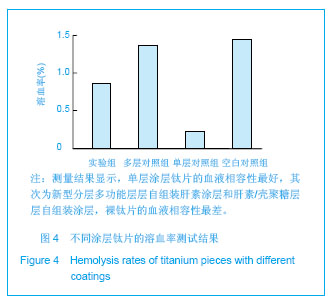
2.1 层层自组装技术组装的肝素涂层的溶血率 见图4。 结果显示,所有组涂层的溶血率均小于5%的国家标准。溶血率越低血液相容性越好,实验组溶血率为0.87%,小于裸钛片空白对照组的1.45%,证明实验组涂层血液相容性优于裸钛片。同时,实验组涂层溶血率0.87%也小于多层对照组涂层的1.38%,说明相同层数的涂层,实验组的分层涂层在血液相容性方面优于多层对照组。单层对照组的溶血率最低,且远远小于空白对照组,说明壳聚糖和肝素有明显改善材料血液相容性的作用。"
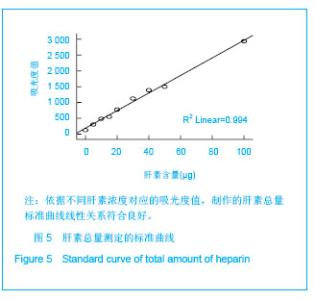
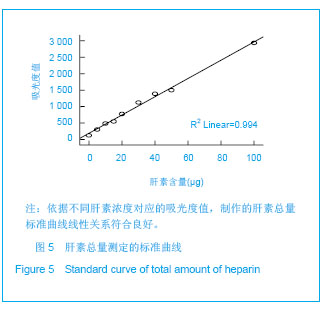
2.2 层层自组装技术组装的肝素涂层的表面肝素总量 肝素总量测定的标准曲线 见图5。实验重复3次,测得不同浓度梯度的肝素含量对应的吸光度值的平均值,应用SPSS 17.0软件得到回归方程,计算各组涂层的肝素总含量分别为实验组 7.94 μg/cm2,多层对照组5.51 μg/cm2,单层对照组 1.97 μg/cm2。对于同样层数的涂层,实验组有更多的肝素,是作为自组装的阳离子壳聚糖和Fe 3+在组装时导致的不同。壳聚糖分子量较大,分子体积较大,在与肝素组装时会受到空间构象的影响;而Fe 3+分子量小,受到空间构象的限制较小。所以,Fe 3+和肝素的组装使肝素携带量增大,优于传统的肝素/壳聚糖自组装涂层。"
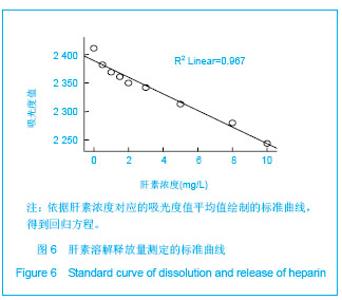
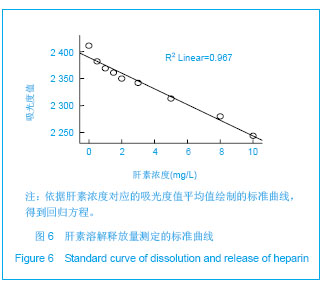
2.3 层层自组装技术组装的肝素涂层中肝素的溶解释放量 反复测试不同肝素浓度对应的吸光度值,取平均值绘制标准曲线,应用SPSS 17.0软件得到回归方程,并计算各组样本的肝素释放量。绘制肝素释放量标准曲线见图6。"
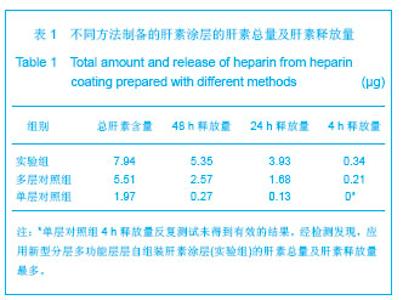
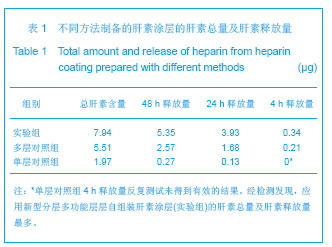
测试各组不同时间段肝素释放量结果见表1。 "
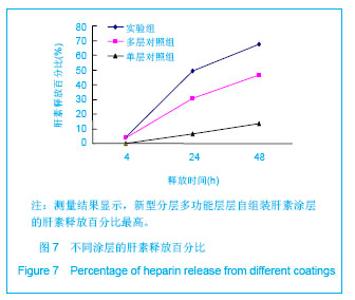
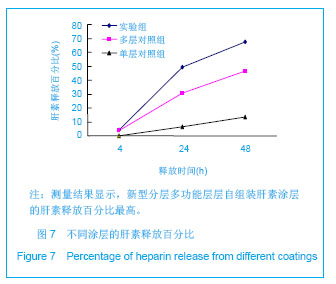
肝素释放量除以各自样本的肝素总量,绘制肝素释放百分比,见图7。可以看出,实验组的肝素释放量和释放百分比均大于对照组,说明Fe 3+和肝素的组装使得肝素更易释放,且释放量更大。实验组的释放百分比曲线在24 h有一个释放峰值,所以如果控制肝素/Fe3+的表层自组装层数及组装时间,可以间接控制肝素释放量和释放速度,达到根据药物控释的作用。同时可以看到,单层对照组的释放百分百很低,说明使用γ-氨丙基三乙氧基硅烷化学接枝的方法涂层稳定性较好,不易溶解释放,这也是选择化学接枝方法制作实验组底层的目的,即延长底层的作用时间。"
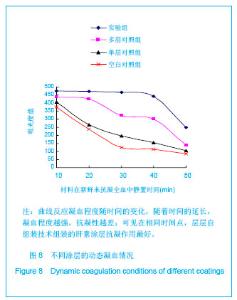
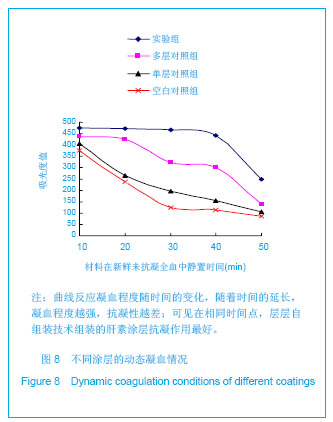
2.4 层层自组装技术组装的肝素涂层的体外动态凝血情况 动态凝血时间是测试每个时间点每种材料的凝血程度,实验测试了各组涂层在10,20,30,40,50 min时的动态凝血情况,见图8。由图可以看出在每个时间点的凝血程度均为:裸钛片空白对照组>单层对照组>多层对照组>实验组。同时,将每个时间点连接成线,可见实验组凝血程度在前 40 min变化较小,曲线下降较缓慢;但是裸钛片空白对照组在前30 min凝血程度急剧变化,曲线急速下滑;多层对照组和单层对照组介于其中。单层对照组由于涂层数量少,肝素含量也少,故抗凝血性能略优于空白对照组,并与空白对照组保持较一致的下降曲线。实验组的肝素含量在各组中最多,同时释放量较大,故抗凝血性能最好。多层对照组肝素含量和释放量介于实验组和单层对照组之间,曲线也居于其中。"
| [1]DeBakey ME. Development of mechanical heart devices. Ann Thorac Surg. 2005;79(6):S2228-2231.[2]Lietz K, Long JW, Kfoury AG, et al. Outcomes of left ventricular assist device implantation as destination therapy in the post-REMATCH era: implications for patient selection. Circulation. 2007;116(5):497-505.[3]Rose EA, Gelijns AC, Moskowitz AJ, et al. Long-term use of a left ventricular assist device for end-stage heart failure. N Engl J Med. 2001;345(20):1435-1443.[4]Thunberg CA, Gaitan BD, Arabia FA, et al. Ventricular Assist Devices Today and Tomorrow. J Cardiothorac Vasc Anesth. 2010;24(4):656-680.[5]Pagani FD, Miller LW, Russell SD, et al. Extended mechanical circulatory support with a continuous-flow rotary left ventricular assist device. J Am Coll Cardiol. 2009;54(4): 312-321.[6]Wiliams DF. On the mechanisms of biocompatibility. Biomaterials. 2008;29(20):2941-2953.[7]Ito Y, Hasuda H, Sakuragi M, et al. Surface modification of plastic, glass and titanium by photoimmobilization of polyethylene glycol for antibiofouling. Acta Biomater. 2007; 3(6):1024-1032.[8]Krishnan LK, Varghese N, Muraleedharan CV, et al. Quantitation of platelet adhesion to Ti and DLC-coated Ti in vitro using (125)I-labeled platelets. Biomol Eng. 2002;19(2-6): 251-253.[9]Treves C, Martinesi M, Stio M, et al. In vitro biocompatibility evaluation of surface-modified titanium alloys. J Biomed Mater Res A. 2010;92(4):1623-1634.[10]Kuo WH, Wang MJ Chien HW, et al. Surface modification with poly(sulfobetaine methacrylate-co-acrylic acid) to reduce fibrinogen adsorption, platelet adhesion, and plasma coagulation. Biomacromolecules. 2011;12(12):4348-4356.[11]Choi J, Konno T, Matsuno R, et al. Surface immobilization of biocompatible phospholipid polymer multilayered hydrogel on titanium alloy. Colloids Surf B Biointerfaces. 2008;67(2): 216-223.[12]Ye SH, Johnson CA, Woolley JR, et al. Surface modification of a titanium alloy with a phospholipid polymer prepared by a plasma-induced grafting technique to improve surface thromboresistance. Colloids Surf B Biointerfaces. 2009; 74(1):96-102.[13]Ye SH, Johnson CA Jr, Woolley JR, et al. Simple surface modification of a titanium alloy with silanated zwitterionic phosphorylcholine or sulfobetaine modifiers to reduce thrombogenicity. Colloids Surf B Biointerfaces. 2010;79(2): 357-364.[14]Choi J, Konno T, Takai M, et al. Controlled drug release from multilayered phospholipid polymer hydrogel on titanium alloy surface. Biomaterials. 2009;30(28):5201-5208.[15]Yang Z, Wang J, Luo R, et al. The covalent immobilization of heparin to pulsed-plasma polymeric allylamine films on 316L stainless steel and the resulting effects on hemocompatibility. Biomaterials. 2010;31(8):2072-2083.[16]Li G, Yang P, Liao Y, et al. Tailoring of the titanium surface by immobilization of heparin/fibronectin complexes for improving blood compatibility and endothelialization: an in vitro study. Biomacromolecules. 2011;12(4):1155-1168.[17]Subramanian A, Lin HY. Crosslinked chitosan: its physical properties and the effects of matrix stiffness on chondrocyte cell morphology and proliferation. J Biomed Mater Res A. 2005;75(3):742-753.[18]Meng S, Liu Z, Shen L, et al. The effect of a layer-by-layer chitosan–heparin coating on the endothelialization and coagulation properties of a coronary stent system. Biomaterials. 2009;30(12):2276-2283.[19]Sheng YH, Kong XQ, Li SJ, et al. Zhongguo Zuzhi Gongcheng Yanjiu yu Linchuang Kangfu. 2007;11(22): 4308-4312.盛燕辉,孔祥清,李世杰,等.壳聚糖/肝素和壳聚糖/重组水蛭素共价包被镍钛合金片的体外生物相容性[J].中国组织工程研究与临床康复,2007,11(22):4308-4312.[20]Li G, Yang P, Qin W, et al. The effect of coimmobilizing heparin and fibronectin on titanium on hemocompatibility and endothelialization. Biomaterials. 2011;32(21):4691-4703.[21]Li G, Zhang F, Liao Y, et al. Coimmobilization of heparin/fibronectin mixture on titanium surfaces and their blood compatibility. Colloids Surf B Biointerfaces. 2010; 81(1):255-262.[22]Smith PK, Mallia AK, Hermanson GT. Colorimetric method for the assay of heparin content in immobilized heparin preparations. Anal Biochem.1980;109(2):466-473.[23]Gaunt A. Anaesthesia for cardiothoracic transplantation and ventricular assist devices. Anaesthesia & Intensive Care Medicine. 2006;7(9):317-320.[24]Sin DC, Kei HL, Miao X. Surface coatings for ventricular assist devices. Expert Rev Med Devices. 2009;6(1):51-60.[25]Eisenstein E L, Anstrom K J, Kong D F, et al. Clopidogrel use and long-term clinical outcomes after drug-eluting stent implantation. JAMA. 2007;297(2):159-168.[26]Liu M, Xing L, Dai ZF, et al. Zhongguo Zuzhi Gongcheng Yanjiu yu Linchuang Kangfu. 2008;12(48):9478-9480.刘萌,邢雷,戴志飞,等.新型肝素铁抗凝血涂层修饰血管内支架[J].中国组织工程研究与临床康复,2008,12(48):9478-9480.[27]Luo P, Yang J, Liu WY. Zhongguo Shengwu Yixue Gongcheng Xuebao. 2010;29(004):614-618.罗鹏,杨剑,刘维永.体外循环管道表面改性的回顾与进展[J].中国生物医学工程学报, 2010,29(004):614-618. [28]Zeng WJ, Zhi QY. Zhongguo Zuzhi Gongcheng Yanjiu yu Linchuang Kangfu. 2010;14(42):7903-7906.曾伟杰,支峭原.药物缓释涂层支架的材料学特点及其生物相容性[J].中国组织工程研究与临床康复,2010,14(42):7903-7906. [29]Chen J, Chen C, Chen Z, et al. Collagen/heparin coating on titanium surface improves the biocompatibility of titanium applied as a blood-contacting biomaterial. J Biomed Mater Res A. 2010;95(2):341-349.[30]Chuang TW, Masters KS. Regulation of polyurethane hemocompatibility and endothelialization by tethered hyaluronic acid oligosaccharides. Biomaterials. 2009;30(29): 5341-5351. |
| [1] | Li Qingbin, Lin Jianhui, Huang Wenjie, Wang Mingshuang, Du Jiankai, Lao Yongqiang. Bone cement filling after enlarged curettage of giant cell tumor around the knee joint: a comparison of subchondral bone grafting and non-grafting [J]. Chinese Journal of Tissue Engineering Research, 2026, 30(8): 1896-1902. |
| [2] | Liu Hongjie, Mu Qiuju, Shen Yuxue, Liang Fei, Zhu Lili. Metal organic framework/carboxymethyl chitosan-oxidized sodium alginate/platelet-rich plasma hydrogel promotes healing of diabetic infected wounds [J]. Chinese Journal of Tissue Engineering Research, 2026, 30(8): 1929-1939. |
| [3] | Tan Jing, Li Li, Wang Liangliang, Qin Xiangyu. Bionic functional coating improves the integration of titanium implants and skin tissue interface [J]. Chinese Journal of Tissue Engineering Research, 2026, 30(8): 2014-2022. |
| [4] | Guo Yuchao, Ni Qianwei, Yin Chen, Jigeer·Saiyilihan, Gao Zhan . Quaternized chitosan hemostatic materials: synthesis, mechanism, and application [J]. Chinese Journal of Tissue Engineering Research, 2026, 30(8): 2091-2100. |
| [5] | Xu Shencong, Fang Zifei, Ji Mingyi, Xu Chengrui, Li Binhong, Cao Jiayu, Xu Junfeng. Application of Onlay bone grafts from mandibular lateral oblique line in implant restoration of bone defects in upper anterior teeth [J]. Chinese Journal of Tissue Engineering Research, 2026, 30(4): 841-848. |
| [6] | Yu Shiyu, Yu Sutong, Xu Yang, Zhen Xiangyan, Han Fengxuan. Advances in research and application of tissue engineering therapeutic strategies in oral submucous fibrosis [J]. Chinese Journal of Tissue Engineering Research, 2026, 30(4): 936-948. |
| [7] | Wang Quan, Tang Zhenglong. Visualization analysis of literature on medication-related osteonecrosis of the jaw [J]. Chinese Journal of Tissue Engineering Research, 2026, 30(35): 9327-9335. |
| [8] | Jin Yuan, Zhou Jiabing. Applications and advances of hydrogels in bone tissue engineering repair related to sports injuries [J]. Chinese Journal of Tissue Engineering Research, 2026, 30(32): 8512-8520. |
| [9] | Sun Jingshan, Deng Jingqian, Qi Liya, Zhao Xiaohuan, Hou Dandan. Material selection and manufacture method of non-porous adherent cell microcarriers [J]. Chinese Journal of Tissue Engineering Research, 2026, 30(32): 8536-8543. |
| [10] | Xia Jinyan, Su Meifang, Yang Wenyu, Hu Qilan, Gong Li. Application of novel materials in tissue repair of diabetic foot wounds [J]. Chinese Journal of Tissue Engineering Research, 2026, 30(32): 8563-8568. |
| [11] | Li Xuanze, Fang Hanhong, Xu Zhe. Preparation and cytocompatibility of sodium alginate-hydroxyapatite-graphene oxide hydrogels [J]. Chinese Journal of Tissue Engineering Research, 2026, 30(32): 8420-8426. |
| [12] | Xu Yiqi, Huang Yuming, Wu Xuedong, Feng Xiaoqin, Liu Xuan, Wen Jianyun, Chen Libai, Ruan Yongsheng. Age analysis of graft-versus-host disease after fully matched hematopoietic stem cell transplantation in children with thalassemia [J]. Chinese Journal of Tissue Engineering Research, 2026, 30(31): 8116-8121. |
| [13] | Jia Yingao, Gao Shitao, Wang Fei. Application of 3D printed titanium cage cutting model in anterior cervical vertebrae subtotal decompression and bone graft fusion [J]. Chinese Journal of Tissue Engineering Research, 2026, 30(3): 604-611. |
| [14] | Yang Hu, Zheng Yu, Jia Chengming, Wang Tong, Zhang Guangfei, Ji Yaoyao. Immune microenvironment regulates bone regeneration [J]. Chinese Journal of Tissue Engineering Research, 2026, 30(3): 701-710. |
| [15] | Tan Kunyuan. 3D-printed personalized osteotomy guides affect mid- to long-term efficacy of unicompartmental knee arthroplasty: mechanisms, evidence, and prospects [J]. Chinese Journal of Tissue Engineering Research, 2026, 30(27): 7196-7202. |
| Viewed | ||||||
|
Full text |
|
|||||
|
Abstract |
|
|||||