Chinese Journal of Tissue Engineering Research ›› 2026, Vol. 30 ›› Issue (27): 7196-7202.doi: 10.12307/2026.467
Previous Articles Next Articles
3D-printed personalized osteotomy guides affect mid- to long-term efficacy of unicompartmental knee arthroplasty: mechanisms, evidence, and prospects
Tan Kunyuan
- School of Medicine, Henan Polytechnic University, Jiaozuo 454000, Henan Province, China
-
Received:2026-01-13Accepted:2026-02-14Online:2026-09-28Published:2026-05-25 -
Contact:Tan Kunyuan, School of Medicine, Henan Polytechnic University, Jiaozuo 454000, Henan Province, China -
About author:Tan Kunyuan, School of Medicine, Henan Polytechnic University, Jiaozuo 454000, Henan Province, China

CLC Number:
Cite this article
Tan Kunyuan. 3D-printed personalized osteotomy guides affect mid- to long-term efficacy of unicompartmental knee arthroplasty: mechanisms, evidence, and prospects[J]. Chinese Journal of Tissue Engineering Research, 2026, 30(27): 7196-7202.
share this article
Add to citation manager EndNote|Reference Manager|ProCite|BibTeX|RefWorks
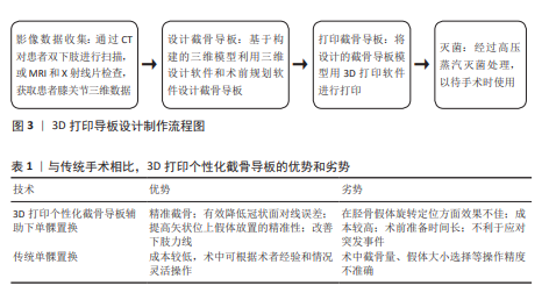
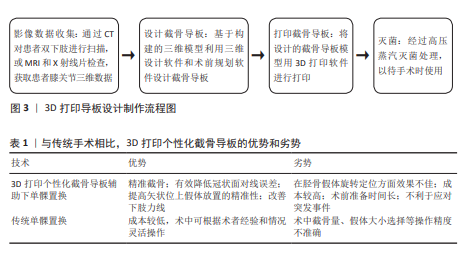
2.1 3D打印个性化截骨导板的制作方法 2.1.1 影像数据收集 通过CT对患者双下肢进行扫描,或MRI和X射线片检查,获取患者膝关节三维数据。 2.1.2 构建三维模型 将CT数据导入图像处理软件(例如Mimics,是目前使用最广泛和最全面的软件之一)利用阈值分析法进行骨骼分离和重建,构建三维模型(无肌肉软骨,只保留骨赘和骨骼特征)[17]。 2.1.3 设计截骨导板 基于构建的三维模型利用三维设计软件(例如Greo)确定机械轴、截骨位置、截骨平面及截骨的角度等。利用术前规划软件模拟设计截骨导板模型和进行虚拟假体置入,可在人工智能的辅助下,设计好的导板分为3个部分[18],分别为胫骨平台截骨导板、股骨前髁截骨导板、股骨后髁截骨导板,每个导板上均设计有固定的定位钉通道。 2.1.4 3D打印截骨导板 将设计的截骨导板模型用3D打印软件(例如Magics)打印出来,并经过高压蒸汽灭菌处理,以待手术时使用[19]。 2.1.5 打印模型材料 由于3D打印个性化截骨导板需要与人体组织直接接触,所以对该材料的要求较高,材料要能够安全应用于人体,且要有生物兼容性、可灭菌性、一定的强度及精密度等[20-21]。常见的材料有光敏树脂,金属(例如钛合金)、医用尼龙、聚十二内酰胺、聚乳酸丝和丙烯腈-丁二烯共聚物等。 3D打印导板设计制作流程图,见图3。 2.2 3D打印个性化截骨导板提升单髁置换手术精度分析 在传统的单髁置换手术过程中,由于受到术者主、客观因素的影响,且在传统单髁置换中使用的截骨工具是根据欧美人群的解剖特点设计的,对于中国人群适用性存在一定的限制,容易导致术中截骨量、假体大小选择等操作精度不准确。而3D打印个性化截骨导板可以有效实现精准化个性截骨,通过省去髓内定位步骤和截骨量的手动测量,并根据中国人群所特有的解剖特征进行定制截骨导板,避免套用欧美标准工具导致的误差,弥补操作设备带来的不足,显著提高假体安装的精准性,见表1。 3D打印个性化截骨导板能有效降低冠状面对线误差。郭东辉等[22]通过测量术后假体放置角度与目标值的差值以考察手术精确性,结果表明3D打印个性化截骨导板辅助下的股骨假体内外翻角(A角)和胫骨假体内外翻角(E角)可分别稳定在(1.50±1.30)°和(2.65±1.83)°,优于传统单髁置换手术效果,此结论在孙旭东等[23]通过一项随机对照试验对比 3D打印个性化截骨导板技术辅助单髁置换和传统单髁置换的胫骨假体和股骨假体安放的角度的研究中进一步证实,两者的结果均有效证明3D打印个性化截骨导板技术可提高胫骨假体和股骨假体在冠状面的精准性。 3D打印个性化截骨导板也能改善矢状位上假体放置的精准性。一项研究对比了3D打印辅助单髁置换(试验组)和传统手术(对照组)术后假体各角的偏差值,数据表明试验组上述各值均小于对照组 [24]。孟祥宇等[16]通过比较3D打印个性化截骨导板组和非3D打印个性化截骨导板组假体位置安装的准确性,发现3D打印个性化截骨导板组不仅在冠状位上假体内外翻更优,而且在矢状位上股骨假体的屈曲角度及胫骨假体的后倾上也都有明显的优势,甚至胫骨后倾角的偏差值可有效控制在2°以内。马鹏程等[25]在一项应用3D打印个性化截骨导板对单髁置换手术效果影响的Meta分析中也显示,3D打印个性化截骨导板与传统截骨导板相比可以有效减少胫骨假体矢状面的位置偏差,更好地辅助胫骨假体定位。 在下肢力线改善上,也有研究发现术后下肢力线和术前相比均得到明显的改善,患者术后腿部畸形得以矫正,下肢机械轴恢复至中心附近且关节间隙恢复至正常宽度,治疗效果良好[16,26]。在以往研究中也表明3D打印个性化截骨导板工具可以在单髁置换中实现较高准确度的假体定位和较优的下肢力线改善,并且达到与机器人辅助单髁置换相当的结果[27]。但是在胫骨假体旋转定位上,3D打印个性化截骨导板并没有表现出特别明显的优势。一项前瞻性研究表明,虽然在单髁置换中3D打印个性化截骨导板技术是可靠有效的,它能准确地将术前计划转化为体内实际情况,但在胫骨旋转位置方面除外,效果并不理想[28]。 因此,3D打印个性化截骨导板对单髁置换中实现精准截骨、提高假体放置的精准性(如冠状面对线误差降低至约2°、胫骨后倾角偏差控制到2°以内等)、改善下肢力线方面具有积极的影响,使假体位置安装更加精准和个体化;但在胫骨旋转这个特定参数上仍需进一步优化或结合术中其他技术(如间隙平衡、骨性标志)来确保最佳效果。"
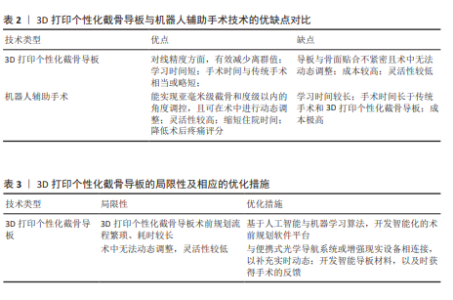
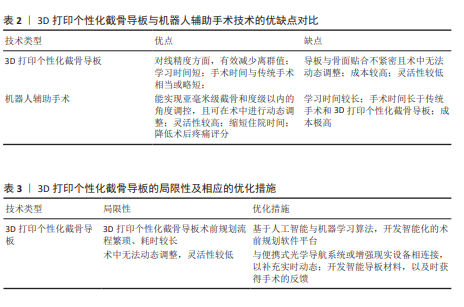
2.3 3D打印个性化截骨导板技术改善单髁置换后中长期疗效分析 假体生存率是衡量3D打印个性化截骨导板辅助单髁置换中长期疗效的核心指标,假体生存率越高,翻修率即假体在术后数年乃至10年及以上时,因无菌性松动、磨损、感染及对线不良等原因需要再次行手术翻修的百分比越低。单髁置换在治疗单髁膝关节炎方面具有很大的优势,但多项研究表明其翻修率却高于全膝关节置换术。这主要源于单髁置换的手术精度和难度高于全膝关节置换术[5,29-31],在术中轻微的手术偏差都可能导致术后一系列问题的出现,单髁置换引起翻修的不良反应主要是无菌性松动[32-34]、胫骨截骨不精准下肢力线恢复不良使对侧间室骨关节炎进展[35]、衬垫脱位、感染及不明原因疼痛等原因,其中假体位置不良引起的无菌性松动被确定为单髁置换失败的主要原因[36-38]。因此,手术技术也是导致单髁置换失败的一个重要因素,在手术过程中要精心操作保证截骨导板和钻孔导向器位置放置正确,实现精确截骨和理想的假体对位,才能有效降低单髁置换的翻修率,提升中长期疗效。3D打印个性化截骨导板技术可以有效地提高单髁置换手术操作中的精确性,提高假体定位精度,减少患者的不良反应[39-40]。 同时,一项回顾性分析了500多例使用3D打印个性化截骨导板行单髁置换的研究中表明5年后假体的生存率为96%,其中30个外侧膝关节的4年存活率为100%,相比于传统的单髁置换翻修率有明显降低[41]。下面文章从延长假体寿命和减少术后不良反应两个方面进行中长期疗效分析。 2.3.1 优化生物力学环境,延长假体寿命 假体的精准对位和安装以及下肢力线恢复,是确保膝关节负荷接近生理状态的关键[42-43]。如前所述3D打印个性化截骨导板技术可提升单髁置换手术精度,进而使患者膝关节的生物力学状态接近正常生理状态,从而有效延长假体的使用寿命。 提升股骨及胫骨假体的匹配率,降低边缘载荷与聚乙烯磨损:在单髁置换中,理想的假体对线应确保载荷通过假体中心均匀传导,避免应力集中于边缘区域。体外力学测试与有限元分析(FEA)均证实,对线存在较大偏差是造成局部应力集中并加速聚乙烯磨损的主要原因[44], 3D打印个性化截骨导板通过精准调控股骨及胫骨假体对线,实现更佳的对线效果,从而分散应力,降低边缘载荷与聚乙烯磨损。这不仅有效延长假体的寿命,也从力学机制上为提升单髁置换的长期疗效提供了可靠支持[45-46]。 精准的恢复解剖结构,保障假体功能稳定:单髁置换核心优势在于最大限度地保留了膝关节的生理解剖结构与生物力学特性,恢复膝关节生病前的生理运动状态,这样更加符合生理解剖,减少矛盾运动和异常磨损,有助提升假体的生存率[31,47]。首先,3D打印个性化截骨导板辅助单髁置换可以通过术前精准规划精确计算截骨量、术中精准操作,以恢复并维持关节线的生理高度;研究证实,关节线位置的异常改变(尤其是抬高),会显著影响膝关节周围韧带张力平衡与髌股关节的应力分布,是导致术后关节功能障碍与疼痛的重要原因之一[33],并建议控制单髁置换假体关节线误差为-2 mm至2 mm,从而降低内侧单髁置换假体失效风险和外侧软骨退化风险,为长期稳定奠定力学基础。其次,3D打印个性化截骨导板支持个体化重建优化髌骨运动轨迹。基于患者术前三维重建数据,3D打印个性化截骨导板可精确设定股骨假体的旋转对位和适宜的外翻角度,并辅助矫正下肢力线,这些措施共同优化了髌骨关节的运动轨迹,减少关节内矛盾运动,有助于提升关节功能持久性、延缓磨损,进而延长假体使用寿命[43-45]。 2.3.2 减少术后不良反应 多项研究显示,3D打印个性化截骨导板技术可以直接降低单髁置换后中长期不良反应的发生风险[41]。单髁置换中伸屈膝间隙不平衡、股骨或胫骨假体位置放置不当、对线存在较大偏差,将直接导致术后长期随访时更易出现关节半脱位、聚乙烯磨损、假体周围骨折、假体松动、对侧间室病变等不良反应[36-38,48],3D打印个性化截骨导板技术凭借其个体化、精准性等上述诸多优势,能显著减少患者术后相关的不良反应,降低翻修率[49]。一项回顾性研究显示,采用3D打印个性化截骨导板的患者术后因无菌性松动、骨关节炎进展等原因导致的假体翻修率显著低于传统手术组,此外,平均随访4.8年后,3D打印个性化截骨导板组的假体生存率可高达97.9%。这表明3D打印个性化截骨导板技术通过减少关键不良反应,为维持假体长期稳定、提升远期疗效提供了可靠保障[50]。 2.4 3D打印个性化截骨导板相关研究、争议与挑战分析 尽管3D打印个性化截骨导板技术在单髁置换中的优势提示其未来可能具有良好的发展前景,但远期临床获益仍有许多争议,该技术的广泛应用仍存在诸多挑战,需开展大量的临床研究进一步验证。 首先,3D打印个性化截骨导板辅助行单髁置换作为一种新兴技术,现有研究多为回顾性队列研究或2-5年的前瞻性研究,如前所述,虽大量的文献已证实其可提升单髁置换假体的精度,通过理论分析可得3D打印个性化截骨导板能改善单髁置换的远期疗效,但目前仅有少量远期疗效研究,仍缺乏大量高质量研究如长期随访的随机对照试验等直接有力证据进一步证实其疗效。 其次,和传统手术相比,3D打印个性化截骨导板辅助单髁置换在术后近期临床评分等功能中并未表现出很明显的优势[51-52],并且3D打印个性化截骨导板会增加患者的花费,一项研究发现3D打印个性化截骨导板技术非但没有降低成本,反而使每例手术的成本增加了近 1 300 美元,分析原因可能和时间成本增加、导板费用以及 CT扫描的额外支出有关[53]。因此,从上述数据来看,3D打印个性化截骨导板能显著提高假体安放的精准度和可重复性,大幅度减少术中对线不良的发生,但是从患者主观感受和关节功能恢复角度分析,3D打印个性化截骨导板技术并未实现真正的临床获益,这也是这项技术未得到广泛应用的原因之一。未来若有明确的直接证据证实其对单髁置换后患者的远期疗效显著,那么随着3D打印个性化截骨导板 的性价比得到提高,则这一方面不会阻碍其广泛应用。 再次,3D打印个性化截骨导板与机器人辅助手术临床疗效比较仍是当前该领域面临的争议话题,两项技术的优缺点对比,见表2。多项研究指出,机器人辅助手术在实现精准、可重复的假体对线方面具有明确优势[54-56]。例如,一项系统综述的数据显示,与传统手术相比,机器人辅助的单髁置换具有诸多好处,包括缩短住院时间、降低术后疼痛评分和改善功能结果[57]。然而,高昂的设备与专用耗材造成机器人辅助手术成本极高,且由手术时间延长(平均延长15-30 min)和临床医生需反复练习机器人辅助手术才能熟练掌握(通常20-30次手术)而产生的时间成本亦不容忽视[58]。3D打印个性化截骨导板和机器人辅助手术两种技术各有利弊,需综合权衡,二者在远期临床疗效方面是否存在显著差异,仍需开展长期随访的随机对照试验进行进一步的验证。 最后,3D打印个性化截骨导板技术的成功实施高度依赖于精准的影像学(CT/MRI)数据采集、高质量的影像分割与三维重建以及合理的术前数字化规划,其中任一环节出现偏差均可能导致导板的匹配不佳[18-19]。并且这个过程常需要数天完成,术前准备长,延长住院周期,也是限制其使用的因素。因此,临床医生需认真学习并系统掌握该工作流程,并充分理解其临床局限性。"
| [1] MA W, CHEN H, YUAN Q, et al. Global, regional, and national epidemiology of osteoarthritis in working-age individuals: insights from the global burden of disease study 1990-2021. Sci Rep. 2025;15(1):7907. [2] HUNTER DJ, BIERMA-ZEINSTRA S. Osteoarthritis. Lancet. 2019;393(10182):1745-1759. [3] COURTIES A, KOUKI I, SOLIMAN N, et al. Osteoarthritis year in review 2024: epidemiology and therapy. Osteoarthritis Cartilage. 2024;32(11):1397-1404. [4] 王成岩,安静楠,刘畅,等.1990至2019年中国不同部位骨关节炎疾病负担的年龄-时期-队列分析[J].中国骨与关节杂志, 2024,13(8):614-620. [5] XIA K, MIN L, XIE W, et al. Is unicompartmental knee arthroplasty a better choice than total knee arthroplasty for unicompartmental osteoarthritis? A systematic review and meta-analysis of randomized controlled trials. Chin Med J (Engl). 2025;138(13):1568-1577. [6] ZHANG X, HAN Y, BAI Q, et al. Clinical efficacy of unicompartmental knee arthroplasty on limb swelling, pain, and functional rehabilitation in knee osteoarthritis patients. J Orthop Surg Res. 2025;20(1):616. [7] JIANG Y, LIU C, ZHANG Q, et al. Restoring coronal pre-arthritic alignment in mobile-bearing unicompartmental knee arthroplasty: mid- to long-term outcomes. BMC Musculoskelet Disord. 2025;26(1):124. [8] JIAO XF, AN S, CAO GL, et al. Research progress of three-dimensional printed guides in unicompartmental knee arthroplasty. Zhonghua Wai Ke Za Zhi. 2021;59(6):550-554. [9] RAUCK RC, BLEVINS JL, CROSS MB. Component placement accuracy in unicompartmental knee arthroplasty is improved with robotic-assisted surgery: will it have an effect on outcomes? HSS J. 2018;14(2):211-213. [10] 余浪波,彭笳宸.3D打印个性化截骨导板在全膝关节置换术中的研究进展[J].东南国防医药, 2020,22(4):403-407. [11] 张衡,赵建宁,周建生.机器人辅助关节置换临床应用现状与展望[J].中国骨伤,2025, 38(10): 981-986. [12] PUMFORD AD, SALMONS HI, LEDFORD CK, et al. Unicompartmental knee arthroplasty revisions to total knee arthroplasty: good outcomes at mid-term follow-up. Bone Joint J. 2025;107-b(12):1281-1287. [13] SEVER GB, CANKUŞ C. The long-term results of cemented Oxford unicompartmental knee arthroplasty: a single-center experience. Eklem Hastalik Cerrahisi. 2019;30(3):233-240. [14] LEE HJ, XU S, LIOW MHL, et al. Unicompartmental knee arthroplasty in obese patients, poorer survivorship at 15 years. J Orthop. 2024;53:156-162. [15] 郭东辉,董军,马世强,等.三维PSI导板辅助单髁置换治疗膝骨性关节炎[J].西部医学. 2021,33(8):1189-1193. [16] 孟祥宇,王志学,吴鹏,等.个性化截骨导板辅助人工膝关节单髁置换的临床疗效[J].中华骨科杂志,2024,44(22):1441-1449. [17] GU F, LI L, ZHANG H, et al. Three-dimensional-printed guiding template for unicompartmental knee arthroplasty. Biomed Res Int. 2020;2020: 7019794. [18] 明朝畅,冯家威,裴鸿鑫,等.3D打印个体化导板辅助下固定平台单髁置换治疗膝骨关节炎的早期临床疗效[J].骨科,2025, 16(1):14-19. [19] 樊宗庆,聂宇,符东林,等.3D打印截骨导板在膝关节单髁置换中的应用[J].中华全科医学,2018,16(7):1085-1087,1215. [20] MAMO HB, ADAMIAK M, KUNWAR A. 3D printed biomedical devices and their applications: a review on state-of-the-art technologies, existing challenges, and future perspectives. J Mech Behav Biomed Mater. 2023;143105930. [21] QU Z, YUE J, SONG N, et al. Innovations in three-dimensional-printed individualized bone prosthesis materials: revolutionizing orthopedic surgery: a review. Int J Surg. 2024;110(10):6748-6762. [22] 郭东辉,马世强,董军,等.3D打印个性化截骨模块导板辅助单髁膝关节置换术的临床疗效[J].临床骨科杂志,2022,25(3):368-373. [23] 孙旭东,邵安泽,顾飞,等.3D打印个性化截骨模块导板辅助膝关节单髁置换治疗骨关节炎的临床效果[J].医学研究与战创伤救治,2025,38(2):180-185. [24] 胡家乐,蔚涛,曹志,等.3D打印辅助单髁置换手术对膝骨关节炎患者手术相关指标及膝关节活动度的影响[J].临床医学工程,2025,32(8):895-898. [25] 马鹏程,张思平,柴浩,等.单髁置换中应用3D打印导板对手术效果的影响[J].中华关节外科杂志(电子版),2023,17(1):35-43. [26] 顾飞,姚庆强,刘帅,等.3D打印截骨导板在膝关节单髁置换中的应用[J].中国数字医学,2020,15(6):97-100. [27] CAO G, DU M, LI Z, et al. Novel patient-specific instrument with comparable accuracy to robotic assistance in medial unicompartmental knee arthroplasty: a prospective study. Int J Surg. 2025;111(7):4487-4494. [28] KERENS B, LEENDERS AM, SCHOTANUS MGM, et al. Patient-specific instrumentation in Oxford unicompartmental knee arthroplasty is reliable and accurate except for the tibial rotation. Knee Surg Sports Traumatol Arthrosc. 2018;26(6):1823-1830. [29] EL-GALALY A, KAPPEL A, NIELSEN PT, et al. Revision risk for total knee arthroplasty converted from medial unicompartmental knee arthroplasty: comparison with primary and revision arthroplasties, based on mid-term results from the danish knee arthroplasty registry. J Bone Joint Surg Am. 2019;101(22):1999-2006. [30] TAY ML, YOUNG SW, FRAMPTON CM, et al. The lifetime revision risk of unicompartmental knee arthroplasty. Bone Joint J. 2022;104-b(6): 672-679. [31] BUNYOZ KI, LINDBERG-LARSEN M, GROMOV K, et al. Optimising outcomes in lateral unicompartmental knee arthroplasty: analysing 25 years of registry data. Knee Surg Sports Traumatol Arthrosc. 2025;33(12):4324-4334. [32] MIGLIORINI F, MAFFULLI N, KäMMER D, et al. Coronal axis deviations in medial unicompartmental knee arthroplasty failures: an imaging study of patients revised for aseptic loosening. Eur J Med Res. 2025;30(1):832. [33] SZYMSKI D, STRAUB J, WALTER N, et al. Revision of unicondylar knee arthroplasty: an analysis of failure rates and contributing factors. Knee Surg Relat Res. 2025;37(1):25. [34] STRAUB J, SZYMSKI D, WALTER N, et al. Unicondylar knee arthroplasty demonstrating a significant increased risk for aseptic revisions compared to unconstrained and constrained total knee arthroplasty: an analysis of aseptic revisions after unicondylar and primary total knee arthroplasty of the German Arthroplasty Registry. Knee Surg Sports Traumatol Arthrosc. 2024;32(7):1775-1784. [35] 李昭阳,马童.膝关节单髁置换后对侧间室进展性骨关节炎的研究进展[J].中华关节外科杂志(电子版),2025,19(1):88-93. [36] MIGLIORINI F, BOSCO F, SCHäFER L, et al. Revision of unicompartmental knee arthroplasty: a systematic review. BMC Musculoskelet Disord. 2024;25(1):985. [37] SANG W, QIU H, XU Y, et al. Malposition is main cause of failure of Oxford mobile-bearing medial unicompartmental knee arthroplasty. Bone Jt Open. 2023;4(12):914-922. [38] ZHAO JL, JIN X, HUANG HT, et al. Analysis of the causes of primary revision after unicompartmental knee arthroplasty: a case series. World J Clin Cases. 2024;12(9): 1560-1568. [39] 王煜东,汪利合,孙明帅,等.单髁置换后假体周围骨折的危险因素及防治措施的研究进展[J].实用临床医药杂志,2022,26(14): 144-148. [40] 谭红略,于进洋,王啸,等.膝关节活动平台单髁置换后衬垫脱位研究进展[J].国际骨科学杂志,2022,43(5):267-271. [41] WEBER P, BECK M, KLUG M, et al. Survival of patient-specific unicondylar knee replacement. J Pers Med. 2023;13(4):665. [42] 钱利海,张辉,张瑞祥,等.运动学对线牛津3代单髁置换后下肢力线的影响因素分析[J].实用骨科杂志,2025,31(10):878-882. [43] 程宇翔,陈歌,陈建,等.膝骨关节炎单髁置换后下肢冠状位力线对早期临床效果的影响[J].骨科,2022,13(3):198-203,211. [44] 党晓栋,熊守林,屈亚飞,等.UKA假体后倾角安装位置对衬垫磨损的影响[J].医用生物力学,2024,39(2):236-242. [45] 李相伟,丁晶,甘煜东.个体化导航模板在Oxford单髁置换股骨和胫骨假体定位中的应用[J].中华骨科杂志,2018,38(3):172-178. [46] 王子呓,叶永杰,孙官军,等.胫骨平台不同内侧髁间棘线悬出对单髁置换应力分布的有限元分析[J].实用骨科杂志,2024, 30(5):454-459. [47] NWANKWO TN, LI KK, PARKS NL, et al. Outcomes and implant survival in lateral unicompartmental knee arthroplasty: the path less traveled. J Arthroplasty. 2025. doi: 10.1016/j.arth.2025.10.050. [48] 王鸿宇,王妍,杨瑞祥,等.微创第三代牛津单髁置换治疗膝关节内侧间室骨关节病的远期效果随访[J].中华外科杂志, 2022;60(7):703-708. [49] DENG Y, BAI XW, ZHAO Z. Evaluation of early efficacy of computer-assisted production of patient specific instrumentation osteotomy plate in unicompartmental knee arthroplasty. Zhongguo Gu Shang. 2025;38(7):687-692. [50] PUMILIA CA, SCHROEDER L, SARPONG NO, et al. Patient satisfaction, functional outcomes, and implant survivorship in patients undergoing customized unicompartmental knee arthroplasty. J Pers Med. 2021;11(8):753. [51] FLURY A, HASLER J, DIMITRIOU D, et al. Midterm clinical and radiographic outcomes of 115 consecutive patient-specific unicompartmental knee arthroplasties. Knee. 2019;26(4):889-896. [52] LEENDERS AM, KORT NP, KOENRAADT KLM, et al. Patient-specific instruments do not show advantage over conventional instruments in unicompartmental knee arthroplasty at 2 year follow-up: a prospective, two-centre, randomised, double-blind, controlled trial. Knee Surg Sports Traumatol Arthrosc. 2022; 30(3):918-927. [53] THAYAPARAN GK, OWBRIDGE MG, LINDEN M, et al. Measuring the performance of patient-specific solutions for minimally invasive transforaminal lumbar interbody fusion surgery. J Clin Neurosci. 2020;71:43-50. [54] 曹正,孔祥朋,李小娅,等.MAKO机器人辅助膝关节内侧单髁置换的中期疗效[J].中华骨与关节外科杂志,2024,17(5):437-443. [55] 冯文杰,林宇宁,邓海棠,等.天玑机器人辅助膝关节单髁置换的应用研究[J].中国医药科学,2025,15(20):129-133,153. [56] ANDRIOLLO L, BENAZZO F, CINELLI V, et al. The use of an imageless robotic system in revision of unicompartmental knee arthroplasty. Knee Surg Sports Traumatol Arthrosc. 2025; 33(5):1792-1803. [57] ITURRIAGA C, SALEM HS, EHIOROBO JO, et al. Robotic-assisted versus manual unicompartmental knee arthroplasty: a systematic review. Surg Technol Int. 2020;37: 275-279. [58] FU X, SHE Y, JIN G, et al. Comparison of robotic-assisted total knee arthroplasty: an updated systematic review and meta-analysis. J Robot Surg. 2024;18(1):292. [59] LIU S, YANG S, LIU G. 3D-printed patient-specific instruments-combined ai virtual preoperative planning-assisted medial fixed-bearing unicompartmental knee arthroplasty. J Vis Exp. 2025. doi: 10.3791/69472. [60] CORNEJO J, CORNEJO-AGUILAR JA, VARGAS M, et al. Anatomical engineering and 3D Printing for surgery and medical devices: international review and future exponential innovations. Biomed Res Int. 2022;2022:6797745. [61] JONES GG, CLARKE S, JAERE M, et al. 3D printing and unicompartmental knee arthroplasty. EFORT Open Rev. 2018;3(5): 248-253. [62] MENG M, WANG J, SUN T, et al. Clinical applications and prospects of 3D printing guide templates in orthopaedics. J Orthop Translat. 2022;34:22-41. [63] WANG Z, NI J, MAO Z, et al. Survival of lateral unicompartmental knee arthroplasty at short-, mid-, and long-term follow-up: a systematic review and meta-analysis. ANZ J Surg. 2023; 93(4):980-988. [64] MARSILIO L, FAGLIA A, ROSSI M, et al. CEL-Unet: a novel CNN architecture for 3D segmentation of knee bones affected by severe osteoarthritis for psi-based surgical planning. Annu Int Conf IEEE Eng Med Biol Soc. 2022;2022:5039-5042. [65] YU H, DONG J, WANG L, et al. AI-driven CT-MRI image fusion and segmentation for automatic preoperative planning of ACL reconstruction: development and application. J Bone Joint Surg Am. 2026;108(4):249-250. |
| [1] | Liu Jinlong, Abuduwupuer·Haibier, Bai Zhen, Su Danyang, Miao Xin, Li Fei, Yang Xiaopeng. Efficacy of different nonsurgical treatments for adolescent idiopathic scoliosis: a systematic review and network meta-analysis [J]. Chinese Journal of Tissue Engineering Research, 2026, 30(9): 2370-2379. |
| [2] | Wu Hongxu, Liu Xuanyu, Wang Taoyu, Wang Shiyao, Cheng Jingyi, Zhang Mingwen, Zhang Yinxia, Liu Zhihua, Wang Xiaojie. Finite element simulation of scoliosis with muscle unit introduction: verification of correction effect under bidirectional load [J]. Chinese Journal of Tissue Engineering Research, 2026, 30(9): 2172-2181. |
| [3] | Zhang Zizheng, Luo Wang, Liu Changlu. Application value of finite element analysis on unicompartmental knee arthroplasty for medial knee compartmental osteoarthritis [J]. Chinese Journal of Tissue Engineering Research, 2026, 30(9): 2313-2322. |
| [4] | Liu Wenlong, Dong Lei, Xiao Zhengzheng, Nie Yu. Finite element analysis of tibial prosthesis loosening after fixed-bearing unicompartmental knee arthroplasty for osteoporosis [J]. Chinese Journal of Tissue Engineering Research, 2026, 30(9): 2191-2198. |
| [5] | Yang Qiongqiong, Liu Wei. Comparison of performance and clinical effects of zirconia and titanium implants [J]. Chinese Journal of Tissue Engineering Research, 2026, 30(8): 2063-2071. |
| [6] | Zhou Hongli, Wang Xiaolong, Guo Rui, Yao Xuanxuan, Guo Ru, Zhou Xiongtao, He Xiangyi. Fabrication and characterization of nanohydroxyapatite/sodium alginate/polycaprolactone/alendronate scaffold [J]. Chinese Journal of Tissue Engineering Research, 2026, 30(8): 1962-1970. |
| [7] | Wang Qisa, Lu Yuzheng, Han Xiufeng, Zhao Wenling, Shi Haitao, Xu Zhe. Cytocompatibility of 3D printed methyl acrylated hyaluronic acid/decellularized skin hydrogel scaffolds [J]. Chinese Journal of Tissue Engineering Research, 2026, 30(8): 1912-1920. |
| [8] | Wang Zhenze, Liu Fende, Zhang Rui, Li Wujun. Mesenchymal stem cells in treatment of arteriosclerosis obliterans of lower extremities: systematic review and meta-analysis [J]. Chinese Journal of Tissue Engineering Research, 2026, 30(7): 1869-1876. |
| [9] | Li Guan, Wang Haopeng, Wang Jinbao, Song Xinhao, Qin Guochu, Shao Yang. Feasibility of optimizing radiation dose for three-dimensional printing of the maxillofacial bone based on low-dose CT technology [J]. Chinese Journal of Tissue Engineering Research, 2026, 30(6): 1384-1389. |
| [10] | Zhou Jian, Zhang Tao, Zhou Weili, Zhao Xingcheng, Wang Jun, Shen Jie, Qian Li, Lu Ming. Effects of resistance training on quadriceps mass and knee joint function in patients with osteoporosis and sarcopenia [J]. Chinese Journal of Tissue Engineering Research, 2026, 30(5): 1081-1088. |
| [11] | Wu Ruiqi, Dong Panfeng, Zhang Hongrui, Lyu Yongbin, Peng Qinglin, Zhuo Yinghong, Chen Yueping . Different physical factor therapies for knee osteoarthritis: a network meta-analysis of efficacy and safety [J]. Chinese Journal of Tissue Engineering Research, 2026, 30(34): 9056-9066. |
| [12] | Zhang Zhanyue, Zhao Lijun, Zhang Chunyang, Zhang Zhongqi, Fu Kang, Zhang Zhihong. Application and development of polyetheretherketone material in skull defect repair [J]. Chinese Journal of Tissue Engineering Research, 2026, 30(32): 8569-8576. |
| [13] | Yang Ping, Qi Xiaoyang, Lei Zhijie, Chen Yixin, Qiu Xusheng. Novel collagen membrane in repairing skull bone defects in rats [J]. Chinese Journal of Tissue Engineering Research, 2026, 30(32): 8364-8371. |
| [14] | Liu Fang, Hu Haimin, Song Dan, Nan Jie, Cai Xiaoxiao, He Qingrui, Lian Ruijiao, Luo Lin, Yuan Chunhui. Human umbilical cord-derived mesenchymal stem cells to treat osteoarthritis in rats: dual effect of relieving pain and protecting cartilage [J]. Chinese Journal of Tissue Engineering Research, 2026, 30(31): 8108-8115. |
| [15] | Wang Yalei, Wang Xuezhi, Zhou Tao, Shen Xinxin, Fang Ding, Chen Hongliang. Effect of sacroiliac joint ankylosis on outcomes of L5/S1 transforminal lumbar interbody fusion and lumbar sagittal parameters [J]. Chinese Journal of Tissue Engineering Research, 2026, 30(3): 634-641. |
| Viewed | ||||||
|
Full text |
|
|||||
|
Abstract |
|
|||||