Chinese Journal of Tissue Engineering Research ›› 2026, Vol. 30 ›› Issue (36): 9597-9603.doi: 10.12307/2026.916
Previous Articles Next Articles
Protective effect of kaempferol against renal injury in lupus nephritis
Zhang Bo1, Zhao Jingjing1, Li Wenting2, Kong Jie1
- 1Department of Rheumatology and Immunology, 2Department of Infectious Diseases, The First People’s Hospital of Nantong, Nantong 226500, Jiangsu Province, China
-
Received:2025-11-06Revised:2026-03-17Online:2026-12-28Published:2026-05-25 -
Contact:Kong Jie, MS, Physician, Department of Rheumatology and Immunology, The First People’s Hospital of Nantong, Nantong 226500, Jiangsu Province, China -
About author:Zhang Bo, MS, Physician, Department of Rheumatology and Immunology, The First People’s Hospital of Nantong, Nantong 226500, Jiangsu Province, China -
Supported by:Nantong Municipal Health Commission Scientific Research Project, No. QN2023013 (to KJ)

CLC Number:
Cite this article
Zhang Bo, Zhao Jingjing, Li Wenting, Kong Jie. Protective effect of kaempferol against renal injury in lupus nephritis[J]. Chinese Journal of Tissue Engineering Research, 2026, 30(36): 9597-9603.
share this article
Add to citation manager EndNote|Reference Manager|ProCite|BibTeX|RefWorks
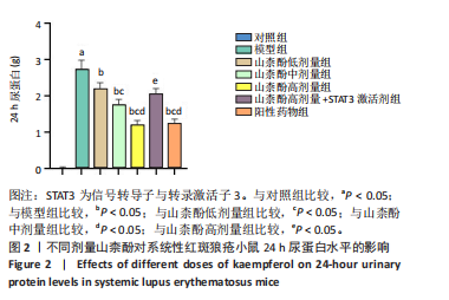
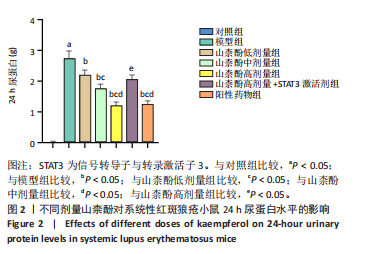
2.1 实验动物数量分析 72只MRL/lpr小鼠与12只C57BL/6小鼠全部进入结果分析。 2.2 不同剂量山柰酚对MRL/lpr小鼠24 h尿蛋白水平的影响 与对照组比较,模型组小鼠24 h尿蛋白水平升高(P < 0.05);与模型组比较,山柰酚低、中、高剂量组与阳性药物组小鼠24 h尿蛋白水平降低(P < 0.05);山柰酚高剂量组小鼠24 h尿蛋白水平低于山柰酚低、中剂量组(P < 0.05),山柰酚中剂量组小鼠24 h尿蛋白水平低于山柰酚低剂量组(P < 0.05),山柰酚高剂量组与阳性药物组小鼠24 h尿蛋白水平比较差异无显著性意义(P > 0.05),山柰酚高剂量+STAT3激活剂组小鼠24 h尿蛋白水平高于山柰酚高剂量组(P < 0.05),见图2。"
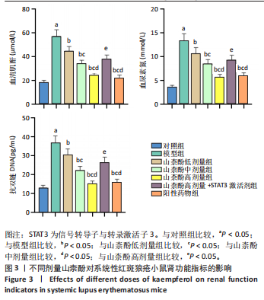
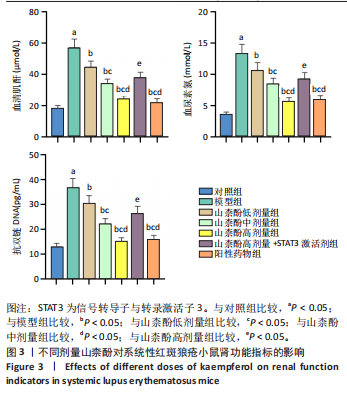
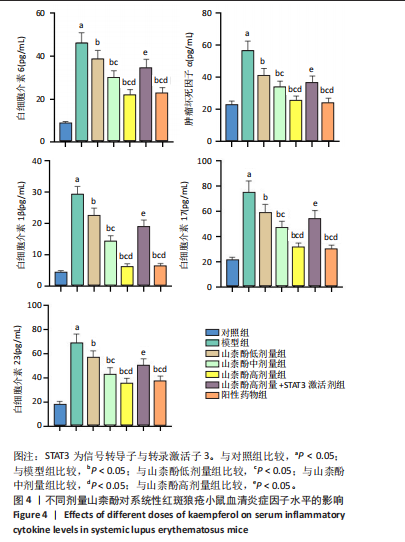
2.3 不同剂量山柰酚对MRL/lpr小鼠肾功能指标的影响 与对照组比较,模型组小鼠血清肌酐、血尿素氮、抗双链DNA水平上升(P < 0.05);与模型组比较,山柰酚低、中、高剂量组与阳性药物组小鼠血清肌酐、血尿素氮、抗双链DNA水平下降(P < 0.05);山柰酚高剂量组小鼠血清肌酐、血尿素氮、抗双链DNA水平低于山柰酚低、中剂量组(P < 0.05),山柰酚中剂量组小鼠血清肌酐、血尿素氮、抗双链DNA水平低于山柰酚低剂量组(P < 0.05),山柰酚高剂量组与阳性药物组小鼠血清肌酐、血尿素氮、抗双链DNA水平比较差异无显著性意义(P > 0.05),山柰酚高剂量+STAT3激活剂组小鼠血清肌酐、血尿素氮、抗双链DNA水平高于山柰酚高剂量组(P < 0.05),见图3。 2.4 不同剂量山柰酚对MRL/lpr小鼠血清炎症因子的影响 与对照组比较,模型组白细胞介素6、肿瘤坏死因子α、白细胞介素"
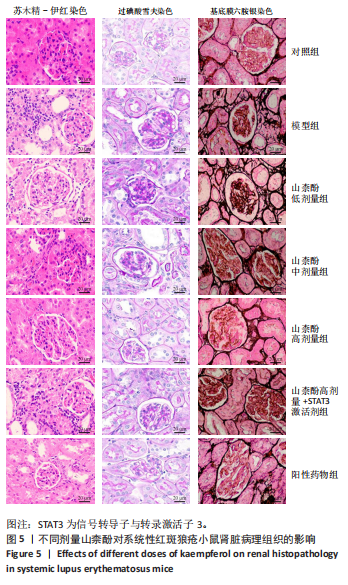
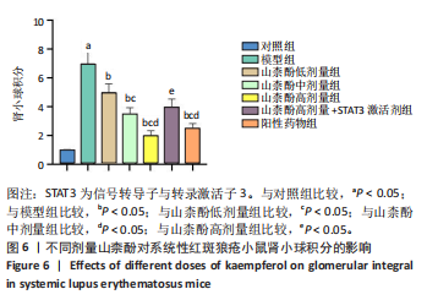
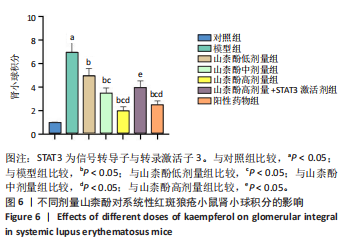
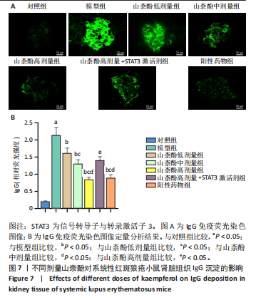
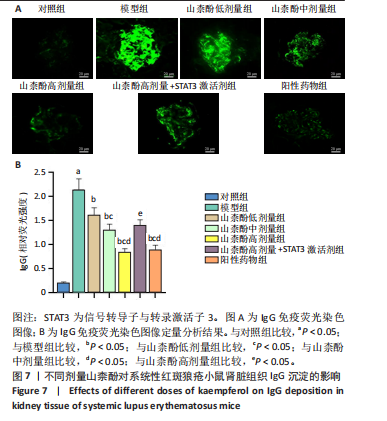
1β、白细胞介素17、白细胞介素23水平上升(P < 0.05);与模型组比较,山柰酚低、中、高剂量组与阳性药物组上述指标水平降低(P < 0.05);山柰酚高剂量组上述指标水平低于山柰酚低、中剂量组(P < 0.05),山柰酚中剂量组上述指标水平低于山柰酚低剂量组(P < 0.05),山柰酚高剂量组与阳性药物组上述指标比较差异无显著性意义(P > 0.05),山柰酚高剂量+STAT3激活剂组上述指标水平高于山柰酚高剂量组(P < 0.05),见图4。 2.5 不同剂量山柰酚对MRL/lpr小鼠小鼠肾脏病理组织的影响 苏木精-伊红、过碘酸雪夫与基底膜六胺银染色显示,与对照组比较,模型组小鼠肾小球出现硬化、增生,周围出现炎症细胞浸润,肾小球球囊粘连,基底膜均质增厚,系膜细胞、基质增生,肾小球积分增加(P < 0.05);与模型组比较,山柰酚低、中、高剂量组与阳性药物组小鼠肾小球周围炎症减轻,肾小球系膜细胞和基质增生明显改善,肾小球积分减少(P < 0.05),山柰酚高剂量组肾小球积分低于山柰酚低、中剂量组,山柰酚中剂量组肾小球积分低于山柰酚低剂量组(P < 0.05),山柰酚高剂量组与阳性药物组肾小球积分比较差异无显著性意义(P > 0.05);与山柰酚高剂量组相比,山柰酚高剂量+STAT3激活剂组小鼠肾脏病理损伤加重,肾小球积分增加(P < 0.05),见图5,6。 2.6 不同剂量山柰酚对MRL/lpr小鼠肾脏组织IgG沉淀的影响 与对照组比较,模型组IgG沉淀物增多,(P < 0.05);与模型组比较,山柰酚低、中、高剂量组与阳性药物组IgG沉淀物减少(P < 0.05);山柰酚高剂量组IgG沉淀物少于山柰酚低、中剂量组(P < 0.05),山柰酚中剂量组IgG沉淀物少于山柰酚低剂量组(P < 0.05),山柰酚高剂量组与阳性药物组IgG沉淀物比较差异无显著性意义(P > 0.05),山柰酚高剂量+STAT3激活剂组IgG沉淀物多于山柰酚高剂量组(P < 0.05),见图7。"
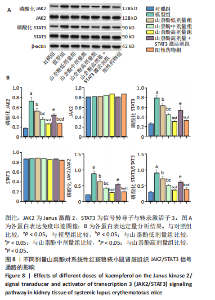
2.7 不同剂量山柰酚对MRL/lpr小鼠肾脏组织JAK2/STAT3信号通路的影响 Western blot检测显示,各组JAK2、STAT3蛋白表达比较差异无显著性意义(P > 0.05);与对照组比较,模型组磷酸化JAK2、磷酸化STAT3、磷酸化JAK2/JAK2、磷酸化STAT3/STAT3蛋白表达上调(P < 0.05);与模型组比较,山柰酚低、中、高剂量组与阳性药物组磷酸化JAK2、磷酸化STAT3、磷酸化JAK2/JAK2、磷酸化STAT3/STAT3蛋白表达下调(P < 0.05);山柰酚高剂量磷酸化JAK2、磷酸化STAT3、磷酸化JAK2/JAK2、磷酸化STAT3/STAT3蛋白表达低于山柰酚低、中剂量组(P < 0.05),山柰酚中剂量组磷酸化JAK2、磷酸化STAT3、磷酸化JAK2/JAK2、磷酸化STAT3/STAT3蛋白表达低于山柰酚低剂量组(P < 0.05),山柰酚高剂量组与阳性药物组磷酸化JAK2、磷酸化STAT3、磷酸化JAK2/JAK2、磷酸化STAT3/STAT3蛋白表达比较差异无显著性意义(P > 0.05),山柰酚高剂量+STAT3激活剂组磷酸化JAK2、磷酸化STAT3、磷酸化JAK2/JAK2、磷酸化STAT3/STAT3蛋白表达高于山柰酚高剂量组(P < 0.05),见图8。"
"
"
"
| [1] PENNESI M, BENVENUTO S. Lupus nephritis in children: novel perspectives. Medicina (Kaunas). 2023;59(10):1841-1865. [2] YU C, LI P, DANG X, et al. Lupus nephritis: new progress in diagnosis and treatment. J Autoimmun. 2022;132(1):102871-102890. [3] KANEKO M, JACKSON SW. Recent advances in immunotherapies for lupus nephritis. Pediatr Nephrol. 2023;38(4):1001-1012. [4] KOSTOPOULOU M, PITSIGAVDAKI S, BERTSIAS G. Lupus nephritis: improving treatment options. Drugs. 2022;82(7):735-748. [5] SHENG H, ZHANG D, ZHANG J, et al. Kaempferol attenuated diabetic nephropathy by reducing apoptosis and promoting autophagy through AMPK/mTOR pathways. Front Med (Lausanne). 2022;9(1):986825-986835. [6] MA J, LI C, LIU T, et al. Identification of markers for diagnosis and treatment of diabetic kidney disease based on the ferroptosis and immune. Oxid Med Cell Longev. 2022;2022(1):9957172-9957193. [7] DAI G, HE Y. Adiponectin alleviated renal cell apoptosis and inflammation via inactivation of JAK2/STAT3 signal pathway in an acute pyelonephritis mouse model. Ann Transl Med. 2021;9(16):1311-1322. [8] TAN Z, LIU Q, CHEN H, et al. Pectolinarigenin alleviated septic acute kidney injury via inhibiting Jak2/Stat3 signaling and mitochondria dysfunction. Biomed Pharmacother. 2023;159(1):114286-114296. [9] 陈卓,刘胜楠,陈光侠,等.山奈酚联合骨髓间充质干细胞治疗溃疡性结肠炎小鼠的疗效及机制[J]. 山东医药,2023,63(17):42-46. [10] 夏芳,万亚琴,胡龙,等.青蒿琥酯通过白细胞介素6/转录激活因子3信号通路对紫癜性肾炎大鼠肾脏保护作用机制研究[J].临床肾脏病杂志,2022, 22(12):1030-1035. [11] 许诣,秦建品,沈文婷.人参皂苷通过NF-κB/NLRP3途径改善狼疮性肾炎小鼠肾损伤[J].中南医学科学杂志,2022,50(6):832-836. [12] 陈晨晨,宋珂,丁樱,等.雷公藤多苷对IgA肾病大鼠肾脏保护及肾组织CB2R/NOX4/NLRP3表达的影响[J].中国药理学通报,2024,40(11):2037-2041. [13] 罗慧臣,胡丹慧,曾宏宇.山茱萸总苷对MRL/lpr狼疮性肾炎小鼠肾炎症反应的改善作用及机制[J]. 安徽医科大学学报,2023,58(10):1689-1694. [14] 马天星,李金田,李娟,等.归芪益元膏通过NLRP3/ASC/caspase-1通路调控12C6+束辐射肺肾旁效应损伤大鼠的机制[J].中华中医药杂志,2024, 39(10):5162-5168. [15] 周颖,张建荣.TLR4信号转导途径在大鼠系膜增生性肾小球肾炎的作用机制探讨[J].中华临床医师杂志(电子版),2013,7(6):4-11. [16] ALDURAIBI FK, TSOKOS GC. Lupus nephritis biomarkers: a critical review. Int J Mol Sci. 2024;25(2):805-827. [17] KWANT LE, VEGTING Y, TSANG-A-SJOE MWP, et al. Macrophages in lupus nephritis: exploring a potential new therapeutic avenue. Autoimmun Rev. 2022; 21(12):103211-103222. [18] AVASARE R, DREXLER Y, CASTER DJ, et al. Management of lupus nephritis: new treatments and updated guidelines. Kidney360. 2023;4(10):1503-1511. [19] PERIFERAKIS A, PERIFERAKIS K, BADARAU IA, et al. Kaempferol: antimicrobial properties, sources, clinical, and traditional applications. Int J Mol Sci. 2022; 23(23):15054-15093. [20] WU Q, CHEN J, ZHENG X, et al. Kaempferol attenuates doxorubicin-induced renal tubular injury by inhibiting ROS/ASK1-mediated activation of the MAPK signaling pathway. Biomed Pharmacother. 2023;157(1):114087-114100. [21] ALRUMAIHI F, ALMATROODI SA, ALHARBI HOA, et al. Pharmacological potential of kaempferol, a flavonoid in the management of pathogenesis via modulation of inflammation and other biological activities. Molecules. 2024;29(9):2007-2047. [22] DONG H, SONG G, WANG Z, et al. Kaempferol as a multifaceted immunomodulator: implications for inflammation, autoimmunity, and cancer. Front Immunol. 2025;16(1):1671519-1671532. [23] XU Z, WANG X, KUANG W, et al. Kaempferol improves acute kidney injury via inhibition of macrophage infiltration in septic mice. Biosci Rep. 2023;43(7): BSR20230873-BSR20230883. [24] YUAN P, SUN X, LIU X, et al. Kaempferol alleviates calcium oxalate crystal-induced renal injury and crystal deposition via regulation of the AR/NOX2 signaling pathway. Phytomedicine. 2021;86(1):153555-153570. [25] HOU L, ZHOU P, ZHAO C, et al. Tofacitinib for child-onset systemic lupus erythematosus. Front Immunol. 2024;15(1):1457821-1457829. [26] YAN Q, CHEN W, SONG H, et al. Tofacitinib ameliorates lupus through suppression of t cell activation mediated by TGF-Beta type I receptor. Front Immunol. 2021; 12(1):675542-675553. [27] SHAO YF, TANG BB, DING YH, et al. Kaempferide ameliorates cisplatin-induced nephrotoxicity via inhibiting oxidative stress and inducing autophagy. Acta Pharmacol Sin. 2023;44(7):1442-1454. [28] ABOUSAAD S, AHMED F, ABOUZEID A, et al. Meprin β expression modulates the interleukin-6 mediated JAK2-STAT3 signaling pathway in ischemia/reperfusion-induced kidney injury. Physiol Rep. 2022;10(18):e15468-e15486. [29] TANG L, LIU Y, TAO H, et al. Combination of youhua kuijie prescription and sulfasalazine can alleviate experimental colitis via IL-6/JAK2/STAT3 pathway. Front Pharmacol. 2024;15(1):1437503-1437523. [30] LIU H, LU H, FAN X, et al. Probing the molecular mechanism of kaempferol in relieving rheumatoid arthritis based on network pharmacology. Sci Rep. 2025; 15(1):12645-12659. [31] REN Q, TAO S, GUO F, et al. Natural flavonol fisetin attenuated hyperuricemic nephropathy via inhibiting IL-6/JAK2/STAT3 and TGF-β/SMAD3 signaling. Phytomedicine. 2021;87(1):153552-153564. [32] WANG M, ZHOU Y, HAO G, et al. Recombinant klotho alleviates vancomycin-induced acute kidney injury by upregulating anti-oxidative capacity via JAK2/STAT3/GPx3 axis. Toxicology. 2023;499(1):153657-153679. [33] ZHANG Y, PAN Y, ZHANG P, et al. AhR agonist tapinarof ameliorates lupus autoimmunity by suppressing Tfh cell differentiation via regulation of the JAK2-STAT3 signaling pathway. Immun Inflamm Dis. 2023;11(6):e903-e916. [34] YE B, CHEN B, GUO C, et al. C5a-C5aR1 axis controls mitochondrial fission to promote podocyte injury in lupus nephritis. Mol Ther. 2024;32(5):1540-1560. [35] WANG H, SHEN M, MA Y, et al. Novel mitophagy inducer alleviates lupus nephritis by reducing myeloid cell activation and autoantigen presentation. Kidney Int. 2024;105(4):759-774. [36] 宋子瑜,李莹,黄硕,等.基于CaMK4介导的细胞骨架重排探讨解毒祛瘀滋肾方对MRL/lpr狼疮小鼠足细胞损伤的影响[J].中华中医药杂志,2024, 39(5):2357-2362. [37] 张知英,黄志敏,刘晓羽,等.三七注射液对MRL/lpr狼疮肾炎小鼠慢性炎症及NLRP3信号通路的影响[J].中成药,2025,47(2):579-584. |
| [1] | Jiang Xin, Han Zhixin, Ma Jiaqi, Yang Wen, Zhao Xiaojing. Ginsenoside Rb1 promotes wound healing in burn rats [J]. Chinese Journal of Tissue Engineering Research, 2026, 30(36): 9566-9571. |
| [2] | Wang Chenmoji, Wu Yadong, Gao Di, Wang Hao, Li Nianhu. Mechanism by which kaempferol inhibits intervertebral disc degeneration in rats by regulating mitophagy levels [J]. Chinese Journal of Tissue Engineering Research, 2026, 30(29): 7529-7538. |
| [3] | Shi Gaolong, Ge Caijun, Chen Jianpeng, Wang Yuanbin, Fan Zelin, Yan Jun, Wang Qianliang. Mechanism by which the paraventricular nucleus of the hypothalamus is involved in chronic pain and anxiety in mice with lumbar disc herniation [J]. Chinese Journal of Tissue Engineering Research, 2026, 30(22): 5707-5715. |
| [4] | Wang Peng, Lu Huan, Liu Haifeng, Li Feng. Mechanism by which andrographolide intervenes in insulin resistance in rats with gestational diabetes mellitus [J]. Chinese Journal of Tissue Engineering Research, 2026, 30(12): 3058-3065. |
| [5] | Zhi Fang, Zhu Manhua, Xiong Wei, Lin Xingzhen. Analgesic effect of acupuncture in a rat model of lumbar disc herniation [J]. Chinese Journal of Tissue Engineering Research, 2025, 29(5): 936-941. |
| [6] | Xu Biao, Dong Yuzhen, Lu Tan. Effect of dihydroquercetin on the expression of inflammatory response markers in rats with spinal cord injury [J]. Chinese Journal of Tissue Engineering Research, 2025, 29(32): 6843-6850. |
| [7] | Liang Zhou, Zhang Chi, Pan Chengzhen, Yang Bo, Pu Zhanglin, Liu Hua, Peng Jinhui, Wen Lichun, Ling Guanhan, Chen Feng. Anti-osteoporotic mechanisms of kaempferol based on gut microbiota and comprehensive targeted metabolomics [J]. Chinese Journal of Tissue Engineering Research, 2025, 29(20): 4190-4204. |
| [8] | Yang Qipei, Chen Feng, Cui Wei, Zhang Chi, Wu Ruiqi, Song Zhenheng, Meng Xin. Signaling pathways related to kaempferol active monomers in the treatment of osteoporosis [J]. Chinese Journal of Tissue Engineering Research, 2024, 28(26): 4242-4249. |
| [9] | Liu Gang, Zeng Jie, Zhao Yalin, Deng Bowen, Jiang Shengyuan, Zhang Yaqi, Zhao Yi, Ren Jingpei, Hu Chuanyu, Xu Lin, Mu Xiaohong. Shujin Jiannao Prescription alleviates inflammation in the cerebral cortex of rats with hypoxic-ischemic cerebral palsy [J]. Chinese Journal of Tissue Engineering Research, 2024, 28(23): 3674-3679. |
| [10] | Ding Lili, Hu Mingzhi, Wu Zhihui, Sun Xiaolin, Wang Yongfu. Therapeutic effect of umbilical cord mesenchymal stem cells modified by miR-1-5p in MRL/lpr lupus mice [J]. Chinese Journal of Tissue Engineering Research, 2023, 27(10): 1492-1500. |
| [11] | Li Qingru, Zhang Linqi, Chen Xu, Shi Ruoyu, Wang Xixi. Mesenchymal stem cells-derived extracellular vesicles in the treatment and repair of acute and chronic renal injuries [J]. Chinese Journal of Tissue Engineering Research, 2022, 26(31): 5069-5075. |
| [12] | Cheng Mengwei, Tang Yu, Ma Cui, Shi Wei, Zheng Wenjuan, Qiu Yingying, Rui Jinbing, Wang Yanru. Effects of allogeneic bone marrow mesenchymal stem cells infusion on the expression of CXCL12/CXCR4 in the kidney of MRL/lpr lupus mice [J]. Chinese Journal of Tissue Engineering Research, 2022, 26(19): 3018-3023. |
| [13] | An Yang, Liao Yinan, Xie Chengxin, Li Qinglong, Huang Ge, Jin Xin, Yin Dong. Mechanism of Inulae flos in the treatment of osteoporosis: an analysis based on network pharmacology [J]. Chinese Journal of Tissue Engineering Research, 2021, 25(在线): 1-8. |
| [14] | Zeng Zhen, Hu Jingwei, Li Xuan, Tang Linmei, Huang Zhiqiang, Li Mingxing. Quantitative analysis of renal blood flow perfusion using contrast-enhanced ultrasound in rats with hemorrhagic shock during resuscitation [J]. Chinese Journal of Tissue Engineering Research, 2021, 25(8): 1201-1206. |
| [15] | An Yang, Liao Yinan, Xie Chengxin, Li Qinglong, Huang Ge, Jin Xin, Yin Dong. Mechanism of Inulae flos in the treatment of osteoporosis: an analysis based on network pharmacology [J]. Chinese Journal of Tissue Engineering Research, 2021, 25(35): 5662-5669. |
| Viewed | ||||||
|
Full text |
|
|||||
|
Abstract |
|
|||||