Chinese Journal of Tissue Engineering Research ›› 2026, Vol. 30 ›› Issue (35): 9327-9335.doi: 10.12307/2026.413
Previous Articles Next Articles
Visualization analysis of literature on medication-related osteonecrosis of the jaw
Wang Quan1, Tang Zhenglong2
- 1School of Stomatology, Guizhou Medical University, Guiyang 550000, Guizhou Province, China; 2Stomatological Hospital of Guizhou Medical University, Guiyang 550000, Guizhou Province, China
-
Received:2025-09-25Revised:2026-01-04Online:2026-12-18Published:2026-04-30 -
Contact:Tang Zhenglong, Professor, Doctoral supervisor, Chief physician, Stomatological Hospital of Guizhou Medical University, Guiyang 550000, Guizhou Province, China -
About author:Wang Quan, MS candidate, School of Stomatology, Guizhou Medical University, Guiyang 550000, Guizhou Province, China -
Supported by:National Natural Science Foundation of China, No. 82460193 (to TZL)

CLC Number:
Cite this article
Wang Quan, Tang Zhenglong. Visualization analysis of literature on medication-related osteonecrosis of the jaw[J]. Chinese Journal of Tissue Engineering Research, 2026, 30(35): 9327-9335.
share this article
Add to citation manager EndNote|Reference Manager|ProCite|BibTeX|RefWorks
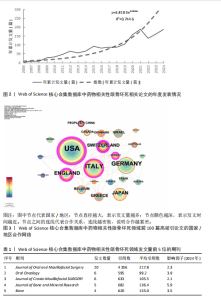
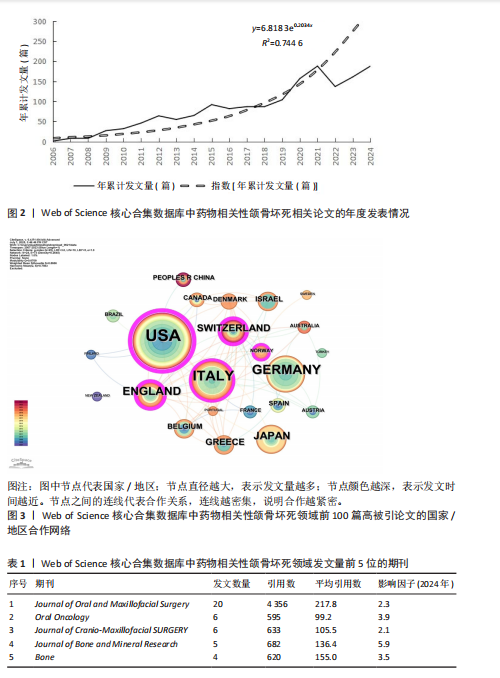
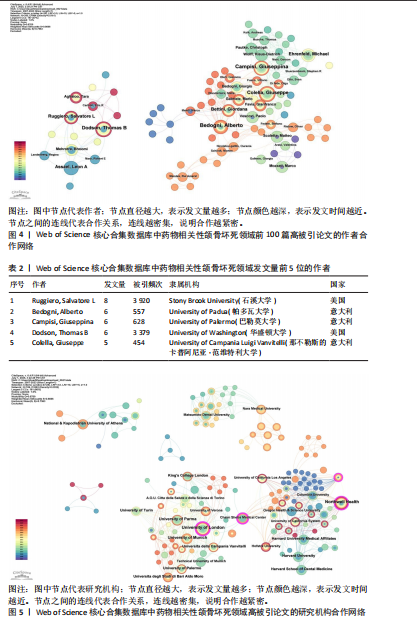
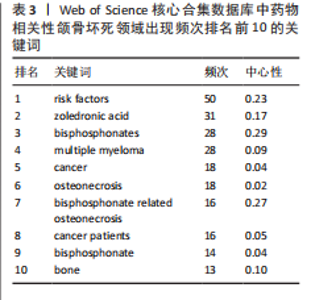
2.1 前100篇高被引论文的年发文量、引用量 基于上述检索策略,共检索到1 763篇文献。其中,发表于2007-2023年间的前100篇高被引文献(占总检索量的 5.67%)在Web of Science核心合集数据库累计被引12 337次,篇均被引123.37次,年均被引6.17次。此外,年累计发文量呈指数增长(R2=0.744 6,P < 0.001),表明研究规模持续扩大(图2)。 2.2 国家/地区合作网络分析 以“国家”为节点,采用g-index(k=25)、Top N=50阈值,构建了包含24个节点和73条连线的国家合作网络图谱(图3)。从科研产出来看,美国以35篇文献稳居首位,意大利(n=22)、德国(n=18)、英国(n=11)、日本(n=9)紧随其后,构成核心发文国家群。网络中介中心性分析进一步揭示合作格局:美国(0.47)处于核心枢纽地位,英国(0.27)、瑞士(0.22)、意大利(0.20)、挪威(0.15)等国的中介中心性均超过关键阈值0.1,表明这些国家在推动国际合作中的关键作用。 2.3 来源期刊分析 前100篇高被引文献分布于40种专业期刊,其中38种被2024 JCR收录,影响因子(IF)自0.8跨越至41.9。肿瘤学顶级期刊《Journal of Clinical Oncology》(IF=41.9)位居榜首,显示它对这一交叉学科研究的高度关注;材料科学领域期刊《Advanced Functional Materials》(IF=15.6)与《Clinical Cancer Research》(IF=10.1)亦位于前列,印证跨学科研究的深度融合。如表1所示,《Journal of Oral and Maxillofacial Surgery》发文量最高,彰显它在药物相关性颌骨坏死研究领域的核心地位,刊载的前沿成果为临床诊疗提供了可靠的循证基础。 2.4 作者合作网络分析 以“作者”为节点,阈值选择g-index(k=25)、Top N=50,构建了包含350个节点和984条连线的作者合作网络图谱(图4)。此网络呈现高度密集的连接特征,反映出领域内核心作者群体协作紧密。表2列出了发文量排名前5位的学者,其中,美国霍夫斯特拉大学医学院教授Ruggiero Salvatore L以8篇文献量位居榜首,作为药物相关性颌骨坏死研究领域的权威学者,一系列研究在该领域具有里程碑式的贡献。"
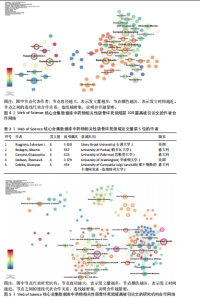
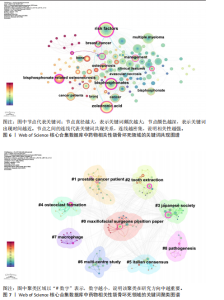
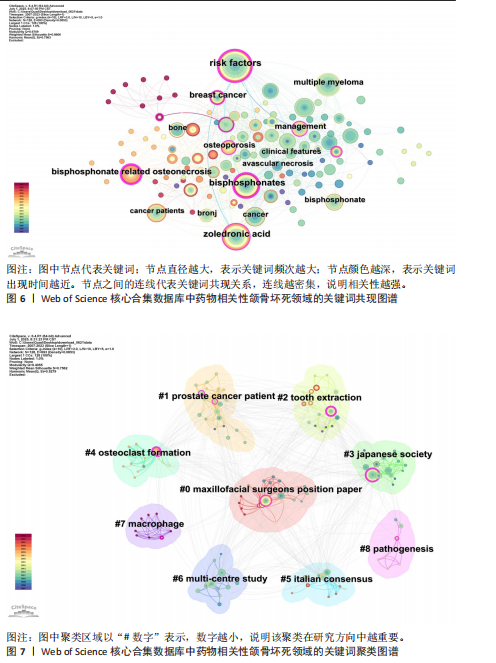
2.5 合作机构分析 以“机构”为节点,阈值选择g-index(k=25)、Top N=50,构建了包含199个节点和693条连线的全球机构合作网络图谱(图5)。该网络线条纵横,节点稠密,直观映射出全球药物相关性颌骨坏死研究的多中心、跨学科协同态势。核心区域多中心节点构成密集协作簇,表明头部机构高频次联动;边缘区域节点稀疏提示新兴研究力量对核心合作网络的参与度仍有提升空间。整体勾勒出成熟科研共同体与新兴探索并存的动态格局。 2.6 关键词共现分析 以“关键词”为节点,设定阈值g-index(k=10)、Top N=50,生成了包含128个节点和693条连线的关键词共现图谱(图6),图谱密度为0.085 3。关键词共现与聚类分析能够深入揭示不同研究主题间的关联性与密切程度,进而反映此领域的研究热点、发展趋势及内在联系。表3列出了频次排名前10的关键词,集中展示了药物相关性颌骨坏死领域的核心主题与研究热点。 图6中,节点大小代表关键词的出现频率。从图中可以看出,“risk factor”(风险因素)和“zoledronic acid” (唑来磷酸)等关键词节点显著突出,表明药物相关性颌骨坏死研究的核心关注点集中在风险因素及唑来磷酸等方面。值得关注的是,2023年涌现新兴的关键词中“Macrophage polarization”(巨噬细胞极化)、“Tetrahedral DNA nanostructures”(四面体DNA纳米结构)及“Framework nucleic acids” (框架核酸)与组织工程密切相关,这些新兴方向标志着该领域正深度整合细胞生物学、纳米技术与生物材料科学的前沿进展,为组织修复与再生提供创新性策略与工具。这一交叉融合趋势表明,跨学科研究将成为推动药物相关性颌骨坏死领域及组织工程领域发展的核心驱动力,并促进临床转化。 2.7 关键词聚类分析 关键词聚类通过构建多维度语义网络,深度解析关键词共现图谱并提炼研究主题,进而以可视化方式呈现研究领域的内在结构。在关键词共现分析的基础上,选择对数似然率(LLR)算法进行关键词聚类分析,生成具有明确主题边界的聚类图谱(图7)。其中,聚类模块性指数(Modularity Q)为0.405 5 (> 0.3),表明聚类结构显著且研究方向清晰可辨。聚类轮廓性指数S值(Mean Silhouette)为0.756 2(> 0.7),说明聚类效果合理,具有良好的同质性和较高的信度。 图7共包含9个由不同颜色表示的聚类群。每个聚类群均由密切相关的关键词组成,标签以最具代表性的关键词命名,从而反映出各聚类的核心主题。与聚类群标签关联的数字越小,则表明该聚类群中所包含的关键词数量越多。在过去20年中,药物相关性颌骨坏死研究领域呈现出聚集性、多元化和快速增长的特征。该领域最具代表性的关键词集群是#0 maxillofacial surgeons position paper(口腔颌面外科医师立场文件)、#1 prostate cancer patient (前列腺癌患者)和#2 tooth extraction(拔牙),这些关键词不仅在时间维度上贯穿近20年研究周期,更在知识网络中占据中枢地位。 这些主题集群的演变,既反映了药物相关"
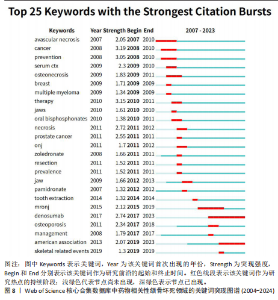
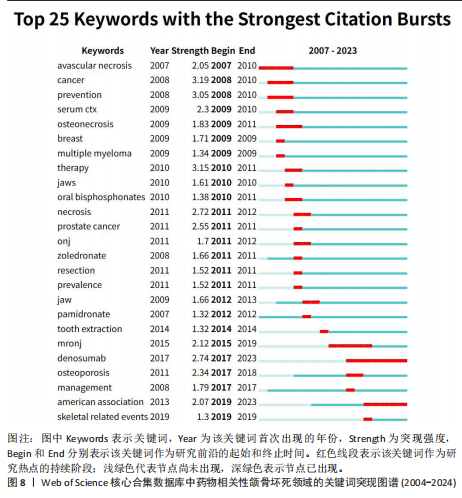
性颌骨坏死研究从临床现象观察到分子机制解析的认知跃迁,也预示着未来研究应重点关注跨学科诊疗方案优化、肿瘤治疗相关性骨并发症防治以及口腔治疗风险评估体系构建。对这些方向的深入探索将为突破药物相关性颌骨坏死临床诊疗中的关键瓶颈提供重要路径指引,并有力推动组织工程策略在颌骨修复中的转化应用。 2.8 关键词突现分析 基于关键词聚类分析,对排名前25的突现词进行了分析,结果如图8所示。突现词是指在特定时间段内出现频率发生显著变化的关键词;具有较高突现强度的关键词更能有效地预测未来的研究热点和前沿内容,从而在一定程度上揭示药物相关性颌骨坏死领域的发展趋势[12]。该动态图谱系统展示了2007-2023年药物相关性颌骨坏死研究范式的三阶段演进:在研究初期,聚焦于癌症患者群体,特别是使用唑来膦酸或帕米膦酸肿瘤患者的颌骨坏死风险评估与预防策略构建,形成了以“prostate cancer patient”(前列腺癌患者)与“prevention”(预防)为核心的临床干预框架;中期研究重心转向“tooth extraction”(拔"
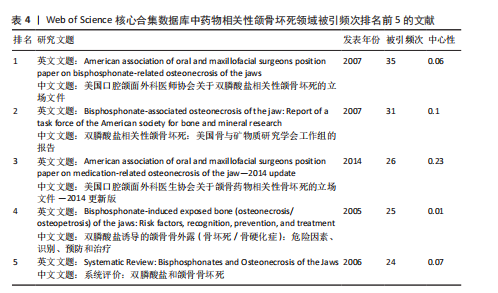
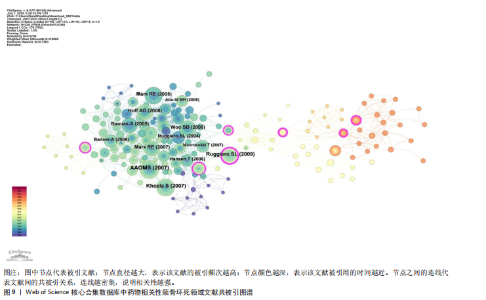
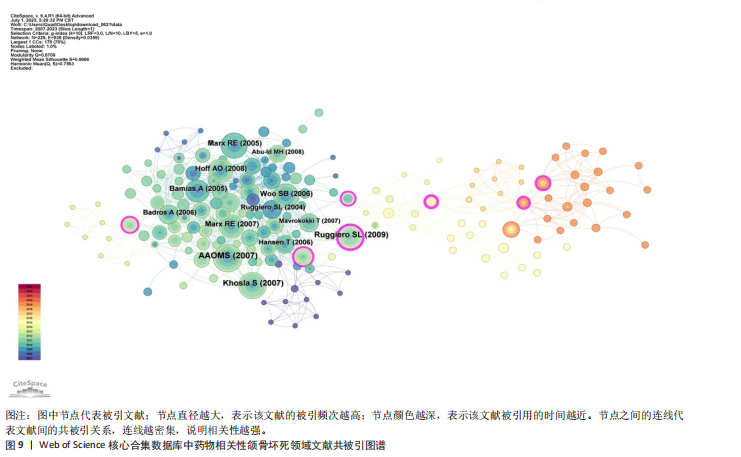
牙)这一关键诱因及外科干预效果评价,同时关注口服双膦酸盐群体风险谱系扩展;2015年后”MRONJ”术语的标准化突现标志着疾病认知的范式转换。 值得关注的是,“denosumab”(地诺单抗)呈现持续爆发态势,表明核因子κB受体活化因子配体抑制剂引发的长期颌骨并发症管理已成为当前核心前沿。同时,“American association”(美国协会)的突现则预示着基于循证医学的临床指南迭代,特别是风险分层管理体系与标准化诊疗路径的构建,为优化临床实践提供关键指引。这种从药物毒性监测到精准防控的演进轨迹,凸显了药物相关性颌骨坏死研究正向疾病全程管理、多学科协作方向深度发展,以应对复杂的临床挑战。 2.9 文献共被引分析 以“被引文献”为分析节点,设置阈值参数为g-index(k=10)、Top N=50,构建了包含229个节点和938条连线的文献共被引图谱(图9)。通过解析文献之间的共被引关系网络,可以系统勾勒药物相关性颌骨坏死领域的知识结构并精准识别核心文献集群,这些高频共被引文献构成了领域发展的理论基础与学术脉络。图9直观显示,同一时期发表的文献之间存在密集的共被引关系,表明特定阶段内的研究形成了学术共识与理论聚焦点。 表4列出了被引频次排名前5的经典文献,这些文献卓越的学术影响力与理论价值已获得领域内广泛认可。进一步聚焦Web of Science数据库中100篇高被引文献的共被引网络可见,美国口腔颌面外科医师协会于2007年发布的双膦酸盐相关性颌骨坏死临床诊疗指南以35次的被引频次位居榜首,奠定了该领域早期诊疗规范的核心框架。Ruggiero SL团队于2009年更新的美国口腔颌面外科医师协会立场文件则凭借最高的中介中心性(0.23)成为网络中的关键枢纽节点[13],凸显它在衔接基础研究与临床实践中的桥梁作用。该团队在2014年进一步更新了风险因素、诊断分期及治疗策略[3],总被引频次高达1 687次,位居高被引文献首位,对推动药物相关性颌骨坏死研究具有里程碑意义。在2022年,Ruggiero SL团队再次主导了美国口腔颌面外科医师协会立场文件的关键更新[4],并首次将组织工程策略纳入药物相关性颌骨坏死综合管理框架,标志着研究范式向再生修复方向的转变,为未来临床转"

"
"
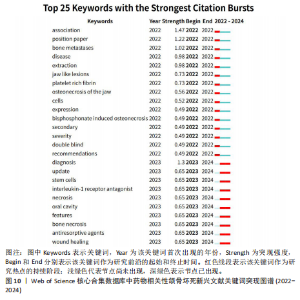
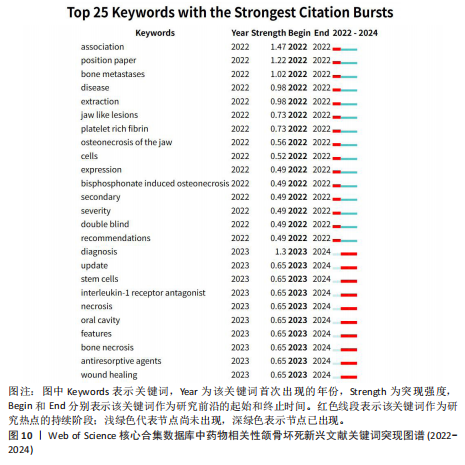
化奠定了新的基础,并进一步巩固了该系列文献在学术网络中的核心枢纽地位。 2.10 对新兴高潜力文献的补充分析 药物相关性颌骨坏死的研究进展迅速,鉴于2004-2024年间高被引文献分析存在时效性局限,在保持与原研究完全一致的检索策略下,补充分析了2022-2024年间发表的前100篇高被引文献,以捕捉最新研究焦点(图10)。 结果显示,“干细胞”(stem cells)、“富血小板纤维蛋白”(platelet rich fibrin)及“伤口愈合”(wound healing)等再生医学相关关键词显著突现,与前期识别出的“组织工程与生物材料”前沿高度吻合,并进一步聚焦于细胞疗法和生物材料应用;“白细胞介素1受体拮抗剂”(interleukin-1 receptor antagonist)的突现提示机制研究已深入至骨免疫微环境调控;同时,“立场文件”(position paper)、“推荐意见”(recommendations)等关键词的持续活跃则再次印证临床指南的核心地位。分析结果表明,新兴文献所聚焦的主题与此研究所揭示的趋势高度吻合,增强了研究结论的稳健性与前瞻性。"
"
| [1] RUAN HJ, CHEN H, HOU JS, et al. Chinese expert consensus on the diagnosis and clinical management of medication-related osteonecrosis of the jaw. J Bone Oncol. 2024;49:100650. [2] MARX RE. Pamidronate (Aredia) and zoledronate (Zometa) induced avascular necrosis of the jaws: a growing epidemic. J Oral Maxillofac Surg. 2003;61(9):1115-1117. [3] RUGGIERO SL, DODSON TB, FANTASIA J, et al. American Association of Oral and Maxillofacial Surgeons position paper on medication-related osteonecrosis of the jaw--2014 update. J Oral Maxillofac Surg. 2014;72(10):1938-1956. [4] RUGGIERO SL, DODSON TB, AGHALOO T, et al. American Association of Oral and Maxillofacial Surgeons’ Position Paper on Medication-Related Osteonecrosis of the Jaws-2022 Update. J Oral Maxillofac Surg. 2022;80(5):920-943. [5] BOSTON B, IPE D, CAPITANESCU B, et al. Medication-related osteonecrosis of the jaw: A disease of significant importance for older patients. J Am Geriatr Soc. 2023;71(8):2640-2652. [6] WANG Q, LIU J, QI S, et al. Clinical analysis of medication related osteonecrosis of the jaws: A growing severe complication in China. J Dent Sci. 2018;13(3):190-197. [7] ALHUSSAIN A, PEEL S, DEMPSTER L, et al. Knowledge, practices, and opinions of ontario dentists when treating patients receiving bisphosphonates. J Oral Maxillofac Surg. 2015;73(6):1095-1105. [8] BISSINGER O, GREISER J, MAIER E, et al. How does medication-related osteonecrosis of the jaw (MRONJ) influence the health-related quality of life after surgery? BMC Oral Health. 2025;25(1):951. [9] MARTIN K, MARTIN S. Reporting MRONJ as an adverse drug reaction: an oral surgery survey. Br Dent J. 2024. doi: 10.1038/s41415-024-8016-1. [10] BEDOGNI A, MAUCERI R, FUSCO V, et al. Italian position paper (SIPMO-SICMF) on medication-related osteonecrosis of the jaw (MRONJ). Oral Dis. 2024;30(6):3679-3709. [11] BAYRAM F, KILIC SS, AYDIN V, et al. Medication-Related Osteonecrosis of the Jaw: Bibliometric Analysis from 2003 to 2023. Adv Exp Med Biol. 2025;1474:119-130. [12] Advisory task force on bisphosphonate-related ostenonecrosis of the jaws, american association of oral and maxillofacial surgeons. American Association of Oral and Maxillofacial Surgeons position paper on bisphosphonate-related osteonecrosis of the jaws. J Oral Maxillofac Surg. 2007;65(3):369-376. [13] RUGGIERO SL, DODSON TB, ASSAEL LA, et al. American Association of Oral and Maxillofacial Surgeons position paper on bisphosphonate-related osteonecrosis of the jaws--2009 update. J Oral Maxillofac Surg. 2009;67(5 Suppl):2-12. [14] MIGLIORATI CA. Bisphosphanates and oral cavity avascular bone necrosis. J Clin Oncol. 2003; 21(22):4253-4254. [15] RUGGIERO SL, MEHROTRA B, ROSENBERG TJ, et al. Osteonecrosis of the jaws associated with the use of bisphosphonates: a review of 63 cases. J Oral Maxillofac Surg. 2004;62(5):527-534. [16] VAN BEEK E, HOEKSTRA M, VAN DE RUIT M, et al. Structural requirements for bisphosphonate actions in vitro. J Bone Miner Res. 1994;9(12):1875-1882. [17] RUSSELL RG, WATTS NB, EBETINO FH, et al. Mechanisms of action of bisphosphonates: similarities and differences and their potential influence on clinical efficacy. Osteoporos Int. 2008;19(6):733-759. [18] LI JW, WANG JY, YU RQ, et al. Expression of angiogenic markers in jawbones and femur in a rat model treated with zoledronic acid. BMC Res Notes. 2022;15(1):12. [19] ZHU W, XU R, DU J, et al. Zoledronic acid promotes TLR-4-mediated M1 macrophage polarization in bisphosphonate-related osteonecrosis of the jaw. FASEB J. 2019;33(4):5208-5219. [20] JIANG A, ZHANG Z, QIU X, et al. Medication-related osteonecrosis of the jaw (MRONJ): a review of pathogenesis hypothesis and therapy strategies. Arch Toxicol. 2024;98(3):689-708. [21] KIM S, MUN S, SHIN W, et al. Identification of Potentially Pathogenic Variants Associated with Recurrence in Medication-Related Osteonecrosis of the Jaw (MRONJ) Patients Using Whole-Exome Sequencing. J Clin Med. 2022;11(8):2145. [22] BOFFANO P, AGNONE AM, NEIROTTI F, et al. Epidemiology, etiopathogenesis, and management of MRONJ: A European multicenter study. J Stomatol Oral Maxillofac Surg. 2024;125(12 Suppl 2): 101931. [23] MAUCERI R, COPPINI M, ATTANASIO M, et al. MRONJ in breast cancer patients under bone modifying agents for cancer treatment-induced bone loss (CTIBL): a multi-hospital-based case series. BMC Oral Health. 2023;23(1):71. [24] BAGAN J, SCULLY C, SABATER V, et al. Osteonecrosis of the jaws in patients treated with intravenous bisphosphonates (BRONJ): A concise update. Oral Oncol. 2009;45(7):551-554. [25] KÜHL S, WALTER C, ACHAM S, et al. Bisphosphonate-related osteonecrosis of the jaws--a review. Oral Oncol. 2012;48(10):938-947. [26] YAO S, DING X, RONG G, et al. Association Between Malignant Diseases and Medication-Related Osteonecrosis of the Jaw (MRONJ): A Systematic Review and Meta-Analysis. J Craniofac Surg. 2023;34(2):669-673. [27] ŞAHIN O, ODABAŞI O, ALIYEV T, et al. Risk factors of medication-related osteonecrosis of the jaw: a retrospective study in a Turkish subpopulation. J Korean Assoc Oral Maxillofac Surg. 2019;45(2):108-115. [28] LIMONES A, SÁEZ-ALCAIDE LM, DÍAZ-PARREÑO SA, et al. Medication-related osteonecrosis of the jaws (MRONJ) in cancer patients treated with denosumab VS. zoledronic acid: A systematic review and meta-analysis. Med Oral Patol Oral Cir Bucal. 2020;25(3):e326-e336. [29] SCHWECH N, NILSSON J, GABRE P. Incidence and risk factors for medication-related osteonecrosis after tooth extraction in cancer patients-A systematic review. Clin Exp Dent Res. 2023;9(1):55-65. [30] MORENO RABIE C, CAVALCANTE FONTENELE R, OLIVEIRA SANTOS N, et al. Three-dimensional clinical assessment for MRONJ risk in oncologic patients following tooth extractions. Dentomaxillofac Radiol. 2023;52(8):20230238. [31] MORENO-RABIÉ C, LAPAUW L, GAÊTA-ARAUJO H, et al. Radiographic predictors for MRONJ in oncologic patients undergoing tooth extraction. Sci Rep. 2022;12(1):11280. [32] COROPCIUC R, COOPMAN R, GARIP M, et al. Risk of medication-related osteonecrosis of the jaw after dental extractions in patients receiving antiresorptive agents - A retrospective study of 240 patients. Bone. 2023;170:116722. [33] LI CL, LU WW, SENEVIRATNE CJ, et al. Role of periodontal disease in bisphosphonate-related osteonecrosis of the jaws in ovariectomized rats. Clin Oral Implants Res. 2016;27(1):1-6. [34] DAYISOYLU EH, ÜNGÖR C, TOSUN E, et al. Does an alkaline environment prevent the development of bisphosphonate-related osteonecrosis of the jaw? An experimental study in rats. Oral Surg Oral Med Oral Pathol Oral Radiol. 2014;117(3):329-334. [35] YAMAZA T, REN G, AKIYAMA K, et al. Mouse mandible contains distinctive mesenchymal stem cells. J Dent Res. 2011;90(3):317-324. [36] MATSUURA T, TOKUTOMI K, SASAKI M, et al. Distinct characteristics of mandibular bone collagen relative to long bone collagen: relevance to clinical dentistry. Biomed Res Int. 2014; 2014:769414. [37] DUNPHY L, SALZANO G, GERBER B, et al. Medication-related osteonecrosis (MRONJ) of the mandible and maxilla. BMJ Case Rep. 2020; 13(1):e224455. [38] KUEHN S, SCARIOT R, ELSALANTY M. Medication-Related Osteonecrosis: Why the Jawbone? Dent J (Basel). 2023;11(5):109. [39] ZHENG Y, DONG X, CHEN S, et al. Low-level laser therapy prevents medication-related osteonecrosis of the jaw-like lesions via IL-1RA-mediated primary gingival wound healing. BMC Oral Health. 2023;23(1):14. [40] FUNAYAMA N, YAGYUU T, IMADA M, et al. Impact of beta-tricalcium phosphate on preventing tooth extraction-triggered bisphosphonate-related osteonecrosis of the jaw in rats. Sci Rep. 2023;13(1):16032. [41] NISI M, GENNAI S, GRAZIANI F, et al. Clinical and radiologic treatment outcomes of implant presence tirggered-MRONJ: Systematic review of literature. Oral Dis. 2024;30(8):5255-5267. [42] HUANG S, GAO Y, LI H, et al. Manganese@Albumin Nanocomplex and Its Assembled Nanowire Activate TLR4-Dependent Signaling Cascades of Macrophages. Adv Mater. 2024;36(5):e2310979. [43] LUO L, ZHENG W, LI J, et al. 3D-Printed Titanium Trabecular Scaffolds with Sustained Release of Hypoxia-Induced Exosomes for Dual-Mimetic Bone Regeneration. Adv Sci (Weinh). 2025; 12(23):e2500599. [44] BOULAND CL, JAVADIAN R, GILIS S, et al. Treatment of medication-related osteonecrosis of the jaw with cell therapy. Front Cell Dev Biol. 2024;12:1338376. [45] TONG L, PU X, LIU Q, et al. Nanostructured 3D-Printed Hybrid Scaffold Accelerates Bone Regeneration by Photointegrating Nanohydroxyapatite. Adv Sci (Weinh). 2023;10(13):e2300038. [46] XING F, SHEN HY, ZHE M, et al. Nano-Topographically Guided, Biomineralized, 3D-Printed Polycaprolactone Scaffolds with Urine-Derived Stem Cells for Promoting Bone Regeneration. Pharmaceutics. 2024;16(2):204. [47] BRIANNA, LING APK, WONG YP. Applying stem cell therapy in intractable diseases: a narrative review of decades of progress and challenges. Stem Cell Investig. 2022;9:4. [48] XU N, LU D, QIANG L, et al. 3D-Printed Composite Bioceramic Scaffolds for Bone and Cartilage Integrated Regeneration. ACS Omega. 2023;8(41):37918-37926. [49] COROPCIUC R, MORENO-RABIÉ C, DE VOS W, et al. Navigating the complexities and controversies of medication-related osteonecrosis of the jaw (MRONJ): a critical update and consensus statement. Acta Chir Belg. 2024;124(1):1-11. [50] SHOBACK D, ROSEN CJ, BLACK DM, et al. Pharmacological Management of Osteoporosis in Postmenopausal Women: An Endocrine Society Guideline Update. J Clin Endocrinol Metab. 2020; 105(3):dgaa048. [51] ZHANG C, SHEN G, LI H, et al. Incidence rate of osteonecrosis of jaw after cancer treated with bisphosphonates and denosumab: A systematic review and meta-analysis. Spec Care Dentist. 2024;44(2):530-541. [52] MOON C, KIM H, PARK JH, et al. High-dose denosumab (Xgeva®) Associated Medication-Related Osteonecrosis of the Jaws (MRONJ): incidence and clinical characteristics in a retrospective analysis of 1278 patients. Support Care Cancer. 2024;32(12):774. [53] BUNDKIRCHEN K, YE W, ZHANG T, et al. A single acute alcohol intoxication before fracture insult causes long-term elevated systemic RANKL and OPG levels in young adult mice. Sci Rep. 2025; 15(1):24423. |
| [1] | Xu Canli, He Wenxing, Wang Yuping, Ba Yinying, Chi Li, Wang Wenjuan, Wang Jiajia. Research context and trend of TBK1 in autoimmunity, signaling pathways, gene expression, tumor prevention and treatment [J]. Chinese Journal of Tissue Engineering Research, 2026, 30(在线): 1-11. |
| [2] | Zhu Xiaolong, Zhang Wei, Yang Yang. Visualization analysis of research hotspots and cutting-edge information in the field of intervertebral disc regeneration and repair [J]. Chinese Journal of Tissue Engineering Research, 2026, 30(9): 2391-2402. |
| [3] | Wen Fayan, Li Yan, Qiang Tianming, Yang Chen, Shen Linming, Li Yadong, Liu Yongming. Unilateral biportal endoscopic technology for treatment of lumbar degenerative diseases: global research status and changing trends [J]. Chinese Journal of Tissue Engineering Research, 2026, 30(9): 2380-2390. |
| [4] | Liu Yang, Liu Donghui , Xu Lei, Zhan Xu, Sun Haobo, Kang Kai. Role and trend of stimuli-responsive injectable hydrogels in precise myocardial infarction therapy [J]. Chinese Journal of Tissue Engineering Research, 2026, 30(8): 2072-2080. |
| [5] | Lai Yu, Chen Yueping, Zhang Xiaoyun. Research hotspots and frontier trends of bioactive materials in treating bone infections [J]. Chinese Journal of Tissue Engineering Research, 2026, 30(8): 2132-2144. |
| [6] | Wang Qisa, Lu Yuzheng, Han Xiufeng, Zhao Wenling, Shi Haitao, Xu Zhe. Cytocompatibility of 3D printed methyl acrylated hyaluronic acid/decellularized skin hydrogel scaffolds [J]. Chinese Journal of Tissue Engineering Research, 2026, 30(8): 1912-1920. |
| [7] | Wang Songpeng, Liu Yusan, Yu Huanying, Gao Xiaoli, Xu Yingjiang, Zhang Xiaoming, Liu Min. Bidirectional regulation of reactive oxygen species based on zeolitic imidazolate framework-8 nanomaterials: from tumor therapy and antibacterial activity to cytoprotection [J]. Chinese Journal of Tissue Engineering Research, 2026, 30(8): 2033-2013. |
| [8] | Ding Yifan, Yin Wenjie, Zhang Li, Yuan Shuya, Sun Guoju, Zhang Naili, Zhao Dongmei, Ma Lina. Repair of segmental bone defect of rabbit radius by decalcified bone matrix loaded with adipose-derived stem cells [J]. Chinese Journal of Tissue Engineering Research, 2026, 30(7): 1679-1686. |
| [9] | Zhu Jing, Zhai Xiguo, Wu Qizhen, Wang Yupei, Lyu Ling, Hou Qinzheng. Development and application of human amniotic membrane in tissue engineering [J]. Chinese Journal of Tissue Engineering Research, 2026, 30(7): 1818-1827. |
| [10] | Huang Jie, Zeng Hao, Wang Wenchi, Lyu Zhucheng, Cui Wei. Visualization analysis of literature on the effect of lipid metabolism on osteoporosis [J]. Chinese Journal of Tissue Engineering Research, 2026, 30(6): 1558-1568. |
| [11] | Yu Huifen, Mo Licun, Cheng Leping. The position and role of 5-hydroxytryptamine in the repair of tissue injury [J]. Chinese Journal of Tissue Engineering Research, 2026, 30(5): 1196-1206. |
| [12] | Wang Mingqi, Feng Shiya, Han Yinhe, Yu Pengxin, Guo Lina, Jia Zixuan, Wang Xiuli. Construction and evaluation of a neuralized intestinal mucosal tissue engineering model in vitro [J]. Chinese Journal of Tissue Engineering Research, 2026, 30(4): 892-900. |
| [13] | Yu Shiyu, Yu Sutong, Xu Yang, Zhen Xiangyan, Han Fengxuan. Advances in research and application of tissue engineering therapeutic strategies in oral submucous fibrosis [J]. Chinese Journal of Tissue Engineering Research, 2026, 30(4): 936-948. |
| [14] | Chen Xiaoxia, Zhao Lihua, Li Taowen, Qin Yimei, Liang Jinyu. Postmenopausal cognitive impairment: a bibliometric analysis of developmental context and hot trends [J]. Chinese Journal of Tissue Engineering Research, 2026, 30(35): 9336-9344. |
| [15] | He Renda, Ma Wei, Sun Yongsi, Mo Xueni. Future medical research on brain organoids: interdisciplinary training, bioengineering technologies, and optimized model maturity [J]. Chinese Journal of Tissue Engineering Research, 2026, 30(34): 9088-9094. |
| Viewed | ||||||
|
Full text |
|
|||||
|
Abstract |
|
|||||