Chinese Journal of Tissue Engineering Research ›› 2026, Vol. 30 ›› Issue (33): 8794-8801.doi: 10.12307/2026.483
Previous Articles Next Articles
Construction and validation of a nomogram prediction model for cognitive impairment at admission in elderly patients with acute cerebral infarction
Gao Lin, Hu Yirong, Deng Xinbo, Zeng Ying, Xiong Juan, Shi Xin
- Department of Neurology, Yichun People’s Hospital, Yichun 336000, Jiangxi Province, China
-
Received:2025-11-13Revised:2026-03-16Online:2026-11-28Published:2026-06-17 -
Contact:Hu Yirong, Department of Neurology, Yichun People’s Hospital, Yichun 336000, Jiangxi Province, China -
About author:Gao Lin, Associate chief physician, Department of Neurology, Yichun People’s Hospital, Yichun 336000, Jiangxi Province, China -
Supported by:Jiangxi Provincial Health and Family Planning Commission Science and Technology Program, No. 20204734 (to HYR); Jiangxi Provincial Health Commission Science and Technology Program, No. 202140869 (to GL); Jiangxi Provincial Health Commission Science and Technology Program, No. 202212643 (to GL [project participant])

CLC Number:
Cite this article
Gao Lin, Hu Yirong, Deng Xinbo, Zeng Ying, Xiong Juan, Shi Xin. Construction and validation of a nomogram prediction model for cognitive impairment at admission in elderly patients with acute cerebral infarction[J]. Chinese Journal of Tissue Engineering Research, 2026, 30(33): 8794-8801.
share this article
Add to citation manager EndNote|Reference Manager|ProCite|BibTeX|RefWorks
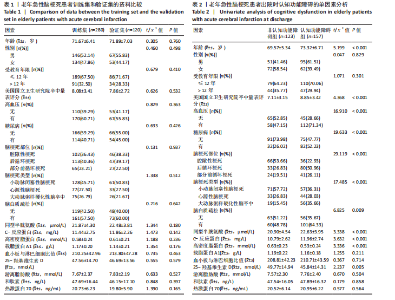
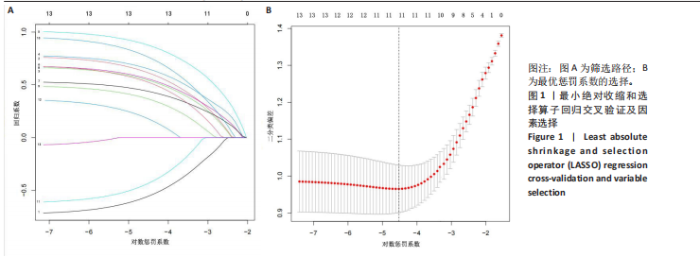
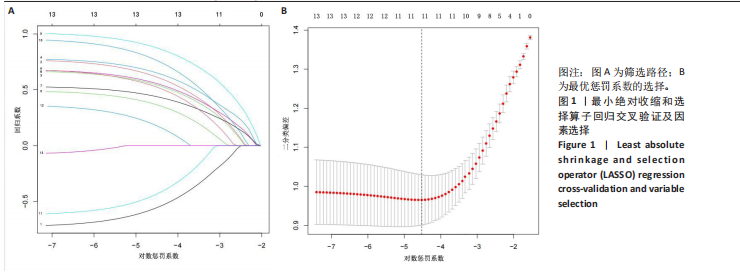
2.1 老年急性脑梗死患者的一般资料 训练集280例患者中,男146例(52.14%)、女134例(47.86%);年龄60-88岁,平均(71.67±6.41)岁;其中157例患者出院时发生认知功能障碍,作为认知功能障碍组,剩余123例患者作为非认知功能障碍组。验证集120例患者中,男67例(55.80%)、女53例(44.20%);年龄61-86岁,平均(71.89±7.03)岁;其中有63例出院时发生认知功能障碍。对比训练集与验证集的临床及血清生化指标,差异均无显著性意义(均P > 0.05),见表1。 2.2 老年急性脑梗死患者出院时认知功能障碍的单因素分析 非认知功能障碍组与认知功能障碍组之间的年龄、美国国立卫生研究院卒中量表评分、高血压、糖尿病、脑梗死部位、脑梗死类型、脑白质疏松、同型半胱氨酸、C-反应蛋白、高密度脂蛋白、25-羟基维生素D比较,差异有显著性意义(均P < 0.05),见表2。 2.3 最小绝对收缩和选择算子回归筛选 通过最小绝对收缩和选择算子回归对单因素分析中显著的11个潜在危险因素进行降维处理,并采用十折交叉验证对最小绝对收缩和选择算子回归的最优惩罚系数进行验证,最优惩罚系数为11,将11个潜在危险因素纳入下一步筛选,见图1。 2.4 多因素Logistic回归分析结果 以老年急性脑梗死患者是否发生认知功能障碍为因变量,对年龄、美国国立卫生研究院卒中量表评分、同型半胱氨酸、C-反应蛋白、高密度脂蛋白及25-羟基维生素D赋原值;对脑梗死部位(腔隙性梗死=0,后循"
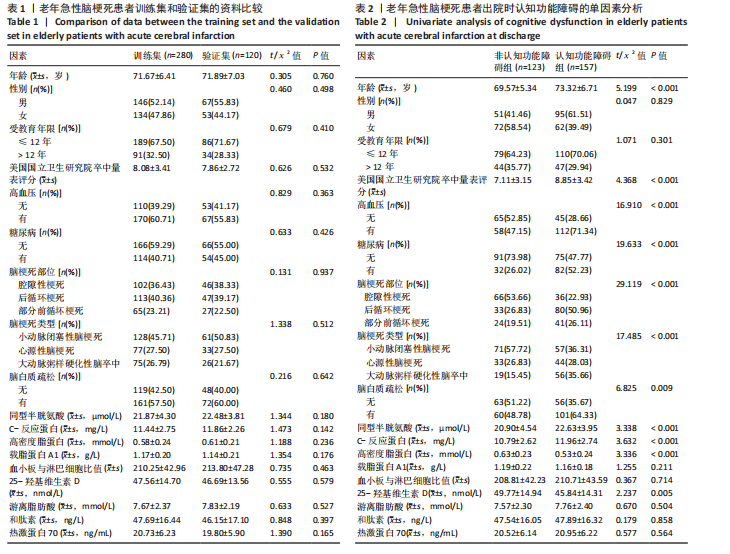
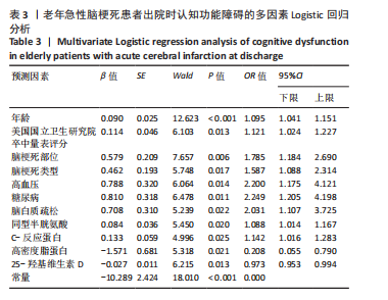
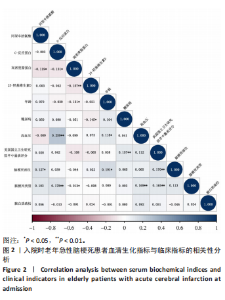
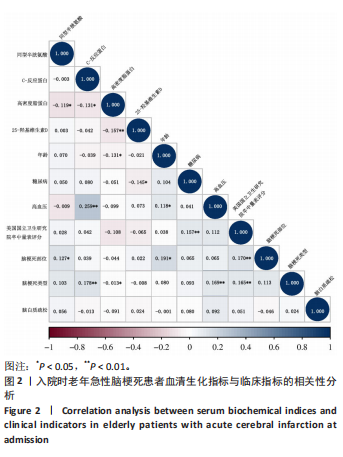
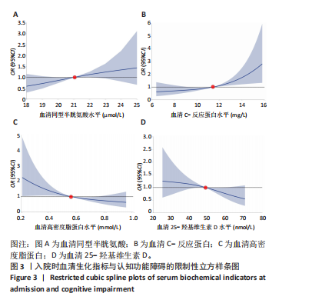
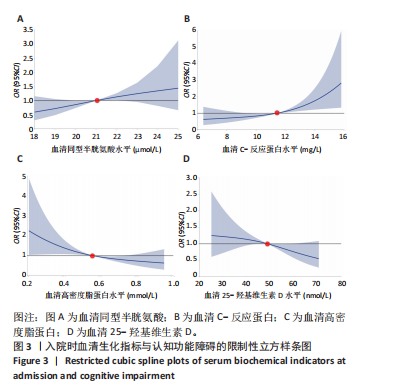
环梗死=1,部分前循环梗死=2)、脑梗死类型(小动脉闭塞性脑梗死=0,心源性脑梗死=1,大动脉粥样硬化性脑卒中=2)、高血压(无=0,有=1)、糖尿病(无=0,有=1)、脑白质疏松(无=0,有=1)等分类变量进行赋值,得出11个老年急性脑梗死患者认知功能障碍的独立危险因素,分别为年龄、美国国立卫生研究院卒中量表评分、高血压、糖尿病、脑梗死部位、脑梗死类型、脑白质疏松、同型半胱氨酸、C-反应蛋白、高密度脂蛋白及25-羟基维生素D,见表3。 2.5 入院时血清生化指标与临床指标的关系 Spearman相关性分析结果显示,老年急性脑梗死患者的同型半胱氨酸水平与脑梗死部位呈正相关(r=0.127,P < 0.05);C-反应蛋白水平与高血压、脑梗死类型呈正相关(r=0.259,P < 0.001;r=0.178,P < 0.001);高密度脂蛋白水平与年龄呈负相关(r=-0.131,P < 0.05);25-羟基维生素D水平与糖尿病呈负相关(r=-0.145,P < 0.05),见图2。 2.6 入院时血清生化指标与老年急性脑梗死患者认知功能障碍的非线性关系 调整其他独立危险因素后,同型半胱氨酸和C-反应蛋白水平上升增加认知功能障碍发生的风险,而高密度脂蛋白和25-羟基维生素D水平上升则降低认知功能障碍发生的"
风险。同型半胱氨酸、C-反应蛋白、高密度脂蛋白及25-羟基维生素D的风险临界值分别为21.44 μmol/L、11.73 mg/L、0.56 mmol/L、48.22 nmol/L,见图3。"
"
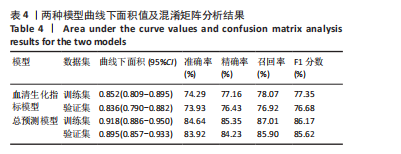
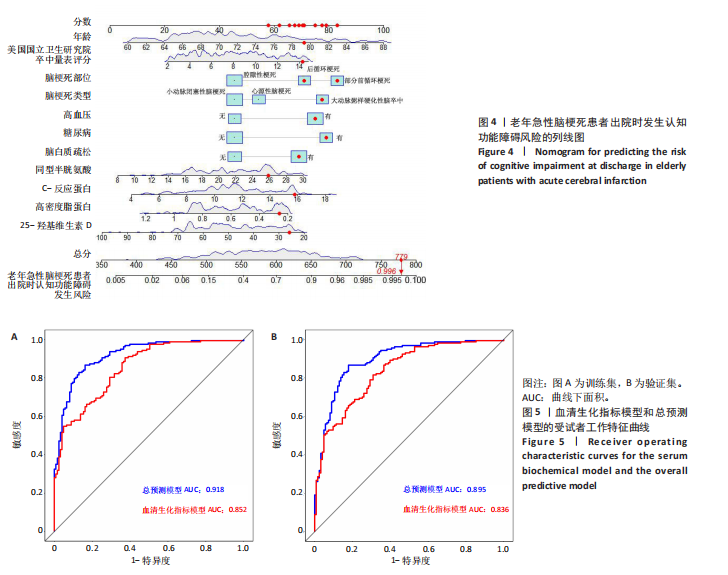
2.7 Logistic模型的构建与评价 将11个老年急性脑梗死患者认知功能障碍的独立危险因素构建Logistic模型。模型公式:Logit(p)=0.090×年龄+0.114×美国国立卫生研究院卒中量表评分+0.579×脑梗死部位+0.462×脑梗死类型+0.788×高血压+0.810×糖尿病+0.708×脑白质疏松+0.084×同型半胱氨酸+0.133×C-反应蛋白-1.571×高密度脂蛋白-0.027×25-羟基维生素D-10.289。根据构建出的Logistic模型绘制列线图,见图4。血清生化指标模型中,训练集和验证集的曲线下面积分别为0.852和0.836;总预测模型中,训练集和验证集的曲线下面积分别为0.918和0.895。各项混淆矩阵指标结果显示,血清生化指标模型和总预"
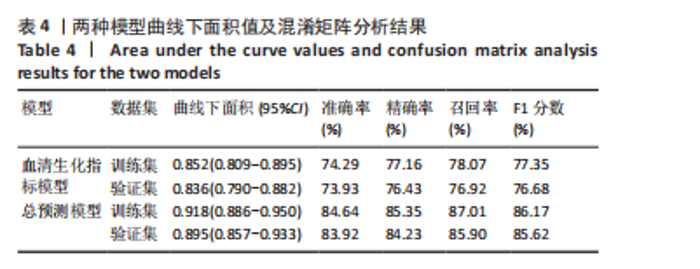
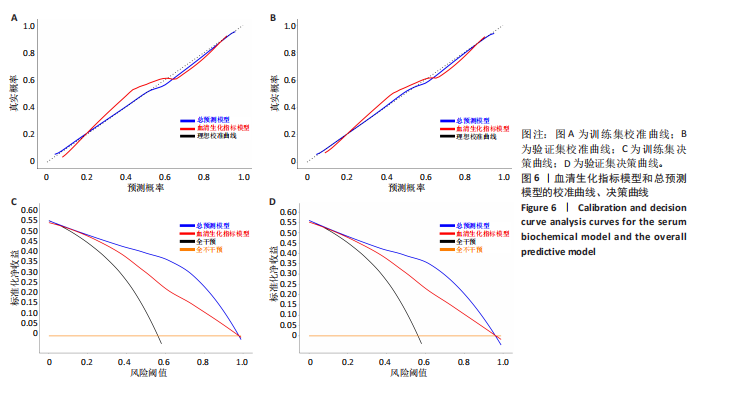
测模型的预测效能均较好,见图5、表4。两个模型训练集及验证集的校准曲线均贴近标准曲线,即模型预测的准确性较好。决策曲线提示,当风险概率为0.00-1.00时,标准化净收益均大于“全干预”和“不全干预”方案,提示两个模型均具有良好的临床获益情况,见图6。"
"
"
| [1] CAO QY, LI Z. Evolving of treatment options for cerebral infarction. World J Clin Cases. 2024;12(32):6534-6537. [2] 尹晴,杨利.脑梗死相关认知障碍机制[J].中南大学学报(医学版), 2024,49(10):1692-1699. [3] 张琳.轻型脑梗死恢复期患者认知功能障碍情况及危险因素探讨[J].黑龙江医药科学,2024,47(4):126-128. [4] 窦焱,徐越.低场强MRI在评估脑梗死与认知功能障碍关系中的应用价值[J].影像研究与医学应用,2024,8(20):101-103+107. [5] 李晋娜,许丽娜,孙烨婷,等.急性脑梗死患者血清炎症因子白细胞介素-1β白细胞介素-6白细胞介素-10和肿瘤坏死因子-α的表达水平与血管性认知功能障碍的关系研究[J].山西医药杂志,2024,53(21):1603-1609. [6] WANG X, DENG L, LIU X, et al. Relationship between glymphatic system dysfunction and cognitive impairment in patients with mild-to-moderate chronic traumatic brain injury: an analysis of the analysis along the perivascular space (ALPS) index. Quant Imaging Med Surg. 2024;14(12): 9246-9257. [7] 王燕,汪晶晶,王红丽,等.急性脑梗死并认知功能障碍的血清生化指标预测研究[J].黑龙江医学,2025,49(6):659-662. [8] CHEN F, WANG J, CHENG Y, et al. Magnesium and Cognitive Health in Adults: A Systematic Review and Meta-Analysis. Adv Nutr. 2024;15(8):100272. [9] RILEY RD, ENSOR J, SNELL KIE, et al. Calculating the sample size required for developing a clinical prediction model. BMJ. 2020;368:m441. [10] LIANG FF, LIU XX, LIU JH, et al. Effect of infarct location and volume on cognitive dysfunction in elderly patients with acute insular cerebral infarction. World J Psychiatry. 2024;14(8):1190-1198. [11] 中华医学会神经病学分会,中华医学会神经病学分会脑血管病学组,彭斌,等.中国急性缺血性脑卒中诊治指南2018[J].中华神经科杂志, 2018,51(9):666-682. [12] 汪凯,董强,郁金泰,等.卒中后认知障碍管理专家共识2021[J].中国卒中杂志,2021,16(4):376-389. [13] LIM KB, KIM J, LEE HJ, et al. Correlation Between Montreal Cognitive Assessment and Functional Outcome in Subacute Stroke Patients With Cognitive Dysfunction. Ann Rehabil Med. 2018;42(1):26-34. [14] 庞婷,张亚萍,陈仁伟,等.简短版蒙特利尔认知评估量表在社区中老年人群中判别认知障碍的有效性及成本结果分析[J].中国医学科学院学报,2025,47(3):382-389. [15] 张鹏.脑卒中患者TOAST、OCSP分型与外周血DNA甲基转移酶及MeCp2蛋白水平的关系[J].检验医学与临床,2023,20(8):1160-1164. [16] 肖根香,杨欢欢,赖婷,等.TOAST分型在HMCAS急性缺血性卒中预后判断的价值研究[J].青岛医药卫生,2024,56(4):294-298. [17] 刘莉,朱静,李洪贺,等.MHR对急性腔隙性脑梗死患者认知功能的预测价值[J].分子诊断与治疗杂志,2025,17(1):30-33. [18] 林文静,李卿,张建平.H型高血压合并ACI病人血压变异性、脉压指数与认知功能的关系[J].中西医结合心脑血管病杂志,2024,22(18): 3293-3298. [19] 熊兵,王康,桂红,等.FVH-DWI不匹配与脑梗死后认知功能障碍发生及预后的相关性研究[J].卒中与神经疾病,2024,31(6):541-546+556. [20] 赵珺志,闫兴利,梁杨.脑梗死患者MRI检查与认知功能关系的临床分析[J].医学影像学杂志,2023,33(7):1255-1258. [21] 罗婧,高竹娟.老年腔隙性脑梗死后血管性认知功能障碍与血清Hcy、SAA、TIMP-1水平的关系[J].中国老年学杂志,2024,44(10):2416-2419. [22] 曹友林,余青龙,王振国,等.AD相关神经丝蛋白、尿酸、hs-CRP水平与老年腔隙性脑梗死患者认知功能受损程度的相关性[J].临床和实验医学杂志,2022,21(10):1030-1034. [23] 马莉,陈阳,杜宇平,等.尿神经丝轻链、高密度脂蛋白及载脂蛋白A1在脑梗死患者认知功能障碍中的作用和预测价值[J].中国医药导报, 2024,21(11):66-69. [24] 崔蕾,张婧晨,李晓芳,等.MG、25(OH)D3及CXCL16对高血压脑梗死合并认知功能障碍的评估价值[J].分子诊断与治疗杂志,2022, 14(7):1167-1170. [25] WANG B, CHENG X, FU S, et al. Associations of Serum 25(OH)D, PTH, and β-CTX Levels with All-Cause Mortality in Chinese Community-Dwelling Centenarians. Nutrients. 2022;15(1):94. [26] 范驰,马珊珊,张薇,等.血清Hcy HbA1c及APN与急性脑梗死患者认知功能障碍的相关性分析[J].河北医学,2023,29(1):147-153. [27] XIONG X, FAN M, MA J, et al. Association of Atrial Fibrillation and Cardioembolic Stroke with Poststroke Delirium Susceptibility: A Systematic Review and Meta-Analysis of Observational Studies. World Neurosurg. 2022;167:e378-e385. [28] 陈笛,顾亮亮,孙军,等.老年腔隙性脑梗死合并高血压患者认知功能障碍影响因素分析及25-羟基维生素D的预测价值[J].临床心身疾病杂志,2023,29(5):28-34. [29] 邓玉琴.氨氯地平叶酸片联合氯沙坦钾片对急性脑梗死伴H型高血压患者血清Apelin-13、omentin-1水平的影响[J].心血管病防治知识, 2024,14(10):52-55. [30] 张建强,张辉,陈晓翼,等.多模态MRI参数及Hcy水平与早期脑梗死后认知功能障碍的关系[J].新疆医科大学学报,2023,46(7):931-936. [31] 叶晔,翟占强,徐磊.ApoA1、CRP在肺癌合并腔隙性脑梗死评估中的应用价值[J].中国现代医生,2024,62(7):34-37. [32] 陈娟,皮银珍.口服维生素D辅助银杏叶片对老年2型糖尿病合并轻度认知功能障碍患者的影响[J].中国糖尿病杂志,2023,31(3):191-195. [33] 康敏毅,梁康.血清同型半胱氨酸、维生素B12及血尿酸水平与脑梗死的相关性[J].贵州医药,2024,48(4):585-587. [34] 陈三丽.老年脑梗死患者25(OH)D水平与神经功能缺损程度和认知障碍的关系[J].临床与病理杂志,2021,41(12):2848-2854. [35] QI Y, YANG S, LI J, et al. Development and validation of a nomogram to predict impacted ureteral stones via machine learning. Minerva Urol Nephrol. 2024;76(6):736-747. [36] SUN T, LIU J, YUAN H, et al. Construction of a risk prediction model for lung infection after chemotherapy in lung cancer patients based on the machine learning algorithm. Front Oncol. 2024;14:1403392. [37] RONG J, ZHANG N, WANG Y, et al. Development and validation of a nomogram to predict the depressive symptoms among older adults: A national survey in China. J Affect Disord. 2024;361:367-375. [38] MIAO X, GUO Y, DING L, et al. A dynamic online nomogram for predicting the heterogeneity trajectories of frailty among elderly gastric cancer survivors. Int J Nurs Stud. 2024;153:104716. [39] 于媛媛,代建霞,刘媛.ACI患者血清APN、Lp-PLA2、PECAM-1水平与出院后一年认知功能障碍的相关性探讨[J].脑与神经疾病杂志,2024, 32(6):331-336. [40] 杨存美,舒刚明,胡亦新,等.社区主观认知下降老年人的运动认知风险综合征发生情况及影响因素研究[J].中国全科医学,2022,25(34): 4278-4285. [41] 姬燕梅,李文俊,李青芸,等.急性缺血性脑卒中后认知障碍相关因素分析及列线图模型构建[J].昆明医科大学学报,2024,45(5):73-81. |
| [1] | Shi Yaozhou, Jia Fanglin, Zhang Heling, Song Hanlin, Gao Haoran, Gao Xiao, Sun Wei, Feng Hu. Establishment and validation of a prediction model for axial symptoms after laminectomy with lateral mass screw fixation [J]. Chinese Journal of Tissue Engineering Research, 2026, 30(9): 2269-2277. |
| [2] | Liu Yu, Lei Senlin, Zhou Jintao, Liu Hui, Li Xianhui. Mechanisms by which aerobic and resistance exercises improve obesity-related cognitive impairment [J]. Chinese Journal of Tissue Engineering Research, 2026, 30(5): 1171-1183. |
| [3] | Li Guangzheng, Li Wei, Zhang Bochun, Ding Haoqin, Zhou Zhongqi, Li Gang, Liang Xuezhen. A prediction model for sarcopenia in postmenopausal women: information analysis based on the China Health and Retirement Longitudinal Study database [J]. Chinese Journal of Tissue Engineering Research, 2026, 30(4): 849-857. |
| [4] | Chen Xiaoxia, Zhao Lihua, Li Taowen, Qin Yimei, Liang Jinyu. Postmenopausal cognitive impairment: a bibliometric analysis of developmental context and hot trends [J]. Chinese Journal of Tissue Engineering Research, 2026, 30(35): 9336-9344. |
| [5] | Chen Yanni, Chen Liang, Zhang Jianhong, Lu Zhenfang, Liu Min, Li Jian. Lung tissue repair mechanisms and risk models for chronic obstructive pulmonary disease: an analysis based on computer simulation and experimental validation [J]. Chinese Journal of Tissue Engineering Research, 2026, 30(35): 9375-9380. |
| [6] | Yang Peng, Xu Chenghan, Zhou Yingjie, Chai Xubin, Zhuo Hanjie, Li Lin, Shi Jinyu. A meta-analysis of risk factors for residual back pain after vertebral augmentation for osteoporotic vertebral compression fractures [J]. Chinese Journal of Tissue Engineering Research, 2026, 30(3): 731-739. |
| [7] | Zhao Feifan, Cao Yujing. An artificial neural network model of ankylosing spondylitis and psoriasis shared genes and machine learning-based mining and validation [J]. Chinese Journal of Tissue Engineering Research, 2026, 30(3): 770-784. |
| [8] | Yin Xingxiao, Peng Hao, Song Yanping, Yao Na, Shen Zhen, Jiang Yang, Chen Hongbo, Huang Li, Song Yueyu, Li Yanqi, Chen Qigang. Sarcopenia and cognitive impairment: a data analysis based on European population databases [J]. Chinese Journal of Tissue Engineering Research, 2026, 30(28): 7388-7395. |
| [9] | Hu Zanying, Gao Fei. Construction and validation of a temperature prediction model for cortical bone during orthopedic surgery [J]. Chinese Journal of Tissue Engineering Research, 2026, 30(27): 7167-7175. |
| [10] | Yang Chong, Wu Yuci, Yang Han, Wang Meiting, Liu Lei. Promoting effect of acupuncture combined with rehabilitation training on the reconstruction of damaged neurological function in rats with cerebral infarction [J]. Chinese Journal of Tissue Engineering Research, 2026, 30(17): 4347-4356. |
| [11] | Xu Feng, Gu Dongyang, Zhu Zihao, Li Qiujie, Wan Xianglin. Relationship between spatio-temporal gait characteristics and fall risk in stroke patients [J]. Chinese Journal of Tissue Engineering Research, 2026, 30(16): 4038-4044. |
| [12] | Li Jie, Zhao Xiaofeng, Zeng Qi, Zhou Runtian, Chen Rong, Hu Xijian, Zhao Bin. Influencing factors of spine deformity progression in adolescent idiopathic scoliosis and construction of a joint prediction model and nomogram [J]. Chinese Journal of Tissue Engineering Research, 2026, 30(11): 2727-2735. |
| [13] | Jiang Kai, Rong Yifa, Jia Haifeng, Li Hanzheng, Lu Bowen, Liang Xuezhen, Li Gang. Relationship between inflammatory factors and rheumatoid arthritis: a large-sample analysis based on the FinnGen R10 database and genome-wide association studies [J]. Chinese Journal of Tissue Engineering Research, 2026, 30(10): 2629-2640. |
| [14] | Huang Fengqin, Hu Yalin, Yang Boyin, Luo Xingmei. Constructing a risk prediction nomogram model for cognitive impairment in hypertensive intracerebral hemorrhage [J]. Chinese Journal of Tissue Engineering Research, 2026, 30(10): 2466-2474. |
| [15] | Zhang Yuxin, Yu Cong, Zhang Cui, Ding Jianjun, Chen Yan. Differences in postural control ability between older adults with mild cognitive impairment and those with normal cognition under different single-task and dual-task conditions [J]. Chinese Journal of Tissue Engineering Research, 2025, 29(8): 1643-1649. |
| Viewed | ||||||
|
Full text |
|
|||||
|
Abstract |
|
|||||