Chinese Journal of Tissue Engineering Research ›› 2026, Vol. 30 ›› Issue (31): 8100-8107.doi: 10.12307/2026.848
Previous Articles Next Articles
Modulation of nasal mucosa-derived ectomesenchymal stem cell senescence by mechanical modulus
Zhou Jinlong1, 2, Wang Juan2, Bian Lu2, 3, Lyu Long2, Que Yunduan1, Qian Wenwu1
- 1Department of Orthopedics, Nanjing Gaochun People’s Hospital Affiliated to Jiangsu Health Vocational College, Nanjing 211300, Jiangsu Province, China; 2Central Laboratory, Gaochun Hospital Affiliated to Jiangsu University, Nanjing 211300, Jiangsu Province, China; 3Wuxi Medical School, Jiangnan University, Wuxi 214026, Jiangsu Province, China
-
Received:2025-09-26Accepted:2026-02-13Online:2026-11-08Published:2026-05-23 -
Contact:Qian Wenwu, Master’s supervisor, Associate chief physician, Department of Orthopedics, Nanjing Gaochun People’s Hospital Affiliated to Jiangsu Health Vocational College, Nanjing 211300, Jiangsu Province, China -
About author:Zhou Jinlong, MS candidate, Attending physician, Department of Orthopedics, Nanjing Gaochun People’s Hospital Affiliated to Jiangsu Health Vocational College, Nanjing 211300, Jiangsu Province, China; Central Laboratory, Gaochun Hospital Affiliated to Jiangsu University, Nanjing 211300, Jiangsu Province, China -
Supported by:Jiangsu Health Vocational College Institutional Research Project, No. YJXTG202309 (to ZJL); Nanjing Municipal Health Science and Technology Development Special Fund Project (Key Project), No. ZKX21063 (to QYD)

CLC Number:
Cite this article
Zhou Jinlong, Wang Juan, Bian Lu, Lyu Long, Que Yunduan, Qian Wenwu. Modulation of nasal mucosa-derived ectomesenchymal stem cell senescence by mechanical modulus[J]. Chinese Journal of Tissue Engineering Research, 2026, 30(31): 8100-8107.
share this article
Add to citation manager EndNote|Reference Manager|ProCite|BibTeX|RefWorks
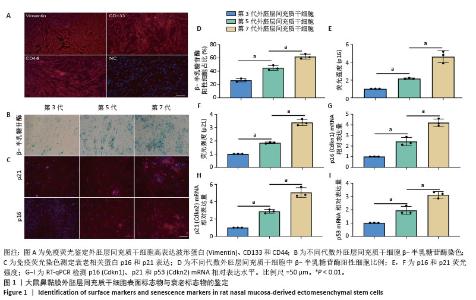
2.1 外胚层间充质干细胞表面标志物与衰老标志物的鉴定结果 外胚层间充质干细胞是一群高表达波形蛋白、CD44、CD133而CD14阴性的细胞群[10]。该研究对第3代外胚层间充质干细胞进行上述表面标志物免疫荧光染色,结果显示第3代外胚层间充质干细胞高表达波形蛋白、CD44、CD133,与以往报道一致(图1A)。经过连续传代培养后,第7代外胚层间充质干细胞中β-半乳糖苷酶染色阳性细胞比例最高(图1B,D)。免疫荧光染色(图1C)观察到p16和p21荧光强度随代数增加而升高(图1E,F);RT-qPCR检测衰老标志物p21、p53和p16的mRNA表达水平也随之提高(图1G-I)。这说明使用培养板培养的外胚层间充质干细胞,从第5代细胞开始会进入一个快速衰老期。因此,对第5代细胞进行特殊干预可能会延缓衰老。 "
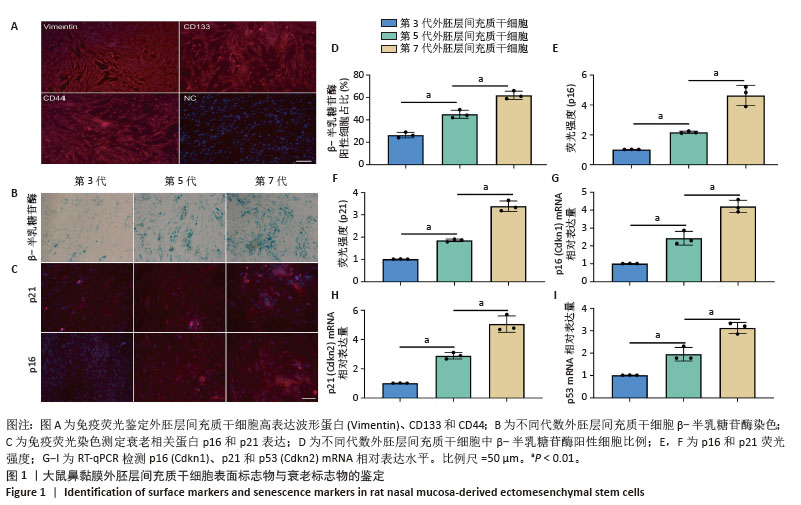
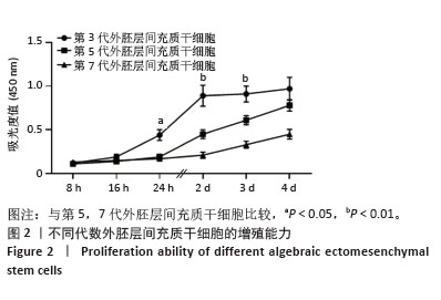
2.2 不同代数外胚层间充质干细胞的增殖能力 增殖能力降低是具有自我更新能力的细胞出现衰老的典型特征[12-13],CCK-8检测显示,第3代外胚层间充质干细胞具有较强的增殖能力,但是第5代外胚层间充质干细胞增殖能力明显下降,第7代外胚层间充质干细胞已经出现增殖停滞,见图2。"
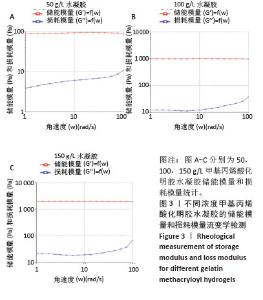
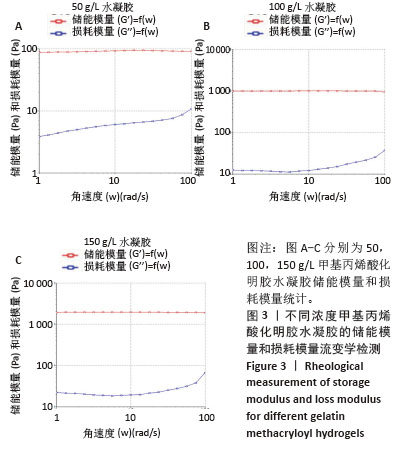
2.3 甲基丙烯酸化明胶水凝胶的机械模量 随着甲基丙烯酸化明胶质量浓度的提高,机械模量也随之提高,利用流变仪检测50 g/L水凝胶的储能模量为(91.78±2.28) Pa,100 g/L水凝胶的储能模量为(987.28±15.64) Pa,150 g/L水凝胶的储能模量为 (1 937.71±15.40) Pa。将50 g/L水凝胶定义为低机械模量(图3A)、100 g/L水凝胶定义为中机械模量(图3B)、150 g/L水凝胶定义为高机械模量(图3C),3种水凝胶可以较好地模拟不同机械模量对外胚层间充质干细胞衰老的影响。"
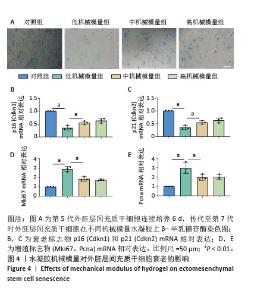
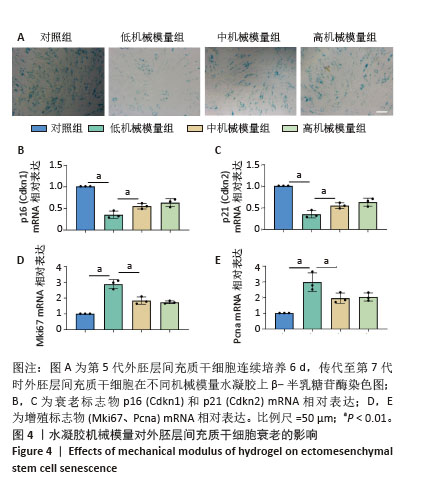
2.4 机械模量对外胚层间充质干细胞衰老的影响 从第5代开始外胚层间充质干细胞会进入一个快速衰老期,此研究将第5代细胞种植到上述3种水凝胶上,连续培养传代至第7代,观察外胚层间充质干细胞的衰老水平。数据显示,在3种水凝胶上的外胚层间充质干细胞连续传代至第7代后,随着机械模量的降低,β-半乳糖苷酶阳性细胞数(图4A)以及Cdkn1和Cdkn2的基因表达水平也持续降低(图4B,C),Mki67和Pcna表达升高(图4D,E),尤其是低机械模量组。 "
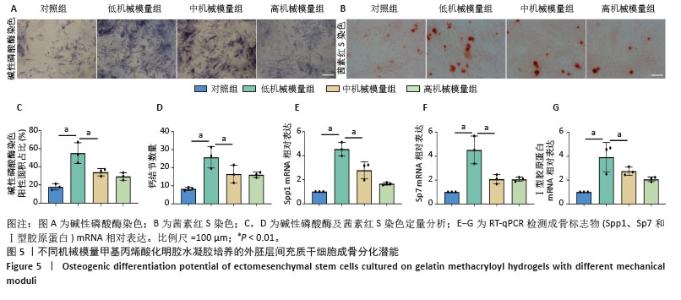
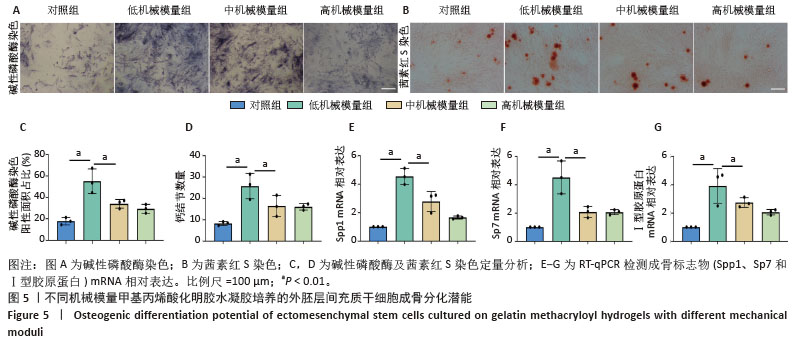
2.5 机械模量对外胚层间充质干细胞分化的影响 评估干细胞衰老的另一个重要指征是多向分化能力[14-16]。该研究对不同机械模量水凝胶上的外胚层间充质干细胞进行成骨诱导,结果显示,低机械模量水凝胶上的外胚层间充质干细胞中碱性磷酸酶活性强于其他两组,形成的钙结节多于其他两组,差异有显著性意义(图5A-D)。RT-qPCR结果显示,成骨分化7 d后成骨相关基因Spp1、Sp7和Ⅰ型胶原蛋白表达水平也明显高于其他两组(图5E-G)。上述数据表明,低机械模量水凝胶上的外胚层间充质干细胞表现出较强的成骨分化能力。 "
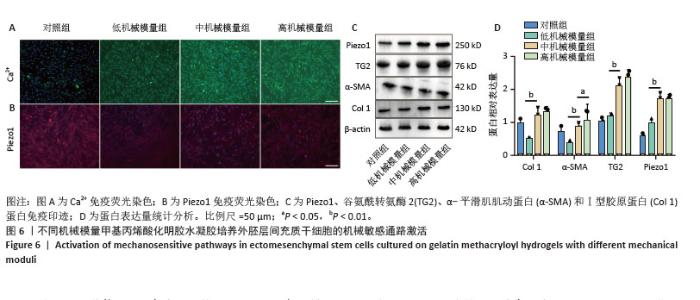
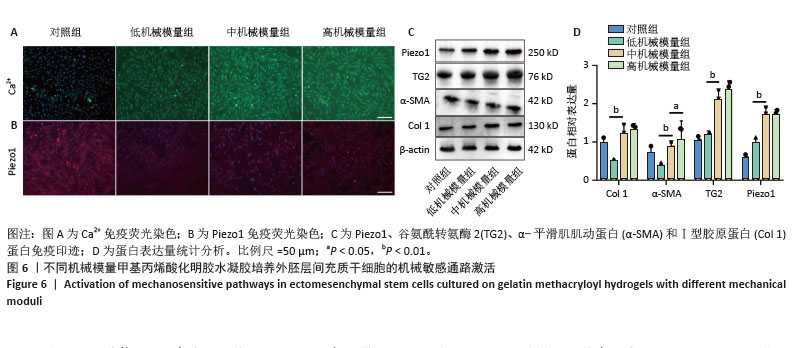
2.6 机械模量延缓外胚层间充质干细胞衰老的分子机制 机械信号通路激活可能是导致衰老的一个重要因素,其中Piezo1是细胞膜表面感知机械信号的重要Ca2+离子通道[17-19]。该研究利用免疫荧光和免疫印迹方法检测了不同机械模量水凝胶上的外胚层间充质干细胞内Ca2+(图6A)以及Piezo1表达水平变化(图6B),发现低机械模量水凝胶上的外胚层间充质干细胞内Ca2+和Piezo1表达低于其他两组。免疫印迹数据显示,与低机械模量组相比,中、高机械模量组Ca2+依赖性蛋白酶谷氨酰转氨酶2表达升高(图6C),同时检测到纤维化指标α-平滑肌肌动蛋白和Ⅰ型胶原蛋白表达明显升高(图6D)。 "
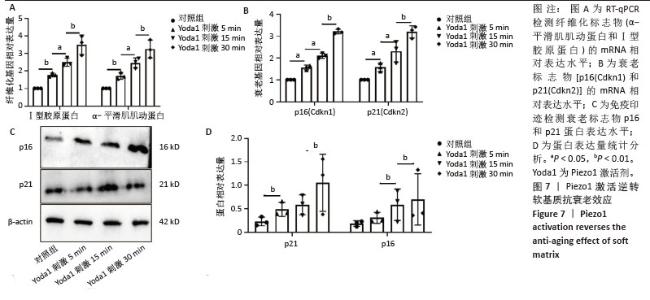
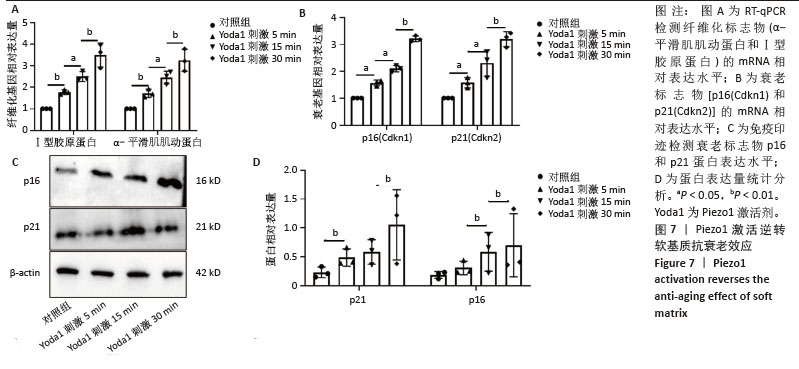
2.7 Piezo1激活加速外胚层间充质干细胞衰老 为了进一步证实上述实验结果,该研究利用yoda1对低机械模量水凝胶上的外胚层间充质干细胞进行Piezo1激活实验[20-21],实验结果显示,低机械模量水凝胶上的外胚层间充质干细胞用Yoda1激活后,仍然表现出衰老加快的现象,并且随着Yoda1作用时间延长,细胞衰老加重,主要表现在纤维化相关基因(Ⅰ型胶原蛋白和α-平滑肌肌动蛋白)表达水平升高(图7A),衰老相关基因Cdkn1和Cdkn2表达升高(图7B),同时衰老相关蛋白(p16和p21)表达水平也升高(图7C,D)。"
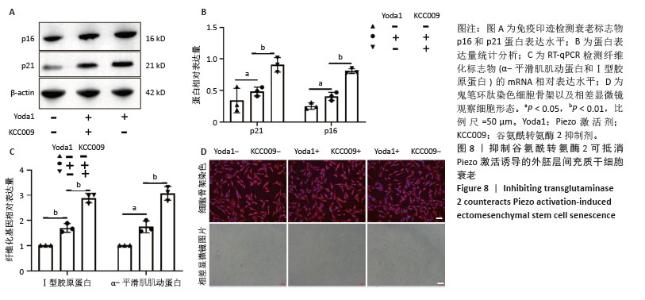
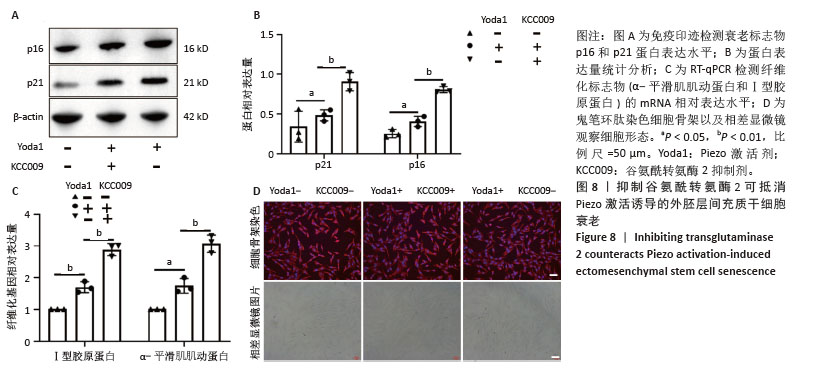
2.8 谷氨酰转氨酶2抑制实验 上述实验可见,Piezo1激活会加速外胚层间充质干细胞衰老,但利用KCC009抑制谷氨酰转氨酶2活性后,低机械模量水凝胶上的外胚层间充质干细胞衰老延缓,主要表现在衰老标志物p16和p21蛋白表达水平降低(图8A,B),同时纤维化相关基因(α-平滑肌肌动蛋白和Ⅰ型胶原蛋白)表达水平降低(图8C)。鬼笔环肽染色观察Yoda1和KCC009刺激后的细胞形态学变化,结果显示细胞未出现明显的形态学改变,相差显微镜下也未观察到明显的改变(图8D),表明细胞未受到明显的毒性。 "
| [1] ZHIDU S, YING T, RUI J, et al. Translational potential of mesenchymal stem cells in regenerative therapies for human diseases: challenges and opportunities. Stem Cell Res Ther. 2024;15(1):266. [2] LEE AE, CHOI JG, SHI SH, et al. DPSC-Derived Extracellular Vesicles Promote Rat Jawbone Regeneration. J Dent Res. 2023;102(3):313-321. [3] AL-AZAB M, SAFI M, IDIIATULLINA E, et al. Aging of mesenchymal stem cell: machinery, markers, and strategies of fighting. Cell Mol Biol Lett. 2022;27(1):69. [4] RASOULI M, NAEIMZADEH Y, HASHEMI N, et al. Age-Related Alterations in Mesenchymal Stem Cell Function: Understanding Mechanisms and Seeking Opportunities to Bypass the Cellular Aging. Curr Stem Cell Res Ther. 2024; 19(1):15-32. [5] WANG Y, XIE F, HE Z, et al. Senescence-Targeted and NAD+-Dependent SIRT1-Activated Nanoplatform to Counteract Stem Cell Senescence for Promoting Aged Bone Regeneration. Small. 2024;20(12):e2304433. [6] YANG MC, CHIN IL, FANG H, et al. Tailored environments for directed mesenchymal stromal cell proliferation and differentiation using decellularized extracellular matrices in conjunction with substrate modulus. Acta Biomater. 2024;187:110-122. [7] ISHIHARA K, KANEYASU M, FUKAZAWA K, et al. Induction of mesenchymal stem cell differentiation by co-culturing with mature cells in double-layered 2-methacryloyloxyethyl phosphorylcholine polymer hydrogel matrices. J Mater Chem B. 2022;10(14):2561-2569. [8] GUO J, SHU X, DENG H, et al. Stiff and Tough Hydrogels Prepared Through Integration of Ionic Cross-linking and Enzymatic Mineralization. Acta Biomater. 2022;149:220-232. [9] LIN CY, SASSI A, WU Y, et al. Mechanotransduction pathways regulating YAP nuclear translocation under Yoda1 and vibration in osteocytes. Bone. 2025;190: 117283. [10] DENG W, SHAO F, HE Q, et al. EMSCs Build an All-in-One Niche via Cell-Cell Lipid Raft Assembly for Promoted Neuronal but Suppressed Astroglial Differentiation of Neural Stem Cells. Adv Mater. 2019;31(10):e1806861. [11] SHI W, WU Y, WU J, et al. NPS-Crosslinked Fibrin Gels Load with EMSCs to Repair Peripheral Nerve Injury in Rats. Macromol Biosci. 2023;23(3):e2200381. [12] WENG Z, WANG Y, OUCHI T, et al. Mesenchymal Stem/Stromal Cell Senescence: Hallmarks, Mechanisms, and Combating Strategies. Stem Cells Transl Med. 2022;11(4):356-371. [13] LEI Q, GAO F, LIU T, et al. Extracellular vesicles deposit PCNA to rejuvenate aged bone marrow-derived mesenchymal stem cells and slow age-related degeneration. Sci Transl Med. 2021;13(578):eaaz8697. [14] VOSKAMP C, KOEVOET WJLM, VAN OSCH GJVM, et al. Senescence during early differentiation reduced the chondrogenic differentiation capacity of mesenchymal progenitor cells. Front Bioeng Biotechnol. 2023;11:1241338. [15] YU A, YU R, LIU H, et al. SIRT1 safeguards adipogenic differentiation by orchestrating anti-oxidative responses and suppressing cellular senescence. Geroscience. 2024;46(1):1107-1127. [16] SHANG L, LI X, DING X, et al. S-Adenosyl-l-Methionine Alleviates the Senescence of MSCs Through the PI3K/AKT/FOXO3a Signaling Pathway. Stem Cells. 2024; 42(5):475-490. [17] XIE M, CAO H, QIAO W, et al. Shear stress activates the Piezo1 channel to facilitate valvular endothelium-oriented differentiation and maturation of human induced pluripotent stem cells. Acta Biomater. 2024;178:181-195. [18] DEMAGNY J, POIRAULT-CHASSAC S, ILSAINT DN, et al. Role of the mechanotransductor PIEZO1 in megakaryocyte differentiation. J Cell Mol Med. 2024;28(18):e70055. [19] ZHOU Y, LI M, LIN S, et al. Mechanical sensing protein PIEZO1 controls osteoarthritis via glycolysis mediated mesenchymal stem cells-Th17 cells crosstalk. Cell Death Dis. 2025;16(1):231. [20] SUN M, MAO S, WU C, et al. Piezo1-Mediated Neurogenic Inflammatory Cascade Exacerbates Ventricular Remodeling After Myocardial Infarction. Circulation. 2024;149(19):1516-1533. [21] GAN D, TAO C, JIN X, et al. Piezo1 activation accelerates osteoarthritis progression and the targeted therapy effect of artemisinin. J Adv Res. 2024;62:105-117. [22] WU M, MI J, QU GX, et al. Role of Hedgehog Signaling Pathways in Multipotent Mesenchymal Stem Cells Differentiation. Cell Transplant. 2024;33: 9636897241244943. [23] LV D, LI B, LIU Z, et al. LPS‑mediated adaptation accelerates ecto‑MSCs differentiation into osteoblasts. Mol Med Rep. 2024;30(6):241. [24] HAO M, JIANG H, ZHAO Y, et al. Identification of potential biomarkers for aging diagnosis of mesenchymal stem cells derived from the aged donors. Stem Cell Res Ther. 2024;15(1):87. [25] REGNER AM, DELEON M, GIBBONS KD, et al. Increased deformations are dispensable for cell mechanoresponse in engineered bone analogs mimicking aging bone marrow. bioRxiv [Preprint]. 2023:2023.09.24.559187. [26] CAI Z, XIN Z, WANG H, et al. Extracellular Vesicle-Contained Thrombospondin 1 Retards Age-Related Degenerative Tendinopathy by Rejuvenating Tendon Stem/Progenitor Cell Senescence. Small. 2024;20(38):e2400598. [27] MAHONEY SA, DARRAH MA, VENKATASUBRAMANIAN R, et al. Late Life Supplementation of 25-Hydroxycholesterol Reduces Aortic Stiffness and Cellular Senescence in Mice. Aging Cell. 2025;24(8):e70118. [28] VENKATASUBRAMANIAN R, DARRAH MA, MAHONEY SA, et al. Cellular Senescence Mediates Doxorubicin Chemotherapy-Induced Aortic Stiffening: Role of Glycation Stress. bioRxiv [Preprint]. 2025:2025.05.13.653823. [29] COLDEA A, MAYINGER F, MEINEN J, et al. Mechanical properties of 3D printed denture base polymers. J Prosthet Dent. 2025;133(5):1361.e1-1361.e8. [30] SHIN JW, JANG DH, KIM SY, et al. Propagation of senescent phenotypes by extracellular HMGB1 is dependent on its redox state. Metabolism. 2025;168: 156259. [31] WU L, ZHU X, PAN S, et al. Diabetes Advances Cardiomyocyte Senescence Through Interfering Rnd3 Expression and Function. Aging Cell. 2025;24(6):e70031. [32] YAN X, FU S, XIE Y, et al. Piezo1-driven mechanotransduction as a key regulator of cartilage degradation in early osteoarthritis. Biomol Biomed. 2025;25(4):905-913. [33] BRAIDOTTI N, RIZZO D, CIUBOTARU CD, et al. Actin instability alters red blood cell mechanics and Piezo1 channel activity. Biomech Model Mechanobiol. 2025; 24(2):507-520. [34] ZHANG G, PAN R, LAI S, et al. Phosphatidylserine-functional polydimethylsiloxane substrates regulate macrophage M2 polarization via modulus-dependent NF-κB/PPARγ pathway. Biomater Adv. 2024;165:213997. [35] CAO Q, TARTAGLIA G, ALEXANDER M, et al. Collagen VII maintains proteostasis in dermal fibroblasts by scaffolding TANGO1 cargo. Matrix Biol. 2022;111:226-244. [36] CONDELLO S, PRASAD M, ATWANI R, et al. Tissue transglutaminase activates integrin-linked kinase and β-catenin in ovarian cancer. J Biol Chem. 2022;298(8): 102242. [37] CHEN Y, YAN Y, LI Y, et al. Deletion of Tgm2 suppresses BMP-mediated hepatocyte-to-cholangiocyte metaplasia in ductular reaction. Cell Prolif. 2024;57(10):e13646. [38] MA T, GE X, ZHU J, et al. Dioscin Impedes Proliferation, Metastasis and Enhances Autophagy of Gastric Cancer Cells via Regulating the USP8/TGM2 Pathway. Mol Biotechnol. 2024;66(12):3700-3711. [39] LIU X, ZHANG R, LIU L, et al. Sohlh2 Promotes the Progression of Hepatocellular Carcinoma via TGM2-Mediated Autophagy. Mol Carcinog. 2025;64(1):138-151. [40] CHEN J, MA J, QI D, et al. Inhibition of transglutaminase 2 inhibits ionizing radiation-induced cellular senescence in skin keratinocytes in vitro. IUBMB Life. 2024;76(12):1252-1263. |
| [1] | Haonan Yang, Zhengwei Yuan, Junpeng Xu, Zhiqi Mao, Jianning Zhang. Preliminary study on the mechanisms and efficacy of deep brain stimulation in treating depression [J]. Chinese Journal of Tissue Engineering Research, 2026, 30(在线): 1-9. |
| [2] | Wu Yanting, Li Yu, Liao Jinfeng. Magnesium oxide nanoparticles regulate osteogenesis- and angiogenesis-related gene expressions to promote bone defect healing [J]. Chinese Journal of Tissue Engineering Research, 2026, 30(8): 1885-1895. |
| [3] | Li Zhenyu, Zhang Siming, Bai Jiaxiang, Zhu Chen. Osthole improves osteogenic differentiation function of bone marrow mesenchymal stem cells under high-glucose conditions [J]. Chinese Journal of Tissue Engineering Research, 2026, 30(7): 1641-1648. |
| [4] | Jin Dongsheng, Zhao Zhanghong, Zhu Ziyin, Zhang Sen, Sun Zuyan, Deng Jiang. Effects of icariin-loaded microsphere-three-dimensional scaffold on osteogenic differentiation of rabbit bone marrow mesenchymal stem cells [J]. Chinese Journal of Tissue Engineering Research, 2026, 30(7): 1658-1668. |
| [5] | Zou Yulian, Chen Chaopei, Huang Haixia, Lan Yuyan, Liu Min, Huang Ting. Resveratrol promotes osteogenic differentiation of bone marrow mesenchymal stem cells in an inflammatory microenvironment [J]. Chinese Journal of Tissue Engineering Research, 2026, 30(7): 1669-1678. |
| [6] | Zhang Haiwen, Zhang Xian, Xu Taichuan, Li Chao. Bibliometric and visual analysis of the research status and trends of senescence in osteoporosis [J]. Chinese Journal of Tissue Engineering Research, 2026, 30(6): 1580-1591. |
| [7] | Lai Jiaming, , Song Yuling, Chen Zixi, Wei Jinghuan, Cai Hao, , Li Guoquan, . Screening of diagnostic markers for endothelial cell Senescence in mice with radiation-induced heart disease and analysis of immune infiltration [J]. Chinese Journal of Tissue Engineering Research, 2026, 30(6): 1450-1463. |
| [8] | Wang Houyuan, Xiao Jiacong, Shao Shoujia, He Paian, Yang Nan, Jiang Ziwei. Aucubin promotes osteogenic differentiation of mouse cranial pre-osteoblasts MC3T3-E1 [J]. Chinese Journal of Tissue Engineering Research, 2026, 30(36): 9381-9392. |
| [9] | Xu Hongtao, Wang Jianping, Xu Yuehong, Li Qin, Qi Qihua, Xia Qipeng. Asiaticoside promotes osteogenic differentiation in osteoporotic rats [J]. Chinese Journal of Tissue Engineering Research, 2026, 30(35): 9113-9119. |
| [10] | Zhao Minjun, , Wu Xubo, , Yin Jianli, , Ge Yangshuo, Ding Jiaying, Huang Chunmeng, Meng Tingting, Wang Xuezong, Liu Zhenfeng, Ding Daofang. Effects of cobimetinib versus combination of dasatinib and quercetin on stress-induced chondrocyte senescence [J]. Chinese Journal of Tissue Engineering Research, 2026, 30(35): 9151-9158. |
| [11] | Yang Huaqun, Abudouainijiang·Abulimiti, Wang Fazheng, Maimaitishawutiaji·Maimaiti, Li Simi, Muhetaer·Maimaitirexiati. Weighted gene co-expression network analysis combined with machine learning identifies autophagy and senescence signature genes in osteoarthritis chondrocytes [J]. Chinese Journal of Tissue Engineering Research, 2026, 30(34): 8889-8898. |
| [12] | Hu Liqun, Xiao Dongqin, Ma Chenxi, Li Zhuohan, Yan Jiyuan, Li Zhong, He Kui, Duan Ke. Performance of calcium sulfate-magnesium oxide composites as anti-infective bone graft materials [J]. Chinese Journal of Tissue Engineering Research, 2026, 30(32): 8309-8318. |
| [13] | Yang Yanjun, Zhu Lin, Gu Yongchun, Yan Zhanjun. Mechanism by which magnesium implant-activated integrin α10β1 promotes osteogenic differentiation of periosteal stem cells [J]. Chinese Journal of Tissue Engineering Research, 2026, 30(32): 8319-8326. |
| [14] | Jia Xianghong, Xu Yan, Zhang Xujing. Mechanical and fluid dynamic characteristics of S-type triply periodic minimal surface radial functionally graded bone scaffolds [J]. Chinese Journal of Tissue Engineering Research, 2026, 30(32): 8327-8334. |
| [15] | Yan Yanliuxing, Deng Xinxin, Zou Jie, Li Jianmo. Effectiveness of collagen and fibrin sealant in repairing articular cartilage damage in rabbits [J]. Chinese Journal of Tissue Engineering Research, 2026, 30(32): 8335-8344. |
| Viewed | ||||||
|
Full text |
|
|||||
|
Abstract |
|
|||||