Chinese Journal of Tissue Engineering Research ›› 2026, Vol. 30 ›› Issue (32): 8335-8344.doi: 10.12307/2026.417
Previous Articles Next Articles
Effectiveness of collagen and fibrin sealant in repairing articular cartilage damage in rabbits
Yan Yanliuxing, Deng Xinxin, Zou Jie, Li Jianmo
- Konee Co., Ltd., Shenzhen 518057, Guangdong Province, China
-
Accepted:2026-01-06Online:2026-11-18Published:2026-04-23 -
Contact:Li Jianmo, PhD, Senior engineer, Konee Co., Ltd., Shenzhen 518057, Guangdong Province, China -
About author:Yan Yanliuxing, PhD, Konee Co., Ltd., Shenzhen 518057, Guangdong Province, China -
Supported by:Shenzhen Science and Technology Program, Grant No. KQTD20190929172501638 (to LJM)

CLC Number:
Cite this article
Yan Yanliuxing, Deng Xinxin, Zou Jie, Li Jianmo. Effectiveness of collagen and fibrin sealant in repairing articular cartilage damage in rabbits[J]. Chinese Journal of Tissue Engineering Research, 2026, 30(32): 8335-8344.
share this article
Add to citation manager EndNote|Reference Manager|ProCite|BibTeX|RefWorks
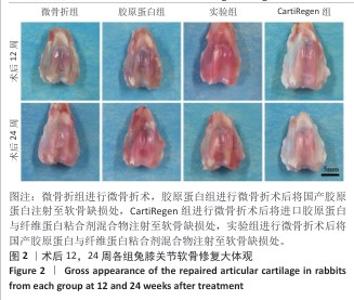
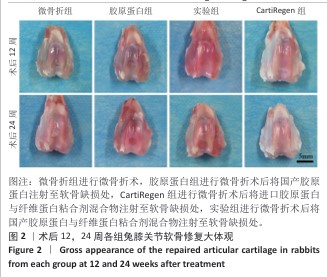
2.1 实验动物数量分析 48只新西兰白兔全部进入结果分析。 2.2 各组兔膝关节软骨大体外观评价结果 术后12,24周,4组兔膝关节均未见明显感染迹象,无红肿、发炎等现象。术后12周,微骨折组软骨缺损区修复组织较多,亮白色组织与纤维样组织夹杂,表面有明显裂痕,修复组织表面低于周围正常软骨面;胶原蛋白组软骨缺损区修复组织与周围软骨面一致,修复组织表面粗糙,与周围组织整合欠佳;实验组软骨缺损修复平面与正常软骨面基本一致,表面欠平整,与周围组织整合基本一致;CartiRegen组软骨缺损区填充完全,修复平面与正常软骨面基本一致,修复组织表面略粗糙,与周围组织基本整合,见图2。 术后24周,微骨折组软骨缺损区已基本填充完全,与周围组织相比仍存在一定凹陷,与周围组织有部分整合,整体修复组织的颜色与周围正常组织存在一定差异;胶原蛋白组软骨缺损区修复组织与周围正常软骨面基本一致,修复组织表面较平整,与周围组织整合基本一致,修复组织与正常软骨组织颜色略有差异;实验组软骨缺损填充完全,修复效果明显,修复软骨平面、整合、颜色与周围正常软骨未见明显差异;CartiRegen组与实验组结果类似,软骨缺损区填充完全,修复软骨与周围正常软骨颜色、界面、整合几乎无差异,见图2。 "
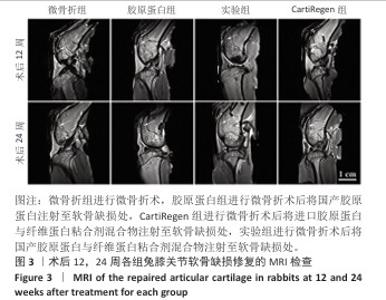
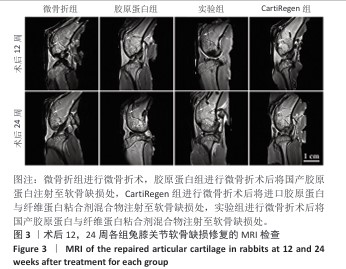
2.3 各组兔膝关节软骨组织影像学检查结果 图3显示术后12,24周各组兔膝关节软骨修复组织的MRI影像学结果。术后12周,微骨折组软骨缺损区内新生组织较多,但填充不完全,内部有高亮信号,与周围正常软骨整合欠佳,提示修复组织与正常软骨组织差异较大;胶原蛋白组软骨缺损区基本填充完全,但修复组织不完全均匀,呈现混杂的高亮信号,与周围正常软骨组织有部分整合;实验组软骨缺损区填充完全,基底部也变为灰白信号,关节面侧仍有混杂的高亮信号,与周围组织已经基本整合;CartiRegen组软骨缺损区域已经形成一层类软骨信号,基底部变为灰白色信号,缺损区靠近关节面部分仍有高亮信号,与周围正常软骨组织已经大部分整合。 术后24周,微骨折组软骨缺损区基本填充完全,与周边正常组织边界处的信号不一致,内部混杂有高信号,提示内部结构不均匀,与周围组织整合差;胶原蛋白组软骨缺损区填充完全,有少量灰白色信号,与周围正常软骨组织基本完全整合;实验组软骨缺损区填充完全,整个缺损区未见明显高亮信号,与周围软骨组织界限不明显;CartiRegen组软骨缺损区填充完全,信号均匀,未见明显高亮信号,与周围软骨组织整合边界信号均匀,提示内部结构均一、整合良好。 "
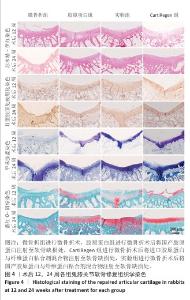
2.4 各组兔膝关节软骨组织形态观察结果 图4显示各组兔膝关节软骨修复组织苏木精-伊红、甲苯胺蓝和番红O-固绿染色与Ⅱ型胶原免疫组化染色结果。 苏木精-伊红染色:术后12周,微骨折组软骨缺损区内修复组织较多,但距完全填充缺损深度仍有一定差距,修复组织呈现纤维样修复,排列杂乱,细胞量少,与周边正常软骨整合较差;胶原蛋白组软骨缺损区基本完全填充,细胞数量较多,但修复组织与周边正常软骨整合性依然欠佳,交界处仍有裂隙和不平整;实验组软骨缺损区修复组织填充明显,细胞数量多,修复组织和正常软骨交界区少见裂隙,融合性好,软骨面略微不平整;CartiRegen组软骨缺损区填充明显,细胞数量较多,交界处极少有裂隙,修复软骨面稍微不平整。术后24周,微骨折组软骨缺损区基本填充完全,填充组织表现为明显的纤维样修复组织,边缘毛糙且与周围组织整合不佳;胶原蛋白组软骨缺损区域填充完全,与周围组织整合存在一些裂隙,软骨修复面平整;实验组软骨缺损区填充完全,与周围组织连接区域未见裂隙,新生软骨层较正常软骨略薄,表面光滑平整;CartiRegen组软骨缺损部位填充完全,与周围组织整合良好,表面较光滑。 Ⅱ型胶原免疫组化染色:术后12周,微骨折组软骨缺损基底部有部分区域Ⅱ型胶原染色呈阳性,但染色较浅且不均匀,其他区域染色仍呈阴性;胶原蛋白组软骨缺损大部分区域与正常软骨相比染色接近,但表层染色较浅且软骨表面不太平整;实验组软骨缺损染色情况与正常软骨区域基本一致,但与周围组织连接处欠佳,软骨修复面略微不平整;CartiRegen组软骨缺损区染色情况与正常软骨染色趋于一致,部分表层区域染色不够深。术后24周,各组在软骨缺损部位均形成了明显Ⅱ型胶原蛋白层,其中微骨折组缺损修复区域基本填充纤维样组织,新生Ⅱ型胶原蛋白层型结构相比其他3组更松散,整体染色不均匀,与正常软骨分界明显;胶原蛋白组软骨缺损区域Ⅱ型胶原染色基本接近正常软骨,但表面不平整且连接处仍可见裂隙;实验组软骨缺损修复区域填充完整,Ⅱ型胶原染色接近正常软骨,表面平整,与周围组织连接完整;CartiRegen组填充程度好,组织致密,Ⅱ型胶原染色着色深,接近正常软骨。 甲苯胺蓝染色:术后12周,胶原蛋白组、实验组与CartiRegen组软骨缺损修复部位均显示大量蛋白多糖,而微骨折组中蛋白多糖较少。术后24周,微骨折组软骨缺损基底区染色,但表层区域染色较浅;胶原蛋白组软骨缺损区均有染色,但染色深度略有不均;实验组和CartiRegen组软骨缺损区染色均匀且表面光滑。 番红O-固绿染色:术后12周,胶原蛋白组、实验组与CartiRegen组软骨缺损修复部位有软骨组织生成,而微骨折组没有显示出软骨染色,整个修复部位呈现出骨组织的染色特征。术后24周,4组软骨缺损区均有不同程度修复,其中,微骨折组基底区染色,但表层区域染色较浅,只有少量红色,说明形成了少量软骨组织;胶原蛋白组、实验组与CartiRegen组形成了明显的软骨组织层,与软骨下骨有明显的染色区别。 "
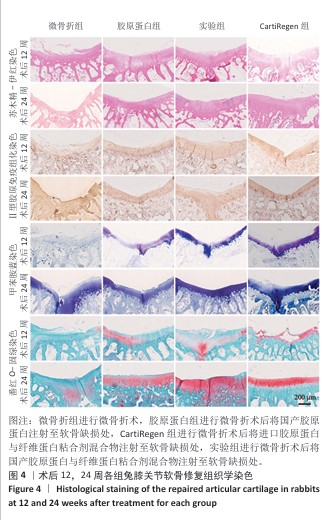
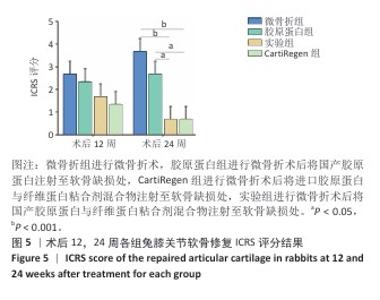
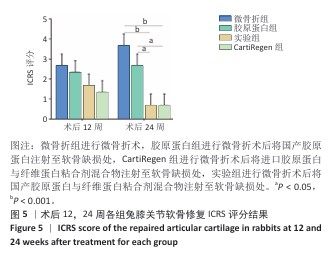
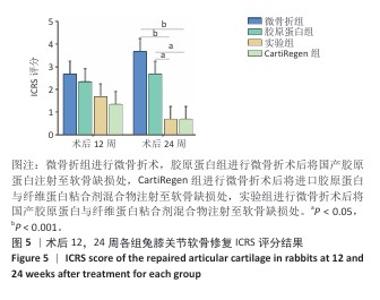
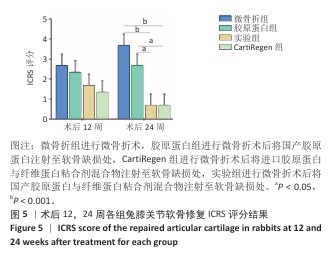
2.5 各组兔膝关节软骨修复组织评分结果 图5显示术后12,24周各组兔膝关节软骨修复ICRS 评分结果。术后12周,微骨折组、胶原蛋白组、实验组与CartiRegen组软骨缺损修复区ICRS 评分分别为2.67±0.58,2.33±0.58,1.67±0.58,1.33±0.58,4组间比较差异无显著性意义(P > 0.05)。术后24周,微骨折组、胶原蛋白组、实验组与CartiRegen组软骨缺损修复区ICRS 评分分别为3.67±0.58,2.67±0.58,0.67±0.58,0.67±0.58,实验组与CartiRegen组软骨缺损修复区ICRS 评分低于微骨折组、胶原蛋白组(P < 0.001,P < 0.05)。结果表明,无论是国产胶原还是进口胶原,与纤维蛋白粘合剂混合后联合微骨折术治疗软骨损伤的效果都比单纯使用胶原蛋白材料结合微骨折术或者单纯使用微骨折术更好。 图6显示术后12,24周各组兔膝关节软骨修复Mankin评分结果。术后12周,微骨折组、胶原蛋白组、实验组与CartiRegen组软骨缺损修复区Mankin评分分别为10.33±1.53,7.67±1.15,5.33±1.53,4.67±1.15,实验组与CartiRegen组软骨缺损修复区Mankin评分低于微骨折组(P < 0.01)。术后24周,微骨折组、胶原蛋白组、实验组与CartiRegen组软骨缺损修复区Mankin评分分别为11.67±0.58,8.00±1.00,3.33±1.41,3.00±1.00,胶原蛋白组软骨缺损修复区Mankin评分低于微骨折组(P < 0.01),实验组与CartiRegen组软骨缺损修复区Mankin评分低于微骨折组、胶原蛋白组(P < 0.001)。结果表明,无论是国产胶原还是进口胶原,与纤维蛋白粘合剂混合后联合微骨折术治疗软骨损伤的效果显著优于单纯使用胶原蛋白材料结合微骨折术和单纯微骨折术治疗。 从软骨修复进程看,随着时间的推移,实验组和CartiRegen组ICRS评分和Mankin评分都下降,提示软骨修复组织正逐渐趋向正常软骨转化;但微骨折组和胶原蛋白组略有反常,软骨组织评分随着时间的推移略微有所上升,这可能主要是因为每个时间点每组样本量太少(n=3)导致受个体差异影响较大。"
"
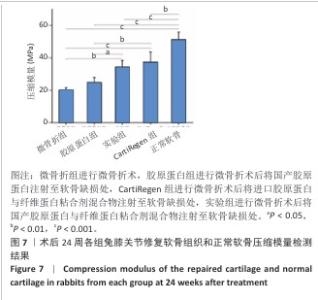
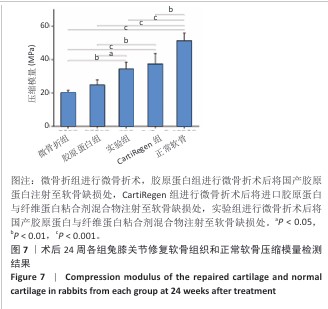
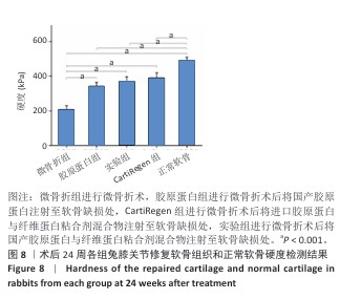
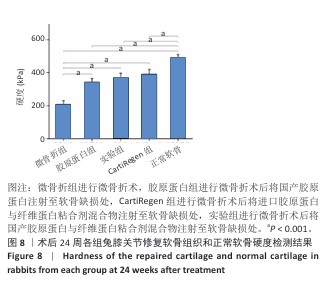
2.6 各组兔膝关节软骨组织生物力学评价结果 术后24周各组兔膝关节软骨组织压缩模量检测结果,如图7所示。微骨折组、胶原蛋白组、实验组与CartiRegen组软骨组织压缩模量分别为(20.10±1.36),(24.89±2.93),(34.35±3.96),(37.53±6.19) MPa, 实验组与CartiRegen 组软骨组织压缩模量高于微骨折组、胶原蛋白组(P < 0.01,P < 0.05,P < 0.001,P < 0.01),实验组与CartiRegen组软骨组织压缩模量低于正常软骨组织[(51.30±4.53) MPa](P < 0.001,P < 0.01)。结果表明,无论使用国产胶原蛋白还是进口胶原蛋白,与纤维蛋白粘合剂混合后联合微骨折术治疗软骨缺损表现出最接近健康正常软骨的黏弹性行为。 术后24周各组兔膝关节软骨组织硬度检测结果,见图8。微骨折组、胶原蛋白组、实验组与CartiRegen组软骨组织硬度分别为(207.14±22.26),(341.59±22.45),(368.02±29.02),(389.65±30.29) kPa,胶原蛋白组、实验组与CartiRegen组软骨组织硬度大于微骨折组(P < 0.001),胶原蛋白组、实验组与CartiRegen组软骨组织硬度低于正常软骨组织[(488.77±21.31) kPa] (P < 0.001)。结果表明,使用胶原蛋白进行软骨修复,人纤维蛋白粘合剂的添加与否对生成软骨组织的硬度无明显影响。考虑到该结果仅为术后24周的结果,而软骨修复及组织力学性能的恢复和重建可能需要更久的时间,随着修复时间的推移,修复软骨的硬度可能会进一步增加,更加接近原生软骨的力学性能。 "
"
| [1] 王新军,沈明球,刘俊昌,等.膝关节骨性关节炎的病因研究现状[J].新疆中医药,2011,29(3):77-80. [2] 李民仆,胡佳琦,温春蕾,等.膝关节骨性关节炎射频治疗研究进展[J].中国疼痛医学杂志,2020,26(1):61-65. [3] 宗亿洲,戴易,李哲,等.坏死性凋亡与铁死亡在膝骨关节炎中的研究进展[J].海南医学院学报,2023,29(21):1675-1680. [4] MARTEL-PELLETIER J, BARR AJ, CICUTTINI FM, et al. Osteoarthritis. Nat Rev Dis Primers. 2016;2:16072. [5] 赵忠琪,王晓坤,彭慧敏,等.提高关节软骨脱细胞支架孔隙率及细胞渗透性方法的研究进展[J].中国生物医学工程学报,2018,37(1): 112-118. [6] 史冬泉,李嘉威.软骨修复临床转化的挑战与机遇[J].医学研究生学报, 2019,32(9):897-903. [7] MEDVEDEVA EV, GREBENIK EA, GORNOSTAEVA SN, et al. Repair of Damaged Articular Cartilage: Current Approaches and Future Directions. Int J Mol Sci. 2018;19(8):2366. [8] 敖英芳,代文立.关节软骨损伤修复研究展望[J].临床外科杂志,2021, 29(4):301-304. [9] KANG SW, BADA LP, KANG CS, et al. Articular cartilage regeneration with microfracture and hyaluronic acid. Biotechnol Lett. 2008;30(3):435-439. [10] ARMIENTO AR, ALINI M, STODDART MJ. Articular fibrocartilage-Why does hyaline cartilage fail to repair? Adv Drug Deliv Rev. 2019;146:289-305. [11] BERTHO P, PAUVERT A, POUDEROUX T, et al. Treatment of large deep osteochondritis lesions of the knee by autologous matrix-induced chondrogenesis (AMIC): Preliminary results in 13 patients. Orthop Traumatol Surg Res. 2018;104(5):695-700. [12] 代岭辉.膝关节软骨损伤修复重建指南(2021)[J].中国运动医学杂志, 2022,41(4):249-259. [13] MITHOEFER K, MCADAMS T, WILLIAMS RJ, et al. Clinical efficacy of the microfracture technique for articular cartilage repair in the knee: an evidence-based systematic analysis. Am J Sports Med. 2009;37(10): 2053-2063. [14] 李美明,马永胜,林啟泰,等.同种异体骨软骨移植的适应证和禁忌证[J].实用骨科杂志,2024,30(8):673-678. [15] 兰伟伟,陈维毅,黄棣.骨软骨组织工程研究进展[J].生物医学工程学杂志,2019,36(3):504-510. [16] 周建林,方洪松,彭昊,等.自体、异体骨软骨移植及组织工程材料修复的关节软骨损伤[J].中国组织工程研究,2015,19(34):5530-5535. [17] 齐义营,施培华,欧阳宏伟.自体软骨细胞移植治疗关节软骨缺损的进展[J].中华骨科杂志,2008,28(1):71-73. [18] 徐磊,叶朝阳,周燕,等.体外传代培养兔关节软骨细胞的去分化现象[J].中国组织工程研究,2013,17(20):3626-3634. [19] 关炼雄,段莉,黄江鸿,等.软骨细胞去分化研究进展[J].国际骨科学杂志,2014,35(4):250-253. [20] KARLSEN TA, SHAHDADFAR A, BRINCHMANN JE. Human primary articular chondrocytes, chondroblasts-like cells, and dedifferentiated chondrocytes: differences in gene, microRNA, and protein expression and phenotype. Tissue Eng Part C Methods. 2011;17(2):219-227. [21] KNUTSEN G, DROGSET JO, ENGEBRETSEN L, et al. A randomized trial comparing autologous chondrocyte implantation with microfracture. Findings at five years. J Bone Joint Surg Am. 2007;89(10):2105-2112. [22] 金璐頔,徐晶晶,张勇,等.软骨细胞体外增殖去分化的拉曼光谱分析[J].物理化学学报,2017,33(12):2446-2453. [23] 刘振龙,侯振宸,胡晓青,等.关节镜下组织工程支架修复软骨损伤[J].北京大学学报(医学版),2025,57(2):384-387. [24] 许航,何其泽,黄为,等.组织工程关节软骨的研究进展[J].中国骨与关节损伤杂志,2022,37(5):558-560. [25] 敖英芳.关节软骨损伤修复重建学[M].北京:北京大学医学出版社, 2020. [26] 陈微,孙倩雯,韩艳琪,等.丝素蛋白水凝胶在骨关节炎中的应用研究[J].药物流行病学杂志,2023,32(5):582-589. [27] LI Y, CHEN M, ZHOU W, et al. Cell-free 3D wet-electrospun PCL/silk fibroin/Sr2+ scaffold promotes successful total meniscus regeneration in a rabbit model. Acta Biomater. 2020;113:196-209. [28] LI Q, XU S, FENG Q, et al. 3D printed silk-gelatin hydrogel scaffold with different porous structure and cell seeding strategy for cartilage regeneration. Bioact Mater. 2021;6(10):3396-3410. [29] 王武,樊晓磊,谢杰,等.羟基磷灰石-聚乙烯醇/胶原-壳聚糖-明胶复合水凝胶修复兔骨软骨缺损[J]. 中国组织工程研究,2024,28(5): 682-689. [30] 张本妥,杨昕.人工生物材料在关节软骨损伤修复中的应用[J].中国组织工程研究,2024,28(10):1599-1605. [31] SALONIUS E, MELLER A, PAATELA T, et al. Cartilage Repair Capacity within a Single Full-Thickness Chondral Defect in a Porcine Autologous Matrix-Induced Chondrogenesis Model Is Affected by the Location within the Defect. Cartilage. 2021;13(2_suppl):744S-754S. [32] INTINI C, JOYCE M, UBERTI M, et al. A biomimetic reinforced type I/II collagen and hyaluronic acid scaffold in combination with a chondral biomaterial fixation technique for large articular cartilage defect repair: A pilot pre-clinical study. Int J Biol Macromol. 2025;318(Pt 4):145302. [33] 王征,于会,于尧,等.自体脂肪干细胞、壳聚糖/胶原蛋白支架材料及GDF-5复合物移植修复兔软骨缺损[J].中国组织工程研究,2018, 22(25):3969-3974. [34] MAINIL-VARLET P, AIGNER T, BRITTBERG M, et al. Histological assessment of cartilage repair: a report by the Histology Endpoint Committee of the International Cartilage Repair Society (ICRS). J Bone Joint Surg Am. 2003; 85-A Suppl 2:45-57. [35] MANKIN HJ, DORFMAN H, LIPPIELLO L, et al. Biochemical and metabolic abnormalities in articular cartilage from osteo-arthritic human hips. II. Correlation of morphology with biochemical and metabolic data. J Bone Joint Surg Am. 1971;53(3):523-537. [36] MCCARTHY HS, ROBERTS S. A histological comparison of the repair tissue formed when using either Chondrogide (®) or periosteum during autologous chondrocyte implantation. Osteoarthritis Cartilage. 2013;21(12):2048-2057. [37] CAREY JL, REMMERS AE, FLANIGAN DC. Use of MACI (autologous cultured chondrocytes on porcine collagen membrane) in the United States: preliminary experience. Orthop J Sports Med. 2020;8(8): 2325967120941816. [38] MAYBIN JA, CRITCHLEY HO. Menstrual physiology: implications for endometrial pathology and beyond. Hum Reprod Update. 2015;21(6): 748-761. [39] KIM MK, CHOI SW, KIM SR, et al. Autologous chondrocyte implantation in the knee using fibrin. Knee Surg Sports Traumatol Arthrosc. 2010; 18(4):528-534. [40] DI CAVE E, VERSARI P, SCIARRETTA F, et al. Biphasic bioresorbable scaffold (TruFit Plug®) for the treatment of osteochondral lesions of talus: 6- to 8-year follow-up. Foot (Edinb). 2017;33:48-52. [41] PARK IS, JIN RL, OH HJ, et al. Sizable scaffold-free tissue-engineered articular cartilage construct for cartilage defect repair. Artif Organs. 2019;43(3):278-287. [42] 刘恒宇,阮耀宽,姜振德,等.中晚期踝关节炎治疗方案选择原则及治疗方法的研究进展[J].吉林大学学报(医学版),2025,51(1):266-274. [43] KIM SJ, SHETTY AA, KURIAN NM, et al. Articular cartilage repair using autologous collagen-induced chondrogenesis (ACIC): a pragmatic and cost-effective enhancement of a traditional technique. Knee Surg Sports Traumatol Arthrosc. 2020;28(8):2598-2603. [44] ANDERS S, VOLZ M, FRICK H, et al. A randomized, controlled trial comparing autologous matrix-induced chondrogenesis (AMIC®) to microfracture: analysis of 1- and 2-year follow-up data of 2 centers. Open Orthop J. 2013; 7:133-143. [45] VOLZ M, SCHAUMBURGER J, GELLIßEN J, et al. A randomized controlled trial demonstrating sustained benefit of autologous matrix-induced chondrogenesis (AMIC®) over microfracture: 10-year follow-up. Eur J Orthop Surg Traumatol. 2024;34(5):2429-2437. [46] 李威.关节镜微骨折术联合使用胶原蛋白软骨再生载体对膝关节软骨缺损患者治疗的临床疗效分析[D].石家庄:河北医科大学,2021. [47] 罗洁,王凤山.医用软组织粘合剂的研究进展及临床应用现状[J].药物生物技术,2014,21(3):274-278. [48] 郭偲,刘宏,周萌萌.医用纤维蛋白粘合剂的研究进展[J].中国药房, 2016,27(17):2439-2442. [49] 曾俐,孙材江.自制纤维蛋白粘合剂对同种异体关节软骨移植的作用[J].中华骨科杂志,1993,13(6):442-445,C2. [50] 杨万波.关节软骨组织工程学研究进展[J].中国矫形外科杂志,2003(Z2): 96-98. [51] 杨贵勇,卢世璧.生物组织粘合剂对软骨修复材料和修复过程的影响[J].中国临床康复,2002,6(10):1416-1417. [52] JEONG IH, SHETTY AA, KIM SJ, et al. Autologous collagen-induced chondrogenesis using fibrin and atelocollagen mixture. Cells Tissues Organs. 2013;198(4):278-288. [53] 组织工程医疗产品 第10部分:修复或再生关节软骨的植入物体内评价指南:YY/T 0606.10-2008[S]. 2008. [54] 用于关节软骨组织修复或再生的植入性医疗器械体内评价:T/CSBM 0029-2022[S].2022. [55] DIAS IR, VIEGAS CA, CARVALHO PP. Large Animal Models for Osteochondral Regeneration. Adv Exp Med Biol. 2018;1059:441-501. [56] MORAN CJ, RAMESH A, BRAMA PA, et al. The benefits and limitations of animal models for translational research in cartilage repair. J Exp Orthop. 2016;3(1):1. [57] 国家药监局器审中心.I型胶原软骨修复产品注册审查指导原则:国家药监局器审中心关于发布I型胶原软骨修复产品等10项医疗器械注册审查指导原则的通告2025年第6号[Z]. [58] COOK JL, HUNG CT, KUROKI K, et al. Animal models of cartilage repair. Bone Joint Res. 2014;3(4):89-94. [59] TESSARO I, NGUYEN VT, DI GIANCAMILLO A, et al. Animal models for cartilage repair. J Biol Regul Homeost Agents. 2018; 32(6 Suppl. 1): 105-116. |
| [1] | Chen Mingwei, Yu Wenli, Xia Suhang, Chen Bin, Chen Wenzhong, Li Fengzhen, Zhou Yu, Si Wenteng. rticular cartilage injury repaired with microRNA-140 exosomes/sodium alginate/collagen hydrogel [J]. Chinese Journal of Tissue Engineering Research, 2025, 29(16): 3326-3334. |
| [2] | hang Zining, Deng Ronghui, Yu Jiakuo. Alleviation of oxidative stress damage in chondrocytes by a new Mn-containing bioceramic powder [J]. Chinese Journal of Tissue Engineering Research, 2025, 29(16): 3335-3342. |
| Viewed | ||||||
|
Full text |
|
|||||
|
Abstract |
|
|||||