Chinese Journal of Tissue Engineering Research ›› 2026, Vol. 30 ›› Issue (26): 6868-6872.doi: 10.12307/2026.209
Previous Articles Next Articles
Apical sealing and resistance strength of C-Root BP material in in vitro environment
Zhou Lijing, Wang Shuang, Xiang Jinjiao, Wang Huichao, Chai Xuejiao
- Department of Stomatology, Shijiazhuang Second Hospital, Shijiazhuang 050000, Hebei Province, China
-
Accepted:2025-09-10Online:2026-09-18Published:2026-03-12 -
Contact:Zhou Lijing, MS, Associate chief physician, Department of Stomatology, Shijiazhuang Second Hospital, Shijiazhuang 050000, Hebei Province, China -
About author:Zhou Lijing, MS, Associate chief physician, Department of Stomatology, Shijiazhuang Second Hospital, Shijiazhuang 050000, Hebei Province, China -
Supported by:Hebei Province 2025 Medical Research Project, No. 20251097 (to ZLJ)

CLC Number:
Cite this article
Zhou Lijing, Wang Shuang, Xiang Jinjiao, Wang Huichao, Chai Xuejiao. Apical sealing and resistance strength of C-Root BP material in in vitro environment[J]. Chinese Journal of Tissue Engineering Research, 2026, 30(26): 6868-6872.
share this article
Add to citation manager EndNote|Reference Manager|ProCite|BibTeX|RefWorks
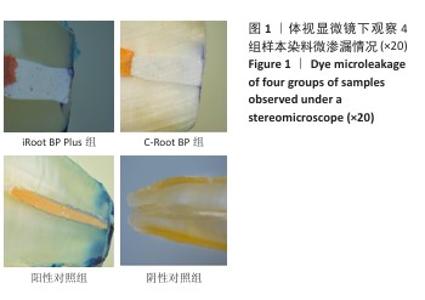
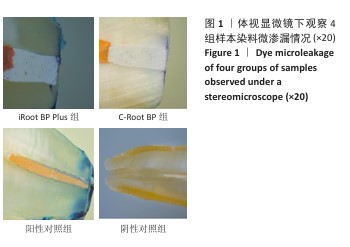
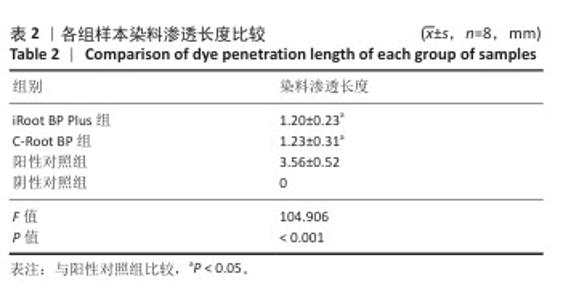
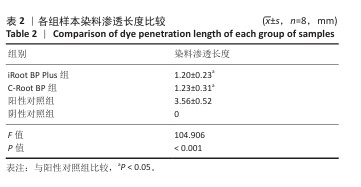
2.1 各组样本根尖封闭性比较 染色7 d后, 体视显微镜下观察4组染料微渗漏情况,见图1。 阳性对照组染料渗透长度大于iRoot BP Plus组、C-Root BP组(P < 0.05),iRoot BP Plus组和C-Root BP组染料渗透长度比较差异无显著性意义(P > 0.05),见表2。"
"
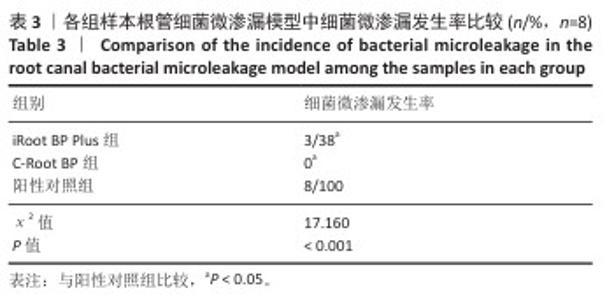
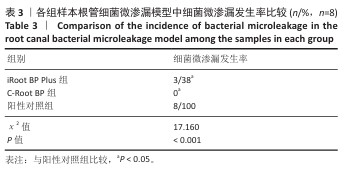
2.2 各组样本细菌微渗漏情况比较 经过90 d培养,阳性对照组细菌微渗漏发生率高于iRoot BP Plus组和C-Root BP组(P < 0.05),iRoot BP Plus组和C-Root BP组细菌微渗漏发生率比较差异无显著性意义(P > 0.05),见表3。"
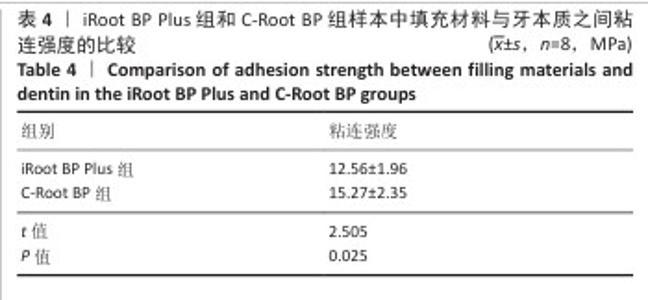
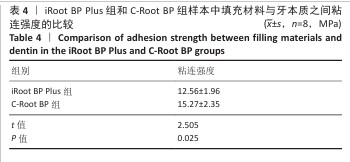
2.3 C-Root BP组与iRoot BP Plus组样本中填充材料与牙本质之间粘连强度的比较 C-Root BP组样本中填充材料与牙本质之间的粘连强度大于iRoot BP Plus组(P < 0.05),见表4。"
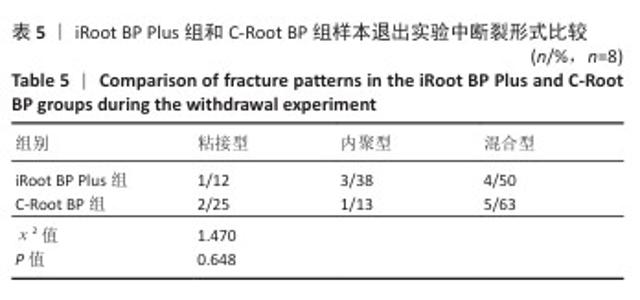
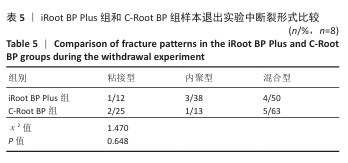
2.4 iRoot BP Plus组和C-Root BP组样本断裂形式比较 Root BP Plus组和C-Root BP组样本均以混合型为主要断裂形式,两组断裂形式比较差异无显著性意义(P > 0.05),见表5。"
| [1] SEBRING D, BUHLIN K, LUND H, et al. Endodontic Inflammatory Disease and Future Cardiovascular Events and Mortality:A Report from the PAROKRANK Study. J Endod. 2024;50(8):1073-1081. [2] MOHAMED KHAZIN S, ABDULLAH D, LIEW AKC, et al. Pulpal and periapical disease in crowned vital teeth:A prospective matched cohort study. Aust Endod J. 2022;48(1):8-19. [3] CHAUDHARI PS, CHANDAK MG, JAISWAL AA, et al. Comparative evaluation of push-out bond strength of three retrograde filling materials in teeth with root apices resected at 90°:Mineral trioxide aggregate Angelus, Zirconomer, and Bioactive bone cement. J Conserv Dent. 2022;25(6):605-609. [4] VERGAÇAS JHN, DE LIMA CO, BARBOSA AFA, et al. Marginal gaps and voids of three root-end filling materials:A microcomputed tomographic study. Microsc Res Tech. 2022;85(2):617-622. [5] S A, AZHAR S, MANAN R, et al. Comparison of the Microleakages of Four Root-End Filling Materials: An In Vitro Study. Cureus. 2023;15(6):e40461. [6] 杨习良,郑天霞,李文,等.硅酸盐根管封闭剂的体外细胞毒性,成骨潜力和抗菌活性评价[J].上海口腔医学,2023,32(3):246-250. [7] CHAO YC, CHEN PH, SU WS, et al. Effectiveness of different root-end filling materials in modern surgical endodontic treatment:A systematic review and network meta-analysis. J Dent Sci. 2022;17(4):1731-1743. [8] ZHOU G, ZHAO Y, CAI L, et al. Cytotoxicity and cell migration evaluation of a strontium silicate-based root canal sealer on stem cells from rat apical papilla:an in vitro study. BMC Oral Health. 2024;24(1):1023. [9] DONG X, SU Q, LI W, et al. The outcome of combined use of iRoot BP Plus and iRoot SP for root-end filling in endodontic microsurgery:a randomized controlled trial. Clin Oral Investig. 2024;28(3):188. [10] ZHOU W, ZHENG Q, TAN X, et al. Comparison of Mineral Trioxide Aggregate and iRoot BP Plus Root Repair Material as Root-end Filling Materials in Endodontic Microsurgery:A Prospective Randomized Controlled Study. J Endod. 2017;43(1): 1-6. [11] 王冬梅,沈嵩,高学军.根管细菌渗漏体外模型的建立[J].牙体牙髓牙周病学杂志,2006,16(5):250-253. [12] 任颖超,孔祥红,何苗苗,等.根管封闭剂iRoot SP和AH Plus与牙本质粘接强度的体外研究[J].口腔医学研究,2022,38(10):936-940. [13] JUNIOR LR, BAROUDI K, BARROSO LS, et al. Bond strength of self-adhesive resin cement to dentin using different adhesion protocols. J Clin Exp Dent. 2022;14(1): e35-e39. [14] SHIMIZU K, SATOH T, SHINKAI K. Evaluation of Restorative Techniques for Vertically Fractured Roots. Materials (Basel). 2021;14(9):2099. [15] KUNAM D, BODE Y, NARRA PM, et al. Comparative evaluation of apical microleakage of mineral trioxide aggregate, Biodentine, and Bio-C Repair as root-end filling materials using dye extraction method:An in vitro study. J Conserv Dent Endod. 2024;27(12):1305-1309. [16] AKHTAR H, NAZ F, HASAN A, et al. Exploring the Most Effective Apical Seal for Contemporary Bioceramic and Conventional Endodontic Sealers Using Three Obturation Techniques. Medicina (Kaunas). 2023;59(3):567. [17] WANG YH, LIU SY, DONG YM. In vitro evaluation of the impact of a bioceramic root canal sealer on the mechanical properties of tooth roots. J Dent Sci. 2024; 19(3):1734-1740. [18] WANG L, REN S, SUN X, et al. Six-year clinical evaluation of iRoot BP Plus as apical barrier in permanent teeth of periapical periodontitis. Aust Endod J. 2024;50(1):115-122. [19] ORTEGA MA, RIOS L, FRAILE-MARTINEZ O, et al. Bioceramic versus traditional biomaterials for endodontic sealers according to the ideal properties. Histol Histopathol. 2024;39(3):279-292. [20] HE X, LIU K, ZHANG Z, et al. Assessment of Physical Properties, Obturation Quality, and Cytocompatibility/Osteogenic Potential of KP-Root SP: A New Calcium Silicate-based Bio-ceramic Sealer. J Endod.2025;51(6):768-780. [21] 王群,黄念,张平,等.Iroot BP在原发性下颌磨牙发生不可逆性牙髓炎牙髓切断术中的应用效果[J].中国医师杂志,2024,26(9):1390-1393. [22] ZAMPARINI F, PRATI C, TADDEI P, et al. Chemical-Physical Properties and Bioactivity of New Premixed Calcium Silicate-Bioceramic Root Canal Sealers. Int J Mol Sci. 2022;23(22):13914. [23] 许明明,麦天倩,殷亮亮,等.iRoot BP与Dycal盖髓剂联合三种不同垫底材料对树脂材料粘接强度及微渗漏的影响[J].现代口腔医学杂志,2023,37(3): 155-160. [24] BADAWY RE, MOHAMED DA. Evaluation of new bioceramic endodontic sealers:An in vitro study. Dent Med Probl. 2022;59(1):85-92. [25] DONG X, XIE Q, XU X. In vitro evaluation of the sealing ability of combined use of iRoot BP Plus and iRoot SP for root-end filling. Clin Oral Investig. 2023;27(6): 2969-2977. [26] CHEN X, ZHANG H, ZHONG J, et al. Retraction Note:Comparison of indirect pulp treatment and iRoot BP Plus pulpotomy in primary teeth with extremely deep caries:a prospective randomized trial. Clin Oral Investig. 2022;26(4):3793. [27] HUANG X, GE X, FU W, et al. Effects of Novel Nanoparticulate Bioceramic Endodontic Material on Human Dental Pulp Stem Cells In Vitro. Int Dent J. 2024; 74(3):482-491. [28] 李立,刘佳,尹仕海,等.iRoot用于根尖倒充填封闭性的体外研究[J].重庆医学,2017,46(22):3097-3100. [29] 李娜,李祥伟.根管系统封闭性的影响因素及其检测方法[J].口腔医学研究, 2021,37(3):200-203. [30] MINICH DJ, MARROW JC, SADAR MJ, et al. High incidence of complications following intraoral extractions and treatment of periapical infections in the management of domestic rabbit (Oryctolagus cuniculus) dental disease (51 cases). J Am Vet Med Assoc. 2024;263(2):193-198. [31] ABDALLA MM, LUNG CYK, BIJLE MN, et al. Physicochemical Properties and Inductive Effect of Calcium Strontium Silicate on the Differentiation of Human Dental Pulp Stem Cells for Vital Pulp Therapies:An In Vitro Study. Materials (Basel). 2022;15(17):5854. [32] PELEPENKO LE, MARCIANO MA, FRANCATI TM, et al. Can strontium replace calcium in bioactive materials for dental applications. J Biomed Mater Res A. 2022;110(12):1892-1911. [33] RUBAIYA Y,DOBLE M. Dentin remineralizing ability and enhanced antibacterial activity of strontium and hydroxyl ion co-releasing radiopaque hydroxyapatite cement. J Mater Sci Mater Med. 2017; 28(6):95. [34] 黄子璇,王小聪,乐曼妮,等.MTA和三种改良盖髓剂对人牙髓干细胞增殖及分化为成牙本质细胞的促进作用观察[J].山东医药,2024,64(30):44-49. [35] YANG X, XIA L, CHEN Y, et al. Cytotoxicity and Bone Biocompatibility of the C-Root SP Experimental Root Canal Sealer. Aust Endod J. 2025;51(1):124-132. [36] 石力吉,袁煜松,李丽洁.iRoot BP plus和MTA材料用于牙髓血运重建术在治疗年轻恒牙根尖感染的临床比较疗效研究[J].中国医学装备,2023, 20(12):130-133. [37] DONG X, SU Q, LI W, et al. The outcome of combined use of iRoot BP Plus and iRoot SP for root-end filling in endodontic microsurgery:a randomized controlled trial. Clin Oral Investig. 2024;28(3):188. [38] ZAMPARINI F, PRATI C, TADDEI P, et al. Chemical-Physical Properties and Bioactivity of New Premixed Calcium Silicate-Bioceramic Root Canal Sealers. Int J Mol Sci. 2022;23(22):13914. [39] 杨习良,郑天霞,李文,等.硅酸盐根管封闭剂的体外细胞毒性、成骨潜力和抗菌活性评价[J].上海口腔医学,2023,32(3):246-250.. [40] YUAN X, WU T, LU T, et al. Effects of Zinc and Strontium Doping on In Vitro Osteogenesis and Angiogenesis of Calcium Silicate/Calcium Phosphate Cement. ACS Biomater Sci Eng. 2023;9(10):5761-5771. [41] ZHANG S, DONG Y, CHEN M, et al. Recent developments in strontium-based biocomposites for bone regeneration. J Artif Organs. 2020;23(3):191-202. [42] ZHANG L, YIN L, WU J, et al. Clinical influencing factors of vital pulp therapy on pulpitis permanent teeth with 2 calcium silicate-based materials:A randomized clinical trial. Medicine (Baltimore). 2024;103(18):e38015. [43] PELOZO LL, SOUZA-GABRIEL AE, ALVES DOS SANTOS GN, et al. Canal Drying Protocols to Use with Calcium Silicate-based Sealer:Effect on Bond Strength and Adhesive Interface. J Endod. 2023;49(9):1154-1160. [44] HU X, LIANG Z, WANG Q, et al. A retrospective study of iRoot BP Plus pulpotomy compared with Vitapex pulpectomy for irreversible pulpitis of primary molars with the presence of coronal pulp tissue. Int J Paediatr Dent. 2023;33(2):216-226. [45] KWAK SW, KOO J, SONG M, et al. Physicochemical Properties and Biocompatibility of Various Bioceramic Root Canal Sealers:In Vitro Study. J Endod. 2023;49(7): 871-879. |
| [1] | Song Muze, Liu Chuyi, , Tang Qingjuan, Dai Yuankun, , Song Wenshan, Li Bafang, Wang Yuanyuan. Biocompatibility evaluation of polylactic acid/collagen electrospinning bilayer guided tissue regeneration membrane [J]. Chinese Journal of Tissue Engineering Research, 2026, 30(26): 6880-6891. |
| [2] | Yang Qi, Xiang Xi, Wang Han, Zou Zhen, Zhang Lunci, Mireadeli·Abulimiti, Liao Yue, Li Xinzhi. Development and application of natural oral hydrogels in drug delivery systems [J]. Chinese Journal of Tissue Engineering Research, 2026, 30(26): 6930-6936. |
| [3] | Yang Guang, Yin Zhitao, Xu Yan. Three-dimensional printed isoniazid liposome photothermal composite scaffolds and their performance evaluation [J]. Chinese Journal of Tissue Engineering Research, 2026, 30(26): 6701-6709. |
| [4] | Zhao Zhanghong, Jin Dongsheng, Ruan Shiqiang, Huang Wenliang, Wan Yu, Tian Renyuan, Deng Jiang. In vitro osteogenic and anti-inflammatory properties of icariin sustained-release microsphere three-dimensional scaffolds [J]. Chinese Journal of Tissue Engineering Research, 2026, 30(26): 6710-6718. |
| [5] | Pi Zhilong, Li Jiayuan, Tan Zhichao, Lu Xiaomei, Zhang Zhiqiang, Ye Xiangling. 3D printed neobavaisoflavone-coated scaffolds promote bone regeneration by regulating osteoblast/osteoclast activities [J]. Chinese Journal of Tissue Engineering Research, 2026, 30(26): 6736-6743. |
| [6] | Zhou Yunqi, Liu Xu, Xiao Dongqin, Li Xingping, Shi Feng, Zhang Bo, Pu Chao, Luo Xuwei, Zhang Chengdong. Fabrication and characterization of hydrogels with both antibacterial and osteogenic functions [J]. Chinese Journal of Tissue Engineering Research, 2026, 30(26): 6768-6778. |
| [7] | Chen Gang, Ge Caijun, Chen Jianpeng, Wang Yuanbin, Wang Qianliang. Mechanism of ferrostatin-1 hydrogel in treatment of lumbar disc herniation [J]. Chinese Journal of Tissue Engineering Research, 2026, 30(26): 6807-6813. |
| [8] | Zhao Wenbo, Miao Xin, Wang Yang, Liu Hao, Li Shengfa, Tao Qifeng. Sr/birabresib-loaded bioactive glass modulating bone microenvironment for osteoporosis therapy [J]. Chinese Journal of Tissue Engineering Research, 2026, 30(26): 6814-6825. |
| [9] | Yu Jinye, Jiang Nan, Zhao Yixun, Huang Mengjing, Yang Jie, Sun Rui, Feng Suolan, Jiang Hui, Yang Jun. Ready-to-use sodium alginate@paper material for three-dimensional cell culture [J]. Chinese Journal of Tissue Engineering Research, 2026, 30(26): 6873-6879. |
| [10] | Zhou Xiaohui, Wang Siyi, Zhou Qiyun, He Zhao, Jia Yujuan, Wang Yuanbin, Ma Jianwu, Chen Gang, Zheng Feng, Chu Genglei. Nanohydroxyapatite-polyether carbonate urethane electrospinning membrane promotes bone defect repair [J]. Chinese Journal of Tissue Engineering Research, 2026, 30(20): 5134-5142. |
| [11] | Diao Youlu, Gao Jia, Pan Guoqing. Recruitable tissue repair biomaterials: advantages of regulating cell and factor migration and improving tissue integration [J]. Chinese Journal of Tissue Engineering Research, 2026, 30(20): 5270-5281. |
| [12] | Xu Yawei, Meng Shilong, Zhang Xu, Wang Chengjie, Yuan Yifeng, Shi Xiaolin, Wang Jiao, Liu Kang . Repairing bone defects with active ingredients of traditional Chinese medicine combined with hydrogels: successes and challenges [J]. Chinese Journal of Tissue Engineering Research, 2026, 30(20): 5295-5303. |
| [13] | Wang Zitong, Wu Zijian, Yang Aofei, Mao Tian, Fang Nan, Wang Zhigang. Biomaterials regulate microenvironment imbalance for treating spinal cord injury [J]. Chinese Journal of Tissue Engineering Research, 2026, 30(20): 5321-5330. |
| [14] | Chen Weifei, Mei Yuandong, Ju Jihui. Repair of infected bone defect with dual-ion time-sequenced release multifunctional hydrogels [J]. Chinese Journal of Tissue Engineering Research, 2026, 30(20): 5188-5200. |
| [15] | Jiang Kan, Alimujiang·Abudourousuli, Shalayiding·Aierxiding, Aikebaierjiang·Aisaiti, Kutiluke·Shoukeer, Aikeremujiang·Muheremu. Biomaterials and bone regeneration: research hotspots and analysis of 500 influential papers [J]. Chinese Journal of Tissue Engineering Research, 2026, 30(2): 528-536. |
| Viewed | ||||||
|
Full text |
|
|||||
|
Abstract |
|
|||||