Chinese Journal of Tissue Engineering Research ›› 2026, Vol. 30 ›› Issue (20): 5229-5242.doi: 10.12307/2026.157
Previous Articles Next Articles
Preparation and antibacterial properties of composite hydrogels with photothermal effects
Cui Jie1, 2, Liao Ruohan1, Zhang Chengdong1, Li Xingping2, Chi Feng3, Luo Xuwei1, Pu Chao2, Zhang Bo1, Xiao Dongqin1
- 1Department of Orthopedics, Nanchong Central Hospital, Second Clinical College of North Sichuan Medical College, Institute of Tissue Engineering and Stem Cells, Nanchong 637000, Sichuan Province, China; 2Department of Orthopedics, Chengfei Hospital, Chengdu 610091, Sichuan Province, China; 3Collaborative Innovation Center for Tissue Repair Materials Engineering Technology, China West Normal University, Nanchong 637000, Sichuan Province, China
-
Accepted:2025-05-19Online:2026-07-18Published:2025-11-27 -
Contact:Li Xingping, MS, Attending physician, Department of Orthopedics, Chengfei Hospital, Chengdu 610091, Sichuan Province, China Zhang Bo, MD, Chief physician, Department of Orthopedics, Nanchong Central Hospital, Second Clinical College of North Sichuan Medical College, Institute of Tissue Engineering and Stem Cells, Nanchong 637000, Sichuan Province, China Xiao Dongqin, MD, Associate researcher, Department of Orthopedics, Nanchong Central Hospital, Second Clinical College of North Sichuan Medical College, Institute of Tissue Engineering and Stem Cells, Nanchong 637000, Sichuan Province, China -
About author:Cui Jie, Master candidate, Department of Orthopedics, Nanchong Central Hospital, Second Clinical College of North Sichuan Medical College, Institute of Tissue Engineering and Stem Cells, Nanchong 637000, Sichuan Province, China; Department of Orthopedics, Chengfei Hospital, Chengdu 610091, Sichuan Province, China -
Supported by:Sichuan Natural Science Foundation, No. 2023NSFSC1740 (to ZCD); Nanchong City-University Collaborative Research Project, No. 22SXJCQN0002 (to XDQ); Sichuan Provincial Medical Research Project, No. Q22061 (to PC); General Medical Research Foundation, No. TYYLKYJJ-2022-051 (to LXP)

CLC Number:
Cite this article
Cui Jie, Liao Ruohan, Zhang Chengdong, Li Xingping, Chi Feng, Luo Xuwei, Pu Chao, Zhang Bo, Xiao Dongqin. Preparation and antibacterial properties of composite hydrogels with photothermal effects[J]. Chinese Journal of Tissue Engineering Research, 2026, 30(20): 5229-5242.
share this article
Add to citation manager EndNote|Reference Manager|ProCite|BibTeX|RefWorks
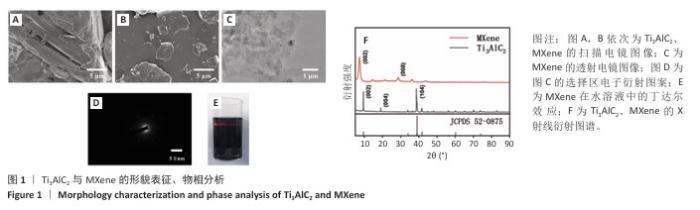
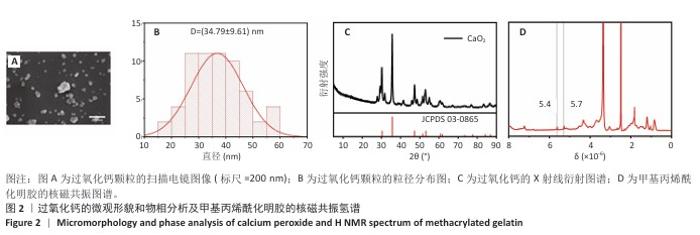
2.1 水凝胶各成分的性能表征结果 采用扫描电镜观察原材料Ti3AlC2的表面形貌,可见致密的层状结构,反应后的MXene呈现薄片结构(图1A,B)。透射电镜下片层状的MXene纳米片薄而透明,选择区电子衍射斑点表明MXene具有较高的结晶度[20](图1C,D)。MXene水溶液具有丁达尔效应(图1E),表明该胶体溶液具有一定的稳定性[21]。 将Ti3AlC2和Ti3C2Tx(MXene)的典型X射线衍射图谱进行对比(图1F),在MXene中2θ=38.68°处附近的特征峰几乎完全消失,表明Al层被成功蚀刻掉;在2θ=7.40°处出现了MXene的特征峰,与(002)晶面所对应,2θ=38.68°处的Al特征峰消失[22],并且(002)晶面增宽且向低角度偏移,表明MXene层距增加[23],证明了MXene纳米片成功合成。 扫描电镜镜下可见过氧化钙微粒为近球形结构,粒径为(34.79±9.61) nm(图2A,B)。为进一步检测合成产物,通过X射线衍射检测合成的过氧化钙纳米颗粒,检测到5个主峰,2θ值分别为30.22°,35.54°,47.32°,51.58°和60.72°,与过氧化钙的标准X射线衍射图谱(JCPDS 52-0875)一致(图2C),表明纳米材料过氧化钙合成成功[24]。甲基丙烯酸乙烯基酯的特征峰分别出现δ=5.4×10⁻⁶和5.7×10⁻⁶处,证明了甲基丙烯酰化明胶的成功合成[25](图2D)。计算得甲基丙烯酰化明胶的接枝率约为39.4%。"
"
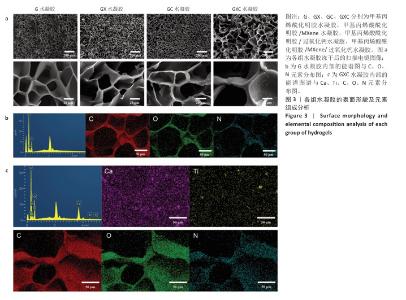
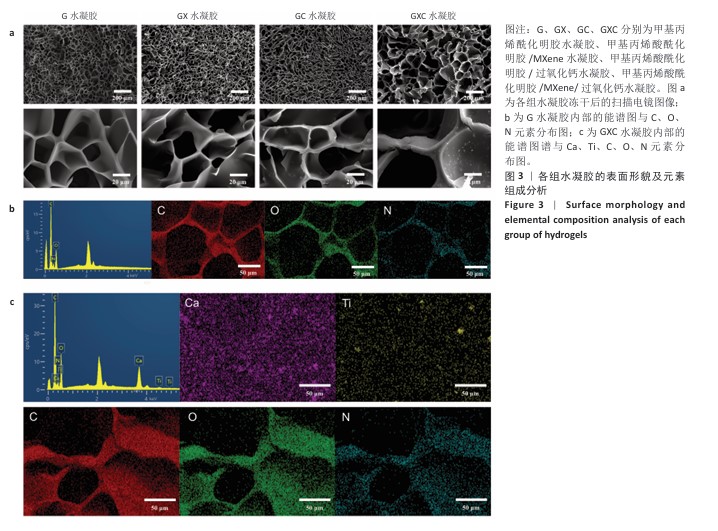
2.2 水凝胶的表面形貌观察结果 采用扫描电镜观察冻干后的各组水凝胶表面形貌,可见所有水凝胶都具有疏松的多孔结构,其中G、GX水凝胶孔隙表面较光滑,GC、GXC水凝胶孔隙表面较粗糙(图3A)。G水凝胶的能谱图和mapping显示C、O、N元素在水凝胶内部均匀分布(图3B),GXC水凝胶的能谱图和mapping显示C、O、N、Ca、Ti元素均匀分布在水凝胶之中(图3C),表明MXene和过氧化钙在水凝胶中分散均匀。"
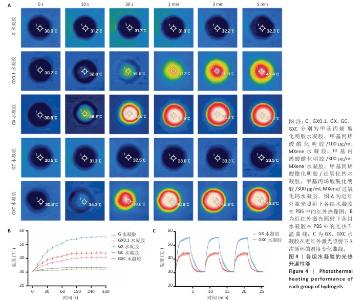
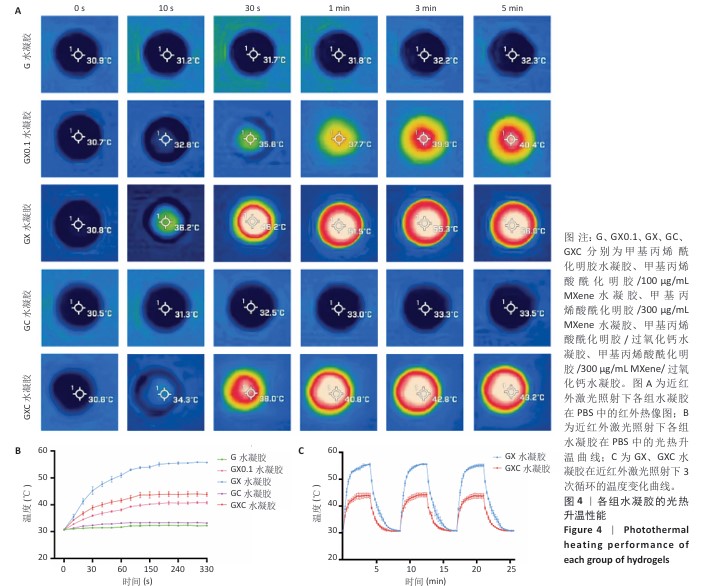
2.3 水凝胶的光热性能检测结果 经近红外激光照射5 min后,GX0.1、GX、GXC水凝胶温度分别升高了(10.0±0.4),(24.8±0.2),(13.1±0.7) ℃,G、GC水凝胶温度仅升高了(1.4±0.2 ) ℃和(2.5±0.05) ℃(图4A,B),表明温度升高的趋势与MXene浓度呈正相关[26]。由于GX0.1水凝胶升温效果与GX水凝胶相比较差,并且预实验发现MXene质量浓度大于400 μg/mL时水凝胶不易交联,且加入过氧化钙质量浓度大于5 mg/mL呈现出细胞毒性,所以选用300 μg/mL MXene和5 mg/mL过氧化钙进行后续实验。加入过氧化钙后水凝胶温度升高幅度降低,考虑为透光率下降所致,但GXC水凝胶光照后的温度为(43.8±0.7) ℃,仍能满足后续光热抗菌需求[27]。对含有MXene的GX、GXC水凝胶进行了3个近红外激光开/关循环照射,这两组水凝胶在3个周期的照射后温度仍会恒定升高(图4C),均表现出良好的光热稳定性。 "
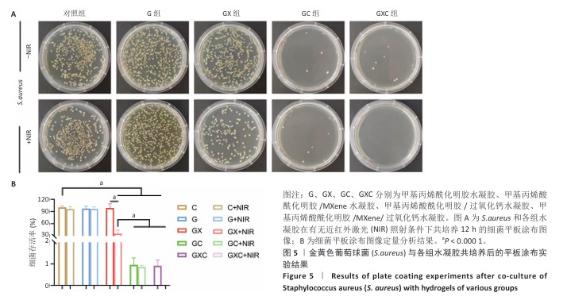
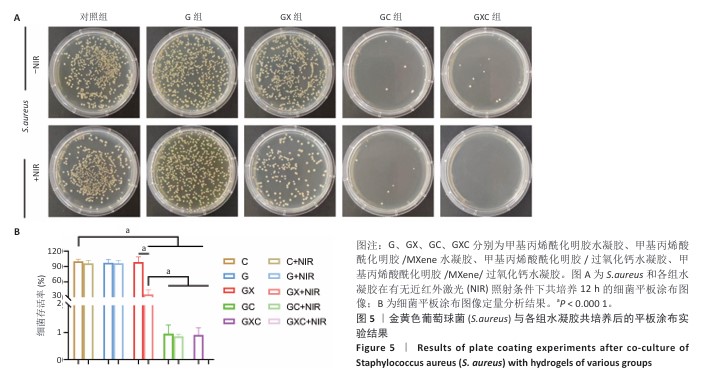
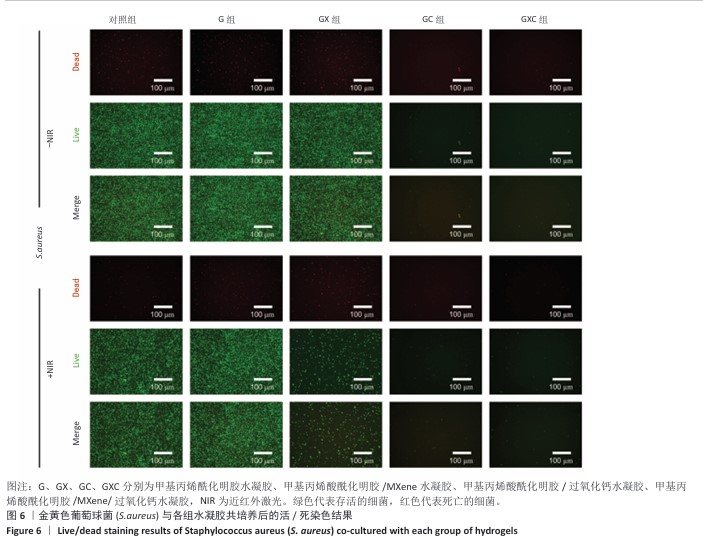
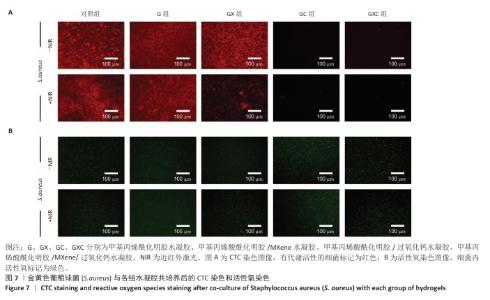
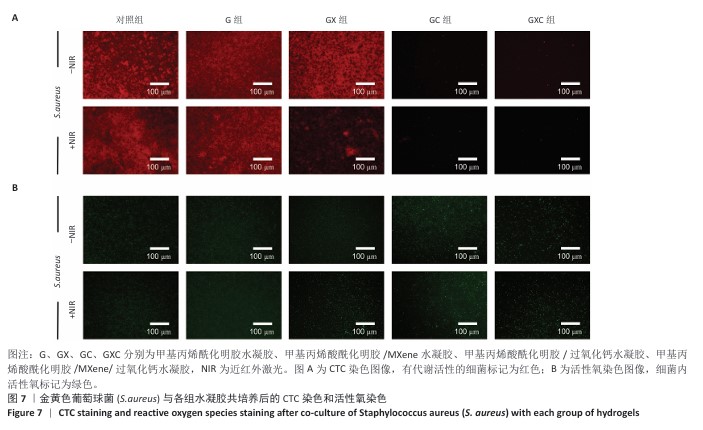
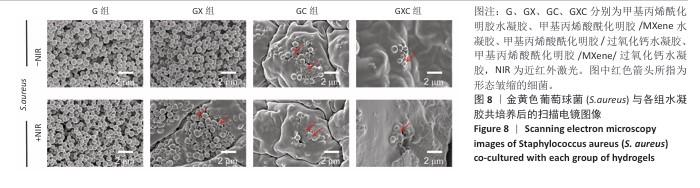
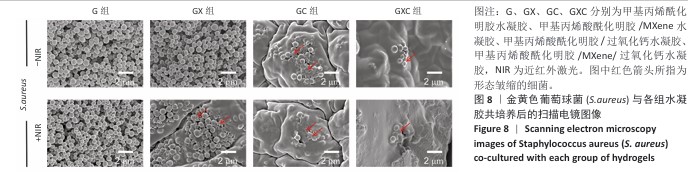
2.4 水凝胶的体外抗菌活性评价 此次研究选用金黄色葡萄球菌为细菌模型,采用涂布平板法检测水凝胶的抗菌性。无近红外激光照射条件下,对照组、G组、GX组涂板细菌数量最多,GC组和GXC组涂板细菌数量明显减少,细菌存活率均低于1%;经过近红外激光照射后,对照组、G组和GC组较无近红外激光照射照射条件下的菌落数无明显差异,GX组明显减少,值得一提的是GXC组涂板未见细菌生长,见图5,表明MXene和过氧化钙在近红外激光照射下具有联合抗菌的作用。 细菌活/死染色结果显示,无近红外激光照射条件下,与对照组相比,G组和GC组活死细菌数量无明显变化,GC组和GXC组活细菌数量明显减少;经近红外激光照射后,对照组、G组和GC组活死细菌数量与无近红外激光照射条件下相比无明显差异,GX组、GXC组活细菌数量较无近红外激光照射条件下明显增加,见图6。 细菌CTC染色结果显示,无近红外激光照射条件下,与对照组相比,G组、GX组细菌红色荧光无明显变化,表明呼吸链功能无明显抑制,GC组和GXC组细菌红色荧光明显减弱,表明呼吸链功能明显被抑制;经近红外激光照射后,对照组、G组和GC组细菌红色荧光与无近红外激光照射条件下相比无明显变化,GX组和GXC组细菌红色荧光与无近红外激光照射条件下相比明显减弱,见图7A。 通过DCFH-DA染色观察细菌内活性氧水平,无经红外激光照射条件下,与对照组相比,G组和GX组绿色荧光强度较弱,说明这2组细菌体内活性氧水平较低,GC组和GXC组绿色荧光明显增强,说明这两组细菌内活性氧水平明显升高;经近红外激光照射后,对照组和G组绿色荧光无明显变化,GX组绿色荧光明显增强,说明细菌内活性氧水平升高,而GC组和GXC组绿色荧光同近红外激光照射前相比无明显变化,见图7B。 为进一步探究水凝胶光热杀菌机制,采用扫描电镜观察水凝胶表面细菌的形态(图8)。无近红外光激光照射条件下,G组和GX组细菌数量多且形态饱满圆润,GC组和GXC组中细菌数量明显减少,并且细菌表面出现明显褶皱。经过近红外激光照射后,G组和GC组细菌数量及形态并无明显差异,GX组、GXC组细菌数量明显减少,并且多数细菌呈现皱缩、塌陷的形态。 "
"
"
"
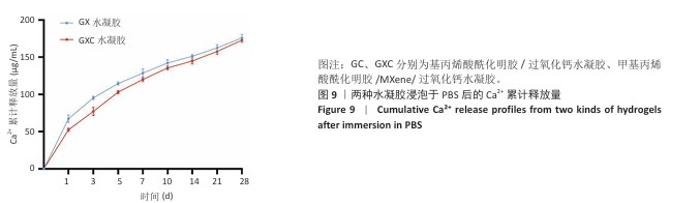
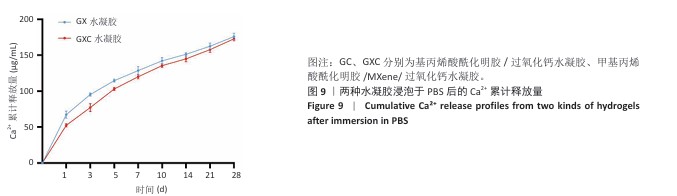
2.5 水凝胶的Ca2+释放行为评价 为了评估水凝胶释放过氧化钙的性能,此次实验对GC、GXC水凝胶释放Ca2+的能力进行测定,结果显示两组复合水凝胶在初始阶段释放了50-70 μg/mL的Ca2+,GC水凝胶释放Ca2+速率较GXC水凝胶更快,见图9。两组水凝胶过氧化钙负载量一致,在后续阶段均表现出持续释放Ca2+的能力。"
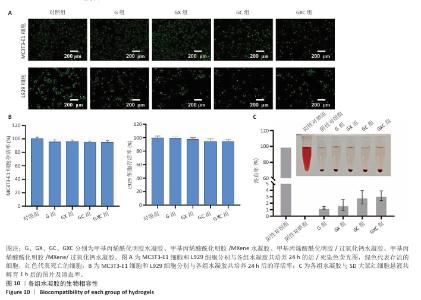
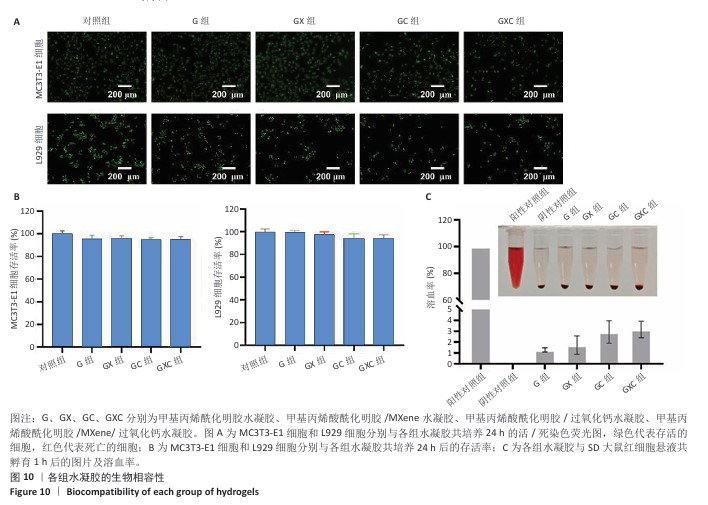
2.6 水凝胶的生物相容性评价 为将此次研究制备的水凝胶应用于组织修复领域,因此评估了该水凝胶的生物相容性。活/死染色结果显示,各组MC3T3-E1细胞(或L929细胞)均显示出相似的绿色荧光,见图10A,表明细胞活性良好,证明了各组水凝胶的细胞毒性低。CCK-8检测结果显示,各组MC3T3-E1细胞(或L929细胞)存活率比较差异无显著性意义(P > 0.05),见图10B,表明各组水凝胶均无明显细胞毒性。各组水凝胶的溶血率均小于5%,见图10C,表明各组水凝胶均具有良好的血液相容性。以上结果均表明各组水凝胶具有良好的细胞相容性和血液相容性。"
| [1] TU L, FAN Y, DENG Y, et al. Production and Anti-Inflammatory Performance of PVA Hydrogels Loaded with Curcumin Encapsulated in Octenyl Succinic Anhydride Modified Schizophyllan as Wound Dressings. Molecules. 2023;28(3):1321. [2] WANG F, ZHANG W, LI H, et al. How Effective are Nano-Based Dressings in Diabetic Wound Healing? A Comprehensive Review of Literature. Int J Nanomed. 2022;17:2097-2119. [3] GUPTA M, NAIK AK, SINGH SK. Bacteriological profile and antimicrobial resistance patterns of burn wound infections in a tertiary care hospital. Heliyon. 2019;5(12):e02956. [4] SUN Y, WANG J, LI D, et al. The Recent Progress of the Cellulose-Based Antibacterial Hydrogel. Gels. 2024;10(2):109. [5] SARKHOSH-INANLOU R, SHAFIEI-IRANNEJAD V, AZIZI S, et al. Applications of scaffold-based advanced materials in biomedical sensing. Trends Anal Chem. 2021;143:116342. [6] KANG H, HAN J, JIN M, et al. Decellularized squid mantle scaffolds as tissue-engineered corneal stroma for promoting corneal regeneration. Bioeng Transl Med. 2023;8(4):e10531. [7] LIN J, SHI T, WANG Y, et al. Hybrid Hydrogel Loaded with Chlorhexidine β-CD-MSN Composites as Wound Dressing. Int J Nanomed. 2023; 2023(18):1725-1740. [8] WANG Z, LI J, QIAO Y, et al. Rapid Ferroelectric-Photoexcited Bacteria-Killing of Bi4Ti3O12/Ti3C2Tx Nanofiber Membranes. Adv Fiber Mater. 2023;5(2):484-496. [9] RANJBARI S, DARROUDI M, HATAMLUYI B, et al. Application of MXene in the diagnosis and treatment of breast cancer: A critical overview. Front Bioeng Biotech. 2022;10(984336):1-15. [10] ZHENG S, ZHAO W, CHEN J, et al. 2D Materials Boost Advanced Zn Anodes: Principles, Advances, and Challenges. Nanomicro Lett. 2023;15(46):1-22. [11] ELKHOURY K, RUSSELL C, SANCHEZ-GONZALEZ L, et al. Soft-Nanoparticle Functionalized Natural Hydrogels for Tissue Engineering Applications. Adv Healthcare Mater. 2019;8(18):e1900506. [12] ZHANG YZ, LEE KH, ANJUM DH, et al. MXenes stretch hydrogel sensor performance to new limits. Sci Adv. 2018;4(6):eaat0098. [13] HASSAN S, CECEN B, PEÑA-GARCIA R, et al. Survival and Proliferation under Severely Hypoxic Microenvironments Using Cell-Laden Oxygenating Hydrogels. J Funct Biomater. 2021;12(2):30. [14] THI PL, LEE Y, TRAN DL, et al. Calcium peroxide-mediated in situ formation of multifunctional hydrogels with enhanced mesenchymal stem cell behaviors and antibacterial properties. J Mater Chem B. 2020;8(48):11033-11043. [15] ZHANG X, WEI P, YANG Z, et al. Current Progress and Outlook of Nano-Based Hydrogel Dressings for Wound Healing. Pharmaceutics. 2022;15(1):68. [16] 王赛楠,王晓菲,张莉.甲基丙烯酰明胶水凝胶作为细胞三维培养支架在骨组织工程中的应用[J].中国组织工程研究,2024, 28(22):3576-3582. [17] ZHOU B, JIANG X, ZHOU X, et al. GelMA-based bioactive hydrogel scaffolds with multiple bone defect repair functions: therapeutic strategies and recent advances. Biomater Res. 2023;27(1):86-134. [18] HU B, QIAO W, CAO Y, et al. A sono-responsive antibacterial nanosystem co-loaded with metformin and bone morphogenetic protein-2 for mitigation of inflammation and bone loss in experimental peri-implantitis. Front Bioeng Biotech. 2024;12:1410230. [19] WANG Y, WEI Q. Editorial on the Special Issue “Modification of Hydrogels and Their Applications in Biomedical Engineering”. Gels. 2023;9(4):263. [20] ZHOU T, YU Y, HE B, et al. Ultra-compact MXene fibers by continuous and controllable synergy of interfacial interactions and thermal drawing-induced stresses. Nat Commun. 2022;13(4564):1-13. [21] XIE Y, CHENG Y, MA Y, et al. 3D MXene‐Based Flexible Network for High‐Performance Pressure Sensor with a Wide Temperature Range. Adv Sci. 2022;10(6):2205303. [22] CUI D, KONG N, DING L, et al. Ultrathin 2D Titanium Carbide MXene (Ti3C2Tx) Nanoflakes Activate WNT/HIF-1𝜶-Mediated Metabolism Reprogramming for Periodontal Regeneration. Adv Healthcare Mater. 2021;10(22):2101215. [23] KUMAR S, KANG D, HONG H, et al. Effect of Ti3C2Tx MXenes etched at elevated temperatures using concentrated acid on binder-free supercapacitors. RSC Adv. 2020;10(68):41837-41845. [24] LI F, CHOONG TSY, ABDULLAH LC, et al. Effective Removal of Glyphosate from Aqueous Systems Using Synthesized PEG-Coated Calcium Peroxide Nanoparticles: Kinetics Study, H2O2 Release Performance and Degradation Pathways. Polymers. 2023;15(3):775. [25] LI X, CHEN S, LI J, et al. 3D Culture of Chondrocytes in Gelatin Hydrogels with Different Stiffness. Polymers. 2016;8(8):269. [26] NIE R, SUN Y, LV H, et al. 3D printing of MXene composite hydrogel scaffolds for photothermal antibacterial activity and bone regeneration in infected bone defect models. Nanoscale. 2022;14(22):8112-8129. [27] ZHAO Y, WANG X, QI R, et al. Recent Advances of Natural-Polymer-Based Hydrogels for Wound Antibacterial Therapeutics. Polymers. 2023;15(15):3305. [28] HAN M, SUN W, CHEN Y, et al. Fabrication of a photothermal antibacterial platform for bacterial infectious skin wound healing: a review. Mol Syst Des Eng. 2024;9(8):800-813. [29] NAGHAVI M, MURRAY CJL, IKUTA KS, et al. Global burden of antimicrobial resistance: essential pieces of a global puzzle - Authors’ reply. Lancet. 2022;399(10344):2349-2350. [30] BERNARDES BG, DEL GAUDIO P, ALVES P, et al. Bioaerogels: Promising Nanostructured Materials in Fluid Management, Healing and Regeneration of Wounds. Molecules. 2021;26(13):3834. [31] HAN Z, DENG L, CHEN S, et al. Zn2+-Loaded adhesive bacterial cellulose hydrogel with angiogenic and antibacterial abilities for accelerating wound healing. Burns Trauma. 2023;11: tkac048. [32] ZOGHI S. Advancements in Tissue Engineering: A Review of Bioprinting Techniques, Scaffolds, and Bioinks. Biomed Eng Comput Biol. 2024;15: 11795972241288099. [33] ZHANG W, DU A, LIU S, et al. Research progress in decellularized extracellular matrix-derived hydrogels. Regen Ther. 2021;18:88-96. [34] YOU S, XIANG Y, QI X, et al. Harnessing a biopolymer hydrogel reinforced by copper/tannic acid nanosheets for treating bacteria-infected diabetic wounds. Mater Today Adv. 2022;15:100271. [35] SHIEKH PA, SINGH A, KUMAR A. Data supporting exosome laden oxygen releasing antioxidant and antibacterial cryogel wound dressing OxOBand alleviate diabetic and infectious wound healing. Data Brief. 2020;31:105671. [36] YIN L, LI Y, YAO X, et al. MXenes for Solar Cells. Nano-Micro Lett. 2021;13:78. [37] YE S, ZHANG H, LAI H, et al. MXene: A wonderful nanomaterial in antibacterial. Front Bioeng Biotech. 2024;12:1338539. [38] LIU N, YU L, LIU B, et al. Ti3C2-MXene Partially Derived Hierarchical 1D/2D TiO2/Ti3C2 Heterostructure Electrode for High-Performance Capacitive Deionization. Adv Sci. 2022;10(2):2204041. [39] YAN S, LI L, ZHANG H, et al. Flexible Sandwich-Shaped Cellulose Nanocrystals/Silver Nanowires/MXene Films Exhibit Efficient Electromagnetic-Shielding Interference Performance. Nanomaterials. 2024;14(7):647. [40] RASOOL K, HELAL M, ALI A, et al. Antibacterial Activity of Ti3C2Tx MXene. ACS Nano. 2016;10(3):3674-3684. [41] ARABI SHAMSABADI A, SHARIFIAN GH M, ANASORI B, et al. Antimicrobial Mode-of-Action of Colloidal Ti3C2Tx MXene Nanosheets. ACS Sustain Chem Eng. 2018;6(12):16586-16596. [42] ZHANG W, ZHANG C, YANG C, et al. Photochemically-driven highly efficient intracellular delivery and light/hypoxia programmable triggered cancer photo-chemotherapy. J Nanobiotechnol. 2023; 21:11. [43] 罗浙,练雷栋,干开丰.释氧生物材料用于组织工程的研究进展[J].南京医科大学学报(自然科学版),2024,44(9):1292-1297. [44] TEH SW, KOH AEH, TONG JB, et al. Hypoxia in Bone and Oxygen Releasing Biomaterials in Fracture Treatments Using Mesenchymal Stem Cell Therapy: A Review. Front Cell Dev Biol. 2021; 9:634131. [45] SHASHA Z, CHUANCHUAN H, YAWEN Z. The Progress and Prospect of calcium peroxide nanoparticles in antibacterial activity. Colloid Interface Sci Commun. 2024;61:100793. [46] 路冬冬,朱天峰,张一健,等.3D生物打印甲基丙烯酰化明胶水凝胶支架促进软骨下骨缺损的修复[J].中国组织工程研究,2022, 26(34):5454-5460. [47] QI ML, LI M, YUAN K, et al. Fabrication and X-ray microtomography of sandwich-structured PEEK implants for skull defect repair. Sci Rep. 2024;14:28585. [48] LIANG C, WANG H, LIN Z, et al. Augmented wound healing potential of photosensitive GelMA hydrogel incorporating antimicrobial peptides and MXene nanoparticles. Front Bioeng Biotech. 2023;11:1310349. [49] XIONG S, ZHANG Y, ZENG J, et al. DLP fabrication of HA scaffold with customized porous structures to regulate immune microenvironment and macrophage polarization for enhancing bone regeneration. Mater Today Bio. 2023;24:100929. [50] GU H, LI H, WEI L, et al. Collagen-based injectable and self-healing hydrogel with multifunction for regenerative repairment of infected wounds. Regen Biomater. 2023;10:rbad018. [51] SEIDI F, ARABI SHAMSABADI A, DADASHI FIROUZJAEI M, et al. MXenes Antibacterial Properties and Applications: A Review and Perspective. Small. 2023;19(14):2206716. [52] XU S, CHANG L, HU Y, et al. Tea polyphenol modified, photothermal responsive and ROS generative black phosphorus quantum dots as nanoplatforms for promoting MRSA infected wounds healing in diabetic rats. J Nanobiotechnol. 2021;19:362. [53] ZHAO H, WANG T, FANG X, et al. 2D MXene Nanosheets with ROS Scavenging Ability Effectively Delay Osteoarthritis Progression. Nanomaterials (Basel). 2024;14(19):1572. [54] LI J, MA J, FENG Q, et al. Building Osteogenic Microenvironments with a Double-Network Composite Hydrogel for Bone Repair. Research(Wash D C). 2023;6:0021. [55] YANG M, CAI X, WANG C, et al. Highly Stable Amorphous (Pyro)phosphate Aggregates: Pyrophosphate as a Carrier for Bioactive Ions and Drugs in Bone Repair Applications. ACS Omega. 2024;9(22): 23724-23740. [56] MUBARAKI S, PANI SC, ALSERAIHY A, et al. The efficacy of two different oral hygiene regimens on the incidence and severity of oral mucositis in pediatric patients receiving hematopoietic stem cell transplantation: A prospective interventional study. Spec Care Dentist. 2020;40(6): 566-573. |
| [1] | Gu Jianmei, Yuan Kunshan, Zhou Qiang, Zhang Haijun, , . Application of laser microporous decellularized scaffolds in tissue regeneration [J]. Chinese Journal of Tissue Engineering Research, 2026, 30(2): 499-507. |
| [2] | Liu Ziyang, Lao An, Xu Chenci, AiRi Shin, Wu Jiaqing, Liu Jiaqiang. Polycaprolactone-polydopamine-AOPDM1 scaffold promotes bone formation in a high-glucose environment [J]. Chinese Journal of Tissue Engineering Research, 2024, 28(17): 2667-2674. |
| Viewed | ||||||
|
Full text |
|
|||||
|
Abstract |
|
|||||