Chinese Journal of Tissue Engineering Research ›› 2024, Vol. 28 ›› Issue (12): 1863-1868.doi: 10.12307/2024.026
Previous Articles Next Articles
Accuracy and influencing factor of artificial intelligence planning system in patients undergoing total hip arthroplasty
Zhang Kai1, Guo Zhuotao1, Ma Qiaoqiao1, Zha Guochun2, Guo Kaijin2
- 1Xuzhou Medical University, Xuzhou 221000, Jiangsu Province, China; 2Department of Orthopedics, Affiliated Hospital of Xuzhou Medical University, Xuzhou 221000, Jiangsu Province, China
-
Received:2023-02-09Accepted:2023-03-22Online:2024-04-28Published:2023-08-22 -
Contact:Guo Kaijin, MD, Chief physician, Department of Orthopedics, Affiliated Hospital of Xuzhou Medical University, Xuzhou 221000, Jiangsu Province, China -
About author:Zhang Kai, Master candidate, Physician, Xuzhou Medical University, Xuzhou 221000, Jiangsu Province, China -
Supported by:Young Medical Talent Project of Jiangsu Province, No. QNRC2016800 (to ZGC); General Project of Jiangsu Provincial Health and Family Planning Commission, No. H2017081 (to ZGC)

CLC Number:
Cite this article
Zhang Kai, Guo Zhuotao, Ma Qiaoqiao, Zha Guochun, Guo Kaijin. Accuracy and influencing factor of artificial intelligence planning system in patients undergoing total hip arthroplasty[J]. Chinese Journal of Tissue Engineering Research, 2024, 28(12): 1863-1868.
share this article
Add to citation manager EndNote|Reference Manager|ProCite|BibTeX|RefWorks
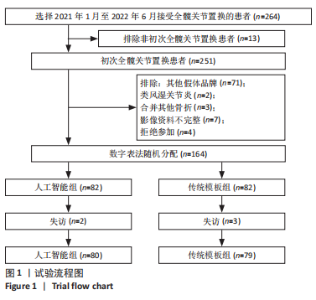
2.1 参与者数量分析 试验期间共有5例失访,最终人工智能组80例,传统模板组79例,共159例患者均进入结果分析。 2.2 试验流程 见图1。"
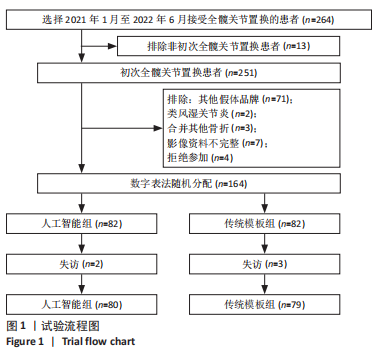
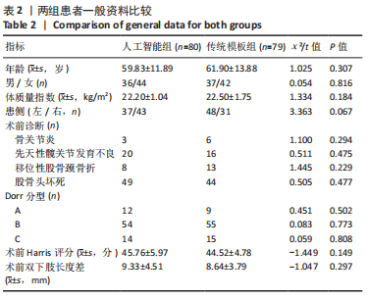
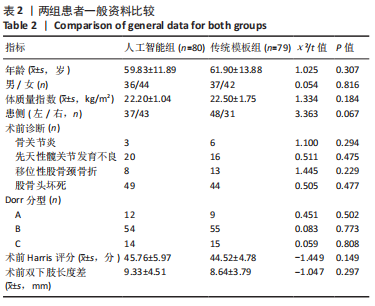
2.3 两组基线资料比较 两组患者的性别、年龄、体质量指数、术前诊断及术前Harris评分、双下肢长度差等比较差异均无显著性意义(均P > 0.05),具有可比性,见表2。"
2.4 两组规划假体型号的准确性 人工智能组预测臼杯、股骨侧假体的准确率分别为50%(40/80)、55%(44/80),显著高于传统模板组的34%(27/79)、37%(29/79),组间差异均有显著性意义(P=0.043,P=0.021)。人工智能组预测股骨侧型号相差±1个尺寸内的准确率为86%(69/80),显著高于传统模板组的73%(58/79),差异有显著性意义(P=0.044);而在臼杯侧差异无显著性意义(91% vs. 82%,P=0.095)。见表3。"
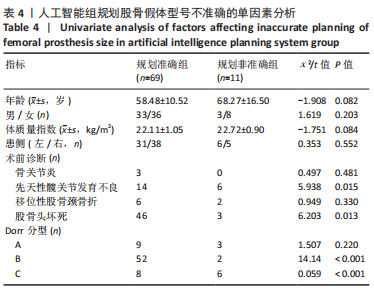
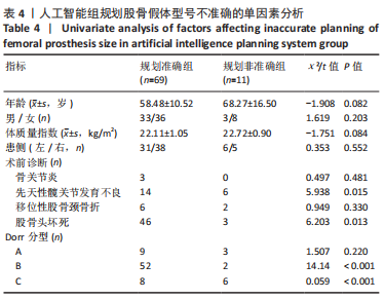
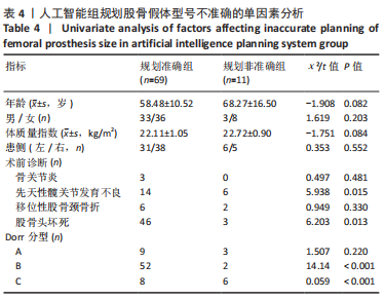
2.5 两组患者术后髋关节功能Harris评分比较 两组患者全部获得随访,人工智能组随访时间平均(13.82±5.06)个月,传统模板组平均(13.61±6.23)个月;末次随访时,人工智能组和传统模板组的Harris评分分别为(92.74±3.08)分、(91.81±3.52)分,上述指标两组比较差异均无显著性意义(P > 0.05)。 2.6 两组患者术后影像学随访结果 所有患者术中均无股骨劈裂骨折发生,至末次随访均未出现假体松动、脱位等情况。人工智能组和传统模板组术后双下肢不等长分别为(3.56±2.32) mm、(3.52±2.41) mm,差异无显著性意义(P > 0.05)。 2.7 AIHIP规划股骨柄与术中选择相差2个型号及以上的单因素分析 人工智能组中69例进入规划准确组,11例进入规划非准确组。单因素分析结果显示,术前诊断为先天性髋关节发育不良、股骨头坏死、Dorr B型及Dorr C型股骨在两组间差异有显著性意义(P < 0.05),见表4。"
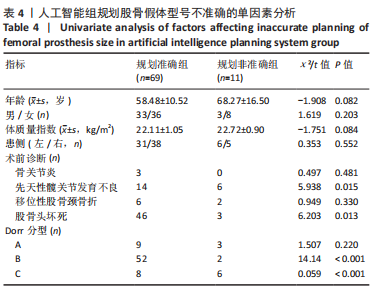
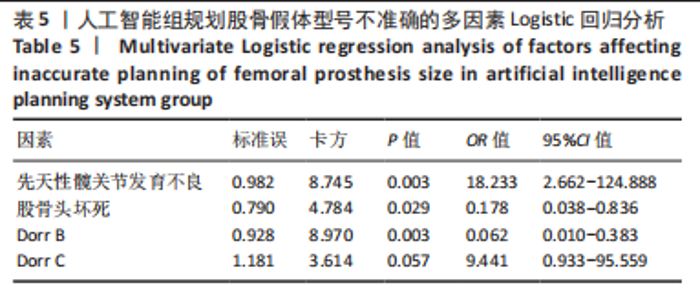
2.8 AIHIP规划股骨柄与术中选择相差2个型号及以上的多因素分析 纳入单因素分析中P < 0.1的6个变量进行多因素logistic回归分析,排除各因素间的相互影响后结果显示:术前诊断为先天性髋关节发育不良(OR=18.233,95%CI:2.662-124.888)是影响AIHIP规划股骨柄准确率的独立危险因素(P < 0.05),而术前诊断为股骨头坏死(OR=0.178,95%CI:0.038-0.836)、Dorr B 型(OR=0.062,95%CI:0.010-0.383)是影响AIHIP规划股骨柄准确率的保护因素(P < 0.05),见表5。"

2.9 植入物与宿主的生物相容性 植入物与宿主的相容性好,患者均未出现植入物周围感染、过敏反应、免疫反应及排斥反应等并发症。"

| [1] BRENNEIS M, BRAUN S, VAN DRONGELEN S, et al. Accuracy of Preoperative Templating in Total Hip Arthroplasty With Special Focus on Stem Morphology: A Randomized Comparison Between Common Digital and Three-Dimensional Planning Using Biplanar Radiographs. J Arthroplasty. 2021;36(3):1149-1155. [2] TRIPURANENI KR, ARCHIBECK MJ, JUNICK DW, et al. Common errors in the execution of preoperative templating for primary total hip arthroplasty. J Arthroplasty. 2010;25(8):1235-1239. [3] BISHI H, SMITH JBV, ASOPA V, et al. Comparison of the accuracy of 2D and 3D templating methods for planning primary total hip replacement: a systematic review and meta-analysis. EFORT Open Rev. 2022;7(1):70-83. [4] ADAMCZYK A, LABOUDIE P, NESSEK H, et al. Accuracy of digital templating in uncemented primary total hip arthroplasty: which factors are associated with accuracy of preoperative planning? Hip Int. 2022:11207000221082026. [5] EGGLI S, PISAN M, MÜLLER M. The value of preoperative planning for total hip arthroplasty. J Bone Joint Surg Br. 1998;80(3):382-390. [6] CARTER L, STOVALL D, YOUNG T. Determination of accuracy of preoperative templating of noncemented femoral prostheses. J Arthroplasty. 1995;10(4):507-513. [7] CHEN X, WANG Y, MA R, et al. Validation of CT-Based Three-Dimensional Preoperative Planning in Comparison with Acetate Templating for Primary Total Hip Arthroplasty. Orthop Surg. 2022;14(6):1152-1160. [8] GAMBLE P, DE BEER J, PETRUCCELLI D, et al. The accuracy of digital templating in uncemented total hip arthroplasty. J Arthroplasty. 2010;25(4):529-532. [9] GONZALEZ DELLA VALLE A, COMBA F, TAVERAS N, et al. The utility and precision of analogue and digital preoperative planning for total hip arthroplasty. Int Orthop. 2008;32(3):289-294. [10] 丁冉, 王淇, 刘烨, 等. 人工智能三维术前规划在全髋关节置换术中的应用和准确性分析[J]. 生物骨科材料与临床研究,2022,19(2):33-38. [11] 李兴鑫, 陈施展, 娄延举, 等. 人工智能三维术前规划在全髋关节置换术中的应用[J]. 中国新通信,2022,24(17):104-106. [12] 万超, 董圣杰, 王诗军, 等. 人工智能辅助手术规划系统在个体化全髋关节假体精准植入中的应用[J]. 骨科,2022,13(3):204-211. [13] 胡陈贵. 人工智能辅助全髋关节置换术三维规划系统的应用价值分析[J]. 保健文汇,2022,23(10):185-187. [14] 吴东, 刘星宇, 张逸凌, 等. 人工智能辅助全髋关节置换术三维规划系统的研发及临床应用研究[J]. 中国修复重建外科杂志,2020,34(9):1077-1084. [15] SCHIFFNER E, LATZ D, JUNGBLUTH P, et al. Is computerised 3D templating more accurate than 2D templating to predict size of components in primary total hip arthroplasty? Hip Int. 2019;29(3):270-275. [16] SARIALI E, MAUPRIVEZ R, KHIAMI F, et al. Accuracy of the preoperative planning for cementless total hip arthroplasty. A randomised comparison between three-dimensional computerised planning and conventional templating. Orthop Traumatol Surg Res. 2012;98(2):151-158. [17] REINBACHER P, SMOLLE MA, FRIESENBICHLER J, et al. Pre-operative templating in THA using a short stem system: precision and accuracy of 2D versus 3D planning method. J Orthop Traumatol. 2022;23(1):16. [18] LIM YW, HUDDLESTON JI 3RD, GOODMAN SB, et al. Proximal Femoral Shape Changes the Risk of a Leg Length Discrepancy After Primary Total Hip Arthroplasty. J Arthroplasty. 2018;33(12):3699-3703. [19] CHEN X, LIU X, WANG Y, et al. Development and Validation of an Artificial Intelligence Preoperative Planning System for Total Hip Arthroplasty. Front Med (Lausanne). 2022;9:841202. [20] PETRETTA R, STRELZOW J, OHLY NE, et al. Acetate templating on digital images is more accurate than computer-based templating for total hip arthroplasty. Clin Orthop Relat Res. 2015;473(12):3752-3759. [21] DELLA VALLE A, PADGETT D, SALVATI E. Preoperative planning for primary total hip arthroplasty. J Am Acad Orthop Surg. 2005;13(7):455-462. [22] KRISTOFFERSSON E, OTTEN V, CRNALIC S. The accuracy of digital templating in cementless total hip arthroplasty in dysplastic hips. BMC Musculoskelet Disord. 2021;22(1):942. [23] SERSHON RA, DIAZ A, BOHL DD, et al. Effect of Body Mass Index on Digital Templating for Total Hip Arthroplasty. J Arthroplasty. 2017;32(3):1024-1026. [24] BOESE CK, WILHELM S, HANEDER S, et al. Influence of calibration on digital templating of hip arthroplasty. Int Orthop. 2019;43(8):1799-1805. [25] RAMME AJ, FISHER ND, EGOL J, et al. Scaling Marker Position Determines the Accuracy of Digital Templating for Total Hip Arthroplasty. HSS J. 2018;14(1):55-59. [26] SINCLAIR VF, WILSON J, JAIN NP, et al. Assessment of accuracy of marker ball placement in pre-operative templating for total hip arthroplasty. J Arthroplasty. 2014;29(8):1658-1660. [27] ECKRICH S, NOBLE P, TULLOS H. Effect of rotation on the radiographic appearance of the femoral canal. J Arthroplasty. 1994;9(4):419-426. [28] OSMANI F A, THAKKAR S, RAMME A, et al. Variance in predicted cup size by 2-dimensional vs 3-dimensional computerized tomography-based templating in primary total hip arthroplasty. Arthroplast Today. 2017;3(4):289-293. [29] WAKO Y, NAKAMURA J, MIURA M, et al. Interobserver and Intraobserver Reliability of Three-Dimensional Preoperative Planning Software in Total Hip Arthroplasty. J Arthroplasty. 2018;33(2):601-607. [30] HUO J, HUANG G, HAN D, et al. Value of 3D preoperative planning for primary total hip arthroplasty based on artificial intelligence technology. J Orthop Surg Res. 2021;16(1):156. [31] DING X, ZHANG B, LI W, et al. Value of preoperative three-dimensional planning software (AI-HIP) in primary total hip arthroplasty: a retrospective study. J Int Med Res. 2021;49(11):3000605211058874. [32] ZHAO X, ZHU ZA, ZHAO J, et al. The utility of digital templating in Total Hip Arthroplasty with Crowe type II and III dysplastic hips. Int Orthop. 2011;35(5):631-638. [33] WUESTEMANN T, HOARE SG, PETERSIK A, et al. Bone morphology of the proximal femoral canal: ethnicity related differences and the influence on cementless tapered wedge stem designs. Hip Int. 2021;31(4):482-491. [34] DORR L, FAUGERE M, MACKEL A, et al. Structural and cellular assessment of bone quality of proximal femur. Bone. 1993;14(3):231-242. [35] MAVCIC B, ANTOLIC V. Cementless femoral stem fixation and leg-length discrepancy after total hip arthroplasty in different proximal femoral morphological types. Int Orthop. 2021;45(4):891-896. |
| [1] | He Yixiang, Qiao Wanjia, Wang Wenji. Effectiveness and safety of tranexamic acid versus epsilon-aminocaproic acid in total hip and knee arthroplasties: a meta-analysis [J]. Chinese Journal of Tissue Engineering Research, 2026, 30(9): 2361-2369. |
| [2] | Guan Yujie, Zhao Bin. Application and prospect of artificial intelligence in screening and diagnosis of scoliosis [J]. Chinese Journal of Tissue Engineering Research, 2026, 30(3): 721-730. |
| [3] | Yue Yuhang, Xie Liangyu, Shi Liupeng, Yin Zuozhen, Cao Shengnan, Shi Bin, Sun Guodong. Bibliometric analysis of application of artificial intelligence in orthopedic imaging diagnosis [J]. Chinese Journal of Tissue Engineering Research, 2026, 30(28): 7418-7427. |
| [4] | Zhang Xin, Zhang Meishu, Ge Miao, Sun Jianhao, Lyu Longlong, Gao Peng. Deep learning in bone imaging diagnosis [J]. Chinese Journal of Tissue Engineering Research, 2026, 30(27): 7203-7209. |
| [5] | Song Yang, Yuan Liufeng, Guo Zheng, Shen Dahui, Sun Shoukang, Xu Xiangjun, Guo Dongsheng, Dong Yuefu. Effect of proximal femoral morphology on coronal varus positioning of cementless femoral stems [J]. Chinese Journal of Tissue Engineering Research, 2026, 30(27): 7108-7114. |
| [6] | Cheng Yongzhong, Li Rui, Luo Xiangli, Wang Fan, Chen Yang, Yan Wei. AI algorithm analysis for CT three-dimensional diagnosis and accurate assessment of posterior cruciate ligament tibial avulsion fractures [J]. Chinese Journal of Tissue Engineering Research, 2026, 30(21): 5589-5596. |
| [7] | Cao Xun, Zheng Shanbin, Sun Jiahao, Chen Zhiyuan, Zhu Jiaqing, Ma Bowen, Xia Tianwei, Zhang Chao, Shen Jirong. Non-infectious knee prosthesis loosening treated by revision with Sleeve extension rod combined with MBT prosthesis under the aid of pre-operative planning [J]. Chinese Journal of Tissue Engineering Research, 2026, 30(21): 5437-5444. |
| [8] | Meng Zhuo, Zhao Renghao, Zhang Anqi, Hua Haotian, Wang Zicheng, Xu Yingtian, Tong Peijian. Literature visualization analysis of brain-computer interface applications in stroke rehabilitation [J]. Chinese Journal of Tissue Engineering Research, 2026, 30(18): 4802-4813. |
| [9] | Guan Mingqiang, Wei Jinqiang, Chen Weijian, Zhou Guanming. Reconstruction of bone defect at the top of acetabulum during revision total hip arthroplasty with cup blocking screws and impaction bone grafting [J]. Chinese Journal of Tissue Engineering Research, 2026, 30(15): 3878-3884. |
| [10] | Yang Bin, Tao Guangyi, Yang Shun, Xu Junjie, Huang Junqing . Visualization analysis of research hotspots of artificial intelligence in field of spinal cord nerve injury and repair [J]. Chinese Journal of Tissue Engineering Research, 2025, 29(4): 761-770. |
| [11] | Jiang Qiyu, Zeng Huiyan. A novel analysis and prediction method for potential mechanisms of traditional Chinese medicine based on artificial intelligence and omics data-driven approach [J]. Chinese Journal of Tissue Engineering Research, 2025, 29(35): 7552-7561. |
| [12] | Wang Simin, Zhang Dezhou, Zhao Jing, Wang Chaoqun, Li Kun, Chen Jie, Bai Xue, Zhao Hailong, Zhang Shaojie, Ma Yuan, Hao Yunteng, Yang Yang, Li Zhijun, Shi Jun, Wang Xing. Artificial intelligence and cervical spine image recognition: application prospects and challenges [J]. Chinese Journal of Tissue Engineering Research, 2025, 29(33): 7231-7240. |
| [13] | Song Haoran, Zhang Yuqiang, Gu Na, Zhi Xiaodong, Wang Wei. Visualization analysis of artificial intelligence in bone trauma research based on Citespace [J]. Chinese Journal of Tissue Engineering Research, 2025, 29(3): 493-502. |
| [14] | Zhang Ziyu, Chen Longhao, Sheng Wei, Lyu Hanzhe, Shen Ying, Wang Binghao, Lyu Zhizhen, Lyu Lijiang. Application of artificial intelligence in the diagnosis and treatment of lumbar disc herniation: evolution towards standardization, efficiency, and precision of diagnosis and treatment methods [J]. Chinese Journal of Tissue Engineering Research, 2025, 29(29): 6269-6276. |
| [15] | Bai Liang, Fu Su, Yan Xu, Zhang Chunlin, Li Ying . Measurement of intervertebral disc height and analysis of strength after induced resorption of herniated nucleus pulpous [J]. Chinese Journal of Tissue Engineering Research, 2025, 29(27): 5785-5794. |
| Viewed | ||||||
|
Full text |
|
|||||
|
Abstract |
|
|||||