Chinese Journal of Tissue Engineering Research ›› 2024, Vol. 28 ›› Issue (12): 1815-1822.doi: 10.12307/2024.030
Previous Articles Next Articles
Finite element analysis of lumbar vertebra biomechanics after transforaminal lumbar interbody fusion combined with bilateral transpedicular transdiscal lumbar screw fixation
Chen Liuxu, Yang Han, Yang Jian, Yang Linyu, Kang Jianping
- Affiliated Hospital of Southwest Medical University, Luzhou 646000, Sichuan Province, China
-
Received:2023-01-10Accepted:2023-03-18Online:2024-04-28Published:2023-08-22 -
Contact:Kang Jianping, Master, Professor, Master’s supervisor, Affiliated Hospital of Southwest Medical University, Luzhou 646000, Sichuan Province, China -
About author:Chen Liuxu, Master candidate, Affiliated Hospital of Southwest Medical University, Luzhou 646000, Sichuan Province, China

CLC Number:
Cite this article
Chen Liuxu, Yang Han, Yang Jian, Yang Linyu, Kang Jianping. Finite element analysis of lumbar vertebra biomechanics after transforaminal lumbar interbody fusion combined with bilateral transpedicular transdiscal lumbar screw fixation[J]. Chinese Journal of Tissue Engineering Research, 2024, 28(12): 1815-1822.
share this article
Add to citation manager EndNote|Reference Manager|ProCite|BibTeX|RefWorks
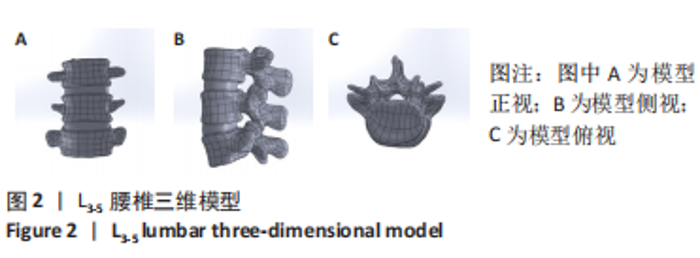
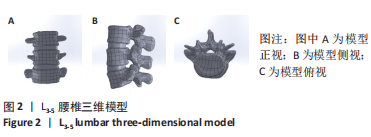
2.1 建立L3-5三维模型 在此次研究建立的模型中,L3/4椎间盘纤维环和髓核的体积为4 692.29 mm3、3 570.21 mm3,L4/5椎间盘纤维环和髓核的体积为4 619.30 mm3、4 108.06 mm3,与临床中影像学测量结果验证相近[10]。L3-5三维模型见图2。"
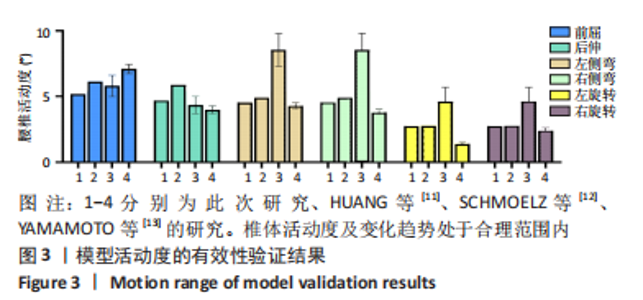
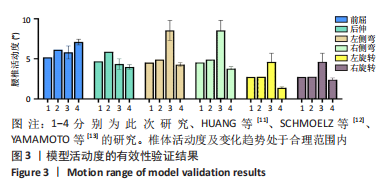
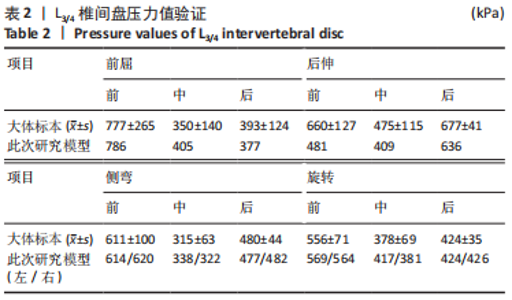
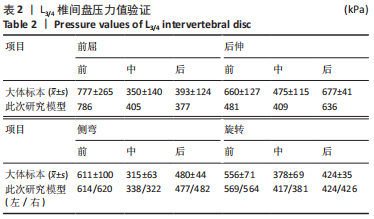
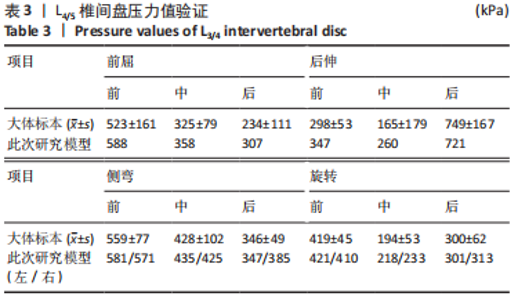
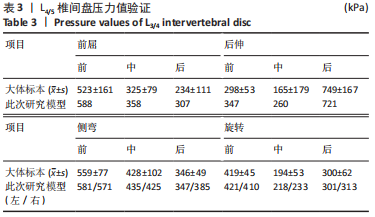
2.2 模型的有效性验证 在6种运动载荷下,模型的活动度及变化趋势同大体实验相比在合理范围内[11-13],详见图3。测得L3/4、L4/5椎间盘在6种工况下其前、中、后3部分压力与大体模型所测得数据接近,详见表2,3。因此说明该模型能够模仿正常腰椎的6种活动,可进一步进行研究。"
"
"
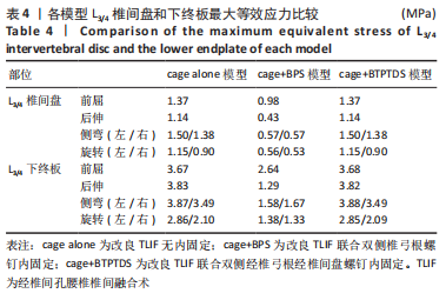
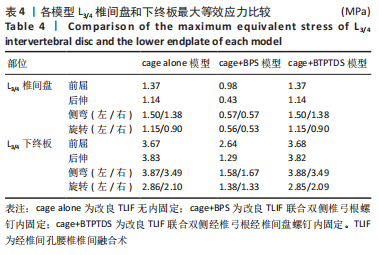
2.3 不同工况非融合节段椎间盘及下终板应力 观察发现,3种不同融合方案在各个运动载荷下,cage alone模型和cage+BTPTDS模型的非融合节段椎间盘及下终板最大等效应力相近,略大于cage+BPS模型,详见表4。"
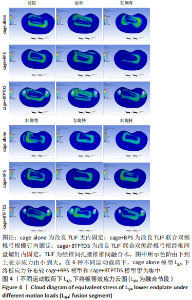
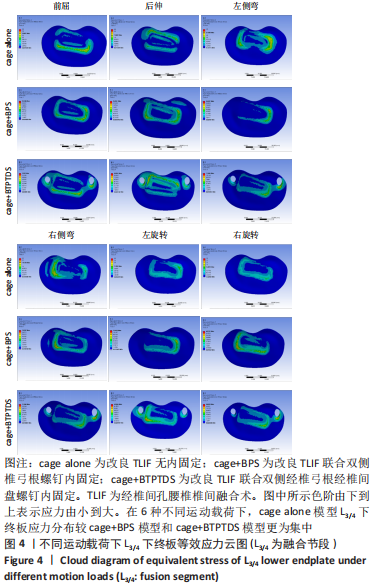
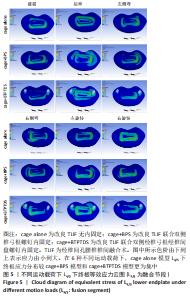
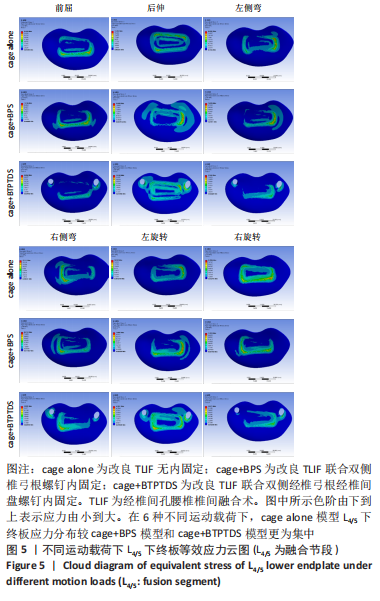
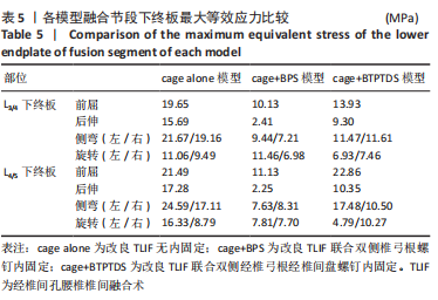
2.4 不同工况对融合节段下终板应力的影响 cage alone模型在6种运动载荷下融合节段下终板最大应力最大而cage+BPS模型最小;cage+BTPTDS模型融合节段下终板最大应力小于cage alone模型,稍大于cage+BPS模型,见图4,5及表5。"
"
"

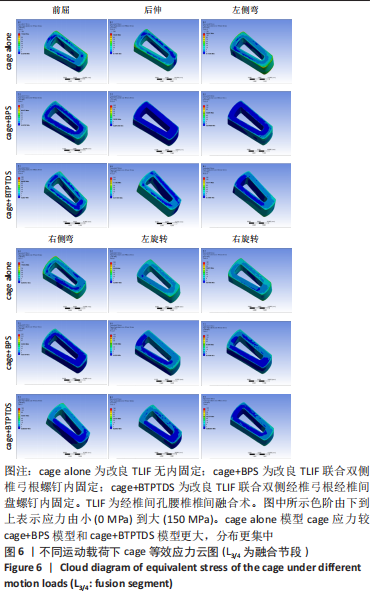
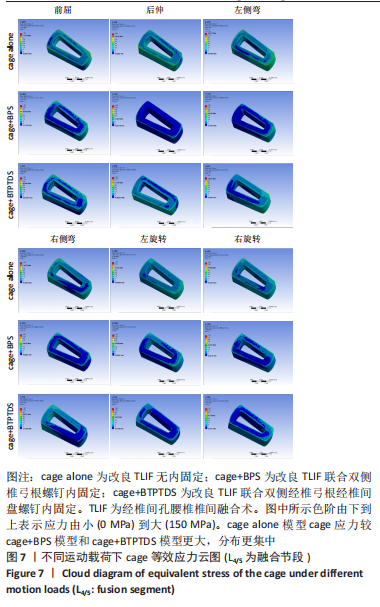
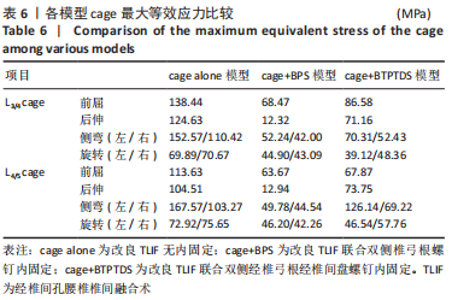
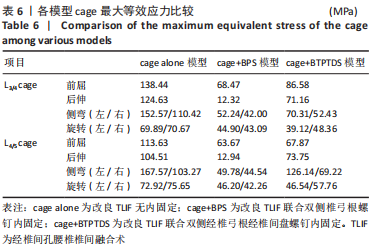
2.5 各模型在不同运动载荷下cage和内固定的应力分布比较 cage alone模型在6种工况下其cage最大应力均最大;在前屈运动载荷下,cage+BPS模型cage最大应力稍大于cage+BTPTDS模型;在后伸运动载荷下,cage+BTPTDS模型cage最大应力明显小于cage alone模型和cage+BPS模型;在左右侧弯载荷下,cage+BTPTDS模型cage最大应力稍大于cage+BPS模型,二者明显小于cage alone模型;在左右旋转载荷下,cage+BTPTDS模型与cage+BPS模型cage最大应力接近,小于cage alone模型,见图6,7及表6。"

"
"
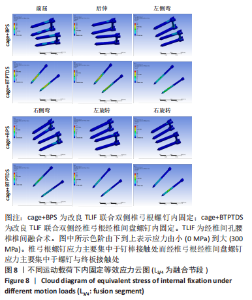
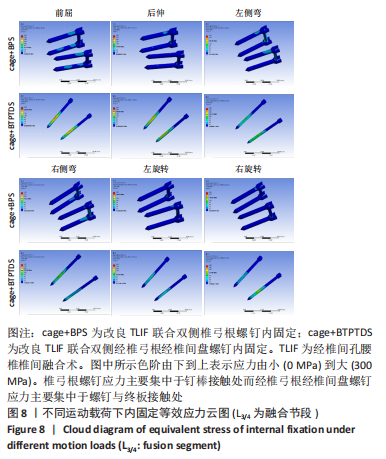
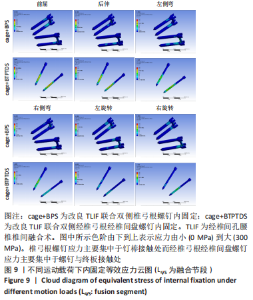
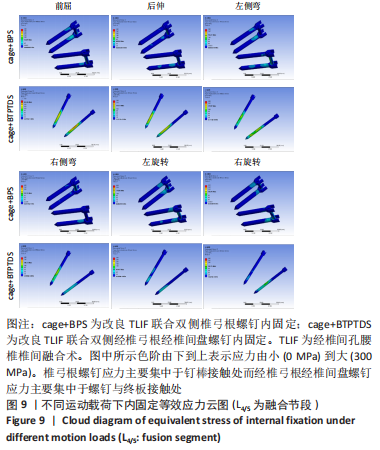
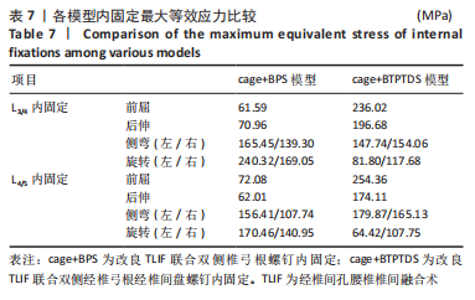
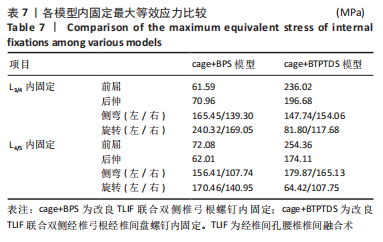
在前屈和后伸工况时,cage+BTPTDS模型内固定最大应力明显大于cage+BPS模型;在左右侧弯工况时,cage+BTPTDS模型与cage+BPS模型二者内固定最大应力接近;而在左右旋转工况时,cage+BTPTDS模型内固定最大应力则小于cage+BPS模型,见图8,9及表7。"
"
"
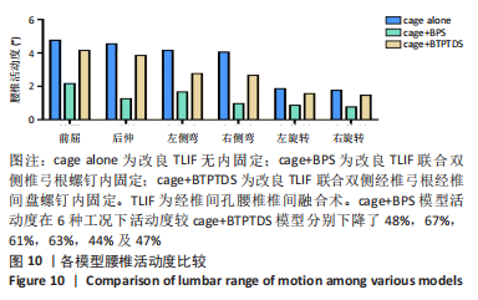
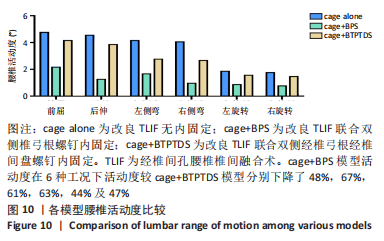
2.6 不同工况下各模型活动度的比较 在6种工况时,cage alone模型其活动度均最高,age+BPS模型活动度最低,cage+BTPTDS模型的活动度介于前两者之间,较cage alone模型接近,大于cage+BPS模型,以L4/5为融合节段为例,如图10。"
| [1] MENG B, BUNCH J, BURTON D, et al. Lumbar interbody fusion: recent advances in surgical techniques and bone healing strategies. Eur Spine J. 2021;30(1):22-33. [2] UÇAR BY, ÖZCAN Ç, POLAT Ö, et al. Transforaminal Lumbar Interbody Fusion For Lumbar Degenerative Disease: Patient Selection And Perspectives. Orthop Res Rev. 2019;11:183-189. [3] KIM CH, EASLEY K, LEE JS, et al. Comparison of Minimally Invasive Versus Open Transforaminal Interbody Lumbar Fusion. Global Spine J. 2020;10(2 Suppl):143s-150s. [4] ROSINSKI A, ODEH K, UNGUREAN V JR, et al. Non-Pedicular Fixation Techniques for the Treatment of Spinal Deformity: A Systematic Review. JBJS Rev. 2020;8(5):e0150. [5] WU AM, HARRIS JA, HAO JC, et al. Biomechanical properties of posterior transpedicular-transdiscal oblique lumbar screw fixation with novel trapezoidal lateral interbody spacer: an in vitro human cadaveric model. Eur Spine J. 2017;26(11):2873-2882. [6] BELYTSCHKO T, ANDRIACCHI T, SCHULTZ A, et al. Analog studies of forces in the human spine: computational techniques. J Biomech. 1973;6(4):361-371. [7] LU T, LU Y. Comparison of Biomechanical Performance Among Posterolateral Fusion and Transforaminal, Extreme, and Oblique Lumbar Interbody Fusion: A Finite Element Analysis. World Neurosurg. 2019;129:e890-e899. [8] PINTAR FA, YOGANANDAN N, MYERS T, et al. Biomechanical properties of human lumbar spine ligaments. J Biomech. 1992;25(11):1351-1356. [9] ROSINSKI AA, MITTAL A, ODEH K, et al. Alternatives to traditional pedicle screws for posterior fixation of the degenerative lumbar spine. JBJS Rev. 2021;9(7):e20. [10] 文兵, 杜瑛, 胡良波,等. 磁共振对 BMI 正常人群髓核体积的测量与临床应用研究[J]. 中国医学计算机成像杂志,2016,22(4): 346-350. [11] HUANG YP, DU CF, CHENG CK, et al. Preserving posterior complex can prevent adjacent segment disease following posterior lumbar interbody fusion surgeries: a finite element analysis. PLoS One. 2016; 11(11):e0166452. [12] SCHMOELZ W, ERHART S, UNGER S, et al. Biomechanical evaluation of a posterior non-fusion instrumentation of the lumbar spine. Eur Spine J. 2012;21(5):939-945. [13] YAMAMOTO I, PANJABI MM, CRISCO T, et al. Three-dimensional movements of the whole lumbar spine and lumbosacral joint. 1989; 14(11):1256-1260. [14] TENG I, HAN J, PHAN K, et al. A meta-analysis comparing alif, plif, tlif and llif. J Clin Neurosci. 2017;44:11-17. [15] MOBBS RJ, PHAN K, MALHAM G, et al. Lumbar interbody fusion: techniques, indications and comparison of interbody fusion options including PLIF, TLIF, MI-TLIF, OLIF/ATP, LLIF and ALIF. J Spine Surg. 2015; 1(1):2-18. [16] 孙继芾, 黄永辉, 左华,等. 改良 TLIF 治疗腰椎不稳伴腰椎管狭窄症[J]. 中国矫形外科杂志,2015,23(23):2138-2141. [17] TARAWNEH AM, SALEM KM. A systematic review and meta-analysis of randomized controlled trials comparing the accuracy and clinical outcome of pedicle screw placement using robot-assisted technology and conventional freehand technique. Global Spine J. 2021;11(4):575-586. [18] HIYAMA A, KATOH H, SAKAI D, et al. Short-Term Comparison Between Unilateral Versus Bilateral Percutaneous Pedicle Screw Fixation in Short-Level Lateral Lumbar Interbody Fusion–A Prospective Randomized Study. Global Spine J. 2022;21925682221146500. [19] SONG T, WELLINGTON KH, YE T. Lumbar pedicle cortical bone trajectory screw. Chin Med J (Engl). 2014;127(21):3808-3813. [20] 姜伟, 袁峰. 单侧椎弓根螺钉联合经椎板关节突螺钉与双侧椎弓根螺钉固定治疗下腰椎退行性疾病: 2 年随访[J]. 中国组织工程研究, 2017,21(19):2973-2979. [21] 唐强, 廖烨晖, 唐超,等. 椎间融合器的置入方式对腰椎融合效果的影响. 中国脊柱脊髓杂志,2019,29(12):1071-1079. [22] EGUCHI Y, ORITA S, YAMADA H, et al. Pilot study of oblique lumbar interbody fusion using mobile percutaneous pedicle screw and validation by a three-dimensional finite element assessment. J Clin Neurosci. 2020;76:74-80. [23] 魏源标, 郭惠智, 张顺聪. 皮质骨轨迹螺钉固定对相邻节段影响的有限元分析[J]. 中国组织工程研究,2021,25(18):2799-2804. [24] 杨洋, 王洋, 叶晓健. 椎弓根皮质骨轨迹螺钉固定技术的研究进展[J]. 中国脊柱脊髓杂志,2015,25(7):659-662. [25] MATSUKAWA K, YATO Y, HYNES RA, et al. Cortical Bone Trajectory for Thoracic Pedicle Screws. Clin Spine Surg. 2017;30(5):E497-E504. [26] 潘爱星, 刘玉增, 海涌,等. 腰椎皮质骨螺钉联合椎弓根螺钉固定对融合节段应力影响的有限元分析[J]. 中国脊柱脊髓杂志,2022, 32(1):67-74. [27] ABDU WA, WILBER RG, EMERY SE. Pedicular transvertebral screw fixation of the lumbosacral spine in spondylolisthesis. A new technique for stabilization. Spine. 1994;19(6):710-715. [28] ZAGRA A, GIUDICI F, MINOIA L, et al. Long-term results of pediculo-body fixation and posterolateral fusion for lumbar spondylolisthesis. Eur Spine J. 2009;18:151-155. [29] GROB D, HUMKE T, DVORAK J. Direct pediculo-body fixation in cases of spondylolisthesis with advanced intervertebral disc degeneration. Eur Spine J. 1996;5:281-285. [30] AONO H, TAKENAKA S, TOBIMATSU H, et al. Adjacent-segment disease after L3-4 posterior lumbar interbody fusion: does L3-4 fusion have cranial adjacent-segment degeneration similar to that after L4-5 fusion? J Neurosurg Spine. 2020;33(4):455-460. [31] 钟建斌, 张凯伦, 赵波捷. 腰椎邻椎病的危险因素及治疗进展[J]. 中国骨与关节杂志,2020,9(7):555-559. [32] YUAN C, ZHOU J, WANG L, et al. Adjacent segment disease after minimally invasive transforaminal lumbar interbody fusion for degenerative lumbar diseases: incidence and risk factors. BMC Musculoskelet Disord. 2022;23(1):982. [33] DU CF, CAI XY, GUI W, et al. Does oblique lumbar interbody fusion promote adjacent degeneration in degenerative disc disease: A finite element analysis. Comput Biol Med. 2021;128:104122. |
| [1] | Chen Huiting, Zeng Weiquan, Zhou Jianhong, Wang Jie, Zhuang Congying, Chen Peiyou, Liang Zeqian, Deng Weiming. Tail anchoring technique of vertebroplasty in treatment of osteoporotic vertebral compression fractures with intravertebral cleft: a finite element analysis [J]. Chinese Journal of Tissue Engineering Research, 2026, 30(9): 2145-2152. |
| [2] | Zeng Xuan, Weng Rui, Ye Shicheng, Tang Jiadong, Mo Ling, Li Wenchao. Two lumbar rotary manipulation techniques in treating lumbar disc herniation: a finite element analysis of biomechanical differences [J]. Chinese Journal of Tissue Engineering Research, 2026, 30(9): 2153-2161. |
| [3] | Cheng Qisheng, Julaiti·Maitirouzi, Xiao Yang, Zhang Chenwei, Paerhati·Rexiti. Finite element analysis of novel variable-diameter screws in modified cortical bone trajectory of lumbar vertebrae [J]. Chinese Journal of Tissue Engineering Research, 2026, 30(9): 2162-2171. |
| [4] | Wu Hongxu, Liu Xuanyu, Wang Taoyu, Wang Shiyao, Cheng Jingyi, Zhang Mingwen, Zhang Yinxia, Liu Zhihua, Wang Xiaojie. Finite element simulation of scoliosis with muscle unit introduction: verification of correction effect under bidirectional load [J]. Chinese Journal of Tissue Engineering Research, 2026, 30(9): 2172-2181. |
| [5] | Liu Jiafu, Ren Ruxia, Liao Zhouwei, Zhou Xiali, Wu Yihong, Zhang Shaoqun. Three-dimensional finite element analysis of cervical spine biomechanical characteristics in a rat model of cervical vertigo [J]. Chinese Journal of Tissue Engineering Research, 2026, 30(9): 2182-2190. |
| [6] | Zhang Nan, Meng Qinghua, Bao Chunyu. Characteristics and clinical application of ankle joint finite element models [J]. Chinese Journal of Tissue Engineering Research, 2026, 30(9): 2343-2349. |
| [7] | Chen Long, Wang Xiaozhen, Xi Jintao, Lu Qilin. Biomechanical performance of short-segment screw fixation combined with expandable polyetheretherketone vertebral body replacement in osteoporotic vertebrae [J]. Chinese Journal of Tissue Engineering Research, 2026, 30(9): 2226-2235. |
| [8] | Zhang Zizheng, Luo Wang, Liu Changlu. Application value of finite element analysis on unicompartmental knee arthroplasty for medial knee compartmental osteoarthritis [J]. Chinese Journal of Tissue Engineering Research, 2026, 30(9): 2313-2322. |
| [9] | Zhao Feifan, Cao Yujing. Risk factors and coping strategies of internal fixation failure in treatment of intertrochanteric fracture with proximal femoral nail antirotation [J]. Chinese Journal of Tissue Engineering Research, 2026, 30(9): 2323-2333. |
| [10] | Liu Wenlong, Dong Lei, Xiao Zhengzheng, Nie Yu. Finite element analysis of tibial prosthesis loosening after fixed-bearing unicompartmental knee arthroplasty for osteoporosis [J]. Chinese Journal of Tissue Engineering Research, 2026, 30(9): 2191-2198. |
| [11] | Zheng Wangyang, Fei Ji, Yang Di, Zhao Lang, Wang Lingli, Liu Peng, Li Haiyang. Finite element analysis of the force changes of the supraspinatus tendon and glenohumeral joint during the abduction and flexion of the humerus [J]. Chinese Journal of Tissue Engineering Research, 2026, 30(9): 2199-2207. |
| [12] | Cai Qirui, Dai Xiaowei, Zheng Xiaobin, Jian Sili, Lu Shaoping, Liu Texi, Liu Guoke, Lin Yuanfang. Mechanical effects of Long’s traction orthopedic method on cervical functional units: quantitative analysis of biomechanical model of head and neck [J]. Chinese Journal of Tissue Engineering Research, 2026, 30(9): 2208-2216. |
| [13] | Rao Jingcheng, Li Yuwan, Zheng Hongbing, Xu Zhi, Zhu Aixiang, Shi Ce, Wang Bing, Yang Chun, Kong Xiangru, Zhu Dawei. Biomechanical differences between the new proximal femoral stable intramedullary nail and traditional intramedullary nail#br# [J]. Chinese Journal of Tissue Engineering Research, 2026, 30(9): 2217-2225. |
| [14] | Zheng Xuying, Hu Hongcheng, Xu Libing, Han Jianmin, Di Ping. Stress magnitude and distribution in two-piece cement-retained zirconia implants under different loading conditions and with varying internal connection shapes [J]. Chinese Journal of Tissue Engineering Research, 2026, 30(8): 1979-1987. |
| [15] | Zhong Caihong, Xiao Xiaoge, Li Ming, Lin Jianhong, Hong Jing. Biomechanical mechanism of sports-related patellar tendinitis [J]. Chinese Journal of Tissue Engineering Research, 2026, 30(6): 1417-1423. |
| Viewed | ||||||
|
Full text |
|
|||||
|
Abstract |
|
|||||