Chinese Journal of Tissue Engineering Research ›› 2026, Vol. 30 ›› Issue (27): 7037-7043.doi: 10.12307/2026.866
Previous Articles Next Articles
Spinal-pelvic sagittal parameters and plantar pressure characteristics in elderly patients with degenerative lumbar spondylolisthesis
Han Zijia1, 2, He Xiaochen2, Wang Jiarong2, Tian Yichao2, Wang Lixin1, Gong Shuhui2
- 1Graduate School, Hebei Medical University, Shijiazhuang 050011, Hebei Province, China; 2Department of Rehabilitation Medicine, Hebei General Hospital, Shijiazhuang 050057, Hebei Province, China
-
Received:2025-10-15Accepted:2026-01-23Online:2026-09-28Published:2026-04-17 -
Contact:Gong Shuhui, MS, Master’s supervisor, Department of Rehabilitation Medicine, Hebei General Hospital, Shijiazhuang 050057, Hebei Province, China -
About author:Han Zijia, MS candidate, Graduate School, Hebei Medical University, Shijiazhuang 050011, Hebei Province, China; Department of Rehabilitation Medicine, Hebei General Hospital, Shijiazhuang 050057, Hebei Province, China -
Supported by:Government-Funded Program for Cultivating Outstanding Talents in Clinical Medicine, No. 201913 (to GSH)

CLC Number:
Cite this article
Han Zijia, He Xiaochen, Wang Jiarong, Tian Yichao, Wang Lixin, Gong Shuhui. Spinal-pelvic sagittal parameters and plantar pressure characteristics in elderly patients with degenerative lumbar spondylolisthesis[J]. Chinese Journal of Tissue Engineering Research, 2026, 30(27): 7037-7043.
share this article
Add to citation manager EndNote|Reference Manager|ProCite|BibTeX|RefWorks
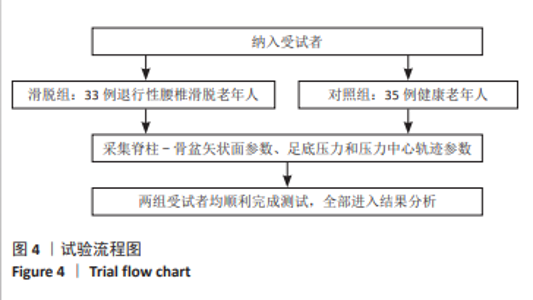
2.1 参与者数量分析 纳入33例退行性腰椎滑脱老年人(滑脱组)和35例健康老年人(对照组)。所有受试者试验过程中依从性较好,均无意外事件发生,全部进入结果分析。 2.2 试验流程 详见图4。"
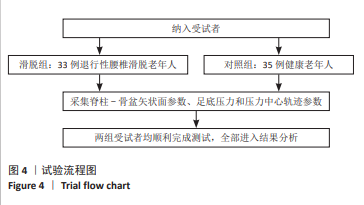
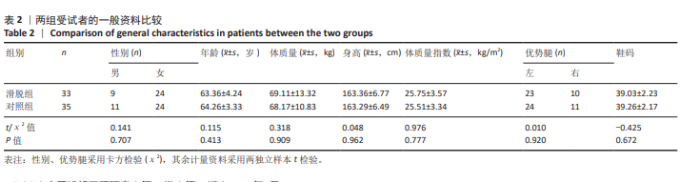
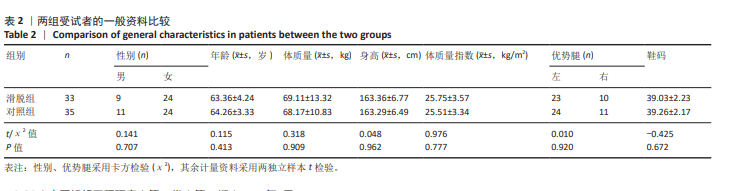
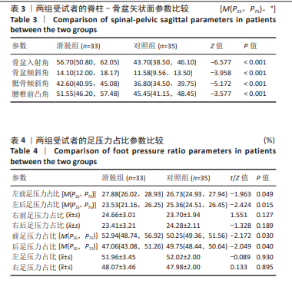
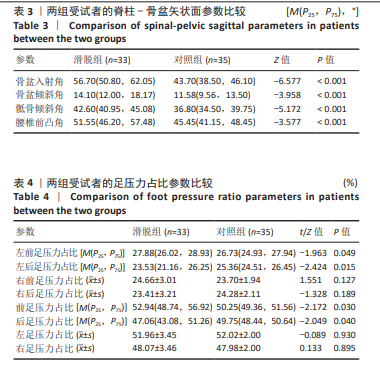
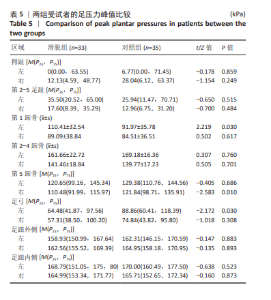
2.3 受试者基本情况 两组受试者的性别、年龄、身高、体质量、体质量指数、优势腿和鞋码相比差异均无显著性意义(P > 0.05),详见表2。 2.4 脊柱-骨盆矢状面参数比较 结果显示,与对照组相比,滑脱组患者的骨盆入射角、骨盆倾斜角、骶骨倾斜角、腰椎前凸角显著增大(P < 0.05),详见表3。 2.5 足压力占比参数比较 两组右前足、右后足、左足、右足压力占比上的差异均无显著性意义(P > 0.05)。但是滑脱组的左前足压力占比和前足压力占比显著高于对照组(P < 0.05),而左后足压力占比和后足压力占比则显著低于对照组(P < 0.05)。详见表4。 2.6 足压力峰值参数比较 比较足底8个区域的峰值压强发现,双侧的拇趾、第2-5足趾、第2-4跖骨、足跟外侧和足跟内侧区域的峰值压强在两组间差异均无显著性意义(P > 0.05)。滑脱组表现出以下特征性改变:左侧第1跖骨区域的峰值压强显著高于对照组(P=0.030),而右侧第5跖骨和左侧足弓区域的峰值压强则显著低于对照组(P < 0.05)。两组受试者右侧第1跖骨、左侧第5跖骨和右侧足弓的峰值压强相比差异均无显著性意义(P > 0.05)。详见表5。"
"
"

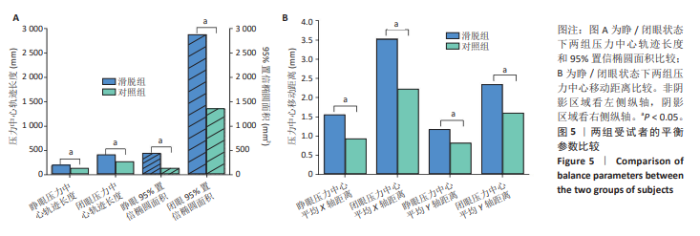
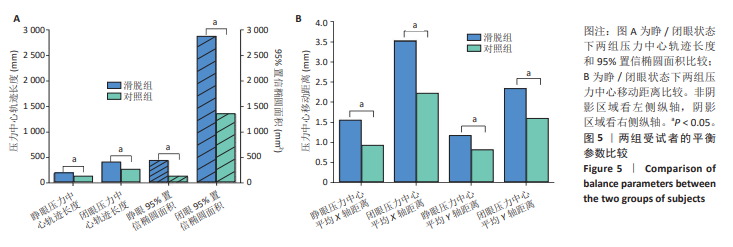
2.7 平衡参数比较 在评价平衡功能的压力中心参数上,无论是睁眼还是闭眼状态,滑脱组的压力中心轨迹长度、95%置信椭圆面积、压力中心在X轴上的平均移动距离以及在Y轴上的平均移动距离均显著大于对照组(P < 0.05)。这清晰地表明退行性腰椎滑脱患者的姿势稳定性下降,平衡控制能力受损,且在闭眼状态下(去除视觉代偿)这种损害更为明显,详见图5。 2.8 不良事件 试验过程中无任何不良事件发生。 "
| [1] SAREMI A, GOYAL KK, BENZEL EC, et al. Evolution of lumbar degenerative spondylolisthesis with key radiographic features. Spine J. 2024;24(6):989-1000. [2] HE LC, WANG YX, GONG JS, et al. Prevalence and risk factors of lumbar spondylolisthesis in elderly Chinese men and women. Eur Radiol. 2014;24(2): 441-448. [3] BYDON M, ALVI MA, GOYAL A. Degenerative Lumbar Spondylolisthesis: Definition, Natural History, Conservative Management, and Surgical Treatment. Neurosurg Clin N Am. 2019;30(3):299-304. [4] CAI T, YANG L, CAI W, et al. Dysplastic spondylolysis is caused by mutations in the diastrophic dysplasia sulfate transporter gene. Proc Natl Acad Sci U S A. 2015;112(26):8064-8069. [5] AOKI Y, TAKAHASHI H, NAKAJIMA A, et al. Prevalence of lumbar spondylolysis and spondylolisthesis in patients with degenerative spinal disease. Sci Rep. 2020;10(1):6739. [6] BALTIC SP, LYONS KW, MARIAUX F, et al. Evaluation of the Clinical and Radiographic Degenerative Spondylolisthesis (CARDS) classification system as a guide to surgical technique selection. Spine J. 2023;23(11):1641-1651. [7] FONG AM, DUCULAN R, ENDO Y, et al. Instability Missed by Flexion-Extension Radiographs Subsequently Identified by Alternate Imaging in L4-L5 Lumbar Degenerative Spondylolisthesis. Spine (Phila Pa 1976). 2023;48(3):E33-E39. [8] 谭蓥滢,曾雪梅. PI-LL对强直性脊柱炎后凸畸形患者截骨矫形术后矢状面平衡的影响[J].徐州医科大学学报,2024,44(11):826-829. [9] LAFAGE V, SCHWAB F, PATEL A, et al. Pelvic tilt and truncal inclination: two key radiographic parameters in the setting of adults with spinal deformity. Spine (Phila Pa 1976). 2009;34(17):E599-E606. [10] CHUANG CY, LIAW MY, WANG LY, et al. Spino-pelvic alignment, balance, and functional disability in patients with low-grade degenerative lumbar spondylolisthesis. J Rehabil Med. 2018;50(10):898-907. [11] CICI H, AKCALI O, ELVAN A, et al. Balance Control and Plantar Pressure Distribution in Hyperkyphotic Adolescent and Young Adults. Turk Neurosurg. 2023;33(3): 451-457. [12] GUO C, LIANG Y, XU S, et al. Lasso Analysis of Gait Characteristics and Correlation with Spinopelvic Parameters in Patients with Degenerative Lumbar Scoliosis. J Pers Med. 2023;13(11):1576. [13] BARREY C, JUND J, NOSEDA O, et al. Sagittal balance of the pelvis-spine complex and lumbar degenerative diseases. A comparative study about 85 cases. Eur Spine J. 2007;16(9):1459-1467. [14] 姜雅文, 刘明威, 肖青霞, 等. 青少年扁平足患者足底压力、下肢平衡与冠状位躯干平衡的相关性研究[J]. 医用生物力学,2024,39(S1):484. [15] ITO T, SAKAI Y, KAWAI K, et al. Proprioceptive reliance on trunk muscles for maintaining postural stability decreases in older patients with sagittal imbalance. Gait Posture. 2023;105:1-5. [16] KIM K, MULLINEAUX D, JEON K. A Comparative Study of Spinal Deformity and Plantar Pressure according to the Static Standing Posture of Female Adolescents with or without Idiopathic Scoliosis. Iran J Public Health. 2019;48(2):345-346. [17] KIRKALDY-WILLIS WH, FARFAN HF. Instability of the lumbar spine. Clin Orthop Relat Res. 1982;(165):110-123. [18] DAHER M, REZK A, BAROUDI M, et al. Lumbar Spondylolisthesis Grading: Current Standards and Important Factors to Consider for Management. World Neurosurg. 2024;190:311-317. [19] MORITA T, YOSHIMOTO M, TERASHIMA Y, et al. Do We Have Adequate Flexion-extension Radiographs for Evaluating Instability in Patients With Lumbar Spondylolisthesis? Spine (Phila Pa 1976). 2020;45(1):48-54. [20] DENG L, WANG C, SUN H, et al. Effects of Cage Implantation Depth on Sagittal Parameters and Functional Outcomes in Posterior Lumbar Interbody Fusion for the Treatment of L4-L5 Lumbar Degenerative Spondylolisthesis. Orthop Surg. 2024;16(6): 1327-1335. [21] SU K, LUAN J, WANG Q, et al. Radiographic Analysis of Minimally Invasive Transforaminal Lumbar Interbody Fusion versus Conventional Open Surgery on Sagittal Lumbar-Pelvic Alignment for Degenerative Spondylolisthesis. World Neurosurg. 2019;124:e733-e739. [22] RADOVANOVIC I, URQUHART JC, GANAPATHY V, et al. Influence of postoperative sagittal balance and spinopelvic parameters on the outcome of patients surgically treated for degenerative lumbar spondylolisthesis. J Neurosurg Spine. 2017;26(4):448-453. [23] 陈涛, 黎观保, 梁科友, 等. 脊柱-骨盆矢状面平衡及其在脊柱疾病治疗中的作用[J]. 中国组织工程研究,2013,17(13):2423-2430. [24] ZHOU L J, YANG M, ZHENG WW, et al. [Analysis of characteristics of lumbar spine-pelvic structural parameters in degenerative lumbar spondylolisthesis]. Zhongguo Gu Shang. 2020;33(9):862-866. [25] 郑召民, 刘辉. 脊柱-骨盆矢状面平衡及其在成人脊柱畸形治疗中的作用[J]. 中国脊柱脊髓杂志,2012,22(3):278-282. [26] DUBOUSSET J, HADDAD F, ZELLER R, et al. La dysplasie ischio-vertébrale (un dangereux syndrome pour la moëlle épinière) [Ischio-vertebral dysplasia (a dangerous syndrome for the spinal cord)]. Rev Chir Orthop Reparatrice Appar Mot. 1994;80(7):610-619. [27] 史祎, 许亚民, 马晓丽, 等. 中度Lenke 3CN型女性青少年特发性脊柱侧弯的静态平衡足底压力特征[J]. 医用生物力学,2024,39(5):923-930. [28] 王欣,罗文,黄文泽,等.单侧膝骨关节炎临床分期与双足足底压力的相关性[J].中国组织工程研究,2021,25(27):4312-4317. [29] 唐智, 郎蕾, 王任远, 等. 拇外翻足有限元模型构建及其第1跖趾关节生物力学分析[J]. 中国组织工程研究,2023,27(27):4283-4290. [30] RUSSELL BS, HOIRIIS KT, HOSEK RS. Walking Gait Before and After Chiropractic Care Following Fifth Metatarsal Fractures: A Single Case Kinetic and Kinematic Study. J Chiropr Med. 2018;17(2):106-116. [31] MATSUMOTO H, TOMOSADA M, NISHI T, et al. Comparing the Ground Reaction Forces, Toe Clearances, and Stride Lengths of Young and Older Adults Using a Novel Shoe Sensor System. Sensors (Basel). 2024;24(21):6871. [32] GONZALEZ-SANMAMED AG, RUIZ-FERNÁNDEZ ML, DEL-VALLE-SOTO ME. Alterations of the center of pressures in the greater trochanter pain syndrome: Evaluation of pelvitrochanteric injuries through dynamic baropodometry. Gait Posture. 2025;119:246-251. [33] WANG XW, CHEN X, FU Y, et al. Analysis of lumbar lateral instability on upright left and right bending radiographs in symptomatic patients with degenerative lumbar spondylolisthesis. BMC Musculoskelet Disord. 2022;23(1):59. [34] PAN W, ZHAO JL, XU J, et al. Lumbar alignment and patient-reported outcomes after single-level transforaminal lumbar interbody fusion for degenerative lumbar spondylolisthesis with and without local coronal imbalance. J Neurosurg Spine. 2020;34(3):464-470. [35] PERRY SD, RADTKE A. Efficacy and effectiveness of a balance-enhancing insole. J Gerontol A Biol Sci Med Sci. 2008;63(6):595-602. [36] 朱飞龙, 张明, 吴宇, 等. 青少年特发性脊柱侧弯患者足部姿势和步态特征的3D形态分析及生物力学评价[J]. 中国组织工程研究,2021,25(33): 5294-5300. [37] BURCAL CJ, WIKSTROM EA. Plantar Cutaneous Sensitivity With and Without Cognitive Loading in People With Chronic Ankle Instability, Copers, and Uninjured Controls. J Orthop Sports Phys Ther. 2016;46(4):270-276. [38] 侯宗辰, 江东, 胡跃林. 足底压力分析在慢性踝关节不稳诊疗中的研究进展[J]. 中国微创外科杂志,2019,19(2):186-189. [39] RHEA CK, KIEFER AW, WRIGHT WG, et al. Interpretation of postural control may change due to data processing techniques. Gait Posture. 2015;41(2):731-735. [40] 段林茹,郑洁皎.脑卒中患者姿势控制的感觉系统特征[J].医用生物力学, 2023,38(4):770-776. [41] 王耀霆, 姚佳琴, 王红雨, 等. 肌电生物反馈疗法结合镜像疗法对脑卒中患者下肢运动和平衡功能的影响[J]. 中国康复医学杂志,2024,39(3):375-381. [42] 颜雯婷, 杨倩倩, 任凤, 等. 双侧膝骨关节炎患者足底压力分布及平衡特征研究[J]. 中国康复医学杂志,2023,38(5):696-699. [43] 王建国, 唐佳, 董继革, 等. 功能性踝关节不稳足底压力分析[J]. 中国康复理论与实践,2022,28(10):1217-1223. [44] GE L, YU Q, WANG C, et al. How cognitive loads modulate the postural control of older women with low back pain? BMC Geriatr. 2021;21(1):82. [45] 罗卫, 钟陶, 黄志锐, 等. 慢性非特异性腰痛患者的静态平衡和稳定极限[J]. 中国组织工程研究,2023,27(27):4362-4366. [46] 葛乐, 余秋华, 郑福明, 等. 腰痛对老年女性动静态平衡功能的影响[J]. 中国康复医学杂志,2022,37(6):760-764. |
| [1] | Cheng Xiaofei, Yang Yuanyuan, Li Sihui, Wang Dehua, Liang Chunting, Li Jiawei, Yao Mingyang, Yao Xiaoduo, Tang Jiqin. Effects of different non-invasive brain stimulation protocols on gait and balance function in patients with Parkinson’s disease: a network meta-analysis [J]. Chinese Journal of Tissue Engineering Research, 2026, 30(18): 4749-4762. |
| [2] | Leng Xiaoxuan, Yu Zifu, Cao Xinyan, Gao Shiai, Chen Jinhui, Liu Xihua. Balance function and its influencing factors in patients with post-stroke hemiplegia [J]. Chinese Journal of Tissue Engineering Research, 2026, 30(18): 4611-4617. |
| [3] | Liu Zixuan, Wei Dehua, Zheng Hailiang, Wang Jiangning, Gao Lei. Plantar pressure characteristics and gait analysis of outdoor workers [J]. Chinese Journal of Tissue Engineering Research, 2026, 30(16): 4146-4153. |
| [4] | Han Zijia, He Xiaochen, Wang Jiarong, Tian Yichao, Wang Lixin, Yang Xiaotong, Gong Shuhui. Analysis of spinal morphology and plantar pressure characteristics under different standing postures [J]. Chinese Journal of Tissue Engineering Research, 2026, 30(15): 3848-3854. |
| [5] | Li Tingwen, , Zhang Jianhua. Meta-analysis of the effects of aquatic exercise on balance function and motor ability in elderly patients with Parkinson’s disease [J]. Chinese Journal of Tissue Engineering Research, 2026, 30(10): 2560-2568. |
| [6] |
Liang Xiaoxiao, Zheng Jiejiao, Duan Linru, Chen Xi, Zhang Tingyu.
Characterization of postural stability in elderly patients with idiopathic normal pressure hydrocephalus #br#
#br#
[J]. Chinese Journal of Tissue Engineering Research, 2025, 29(6): 1208-1213.
|
| [7] | Wang Shoukang, Liang Gang, Liu Xiaolei, Hong Chunbo, Xin Bing. Comparison of imaging findings of paraspinal muscle tissue degeneration in patients with degenerative and isthmic spondylolisthesis [J]. Chinese Journal of Tissue Engineering Research, 2025, 29(27): 5869-5875. |
| [8] | Zhang Xihui, Li Zhengrong, Li Shineng, Xing Zengyu, Wang Jiao. Effect of rehabilitation training guided by Pro-kin balance system on proprioception and balance function of the affected knee after anterior cruciate ligament reconstruction [J]. Chinese Journal of Tissue Engineering Research, 2024, 28(8): 1259-1264. |
| [9] | Ke Jingyue, Ma Shengnan, Dong Hongming, Li Jianping, Zhang Honghao, Liu Chao, Liu Ruihao, Li Guqiang. Changes in plantar pressure of subjects with different foot positions during walking and jogging after Kinesio taping [J]. Chinese Journal of Tissue Engineering Research, 2024, 28(18): 2800-2807. |
| [10] | Zhu Chenchen, Yin Yuan, Zhou Yingji, Ma Tingting, Su Liyao, Zhang Ming. Effects of body mass index on plantar pressure [J]. Chinese Journal of Tissue Engineering Research, 2024, 28(18): 2808-2813. |
| [11] | Zhang Liying, Ding Yuwu, Yu Xiaoming, Liao Wangsheng, Wang Jiening. Body weight support Tai Chi footwork improves balance function after total hip arthroplasty [J]. Chinese Journal of Tissue Engineering Research, 2024, 28(18): 2840-2845. |
| [12] | Yu He, Zheng Jiafa, Song Xiufeng, Guan Shengyi. Tibiotalocalcaneal arthrodesis with blood supplied fibular flap combined with hollow screw in the treatment of end-stage ankle osteoarthritis [J]. Chinese Journal of Tissue Engineering Research, 2023, 27(4): 588-593. |
| [13] | Li Shihao, Li Qi, Li Zhen, Zhang Yuanyuan, Liu Miaomiao, Ouyang Yi, Xu Weiguo. Plantar pressure and gait analysis in patients with anterior cruciate ligament injury and reconstruction [J]. Chinese Journal of Tissue Engineering Research, 2023, 27(4): 626-631. |
| [14] | Chen Peng, Wang Ling, Dong Shiyu, Ding Yue, Jia Shaohui, Kou Xianjuan, Zheng Cheng. Effects of whole-body vibration training on anterior cruciate ligament reconstruction: a meta-analysis [J]. Chinese Journal of Tissue Engineering Research, 2023, 27(36): 5875-5883. |
| [15] | Ma Shengnan, Ke Jingyue, Dong Hongming, Shen Shuang, Ding Hao, Li Jianping, Li Guqiang. Balance and gait characteristics of static standing and walking after anterior cruciate ligament reconstruction [J]. Chinese Journal of Tissue Engineering Research, 2023, 27(36): 5784-5789. |
| Viewed | ||||||
|
Full text |
|
|||||
|
Abstract |
|
|||||