Chinese Journal of Tissue Engineering Research ›› 2026, Vol. 30 ›› Issue (25): 6506-6511.doi: 10.12307/2026.499
Previous Articles Next Articles
Highly sensitive indicators of neck muscle fatigue derived from multimodal electrophysiological and metabolic coupling analysis
Liu Yakun, Lu Guangqi, Liang Long, Li Jing, Sun Xinyue, Liu Guangwei, Zhou Shuaiqi, Mao Hanze, Ma Mingming, Hu Jiaming, Zhu Liguo, Zhuang Minghui, Yu Jie
- Wangjing Hospital, China Academy of Chinese Medical Sciences, Beijing 100102, China
-
Received:2025-09-22Revised:2026-01-28Online:2026-09-08Published:2026-04-21 -
Contact:Zhuang Minghui, PhD, Attending physician, Wangjing Hospital, China Academy of Chinese Medical Sciences, Beijing 100102, China Co-corresponding author: Yu Jie, PhD, Chief physician, Wangjing Hospital, China Academy of Chinese Medical Sciences, Beijing 100102, China -
About author:Liu Yakun, MS candidate, Wangjing Hospital, China Academy of Chinese Medical Sciences, Beijing 100102, China -
Supported by:National Natural Science Foundation of China (Youth Program), No. 82405438 (to ZMH); National Natural Science Foundation of China (General Program), No. 82274560 (to YJ); Wangjing Hospital of China Academy of Chinese Medical Sciences High-Level Traditional Chinese Medicine Hospital Construction Project - Special Program for Evidence-Based Clinical Research in Traditional Chinese Medicine, No. WJYY-XZKT-2023-01 (to YJ); Wangjing Hospital of China Academy of Chinese Medical Sciences Self-Selected Special Research Project, No. WJYY-ZZXT-2023-25 (to ZMH)

CLC Number:
Cite this article
Liu Yakun, Lu Guangqi, Liang Long, Li Jing, Sun Xinyue, Liu Guangwei, Zhou Shuaiqi, Mao Hanze, Ma Mingming, Hu Jiaming, Zhu Liguo, Zhuang Minghui, Yu Jie. Highly sensitive indicators of neck muscle fatigue derived from multimodal electrophysiological and metabolic coupling analysis[J]. Chinese Journal of Tissue Engineering Research, 2026, 30(25): 6506-6511.
share this article
Add to citation manager EndNote|Reference Manager|ProCite|BibTeX|RefWorks
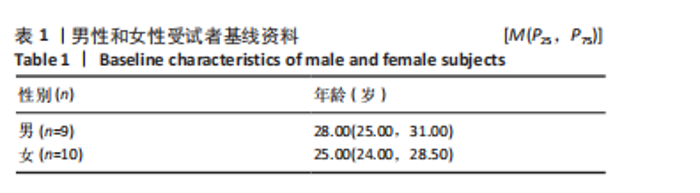
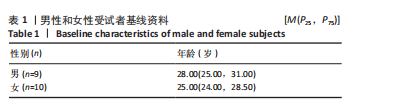
2.1 参与者数量分析及基线资料 试验过程共纳入20名受试者,男、女各10名,因低头角度不足脱落1名男性,其余进入结果分析,基线资料见表1。"
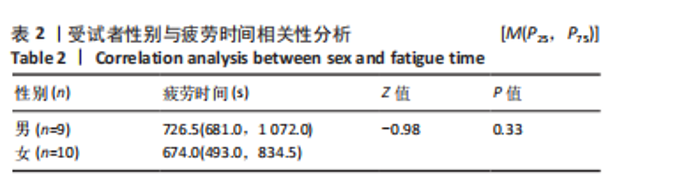
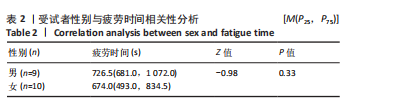
2.2 性别与疲劳时间相关性分析 男性和女性受试者达到疲劳的时间差异无显著性意义(P > 0.05),说明性别与疲劳时间无相关性,见表2。"
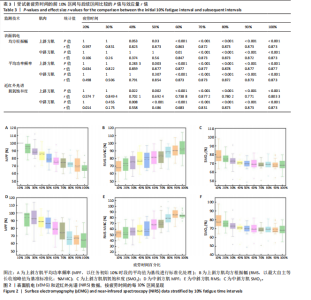
2.3 表面肌电和近红外光谱弗里德曼检验-邦弗罗尼校正结果 所有肌肉的均方根振幅随时间均表现出显著增加(P < 0.001),以力竭时间的前10%阶段为基线对比:上斜方肌自50%阶段起显著增加;中斜方肌自60%阶段起显著增加;类似地,所有肌肉的平均功率频率随时间均显著下降(P < 0.001),以力竭时间的前10%阶段为基线对比:上斜方肌自50%阶段起显著下降;中斜方肌在60%阶段显著下降。在近红外光谱方面,所有肌肉的肌氧饱和度随时间均显著下降(P < 0.001),以力竭时间的前10%阶段为基线对比:上斜方肌自40%阶段起显著下降;中斜方肌在40%阶段显著下降,见表3,图2。 2.4 表面肌电与近红外光谱线性回归分析结果 线性回归分析表明,在不同肌肉中平均功率频率对肌氧饱和度的预测能力显著优于均方根振幅:上斜方肌中平均功率频率(R2=0.58,15/19次"
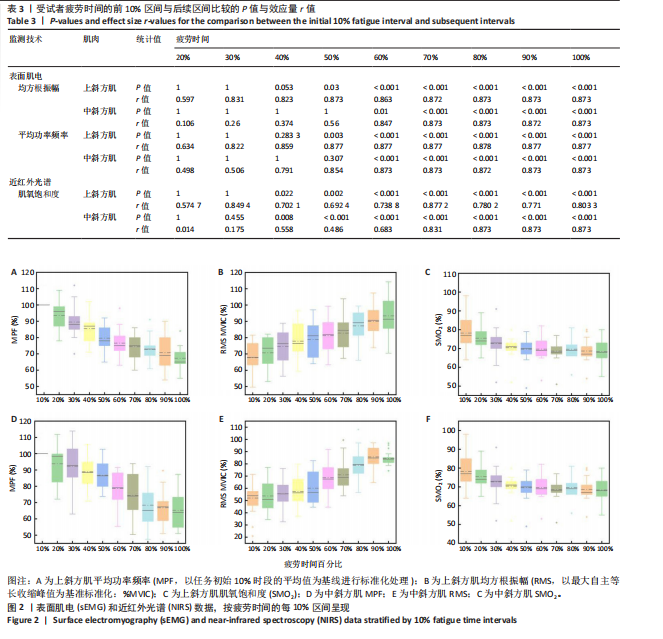
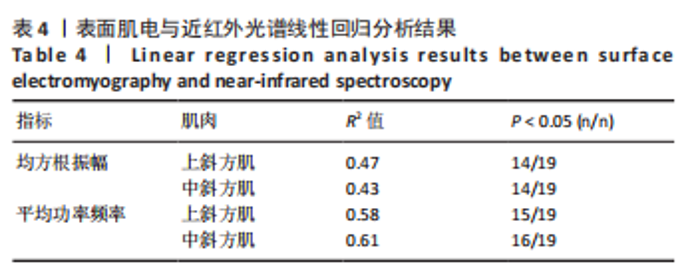
显著)的方差解释度高于均方根振幅(R2=0.47,14/19次显著);中斜方肌中平均功率频率(R2=0.61,16/19次显著)与均方根振幅(R2=0.43,14/19次显著)的差异趋势一致,进一步支持平均功率频率对肌肉氧代谢动态的敏感性和解释力更高,见表4。"

2.5 不良事件 所有受试者在整个试验过程中,均未发生头晕、跌倒等不良事件。"

| [1] 路广琦,庄明辉,常晓娟,等.在读医学硕博研究生颈椎失稳的相关表现及其生活习惯分析[J].颈腰痛杂志,2023,44(3):316-319. [2] 李靖,路广琦,庄明辉,等.基于机器学习构建中青年人群颈椎失稳临床预测模型[J].中国组织工程研究,2025,29(33):7203-7210. [3] 赵锦铎.揿针配合颈部肌群等长抗阻训练治疗青少年颈型颈椎病的临床研究[D].银川:宁夏医科大学,2024. [4] ERNST MJ, SAX N, MEICHTRY A, et al. Cervical musculoskeletal impairments and pressure pain sensitivity in office workers with headache. Musculoskelet Sci Pract. 2023;66:102816. [5] ZHANG W, CHEN Z. Functional Brain Changes in Younger Population of Cervical Spondylosis Patients with Chronic Neck Pain. J Pain Res. 2024;17: 4433-4445. [6] SCANO A, GUANZIROLI E, BRAMBILLA C, et al. A narrative review on multi-domain instrumental approaches to evaluate neuromotor function in rehabilitation. Healthcare (Basel). 2023;11(16):2282. [7] MING D, WANG X, XU R, et al. sEMG feature analysis on forearm muscle fatigue during isometric contractions. Trans Tianjin Univ. 2014;20(2): 139-143. [8] SIMAR C, COLOT M, CEBOLLA AM, et al. Machine learning for hand pose classification from phasic and tonic EMG signals during bimanual activities in virtual reality. Front Neurosci. 2024;18:1329411. [9] GERZ E, GERASKIN D, FRANKE J, et al.Tissue oxygenation during exercise measured with NIRS: reproducibility and influence of wavelengths[C]//Oxygen Transport to Tissue XXXV. Springer New York. 2013:171-177. [10] 毕学翠,郑晓鸿,张英平.近红外光谱技术监控不同水平运动员递增负荷肌群肌氧变化特征[J].科学技术与工程,2024,24(35):14947-14957. [11] FENG M, LIANG L, SUN W, et al. Measurements of cervical range of motion using an optical motion capture system: Repeatability and validity. Exp Ther Med. 2019;18(6):4193-4202. [12] PAREDES-ACUNA N, UTPADEL-FISCHLER D, DING K, et al. Upper limb intention tremor assessment: opportunities and challenges in wearable technology. J Neuroeng Rehabil. 2024;21(1):8. [13] GUNNAR B. The Borg CR Scales® Folder. Methods for measuring intensity of experience. Borg Perception. 2010:4. [14] LI F, WU Y, SONG Z, et al. Characteristics of surface electromyogram signals after Pemberton pelvic osteotomy combined with femoral osteotomy in children with unilateral developmental dysplasia of the hip. Medicine (Baltimore). 2022;101(28):e29794. [15] ZHONG S, JIA N, QU Y, et al. Analysis and study on biomarkers of local muscle fatigue caused by repetitive lifting task. BMC Musculoskelet Disord. 2024;25(1):660. [16] CRUZ-MONTECINOS C, BUSTAMANTE A, CANDIA-GONZÁLEZ M, et al. Perceived physical exertion is a good indicator of neuromuscular fatigue for the core muscles. J Electromyogr Kinesiol. 2019;49:102360. [17] PAUTZ N, OLIVIER B, STEYN F. The use of parametric effect sizes in single study musculoskeletal physiotherapy research: A practical primer. Phys Ther Sport. 2018;32:87-97. [18] LI G, LIU D, YANG D, et al. The Impact of Different Muscle Relaxation Techniques on the Upper Trapezius and Its Relationship with the Middle Trapezius. J Physiol Invest. 2024;67(4):225-232. [19] FU Y, MA S, MA B, et al. Innovative diagnostic framework for shoulder instability: a narrative review on machine learning-enhanced scapular dyskinesis assessment in sports injuries. Eur J Med Res. 2025;30(1):257. [20] MIŠIĆ NŽ, OSTOJIĆ M, CVETKOVIĆ S, et al. Wavelet analysis of respiratory muscle sEMG signals during the physiological breakpoint of static dry end-expiratory breath-holding in Naive apneists: A pilot study. Sensors (Basel). 2023;23(16):7200. [21] GARCIA-RETORTILLO S, IVANOV PC. Inter-muscular networks of synchronous muscle fiber activation. Front Netw Physiol. 2022;2:1059793. [22] DE MEULEMEESTER K, CALDERS P, VAN DORPE J, et al. Morphological differences in the upper trapezius muscle between female office workers with and without trapezius myalgia: Facts or fiction?: A cross-sectional study. Am J Phys Med Rehabil. 2019;98(2):117-124. [23] GILMORE CA, KAPURAL L, MCGEE MJ, et al. Percutaneous peripheral nerve stimulation for chronic low back pain: prospective case series with 1 year of sustained relief following short‐term implant. Pain Pract. 2020;20(3): 310-320. [24] HUANG S, CAI S, LI G, et al. sEMG-based detection of compensation caused by fatigue during rehabilitation therapy: a pilot study. IEEE Access. 2019;7: 127055-127065. [25] GOULDING RP, MARWOOD S. Interaction of factors determining critical power. Sports Med. 2023;53(3):595-613. [26] MENEZES TCF, LEE MH, FONSECA BALLADARES DC, et al. Skeletal muscle pathology in pulmonary arterial hypertension and its contribution to exercise intolerance. J Am Heart Assoc. 2025;14(4):e036952. [27] DE GASPERI R, MO C, AZULAI D, et al. Numb is required for optimal contraction of skeletal muscle. J Cachexia Sarcopenia Muscle. 2022;13(1): 454-466. [28] 徐明伟,金龙哲,于露,等.长时间颈部前屈对颈部肌肉疲劳的影响[J].工程科学学报,2019,41(11):1493-1500. [29] MORENO AJ, UTRILLA G, MARIN J, et al. Cervical spine assessment using passive and active mobilization recorded through an optical motion capture.J Chiropr Med. 2018;17(3):167-181. [30] NIMBARTE AD, ZREIQAT MM, CHOWDHURY SK. Cervical flexion–relaxation response to neck muscle fatigue in males and females. J Electromyogr Kinesiol. 2014;24(6):965-971. [31] GUO W, FANG Y, SHENG X, et al. Measuring motor unit discharge, myofiber vibration, and haemodynamics for enhanced myoelectric gesture recognition. IEEE Trans Instrum Meas. 2023;72:1-10. [32] COMBALIA A, SÁNCHEZ-VIVES MV, DONEGAN T. Immersive virtual reality in orthopaedics—a narrative review. Int Orthop. 2024;48(1):21-30. [33] LONG M, WU G, TAO F, et al. Nanofibrous textured silk aerogel with 3D channel arrays and adjustable mechanical properties for bone tissue regeneration. Int J Biol Macromol. 2024;278:134372. [34] KOPYL S, SURMENEV R, SURMENEVA M, et al. Magnetoelectric effect: principles and applications in biology and medicine–a review. Mater Today Bio. 2021;12:100149. [35] DIAO H, XIN H, JIN Z. Prediction of in vivo lower cervical spinal loading using musculoskeletal multi-body dynamics model during the head flexion/extension, lateral bending and axial rotation. Proc Inst Mech Eng H. 2018; 232(11):1071-1082. |
| [1] | Guo Zhen, Li Shurui, Zheng Weiwei, Li Ruofei, Li Qingwen. Functional near-infrared spectroscopy analysis of prefrontal cortex hemodynamics during dual tasks under cognitive loads [J]. Chinese Journal of Tissue Engineering Research, 2026, 30(25): 6584-6591. |
| [2] | Shao Yunbo, Guo Jiayi, Li Feng. Characteristics of lower limb muscle motor activation in patients with unilateral knee osteoarthritis [J]. Chinese Journal of Tissue Engineering Research, 2026, 30(24): 6174-6181. |
| [3] | Wang Lejun, Chi Wenxin, Song Xiaoqian, Li Qian, Qiao Minjie, Tao Haifeng. Performance of unstable barbell bench press and changes in electromyographic activity after transcranial direct current stimulation [J]. Chinese Journal of Tissue Engineering Research, 2026, 30(23): 6099-6109. |
| [4] | Chen Yuanyue, Shen Junfan, Yu Cui, Lu Jianxia, Hu Wenxuan, Zhu Jun, Guo Chuan. Knowledge structure and evolutionary trends in the application of surface electromyography in musculoskeletal pain rehabilitation [J]. Chinese Journal of Tissue Engineering Research, 2026, 30(18): 4791-4801. |
| [5] | Gao Yuan, Xiong Zheyu, Zheng Wei, Chen Haonan, Chen Fangyuqing. Lower extremity biomechanical characterization during step-down test in patients with patellofemoral pain [J]. Chinese Journal of Tissue Engineering Research, 2025, 29(32): 6913-6919. |
| [6] | Li Yongjie, Liu Mengling, Zhang Dakuan, Fu Shenyu, Liu Hongju. Effect of unilateral knee osteoarthritis on gait dynamics and muscle activation asymmetry in elderly women [J]. Chinese Journal of Tissue Engineering Research, 2025, 29(27): 5750-5756. |
| [7] | Cao Haijie, Song Huijie, Sun Yalu, Zhang Guangyou, Li Xiang. A wearable exoskeleton with posture feedback improves abnormal gait in patients with stroke [J]. Chinese Journal of Tissue Engineering Research, 2025, 29(24): 5127-5133. |
| [8] | Zhai Yifan, Li Hongxia, Tian Shuicheng, Cheng Qiwei, Zhen Xinyue. Visual analysis of functional near-infrared spectroscopy research [J]. Chinese Journal of Tissue Engineering Research, 2025, 29(22): 4832-4840. |
| [9] | Dong Youqing, Wei Zixuan, Wu Haiou, Chen Ruixiong, Duan Peng, Chen Nan, Lin Xikai. Biomechanical characteristics of lower limbs in female patients with different types of patellofemoral pain syndrome [J]. Chinese Journal of Tissue Engineering Research, 2025, 29(21): 4458-4468. |
| [10] | Li Zhenzhen, Zhen Qiaoxia, Chen Keke, Fang Boyan. Effects of different forms of shaker exercises on hyoid muscles activation in healthy adults [J]. Chinese Journal of Tissue Engineering Research, 2025, 29(18): 3791-3797. |
| [11] | Dong Zhiwen, Yu Cong, Chen Yan, Ding Jianjun . Central nervous mechanisms underlying effects of cognitive impairment on dual-task stance: #br# functional near-infrared spectroscopy analysis [J]. Chinese Journal of Tissue Engineering Research, 2025, 29(17): 3579-3587. |
| [12] | Dong Hongming, Li Jianping, Liu Chao, Zhang Honghao, Li Guqiang. Relationship between muscle activation characterization and fall risk in older adults during walking up and down stairs [J]. Chinese Journal of Tissue Engineering Research, 2024, 28(34): 5419-5424. |
| [13] | Li Zhenzhen, Zhou Zhipeng. Effects of dry swallowing and swallowing tasks of varying consistencies and volumes on the hyoid muscles in healthy adults [J]. Chinese Journal of Tissue Engineering Research, 2024, 28(20): 3117-3122. |
| [14] | Peng Xinke, Jia Feiyang, Liu Jing, Liu Hongya, Zhou Guijuan, Liu Danni, Yu Jing, Zhou Jun. Functional brain imaging using near-infrared spectroscopy during the repetitive saliva swallowing test in healthy adults [J]. Chinese Journal of Tissue Engineering Research, 2023, 27(32): 5103-5109. |
| [15] | An Yishuai, Zhang Junxia, Li Hui, Zhang Yuxiao, Xu Guoliang, Gao Kun, Yu Shuhan, Liu Zelong. Synergistic characteristics of lower extremity muscles with unilateral knee flexion limitation [J]. Chinese Journal of Tissue Engineering Research, 2023, 27(29): 4704-4711. |
| Viewed | ||||||
|
Full text |
|
|||||
|
Abstract |
|
|||||