Chinese Journal of Tissue Engineering Research ›› 2026, Vol. 30 ›› Issue (25): 6584-6591.doi: 10.12307/2026.478
Previous Articles Next Articles
Functional near-infrared spectroscopy analysis of prefrontal cortex hemodynamics during dual tasks under cognitive loads
Guo Zhen1, Li Shurui2, Zheng Weiwei1, Li Ruofei2, Li Qingwen1
- 1Tianjin Key Laboratory of Sports-Health Integration and Health Promotion, Tianjin University of Sport, Tianjin 301617, China; 2School of Human Movement Science, Beijing Sport University, Beijing 100091, China
-
Received:2025-10-15Revised:2026-03-09Online:2026-09-08Published:2026-04-22 -
Contact:Li Qingwen, PhD, Professor, Tianjin Key Laboratory of Sports-Health Integration and Health Promotion, Tianjin University of Sport, Tianjin 301617, China -
About author:Guo Zhen, PhD candidate, Senior experimentalist, Tianjin Key Laboratory of Sports-Health Integration and Health Promotion, Tianjin University of Sport, Tianjin 301617, China -
Supported by:National Key Research and Development Program of China, No. 2020YFC2006704 (to GZ [project participant])

CLC Number:
Cite this article
Guo Zhen, Li Shurui, Zheng Weiwei, Li Ruofei, Li Qingwen. Functional near-infrared spectroscopy analysis of prefrontal cortex hemodynamics during dual tasks under cognitive loads[J]. Chinese Journal of Tissue Engineering Research, 2026, 30(25): 6584-6591.
share this article
Add to citation manager EndNote|Reference Manager|ProCite|BibTeX|RefWorks
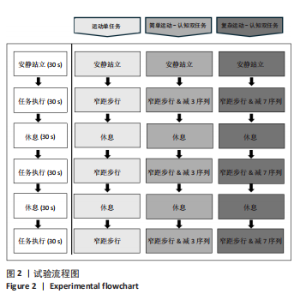
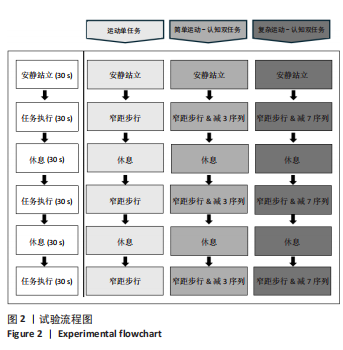
2.1 参与者数量分析 共纳入30名非体育专业大学生受试者,试验过程无脱落,全部进入结果分析。 2.2 试验流程图 见图2。"
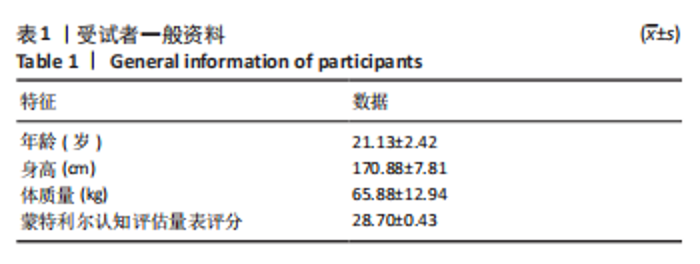
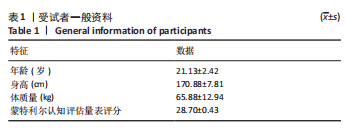
2.3 受试者一般资料 见表1。"
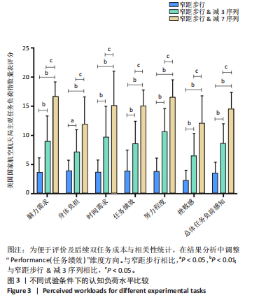
2.4 不同试验任务认知负荷结果 2.4.1 认知任务负荷指数 如图3结果所示。相较于窄距步行运动单任务,窄距步行&减3序列、窄距步行&减7序列的运"
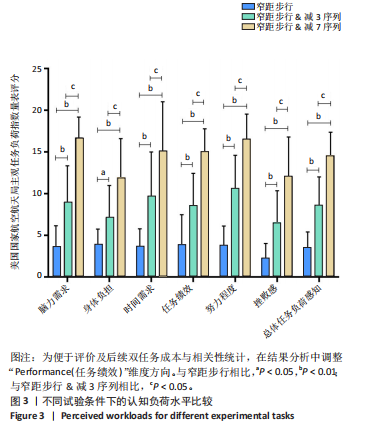
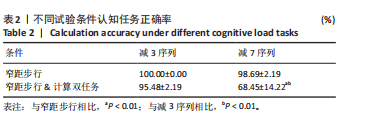
动-认知双任务在脑力需求、身体负担、时间需求、任务绩效、努力程度、挫败感及总体任务负荷感知工作量上有统计学差异 (P < 0.05-0.01);与窄距步行&减3序列比较,窄距步行&减7序列在各任务负荷子维度及总体任务负荷感知工作量上均显著提高(P < 0.01)。 2.4.2 认知任务正确率 窄距步行&计算双任务条件下,减3序列与减7序列正确率分别为(95.48±2.19)%、(68.45±14.22)%,窄距步行&减7序列双任务正确率明显低于其他任务条件(P < 0.01)。详见表2。"
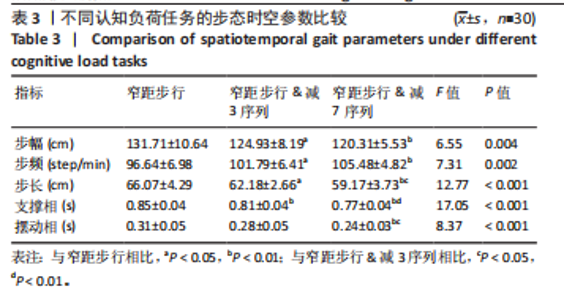
2.5 不同认知负荷任务行为学结果 窄距步行单任务、窄距步行&减3序列双任务及窄距步行&减7序列双任务,3组间在步态时空参数上存在显著性差异。事后检验显示,与窄距步行单任务相比,窄距步行&减3序列与窄距步行&减7序列双任务时,在步幅(P < 0.05,P < 0.01)、步长(P < 0.05,P < 0.01)、支撑相(P < 0.01,P < 0.01)、摆动相(P=0.12,P < 0.01)方面均显示出降低趋势,步频显著升高(P < 0.05,P < 0.01);窄距步行&减7序列与窄距步行&减3序列间相比,在步长(P < 0.05)、支撑相(P < 0.01)、摆动相(P < 0.05)方面进一步降低。详见表3。"
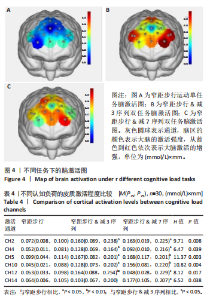
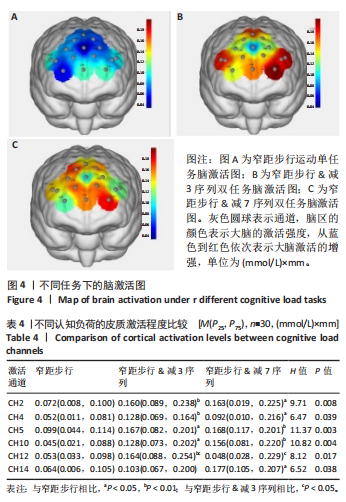
2.6 不同认知负荷皮质激活程度对比 功能性近红外光谱区块分析结果见图4,相较于窄距步行运动单任务,窄距步行&减3序列双任务及窄距步行&减7序列双任务中前额叶皮质激活强度增加具有显著性,主要集中在背外侧前额叶皮质与额极区。两个运动-认知双任务试验条件间比较,位于背外侧前额叶皮质的通道CH12激活水平窄距步行&减3序列高于窄距步行&减7序列(P < 0.05),其他通道未见显著性差异。详见表4。"
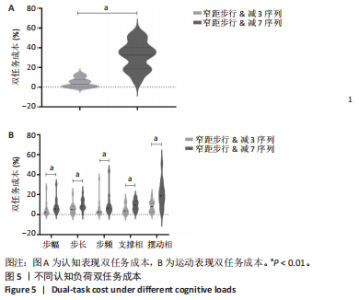
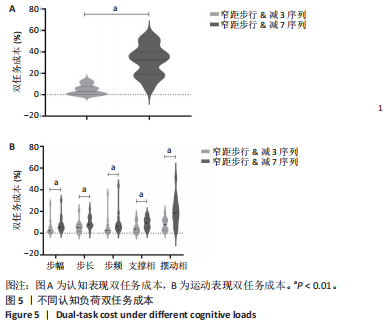
2.7 不同认知负荷双任务成本 运动认知双任务中的认知成本使用正确率进行计算,两种双任务试验中的认知双任务成本,减7序列条件高于减3序列条件,差异有显著性意义(P < 0.01),见图5A。运动双任务成本使用步时空参数进行计算,两种双任务试验中的运动双任务成本,减7序列条件高于减3序列条件,差异有显著性意义(P < 0.01),见图5B。"
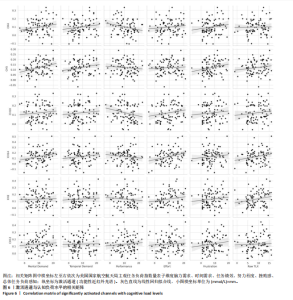
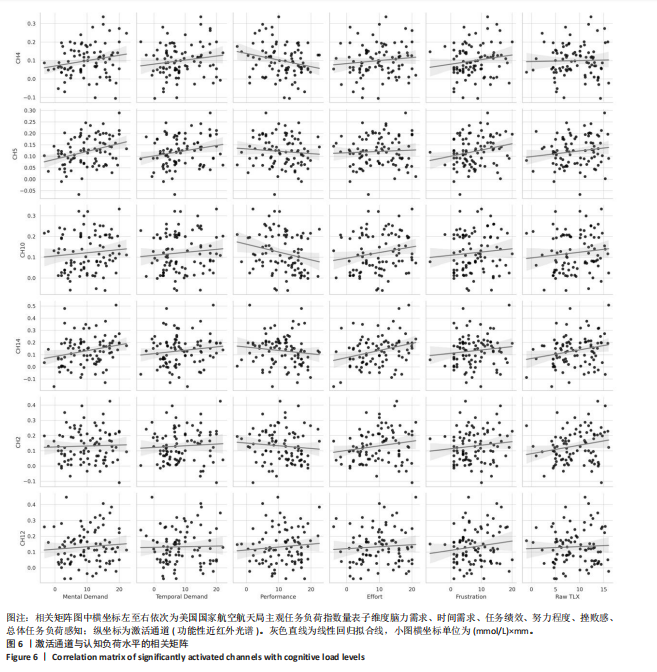
2.8 显著激活通道与认知负荷水平相关性分析 相关性分析结果显示,大脑显著激活的通道与美国国家航空航天局主观任务负荷指数量表中的脑力需求、时间需求、努力程度、挫败感及总体任务负荷感知呈正相关趋势,与任务绩效呈负相关趋势。具体而言,通道CH5与脑力需求(r=0.50,P < 0.01)、任务绩效(r= -0.46,P < 0.01)、努力程度(r=0.47,P < 0.01)及总体任务负荷感知(r=0.42,P < 0.01)均呈中等相关;通道CH10与任务绩效(r=-0.44,P < 0.01)呈中等相关;通道CH14与努力程度(r=0.42,P < 0.01)呈中等相关。见图6。 2.9 不良事件 所有受试者在全部试验过程中均未发生运动损伤等不良事件。"
| [1] STROBACH T. Cognitive control and meta-control in dual-task coordination. Psychon Bull Rev. 2024;31(4):1445-1460. [2] WANG J, WANG W, REN S, et al. Neural correlates of single-task versus cognitive-motor dual-task training. IEEE Trans Cogn Dev Syst. 2021;14(2): 532-540. [3] ERCAN YILDIZ S, FIDAN O, GULSEN C, et al. Effect of dual-task training on balance in older adults: A systematic review and meta-analysis. Arch Gerontol Geriatr. 2024;121:105368. [4] GOH HT, PEARCE M, VAS A. Task matters: an investigation on the effect of different secondary tasks on dual-task gait in older adults. BMC Geriatr. 2021;21(1):510. [5] FENG QM, CHEN JW. Effects of exercise combined with cognitive dual-task training on cognitive function and sustained effects in stroke patients: a systematic review and meta-analysis. Disabil Rehabil. 2025;47(14):3538-3547. [6] 向丽莎, 张一. 认知-运动双任务训练在脑卒中患者康复中的研究进展[J]. 医学研究与教育,2024,41(3):8-17. [7] TAO W, CHEN J, PENG J, et al. Comparing the effectiveness of dual-task and single-task training on walking function in stroke recovery: A systematic review and meta-analysis. Medicine (Baltimore). 2025;104(10):e41776. [8] COLE K, WORTHY D, FLYNN E, et al. Cognitive and Motor Effects of an 8-Week Dual-Task Intervention: Prioritization Matters. Arch Phys Med Rehabil. 2020;101(11):e89. [9] WANG Q, DAI W, XU S, et al. Brain activation of the PFC during dual-task walking in stroke patients: A systematic review and meta-analysis of functional near-infrared spectroscopy studies. Front Neurosci. 2023;17: 1111274. [10] HERMAND E, TAPIE B, DUPUY O, et al. Prefrontal Cortex Activation During Dual Task With Increasing Cognitive Load in Subacute Stroke Patients: A Pilot Study. Front Aging Neurosci. 2019;11:160. [11] RAHMAN TT, POLSKAIA N, ST-AMANT G, et al. An fNIRS Investigation of Discrete and Continuous Cognitive Demands During Dual-Task Walking in Young Adults. Front Hum Neurosci. 2021;15:711054. [12] 许国才, 周勉, 王疆娜, 等. 轻度认知障碍老年人在认知-平衡双任务范式下的前额叶皮质激活特征:一项fNIRS研究[J]. 医用生物力学, 2024,39(S1):137. [13] 李沁议, 罗思仪, 蒋咏春, 等. 双任务范式在中枢神经疾病中的应用及研究[J]. 康复学报,2022,32(5):462-470. [14] 潘津津, 焦学军, 姜劲, 等. 利用功能性近红外光谱成像方法评估脑力负荷[J]. 光学学报,2014,34(11):344-349. [15] 范金, 曾露瑶, 钟冬灵, 等. 功能性近红外光谱技术的10年发展:CiteSpace知识图谱可视化分析[J]. 中国组织工程研究,2021,25(23): 3711-3717. [16] GATEAU T, AYAZ H, DEHAIS F. In silico vs. Over the Clouds: On-the-Fly Mental State Estimation of Aircraft Pilots, Using a Functional Near Infrared Spectroscopy Based Passive-BCI. Front Hum Neurosci. 2018;12:187. [17] 翟艺凡, 李红霞, 田水承, 等. 功能性近红外光谱技术研究的可视化分析 [J]. 中国组织工程研究,2025,29(22):4832-4840. [18] 桑林琼, 王莉, 乔梁, 等. 基于fNIRS的大脑前额叶皮层在不同脑力负荷下的激活模式研究 [J]. 陆军军医大学学报,2022,44(3):210-216. [19] MAZAHERI M, NEGAHBAN H, SOLTANI M, et al. Effects of narrow-base walking and dual tasking on gait spatiotemporal characteristics in anterior cruciate ligament-injured adults compared to healthy adults. Knee Surg Sports Traumatol Arthrosc. 2017;25(8):2528-2535. [20] KELLY VE, SCHRAGER MA, PRICE R, et al. Age-associated effects of a concurrent cognitive task on gait speed and stability during narrow-base walking. J Gerontol A Biol Sci Med Sci. 2008;63(12):1329-1334. [21] 赵文华, 李可基, 王玉英, 等. 中国人群身体活动指南(2021)[J]. 中国公共卫生,2022,38(2):129-130. [22] CHENG S, CONG L, HUI D, et al. Enhancement of prefrontal functional connectivity under the influence of concurrent physical load during mental tasks. Front Hum Neurosci. 2024;18:1500470. [23] 阿力木江·努拉克, 秦华, 赵宇, 等. 手术机器人辅助对骨科医生脑力负荷影响的多模态特征[J]. 科学技术与工程,2025,25(13):5369-5376. [24] FENG Y, MENG H, ZHAO Z, et al. Quantitative Analysis of Dual-Task Rehabilitation. medRxiv. 2025. [25] UDINA C, AVTZI S, DURDURAN T, et al. Functional Near-Infrared Spectroscopy to Study Cerebral Hemodynamics in Older Adults During Cognitive and Motor Tasks: A Review. Front Aging Neurosci. 2019;11:367. [26] ROSS D, WAGSHUL ME, IZZETOGLU M, et al. Prefrontal cortex activation during dual-task walking in older adults is moderated by thickness of several cortical regions. Geroscience. 2021;43(4):1959-1974. [27] FRIEDMAN N P, ROBBINS TW. The role of prefrontal cortex in cognitive control and executive function. Neuropsychopharmacology. 2022;47(1):72-89. [28] MIRELMAN A, MAIDAN I, BERNAD-ELAZARI H, et al. Increased frontal brain activation during walking while dual tasking: an fNIRS study in healthy young adults. J Neuroeng Rehabil. 2014;11:85. [29] 胡芳芳, 张文, 赵明生, 等. 运动强度和任务难度对定向运动员识图决策的影响:来自f NIRS的证据[J]. 首都体育学院学报,2025,37(1):105-115. [30] BAEK CY, KIM HD, YOO DY, et al. Change in activity patterns in the prefrontal cortex in different phases during the dual-task walking in older adults. J Neuroeng Rehabil. 2023;20(1):86. [31] ROSSO AL, CENCIARINI M, SPARTO PJ, et al. Neuroimaging of an attention demanding dual-task during dynamic postural control. Gait Posture. 2017; 57:193-198. [32] LEONE C, FEYS P, MOUMDJIAN L, et al. Cognitive-motor dual-task interference: A systematic review of neural correlates. Neurosci Biobehav Rev. 2017;75:348-360. [33] JUNG J, LAMBON RALPH MA, JACKSON RL. Subregions of DLPFC Display Graded yet Distinct Structural and Functional Connectivity. J Neurosci, 2022; 42(15):3241-3252. [34] PATELAKI E, FOXE JJ, MCFERREN AL, et al. Maintaining Task Performance Levels Under Cognitive Load While Walking Requires Widespread Reallocation of Neural Resources. Neuroscience. 2023;532:113-132. [35] PADULO J, RAMPICHINI S, BORRELLI M, et al. Gait Variability at Different Walking Speeds. J Funct Morphol Kinesiol. 2023;8(4):158. [36] GEORGANTAS A, STEFANI P, LYROS E, et al. Examining Performance between Different Cognitive-Motor Dual-Task Tests in Community-Dwelling Older Adults. Appl Sci. 2024;14(17):7957. [37] TROMBINI-SOUZA F, DE MOURA VTG, DA SILVA LWN, et al. Effects of two different dual-task training protocols on gait, balance, and cognitive function in community-dwelling older adults: a 24-week randomized controlled trial. PeerJ. 2023;11:e15030. [38] GORECKA MM, VASYLENKO O, RODRÍGUEZ-ARANDA C. Dichotic listening while walking: A dual-task paradigm examining gait asymmetries in healthy older and younger adults. J Clin Exp Neuropsychol. 2020;42(8): 794-810. [39] ATAKANOVA A, LAURENTIUS T, BOLLHEIMER C, et al. Does listening to audiobooks affect gait behavior? BMC Sports Sci Med Rehabil. 2023;15(1): 159. [40] PIKE A, MCGUCKIAN TB, STEENBERGEN B, et al. How Reliable and Valid are Dual-Task Cost Metrics? A Meta-analysis of Locomotor-Cognitive Dual-Task Paradigms. Arch Phys Med Rehabil. 2023;104(2):302-314. [41] YUE Q, NEWTON AT, MAROIS R. Ultrafast fMRI reveals serial queuing of information processing during multitasking in the human brain. Nat Commun. 2025;16(1):3057. [42] OU ZT, DING Q, YAO ST, et al. Functional near-infrared spectroscopy evidence of cognitive-motor interference in different dual tasks. Eur J Neurosci. 2024;59(11):3045-3060. [43] XU G, ZHOU M, CHEN Y, et al. Brain activation during standing balance control in dual-task paradigm and its correlation among older adults with mild cognitive impairment: a fNIRS study. BMC Geriatr. 2024;24(1):144. [44] ST GEORGE RJ, JAYAKODY O, HEALEY R, et al. Cognitive inhibition tasks interfere with dual-task walking and increase prefrontal cortical activity more than working memory tasks in young and older adults. Gait Posture. 2022;95:186-191. [45] VARELA-VÁSQUEZ LA, MINOBES-MOLINA E, JEREZ-ROIG J. Dual-task exercises in older adults: A structured review of current literature. J Frailty Sarcopenia Falls. 2020;5(2):31-37. [46] 张雪, 蔡燕, 王聪, 等. 认知-运动双任务训练在预防老年人跌倒中的研究进展[J]. 中华护理杂志,2025,60(3):297-302. [47] 张璐, 马江平, 杨二丽, 等. 认知-运动双重任务训练应用于脑卒中的文献计量分析 [J]. 中国康复理论与实践,2024,30(9):1034-1042. [48] 刘鑫玥, 霍洪峰. 不同类型和负荷双任务对健康人动态姿势控制的影响[J]. 医用生物力学,2023,38(4):791-796+843. [49] KELES HO, CENGIZ C, DEMIRAL I, et al. High density optical neuroimaging predicts surgeons’s subjective experience and skill levels. PLoS One. 2021; 16(2):e0247117. [50] CAUSSE M, CHUA Z, PEYSAKHOVICH V, et al. Mental workload and neural efficiency quantified in the prefrontal cortex using fNIRS. Sci Rep. 2017;7(1): 5222. [51] LI W, LI R, XIE X, et al. Evaluating mental workload during multitasking in simulated flight. Brain Behav. 2022;12(4):e2489. |
| [1] | Liang Tianqi, Zhang Xiaoquan. Control strategies during gait termination in older adults under cognitive-motor dual-task conditions [J]. Chinese Journal of Tissue Engineering Research, 2026, 30(17): 4390-4399. |
| [2] | Cao Haijie, Song Huijie, Sun Yalu, Zhang Guangyou, Li Xiang. A wearable exoskeleton with posture feedback improves abnormal gait in patients with stroke [J]. Chinese Journal of Tissue Engineering Research, 2025, 29(24): 5127-5133. |
| [3] | Zhai Yifan, Li Hongxia, Tian Shuicheng, Cheng Qiwei, Zhen Xinyue. Visual analysis of functional near-infrared spectroscopy research [J]. Chinese Journal of Tissue Engineering Research, 2025, 29(22): 4832-4840. |
| [4] | Dong Zhiwen, Yu Cong, Chen Yan, Ding Jianjun . Central nervous mechanisms underlying effects of cognitive impairment on dual-task stance: #br# functional near-infrared spectroscopy analysis [J]. Chinese Journal of Tissue Engineering Research, 2025, 29(17): 3579-3587. |
| [5] | Yang Yulin, Chang Wanpeng, Ding Jiangtao, Xu Hongli, Wu Xiao, Xiao Boheng, Ma Lihong. Transcranial direct current stimulation at different targets for Parkinson’s disease: a network Meta-analysis [J]. Chinese Journal of Tissue Engineering Research, 2024, 28(11): 1797-1804. |
| [6] | Liu Xinyue, Xing Xinyang, Huo Hongfeng. Differences in human dynamic stability during walking under different cognitive loads [J]. Chinese Journal of Tissue Engineering Research, 2023, 27(9): 1335-1339. |
| [7] | Peng Xinke, Jia Feiyang, Liu Jing, Liu Hongya, Zhou Guijuan, Liu Danni, Yu Jing, Zhou Jun. Functional brain imaging using near-infrared spectroscopy during the repetitive saliva swallowing test in healthy adults [J]. Chinese Journal of Tissue Engineering Research, 2023, 27(32): 5103-5109. |
| [8] | Fan Jin, Zeng Luyao, Zhong Dongling, Li Yuxi, Tian Yanping, Huang Yijie, Jin Rongjiang. Development of functional near-infrared spectroscopy in recent 10 years: a visual analysis using CiteSpace [J]. Chinese Journal of Tissue Engineering Research, 2021, 25(23): 3711-3717. |
| [9] | Wang Liqun, Li Yuxi, Jin Rongjiang, Wang Wenchun, Pang Richao, Zhang Anren. Application of functional near-infrared spectroscopy in the study of depression [J]. Chinese Journal of Tissue Engineering Research, 2021, 25(11): 1799-1804. |
| [10] | Liu Jian-zhe, Quan Wen-xiang, Lv Bin, Xie Yi, Dong Wen-tian. Discriminant analysis of multi-channel near-infrared spectroscopy signal data in the prefrontal lobe [J]. Chinese Journal of Tissue Engineering Research, 2014, 18(20): 3190-3195. |
| Viewed | ||||||
|
Full text |
|
|||||
|
Abstract |
|
|||||