Chinese Journal of Tissue Engineering Research ›› 2026, Vol. 30 ›› Issue (25): 6496-6505.doi: 10.12307/2026.279
Previous Articles Next Articles
Magnetic calcium-regulated mitochondrial sensitivity in adolescents: assessment of skeletal muscle function and body composition
Li Zhongshan1, 2, Li Wenhao1, Du Xinran1, Yang Tieli3, Bai Shi4, 5
- 1Department of Physical Education, Northeastern University, Shenyang 110819, Liaoning Province, China; 2School of Physical Education and Sport Science, Fujian Normal University, Fuzhou 350117, Fujian Province, China; 3School of Physical Education and
-
Received:2025-10-11Revised:2025-12-01Online:2026-09-08Published:2026-04-21 -
Contact:Yang Tieli, School of Physical Education and Sport Science, Dali University, Dali 671003, Yunnan Province, China Co-corresponding author: Bai Shi, School of Information Science and Engineering, Shenyang University of Technology, Shenyang 111003, Liaoning Province, China; Liaoning Provincial Magnetic Medicine Detection and Treatment Professional Technology Innovation Center, Shenyang 110034, Liaoning Province, China -
About author:Sport Science, Dali University, Dali 671003, Yunnan Province, China; 4School of Information Science and Engineering, Shenyang University of Technology, Shenyang 111003, Liaoning Province, China; 5Liaoning Provincial Magnetic Medicine Detection and Treatment Professional Technology Innovation Center, Shenyang 110034, Liaoning Province, China Li Zhongshan, PhD, Associate professor, Department of Physical Education, Northeastern University, Shenyang 110819, Liaoning Province, China; School of Physical Education and Sport Science, Fujian Normal University, Fuzhou 350117, Fujian Province, China -
Supported by:Liaoning Provincial Science and Technology Joint Program (Technology Breakthrough Program), No. 173165312852 (to LZS); Liaoning Provincial International Cooperation Project, No. 2023JH2/10700004 (to BS); National Natural Science Foundation of China, No. 62471320 (to BS); Xingliao Talent Program, No. XLYC2203046 (to BS)

CLC Number:
Cite this article
Li Zhongshan, Li Wenhao, Du Xinran, Yang Tieli, Bai Shi. Magnetic calcium-regulated mitochondrial sensitivity in adolescents: assessment of skeletal muscle function and body composition[J]. Chinese Journal of Tissue Engineering Research, 2026, 30(25): 6496-6505.
share this article
Add to citation manager EndNote|Reference Manager|ProCite|BibTeX|RefWorks
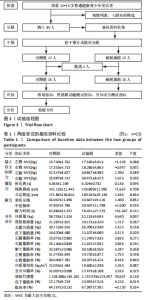
2.1 参与者数量分析 试验过程共有4人因病因事脱组,两组各2人,最终共有30人纳入试验数据分析,每组15人。 2.2 试验流程图 具体的试验流程,见图3。 2.3 基线资料比较 两组受试的最大自主收缩力、爆发力、耐力以及身体成分相关指标无显著性差异(P > 0.05),说明两组受试不同指标基线值水平一致,组间具有可比性,可很好地进行试验方案对比,见表1。 2.4 骨骼肌功能数据指标分析 2.4.1 对照组骨骼肌功能数据指标分析 采集对照组试验前测与后测数据各分类指标,观察发现最大自主收缩力指标中,"
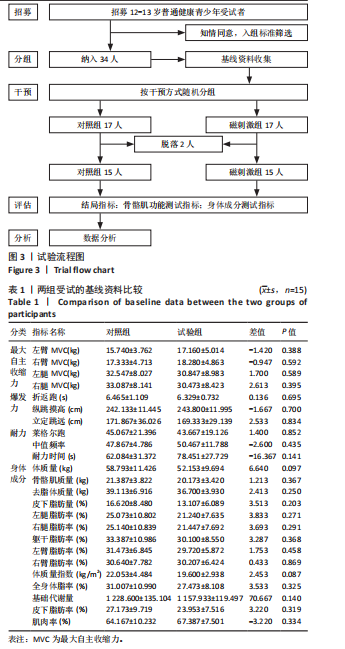
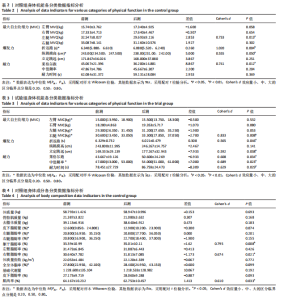
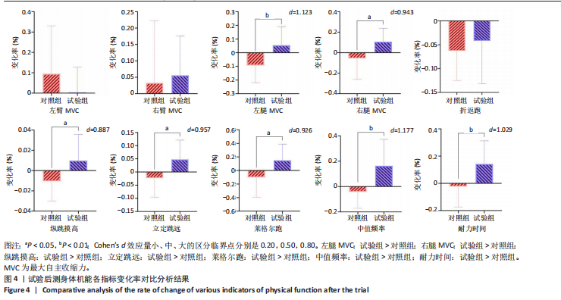
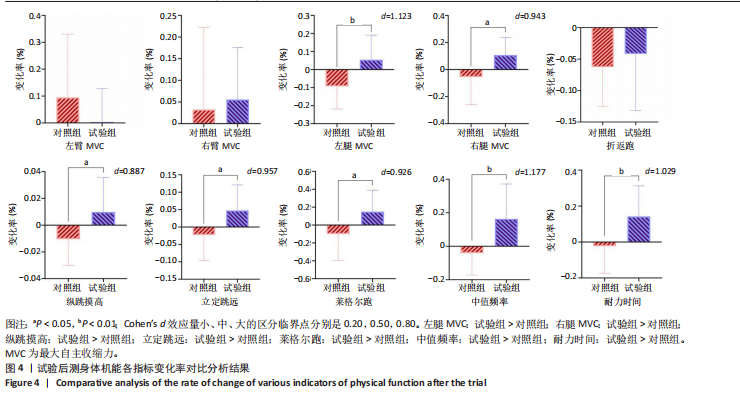
左腿最大自主收缩力(P=0.013,d=0.733)、折返跑(P=0.004,d=1.020)试验后测数据相比试验前测呈现显著性增长,左臂最大自主收缩力、右臂最大自主收缩力以及右腿最大自主收缩力试验后测与试验前测数据无显著性差异。爆发力指标中,纵跳摸高(P=0.050,d=0.555)试验后测数据相比试验前测数据呈现显著性增长,立定跳远试验后测与前测数据无显著性差异。耐力指标中,莱格尔跑(P=0.012,d=0.741)试验后测数据相比前测数据出现显著性增长,中值频率与耐力时间试验后测与前测数据无显著性差异,见表2。 2.4.2 试验组骨骼肌功能各分类数据指标分析 采集试验组试验前测与后测数据各分类指标,观察发现右腿最大自主收缩力(P=0.008,d=0.833)试验后测数据相比前测数据出现显著性增长,左臂最大自主收缩力、右臂最大自主收缩力、左腿最大自主收缩力试验后测与试验前测数据均无显著性差异。爆发力指标中,折返跑(P=0.046,d=0.565)与立定跳远(P=0.038,d=0.592)试验后测数据相比试验前测数据呈现显著性增长,纵跳摸高试验后测与前测数据无显著性差异。耐力指标中,莱格尔跑(P=0.034,d=0.608),中值频率(P=0.023,d=0.689),耐力时间(P=0.0291,d=0.629)试验后测数据相比前测数据出现显著性增长,见表3。 2.4.3 两组组间身体功能各指标提升率独立样本t检验分析结果 通过试验组与对照组大腿各肌群变化率对比发现,试验组的左腿MVC(P=0.005,d=1.123)、右腿MVC(P=0.015,d=0.943)、纵跳摸高(P=0.022,d=0.887)、立定跳远(P=0.014,d=0.957)、莱格尔跑(P=0.017,d=0.923)、中值频率(P=0.003,d=1.177)、耐力时间(P=0.022,d=1.029)提升率显著高于对照组,见图4。 2.5 身体成分各分类评估数据指标分析 2.5.1 对照组数据指标分析 采集对照组试验前测与后测数据各分类指标观察发现,在各分类数据指标中,右臂脂肪率(P=0.021,d=0.674)与躯干脂肪率(P=0.008,d=0.795)试验后测数据相比试验前测数据呈现显著性增长,肌肉率(P=0.033,d=0.610)试验后测数据相比试验前测数据呈现显著性降低,体质量、骨骼肌质量、去脂体质量、皮下脂肪量、左腿脂肪率、右腿脂肪率、左臂脂肪率、体质量指数、脂肪率、基础代谢量、皮下脂肪率试验后测与前测数据无显著性差异,见表4。"
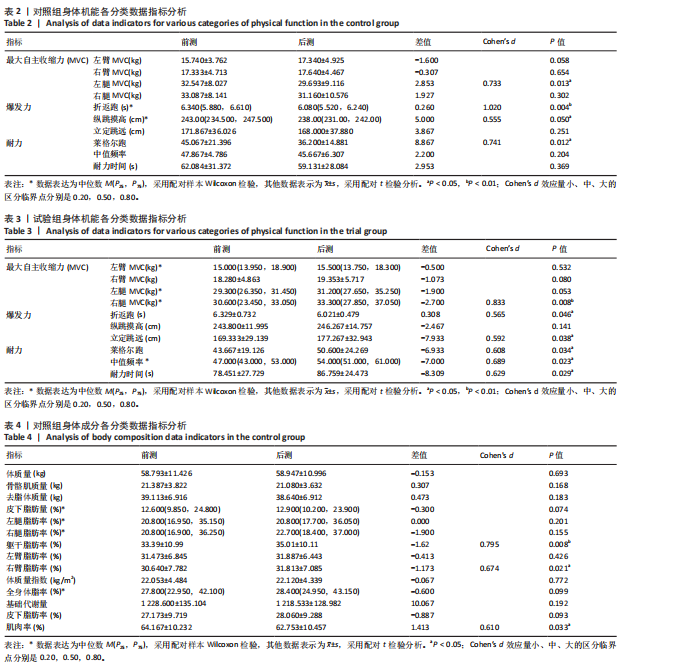
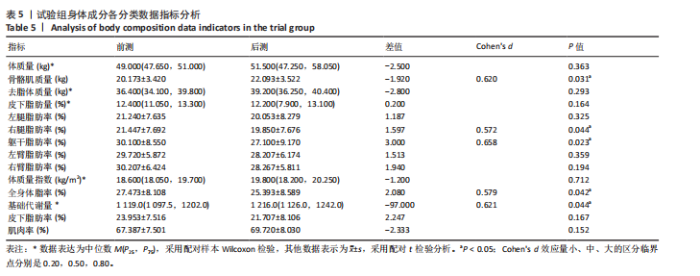
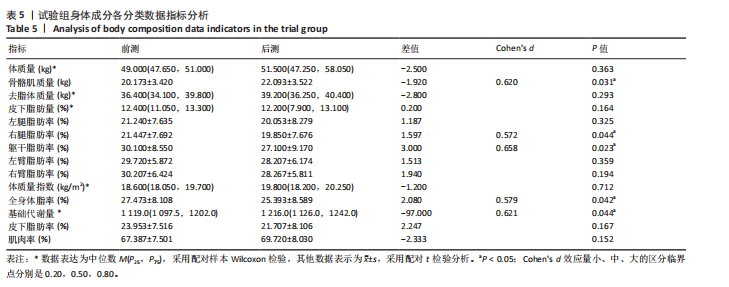
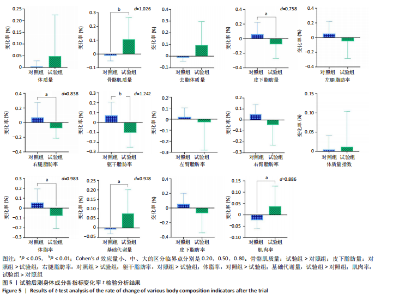
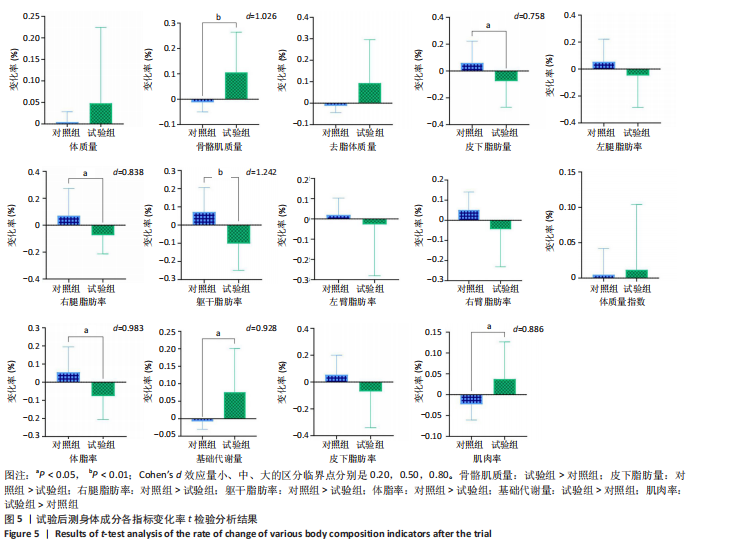
2.5.2 试验组数据指标分析 采集试验组试验前测与后测数据各分类指标观察发现,在各分类数据指标中,骨骼肌质量(P=0.031,d=0.620)和基础代谢量(P=0.044,d=0.621)试验后测数据相比试验前测数据呈现显著性增长,右腿脂肪率(P=0.044,d=0.572)、躯干脂肪率(P=0.023,d=0.658)、全身体脂率(P=0.042,d=0.579)试验后测数据相比试验前测数据呈现显著性降低,体质量、去脂体质量、皮下脂肪量、左腿脂肪率、左臂脂肪率、右臂脂肪率、体质量指数、皮下脂肪率、肌肉率试验后测与前测数据无显著性差异,见表5。 2.5.3 两组组间身体成分各指标提升率独立样本t检验分析结果 通过试验组与对照组身体成分各指标变化率对比发现,试验组的骨骼肌质量(P=0.013,d=1.026)、皮下脂肪量(P=0.047,d=0.758)、右腿脂肪率(P=0.029,d=0.838)、躯干脂肪率(P=0.002,d=1.242)、体脂率(P=0.012,d=0.983)、基础代谢量(P=0.023,d=0.928)、肌肉率(P=0.022,d=0.886)提升率显著高于对照组,见图5。 2.6 不良事件分析 该研究过程要求受试前测与后测之前按照测试要求做好充分热身,并在测试全程提供专人监督保护,确保接受测试的受试不会受到运动损伤,进行磁场刺激的试验组被试在4周的磁刺激全程均无不良反应。"
"
"
| [1] CHENG X, GUO Q, JU L, et al. Association between sedentary behavior, screen time and metabolic syndrome among Chinese children and adolescents. BMC Public Health. 2024;24(1):1715. [2] HU SS, Writing Committee of the Report on Cardiovascular Health and Diseases in China. Influencing Factors on Cardiovascular Health in China. J Geriatr Cardiol. 20248;21(1):4-33. [3] 彭惠媛,李佳川,汤庆华.青少年学生体育锻炼坚持性现状调查与分析[J].体育科技文献通报,2020,28(1):37-40. [4] YAP JLY, TAI YK, FRÖHLICH J, et al. Ambient and supplemental magnetic fields promote myogenesis via a TRPC1-mitochondrial axis: evidence of a magnetic mitohormetic mechanism. FASEB J. 2019;33(11):12853-12872. [5] FRANCO-OBREGÓN A. Harmonizing Magnetic Mitohormetic Regenerative Strategies: Developmental Implications of a Calcium-Mitochondrial Axis Invoked by Magnetic Field Exposure. Bioengineering (Basel). 2023;10(10):1176. [6] 厉中山,白石,王春露,等. 低频脉冲磁场诱导TRPC1技术对力量素质影响及训练应用展望[C].2022年全国第七届“中国体能训练科学大会”,2022: 1642-1648. [7] 厉中山,王春露,刘洁,等. 短期低频脉冲磁场诱导经典瞬时感受器电位通道1对肱二头肌最大自主收缩力与力量耐力的影响[J]. 中国组织工程研究 2023,27(11):1796–1804. [8] STEPHENSON MC, KRISHNA L, PANNIR SELVAN RM, et al. Magnetic field therapy enhances muscle mitochondrial bioenergetics and attenuates systemic ceramide levels following ACL reconstruction: Southeast Asian randomized-controlled pilot trial. J Orthop Translat. 2022;35:99-112. [9] KIVILUOTO S, DECUYPERE JP, DE SMEDT H, et al. STIM1 as a key regulator for Ca2+ homeostasis in skeletal-muscle development and function. Skelet Muscle. 2011;1(1):16. [10] SABOURIN J, COGNARD C, CONSTANTIN B. Regulation by Scaffolding Proteins of Canonical Transient Receptor Potential Channels in Striated Muscle. J Muscle Res Cell Motil. 2009;30(7–8):289-297. [11] ZHANG BT, YEUNG SS, CHEUNG KK, et al. Adaptive Responses of Trpc1 and Trpc3 during Skeletal Muscle Atrophy and Regrowth. Muscle Nerve. 2014;49(5):691-699. [12] GIROLAMI B, SERANO M, DI FONSO A, et al. Searching for Mechanisms Underlying the Assembly of Calcium Entry Units: The Role of Temperature and pH. Int J Mol Sci. 2023;24(6):5328. [13] 张星杰,周家颖.青少年身体素质发展“敏感期”特性与训练干预“溢出效应”机理研究[J].西安体育学院学报,2024,41(2):169-175. [14] THYAGARAJAN B, FOSTER MT. Beiging of white adipose tissue as a therapeutic strategy for weight loss in humans. Horm Mol Biol Clin Investig. 2017;31(2):/j/hmbci.2017.31.issue-2/hmbci-2017-0016/hmbci-2017-0016.xml. [15] 魏佳,李博,冯连世,等.血流限制训练的方法学因素及潜在安全性问题[J].中国体育科技,2019,55(3):3-12. [16] RAMSEY KA, ROJER AGM, D’ANDREA L, et al. The Association of Objectively Measured Physical Activity and Sedentary Behavior with Skeletal Muscle Strength and Muscle Power in Older Adults: A Systematic Review and Meta-Analysis. Ageing Res Rev. 2021;67:101266. [17] PARK JH, MOON JH, KIM HJ, et al. Sedentary Lifestyle: Overview of Updated Evidence of Potential Health Risks. Korean J Fam Med. 2020;41(6):365-373. [18] MEAR E, GLADWELL VF, PETHICK J. The Effect of Breaking up Sedentary Time with Calisthenics on Neuromuscular Function: A Preliminary Study. Int J Environ Res Public Health. 2022;19(21):14597. [19] 厉中山,白石,刘洁,等.短期低频脉冲磁场诱导经典瞬时感受器电位通道1对局部肌肉肌力提升后的保持与衰减变化轨迹[J].中国组织工程研究, 2023,27(23):3721-3727. [20] FREY N, FRANK D,LIPPL S, et al. Calsarcin-2 Deficiency Increases Exercise Capacity in Mice through Calcineurin/NFAT Activation. J Clin Invest. 2008;118(11): 3598-3608. [21] ZHANG BT, YEUNG SS, CHEUNG KK, et al. Adaptive Responses of TRPC1 and TRPC3 during Skeletal Muscle Atrophy and Regrowth. Muscle Nerve. 2014;49(5): 691-699. [22] 周加仙.敏感期的神经可塑性机制研究[J].华东师范大学学报(教育科学版), 2010,28(3):50-53+67. [23] MIRZOEV TM. Mechanotransduction for Muscle Protein Synthesis via Mechanically Activated Ion Channels. Life (Basel Switz). 2023;13(2):341. [24] 李伟,厉中山,白石.TRPC1钙离子通道在骨骼肌收缩功能中的作用及磁诱导激活效应在训练中的应用探索方向[J].体育科技文献通报,2023,31(2): 257-261. [25] XIA L, CHEUNG KK, YEUNG SS, et al. The Involvement of Transient Receptor Potential Canonical Type 1 in Skeletal Muscle Regrowth after Unloading-Induced Atrophy. J Physiol. 2016;594(11):3111-3126. [26] ZANOU N, SCHAKMAN O, LOUIS P, et al. Trpc1 ion channel modulates phosphatidylinositol 3-kinase/Akt pathway during myoblast differentiation and muscle regeneration. J Biol Chem. 2012;287(18):14524-14534. [27] FRANCO-OBREGÓN A, TAI YK, WU KY, et al. The Developmental Implications of Muscle-Targeted Magnetic Mitohormesis: A Human Health and Longevity Perspective. Bioengineering (Basel). 2023;10(8):956. [28] FRAYSSE B, DESAPHY JF, PIERNO S, et al. Decrease in resting calcium and calcium entry associated with slow-to-fast transition in unloaded rat soleus muscle. FASEB J. 2003;17(13):1916-1918. [29] ZANOU N, SHAPOVALOV G, LOUIS M, et al. Role of TRPC1 channel in skeletal muscle function. Am J Physiol Cell Physiol. 2010;298(1):C149-C162. [30] MORALES S, DIEZ A, PUYET A, et al. Calcium controls smooth muscle TRPC gene transcription via the CaMK/calcineurin-dependent pathways. Am J Physiol Cell Physiol. 2007;292(1):C553-C563. [31] LIN J, WU H, TARR P, et al. Transcriptional Co-Activator PGC-1 Alpha Drives the Formation of Slow-Twitch Muscle Fibres. Nature. 2002;418(6899):797-801. [32] LOUZADA RA, BOUVIERE J, MATTA LP, et al. Redox Signaling in Widespread Health Benefits of Exercise. Antioxid Redox Signal. 2020. doi: 10.1089/ars.2019.7949. [33] TAI YK, NG C, PURNAMAWATI K, et al. Magnetic fields modulate metabolism and gut microbiome in correlation with Pgc-1α expression: Follow-up to an in vitro magnetic mitohormetic study. FASEB J. 2020;34(8):11143-11167. [34] CALVO JA, DANIELS TG, WANG X, et al. Muscle-specific expression of PPARgamma coactivator-1alpha improves exercise performance and increases peak oxygen uptake. J Appl Physiol (1985). 2008;104(5):1304-1312. [35] EKMARK M, GRØNEVIK E, SCHJERLING P, et al. Myogenin induces higher oxidative capacity in pre-existing mouse muscle fibres after somatic DNA transfer. J Physiol. 2003;548(Pt 1):259-269. [36] VAN WESSEL T, DE HAAN A, VAN DER LAARSE WJ, et al. The muscle fiber type-fiber size paradox: hypertrophy or oxidative metabolism? Eur J Appl Physiol. 2010;110(4):665-694. [37] HUGHES DC, ELLEFSEN S, BAAR K. Adaptations to Endurance and Strength Training. Cold Spring Harb Perspect Med. 2018;8(6):a029769. [38] BERTERO E, POPOIU TA, MAACK C. Mitochondrial Calcium in Cardiac Ischemia/Reperfusion Injury and Cardioprotection. Basic Res. Cardiol. 2024;119(4):569,585. [39] 杨景慧,王海霞,耿喜臣,等. 基本空战动作“检查6点钟”姿势腰背训练方案的表面肌电图特征研究[J]. 航天医学与医学工程,2020,33(3):196-202. [40] WAGATSUMA A, SAKUMA K. Mitochondria as a potential regulator of myogenesis. ScientificWorldJournal. 2013;2013:593267. [41] 宋淑华,熊开宇.离子浓度改变对骨骼肌膜电位和骨骼肌疲劳的研究进展[J].北京体育大学学报,2009,32(1):84-87. [42] 厉中山,包义君,刘洁,等.低频脉冲磁场诱导TRPC1改善COVID-19患者康复期下肢的肌肉无力症状[J].中国组织工程研究,2024,28(16):2605-2612. [43] 洪金涛,王晶晶,李岩松,等.久坐与社区老年人下肢肌力:跌倒恐惧与年龄的中介和调节作用[J].中国组织工程研究,2025,29(17):3566-3571. [44] 苍穹.老年人下棋莫久坐[J].家庭科技,2016(10):25. [45] 黄秋玉.不同强度功率自行车运动对久坐大学生心肺耐力、下肢力量和心理健康的影响[D].北京: 首都体育学院,2023. [46] WONG CJK, TAI YK, YAP JLY, et al. Brief exposure to directionally-specific pulsed electromagnetic fields stimulates extracellular vesicle release and is antagonized by streptomycin: A potential regenerative medicine and food industry paradigm. Biomaterials. 2022;287:121658. [47] WANG FS, WU RW, CHEN YS, et al. Biophysical Modulation of the Mitochondrial Metabolism and Redox in Bone Homeostasis and Osteoporosis: How Biophysics Converts into Bioenergetics. Antioxidants (Basel). 2021;10(9):1394. [48] LAWLER JM, RODRIGUEZ DA, HORD JM. Mitochondria in the middle: exercise preconditioning protection of striated muscle. J Physiol. 2016;594(18):5161-5183. [49] HÉNIQUE C, MANSOURI A, VAVROVA E, et al. Increasing mitochondrial muscle fatty acid oxidation induces skeletal muscle remodeling toward an oxidative phenotype. FASEB J. 2015;29(6):2473-2483. [50] SUPRUNIUK E, MIKŁOSZ A, CHABOWSKI A. The Implication of PGC-1α on Fatty Acid Transport across Plasma and Mitochondrial Membranes in the Insulin Sensitive Tissues. Front Physiol. 2017;8:923. [51] PEDERSEN BK, FEBBRAIO MA. Muscles, exercise and obesity: skeletal muscle as a secretory organ. Nat Rev Endocrinol. 2012;8(8):457-465.. [52] GONZALEZ-GIL AM, ELIZONDO-MONTEMAYOR L. The Role of Exercise in the Interplay between Myokines, Hepatokines, Osteokines, Adipokines, and Modulation of Inflammation for Energy Substrate Redistribution and Fat Mass Loss: A Review. Nutrients. 2020;12(6):1899. [53] LIU S, CUI F, NING K, et al. Role of irisin in physiology and pathology. Front Endocrinol (Lausanne). 2022;13:962968. [54] MULYA A, KIRWAN JP. Brown and Beige Adipose Tissue: Therapy for Obesity and Its Comorbidities? Endocrinol Metab Clin North Am. 2016;45(3):605-621. [55] GÓRNICKA M, HAMULKA J, WADOLOWSKA L, et al. Activity-Inactivity Patterns, Screen Time, and Physical Activity: The Association with Overweight, Central Obesity and Muscle Strength in Polish Teenagers. Report from the ABC of Healthy Eating Study. Int J Environ Res Public Health. 2020;17(21):7842. [56] KRAUSE MP, MILNE KJ, HAWKE TJ. Adiponectin-Consideration for its Role in Skeletal Muscle Health. Int J Mol Sci. 2019;20(7):1528. [57] WALOWSKI CO, HERPICH C, ENDERLE J, et al. Determinants of bone mass in older adults with normal- and overweight derived from the crosstalk with muscle and adipose tissue. Sci Rep. 2023;13(1):5030. [58] PARATE D, KADIR ND, CELIK C, et al. Pulsed electromagnetic fields potentiate the paracrine function of mesenchymal stem cells for cartilage regeneration. Stem Cell Res Ther. 2020;11(1):46. |
| [1] | Cao Xinyan, Yu Zifu, Leng Xiaoxuan, Gao Shiai, Chen Jinhui, Liu Xihua. Effect of repetitive transcranial magnetic stimulation and transcranial direct current stimulation on motor function and gait in children with cerebral palsy: a network meta-analysis [J]. Chinese Journal of Tissue Engineering Research, 2026, 30(6): 1539-1548. |
| [2] | Zhou Jian, Zhang Tao, Zhou Weili, Zhao Xingcheng, Wang Jun, Shen Jie, Qian Li, Lu Ming. Effects of resistance training on quadriceps mass and knee joint function in patients with osteoporosis and sarcopenia [J]. Chinese Journal of Tissue Engineering Research, 2026, 30(5): 1081-1088. |
| [3] | Leng Xiaoxuan, Zhao Yuxin, Liu Xihua. Effects of different neuromodulatory stimulation modalities on non-motor symptoms in Parkinson’s patients: a network meta-analysis [J]. Chinese Journal of Tissue Engineering Research, 2026, 30(5): 1282-1293. |
| [4] | Yang Zeyu, Zhi Liang, Wang Jia, Zhang Jingyi, Zhang Qingfang, Wang Yulong, Long Jianjun. A visualized analysis of research hotspots in high-frequency repetitive transcranial magnetic stimulation from the macroscopic perspective [J]. Chinese Journal of Tissue Engineering Research, 2026, 30(5): 1320-1330. |
| [5] | Li Hanyue, Li Yini, Xiang Linmei, Li Sen. Effects of resistance exercise therapy on pain and function in patients with cervical spondylotic radiculopathy: a meta-analysis [J]. Chinese Journal of Tissue Engineering Research, 2026, 30(4): 987-996. |
| [6] | Sun Jiahe, Shi Jipeng, Zhu Tianrui, Quan Helong, Xu Hongqi. Effect of exercise intervention in elderly individuals with sarcopenia and its comorbidities: a meta-analysis [J]. Chinese Journal of Tissue Engineering Research, 2026, 30(4): 997-1007. |
| [7] | Wang Yifei, Zhao Jing, Gao Mingchen, Wu Xiaobin. Different doses of aquatic exercise for improving muscle strength in older adults: a meta-analysis [J]. Chinese Journal of Tissue Engineering Research, 2026, 30(34): 9067-9074. |
| [8] | Li Wenhao, Yang Xi, Du Xinran, Bai Shi, Li Zhongshan. Effect of magnetic field mitochondrial regulation technology combined with low-load blood flow restriction on the strength of lower limb muscle groups [J]. Chinese Journal of Tissue Engineering Research, 2026, 30(29): 7555-7564. |
| [9] | Chen Ziang, Li Qinlong, Wu Xue, Zhou Yue. Meta-analysis of blood flow restriction training to improve knee function and muscle strength in patients after anterior cruciate ligament reconstruction [J]. Chinese Journal of Tissue Engineering Research, 2026, 30(29): 7680-7687. |
| [10] | Fan Mengmeng, Ding Jiali, Wan Yujie, Huang Hailiang. A systematic review and network meta-analysis of neuromodulation techniques for promoting upper limb motor function after stroke [J]. Chinese Journal of Tissue Engineering Research, 2026, 30(28): 7494-7504. |
| [11] | Yang Zimeng, Zheng Hongrong, Yu Hao, Gao Peng, Sun Lezhong, Sheng Xiangmei. Correlation between lower limb biomechanics during single-leg landing and hip joint muscle strength in patients with anterior cruciate ligament reconstruction [J]. Chinese Journal of Tissue Engineering Research, 2026, 30(27): 7023-7029. |
| [12] | Liu Qiuli, Liang Yuanyao, Han Bin, Li Zhifei, Zhang Zhanming, Wei Haokai, Zuo Kuangshi, Liu Jun. Exploring the characteristics of neck muscle strength and activation in patients with cervical spondylotic radiculopathy using motion capture-Opensim digital simulation technology [J]. Chinese Journal of Tissue Engineering Research, 2026, 30(25): 6512-6521. |
| [13] | Fang Enhui, Guan Hui, Ma Lihong. Non-invasive brain stimulation for core symptoms in children with autism spectrum disorder: a network meta-analysis [J]. Chinese Journal of Tissue Engineering Research, 2026, 30(24): 6373-6381. |
| [14] | Fu Yingxue, Wang Xianbin, Chen Xingyu, Wu Shuang. Hind limb muscle atrophy in rats with spinal cord injury: effects of different rehabilitation therapy strategies [J]. Chinese Journal of Tissue Engineering Research, 2026, 30(17): 4357-4365. |
| [15] | Chen Jinhui, Yu Zifu, Gao Shiai, Cao Xinyan, Leng Xiaoxuan, Liu Xihua. Effects of central and peripheral rehabilitation therapies on upper extremity function and activities of daily living in stroke patients: a network meta-analysis [J]. Chinese Journal of Tissue Engineering Research, 2026, 30(17): 4457-4471. |
| Viewed | ||||||
|
Full text |
|
|||||
|
Abstract |
|
|||||