Chinese Journal of Tissue Engineering Research ›› 2026, Vol. 30 ›› Issue (27): 7061-7072.doi: 10.12307/2026.451
Previous Articles Next Articles
Biomechanical characteristics of cervical spine movement in cervical spondylotic myelopathy analyzed based on motion capture and Opensim simulation technology
Zuo Kuangshi1, Wei Haokai1, Liu Qiuli1, Li Zhifei1, Han Bin1, Liu Jun1, Zhang Zhanming1, Zhou Jinyan2
- 1Graduate School of Guangxi University of Chinese Medicine, Nanning 530000, Guangxi Zhuang Autonomous Region, China; 2First Affiliated Hospital of Guangxi University of Chinese Medicine, Nanning 530001, Guangxi Zhuang Autonomous Region, China
-
Received:2025-10-18Accepted:2026-01-28Online:2026-09-28Published:2026-05-14 -
Contact:Zhou Jinyan, MD, Associate chief physician, First Affiliated Hospital of Guangxi University of Chinese Medicine, Nanning 530001, Guangxi Zhuang Autonomous Region, China -
About author:Zuo Kuangshi, MS candidate, Graduate School of Guangxi University of Chinese Medicine, Nanning 530000, Guangxi Zhuang Autonomous Region, China

CLC Number:
Cite this article
Zuo Kuangshi, Wei Haokai, Liu Qiuli, Li Zhifei, Han Bin, Liu Jun, Zhang Zhanming, Zhou Jinyan. Biomechanical characteristics of cervical spine movement in cervical spondylotic myelopathy analyzed based on motion capture and Opensim simulation technology[J]. Chinese Journal of Tissue Engineering Research, 2026, 30(27): 7061-7072.
share this article
Add to citation manager EndNote|Reference Manager|ProCite|BibTeX|RefWorks
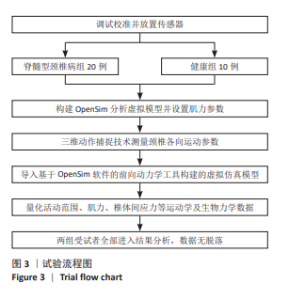
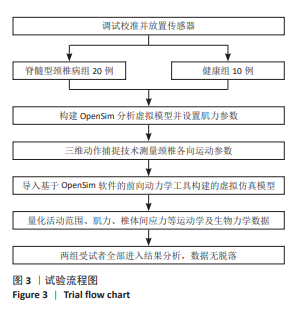
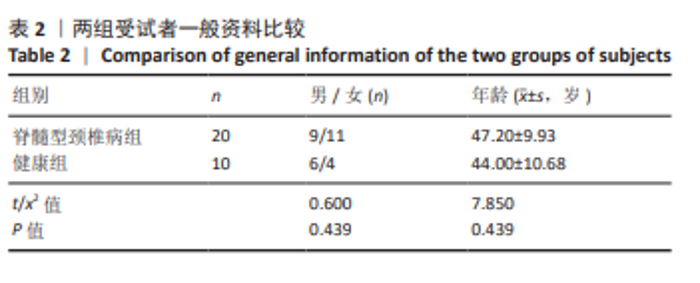
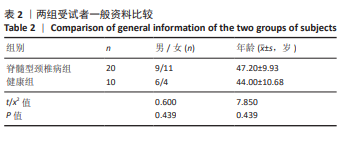
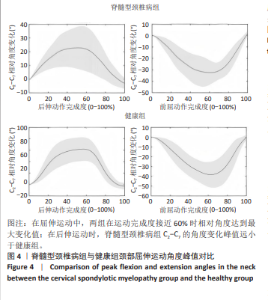
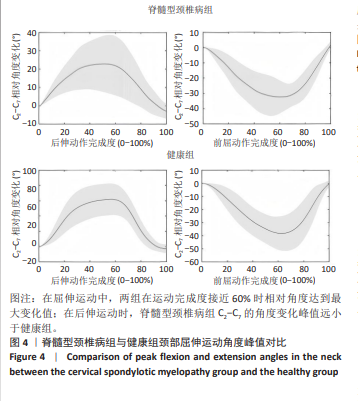
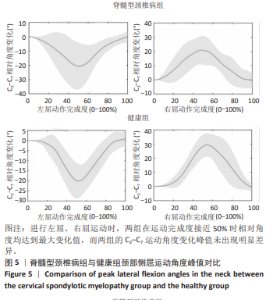
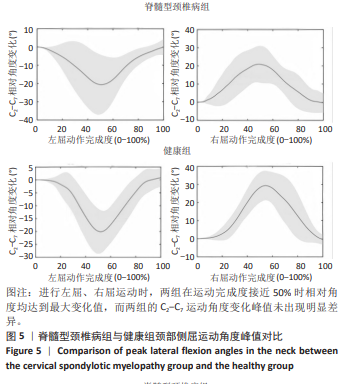
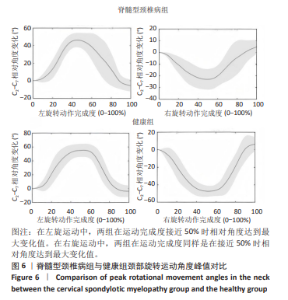
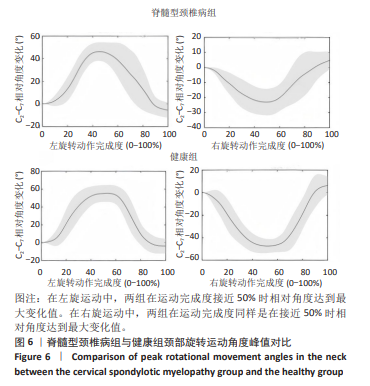
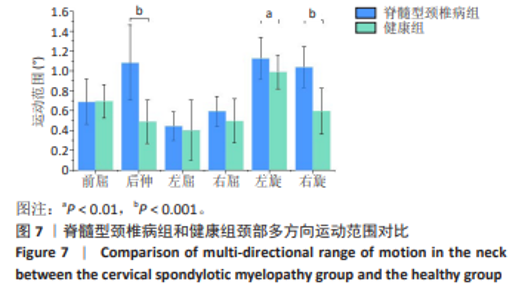
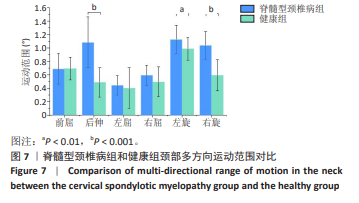
2.1 参与者数量分析 纳入20例脊髓型颈椎病患者设为脊髓型颈椎病组,10例健康个体设为健康组。所有受试者均完成了测试,数据无脱落。 2.2 试验流程图 见图3。 2.3 一般资料比较 两组受试者的性别、年龄相比均无统计学差异(P > 0.05),具有可比性,见表2。 2.4 两组运动学结果分析 如图4所示,在屈伸运动中,两组在运动完成度接近60%时相对角度达到最大变化值,试验表明,在后伸运动时,脊髓型颈椎病组C2-C7的角度变化峰值远小于健康组,而在前屈运动中两组则无统计学意义。 如图5所示,进行左屈、右屈运动时,两组在运动完成度接近50%时相对角度均达到最大变化值,而两组的C2-C7运动角度变化峰值未出现明显差异,无统计学意义。 如图6所示,在左旋运动中,两组在运动完成度接近50%时相对角度达到最大变化值,此时脊髓型颈椎病患者的平均角度变化最大值约为45°,健康组约为58°。在右旋运动中,两组在运动完成度同样是在接近50%时相对角度达到最大变化值,此时脊髓型颈椎病组的平均角度变化最大值约为-25°,健康组约为-50°。 综上,在左旋、右旋和后伸运动方向,脊髓型颈椎病组的运动角度变化峰值显著小于健康组,其颈部的运动控制精度不如健康组稳定,表明脊髓型颈椎病组在神经肌肉系统的调控失效,无法精准控制运动幅度,存在更大概率的异常运动模式。 如图7所示,脊髓型颈椎病组在后伸和旋转运动中的运动范围显著大于健康组,表明脊髓型颈椎病患者在这些方向运动时颈椎稳定性较差,可能是由于脊髓型颈椎病的病理变化导致功能障碍,影响颈部正常运动学特性。即便无需进行试验即能发现患者组和健康组的运动学差异,但此次试验仍通过量化患者组和健康人组运动角度峰值变化和运动范围差异,解释了脊髓型颈椎病患者的颈部运动实质是一种因神经负反馈出现肌肉控制力不足导致低控制精度下的极不稳定性运动,还能够对于出现轻度运动障碍的无症状患者进行预处理,延缓脊髓型颈椎病退变进程。"
"
"
"
"
"
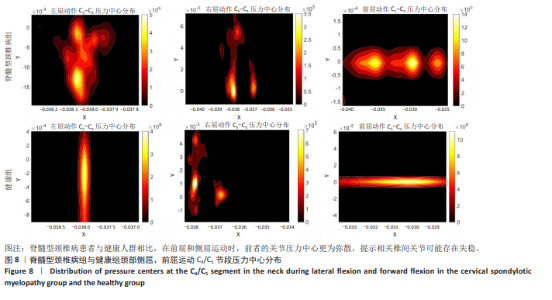
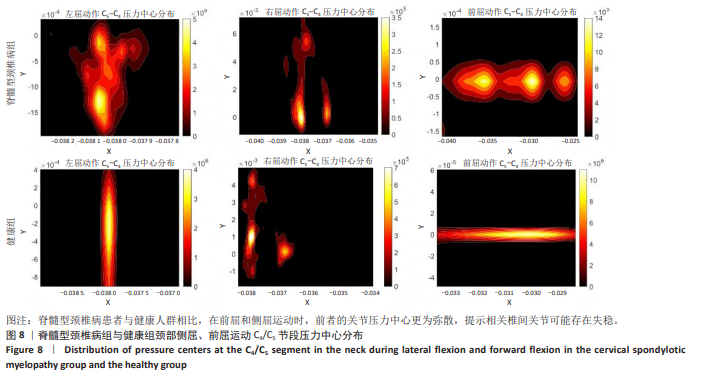
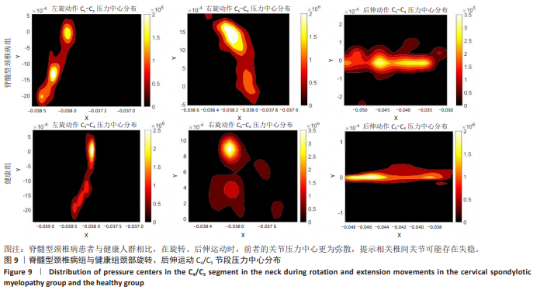
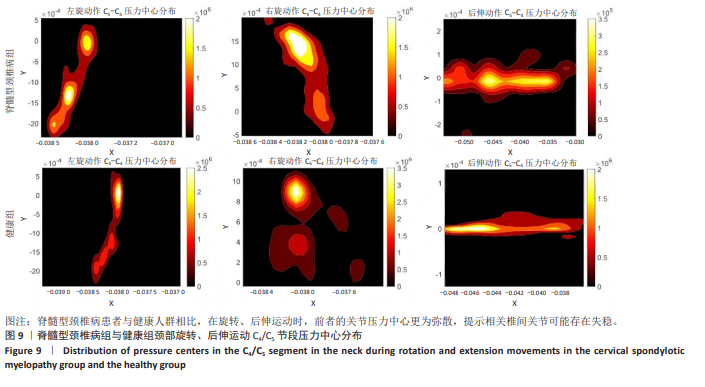
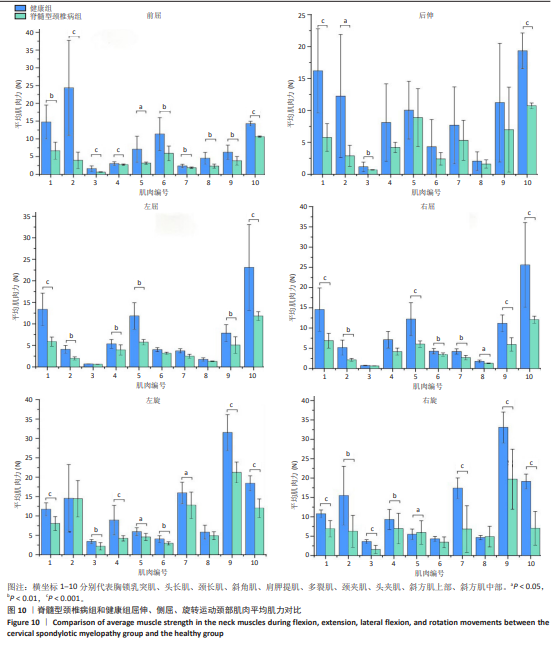
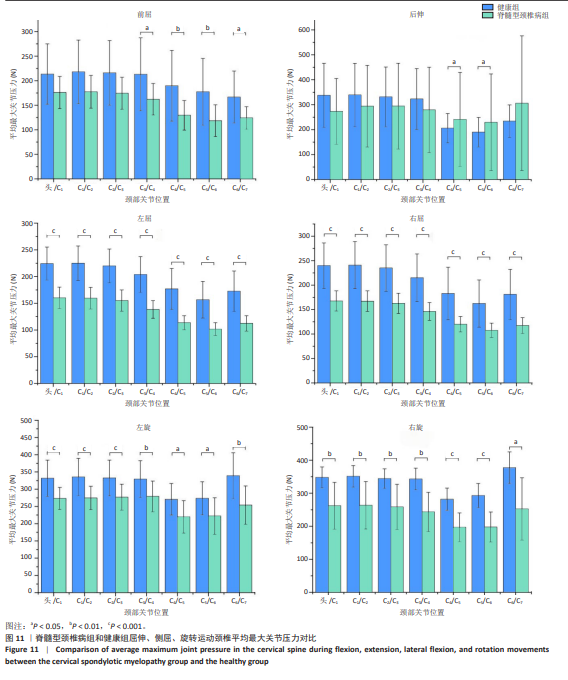
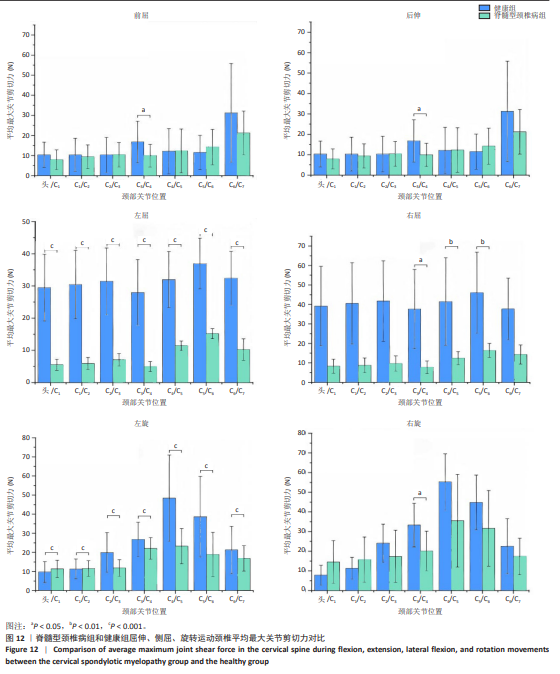
2.5 两组生物力学结果分析 2.5.1 两组颈部致压节段C4/C5的压力中心对比 图8,9分别展现了脊髓型颈椎病患者与健康人群在侧屈、前屈后伸运动和旋转时致压节段C4/C5的压力中心对比。脊髓型颈椎病患者与健康人群相比,在旋转、前屈后伸和侧屈运动时,前者的关节压力中心更为弥散,提示相关椎间关节可能存在失稳。 2.5.2 两组颈部运动各肌肉平均肌力对比 图10为脊髓型颈椎病患者和健康人前屈后伸、侧屈以及旋转运动各肌肉平均肌力对比。对于大部分肌肉,在前屈、后伸的运动模式下,脊髓型颈椎病患者的肌力要显著低于健康人群,尤其以胸锁乳突肌和头长肌为显著。侧屈运动以胸锁乳突肌和斜方肌上部出现明显的肌力减弱。旋转运动中则是斜方肌上部和中部为主。这一现象解释了脊髓型颈椎病患者在各角度运动时由于肌力不足的颈椎失稳机制。 2.5.3 两组颈部运动各颈椎平均最大关节压力对比 如图11所示,在前屈后伸的运动模式下,脊髓型颈椎病患者和健康人群的各颈椎平均最大关节压力对比,发现脊髓型颈椎病患者的前屈动作对C3-C7的压力要显著小于健康人群;而后伸时脊髓型颈椎病组对C4-C6的最大关节压力则显著大于健康人群,解释了脊髓型颈椎病患者在后伸运动时,该段椎体压力过载,超出椎间盘、终板及关节突关节的生理耐受范围,容易导致组织微损伤累积,加速退行性改变。 在侧屈及旋转运动时,对于关节稳定性的角度而言,较大的关节压力恰好说明了颈部椎间关节稳定性的提高,健康人群能够在相同的运动中产生较大的关节压力,椎间关节的对位更好,椎体间稳定性更强。而脊髓型颈椎病患者关节压力明显较小,在维持关节力方面可能存在对位的限制,相对稳定性也较弱。 2.5.4 两组颈部运动各颈椎平均最大关节剪切力对比 如图12所示,两组在屈伸角度运动的剪切力未见明显差异,侧屈运动中脊髓型颈椎病组C1-C7剪切力以及旋转运动中脊髓型颈椎病组C4-C7剪切力较健康组显著降低,上述变化表明:健康人群能够在相同的运动中承载显著更大的关节剪切力,脊髓型颈椎病患者由于椎体剪切力过小,对侧限制椎体偏移能力下降,极大概率出现生物力线歪曲,颈椎在上述运动中较健康群体组稳定性更差。 2.6 不良事件 此次试验在使用运动捕捉测量头颈部运动轨迹时,可能会引起短暂性的头颈部疼痛加重现象,受试者的避痛行为可能会影响测试参数的准确性。为确保试验的安全性及数据的可靠性,防止肌肉疲劳或颈部产生疼痛、麻木感,受试者将在测试前提前预知头颈部安全活动范围,并在每一轮动作完成5 min后再行继续。"
"
"
"
"
| [1] 赵煜,胡宇晴,张浩,等.从“瘀去-新生-髓长”探讨脊髓型颈椎病的疼痛机制及治疗思路[J].中华中医药杂志,2025,40(2):534-537. [2] 贺朋飞,李晋虎,陈毅,等 . 采用零切迹融合器的 ACDF 手术预后模型构建与验证:一项基于颈椎矢状位参数的回顾性研究[J]. 临床神经外科杂志,2024,21(5):546-552,557. [3] OH T, LAFAGE R, LAFAGE V, et al. Comparing quality of life in cervical spondylotic myelopathy with other chronic debilitating diseases using the short form survey 36-health survey. World Neurosurg. 2017;106:699-706. [4] MOWFORTH OD, DAVIES BM, KOTTER MR. Quality of life among informal caregivers of patients with degenerative cervical myelopathy: cross-sectional questionnaire study. Interact J Med Res. 2019;8(4):e12381. [5] DAVIES BM, PHILLIPS R, CLARKE D, et al. Establishing the socio-economic impact of degenerative cervical myelopathy is fundamental to improving outcomes [AO spine RECODE-DCM research priority number 8]. Global Spine J. 2022;12(1_suppl):122S-129S. [6] SAUNDERS LM, SANDHU HS, MCBRIDE L, et al. A retrospective study of degenerative cervical myelopathy and the surgical management within Northern Ireland. Cureus. 2023;15(11):e49513. [7] BONOSI L, MUSSO S, CUSIMANO LM, et al. The role of neuronal plascity in cervical spondylotic myelopathy surgery: functional assessment and prognostic implication. Neurosurg Rev. 2023;46(1):149. [8] TOCI GR, CANSECO JA, KARAMIAN BA, et al. The impact of preoperative neurological symptom severity on postoperative outcomes in cervicalspondylotic myelopathy. J Craniovertebr Junction Spine. 2022; 13(1):94-100. [9] 邱丽英,王利仁.基于“阳化气,阴成形”及“温养督脉”理论探讨脊髓型颈椎病治法[J].陕西中医,2024,45(7):951-954. [10] 莫文,袁文.脊髓型颈椎病中西医结合诊疗指南(2023)[J].中国骨伤, 2024,37(1):103-110. [11] 卜寒梅,冯天笑,王旭,等.从筋骨理论探析神经根型颈椎病的发病机制及手法治疗原则[J].颈腰痛杂志,2025,46(1):196-200. [12] 张怡瑾,李辉,陈子颖,等.基于“筋出槽,骨错缝”病机探析推拿治疗颈椎病的调衡作用[J].中医杂志,2023,64(14):1436-1439. [13] 方维,赵勇.颈椎病发病与软组织张力的相关性探讨[J]. 中国中医基础医学杂志,2017,23(1):100-102. [14] 朱清广,房敏,潘磊,等. 推拿手法对颈椎病“骨错缝”的治疗作用[J]. 中医杂志,2012,53(2):129-132. [15] ZHANG MZ, OU-YANG HQ, LIU JF, et al. Predictingpostoperative recovery in cervical spondylotic myelo-pathy: construction and interpretation of T2-weightedradiomic-based extra trees models. Eur Radiol. 2022;32(5):3565-3575. [16] PARK WT, MIN WK, SHIN JH, et al. High reliability and accuracy of dynamic magnetic resonance imaging in the diagnosis of cervical Spondylotic myelopathy: a multicenter study. BMC Musculoskelet Disord. 2022;23(1):1107. [17] KIM HJ, YANG JH, CHANG DG, et al. Significance of paraspinal muscle quality in risk between single and multiple osteoporotic vertebral fractures. Eur Spine J. 2023;32(5):1763-1770. [18] 刘涛,郝清海,李明,等. 三种手术方法治疗相邻三节段脊髓型颈椎病的比较[J]. 中国骨与关节损伤杂志,2024,39(1):56-59. [19] CAFFARD T, ARZANI A, VERNA B, et al. Importance of the cervical paraspinal muscles in postoperative patient-reported outcomes and maintenance of sagittal alignment after anterior cervical discectomy and fusion. J Neurosurg Spine. 2024;41(2):149-158. [20] CAFFARD T, ARZANI A, VERNA B, et al. Association Between Severity of Cervical Central Spinal Stenosis and Paraspinal Muscle Parameters in Patients Undergoing Anterior Cervical Discectomy and Fusion. Spine (Phila Pa 1976). 2024. doi: 10.1097/BRS.0000000000005004. [21] PARK J, CHO YE, KIM KH, et al. Correlation Between the Severity of Multifidus Fatty Degeneration and the Size of Ossification of Posterior Longitudinal Ligament at Each Spinal Level. Neurospine. 2023;20(3): 921-930. [22] 《现代脊柱外科学》已出版[J].脊柱外科杂志,2007(6):353. [23] ZAMAN R, HOSSAIN MI, RAIYAN AZ, et al. A biomechanical study of neck strength and impact dynamics on head and neck injury parameters. Front Bioeng Biotechnol. 2025;13:1597267. [24] MORTENSEN JD, VASAVADA AN, MERRYWEATHER AS. The inclusion of hyoid muscles improve moment generating capacity and dynamic simulations in musculoskeletal models of the head and neck. PLoS One. 2018;13(6):e0199912. [25] 梁渊耀.基于动作捕捉及opensim数字仿真技术探讨神经根型颈椎病患者颈椎运动的内在生物力学特征[D].南宁: 广西中医药大学,2024. [26] LI Z, ZHANG Y, LIN Y, et al. The role of paraspinal muscle degeneration in cervical spondylosis. Eur Spine J. 2025;34(3):1187-1197. [27] 郑礼,秦大平,李磊,等. 筋骨平衡在骨质疏松症防治中的意义[J]. 中国骨质疏松杂志,2023,29(7):1065-1068. [28] 王拥军,梁倩倩,唐德志,等.施杞防治慢性筋骨病学术思想与研究[J].上海中医药杂志,2017,51(4):1-5. [29] 叶敬尧,李念虎. 结合“筋骨再平衡”理论探析退变性腰椎侧凸[J]. 中医临床研究,2021,13(19):71-3. [30] 曹志阳,杨利学. 基于“筋骨平衡”理论探讨量化定位角度牵引法治疗颈椎病的生物力学内涵研究进展[J]. 河北中医,2023,45(3):509-513. [31] PANJABI MM. The stabilizing system of the spine. Part I. Function, dysfunction, adaptation, and enhancement. J Spinal Disord. 1992;5(4):383-389. [32] 杨钦,周红海,胡梦婷,等.浅析颈椎病相关动静力学平衡[J].颈腰痛杂志,2021,42(1):131-133+139. [33] RUJEEDAWA T, MOWFORTH OD, DAVIES BM, et al. Degenerative Thoracic Myelopathy: A Scoping Review of Epidemiology, Genetics, and Pathogenesis. Global Spine J. 2024;14(5):1664-1677. [34] 王逸松,王辉昊.颈椎手法的生物力学研究进展[J].中医正骨,2023, 35(5):41-43+48. [35] 罗文轩,蔡秉洋,李佳玥,等.经筋学说与肌筋膜链理论相关性初探[J].中医杂志,2020,61(14):1220-1224. [36] BAHREINIZAD H, CHOWDHURY SK. Implant Design and Cervical Spinal Biomechanics and Neurorehabilitation: A Finite Element Investigation. Mil Med. 2024;189(Suppl 3):791-799. [37] HASEGAWA K, DUBOUSSET JF. Cone of Economy with the Chain of Balance-Historical Perspective and Proof of Concept. Spine Surg Relat Res. 2022;6(4):337-349. [38] 谢娇,吴安林,杨程,等.论中医经筋学说与肌筋膜链理论的关联性[J].湖南中医杂志,2019,35(4):113-114. [39] FRANKE H, FRYER G, OSTELO RW, et al. Muscle energy technique for non-specific low-back pain. Cochrane Database Syst Rev. 2015;2015(2):CD009852. [40] LV S, WANG Q, NI Q, et al. Progress of Muscle Chain Theory in Shoulder Pain Rehabilitation: Potential Ideas for Pulmonary Rehabilitation. Evid Based Complement Alternat Med. 2022;2022:2537957. [41] 庄明辉.基于“筋骨平衡”理念探讨颈椎失稳的影像组学模型构建及其应用研究[D].北京:中国中医科学院,2022. [42] KONG X, LIU Z, SONG K, et al. T2-weighted MRI high signal in cervical spondylotic myelopathy is associated with dynamic change. J Orthop Surg Res. 2025;20(1):360. [43] LI Z, ZHANG Y, LIN Y, et al. The role of paraspinal muscle degeneration in cervical spondylosis. Eur Spine J. 2025;34(3):1187-1197. [44] XU ML, YANG YT, ZENG HZ, et al. Finite element modeling and analysis of effect of preexisting cervical degenerative disease on the spinal cord during flexion and extension. Med Biol Eng Comput. 2024;62(4):1089-1104. [45] SHIN JJ, YOO SJ, KIM TW, et al. Radiological and Clinical Significance of Cervical Dynamic Magnetic Resonance Imaging for Cervical Spondylotic Myelopathy. Neurospine. 2024;21(2):443-454. [46] MAKHCHOUNE M, TRIFFAUX M, BOURAS T, et al. The value of dynamic MRI in cervical spondylotic myelopathy: About 24 cases. Ann Med Surg (Lond). 2022;83:104717. [47] GUPTA S, XIAO R, FAINOR M, et al. Level dependent alterations in human facet cartilage mechanics and bone morphometry with spine degeneration. J Orthop Res. 2023;41(3):674-683. [48] HUANG X, YE L, WU Z, et al. Biomechanical Effects of Lateral Bending Position on Performing Cervical Spinal Manipulation for Cervical Disc Herniation: A Three-Dimensional Finite Element Analysis. Evid Based Complement Alternat Med. 2018;2018:2798396. [49] WENG R, HUANG XC, YE LQ, et al. Investigating the mechanical effect of the sagittal angle of the cervical facet joint on the cervical intervertebral disc. Digit Health. 2022;8:20552076221134456. [50] HUANG X, YE L, LIU X, et al. The relationship between facet tropism and cervical disc herniation. J Anat. 2020;236(5):916-922. [51] 杨广南,刘江,蒋强,等.内镜下单侧小关节分级切除对颈椎节段稳定性影响[J].医用生物力学,2024,39(3):400-406. [52] OGURA Y, DIMAR JR, DJURASOVIC M, et al. Etiology and treatment of cervical kyphosis: state of the art review-a narrative review. J Spine Surg. 2021;7(3):422-433. [53] LING J, THIRUMAVALAVAN J, SHIN C, et al. Postoperative Rehabilitation to Improve Outcomes After Cervical Spine Fusion for Degenerative Cervical Spondylosis: A Systematic Review. Cureus. 2023;15(5):e39081. [54] WANG H, XU H, WANG X, et al. Imbalance of Muscles Around the Cervical Spine in Patients with Degenerative Cervical Spondylotic Kyphosis and Myelopathy. World Neurosurg. 2025;195:123605. [55] IBIEBELE A, SCOTT D, D’HEMECOURT P, et al. The use of bracing in the management of lumbar spondylolysis. PM R. 2022;14(5):604-610. [56] BATOOL A, SOOMRO RR, BAIG AAM. Comparing the effects of neck stabilization exercises versus dynamic exercises among patients having nonspecific neck pain with forward head posture: a randomized clinical trial. BMC Musculoskelet Disord. 2024;25(1):707. [57] PEOLSSON A, KARLSSON A, PETERSON G, et al. Morphology and composition of the ventral neck muscles in individuals with chronic whiplash related disorders compared to matched healthy controls: a cross-sectional case-control study. BMC Musculoskelet Disord. 2022;23(1):867. [58] CANT DA, ANDERSEN SBK, HØY K. Cervical spondylotic myelopathy. Ugeskr Laeger. 2024;186(36):V02240149. [59] MCCORMICK JR, SAMA AJ, SCHILLER NC, et al. Cervical spondylotic myelopathy: a guide to diagnosis and management. J Am Board Fam Med. 2020;33(2):303-313. [60] VEDANTAM A, RAJSHEKHAR V. Does the type of T2-weighted hyperintensity influence surgical outcome in patients with cervical spondylotic myelopathy? Eur Spine J. 2013;22(1):96-106. [61] HE B, SHELDRICK K, DAS A, et al. Clinical and research MRI techniques for assessing spinal cord integrity in degenerative cervical myelopathy-a scoping review. Biomedicines. 2022;10(10):2621. [62] XU Z, ZHOU J, WANG J, et al. Analysis of time-space variations during dynamic cervical spine motion in cervical spondylosis myelopathy patients. Spine J. 2022;22(11):1857-1865. |
| [1] | Zheng Wangyang, Fei Ji, Yang Di, Zhao Lang, Wang Lingli, Liu Peng, Li Haiyang. Finite element analysis of the force changes of the supraspinatus tendon and glenohumeral joint during the abduction and flexion of the humerus [J]. Chinese Journal of Tissue Engineering Research, 2026, 30(9): 2199-2207. |
| [2] | Cai Qirui, Dai Xiaowei, Zheng Xiaobin, Jian Sili, Lu Shaoping, Liu Texi, Liu Guoke, Lin Yuanfang. Mechanical effects of Long’s traction orthopedic method on cervical functional units: quantitative analysis of biomechanical model of head and neck [J]. Chinese Journal of Tissue Engineering Research, 2026, 30(9): 2208-2216. |
| [3] | Rao Jingcheng, Li Yuwan, Zheng Hongbing, Xu Zhi, Zhu Aixiang, Shi Ce, Wang Bing, Yang Chun, Kong Xiangru, Zhu Dawei. Biomechanical differences between the new proximal femoral stable intramedullary nail and traditional intramedullary nail#br# [J]. Chinese Journal of Tissue Engineering Research, 2026, 30(9): 2217-2225. |
| [4] | Chen Long, Wang Xiaozhen, Xi Jintao, Lu Qilin. Biomechanical performance of short-segment screw fixation combined with expandable polyetheretherketone vertebral body replacement in osteoporotic vertebrae [J]. Chinese Journal of Tissue Engineering Research, 2026, 30(9): 2226-2235. |
| [5] | Yan Xiangning, Chen Lei, Chen Yonghuan, Wang Chao, Li Xiaosheng. Influence of different depths and loads on knee joint mechanics and peripheral muscle force characteristics during squatting [J]. Chinese Journal of Tissue Engineering Research, 2026, 30(9): 2236-2247. |
| [6] | Zhang Xianxu, Ma Zhong, Liu Xin, Huang Lei, Shen Wenxiang, Luo Zhiqiang . Lumbar fusion combined with unilateral fixation for lumbar degenerative diseases: biomechanics, technical evolution, and clinical applications [J]. Chinese Journal of Tissue Engineering Research, 2026, 30(9): 2334-2342. |
| [7] | Zhou Daobin, Wang Kehao, Xie Yang, Ning Rende. Biomechanical characteristics of volar locking plate only versus combined dorsal mini-plate fixation of distal radius fractures with dorsal ulnar fragment [J]. Chinese Journal of Tissue Engineering Research, 2026, 30(9): 2255-2261. |
| [8] | Li Zhifei, Han Bin, Liu Qiuli, Zhang Zhanming, Wei Haokai, Zuo Kuangshi, Zhang Yisheng. Cervical motion characteristics in patients with cervical spondylotic radiculopathy based on motion capture technology [J]. Chinese Journal of Tissue Engineering Research, 2026, 30(9): 2286-2293. |
| [9] | Zeng Xuan, Weng Rui, Ye Shicheng, Tang Jiadong, Mo Ling, Li Wenchao. Two lumbar rotary manipulation techniques in treating lumbar disc herniation: a finite element analysis of biomechanical differences [J]. Chinese Journal of Tissue Engineering Research, 2026, 30(9): 2153-2161. |
| [10] | Wu Hongxu, Liu Xuanyu, Wang Taoyu, Wang Shiyao, Cheng Jingyi, Zhang Mingwen, Zhang Yinxia, Liu Zhihua, Wang Xiaojie. Finite element simulation of scoliosis with muscle unit introduction: verification of correction effect under bidirectional load [J]. Chinese Journal of Tissue Engineering Research, 2026, 30(9): 2172-2181. |
| [11] | Liu Jiafu, Ren Ruxia, Liao Zhouwei, Zhou Xiali, Wu Yihong, Zhang Shaoqun. Three-dimensional finite element analysis of cervical spine biomechanical characteristics in a rat model of cervical vertigo [J]. Chinese Journal of Tissue Engineering Research, 2026, 30(9): 2182-2190. |
| [12] | Zhang Nan, Meng Qinghua, Bao Chunyu. Characteristics and clinical application of ankle joint finite element models [J]. Chinese Journal of Tissue Engineering Research, 2026, 30(9): 2343-2349. |
| [13] | Zhong Caihong, Xiao Xiaoge, Li Ming, Lin Jianhong, Hong Jing. Biomechanical mechanism of sports-related patellar tendinitis [J]. Chinese Journal of Tissue Engineering Research, 2026, 30(6): 1417-1423. |
| [14] | Wei Haokai, Zuo Kuangshi, Liu Qiuli, Li Zhifei, Han Bin, Zhang Zhanming, Zhou Jinyan. Magnetic resonance imaging, virtual simulation, and motion capture analyses of biomechanical characteristics of the paracervical muscles in cervical spondylotic myelopathy [J]. Chinese Journal of Tissue Engineering Research, 2026, 30(36): 9497-9504. |
| [15] | Lin Shi, Yang Binbin, Tang Zijia, Dongzhi Zhuoma, Wu Jianjun, Chen Tongying, Wan Lei, Huang Hongxing, Huang Hong. Bushen Jianpi Huoxue Formula inhibits bone loss and improves trabecular biomechanical parameters in ovariectomized rats [J]. Chinese Journal of Tissue Engineering Research, 2026, 30(35): 9128-9134. |
| Viewed | ||||||
|
Full text |
|
|||||
|
Abstract |
|
|||||