Chinese Journal of Tissue Engineering Research ›› 2026, Vol. 30 ›› Issue (35): 9309-9315.doi: 10.12307/2026.440
Previous Articles Next Articles
Motor imagery-based brain-computer interface rehabilitation training improves upper limb motor function in stroke patients: a meta-analysis
Guan Hui1, Hou Wangjun2, Fang Enhui1, Chen Kang3, Zhuang He1
- 1School of Rehabilitation Medicine, 2Experimental Center, Shandong University of Traditional Chinese Medicine, Jinan 261500, Shandong Province, China; 3Department of Rehabilitation Medicine, the Central Hospital of Yongzhou, Yongzhou 425000, Hunan Province, China
-
Received:2025-09-28Revised:2026-01-18Online:2026-12-18Published:2026-04-29 -
Contact:Zhuang He, Master’s supervisor, School of Rehabilitation Medicine, Shandong University of Traditional Chinese Medicine, Jinan 261500, Shandong Province, China -
About author:Guan Hui, MS candidate, School of Rehabilitation Medicine, Shandong University of Traditional Chinese Medicine, Jinan 261500, Shandong Province, China

CLC Number:
Cite this article
Guan Hui, Hou Wangjun, Fang Enhui, Chen Kang, Zhuang He. Motor imagery-based brain-computer interface rehabilitation training improves upper limb motor function in stroke patients: a meta-analysis[J]. Chinese Journal of Tissue Engineering Research, 2026, 30(35): 9309-9315.
share this article
Add to citation manager EndNote|Reference Manager|ProCite|BibTeX|RefWorks
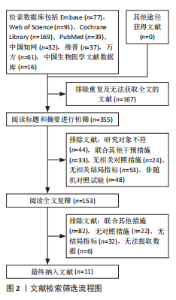
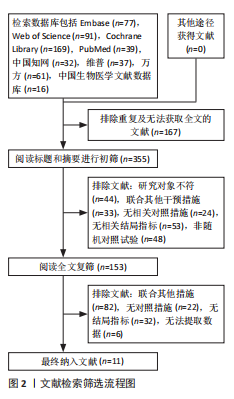
2.1 文献检索结果 初步检索共得到相关文献522篇。经过筛选,排除重复及无法获取的文献167篇;通过审阅文献标题与摘要,进一步剔除202篇;在阅读全文后,再剔除142篇。最终纳入11篇随机对照试验。文献检索的具体流程及结果详见图2。"
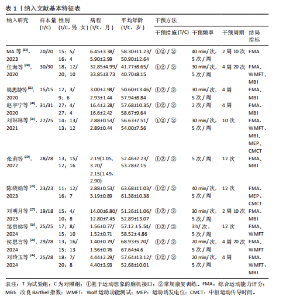
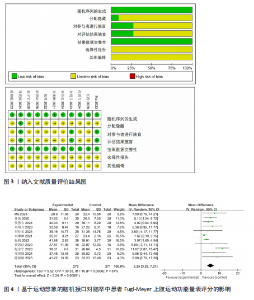
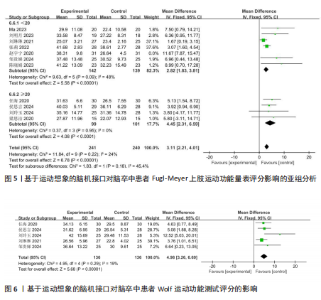
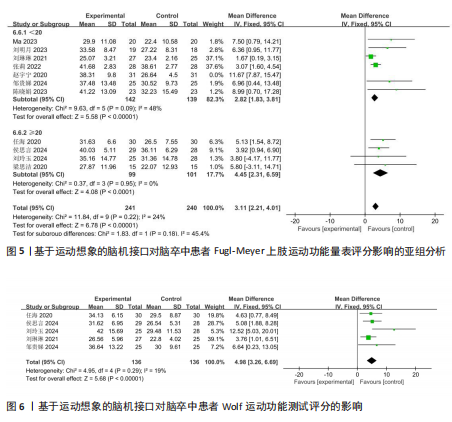
2.2 结果基本特征 最终纳入11项研究[23-33],发表时间在2020-2024年,涉及543例患者,受试者年龄在40岁以上。11项研究采用综合运动能力评分量表评估上肢运动功能[23-33];7项研究采用改良Barthel指数评分量表评估患者的日常生活功能[24,26-31];5项研究采用Wolf运动功能测试评估运动功能[24,26,28,31-32];2项研究采用运动诱发电位、中枢运动传导时间评估患者神经功能[23,31]。纳入研究基本特征见表1。 2.3 发表文献偏倚评估 所有文献均报告了随机分组,其中11篇文献说明了随机序列的产生方法[23-33] ,如简单随机化(随机数字表法、计算机随机法);仅1篇文献具体说明分配隐藏措施[32];3篇文献对参与者和研究者实施盲法及对评估者实施盲法[27,32-33];所有文献的结局数据保持完整性,选择性报告的偏倚风险均较低。具体评价结果见图3。 2.4 Meta分析结果 2.4.1 综合上肢运动能力评分 在综合上肢运动能力评分方面,纳入了11篇文献,包括543例患者,其中试验组272例,对照组271例。异质性检验结果显示I2=67%,P < 0.01,表明各研究间存在较大异质性,因此采用随机效应模型进行分析。分析结果表明,基于运动想象的脑机接口能够显著提高脑卒中患者的Fugl-Meyer运动功能评分[MD=5.25,95%CI(3.28,7.21),P < 0.000 01],具体结果见图4。为进一步探讨异质性来源,采用逐一剔除法进行敏感性分析。剔除赵宇宁等[30]研究后,I2值由67%降至24%,且试验组与对照组之间的差异仍有统计学意义。经分析发现,赵宇宁等[30]研究中脑卒中患者每周接受2次基于运动想象的脑机接口治疗,而其他研究中患者每周接受5次治疗,这一差异提示每周治疗次数可能是异质性的来源之一。 为进一步探索影响疗效的因素,根据基于运动想象的脑机接口技术的干预次数进行亚组分析。按干预次数分为< 20次和≥20次2组。数据显示,干预次数< 20次[MD=2.82,95%CI(1.83,3.81),P < 0.000 01]以及干预次数≥20次[MD=4.45,95%CI(2.31,6.59),P < 0.000 1]均能有效改善脑卒中患者运动功能,其中干预次数≥20次的疗效更好。结果表明,基于运动想象的脑机接口的干预次数是影响上肢运动功能的潜在因素之一。具体结果见图5。 2.4.2 Wolf运动功能测试评分 共纳入5篇文献,涉及272例患者,试验组与对照组各136例。异质性检验结果显示I2=19%,P=0.29,表明各研究间异质性较小,因此采用固定效应模型进行分析。分析结果显示,基于运动想象的脑机接口治疗可显著提升脑卒中患者的运动功能[MD=4.98,95%CI(3.26,6.69),P < 0.000 01],见图6。"
"

"
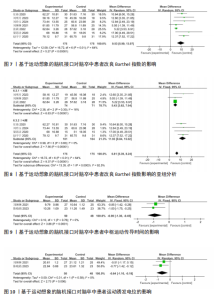
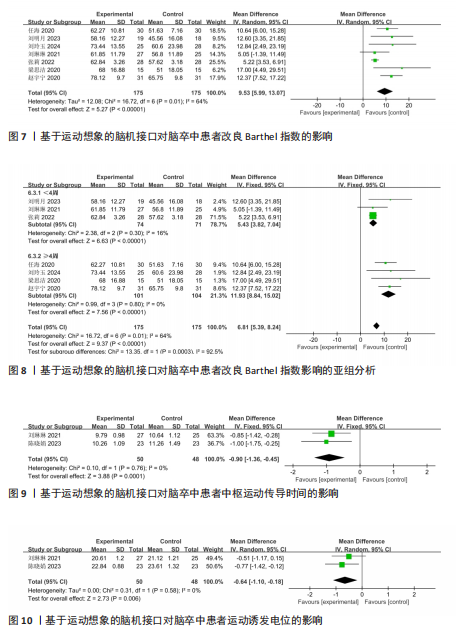
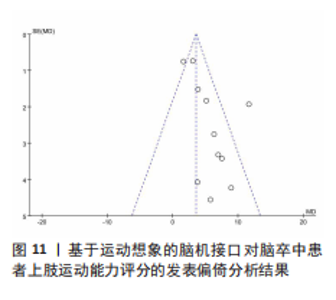
2.4.3 改良Barthel指数 共纳入7篇文献,涉及350例患者,试验组和对照组各175例。异质性检验结果显示I2=64%,P=0.01,提示各研究间存在较大异质性,因此采用随机效应模型进行分析。分析结果显示,基于运动想象的脑机接口治疗能够显著改善脑卒中患者的改良Barthel指数[MD=9.53,95%CI(5.99,13.07),P < 0.000 01],见图7。 采用逐一剔除法进行敏感性分析。在剔除张莉等[29]的研究后,I2值由64%降至0%,试验组与对照组相比有显著性差异。经分析发现,张莉等[29]研究中的脑卒中患者病程最短,为2个月左右,显著短于其他研究的患者,提示患者病程差异为异质性来源之一。 为进一步揭示异质性来源,根据纳入患者的干预周期进行亚组分析。按干预周期分为< 4周和≥4周2组,亚组分析后异质性下降,表明研究结果的异质性可能来源于干预周期的影响。综合分析,干预周期≥4周亚组的疗效略优于干预周期< 4周亚组,表明干预周期越长,对脑卒中上肢功能的改善效果可能越好,见图8。 2.4.4 中枢运动传导时间 纳入2篇文献,共涉及98例患者,其中试验组50例,对照组48例。异质性检验结果显示I2=0%,P=0.76,各研究间异质性小,采用固定效应模型分析。分析结果显示,基于运动想象的脑机接口能够显著提高脑卒中患者的中枢运动传导时间[MD=-0.90,95%CI(-1.36,-0.45), P=0.000 1],见图9。 2.4.5 运动诱发电位 纳入2篇文献,共涉及98例患者,其中试验组50例,对照组48例。异质性检验结果显示I2=0%,P=0.58,各研究间异质性小,采用固定效应模型分析。分析结果显示,基于运动想象的脑机接口能够显著提高脑卒中患者的运动诱发电位[MD=-0.64,95%CI(-1.10,-0.18),P=0.006],见图10。 2.5 发表偏倚结果 Egger’s检验结果显示综合上肢运动能力评分无统计学意义(P > 0.05),提示存在发表偏倚的可能性较小。漏斗图显示散点分布基本对称,见图11,提示综合上肢运动能力评分出现潜在发表偏倚和小样本效应的概率较低。"
"
| [1] 陈红霞,杨志敬,潘锐焕,等.中西医结合康复方案对脑卒中后偏瘫患者运动功能、日常生活活动能力和生活质量的影响[J]. 中国中西医结合杂志,2016,36(4):395-398. [2] CHENG YJ, WANG F, FENG J, et al. Prolonged myelin deficits contribute to neuron loss and functional impairments after ischaemic stroke. Brain. 2024;147(4):1294-1311. [3] GUZEK Z, DZIUBEK W, STEFAŃSKA M, et al. Evaluation of the functional outcome and mobility of patients after stroke depending on their cognitive state. Sci Rep. 2024;14(1):1515. [4] LANG CE, BLAND MD, BAILEY RR, et al. Assessment of upper extremity impairment, function, and activity after stroke: foundations for clinical decision making. J Hand Ther. 2013; 26(2):104-114. [5] VAN MEIJEREN-PONT W, TAMMINGA SJ, GOOSSENS PH, et al. Societal burden of stroke rehabilitation: Costs and health outcomes after admission to stroke rehabilitation. J Rehabil Med. 2021;53(6):jrm00201. [6] HAYWARD KS, KRAMER SF, DALTON EJ, et al. Timing and Dose of Upper Limb Motor Intervention After Stroke: A Systematic Review. Stroke. 2021;52(11):3706-3717. [7] GAUGHAN TCLS, BOE SG. Investigating the dose-response relationship between motor imagery and motor recovery of upper-limb impairment and function in chronic stroke: A scoping review. J Neuropsychol. 2022;16(1):54-74. [8] THAKOR NV. Translating the brain-machine interface. Sci Transl Med. 2013;5(210): 210ps17. [9] 王丽萍,汪蕊雪,温云卿,等.脑机接口在脑卒中患者康复治疗中的应用[J].中国医学前沿杂志(电子版),2025,17(2):1-7. [10] 张海玲,朱永彬,吴静.全球脑机接口战略政策比较及对我国的启示[J].科学与社会, 2024,14(3):57-78. [11] KHAN MA, DAS R, IVERSEN HK, et al. Review on motor imagery based BCI systems for upper limb post-stroke neurorehabilitation: From designing to application. Comput Biol Med. 2020;123:103843. [12] MONTEIRO KB, CARDOSO MDS, CABRAL VRDC, et al. Effects of Motor Imagery as a Complementary Resource on the Rehabilitation of Stroke Patients: A Meta-Analysis of Randomized Trials. J Stroke Cerebrovasc Dis. 2021;30(8):105876. [13] EDELMAN BJ, ZHANG S, SCHALK G, et al. Non-Invasive Brain-Computer Interfaces: State of the Art and Trends. IEEE Rev Biomed Eng. 2025;18:26-49. [14] DEKLEVA BM, CHOWDHURY RH, BATISTA AP, et al. Motor cortex retains and reorients neural dynamics during motor imagery. bioRxiv [Preprint]. 2023;19:2023.01.17.524394. [15] PICHIORRI F, MATTIA D. Brain-computer interfaces in neurologic rehabilitation practice. Handb Clin Neurol. 2020;168:101-116. [16] PICHIORRI F, MORONE G, PETTI M, et al. Brain-computer interface boosts motor imagery practice during stroke recovery. Ann Neurol. 2015;77(5):851-865. [17] DARVISHI S, DATTA GUPTA A, HAMILTON-BRUCE A, et al. Enhancing poststroke hand movement recovery: Efficacy of RehabSwift, a personalized brain-computer interface system. PNAS Nexus. 2024;3(7):240. [18] MA ZZ, WU JJ, CAO Z, et al. Motor imagery-based brain-computer interface rehabilitation programs enhance upper extremity performance and cortical activation in stroke patients. J Neuroeng Rehabil. 2024;21(1):91. [19] 中华医学会神经病学分会,中华医学会神经病学分会脑血管病学组.中国各类主要脑血管病诊断要点2019[J].中华神经科杂志, 2019,52(9):710-715 [20] STERNE JAC, SAVOVIĆ J, PAGE MJ, et al. RoB 2: a revised tool for assessing risk of bias in randomised trials. BMJ. 2019;366:l4898. [21] CUMPSTON M, LI T, PAGE MJ, et al. Updated guidance for trusted systematic reviews: a new edition of the Cochrane Handbook for Systematic Reviews of Interventions. Cochrane Database Syst Rev. 2019;10(10):ED000142. [22] PATSOPOULOS NA, EVANGELOU E, IOANNIDIS JP. Sensitivity of between-study heterogeneity in meta-analysis: proposed metrics and empirical evaluation. Int J Epidemiol. 2008; 37(5):1148-1157. [23] 陈晓娟,纳金花,马晓红,等.脑机接口联合运动想象训练对缺血性脑卒中患者上肢功能恢复的影响[J].中华物理医学与康复杂志,2023,45(3):222-225. [24] 侯思言,汪丽丽,王春方.基于运动想象的脑机接口训练改善脑卒中患者上肢及脑功能的研究[J].中国康复,2024,39(11):643-648. [25] 梁思捷,朱玉连,王卫宁,等.脑机接口技术在脑卒中患者上肢功能障碍康复中的应用[J].中国康复医学杂志,2020,35(2):185-188. [26] 刘玲玉,秦文婷,靳令经,等.基于运动想象的脑机接口在脑卒中后手功能康复中的应用[J].中国康复,2024,39(12):707-713. [27] 刘明月,李哲,曹永生,等.基于运动表象的脑机接口训练对亚急性期脑卒中患者手功能康复的效果[J].中国康复理论与实践, 2023,29(1):71-76. [28] 任海,谢志明.脑机接口技术在脑卒中偏瘫患者上肢运动功能康复治疗中的疗效观察[J].中国实用医药,2020,15(10):181-183. [29] 张莉,张明,张秀芳,等.基于想象疗法的闭环脑机接口训练对脑卒中后偏瘫患者上肢功能的影响[J].中华脑科疾病与康复杂志(电子版),2022,12(6):360-364. [30] 赵宇宁,张小利,刘继红.基于脑-机接口的运动想象训练对卒中患者上肢功能恢复的效果[J].北京医学,2020,42(4):358-360. [31] 刘琳琳,高伟鹏,丛文娟,等.基于运动想象脑-机接口对脑卒中后上肢运动功能及大脑皮层兴奋性的影响[J].中国科技期刊数据库医药,2021(11):020-023. [32] 邹贵娣,陈小凯,谭卉虹,等.脑机接口结合外骨骼机器手对脑梗死患者手功能障碍的闭环康复效果[J].实用医学杂志,2024, 40(17):2395-2400. [33] MA ZZ, WU JJ, HUA XY, et al. Evidence of neuroplasticity with brain-computer interface in a randomized trial for post-stroke rehabilitation: a graph-theoretic study of subnetwork analysis. Front Neurol. 2023;14:1135466. [34] BARRY AJ, TRIANDAFILOU KM, STOYKOV ME, et al. Survivors of Chronic Stroke Experience Continued Impairment of Dexterity But Not Strength in the Nonparetic Upper Limb. Arch Phys Med Rehabil. 2020;101(7):1170-1175. [35] MOSTAJERAN M, ALIZADEH S, ROSTAMI HR, et al. Feasibility and efficacy of an early sensory-motor rehabilitation program on hand function in patients with stroke: a pilot, single-subject experimental design. Neurol Sci. 2024;45(6):2737-2746. [36] BIASIUCCI A, LEEB R, ITURRATE I, et al. Brain-actuated functional electrical stimulation elicits lasting arm motor recovery after stroke. Nat Commun. 2018;9(1):2421. [37] SEBASTIÁN-ROMAGOSA M, CHO W, ORTNER R, et al. Brain Computer Interface Treatment for Motor Rehabilitation of Upper Extremity of Stroke Patients-A Feasibility Study. Front Neurosci. 2020;14:591435. [38] 邹雨栖,徐鹏,高长越.基于神经可塑性理论的感觉刺激疗法在脑卒中运动康复的应用[J].中国康复,2022,37(6):381-384. [39] ZHANG K, DING L, WANG X, et al. Evidence of mirror therapy for recruitment of ipsilateral motor pathways in stroke recovery: A resting fMRI study. Neurotherapeutics. 2024;21(2): e00320. [40] LEBEDEV MA, NICOLELIS MA. Brain-Machine Interfaces: From Basic Science to Neuroprostheses and Neurorehabilitation. Physiol Rev. 2017;97(2):767-837. [41] OLAFSON ER, JAMISON KW, SWEENEY EM, et al. Functional connectome reorganization relates to post-stroke motor recovery and structural and functional disconnection. Neuroimage. 2021;245:118642. [42] MILNER AD, GOODALE MA. Two visual systems re-viewed. Neuropsychologia. 2008;46(3):774-785. [43] YU P, DONG R, WANG X, et al. Neuroimaging of motor recovery after ischemic stroke - functional reorganization of motor network. Neuroimage Clin. 2024;43:103636. [44] BUNDY DT, SOUDERS L, BARANYAI K, et al. Brain-Computer Interface Control of a Powered Exoskeleton for Motor Recovery in Chronic Stroke Survivors. Stroke. 2017;48(7):1908-1915. [45] GOULD L, KRESS S, NEUDORF J, et al. An fMRI, DTI and Neurophysiological Examination of Atypical Organization of Motor Cortex in Ipsilesional Hemisphere Following Post-Stroke Recovery. J Stroke Cerebrovasc Dis. 2021; 30(3):105593. [46] RUSTAMOV N, SOUDERS L, SHEEHAN L, et al. IpsiHand Brain-Computer Interface Therapy Induces Broad Upper Extremity Motor Rehabilitation in Chronic Stroke. Neurorehabil Neural Repair. 2025;39(1): 74-86. [47] RUSTAMOV N, HUMPHRIES J, CARTER A, et al. Theta-gamma coupling as a cortical biomarker of brain-computer interface-mediated motor recovery in chronic stroke. Brain Commun. 2022;4(3):fcac136. [48] FROLOV AA, MOKIENKO O, LYUKMANOV R, et al. Post-stroke Rehabilitation Training with a Motor-Imagery-Based Brain-Computer Interface (BCI)-Controlled Hand Exoskeleton: A Randomized Controlled Multicenter Trial. Front Neurosci. 2017;11:400. [49] 车兴旺,程晋成,蒋东生,等.运动想象训练联合经颅直流电刺激对脑卒中偏瘫患者上肢功能的影响[J].海军医学杂志,2017, 38(4):303-306. [50] KIM MS, PARK H, KWON I, et al. Efficacy of brain-computer interface training with motor imagery-contingent feedback in improving upper limb function and neuroplasticity among persons with chronic stroke: a double-blinded, parallel-group, randomized controlled trial. J Neuroeng Rehabil. 2025; 22(1):1. [51] LIU J, LI Y, ZHAO D, et al. Efficacy and safety of brain-computer interface for stroke rehabilitation: an overview of systematic review. Front Hum Neurosci. 2025;19:1525293. [52] ZANONA AF, PISCITELLI D, SEIXAS VM, et al. Brain-computer interface combined with mental practice and occupational therapy enhances upper limb motor recovery, activities of daily living, and participation in subacute stroke. Front Neurol. 2023;13:1041978. [53] CHENG N, PHUA KS, LAI HS, et al. Brain-Computer Interface-Based Soft Robotic Glove Rehabilitation for Stroke. IEEE Trans Biomed Eng. 2020;67(12):3339-3351. [54] WANG P, LIU J, WANG L, et al. Effects of brain-Computer interface combined with mindfulness therapy on rehabilitation of hemiplegic patients with stroke: a randomized controlled trial. Front Psychol. 2023;14:1241081. [55] POLLOCK A, FARMER SE, BRADY MC, et al. Interventions for improving upper limb function after stroke. Cochrane Database Syst Rev. 2014;2014(11):CD010820. [56] KIM H, CHANG WK, KIM WS, et al. Brain-Computer Interface-controlled Upper Limb Robotic System for Enhancing Daily Activities in Stroke Patients. J Vis Exp. 2025(218). doi: 10.3791/67601. [57] QIAO C, LIU Z, QIE S. The Implications of Microglial Regulation in Neuroplasticity-Dependent Stroke Recovery. Biomolecules. 2023;13(3):571. [58] 赵玲娟,刘岩,文力.《中国急性缺血性卒中诊治指南2023》治疗策略解析[J].临床药物治疗杂志,2024,22(11):1-6. [59] SVEJGAARD B, MODRAU B, HERNÁNDEZ-GLORIA JJ, et al. Associative brain-computer interface training increases wrist extensor corticospinal excitability in patients with subacute stroke. J Neurophysiol. 2025;133(1): 333-341. [60] 薛夏利,邓钟义,李宁.脑机接口辅助训练对脑卒中患者上肢功能恢复效果的Meta分析[J].中国老年学杂志,2023,43(1):8-14. |
| [1] | Chen Qiang, Wu Wenjuan, Jiang Shuhua, Huang Da. Physical exercise improves physical function in burn patients: a systematic review and meta-analysis [J]. Chinese Journal of Tissue Engineering Research, 2026, 30(5): 1269-1281. |
| [2] | Jiang Yang, Peng Hao, Song Yanping, Yao Na, Song Yueyu, Yin Xingxiao, Li Yanqi, Chen Qigang. Isometric exercise reduces resting blood pressure: a meta-analysis of moderating factors and dose effects [J]. Chinese Journal of Tissue Engineering Research, 2026, 30(4): 975-986. |
| [3] | Sun Jiahe, Shi Jipeng, Zhu Tianrui, Quan Helong, Xu Hongqi. Effect of exercise intervention in elderly individuals with sarcopenia and its comorbidities: a meta-analysis [J]. Chinese Journal of Tissue Engineering Research, 2026, 30(4): 997-1007. |
| [4] | Wang Xiaochen, Guo Lin, Wang Changcheng, Xu Tan, Gu Mingxi. Efficacy and safety of romozumab in the treatment of osteoporosis in adults: a meta-analysis [J]. Chinese Journal of Tissue Engineering Research, 2026, 30(35): 9294-9301. |
| [5] | Wang Yifei, Zhao Jing, Gao Mingchen, Wu Xiaobin. Different doses of aquatic exercise for improving muscle strength in older adults: a meta-analysis [J]. Chinese Journal of Tissue Engineering Research, 2026, 30(34): 9067-9074. |
| [6] | Fan Mengmeng, Ding Jiali, Wan Yujie, Huang Hailiang. A systematic review and network meta-analysis of neuromodulation techniques for promoting upper limb motor function after stroke [J]. Chinese Journal of Tissue Engineering Research, 2026, 30(28): 7494-7504. |
| [7] | Xia Caigui, Li Wei, Su Yuying, Shi Yu, Yang Zhonghe. Effects of antioxidant pretreatment on skeletal muscle damage and oxidative stress following acute high-intensity exercise: a meta-analysis [J]. Chinese Journal of Tissue Engineering Research, 2026, 30(24): 6345-6353. |
| [8] | Fang Enhui, Guan Hui, Ma Lihong. Non-invasive brain stimulation for core symptoms in children with autism spectrum disorder: a network meta-analysis [J]. Chinese Journal of Tissue Engineering Research, 2026, 30(24): 6373-6381. |
| [9] | Li Yanfeng, Zhang Yilin, Kong Hao, Zheng Hang, Liu Jiajun, Yin Mingyue, Qiu Bopeng, Huang Kongyun, Liu Hengxian, Zhong Yuming, Chen Jun, Xu Kai. Effect of blood flow restriction training on the magnitude and temporal characteristics of post-activation performance enhancement: a systematic review and meta-analysis [J]. Chinese Journal of Tissue Engineering Research, 2026, 30(23): 6150-6146. |
| [10] | Wu Ronghai, Zheng Zhouhang, Chen Huan, You Dongchun, Guo Weifeng, Liu Xingming, Zhang Yu . Meta-analysis of application effect of 3D-printed artificial vertebral bodies in anterior cervical corpectomy and fusion [J]. Chinese Journal of Tissue Engineering Research, 2026, 30(21): 5621-5628. |
| [11] | Xu Yang, Li Xiupeng, Yang Bing, Yang Chunbaixue, Zhao Zhongwei . Different exercise modalities improve health gains in vascular function in overweight or obese children and adolescents: a Bayesian meta-analysis [J]. Chinese Journal of Tissue Engineering Research, 2026, 30(16): 4204-4218. |
| [12] | Hou Bing, Zhao Hongfei, Che Pengcheng, Wang Ziyi, Gao Zan, Chen Linyu, Wang Jinzhi, Dou Na. Analysis of upper limb motor function and brain function immediately and 3 weeks after transcranial direct current stimulation [J]. Chinese Journal of Tissue Engineering Research, 2026, 30(12): 3066-3074. |
| [13] | Peng Hao, Jiang Yang, Song Yanping, Yao Na, Shen Zhen, Song Yueyu, Chen Qigang. Relationship of training with abnormal posture and spinal curvature disorders in specialized athletes [J]. Chinese Journal of Tissue Engineering Research, 2026, 30(12): 3127-3133. |
| [14] | Chen Ping, Du Jinchao, Wang Hongying, Zhang Hui, Wang Haixia. Different inspiratory muscle training methods improve exercise and cardiopulmonary function of patients after cardiac surgery: a network meta-analysis [J]. Chinese Journal of Tissue Engineering Research, 2026, 30(12): 3134-3144. |
| [15] | Xin Xianyang, Liu Longyan, Guo Yongqing, Wang Hai, Xie Jun. Effects of long-term exercise interventions on appetite-regulating hormones in overweight and obese populations: a meta-analysis [J]. Chinese Journal of Tissue Engineering Research, 2026, 30(11): 2858-2869. |
| Viewed | ||||||
|
Full text |
|
|||||
|
Abstract |
|
|||||