Chinese Journal of Tissue Engineering Research ›› 2026, Vol. 30 ›› Issue (23): 6150-6146.doi: 10.12307/2026.387
Effect of blood flow restriction training on the magnitude and temporal characteristics of post-activation performance enhancement: a systematic review and meta-analysis
Li Yanfeng1, Zhang Yilin2, Kong Hao2, Zheng Hang3, Liu Jiajun4, Yin Mingyue3, 5, Qiu Bopeng4, Huang Kongyun3, Liu Hengxian3, Zhong Yuming3, Chen Jun1, Xu Kai3
- 1Institute of Physical Education and Training, Capital University of Physical Education and Sports, Beijing 100191, China; 2School of Sports Training, Tianjin University of Sport, Tianjin 301617, China; 3School of Athletic Performance, Shanghai University of Sport, Shanghai 200438, China; 4School of Strength and Conditioning, Beijing Sport University, Beijing 100084, China; 5The Mary MacKillop Institute for Health Research, Australian Catholic University, Melbourne, VIC 3000, Australia
-
Received:2025-08-18Accepted:2025-09-29Online:2026-08-18Published:2026-01-06 -
Contact:Xu Kai, MS, School of Athletic Performance, Shanghai University of Sport, Shanghai 200438, China -
About author:Li Yanfeng, MS, Institute of Physical Education and Training, Capital University of Physical Education and Sports, Beijing 100191, China Zhang Yilin, MS candidate, School of Sports Training, Tianjin University of Sport, Tianjin 301617, China Li Yanfeng and Zhang Yilin contributed equally to this work. -
Supported by:Australian Government Research Training Program Funding Scholarships

CLC Number:
Cite this article
Li Yanfeng, Zhang Yilin, Kong Hao, Zheng Hang, Liu Jiajun, Yin Mingyue, Qiu Bopeng, Huang Kongyun, Liu Hengxian, Zhong Yuming, Chen Jun, Xu Kai. Effect of blood flow restriction training on the magnitude and temporal characteristics of post-activation performance enhancement: a systematic review and meta-analysis[J]. Chinese Journal of Tissue Engineering Research, 2026, 30(23): 6150-6146.
share this article
Add to citation manager EndNote|Reference Manager|ProCite|BibTeX|RefWorks
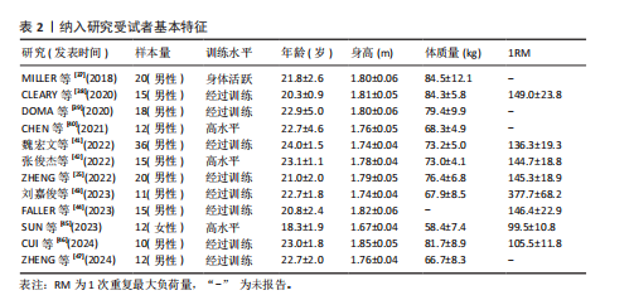
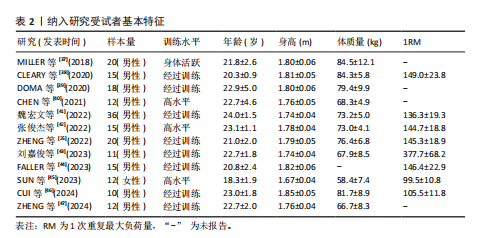
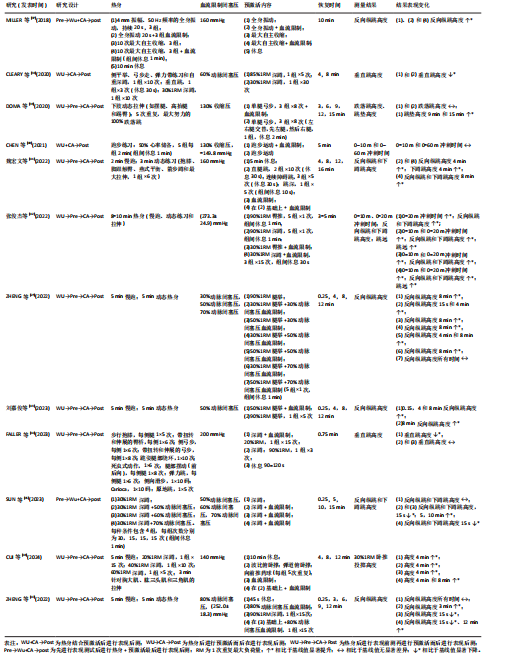
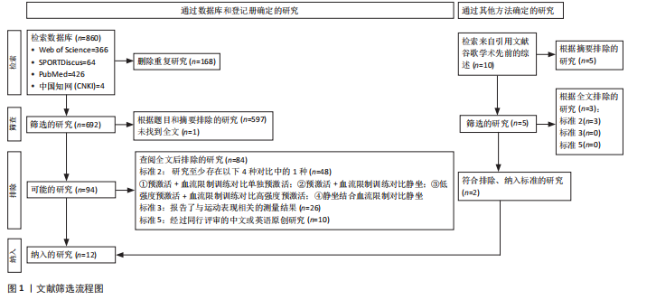
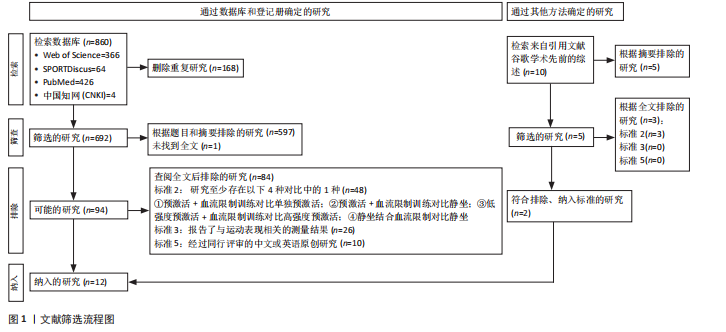
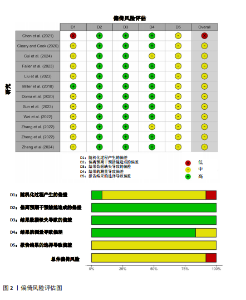
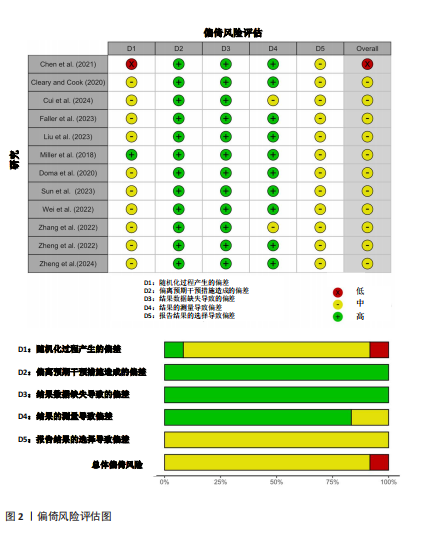
2.1 检索结果 通过制定的检索词共检索到860篇文献。去除重复文献后,剩余692篇文献。经过阅读标题和摘要筛选以及按纳入和排除标准筛选后,剩余10篇文献。此外,通过其他来源(如“ResearchGate”“Google Scholar”等)最终补充了2篇文献。因此,最终符合纳入标准的文献数量为12篇(图1) [25,37-47]。 2.2 纳入研究特征 表2,3提供了纳入研究的受试者参数、热身、预激活、恢复时间、运动表现测试形式和结果。12篇研究共196名受试者,其中女性12名,男性184名;受试者训练水平为身体活跃者1篇,经过训练人群8篇,高水平运动员3篇;年龄为20.3(±0.9)-24(±1.5)岁;身高为1.67(±0.04)-1.85(±0.05) m;体质量为58.4(±7.4)-84.5(±12.1) kg;力量水平为99.5(±10.8)-377.7(±68.2) kg(表2)。5篇研究的血流限制闭塞压通过mmHg测量,5篇通过动脉闭塞压测量,2篇通过收缩压测量;预激活形式包括采用抗阻训练8篇,基于体质量的训练方式4篇;恢复时间为0.25-16 min,测量结果包括,跳跃高度(反向纵跳、下蹲跳、跌落跳、垂直纵跳和立定跳跃)、冲刺时间和卧推投掷高度(表3)。 2.3 偏倚风险 纳入的研究中11篇(91.7%)为存在一些风险,1篇为高风险(8.3%)。仅有1篇报告了随机化的方法,且所有研究均未进行临床的预注册,因此并不清楚是否存在选择性的报告,见图2。"
"
"
"
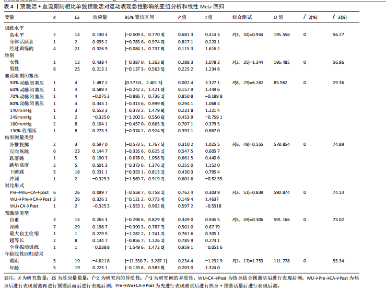
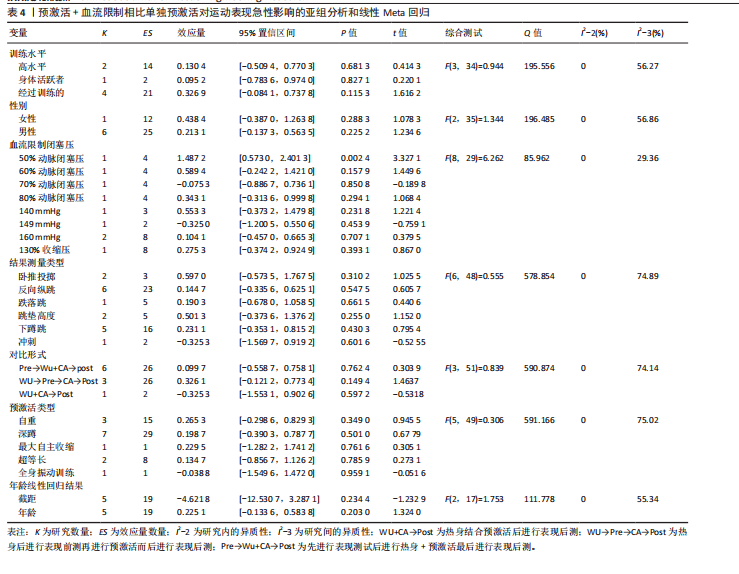
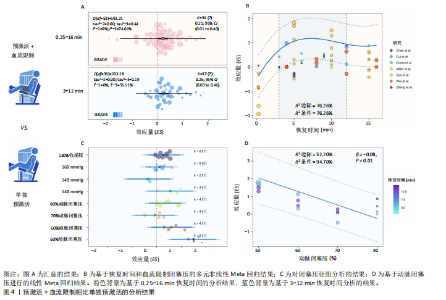
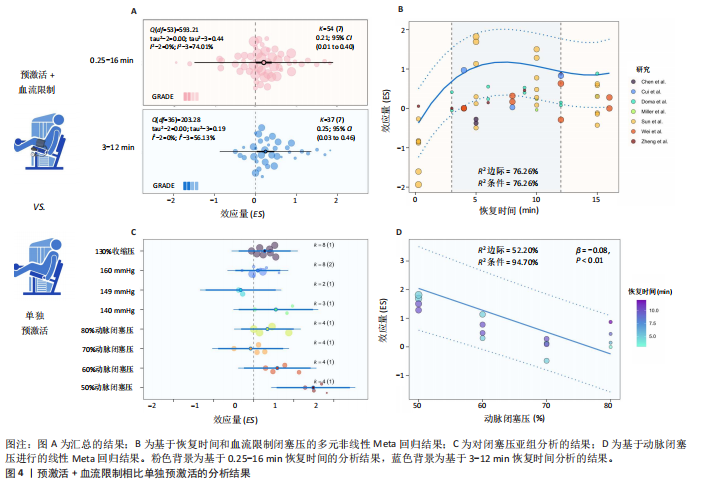
激活展现出更显著的效果(ES=0.21,95%CI=0.01-0.40,PI=-1.49-1.90,GRADE=低),在恢复时间3-12 min时效果类似(ES=0.25,95%CI=0.03-0.46,PI=-0.87-1.36,GRADE=低,图4A)。对血流限制闭塞压进行亚组分析发现,仅在50%动脉闭塞压时比单独预激活更有效(ES=1.49,95%CI=0.57-2.40),且该效果显著大于60%动脉闭塞压(P < 0.01)、70%动脉闭塞压(P < 0.01)、80%动脉闭塞压(P=0.046)、140 mmHg(P=0.03)、149 mmHg(P=0.01)、160 mmHg(P= 0.01)和130%收缩压(P=0.04)闭塞压时的效果(图4C)。此外,其他变量均未显示出统计学显著性(表4)。针对50%-80%动脉闭塞压压力范围的线性Meta回归分析表明,预激活+血流限制对运动表现的提升效果随动脉闭塞压的增加呈递减趋势(R2边际=52.20%,R2条件=94.70%,β=-0.08,P < 0.01;图 4D)。 进一步结合血流限制闭塞压力和恢复时间的多变量非线性Meta回归分析显示,预激活+血流限制的干预效果在4-12 min的时间窗口内最为显著(R2边际=76.26%,R2条件= 76.26%,图4B)。此外,未发现闭塞压与恢复时间显著的交互作用。"
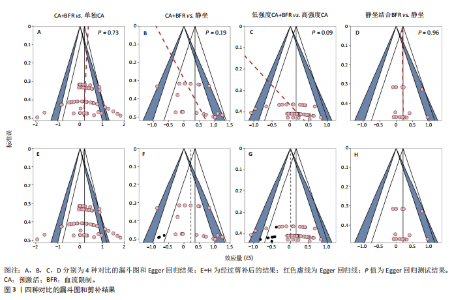
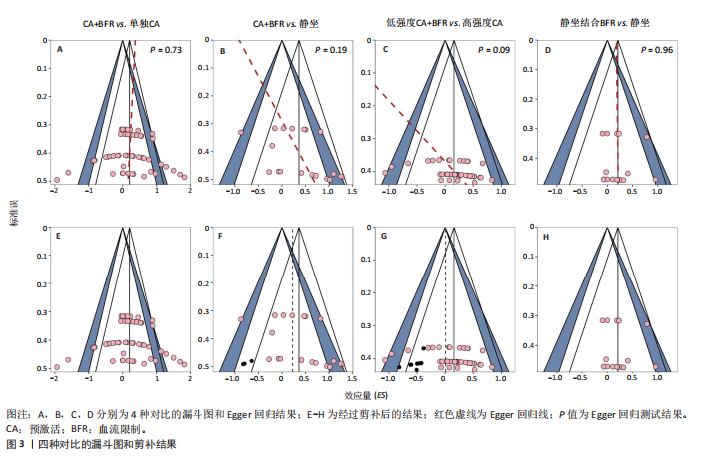
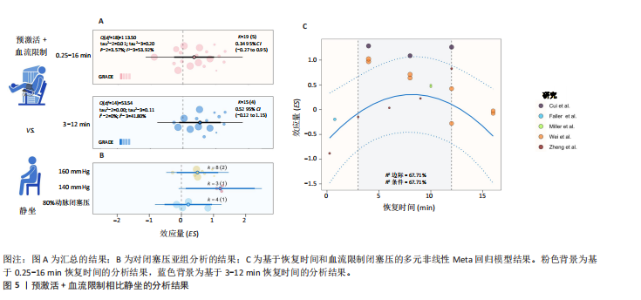
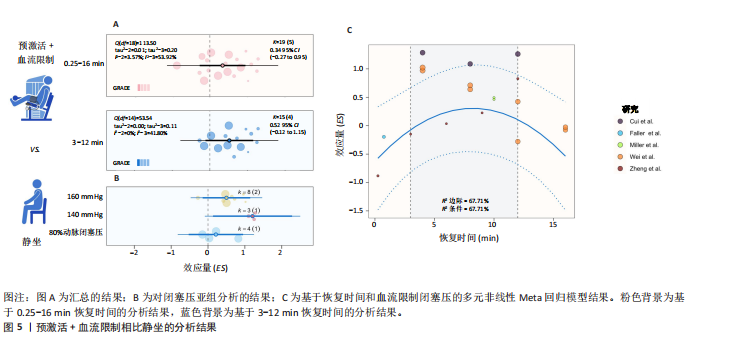
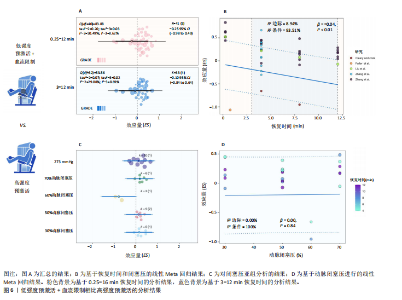
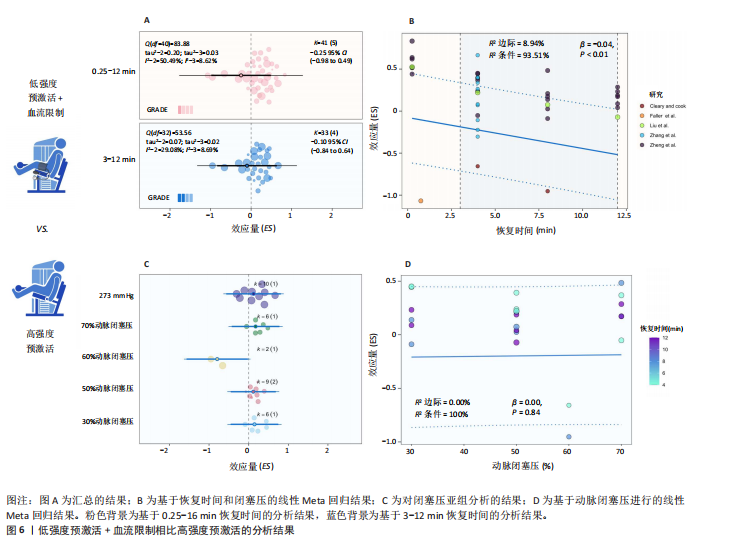
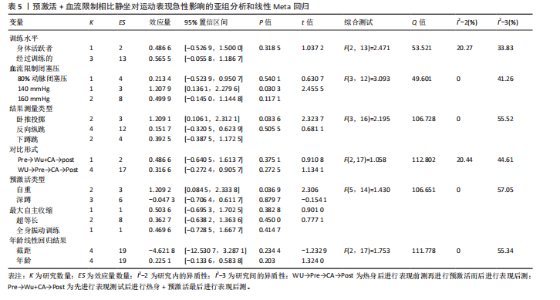
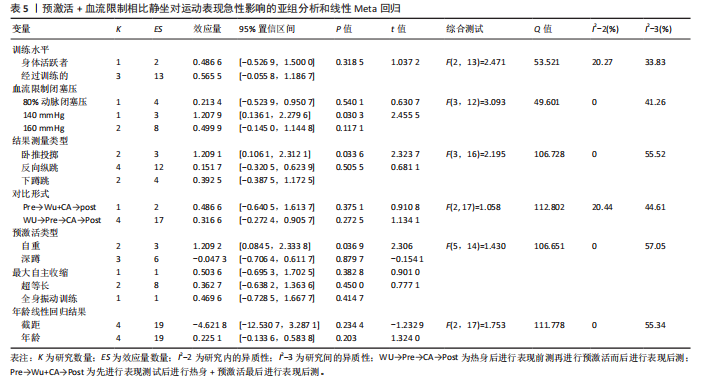
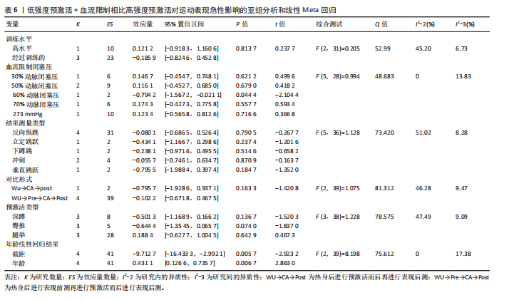
2.4.2 预激活+血流限制相比静坐 在恢复时间0.25-16 min时,预激活+血流限制相较于静坐对运动表现的急性提升无显著差异(ES=0.34,95%CI=-0.27-0.95,PI=-1.14-1.82,GRADE=非常低),在恢复时间3- 12 min时结果类似(ES=0.52,95%CI= -0.12-1.15,PI=-0.78-1.82,GRADE=非常低,图5A)。Egger回归检验结果表明不存在显著的发表偏倚风险(P=0.19,图3B和F)。对血流限制闭塞压进行亚组分析发现,仅在预激活+140 mmHg 血流限制时比单独预激活更有效(ES=1.21,95%CI=0.14-2.28),但相比80%动脉闭塞压(P=0.24)和160 mmHg(P=0.12)并无显著差异(图5B)。此外,其他变量均未显示出统计学显著性(表5)。 进一步结合血流限制闭塞压和恢复时间进行多变量非线性Meta回归发现,预激活+血流限制相比静坐对运动表现的效果随着恢复时间呈现倒U型,但预测的所有时间点均无显著意义(R2边际=67.71%,R2条件=67.71%,图5C)。此外,未发现闭塞压与恢复时间显著的交互作用。 2.4.3 低强度预激活+血流限制相比高强度预激活 在恢复时间0.25-12 min时,低强度预激活+血流限制相比高强度预激活对运动表现的急性提升无显著差异(ES=-0.25,95%CI= -0.98-0.49,PI=-1.77-1.28,GRADE=非常低),在恢复时间3-12 min时效果类似(ES=-0.10,95%CI=-0.84-0.64,PI= -1.33-1.12,GRADE=低,图6A)。Egger回归检验结果表明不存在显著的发表偏倚风险(P=0.09,图3C和G)。对血流限制闭塞压进行亚组分析发现,低强度预激活+60%动脉闭塞压相比高强度预激活显著降低了运动表现(ES=-0.79,95%CI=-1.57至-0.02),但下降的幅度并不比30%动脉闭塞压(P=0.06)、50%动脉闭塞压(P= 0.06)、70%动脉闭塞压(P=0.052)和273 mmHg(P=0.08)更大(图6C)。单独对30%-70%动脉闭塞压进行线性Meta回归并未发现显著结果(R2边际=0.00%,R2条件=100.00%,β=0.00,P=0.84,图6D)。此外,其他变量均未显示出统计学显著性(表6)。 进一步对恢复时间进行线性Meta回归发现,低强度预激活+血流限制相比高强度预激活的效果随着时间显著下降(R2边际=8.94%,R2条件=93.51%,β=-0.04,P < 0.01,图6B)。此外,未发现闭塞压与恢复时间显著的交互作用。"
"
"
"
"
"
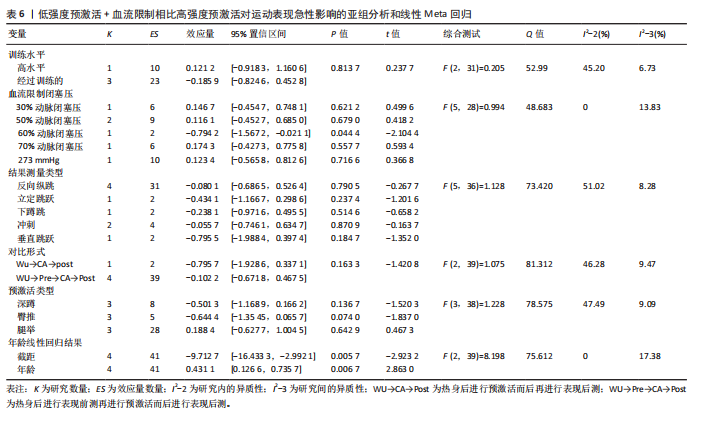
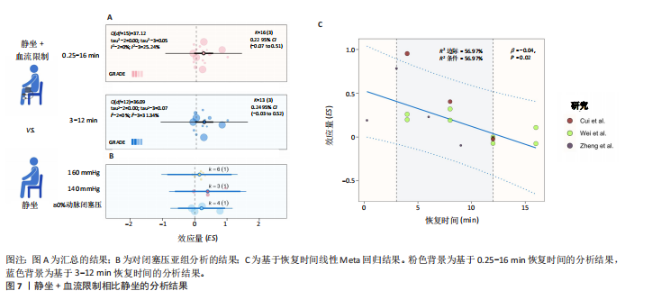
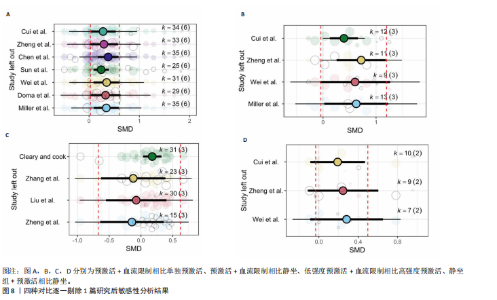
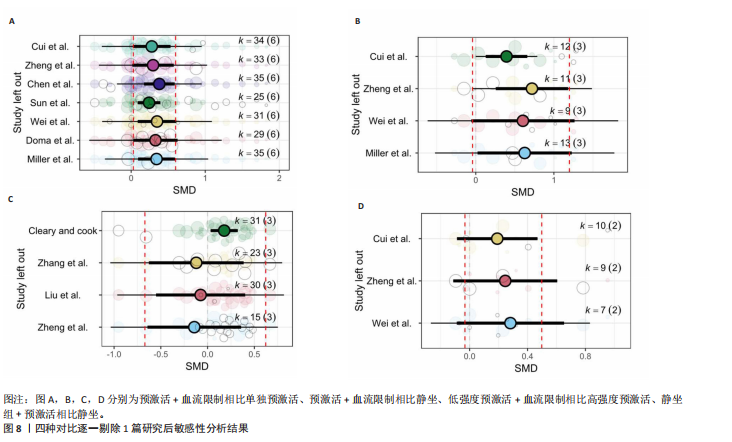
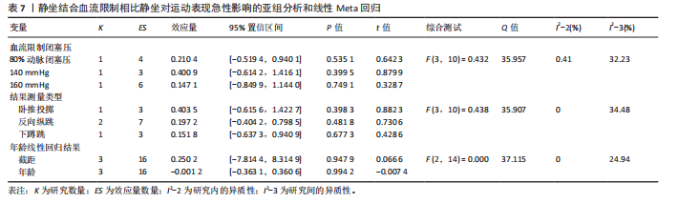
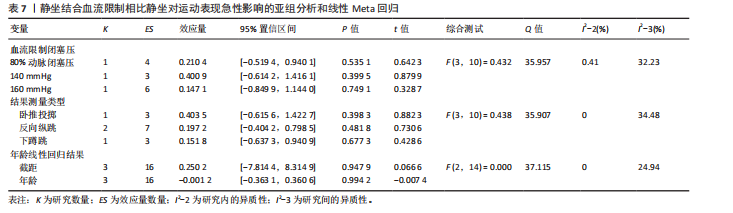
2.4.4 静坐结合血流限制相比静坐 在恢复时间0.25-16 min时,静坐结合血流限制相比静坐对运动表现的急性提升无显著差异(ES=0.22,95%CI=-0.07-0.51,PI=-0.94-1.39,GRADE=低),在恢复3-12 min时结果类似(ES=0.24,95%CI=-0.03-0.52,PI=-1.08-1.56,GRADE=非常低,图7A)。Egger回归检验结果表明不存在显著的发表偏倚风险(P=0.96,图3D和H)。对血流限制闭塞压进行亚组分析发现,结果均不显著(图7B),其他变量也均未发现显著的结果(表7)。 进一步对恢复时间进行线性Meta回归发现,静坐结合血流限制相比静坐对运动表现的效果随着恢复时间显著下降,但预测的所有时间点均无显著意义(R2边际=56.97%,R2条件=56.97%,β=-0.04,P=0.02,图7C)。此外,未发现闭塞压与恢复时间显著的交互作用。 2.5 敏感性分析 剔除1篇高风险研究(CHEN等[40])后,结果没有发生改变(ES=0.31,P=0.01)。对恢复时间3-12 min的汇总结果进行逐一剔除后发现,预激活结合血流限制相比单独预激活的结果稳定,预激活结合血流限制相比静坐剔除CUI等[46](ES=0.39,95%CI=0.13-0.66)、ZHENG等[47](ES=0.72,95%CI=0.26-1.18)和MILLER等[37](ES=0.63,95%CI=0.02-1.23)研究后结果从非显著变为显著。低强度预激活结合血流限制相比高强度预激活剔除CLEARY等[40] (ES=0.18,95%CI=0.03-0.32)研究后结果从非显著变为显著(图8)。静坐结合血流限制相比静坐剔除任意研究后结果均稳定。"
"
"
| [1] XU K, YIN M, ZHONG Y, et al. Acute Effects of Assisted and Resisted Sprint Training on Subsequent Sprint Performance: A Systematic Review and Meta-Analysis. J Strength Cond Res. 2025;39(5):e711-e720. [2] XU K, BLAZEVICH AJ, BOULLOSA D, et al. Optimizing Post-activation Performance Enhancement in Athletic Tasks: A Systematic Review with Meta-analysis for Prescription Variables and Research Methods. Sports Med. 2025;55(4):977-1008. [3] 徐恺,唐文静,路恒,等.激活后增强效应与激活后表现提升:重塑定义与认知[J].中国体育科技,2025,61(1):47-58. [4] BLAZEVICH AJ, BABAULT N. Post-activation Potentiation Versus Post-activation Performance Enhancement in Humans: Historical Perspective, Underlying Mechanisms, and Current Issues. Front Physiol. 2019;10:1359. [5] 梁美富,郭文霞.骨骼肌激活后增强效应的研究进展[J].体育科学,2019,39(5):70-80. [6] BOULLOSA D. Post-activation performance enhancement strategies in sport: a brief review for practitioners. Human Movement. 2021;22(3):101-109. [7] TILLIN NA, BISHOP D. Factors modulating post-activation potentiation and its effect on performance of subsequent explosive activities. Sports Med. 2009;39(2):147-166. [8] ZENG N, LIU H, WANG J, et al. The effects of blood flow restriction training on post activation potentiation and fatigue level: systematic review with meta-analysis. Front Physiol. 2025;16:1558008. [9] LOENNEKE JP, HAMMERT WB, KATAOKA R, et al. Twenty-five years of blood flow restriction training: What we know, what we don’t, and where to next? J Sports Sci. 2025;43(19):2115-2132. [10] PIGNANELLI C, CHRISTIANSEN D, BURR JF. Blood flow restriction training and the high-performance athlete: science to application. J Appl Physiol (1985). 2021;130(4):1163-1170. [11] PATTERSON SD, HUGHES L, WARMINGTON S, et al. Blood Flow Restriction Exercise: Considerations of Methodology, Application, and Safety. Front Physiol. 2019;10:533. [12] SCOTT BR, LOENNEKE JP, SLATTERY KM, et al. Exercise with blood flow restriction: an updated evidence-based approach for enhanced muscular development. Sports Med. 2015;45(3):313-325. [13] ZHANG Y, XU K, YIN M, et al. Effects of blood flow restriction training in athletes: a systematic review and meta-analysis. Int J Sports Med. 2025;46(7):467-481. [14] YIN M, DENG S, DENG J, et al. Physiological adaptations and performance enhancement with combined blood flow restricted and interval training: A systematic review with meta-analysis. J Sport Health Sci. 2025;14: 101030. [15] WORTMAN RJ, BROWN SM, SAVAGE-ELLIOTT I, et al. Blood Flow Restriction Training for Athletes: A Systematic Review. Am J Sports Med. 2021;49(7):1938-1944. [16] KONG H, ZHANG Y, YIN M, et al. Effects of blood flow restriction training on cardiometabolic health and body composition in adults with overweight and obesity: a meta-analysis. Front Physiol. 2025;15:1521995. [17] ZHAO C, SU R, WU J, et al. The effects of blood flow restriction combined with resistance training on post-activation potentiation: A meta-analysis. Science & Sports. 2025;40(2):103-116. [18] LIU H, JIANG L, WANG J. The effects of blood flow restriction training on post activation potentiation and upper limb muscle activation: a meta-analysis. Front Physiol. 2024;15:1395283. [19] WANG J, LIU H, JIANG L. The effects of blood flow restriction training on PAP and lower limb muscle activation: a meta-analysis. Front Physiol. 2023;14:1243302. [20] 徐恺,殷明越,王然.中文体育类核心期刊元分析的选题和方法学问题[J].体育科学,2024,44(1):88-97. [21] KADLEC D, SAINANI KL, NIMPHIUS S. With Great Power Comes Great Responsibility: Common Errors in Meta-Analyses and Meta-Regressions in Strength & Conditioning Research. Sports Med. 2023;53(2):313-325. [22] PUSTEJOVSKY JE, TIPTON E. Meta-analysis with Robust Variance Estimation: Expanding the Range of Working Models. Prev Sci. 2022;23(3):425-438. [23] PAGE MJ, MCKENZIE JE, BOSSUYT PM, et al. The PRISMA 2020 statement: an updated guideline for reporting systematic reviews. Syst Rev. 2021;10(1):89. [24] MCKAY AKA, STELLINGWERFF T, SMITH ES, et al. Defining Training and Performance Caliber: A Participant Classification Framework. Int J Sports Physiol Perform. 2022;17(2):317-331. [25] ZHENG H, LIU J, WEI J, et al. The Influence on Post-Activation Potentiation Exerted by Different Degrees of Blood Flow Restriction and Multi-Levels of Activation Intensity. Int J Environ Res Public Health. 2022;19(17):10597. [26] STERNE JAC, SAVOVIĆ J, PAGE MJ, et al. RoB 2: a revised tool for assessing risk of bias in randomised trials. BMJ. 2019;366:l4898. [27] SCHÜNEMANN HJ, HIGGINS JP,VIST GE, et al. Completing ‘Summary of findings’ tables and grading the certainty of the evidence[M]. Hoboken: John Wiley & Sons, Ltd, 2019:375-402. [28] BECKER BJ. Synthesizing standardized mean‐change measures. Br J Math Stat Psychol. 1988;41(2):257-278. [29] ASSINK M, WIBBELINK CJM. Fitting three-level meta-analytic models in R: A step-by-step tutorial. Quant Method Psychol. 2016;12(3):154-174. [30] JUKIC I, CASTILLA AP, RAMOS AG, et al. The Acute and Chronic Effects of Implementing Velocity Loss Thresholds During Resistance Training: A Systematic Review, Meta-Analysis, and Critical Evaluation of the Literature. Sports Med. 2023;53(1): 177-214. [31] COHEN J. Statistical power analysis for the behavioral sciences[M]. New York: Academic Press, 1977. [32] NAKAGAWA S, SCHIELZETH H. A general and simple method for obtaining R2 from generalized linear mixed‐effects models. Methods Ecol Evol. 2013;4(2):133-142. [33] NAKAGAWA S, LAGISZ M, O’DEA RE, et al. The orchard plot: Cultivating a forest plot for use in ecology, evolution, and beyond. Res Synth Methods. 2021;12(1):4-12. [34] EGGER M, DAVEY SMITH G, SCHNEIDER M, et al. Bias in meta-analysis detected by a simple, graphical test. BMJ. 1997; 315(7109):629-634. [35] VIECHTBAUER W. Conducting meta-analyses in R with the metafor package. J Stat Softw. 2010;36:1-48. [36] PUSTEJOVSKY J, PUSTEJOVSKY MJ. Package ‘clubSandwich’ . CRAN. 2020. [37] MILLER RM, KEETER VM, FREITAS EDS, et al. Effects of Blood-Flow Restriction Combined With Postactivation Potentiation Stimuli on Jump Performance in Recreationally Active Men. J Strength Cond Res. 2018;32(7): 1869-1874. [38] CLEARY CJ, COOK SB. Postactivation Potentiation in Blood Flow-Restricted Complex Training. J Strength Cond Res. 2020;34(4):905-910. [39] DOMA K, LEICHT AS, BOULLOSA D, et al. Lunge exercises with blood-flow restriction induces post-activation potentiation and improves vertical jump performance. Eur J Appl Physiol. 2020;120(3):687-695. [40] CHEN YT, HSIEH YY, HO JY, et al. Effects of Running Exercise Combined With Blood Flow Restriction on Strength and Sprint Performance. J Strength Cond Res. 2021;35(11):3090-3096. [41] 魏宏文,向镜.快速伸缩复合练习伴随血流限制的激活后增强效应研究[J].河南师范大学学报(自然科学版),2022,50(1): 144-149. [42] 张俊杰,魏宏文,刘瑞东,等.低强度抗阻结合血流限制和高强度抗阻练习对男子短跑运动员爆发力的影响[J].广州体育学院学报,2022,42(6):23-31. [43] 刘嘉俊,周喆啸,汤珊,等.血流阻断结合传统抗阻运动对男性大学生运动员激活后增强效应的影响[J].中国体育科技, 2023,59(8):21-27. [44] FALLER JM, THOMPSON B, SOTIR S, et al. The Acute Impacts of Resistance Training Performed with and without Blood Flow Restriction on Lower Body Muscular Power. Int J Exerc Sci. 2023;16(6):1320-1333. [45] SUN D, YANG T. Semi-Squat Exercises with Varying Levels of Arterial Occlusion Pressure during Blood Flow Restriction Training Induce a Post-Activation Performance Enhancement and Improve Vertical Height Jump in Female Football Players. J Sports Sci Med. 2023;22(2):212-225. [46] CUI S, DU Z, WANG N, et al. Assessing the Post-Activation Performance Enhancement of Upper Limbs in Basketball Athletes: A Sensor-Based Study of Rapid Stretch Compound and Blood Flow Restriction Training. Sensors (Basel). 2024;24(14):4439. [47] ZHENG Z, WANG Y, WEI H, et al. Effects of external limb compression and/or low-load resistance exercise on post-activation performance enhancement during countermovement jumps. Eur J Sport Sci. 2024;24(2):249-258. [48] DAVIDS CJ, ROBERTS LA, BJØRNSEN T, et al. Where Does Blood Flow Restriction Fit in the Toolbox of Athletic Development? A Narrative Review of the Proposed Mechanisms and Potential Applications. Sports Med. 2023;53(11):2077-2093. [49] TIAN H, LI H, LIU H, et al. Can Blood Flow Restriction Training Benefit Post-Activation Potentiation? A Systematic Review of Controlled Trials. Int J Environ Res Public Health. 2022;19(19):11954. [50] 唐文静,张立萍,许贻林,等.无创肌肉结构评估:肌骨超声成像技术在运动表现领域中的应用[J].体育科学,2024, 44(11):74-86+97. [51] 黎涌明,李博,王雄,等.赛前准备活动:实践导向的科学证据[J].西安体育学院学报,2022,39(5):606-617+632. [52] NAKATA K, MISHIMA T. Plyometric Exercise Transiently Enhances Twitch Torque but Fails to Enhance the Rate of Force Development Evaluated Using the Isometric Midthigh Pull. J Hum Kinet. 2024;94:171-180. [53] FISCHER J, PATERNOSTER FK. Post-Activation-Performance Enhancement: Possible Contributing Factors. J Sports Sci Med. 2024;23(1):34-45. [54] SPUDIĆ D, DAKSKOBLER J, ŠTIRN I. Differences in post-activation potentiation and post-activation performance enhancement between flywheel and barbell squat protocols. Kinesiol Sloven. 2023;29:5-29. [55] MÁRQUEZ G, GONZÁLEZ-HERNANDEZ J, JIMÉNEZ-REYES P, et al. Co-existence of peripheral fatigue of the knee extensors and jump potentiation after an incremental running test to exhaustion in endurance trained male runners. Front Sports Act Living. 2023;5:1267593. [56] VASCONCELOS GC, BRIETZKE C, CESARIO JCS, et al. No Evidence of Postactivation Performance Enhancement on Endurance Exercises: A Comprehensive Systematic Review and Meta-analysis. Med Sci Sports Exerc. 2024;56(2):315-327. [57] JESSEE MB, BUCKNER SL, DANKEL SJ, et al. The Influence of Cuff Width, Sex, and Race on Arterial Occlusion: Implications for Blood Flow Restriction Research. Sports Med. 2016;46(6):913-921. [58] WILK M, KRZYSZTOFIK M, FILIP A, et al. Does Post-Activation Performance Enhancement Occur During the Bench Press Exercise under Blood Flow Restriction? Int J Environ Res Public Health. 2020;17(11):3752. [59] GAWEL D, JAROSZ J, TRYBULSKI R, et al. Effects of different ischemic pressures on bar velocity during the bench press exercise: A randomized crossover trial. Biol Sport. 2024;41(3):89-96. [60] ZHAO C, LI C, SU R, et al. Comparison of Different Methods on Post-Activation Performance Enhancement: A Meta-Analysis. Int J Sports Med. 2025;46(3):172-181. [61] AMENT W, VERKERKE GJ. Exercise and fatigue. Sports Med. 2009;39(5):389-422. |
| [1] | Yan Xiangning, Chen Lei, Chen Yonghuan, Wang Chao, Li Xiaosheng. Influence of different depths and loads on knee joint mechanics and peripheral muscle force characteristics during squatting [J]. Chinese Journal of Tissue Engineering Research, 2026, 30(9): 2236-2247. |
| [2] | Zhong Caihong, Xiao Xiaoge, Li Ming, Lin Jianhong, Hong Jing. Biomechanical mechanism of sports-related patellar tendinitis [J]. Chinese Journal of Tissue Engineering Research, 2026, 30(6): 1417-1423. |
| [3] | Jin Zhiyong, Wang Yufeng, Zhao Binjie, Xiong Minquan, Yan Li. Effects of inter-limb asymmetry on athletic performance from the perspective of bilateral limb control strategy [J]. Chinese Journal of Tissue Engineering Research, 2026, 30(4): 949-963. |
| [4] | Lu Jieming, Li Yajing, Du Peijie, Xu Dongqing. Effects of artificial turf versus natural grass on biomechanical performance of the lower limbs in young females during jump-landing [J]. Chinese Journal of Tissue Engineering Research, 2025, 29(6): 1101-1107. |
| [5] | Wang Zilong, Meng Xin, Zhang Zhiqi, Xie Yu, Meng Lingyue, Zhang Qiuxia, Kong Lingyu. Biomechanical characteristics of lower extremities during counter movement jump in male patients with functional ankle instability [J]. Chinese Journal of Tissue Engineering Research, 2025, 29(3): 478-485. |
| [6] | Zhao Yuhan, Li Yamei, Yan Shifang, Jiang Huabei. Immediate effects of different stretching methods on knee joint muscle strength and vertical jump performance of healthy adults [J]. Chinese Journal of Tissue Engineering Research, 2025, 29(18): 3784-3790. |
| [7] | Zhang Chen, Ran Linghua, Hu Huimin, Zhang Xin, Zhou Zijian, Xu Hongqi, Shi Jipeng. Topological characteristics of muscle functional networks during repeated leg press to exhaustion [J]. Chinese Journal of Tissue Engineering Research, 2025, 29(12): 2513-2520. |
| [8] | Dong Zhaojing, Jiang Dongting, Luo Xinjian, Yan Bing, Wang Yang, Ling Xiaoyu. Research progress on effects of wearable resistance training on lower limb movement ability [J]. Chinese Journal of Tissue Engineering Research, 2024, 28(29): 4677-4684. |
| [9] | Zhang Junjie, Zhou Wei, Liu Haiyuan, Guo Chenggen. A meta-analysis of the effect of post-activation potentiation on athletic performance after activation of lower-extremity relative strength levels [J]. Chinese Journal of Tissue Engineering Research, 2024, 28(28): 4586-4592. |
| [10] | Song Weijun, Mao Xinyu, Chen Chao, Wang Zhihai, Qu Kaiyuan, Yang Mingming, Wang Dan. Reliability and validity of My Jump 2 application to measure lower limb vertical stiffness of college students [J]. Chinese Journal of Tissue Engineering Research, 2024, 28(2): 172-176. |
| [11] | Wang Ling, Jiang Xia, Chen Peng, Zheng Cheng, Xu Jinrong. Biomechanical characteristics of the lower limbs of athletes after anterior cruciate ligament reconstruction during bilateral vertical jumping [J]. Chinese Journal of Tissue Engineering Research, 2024, 28(14): 2215-2220. |
| [12] | Zhang Jinqin, Cui Jian, Gao Xiaolin, Shi Yongjin, Zhu Chao, Huang Peng. The landing error scoring system as a screening tool for non-contact injury risk in college soccer athletes [J]. Chinese Journal of Tissue Engineering Research, 2024, 28(11): 1641-1646. |
| [13] | Bi Gengchao, Zhang Yanlong, Li Qiuyue, Hu Longwei, Zhang Yu. Knee joint mechanics and activation characteristics of surrounding muscles during deep jumps at different heights and distances [J]. Chinese Journal of Tissue Engineering Research, 2023, 27(8): 1211-1218. |
| [14] | Pan Zhengye, Ma Yong, Zheng Weitao. Finite element analysis of knee joint injury under different arm swinging modes and touchdown postures in standing long jump [J]. Chinese Journal of Tissue Engineering Research, 2023, 27(36): 5778-5783. |
| [15] | Liu Yihui, Yan Ke, Zhang Liwen, Zhang Meizhen, Wu Xiaogang, Chen Weiyi. Finite element analysis of knee joint stress in stop-jump maneuvers after anterior cruciate ligament reconstruction [J]. Chinese Journal of Tissue Engineering Research, 2023, 27(35): 5701-5706. |
| Viewed | ||||||
|
Full text |
|
|||||
|
Abstract |
|
|||||