Chinese Journal of Tissue Engineering Research ›› 2026, Vol. 30 ›› Issue (27): 7189-7195.doi: 10.12307/2026.390
Previous Articles Next Articles
Application of finite element analysis in unicompartmental knee arthroplasty for knee osteoarthritis
Ma Changcheng1, Fan Haiyan2, Li Xiang3, Liu Zhichao1, Shao Jie1, Yang Yun3
- 1Inner Mongolia Medical University, Hohhot 010000, Inner Mongolia Autonomous Region, China; 2Affiliated Hospital of Inner Mongolia Medical University, Hohhot 010000, Inner Mongolia Autonomous Region, China; 3The Second Affiliated Hospital of Inner Mongolia Medical University, Hohhot 010000, Inner Mongolia Autonomous Region, China
-
Received:2025-08-25Accepted:2025-10-10Online:2026-09-28Published:2026-05-25 -
Contact:Yang Yun, Professor, Master’s supervisor, Chief physician, The Second Affiliated Hospital of Inner Mongolia Medical University, Hohhot 010000, Inner Mongolia Autonomous Region, China -
About author:Ma Changcheng, Master candidate, Inner Mongolia Medical University, Hohhot 010000, Inner Mongolia Autonomous Region, China -
Supported by:Inner Mongolia Natural Science Foundation, No. 2023LHMS08012 (to YY); Joint Project of Inner Mongolia Medical University, No. YKD2021LH025 (to YY)

CLC Number:
Cite this article
Ma Changcheng, Fan Haiyan, Li Xiang, Liu Zhichao, Shao Jie, Yang Yun. Application of finite element analysis in unicompartmental knee arthroplasty for knee osteoarthritis[J]. Chinese Journal of Tissue Engineering Research, 2026, 30(27): 7189-7195.
share this article
Add to citation manager EndNote|Reference Manager|ProCite|BibTeX|RefWorks
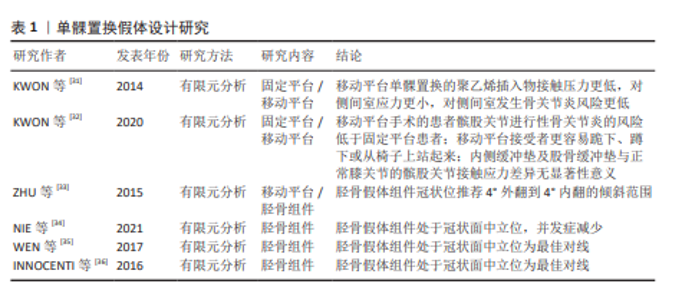
2.1 有限元分析在假体优化设计中的应用 2.1.1 活动平台与固定平台假体的对比 有研究表明单髁置换失效的主要原因是聚乙烯衬垫磨损和对侧间室的骨关节炎[25-26],这可能与膝关节置换术后膝关节假体局部应力增加有关。固定平台假体和移动平台假体的设计理念存在差异[27],固定平台假体将聚乙烯插件和胫骨组件进行锁定,更接近股骨髁在半月板表面运动的状态,其优点是手术技术相对成熟,医生操作起来较为熟悉,且在胫骨假体旋转不佳的情况下,固定平台单髁置换可以获得更好的临床效果,对手术技术的容错率更高[28];缺点是聚乙烯插件与胫骨组件的锁定设计,可能导致局部应力集中,加速聚乙烯插件的磨损,进而影响假体的使用寿命[29]。而移动平台假体的聚乙烯插件与胫骨假体相对独立,因此聚乙烯插件可以在胫骨组件表面自由滑动,移动平台假体的优势在于具有更好的形合性和活动能力,能够降低外侧半月板的压缩力,减少假体的磨损。此外,移动平台假体聚乙烯插件的接触面积较大,表面的接触应力相较于固定平台假体聚乙烯插件更低,从而将聚乙烯磨损降至最低[28],使假体的使用寿命和性能得以提高[30]。KWON等[31]通过有限元分析的方法构建包含骨与软组织的单髁置换模型,对比2种平台的聚乙烯插入物接触压力,结果显示移动平台单髁置换的聚乙烯插入物接触压力更低,对侧间室应力更小,对侧间室发生骨关节炎的风险更低,但在进行移动平台假体置换时应注意聚乙烯衬垫下表面的背侧应力对衬垫磨损的影响。还有研究在深屈膝条件下通过有限元分析评估2种假体设计在髌股关节接触应力和股四头肌力量方面的差异[32],结果显示,在膝关节深度屈曲条件下,移动平台假体对髌股关节的接触应力要低于固定平台单髁假体,因此接受移动平台手术的患者相比于固定平台会降低髌股关节进行性骨关节炎的风险;而二者与正常膝关节髌股关节的接触应力无统计学意义,则表明若患者无明显膝前疼痛,髌股关节退变不应为单髁置换术的绝对禁忌证;与固定平台相比,移动平台产生相同屈曲角度所需的股四头肌肌力较低,且移动平台假体设计保留了正常的生物力学效应,这些特性使得移动平台接受者更容易跪下、蹲下或从椅子上站起来。 2.1.2 单髁关节假体对位对线 单髁膝关节假体主要包括胫骨组件、聚乙烯衬垫以及股骨组件,在单髁置换中胫骨组件与股骨组件的对位及各个组件的倾斜角度的不同,对单髁置换术后对侧间室骨关节炎的发生率及聚乙烯衬垫的磨损存在一定的影响,异常的对位和各组件倾斜角度的不恰当可能会加速聚乙烯衬垫的磨损并且加速对侧间室骨关节炎的进展,以至于单髁假体使用寿命缩短。通过构建膝关节有限元模型,对单髁置换术后在不同倾斜角度、不同对位对线情况下对各个组件及对侧间室进行生物力学分析,可以找出各组件的最佳对位、最佳倾斜角度,从而指导关节外科医生在术中合理规划假体位置,以提高单髁置换的疗效,减少手术并发症发生。 ZHU等[33]运用有限元分析方法构建完整膝关节模型并验证,设置不同的结构、材料、接触关系,定义感兴趣区域分析骨应力/应变、负荷百分比和接触压力等,建立11个胫骨托冠状倾斜角从10°外翻到10°内翻单髁置换模型,以研究不同倾斜角度下胫骨应力应变、接触压力和负荷分布,结果表明胫骨组件冠状位处于4°外翻到4°内翻的倾斜范围时,并发症发生率降低,植入物长期存活率提高。NIE等[34]认为当胫骨植入物处于冠状面中间位置和矢状面接近患者原始倾斜度时,可能会减少单髁置换术后并发症的发生,WEN等[35]研究结果与上述一致。INNOCENTI等[36]通过有限元分析量化胫骨假体内翻/外翻对线在膝关节单髁置换术中对骨应力、负荷分布、韧带应变和聚乙烯衬垫应力分布的影响,建立特定患者的有限元模型,对比不同对线配置,发现当胫骨假体处于中立机械对线或3°内翻对线时,胫骨假体在骨、侧副韧带应变和聚乙烯衬垫方面的生物力学输出相似,6°内翻或外翻变化会带来更多不利影响,这个结论同样也验证了上面两个研究的结果,即当胫骨植入物处于中立位时为最佳排列。单髁假体对位对线对比见表1。"

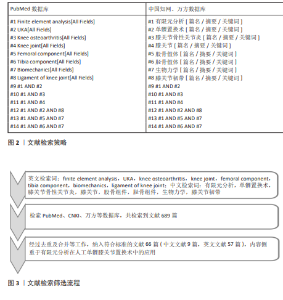
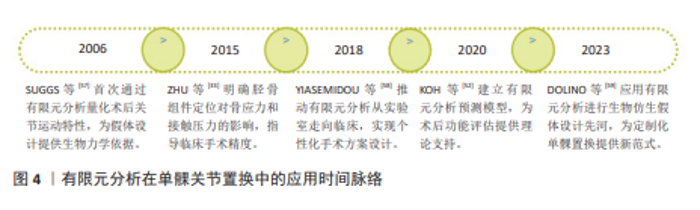
MA等[37]建立正常膝关节模型并验证,设置13种股骨假体工况,分析聚乙烯衬垫上表面、外侧间室软骨表面和胫骨假体下松质骨表面应力变化,他们认为单髁置换的固定平台股骨假体应避免平移或内翻/外翻倾斜。PARK等[38]利用计算模拟评估单髁膝关节置换术中股骨组件矢状位对聚乙烯衬垫、关节软骨和侧副韧带生物力学的影响,该研究构建了下肢有限元模型,分析股骨组件从10°伸展到10°屈曲过程中的情况。结果表明在股骨组件屈曲、伸展错位10°的模型中,相比于中立位模型,聚乙烯衬垫及关节软骨的接触应力均会明显升高,在股骨组件矢状位对线不良的时候,与中立位模型相比,伸展错位时内侧副韧带受力增加,屈曲错位时受力减少,而外侧副韧带、腘腓韧带和前外侧韧带则与内侧副韧带相反。因此,他们认为在单髁置换中,应注意避免股骨组件矢状位对线不良,这与KANG等[39]及HOPKINS等[40]的研究结果相一致。 2.1.3 单髁置换假体植入物设计 INNOCENTI等[41] 基于新鲜冷冻的尸体左膝标本的CT和MRI扫描,构建健康的膝关节模型,在健康膝关节模型的内侧间室虚拟置入固定轴承金属背衬单髁置换(Accuris),选择大号股骨组件和胫骨托盘,设置5种配置:平衡配置、过度填充配置(垫片厚度11 mm和12 mm)、填充不足配置(垫片厚度9 mm和8 mm),假体材料分别为氧化锆、钛合金和超高分子量聚乙烯,假设为均匀、各向同性、线性弹性材料,设定摩擦系数,假体组件与骨界面刚性固定模拟骨水泥使用;对每个膝关节配置施加2 000 N的垂直压缩力(膝关节完全伸展),胫骨远端完全固定,该载荷值对应80 kg体质量者的2.55倍体质量,相当于步态中的最大轴向力。使用四面体单元对每个模型进行网格划分,单元尺寸约1 mm,进行收敛性测试;使用 Abaqus/Standard 进行有限元模拟,提取完整膝关节和5种置换模型的胫骨近端冯·米塞斯应力、侧副韧带应变以及内外侧间室的载荷分布进行有限元分析,以研究单髁置换填充程度对骨应力、负荷分布和韧带应变的影响,研究发现单髁置换会改变膝关节内外侧间室的负荷分布、骨应力和韧带应变,即使在正常软组织张力和胫骨组件厚度正确的情况下也会导致关节僵硬改变,且不同的填充情况会产生不同影响,这些力学改变是术后疼痛、假体松动及外侧间室退变的潜在机制。上述研究为优化单髁置换手术技术(如垫片选择、软组织平衡)和假体设计提供了生物力学依据。 TUNCER等[42]通过对10个新鲜冷冻的尸体膝关节进行CT扫描、置入单髁置换、机械测试并附上应变片,同时开发了4个单髁置换胫骨和股骨的有限元模型,进行敏感性评估和收敛性研究以优化建模参数,对比各模型骨应变的预测值和测量值,发现骨水泥型单髁置换的预测结果相关性更好。该研究通过多样本尸体实验与有限元建模结合,验证了膝关节单髁置换术后骨应变的预测模型,发现骨水泥型假体的力学行为更易通过线性弹性模型模拟,而非骨水泥型需考虑界面非线性特性。精确的皮质骨模量赋值和应变片定位是模型准确性的关键,为膝关节单髁置换假体设计和手术优化提供了可靠的计算工具。 YANG等[43]研究了无骨水泥单髁置换中植入物对齐、骨材料特性、胫股前后平移和植入物设计因素对股骨-骨和胫骨托-骨界面微动的影响,通过有限元模型模拟日常活动,发现胫骨托-骨微动高于股骨-骨微动,且受多种因素影响,该研究结果有助于优化单髁置换的无骨水泥固定。DENG等[44]设计了一种仿生多孔胫骨植入物并应用有限元分析评估它在单髁置换后的生物力学效应,通过设计不同参数的Voronoi结构并制造样本进行准静态压缩测试,建立力学性能与设计参数关系,再构建有限元模型评估植入物在站立阶段的生物力学效应,结果表明设计的胫骨植入物能减少应力屏蔽,重建应力转移途径,该研究通过仿生 Voronoi 多孔结构设计结合有限元分析验证,证实多孔钛合金胫骨托盘可有效改善单髁置换术后的应力传递,减少应力屏蔽,为优化单髁膝关节置换术假体设计提供了新策略。 VAN DEN HEEVER等[45]提出了一种应力分布更理想、植入物与关节面更匹配的定制化假体设计理念,并运用有限元分析将定制化假体与传统假体进行接触应力分布的比较。该研究定制化设计理念是基于神经网络建模和自组织映射算法,利用患者的MRI/CT数据预测健康的膝关节几何形态,具体而言,定制股骨部件的骨-植入物表面被设计成与患者股骨髁精确匹配,而胫骨部件则确保了完整的皮质边缘覆盖,从而达到恢复患者原始关节面、减少骨切除面积、实现假体与骨骼之间最佳覆盖的目的。基于此设计理念,该研究团队进行了详细的有限元建模并进行数据分析,在模型构建阶段,分别构建了定制化单髁假体以及传统固定式和移动式假体的有限元模型并导入MD Patran软件,所有部件均被定义为可变形体,并采用十节点四面体单元进行精细的网格划分;在材料属性方面,股骨部件被设定为线性弹性各向同性材料(钴铬合金),而聚乙烯衬垫则被定义为非线性材料,载荷与约束的施加也严格遵循生理条件;随后,在不同屈曲角度条件下对假体进行了静态有限元分析,全面评估聚乙烯衬垫和骨植入物界面的接触应力分布。结果显示,定制化假体在股骨-胫骨关节处的接触应力明显低于固定式设计,并且在骨植入物界面处呈现出更为均匀的应力分布,而均匀的应力分布对于减少植入区域的骨重塑、降低无菌性松动风险至关重要。因此定制化假体的仿生几何设计,对维持膝关节内侧髁自然曲率、增加骨与假体接触面积、降低边缘应力集中方面有显著的作用,尤其在屈伸过程中能保持膝关节更稳定的应力分布。 这些研究充分证明了有限元分析可以有效模拟手术参数(如填充程度、材料特性及几何形状)、预测生物力学响应,并为临床手术(如垫片选择和软组织平衡)提供可靠依据;作为优化单假体设计的关键工具,通过有限元分析的预测性模拟机制,不仅从理论上降低了术后风险,提高假体耐久和患者预后能力,而且在精确预测参数变化影响、提供数据驱动的基础上,将生物力学模拟与临床应用紧密结合,增强了单体假设计优化的整体可行性和实际效果。 2.2 有限元分析对单髁置换手术规划优化 2.2.1 不同胫骨组件斜率的对比 有研究表明胫骨近端的应力增加,导致胫骨近端骨折的风险也会增加[46]。SIMPSON等[47]使用经过验证的有限元模型,研究单髁膝关节置换术后胫骨近端应力变化的情况,他们发现假体置入后胫骨近端骨应变增加了40%,某些置入错误会导致应变值过高,这可能是术后疼痛的原因,随着时间推移骨重塑会使应变降低,疼痛通常在12个月内消失,但在部分病例中疼痛会持续恶化。因此通过构建有限元模型对单髁置换后进行膝关节生物力学分析,以此改进手术技术,降低胫骨平台的应力从而减少术后并发症是十分必要的。胫骨假体后斜率的变化是导致胫骨近端应力增加的重要因素,具体见表2。DAI等[48]构建正常膝关节和单髁置换模型,设定不同倾斜度测试应力,结果表明胫骨组件倾斜度影响应力分布,轻微内翻倾斜可降低内侧皮质峰值应力并避免龙骨尖端与内侧胫骨皮质间应力上升。而SIMPSON等[49]认为轻微外翻倾斜可能更有利于应力分布,这与IESAKA等[50]的研究得出的结论一致。 KANG等[51]使用有限元分析评估胫骨后斜率对单髁膝关节置换术中聚乙烯衬垫和关节软骨接触应力的影响,构建计算模型,设置-1°-15°不同的胫骨后斜率,在正常水平行走的加载条件下进行研究,结果显示外侧关节软骨接触应力随斜率增加而增加,聚乙烯衬垫接触应力情况较复杂,因此他们认为与初始解剖胫骨斜率±2°的偏差不会对结果产生生物力学影响。KOH等[52]建立7种不同后胫骨斜率的有限元模型,分析在正常行走条件下聚乙烯插入物上下表面、关节软骨的接触应力和前交叉韧带受力情况,他们发现后胫骨斜率增加会使聚乙烯插入物接触应力降低,但外侧关节软骨接触应力和前交叉韧带受力增加,在移动平台单髁置换中,增加胫骨后斜率会使聚乙烯插入物的接触应力降低,但会使外侧关节软骨的接触应力和前交叉韧带受力增加,可能导致对侧间室进行性骨关节炎和前交叉韧带失效。YUAN等[53]构建了健康膝关节有限元模型,模拟5种不同胫骨组件后倾角的移动承载型单髁膝关节置换术模型,计算内外侧间室最大接触压力,结果表明胫骨假体后倾角>7°时,外侧胫骨平台软骨最大接触压力增加,聚乙烯衬垫最大接触压力无显著变化。 总之,对于胫骨假体后倾角度的控制,其核心并非追求一个绝对统一的最优值,而是在深刻理解其生物力学效应的复杂性与矛盾性基础上,进行个体化的精准重建。上述多项研究明确揭示了后倾角调整所带来的“双刃剑”效应:适度增加后倾角虽能有效降低聚乙烯衬垫的接触应力,有利于延长假体使用寿命,但此举会以增加对侧间室软骨及前交叉韧带的负荷为代价,可能加速邻近间室的退变和韧带的失效[52]。因此,理想的后倾角控制策略是在这一对矛盾关系中寻求平衡点。在术中操作层面,为实现这一平衡,外科医生应首先通过术前影像学评估,精确测量并确定患者自身的解剖后倾角,并将其作为手术重建的首要目标。术中需借助精确的髓外定位截骨导向系统,将截骨模块的角度预设为测得的解剖值;在进行胫骨平台截骨时,应避免追求减小衬垫应力而追求过大的后倾角进行的过度截骨。根据上述研究,将后倾角控制在患者自身解剖角度的±2°范围内,这个范围通常是生物力学上可接受的安全区间[51],同时应极力避免后倾角超过7°,以至于导致对侧间室压力骤增从而加速对侧间室骨关节炎的进展[53]。手术的目标是恢复患者个体的正常膝关节功能,在保证假体稳定和低磨损的同时,最大限度地保护膝关节内的其他结构,从而实现长期的临床成功。 2.2.2 关节线保留对单髁置换影响分析 KANG等[54]通过有限元分析,以胫骨内侧平台到解剖轴的垂直投影线定义0 mm关节线,构建±6,±4,±2,0 mm共7种关节线偏移模型,模拟牛津膝关节系统,聚乙烯衬垫设为弹塑性材料,金属部件为线弹性材料,摩擦系数为0.04,构建关节线的有限元模型,模拟正常行走步态周期,施加轴向载荷、屈伸角度、前后/ 内外旋转力矩等,计算聚乙烯衬垫上/下表面、股骨关节软骨的最大接触压力,分析其在步态周期中的变化趋势,对移动平台单髁膝关节置换术的关节线保留效果进行研究。最终得出结论,即活动式平台单髁置换中,术后关节线偏移(尤其是升高)可能导致聚乙烯衬垫磨损加剧、对侧软骨过载,增加无菌性松动和骨关节炎风险。KWON等[55]使用同样的方法,模拟固定平台单髁置换中关节线保留对聚乙烯衬垫、关节软骨和外侧半月板接触应力的影响,通过建立关节线有限元模型并调整关节线位置,在ISO步态加载条件下分析对比,他们发现关节线偏移会导致应力在衬垫、软骨和半月板之间重新分布,过度偏移(尤其是±6 mm)可能引发衬垫磨损、软骨退变或半月板损伤。2篇文章的对比见表3。综上所述,关节线保留在单髁置换中具有十分重要的作用,但因平台类型和分析结构不同,揭示了不同的力学机制,活动式平台单髁置换重点关注关节线升高对衬垫的磨损风险,而固定平台单髁置换则需综合考虑衬垫、软骨和半月板的应力平衡。临床实践中,外科医生应根据假体类型(活动式/固定式)选择个性化关节线管理策略,术前通过影像学精准规划截骨量和衬垫厚度,避免过度偏移引发并发症。 2.2.3 Mikulicz线偏移对单髁置换的影响 OU等[56]以髋-膝-踝关节线定义机械轴(Mikulicz线),从膝关节中点向内侧以 1 mm 间隔标记点,模拟 Mikulicz 线通过膝关节不同点,建立60组不同下肢对线的有限元模型,并且固定胫骨,约束腓骨远端坐标,将股骨定义为实体,设置远程点(股骨头中心)和垂直向下1 000 N的远程力,模拟膝关节生物力学,以研究不同下肢力线对内侧单髁膝关节置换术的影响。他们收集了垫片应力、外侧半月板应力、外侧股骨软骨应力、胫骨软骨应力、股骨假体与垫片接触面积、内外侧股骨软骨接触面积等数据,他们发现当Mikulicz线从膝关节中点向内侧移动时,下肢载荷主要集中在内侧间室,外侧半月板、胫骨软骨和股骨软骨的应力值逐渐降低,内侧聚乙烯衬垫应力逐渐增加,当向外侧移动时则相反;并且当Mikulicz线位于膝关节中点内侧10 mm或稍外侧时,胫骨组件骨折风险较低,外侧间室应力较小,假体负荷较低。当内侧偏移超过10 mm时,胫骨假体周围骨折风险显著增加,骨退化风险增加;外侧偏移会增加外侧间室骨关节炎风险,且应力增加幅度大于骨折风险降低幅度。综上所述,在进行内侧单髁置换时,应确保Mikulicz线处于理想位置,以实现良好的功能结果,避免单髁置换术后与假体相关的并发症风险增加。 2.2.4 单髁置换中软组织平衡的有限元分析 纵观有限元分析在单髁置换术领域的发展历程,其表现出的价值尤为显著,具体的时间脉络如图4所示。在单髁关节置换中,软组织平衡对术后生物力学性能具有举足轻重的影响。膝关节的稳定性在很大程度上高度依赖于其复杂的韧带结构,这包括前交叉韧带、后交叉韧带以及内外侧副韧带(内侧副韧带、外侧副韧带)等重要组成部分。在过去,前交叉韧带缺损曾一度被视为单髁关节置换手术的绝对禁忌证[60]。随着单髁关节技术的成熟及有限元分析技术不断进步,手术适应证得到了有效拓展,前交叉韧带缺损也不再被视为单髁关节置换的绝对禁忌证[61-63]。有限元分析作为一种模拟工具,为研究人员探究不同截骨量、假体尺寸和位置以分析上述因素对韧带张力、关节接触压力以及骨应变分布的精确影响提供了有效手段。KANG等[51]和KOH等[52]的研究利用有限元分析不但揭示了胫骨后倾角的变化如何影响聚乙烯衬垫和对侧软骨的接触应力,还深入探讨了这种变化对侧韧带(如前交叉韧带)负荷的影响。他们的研究结果显示,过度的后倾角度可能导致对侧间室软骨和膝关节周围韧带的负荷增加,从而加速对侧间室软骨磨损和膝关节韧带退变的过程。OU等[64]构建前交叉韧带不同程度缺损的单髁置换模型,对每个模型施加4种不同类型的载荷并进行有限元分析,发现即使前交叉韧带损伤甚至断裂,只要在膝关节的其他结构保持完整并能提供前后向稳定性可以使膝关节仍能保持稳定的条件下,单髁关节置换仍是可行的治疗方案,这与BULL等[65]的结论一致。总之,有限元分析的预测能力使得外科医生能够在术前进行多种手术方案的预演,评估不同手术方案对软组织张力的潜在影响,进而在术中通过调整截骨角度和假体置入位置,以达到最佳的软组织张力平衡,避免韧带过松或过紧,影响单髁假体的使用寿命。 在单髁置换假体优化设计与手术规划两大核心方面,有限元分析凭借其无创性、预测性和卓越的多参数整合能力,引领单髁置换术实现了从经验依赖向数据精准的重大理念转变。在下肢力线及关节面曲率恢复方面,有限元分析能够精确量化截骨方案和假体位置对下肢力线及关节内生物力学的具体影响,将力线调整从经验判断提升到基于量化数据的精准操作层面。通过模拟不同假体结构的应力分布,有限元分析显著提升了假体设计的科学性,确保假体置入后能更好地恢复生理力线及关节面曲率。有限元分析不但为单髁置换术前规划阶段提供了客观、可重复验证的依据,还在假体设计层面实现了力学驱动的精准优化,显著提高了手术的精准度,降低了术后并发症风险,延长了假体的使用寿命。"
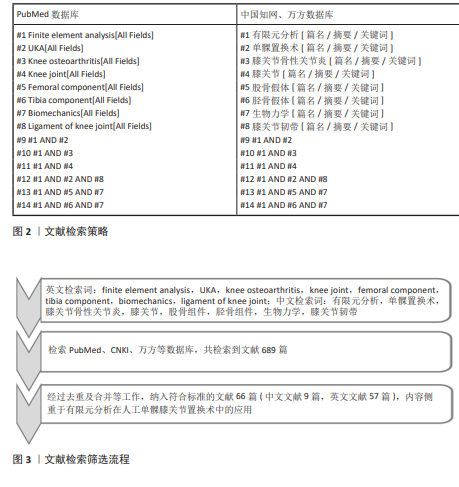
"

| [1] PRIETO-ALHAMBRA D, JUDGE A, JAVAID MK, et al. Incidence and risk factors for clinically diagnosed knee, hip and hand osteoarthritis: influences of age, gender and osteoarthritis affecting other joints. Ann Rheum Dis. 2014;73(9):1659-1664. [2] AROKOSKI JP, JURVELIN JS, VÄÄTÄINEN U, et al. Normal and pathological adaptations of articular cartilage to joint loading. Scand J Med Sci Sports. 2000;10(4):186-198. [3] PALAZZO C, NGUYEN C, LEFEVRE-COLAU MM, et al. Risk factors and burden of osteoarthritis. Ann Phys Rehabil Med. 2016; 59(3):134-138. [4] CROSS M, SMITH E, HOY D, et al. The global burden of hip and knee osteoarthritis: estimates from the global burden of disease 2010 study. Ann Rheum Dis. 2014;73(7): 1323-1330. [5] 廖德发.我国骨性关节炎流行病学调查现状[J].微创医学,2017,12(4):521-524. [6] 黄晓丹,李华,杨山,等.膝单髁置换术后髌股关节生物力学变化的相关研究[J].中华骨与关节外科杂志,2024,17(7):604-608. [7] MURRAY DW, GOODFELLOW JW, O’CONNOR JJ. The Oxford medial unicompartmental arthroplasty: a ten-year survival study. J Bone Joint Surg Br. 1998;80(6):983-989. [8] SANTOSO MB, WU L. Unicompartmental knee arthroplasty, is it superior to high tibial osteotomy in treating unicompartmental osteoarthritis? A meta-analysis and systemic review. J Orthop Surg Res. 2017;12(1):50. [9] BANNURU RR, OSANI MC, VAYSBROT EE, et al. Oarsi guidelines for the non-surgical management of knee, hip, and polyarticular osteoarthritis. Osteoarthritis Cartilage. 2019;27(11):1578-1589. [10] ZHANG W, DOHERTY M, PEAT G, et al. Eular evidence-based recommendations for the diagnosis of knee osteoarthritis. Ann Rheum Dis. 2010;69(3):483-489. [11] MOYER RF, BIRMINGHAM TB, BRYANT DM, et al. Biomechanical effects of valgus knee bracing: a systematic review and meta-analysis. Osteoarthritis Cartilage. 2015;23(2):178-188. [12] LIDDLE AD, JUDGE A, PANDIT H, et al. Adverse outcomes after total and unicompartmental knee replacement in 101,330 matched patients: a study of data from the National Joint Registry for England and Wales. Lancet. 2014;384(9952): 1437-1445. [13] 于风天,魏杰,王晓东.腓骨近端截骨术与胫骨高位截骨术治疗内翻型膝关节骨关节炎的疗效比较[J].中华老年骨科与康复电子杂志, 2016,2(2):97-102. [14] 陈明,吴立生,张存华,等.膝关节骨关节炎单间室置换术研究进展[J].中华关节外科杂志(电子版),2021,15(2):231-238. [15] HUI C, SALMON LJ, KOK A, et al. Long-term survival of high tibial osteotomy for medial compartment osteoarthritis of the knee. Am J Sports Med. 2011; 39(1):64-70. [16] PRICE AJ, ALVAND A, TROELSEN A, et al. Knee replacement. Lancet. 2018;392(10158): 1672-1682. [17] 任俊涛,张云飞,李鹏,等.单髁置换术治疗单间室膝关节疾病的体会[J].中国骨与关节损伤杂志,2022,37(4):363-367. [18] PANDIT H, LIDDLE AD, KENDRICK BJ, et al. Improved fixation in cementless unicompartmental knee replacement: five-year results of a randomized controlled trial. J Bone Joint Surg Am. 2013;95(15):1365-1372. [19] PRIETO-ALHAMBRA D, JUDGE A, JAVAID MK, et al. Incidence and risk factors for clinically diagnosed knee, hip and hand osteoarthritis: influences of age, gender and osteoarthritis affecting other joints. Ann Rheum Dis. 2014;73(9):1659-1664. [20] LI Z, ESPOSITO CI, KOCH CN, et al. Polyethylene Damage Increases With Varus Implant Alignment in Posterior-stabilized and Constrained Condylar Knee Arthroplasty. Clin Orthop Relat Res. 2017; 475(12):2981-2991. [21] ZHANG M, WANG H, ZHANG Y, et al. Gradual restoration of gait following unicompartmental knee arthroplasty: a prospective study. J Orthop Surg Res. 2025;20(1):315. [22] FLURY A, HASLER J, DIMITRIOU D, et al. Midterm clinical and radiographic outcomes of 115 consecutive patient-specific unicompartmental knee arthroplasties. Knee. 2019;26(4):889-896. [23] KOH YG, PARK KM, LEE HY, et al. Influence of tibiofemoral congruency design on the wear of patient-specific unicompartmental knee arthroplasty using finite element analysis. Bone Joint Res. 2019;8(3):156-164. [24] PFEIFFER FM. The Use of Finite Element Analysis to Enhance Research and Clinical Practice in Orthopedics. J Knee Surg. 2016;29(2):149-158. [25] LINDSTRAND A, STENSTRÖM A, LEWOLD S. Multicenter study of unicompartmental knee revision. PCA, Marmor, and St Georg compared in 3,777 cases of arthrosis. Acta Orthop Scand. 1992;63(3):256-259. [26] PALMER SH, MORRISON PJ, ROSS AC. Early catastrophic tibial component wear after unicompartmental knee arthroplasty. Clin Orthop Relat Res. 1998;(350):143-148. [27] 李浩然,黄健.有限元分析在人工膝关节置换中的应用[J].中国组织工程研究,2023,27(31): 5058-5063. [28] 张子恒,齐岩松,徐永胜.有限元分析技术在膝关节骨性关节炎诊疗中的应用进展[J].骨科临床与研究杂志,2024,9(2):96-101. [29] KRETZER JP, JAKUBOWITZ E, REINDERS J, et al. Wear analysis of unicondylar mobile bearing and fixed bearing knee systems: a knee simulator study. Acta Biomater. 2011;7(2):710-715. [30] 雷雪枫,张文正,薛华明,等.活动平台单髁假体和固定平台单髁假体治疗膝关节内侧间室骨性关节炎的研究进展[J].生物骨科材料与临床研究,2023,20(1):76-79. [31] KWON OR, KANG KT, SON J, et al. Biomechanical comparison of fixed- and mobile-bearing for unicomparmental knee arthroplasty using finite element analysis. J Orthop Res. 2014;32(2):338-345. [32] KWON HM, LEE JA, KOH YG, et al. Effects of contact stress on patellarfemoral joint and quadriceps force in fixed and mobile-bearing medial unicompartmental knee arthroplasty. J Orthop Surg Res. 2020;15(1):517. [33] ZHU GD, GUO WS, ZHANG QD, et al. Finite Element Analysis of Mobile-bearing Unicompartmental Knee Arthroplasty: The Influence of Tibial Component Coronal Alignment. Chin Med J (Engl). 2015;128(21): 2873-2878. [34] NIE Y, YU Q, SHEN B. Impact of Tibial Component Coronal Alignment on Knee Joint Biomechanics Following Fixed-bearing Unicompartmental Knee Arthroplasty: A Finite Element Analysis. Orthop Surg. 2021;13(4):1423-1429. [35] WEN PF, GUO WS, GAO FQ, et al. Effects of Lower Limb Alignment and Tibial Component Inclination on the Biomechanics of Lateral Compartment in Unicompartmental Knee Arthroplasty. Chin Med J (Engl). 2017;130(21):2563-2568. [36] INNOCENTI B, PIANIGIANI S, RAMUNDO G, et al. Biomechanical Effects of Different Varus and Valgus Alignments in Medial Unicompartmental Knee Arthroplasty. J Arthroplasty. 2016;31(12): 2685-2691. [37] MA P, MUHEREMU A, ZHANG S, et al. Biomechanical effects of fixed-bearing femoral prostheses with different coronal positions in medial unicompartmental knee arthroplasty. J Orthop Surg Res. 2022;17(1):150. [38] PARK KK, KOH YG, PARK KM, et al. Biomechanical effect with respect to the sagittal positioning of the femoral component in unicompartmental knee arthroplasty. Biomed Mater Eng. 2019;30(2): 171-182. [39] KANG KT, SON J, KOH YG, et al. Effect of femoral component position on biomechanical outcomes of unicompartmental knee arthroplasty. Knee. 2018;25(3):491-498. [40] HOPKINS AR, NEW AM, RODRIGUEZ-Y-BAENA F, et al. Finite element analysis of unicompartmental knee arthroplasty. Med Eng Phys. 2010;32(1):14-21. [41] INNOCENTI B, BILGEN ÖF, LABEY L, et al. Load sharing and ligament strains in balanced, overstuffed and understuffed UKA. A validated finite element analysis. J Arthroplasty. 2014;29(7): 1491-1498. [42] TUNCER M, COBB JP, HANSEN UN, et al. Validation of multiple subject-specific finite element models of unicompartmental knee replacement. Med Eng Phys. 2013;35(10):1457-1464. [43] YANG H, MARRAS D, CLARY CW, et al. Impact of Surgical Alignment, Bone Properties, Anterior-Posterior Translation, and Implant Design Factors on Fixation in Cementless Unicompartmental Knee Arthroplasty. J Biomech Eng. 2025;147(1):011007. [44] DENG T, GONG S, CHENG Y, et al. Stochastic lattice-based porous implant design for improving the stress transfer in unicompartmental knee arthroplasty. J Orthop Surg Res. 2024;19(1):499. [45] VAN DEN HEEVER DJ, SCHEFFER C, ERASMUS P, et al. Contact stresses in a patient-specific unicompartmental knee replacement. Clin Biomech (Bristol). 2011;26(2):159-166. [46] CHANG TW, YANG CT, LIU YL, et al. Biomechanical evaluation of proximal tibial behavior following unicondylar knee arthroplasty: modified resected surface with corresponding surgical technique. Med Eng Phys. 2011;33(10):1175-1182. [47] SIMPSON DJ, PRICE AJ, GULATI A, et al. Elevated proximal tibial strains following unicompartmental knee replacement--a possible cause of pain. Med Eng Phys. 2009;31(7):752-757. [48] DAI X, FANG J, JIANG L, et al. How does the inclination of the tibial component matter? A three-dimensional finite element analysis of medial mobile-bearing unicompartmental arthroplasty. Knee. 2018;25(3):434-444. [49] SIMPSON DJ, KENDRICK BJ, DODD CA, et al. Load transfer in the proximal tibia following implantation with a unicompartmental knee replacement: a static snapshot. Proc Inst Mech Eng H. 2011;225(5):521-529. [50] IESAKA K, TSUMURA H, SONODA H, et al. The effects of tibial component inclination on bone stress after unicompartmental knee arthroplasty. J Biomech. 2002;35(7):969-974. [51] KANG KT, PARK JH, KOH YG, et al. Biomechanical effects of posterior tibial slope on unicompartmental knee arthroplasty using finite element analysis. Biomed Mater Eng. 2019;30(2):133-144. [52] KOH YG, PARK KM, KANG KT. Finite Element Study on the Preservation of Normal Knee Kinematics with Respect to the Prosthetic Design in Patient-Specific Medial Unicompartmental Knee Arthroplasty. Biomed Res Int. 2020;2020:1829385. [53] YUAN B, MO Z, ZHANG K, et al. The effect of different posterior inclinations of tibial component on tibiofemoral contact pressures after unicompartmental knee arthroplasty. J Orthop Surg Res. 2023;18(1):909. [54] KANG KT, KWON OR, SON J, et al. Effect of joint line preservation on mobile-type bearing unicompartmental knee arthroplasty: finite element analysis. Australas Phys Eng Sci Med. 2018;41(1):201-208. [55] KWON OR, KANG KT, SON J, et al. Importance of joint line preservation in unicompartmental knee arthroplasty: Finite element analysis. J Orthop Res. 2017;35(2):347-352. [56] OU D, YE Y, PAN J, et al. Finite element study of stress distribution in medial UKA under varied lower limb alignment. Sci Rep. 2024;14(1):25397. [57] SUGGS JF, LI G, PARK SE, et al. Knee biomechanics after UKA and its relation to the ACL--a robotic investigation. J Orthop Res. 2006;24(4):588-594. [58] YIASEMIDOU M, GLASSMAN D, JAYNE D, et al. Is patient-specific pre-operative preparation FEA sible in a clinical environment? A systematic review and meta-analysis. Comput Assist Surg (Abingdon). 2018;23(1):57-68. [59] DOLINO G, COATO D, FORNI R, et al. Designing a Synthetic 3D-Printed Knee Cartilage: FEA Model, Micro-Structure and Mechanical Characteristics. Appl Sci. 2024;14:331. [60] ENGH GA, AMMEEN D. Is an intact anterior cruciate ligament needed in order to have a well-functioning unicondylar knee replacement? Clin Orthop Relat Res. 2004;(428):170-173. [61] ZHANG X, LIU Y, SHENGYUAN Y, et al. Clinical outcomes of fixed-bearing unicompartmental knee arthroplasty in patients with ACL degeneration and patellofemoral joint degeneration: A retrospective cohort study. Orthop Traumatol Surg Res. 2025;111(8):104333. [62] JIA S, LONG D, ZHANG B, et al. The impact of anterior cruciate ligament deficiency severity on the outcomes of fixed-bearing unicompartmental knee arthroplasty: a retrospective study. J Orthop Surg Res. 2025;20(1):244. [63] PLANCHER KD, BRIGGS KK, COMULADA DB, et al. Fixed-Bearing Lateral Unicompartment Knee Arthroplasty in Degenerative ACL-Deficient and ACL-Intact Knees: A Matched Pair Analysis. J Arthroplasty. 2025;40(1):70-74. [64] OU D, YE Y, PAN J, et al. Anterior cruciate ligament injury should not be considered a contraindication for medial unicompartmental knee arthroplasty: Finite element analysis. PLoS One. 2024;19(3): e0299649. [65] BULL D, MANNAN A, ANSARI J, et al. Medial/central PF arthritis and functionally stable ACL deficiency do not compromise outcomes of fixed-bearing medial UKA. Knee. 2022;35:8-15. [66] 卜延民,赵慧雯,郑得志,等.关节置换术机器人手术系统的现状及发展趋势[J].中国矫形外科杂志,2024,32(19):1780-1785. |
| [1] | Chen Qiuhan, Yang Long, Yuan Daizhu, Wu Zhanyu, Zou Zihao, Ye Chuan. Peri-knee osteotomy for treatment of knee osteoarthritis: optimization of treatment strategies [J]. Chinese Journal of Tissue Engineering Research, 2026, 30(9): 2303-2312. |
| [2] | Zhang Zizheng, Luo Wang, Liu Changlu. Application value of finite element analysis on unicompartmental knee arthroplasty for medial knee compartmental osteoarthritis [J]. Chinese Journal of Tissue Engineering Research, 2026, 30(9): 2313-2322. |
| [3] | Zhang Xianxu, Ma Zhong, Liu Xin, Huang Lei, Shen Wenxiang, Luo Zhiqiang . Lumbar fusion combined with unilateral fixation for lumbar degenerative diseases: biomechanics, technical evolution, and clinical applications [J]. Chinese Journal of Tissue Engineering Research, 2026, 30(9): 2334-2342. |
| [4] | Chen Huiting, Zeng Weiquan, Zhou Jianhong, Wang Jie, Zhuang Congying, Chen Peiyou, Liang Zeqian, Deng Weiming. Tail anchoring technique of vertebroplasty in treatment of osteoporotic vertebral compression fractures with intravertebral cleft: a finite element analysis [J]. Chinese Journal of Tissue Engineering Research, 2026, 30(9): 2145-2152. |
| [5] | Zeng Xuan, Weng Rui, Ye Shicheng, Tang Jiadong, Mo Ling, Li Wenchao. Two lumbar rotary manipulation techniques in treating lumbar disc herniation: a finite element analysis of biomechanical differences [J]. Chinese Journal of Tissue Engineering Research, 2026, 30(9): 2153-2161. |
| [6] | Cheng Qisheng, Julaiti·Maitirouzi, Xiao Yang, Zhang Chenwei, Paerhati·Rexiti. Finite element analysis of novel variable-diameter screws in modified cortical bone trajectory of lumbar vertebrae [J]. Chinese Journal of Tissue Engineering Research, 2026, 30(9): 2162-2171. |
| [7] | Wu Hongxu, Liu Xuanyu, Wang Taoyu, Wang Shiyao, Cheng Jingyi, Zhang Mingwen, Zhang Yinxia, Liu Zhihua, Wang Xiaojie. Finite element simulation of scoliosis with muscle unit introduction: verification of correction effect under bidirectional load [J]. Chinese Journal of Tissue Engineering Research, 2026, 30(9): 2172-2181. |
| [8] | Liu Jiafu, Ren Ruxia, Liao Zhouwei, Zhou Xiali, Wu Yihong, Zhang Shaoqun. Three-dimensional finite element analysis of cervical spine biomechanical characteristics in a rat model of cervical vertigo [J]. Chinese Journal of Tissue Engineering Research, 2026, 30(9): 2182-2190. |
| [9] | Zhou Daobin, Wang Kehao, Xie Yang, Ning Rende. Biomechanical characteristics of volar locking plate only versus combined dorsal mini-plate fixation of distal radius fractures with dorsal ulnar fragment [J]. Chinese Journal of Tissue Engineering Research, 2026, 30(9): 2255-2261. |
| [10] | Liu Wenlong, Dong Lei, Xiao Zhengzheng, Nie Yu. Finite element analysis of tibial prosthesis loosening after fixed-bearing unicompartmental knee arthroplasty for osteoporosis [J]. Chinese Journal of Tissue Engineering Research, 2026, 30(9): 2191-2198. |
| [11] | Zheng Wangyang, Fei Ji, Yang Di, Zhao Lang, Wang Lingli, Liu Peng, Li Haiyang. Finite element analysis of the force changes of the supraspinatus tendon and glenohumeral joint during the abduction and flexion of the humerus [J]. Chinese Journal of Tissue Engineering Research, 2026, 30(9): 2199-2207. |
| [12] | Cai Qirui, Dai Xiaowei, Zheng Xiaobin, Jian Sili, Lu Shaoping, Liu Texi, Liu Guoke, Lin Yuanfang. Mechanical effects of Long’s traction orthopedic method on cervical functional units: quantitative analysis of biomechanical model of head and neck [J]. Chinese Journal of Tissue Engineering Research, 2026, 30(9): 2208-2216. |
| [13] | Rao Jingcheng, Li Yuwan, Zheng Hongbing, Xu Zhi, Zhu Aixiang, Shi Ce, Wang Bing, Yang Chun, Kong Xiangru, Zhu Dawei. Biomechanical differences between the new proximal femoral stable intramedullary nail and traditional intramedullary nail#br# [J]. Chinese Journal of Tissue Engineering Research, 2026, 30(9): 2217-2225. |
| [14] | Chen Long, Wang Xiaozhen, Xi Jintao, Lu Qilin. Biomechanical performance of short-segment screw fixation combined with expandable polyetheretherketone vertebral body replacement in osteoporotic vertebrae [J]. Chinese Journal of Tissue Engineering Research, 2026, 30(9): 2226-2235. |
| [15] | Yan Xiangning, Chen Lei, Chen Yonghuan, Wang Chao, Li Xiaosheng. Influence of different depths and loads on knee joint mechanics and peripheral muscle force characteristics during squatting [J]. Chinese Journal of Tissue Engineering Research, 2026, 30(9): 2236-2247. |
| Viewed | ||||||
|
Full text |
|
|||||
|
Abstract |
|
|||||