Chinese Journal of Tissue Engineering Research ›› 2026, Vol. 30 ›› Issue (21): 5541-5548.doi: 10.12307/2026.342
Previous Articles Next Articles
Comparison of stability of percutaneous minimally invasive pedicle screw insertion in thoracolumbar fractures through and across the injured vertebra under navigation
Jia Yingao1, Qiao Lina2, Zhang Chao1, Liang Jiawen1, Xue Liang1, Wang Fei1
- 1Department of Spine Surgery, 2Department of Pathology, Affiliated Hospital of Yan'an University, Yan'an 716000, Shaanxi Province, China
-
Accepted:2025-05-24Online:2026-07-28Published:2026-03-05 -
Contact:Wang Fei, MD, Chief physician, Department of Spine Surgery, Affiliated Hospital of Yan'an University, Yan'an 716000, Shaanxi Province, China -
About author:Jia Yingao, Master candidate, Department of Spine Surgery, Affiliated Hospital of Yan'an University, Yan'an 716000, Shaanxi Province, China -
Supported by:Yan'an Science and Technology Planning Project, No. 2024-CYL-029 (to WF)

CLC Number:
Cite this article
Jia Yingao, Qiao Lina, Zhang Chao, Liang Jiawen, Xue Liang, Wang Fei. Comparison of stability of percutaneous minimally invasive pedicle screw insertion in thoracolumbar fractures through and across the injured vertebra under navigation[J]. Chinese Journal of Tissue Engineering Research, 2026, 30(21): 5541-5548.
share this article
Add to citation manager EndNote|Reference Manager|ProCite|BibTeX|RefWorks
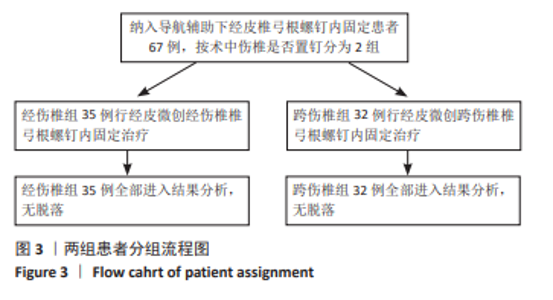
2.1 参与者数量分析 纳入计算机导航辅助下进行经皮椎弓根螺钉内固定治疗67例患者的病历资料, 根据术中伤椎是否置钉分为2组,经伤椎组35例,跨伤椎组32例,全部进入结果分析,无脱落。 2.2 试验流程图 见图3。"
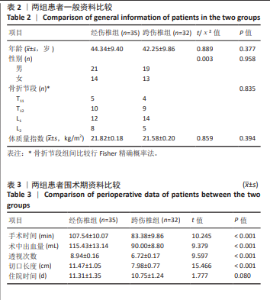
2.3 一般资料对比 两组患者的年龄、性别、骨折节段、体质量指数相比,差异均无显著性意义(P > 0.05),见表2。 2.4 围术期资料对比 对比两组的围术期参数,可见跨伤椎组的手术时间短、出血量少、手术切口小、术中透视次数少,差异均有显著性意义(P < 0.05),而在住院时间上两组差异无显著性意义(P > 0.05),见表3。"
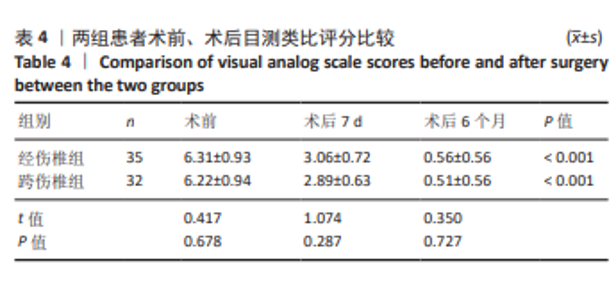
2.5 疼痛及功能评分对比 两组术后7 d、6个月的目测类比评分均较术前减小,差异有显著性意义(P < 0.05),两组间术前和术后的目测类比评分相比差异均无显著性意义,见表4。"
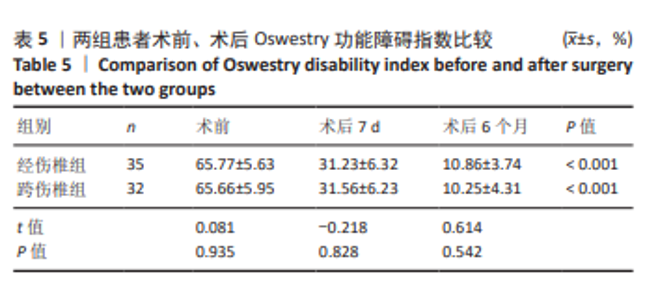
两组患者术后7 d、6个月的Oswestry功能障碍指数均较术前减小,差异有显著性意义(P < 0.05),两组间术前和术后的Oswestry功能障碍指数相比差异均无显著性意义,见表5。 "
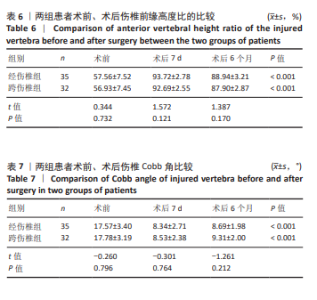
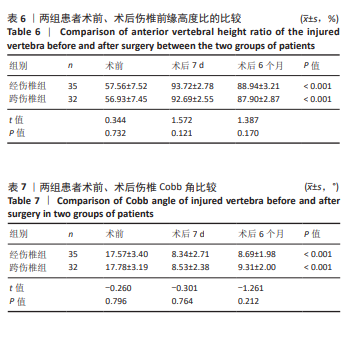
2.6 影像学参数对比 两组患者术前的伤椎前缘高度比和伤椎前缘Cobb角分别和术后7 d、术后6个月进行比较,差异均有显著性意义(P < 0.05),证明两种手术均能有效复位固定伤椎;两组间术前、术后7 d及术后6个月的伤椎前缘高度比和伤椎Cobb角相比差异均无显著性意义(P > 0.05),见表6,7。 表4-7结果显示,两组术前的影像学参数相比差异无显著性意义,具有可比性;而两组术后的影像学参数较术前显著改善,说明经皮椎弓根螺钉经伤椎和跨伤椎两种固定方式术后,伤椎均得到有效复位和固定,而且6个月后复查影像学资料表明,中短期内两种术式对伤椎的高度维持和伤椎Cobb角的矫正无差异;经伤椎组和跨伤椎组术后的目测类比评分和Oswestry功能障碍指数均较术前显著改善,而组间差异无显著性意义,说明经皮微创椎弓根钉经伤椎和跨伤椎均能有效减轻患者疼痛,并且短期内两者疗效并无明显区别。 2.7 安全性对比 两组手术均由临床经验丰富的同一组高年资医师完成,手术全程在计算机导航辅助下进行,两组患者术中均未发生椎弓根螺钉穿破椎弓根壁进入椎管和突破椎体终板的情况。经皮微创椎弓根螺钉固定是微创手术,术中可见出血少,对背部软组织损伤小,术中均未发生腹腔内脏器、脊髓损伤等情况。术后手术切口均未发生感染,愈合良好、按时拆线,后期随访过程中未见椎弓根螺钉松动、断钉等情况出现。"
| [1] JIANG H, SHENG W, YUAN H, et al. Hidden blood loss between percutaneous pedicle screw fixation and the mini-open Wiltse approach with pedicle screw fixation for neurologically intact thoracolumbar fractures: a retrospective study. J Orthop Surg Res. 2023;18(1):113. [2] LINHARES D, PINTO BS, RIBEIRO DA SILVA M, et al. Orthosis in Thoracolumbar Fractures: A Systematic Review and Meta-analysis of Randomized Controlled Trials. Spine (Phila Pa 1976). 2020;45(22): E1523-E1531. [3] SHI Z, ZHANG C, WANG B, et al. Analysis of Influencing Factors of Vertebral Height Loss After Pedicle Screw Fixation of Thoracolumbar Fracture. Clin Spine Surg. 2023;36(8):E362-E368. [4] GROSSBACH AJ, DAHDALEH NS, ABEL TJ, et al. Flexion-distraction injuries of the thoracolumbar spine: open fusion versus percutaneous pedicle screw fixation. Neurosurg Focus. 2013;35(2):E2. [5] NOGUCHI T, YAMASHITA K, KAMEI R, et al. Current status and challenges of percutaneous vertebroplasty (PVP). Jpn J Radiol. 2023;41(1):1-13. [6] SIEBENGA J, LEFERINK VJ, SEGERS MJ, et al. Treatment of traumatic thoracolumbar spine fractures: a multicenter prospective randomized study of operative versus nonsurgical treatment. Spine (Phila Pa 1976). 2006;31(25):2881-2890. [7] LI H, YANG L, XIE H, et al. Surgical outcomes of mini-open Wiltse approach and conventional open approach in patients with single-segment thoracolumbar fractures without neurologic injury. J Biomed Res. 2015;29(1):76-82. [8] AOUDE AA, FORTIN M, FIGUEIREDO R, et al. Methods to determine pedicle screw placement accuracy in spine surgery: a systematic review. Eur Spine J. 2015;24(5):990-1004. [9] KOCIS J, KELBL M, KOCIS T, et al. Percutaneous versus open pedicle screw fixation for treatment of type A thoracolumbar fractures. Eur J Trauma Emerg Surg. 2020;46(1):147-152. [10] LI K, ZHANG W, LIU D, et al. Pedicle screw fixation combined with intermediate screw at the fracture level for treatment of thoracolumbar fractures: A meta-analysis. Medicine (Baltimore). 2016;95(33):e4574. [11] LUO M, YANG Y, LIU Z, et al. Percutaneous versus traditional open approaches for the treatment of thoracolumbar fractures in patients without neurologic deficits: a meta-analysis of 35 cohort studies. Neurosurg Rev. 2024;47(1):62. [12] WANG B, FAN Y, DONG J, et al. A retrospective study comparing percutaneous and open pedicle screw fixation for thoracolumbar fractures with spinal injuries. Medicine (Baltimore). 2017;96(38):e8104. [13] 宋正东, 宋文慧, 刘昌文, 等. 胸腰椎爆裂骨折术后椎体“空壳”体积变化的相关因素分析[J]. 中国脊柱脊髓杂志,2018,28(11): 1011-1019. [14] HIRAHATA M, KITAGAWA T, YASUI Y, et al. Vacuum phenomenon as a predictor of kyphosis after implant removal following posterior pedicle screw fixation without fusion for thoracolumbar burst fracture: a single-center retrospective study. BMC Musculoskelet Disord. 2022;23(1):94. [15] 罗狄鑫, 金勋杰, 徐汪洋, 等. 胸腰椎骨折患者经伤椎置钉与跨节段椎弓根螺钉内固定治疗的临床效果比较[J].中国矫形外科杂志, 2017,25(14):1320-1323. [16] VERLAAN JJ, DIEKERHOF CH, BUSKENS E, et al. Surgical treatment of traumatic fractures of the thoracic and lumbar spine: a systematic review of the literature on techniques, complications, and outcome. Spine (Phila Pa 1976). 2004;29(7):803-814. [17] LIAO JC, CHEN WP, WANG H. Treatment of thoracolumbar burst fractures by short-segment pedicle screw fixation using a combination of two additional pedicle screws and vertebroplasty at the level of the fracture: a finite element analysis. BMC Musculoskelet Disord. 2017;18(1):262. [18] ALVINE GF, SWAIN JM, ASHER MA, et al. Treatment of thoracolumbar burst fractures with variable screw placement or Isola instrumentation and arthrodesis: case series and literature review. J Spinal Disord Tech. 2004;17(4):251-264. [19] ALY TA. Short Segment versus Long Segment Pedicle Screws Fixation in Management of Thoracolumbar Burst Fractures: Meta-Analysis. Asian Spine J. 2017;11(1):150-160. [20] DEFINO HL, CANTO FR. Low thoracic and lumbar burst fractures: radiographic and functional outcomes. Eur Spine J. 2007;16(11): 1934-1943. [21] 孙兵, 车晓明. 视觉模拟评分法(VAS)[J]. 中华神经外科杂志,2012, 28(6):645-645. [22] 俞红, 白跃宏. 简式中文版Oswestry功能障碍指数评定下背痛患者的信度及效度分析[J]. 中华物理医学与康复杂志,2010,32(2): 125-127. [23] LANG Z, TIAN W, LIU Y, et al. Minimally Invasive Pedicle Screw Fixation Using Intraoperative 3-dimensional Fluoroscopy-based Navigation (CAMISS Technique) for Hangman Fracture. Spine (Phila Pa 1976). 2016;41(1):39-45. [24] DAI LY. Remodeling of the spinal canal after thoracolumbar burst fractures. Clin Orthop Relat Res. 2001(382):119-123. [25] WOOD K, BUTTERMANN G, MEHBOD A, et al. Operative compared with nonoperative treatment of a thoracolumbar burst fracture without neurological deficit. A prospective, randomized study. J Bone Joint Surg Am. 2003;85(5):773-781. [26] DENIS F, ARMSTRONG GW, SEARLS K, et al. Acute thoracolumbar burst fractures in the absence of neurologic deficit. A comparison between operative and nonoperative treatment. Clin Orthop Relat Res. 1984(189):142-149. [27] VANEK P, BRADAC O, KONOPKOVA R, et al. Treatment of thoracolumbar trauma by short-segment percutaneous transpedicular screw instrumentation: prospective comparative study with a minimum 2-year follow-up. J Neurosurg Spine. 2014;20(2):150-156. [28] WALKER CT, XU DS, GODZIK J, et al. Minimally invasive surgery for thoracolumbar spinal trauma. Ann Transl Med. 2018;6(6):102. [29] WANG H, ZHOU Y, LI C, et al. Comparison of Open Versus Percutaneous Pedicle Screw Fixation Using the Sextant System in the Treatment of Traumatic Thoracolumbar Fractures. Clin Spine Surg. 2017;30(3):E239-E246. [30] 曾红生, 陈子华, 陈建威, 等. 经伤椎椎弓根螺钉置入内固定修复胸腰椎骨折:远期效果及生物力学分析[J]. 中国组织工程研究, 2016,20(4):571-576. [31] 张海兵, 金大地, 瞿东滨. 骨水泥在骨质疏松椎体中强化和翻修椎弓根螺钉的生物力学研究[J]. 中国临床解剖学杂志,2007,25(5): 587-589. [32] 赵豪, 高山, 陈文恒, 等. 经伤椎与跨伤椎固定胸腰椎爆裂骨折的比较[J]. 中国矫形外科杂志,2022,30(22):2039-2044. [33] TOFUKU K, KOGA H, IJIRI K, et al. Combined posterior and delayed staged mini-open anterior short-segment fusion for thoracolumbar burst fractures. J Spinal Disord Tech. 2012;25(1):38-46. [34] YUSUFU A, ABULAITI A, HAIBIER A, et al. Analysis of the short-term effect of three different level pedicle screws in the treatment of thoracolumbar type A fractures. J Orthop Surg Res. 2025;20(1):133. [35] GAJJAR SH, MENON HJ, CHAUDHARI N, et al. Outcomes of Short Segment Posterior Instrumentation in Unstable Thoracolumbar Fractures. J Clin Diagn Res. 2016;10(11):Rc04-Rc08. [36] AONO H, ISHII K, TOBIMATSU H, et al. Temporary short-segment pedicle screw fixation for thoracolumbar burst fractures: comparative study with or without vertebroplasty. Spine J. 2017;17(8):1113-1119. [37] AONO H, TOBIMATSU H, ARIGA K, et al. Surgical outcomes of temporary short-segment instrumentation without augmentation for thoracolumbar burst fractures. Injury. 2016;47(6):1337-1344. [38] SANDERSON PL, FRASER RD, HALL DJ, et al. Short segment fixation of thoracolumbar burst fractures without fusion. Eur Spine J. 1999; 8(6):495-500. [39] 水小龙,徐华梓,池永龙,等. 微创技术在不同类型胸腰段骨折中的应用[J]. 中华外科杂志,2011,49(12):1086-1090. [40] 王雷,夏天,田纪伟,等. 后路短节段固定联合伤椎置钉治疗胸腰段单椎体骨折[J]. 中华医学杂志,2010,90(13):886-889. [41] 王金宁,宋达炜,乔渝森,等. 胸腰段脊柱骨折内固定:经伤椎与跨伤椎短节段经皮椎弓根螺钉内固定系统的应用[J]. 中国组织工程研究,2019,23(28):4479-4484. |
| [1] | Su Lintao, Jiang Jianfeng, Ma Jun, Huang Liangliang, Lei Changyu, Han Yaozheng, Kang Hui. Precise application of O-arm navigation system in thoracolumbar fractures with developmental pedicle stenosis [J]. Chinese Journal of Tissue Engineering Research, 2025, 29(9): 1855-1862. |
| [2] | Zhou Changjun, Long Shengli, Zou Wei, Xiao Jie, Long Hao, Feng Mingxing, Zhang Yang, Liu Jie, Zeng Zhongwei. Design and clinical application of coplanar screw guide for percutaneous pedicle screw in the treatment of thoracolumbar fracture [J]. Chinese Journal of Tissue Engineering Research, 2023, 27(4): 534-538. |
| [3] | Chen Xiao, He Binbin, Zhou Youliang, Zhao Liang, Zhang Xinguo, Jiang Ziyun, Shen Zhe. Comparison of reduction strength between long-arm single-axis pedicle screw fixation and single-plane pedicle screw fixation in the treatment of traumatic thoracolumbar fractures [J]. Chinese Journal of Tissue Engineering Research, 2023, 27(29): 4641-4646. |
| [4] | Zheng Xiaobo, Yang Sheng, Wang Fengyun. Application and progress of finite element analysis in the treatment of thoracolumbar fractures with pedicle screw fixation [J]. Chinese Journal of Tissue Engineering Research, 2023, 27(13): 2104-2109. |
| [5] | Song Dawei, Yu Hao, Yang Ming, Xie Haifeng, Wu Cenhao, Yan Qi, Wang Yingjie, Yang Huilin, Geng Dechun, Niu Junjie, Wang Jinning. Three approaches of pedicle screw internal fixation for thoracolumbar fractures: spinal function, vertebral height reduction and local Cobb angle recovery [J]. Chinese Journal of Tissue Engineering Research, 2022, 26(36): 5844-5848. |
| [6] | Zhao Yuhui, Gao Yue, Xie Yanchun, Gu Hongwen, Li Linyang, Yu Hailong. Sensitivity and specificity of ultrasound in the assessment of posterior ligament complex injury in thoracolumbar fracture [J]. Chinese Journal of Tissue Engineering Research, 2022, 26(12): 1915-1921. |
| [7] | Wang Ziao, Song Wenhui, Liu Changwen . Short-segment fixation of thoracolumbar burst fractures: method modification and strategies to reduce failure [J]. Chinese Journal of Tissue Engineering Research, 2021, 25(24): 3902-3907. |
| [8] | Xu Yong, Guan Zhong, Li Yongxia, Chen Feng, Ren Lei. Early- and mid-term effects of trans-injured and cross-injured vertebra pedicle screw fixation in the treatment of thoracolumbar fractures [J]. Chinese Journal of Tissue Engineering Research, 2020, 24(12): 1823-1828. |
| [9] |
Wang Jinning, Song Dawei, Qiao Yusen, Yang Yan, Zou Jun, Zhang Linlin, Geng Dechun, Yang Huilin, Wu Guizhong, Ni Li.
Short-segment percutaneous pedicle screw instrumentation for the treatment of thoracolumbar fractures: bilateral fracture level and cross-fracture level
[J]. Chinese Journal of Tissue Engineering Research, 2019, 23(28): 4479-4484.
|
| [10] | Ma Jian, Zhang Meng, Liu Huan, Wang Shouguo. Angle of upper terminate plate parallel line of thoracolumbar vertebral body against the line between the percutaneous anatomic landmarks of the highest point of the spinous process [J]. Chinese Journal of Tissue Engineering Research, 2019, 23(28): 4485-4490. |
| [11] | Zhang Mi, Liu Yang, Tan Junfeng, Li Minghui, Liu Libin. Efficacy of percutaneous kyphoplasty, zoledronic acid infusion versus their combinations for treating osteoporotic vertebral compression fractures in older adults [J]. Chinese Journal of Tissue Engineering Research, 2019, 23(16): 2479-2485. |
| [12] | Peng Jun, Xu Jian-guang. Bone graft fusion combined with internal fixation restores vertebral height after thoracolumbar fracture and dislocation [J]. Chinese Journal of Tissue Engineering Research, 2013, 17(31): 5729-5734. |
| [13] | Song Sheng, Sun Zhen-zhong, Rui Yong-jun, Cai Fu-jin, Yin Qu-dong, Wei Xu-ming, Wang Jian-bing, Ma Yun-hong. Change of spinal canal morphology after pedicle screw rod system fixation and reduction for thoracolumbar burst fracture [J]. Chinese Journal of Tissue Engineering Research, 2013, 17(22): 4047-4054. |
| Viewed | ||||||
|
Full text |
|
|||||
|
Abstract |
|
|||||