Chinese Journal of Tissue Engineering Research ›› 2026, Vol. 30 ›› Issue (27): 7182-7188.doi: 10.12307/2026.321
Previous Articles Next Articles
Local administration of liposomal bupivacaine reduces postoperative pain and complications in spinal surgery: a meta-analysis
Nong Jiahong1, 2, Shi Dayang2, 3, Jin Jiacheng2, 4, Li Zhuhai2, Wei Minke2, Wei Jianxun2
- 1Graduate School of Youjiang Medical University for Nationalities, Baise 533000, Guangxi Zhuang Autonomous Region, China; 2Department of Spine Surgery, Guangxi Zhuang Autonomous Region People’s Hospital · Guangxi Academy of Medical Sciences, Nanning 530000, Guangxi Zhuang Autonomous Region, China; 3Graduate School, Guangxi Medical University, Nanning 530000, Guangxi Zhuang Autonomous Region, China; 4Graduate School, Guangxi University of Chinese Medicine, Nanning 530000, Guangxi Zhuang Autonomous Region, China
-
Received:2025-04-12Accepted:2025-08-24Online:2026-09-28Published:2026-05-25 -
Contact:Wei Jianxun, MS, Chief physician, Master’s supervisor, Department of Spine Surgery, Guangxi Zhuang Autonomous Region People’s Hospital · Guangxi Academy of Medical Sciences, Nanning 530000, Guangxi Zhuang Autonomous Region, China -
About author:Nong Jiahong, Master candidate, Graduate School of Youjiang Medical University for Nationalities, Baise 533000, Guangxi Zhuang Autonomous Region, China; Department of Spine Surgery, Guangxi Zhuang Autonomous Region People’s Hospital · Guangxi Academy of Medical Sciences, Nanning 530000, Guangxi Zhuang Autonomous Region, China -
Supported by:Guangxi Natural Science Foundation (Youth Fund), No. 2024GXNSFBA010270; Guangxi Zhuang Autonomous Region Health Commission Self-raised Fund Research Project, No. Z20210722 (all to LZH); Guangxi Medical and Health Appropriate Technology Development and Promotion Application Project, No. S2023024, S2018026 (to WJX)

CLC Number:
Cite this article
Nong Jiahong, Shi Dayang, Jin Jiacheng, Li Zhuhai, Wei Minke, Wei Jianxun. Local administration of liposomal bupivacaine reduces postoperative pain and complications in spinal surgery: a meta-analysis[J]. Chinese Journal of Tissue Engineering Research, 2026, 30(27): 7182-7188.
share this article
Add to citation manager EndNote|Reference Manager|ProCite|BibTeX|RefWorks
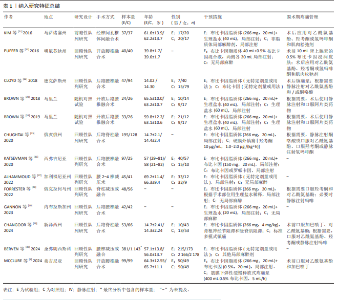
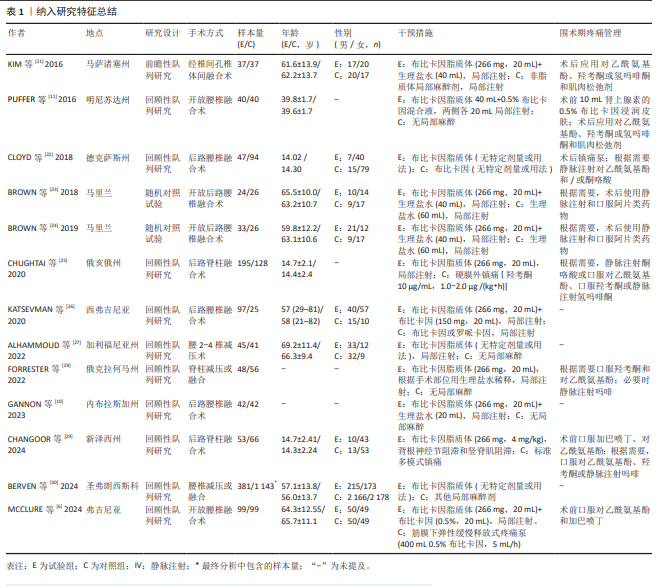
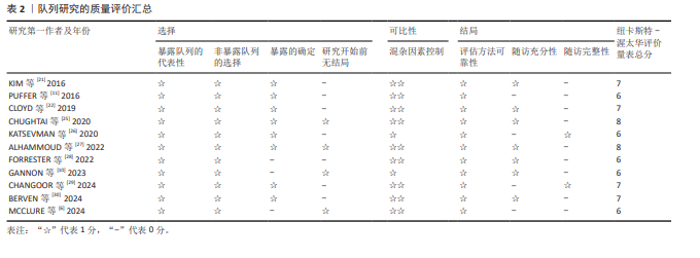
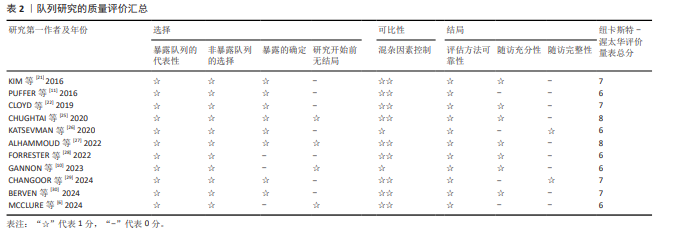
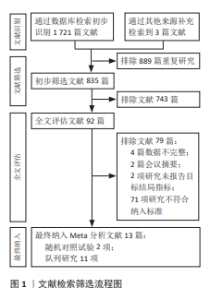
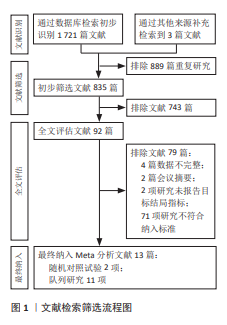
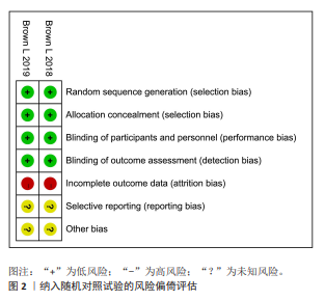
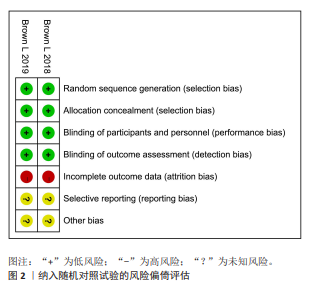
2.1 文献检索结果 在电子数据库和手工检索中初步检索到文献1 724篇,排除889篇重复性研究后,743篇再通过阅读标题和摘要后被剔除。在剩下的92篇文献中,13篇研究在阅读全文后被最终纳入到此次研究[6,10-11,21-30]。文献筛选流程见图1。 2.2 纳入研究的特征及质量评价结果 13篇文献共涉及2 962例患者(布比卡因脂质体组1 141例,对照组1 821例)被纳入到当前的工作中[6,10-11,21-30],其中2项为随机对照试验[23-24],1项为前瞻队列研究[21],10项研究为回顾性队列研究[6,10-11,22,25-30]。这些研究发表于2016-2024年之间,研究的实施地点在美国的多个城市。有2项研究针对接受脊柱融合手术的脊柱侧弯儿童患者[22,25],其余的研究主要聚焦于因退行性脊柱疾病而接受脊柱手术的成年患者,纳入的患者年龄最小为14.02岁,最大的平均年龄为(69.2±11.4)岁。布比卡因脂质体的给药途径均为手术部位软组织局部注射。成年患者布比卡因脂质体的注射剂量为266 mg (1.33%,20 mL),儿童的使用剂量则根据体质量进行计算(最大剂量不超过266 mg)。在纳入的研究中,对照组的干预措施并不统一,主要是使用普通布比卡因或罗哌卡因或生理盐水等其他局麻镇痛药进行与试验组相同部位的局部注射[6,21-26,29-30],部分研究的对照组则不进行局部麻醉[10-11,27-28]。纳入的研究特征总结见表1。此次研究纳入试验的风险偏倚结果均为“低风险”。图2展示了纳入的2个随机对照试验的风险偏倚评价结果。纳入的队列研究均获得6“☆”或更高的评分(表2),表明研究质量较高。"
"
"
"
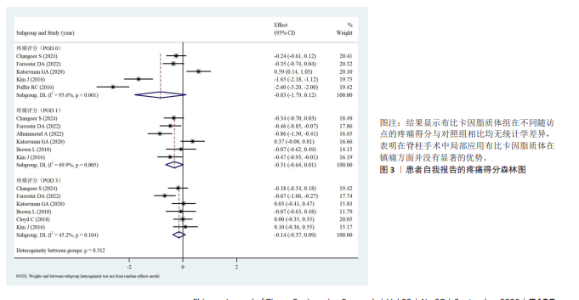
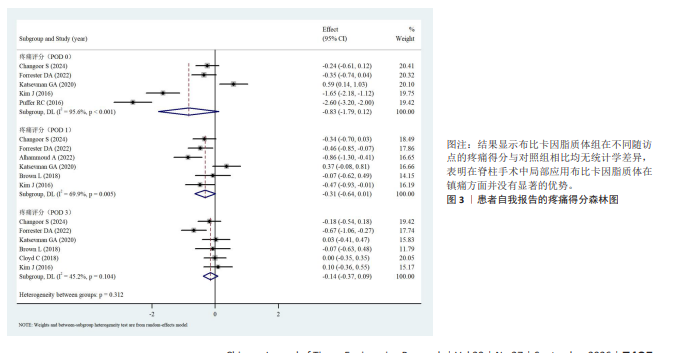
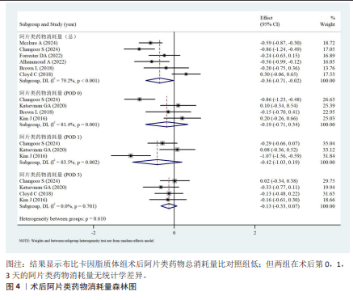
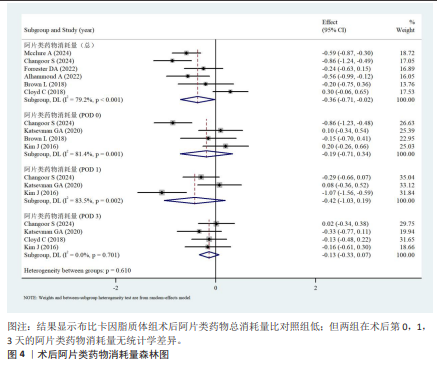
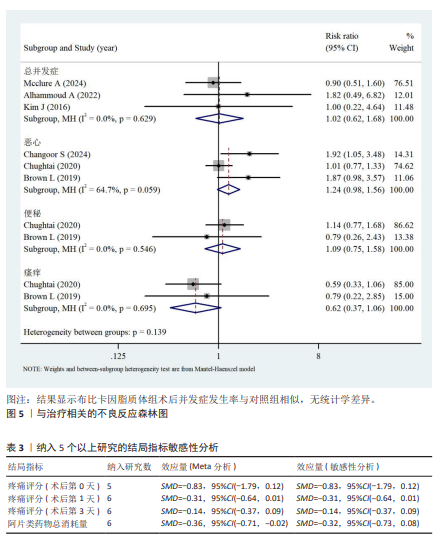
2.3 基于患者自我报告的疼痛得分的Meta分析结果 5个研究[11,21,26,28-29]、6个研究[21,23,26-29]、6个研究分别报道了术后第0,1,3天的疼痛评分[21-23,26,28-29]。各研究间均存在不同等级的异质性(第0天:I2=95.6%,P<0.001;第1天:I2= 69.9%,P=0.005;第3天:I2=45.2%,P=0.104),采用随机效应模型进行数据分析。Meta分析结果显示,布比卡因脂质体组在不同随访点的疼痛得分与对照组相比均无统计学差异[第0天:SMD=-0.83,95%CI(-1.79,0.12);第1天:SMD=-0.31,95%CI (-0.64,0.01);第3天:SMD=-0.14,95%CI (-0.37,0.09)],见图3,表明在脊柱手术中局部应用布比卡因脂质体在镇痛方面并没有显著优势。 2.4 阿片类药物消耗量的Meta分析结果 6个研究[6,22-23,27-29]、4个研究[21,23,26,29]、3个研究[21,26,29]、4个研究分别报道了阿片类药物总消耗量以及术后第0,1,3天的阿片类药物消耗量[21-22,26,29]。各研究间均存在显著异质性(总:I2=79.2%,P < 0.001;第0天:I2=81.4%,P=0.001;第1天:I2=83.5%,P=0.002;第3天:I2=0,P=0.701),采用随机效应模型进行数据分析。Meta分析结果显示,布比卡因脂质体组术后阿片类药物总消耗量比对照组低,差异有显著性意义[SMD=-0.36,95%CI(-0.71,-0.02)]。但两组在术后第0,1,3天的阿片类药物消耗量方面无统计学差异[第0天:SMD=-0.19,95%CI(-0.71,0.34);第1天:SMD=-0.42,95%CI(-1.03,0.19);第3天:SMD=-0.13,95%CI (-0.33,0.07)]。见图4。 2.5 与治疗相关并发症的Meta分析结果 3个研究报道了术后与治疗相关的并发症发生率[6,21,27],各研究间不存在显著异质性(I2=0,P=0.629),采用固定效应模型进行数据分析。Meta分析结果显示布比卡因脂质体组术后并发症发生率与对照组相似,无统计学差异[RR=1.02,95%CI(0.62,1.68)]。对常见的并发症进行亚组分析,发现两组在各并发症发生率方面也无统计学差异[恶心:RR=1.24,95%CI(0.98,1.56);便秘:RR=1.09,95%CI(0.75,1.58);瘙痒:RR=0.62,95%CI(0.37,1.06)],见图5。 2.6 敏感性分析与发表偏倚 对纳入的研究数超过5个的结局指标进行敏感性分析。结果显示除了阿片类药物总消耗量这一结局以外,其他结局指标在剔除某一研究后,剩余研究的合并结果与原合并结果仍保持一致,见表3,表明这些结局指标的稳健性好,证据强度高。当前研究纳入的文献较少,因此,没有采用漏斗图进行发表偏倚的检测。"
"
"
| [1] WEN DJ, TAVAKOLI J, TIPPER JL. Lumbar Total Disc Replacements for Degenerative Disc Disease: A Systematic Review of Outcomes With a Minimum of 5 years Follow-Up. Global Spine J. 2024;14(6):1827-1837. [2] DAVIN SA, SAVAGE J, THOMPSON NR, et al. Transforming Standard of Care for Spine Surgery: Integration of an Online Single-Session Behavioral Pain Management Class for Perioperative Optimization. Front Pain Res (Lausanne). 2022;3: 856252. [3] WALKER EMK, BELL M, COOK TM, et al. Patient reported outcome of adult perioperative anaesthesia in the United Kingdom: a cross-sectional observational study. Br J Anaesth. 2016;117(6):758-766. [4] HARDER T, HARDER J, BAUM G, et al. Antineuropathic Pain Management After Orthopedic Surgery: A Systematic Review. Orthop Rev (Pavia). 2024;16:93012. [5] GLARE P, AUBREY KR, MYLES PS. Transition From Acute to Chronic Pain After Surgery. Lancet. 2019;393(10180):1537-1546. [6] MCCLURE A, SILVERI OC, FODDRELL M, et al. Efficacy of Liposomal Bupivacaine in Reducing Opioid Use After Posterior Lumbar Spinal Decompression and Fusion. Orthopedics. 2024;47(4):244-248. [7] TRENCHFIELD D, FRAS S, MCCURDY M, et al. Opioid Prescription Trends Among Orthopaedic, Primary Care, and Pain Management Providers in Spine Surgery Patients. J Am Acad Orthop Surg. 2024;32(23):e1252-e1259. [8] NGUYEN HV, MITAL S, BUGDEN S, et al. British Columbia’s Safer Opioid Supply Policy and Opioid Outcomes. JAMA Intern Med. 2024;184(3): 256-264. [9] KC B, ALRASHEEDY AA, MOHAMED IBRAHIM MI, et al. Combatting opioid misuse, overuse and abuse: a systematic review of pharmacists’ services and outcomes. Pain Manag. 2024;14(9):519-529. [10] GANNON E, FREEMAN M, CORNETT C, et al. The Effects of Liposomal Bupivacaine on Long-term Outcomes and Decreasing Immediate Postoperative Opioid Use Following One-level and Two-level Posterior Lumbar Fusions. Clin Spine Surg. 2023;36(1):E29-E34. [11] PUFFER RC, TOU K, WINKEL RE, et al. Liposomal bupivacaine incisional injection in single-level lumbar spine surgery. Spine J. 2016;16(11): 1305-1308. [12] NGUYEN A, GRAPE S, GOBBETTI M, et al. The postoperative analgesic efficacy of liposomal bupivacaine versus long-acting local anaesthetics for peripheral nerve and field blocks: A systematic review and meta-analysis, with trial sequential analysis. Eur J Anaesthesiol. 2023;40(9):624-635. [13] LEE JK, GREENBERG S, WIXSON R, et al. Liposomal bupivacaine interscalene blocks demonstrate a greater proportion of total shoulder arthroplasty patients with clinically tolerable pain: a retrospective quality improvement study of 491 patients. J ISAKOS. 2024;9(1):9-15. [14] KANG KK, VOYVODIC L, KOMLOS D, et al. Liposomal Bupivacaine Does Not Decrease Postoperative Pain in Patients with Intracapsular Femoral Neck Fracture Treated with Hemiarthroplasty: HEAT-A Randomized, Controlled Trial. J Bone Joint Surg Am. 2024;106(21): 1957-1962. [15] FOGEL GR, PARIKH RD, RYU SI, et al. Biomechanics of lateral lumbar interbody fusion constructs with lateral and posterior plate fixation: laboratory investigation. J Neurosurg Spine. 2014;20(3): 291-297. [16] PAGE MJ, MCKENZIE JE, BOSSUYT PM, et al. The PRISMA 2020 statement: an updated guideline for reporting systematic reviews. Syst Rev. 2021; 10(1):89. [17] HUGHES D, JUDGE C, MURPHY R, et al. Association of Blood Pressure Lowering With Incident Dementia or Cognitive Impairment: A Systematic Review and Meta-analysis. JAMA. 2020;323(19):1934-1944. [18] STANG A. Critical evaluation of the Newcastle-Ottawa scale for the assessment of the quality of nonrandomized studies in meta-analyses. Eur J Epidemiol. 2010;25(9):603-605. [19] HIGGINS JP, THOMPSON SG. Quantifying heterogeneity in a meta-analysis. Stat Med. 2002;21(11):1539-1958. [20] CHOI SW, LAM DM. Heterogeneity in meta-analyses. Comparing apples and oranges? Anaesthesia. 2017;72(4):532-534. [21] KIM J, BURKE SM, KRYZANSKI JT, et al. The Role of Liposomal Bupivacaine in Reduction of Postoperative Pain After Transforaminal Lumbar Interbody Fusion: A Clinical Study. World Neurosurg. 2016;91:460-467. [22] CLOYD C, MOFFETT BS, BERNHARDT MB, et al. Efficacy of liposomal bupivacaine in pediatric patients undergoing spine surgery. Pediatric Anesthesia. 2018;28(11):982-986. [23] BROWN L, WEIR T, SHASTI M, et al. The Efficacy of Liposomal Bupivacaine in Lumbar Spine Surgery. Int J Spine Surg. 2018;12(4):434-440. [24] BROWN L, WEIR T, KOENIG S, et al. Can Liposomal Bupivacaine Be Safely Utilized in Elective Spine Surgery? Global Spine J. 2019;9(2):133-137. [25] CHUGHTAI M, SULTAN AA, HUDSON B, et al. Liposomal Bupivacaine Is Both Safe and Effective in Controlling Postoperative Pain After Spinal Surgery in Children: A Controlled Cohort Study. Clin Spine Surg. 2020;33(10):E533-E538. [26] KATSEVMAN GA, ALLISON AA, FANG W, et al. Retrospective Assessment of the Use of Liposomal Bupivacaine in Lumbar Fusions in Immediate Postoperative Hospital Care. World Neurosurgery. 2020;141:e820-e828. [27] ALHAMMOUD A, BOULOUSSA H, OGANESIAN A, et al. Does liposomal bupivacaine reduce hospital length of stay for multilevel lumbar decompressions? A retrospective matched cohort study. J Musculoskelet Surg Res. 2022;6:273-277. [28] FORRESTER DA, MINER H, SHIRAZI C, et al. Liposomal bupivacaine in posterior spine surgery: A piece of the puzzle for postoperative pain. J Orthop. 2022;33:55-59. [29] CHANGOOR S, GIAKAS A, SACKS K, et al. The Role of Liposomal Bupivacaine in Multimodal Pain Management Following Posterior Spinal Fusion for Adolescent Idiopathic Scoliosis: Faster and Farther With Less Opioids. Spine (Phila Pa 1976). 2024;49(2):E11-E16. [30] BERVEN S, WANG MY, LIN JH, et al. Effects of liposomal bupivacaine on opioid use and healthcare resource utilization after outpatient spine surgery: a real-world assessment. Spine J. 2024;24(10):1890-1899. [31] BEIRANVAND S, MORADKHANI MR. Bupivacaine Versus Liposomal Bupivacaine For Pain Control. Drug Res (Stuttg). 2018;68(7):365-369. [32] BEIRANVAND S, EATEMADI A, KARIMI A. New Updates Pertaining to Drug Delivery of Local Anesthetics in Particular Bupivacaine Using Lipid Nanoparticles. Nanoscale Res Lett. 2016; 11(1):307. [33] CANDIOTTI K. Liposomal bupivacaine: an innovative nonopioid local analgesic for the management of postsurgical pain. Pharmacotherapy. 2012;32(9 Suppl):19s-26s. [34] HUSSAIN N, BRULL R, SHEEHY B, et al. Perineural Liposomal Bupivacaine Is Not Superior to Nonliposomal Bupivacaine for Peripheral Nerve Block Analgesia. Anesthesiology. 2021;134(2): 147-164. [35] WANG MY, CHANG PY, GROSSMAN J. Development of an Enhanced Recovery After Surgery (ERAS) approach for lumbar spinal fusion. J Neurosurg Spine. 2017;26(4):411-418. [36] MUCHINTALA R, KERN N, DAVIS G, et al. Periarticular Injections with Liposomal Bupivacaine in Comparison with Traditional (Bupivacaine/Ropivacaine) Periarticular Injections in Total Hip Arthroplasty: A Systematic Review. Surg iColl. 2024;2(1)1-8. [37] GRIEFF AN, GHOBRIAL GM, JALLO J. Use of liposomal bupivacaine in the postoperative management of posterior spinal decompression. J Neurosurg Spine. 2016;25(1):88-93. [38] TUMULAK J, JOHNSTON S, ADAMS P. Pain Management Efficacy Study Between Continuous and Single-Administration Bupivacaine Following Lumbar Spinal Fusion. AANA J. 2017;85(2):91-97. [39] NGUYEN TH, ITURRIAGA C, VERMA R. Efficacy of liposomal bupivacaine in spine surgery: a systematic review. Spine J. 2021;21(9):1450-1459. [40] 王长红,周森,朱梦蝶,等. 脂质体布比卡因竖脊肌阻滞用于腰椎融合术的镇痛效果[J]. 广东医学,2025,46(1):54-58. [41] 李桂凤,朱增燕,尚翔,等. 基于FAERS数据库的布比卡因脂质体药品不良反应信号挖掘与分析[J]. 临床合理用药,2025,18(5):1-5. |
| [1] | Fang Fengchao, Yang Wenwu, Wu Hongtao, Peng Peng, Liang Zhiye, Jiang Tao, Chen Weijian, Liu Wengang, Zhao Chuanxi. Association between mitochondrial dynamics imbalance and cartilage degeneration in osteoarthritis [J]. Chinese Journal of Tissue Engineering Research, 2026, 30(在线): 1-8. |
| [2] | Wang Nan, Chen Shuang, Xi Zhipeng, Qian Yuzhang, Zhang Xiaoyu, Gu Jun, Kang Ran, Xie Lin. MRI evaluation of nerve root subsidence sign affecting efficacy of percutaneous endoscopic decompression in lumbar spinal stenosis [J]. Chinese Journal of Tissue Engineering Research, 2026, 30(9): 2262-2268. |
| [3] | Li Zhifei, Han Bin, Liu Qiuli, Zhang Zhanming, Wei Haokai, Zuo Kuangshi, Zhang Yisheng. Cervical motion characteristics in patients with cervical spondylotic radiculopathy based on motion capture technology [J]. Chinese Journal of Tissue Engineering Research, 2026, 30(9): 2286-2293. |
| [4] | Zhu Xiaolong, Zhang Wei, Yang Yang. Visualization analysis of research hotspots and cutting-edge information in the field of intervertebral disc regeneration and repair [J]. Chinese Journal of Tissue Engineering Research, 2026, 30(9): 2391-2402. |
| [5] | Xinjiang Branch of China Trauma Rescue & Treatment Association. Expert consensus on diagnosis and treatment of brucellar osteoarthritis [J]. Chinese Journal of Tissue Engineering Research, 2026, 30(9): 2403-2412. |
| [6] | Wen Fayan, Li Yan, Qiang Tianming, Yang Chen, Shen Linming, Li Yadong, Liu Yongming. Unilateral biportal endoscopic technology for treatment of lumbar degenerative diseases: global research status and changing trends [J]. Chinese Journal of Tissue Engineering Research, 2026, 30(9): 2380-2390. |
| [7] | Zhao Jiaqing, Liu Dong, Lu Suni, Wang Dawei, Geng Xiaopeng, Ning Huaxiu. One-hole split endoscope surgery with the aid of digital 3D technology for highly migrated lumbar disc herniation [J]. Chinese Journal of Tissue Engineering Research, 2026, 30(9): 2278-2285. |
| [8] | Wang Songpeng, Liu Yusan, Yu Huanying, Gao Xiaoli, Xu Yingjiang, Zhang Xiaoming, Liu Min. Bidirectional regulation of reactive oxygen species based on zeolitic imidazolate framework-8 nanomaterials: from tumor therapy and antibacterial activity to cytoprotection [J]. Chinese Journal of Tissue Engineering Research, 2026, 30(8): 2033-2013. |
| [9] | Sun Lei, Zhang Qi, Zhang Yu. Pro-osteoblastic effect of chlorogenic acid protein microsphere/polycaprolactone electrospinning membrane [J]. Chinese Journal of Tissue Engineering Research, 2026, 30(8): 1877-1884. |
| [10] | Wu Yanting, Li Yu, Liao Jinfeng. Magnesium oxide nanoparticles regulate osteogenesis- and angiogenesis-related gene expressions to promote bone defect healing [J]. Chinese Journal of Tissue Engineering Research, 2026, 30(8): 1885-1895. |
| [11] | Li Qingbin, Lin Jianhui, Huang Wenjie, Wang Mingshuang, Du Jiankai, Lao Yongqiang. Bone cement filling after enlarged curettage of giant cell tumor around the knee joint: a comparison of subchondral bone grafting and non-grafting [J]. Chinese Journal of Tissue Engineering Research, 2026, 30(8): 1896-1902. |
| [12] | Jiang Xinghai, Song Yulin, Li Dejin, Shao Jianmin, Xu Junzhi, Liu Huakai, Wu Yingguo, Shen Yuehui, Feng Sicheng. Vascular endothelial growth factor 165 genes transfected into bone marrow mesenchymal stem cells to construct a vascularized amphiphilic peptide gel module [J]. Chinese Journal of Tissue Engineering Research, 2026, 30(8): 1903-1911. |
| [13] | Wang Qisa, Lu Yuzheng, Han Xiufeng, Zhao Wenling, Shi Haitao, Xu Zhe. Cytocompatibility of 3D printed methyl acrylated hyaluronic acid/decellularized skin hydrogel scaffolds [J]. Chinese Journal of Tissue Engineering Research, 2026, 30(8): 1912-1920. |
| [14] | Gao Yanguo, Guo Xu, Li Xiaohan, Chen Shiqi, Zhu Haitao, Huang Liangyong, Ye Fang, Lu Wei Wang Qibin, Zheng Tao, Chen Li. Optimization of prescription ratio of “Honghuangbai” gel by orthogonal test in diabetic skin wound mouse models [J]. Chinese Journal of Tissue Engineering Research, 2026, 30(8): 1921-1928. |
| [15] | Liu Hongjie, Mu Qiuju, Shen Yuxue, Liang Fei, Zhu Lili. Metal organic framework/carboxymethyl chitosan-oxidized sodium alginate/platelet-rich plasma hydrogel promotes healing of diabetic infected wounds [J]. Chinese Journal of Tissue Engineering Research, 2026, 30(8): 1929-1939. |
| Viewed | ||||||
|
Full text |
|
|||||
|
Abstract |
|
|||||